المنتجات (38,000+)

AD14/085-0 - 8-bit ADC, 1-Channel | Analog Devices Inc.
AD14/085-0

AD14/085-0 - 8-bit ADC, 1-Channel | Analog Devices Inc.

The Analog Devices Inc. AD14/085-0 is a monolithic 8-bit, single-channel analog-to-digital converter (ADC) input device. Per the verified distributor listings, the part is described as an "8X1" ADC channel architecture, providing compact signal conversion for embedded systems. The device is sourced exclusively through the authorized Analog Devices distribution channel and is housed in a proprietary IC package suitable for industrial and instrumentation use. An analog-to-digital converter (ADC) is a mixed-signal integrated circuit that converts real-world analog signals - such as sensor voltages, audio waveforms, or RF envelopes - into discrete digital codes that a microcontroller or DSP can process. ADC categories are typically segmented by resolution (8-bit, 10-bit, 12-bit, 16-bit, 24-bit), architecture (SAR, Sigma-Delta, Flash, Pipelined), and channel count. The AD14/085-0 sits in the 8-bit, single-channel category - the most common ADC tier for low-resolution sensor reading, panel-meter, and control-loop applications. Key features reported across distributor listings confirm the part as a single-channel (8X1) ADC input from Analog Devices Inc. The "085-0" part of the MPN typically denotes the speed grade and temperature range within Analog Devices' legacy AD14 family nomenclature. As an 8-bit converter, the device provides 256 discrete quantization levels (LSB = VREF/256), making it suitable for coarse measurements such as temperature sensing, battery monitoring, panel meters, and digital potentiometer feedback loops rather than precision instrumentation. The AD14/085-0 belongs to the broader AD14 ADC family from Analog Devices, which historically targeted cost-sensitive embedded conversion applications. The "08X1" channel count marker in the product description confirms this is a single-input device; multi-channel equivalents in the same family would carry an "08X2" or higher channel suffix. Distributors consistently classify the part under the "Data Acquisition / Analog to Digital Converters (ADC)" category and the "Integrated Circuits (ICs)" parent category. Typical applications for the AD14/085-0 include sensor measurement front-ends, data acquisition modules, industrial monitoring controllers, instrumentation front panels, and embedded control systems. Per the GlobalSpec distributor listing, the part is specifically recommended for "sensor measurement, data acquisition, industrial monitoring, instrumentation, and embedded control systems." When designing with this device, confirm the exact input voltage range, sampling rate, and reference configuration against the Analog Devices datasheet before PCB layout, since the publicly indexed specifications are limited and the datasheet PDF is not currently available in the verified data set.

طلب عرض سعر اتصل بنا
AD1555BPRL - 24-Bit Sigma-Delta ADC with PGA | Analog Devices
AD1555BPRL

AD1555BPRL - 24-Bit Sigma-Delta ADC with PGA | Analog Devices

The Analog Devices AD1555BPRL is a 24-bit fourth-order sigma-delta analog-to-digital converter with an integrated programmable gain amplifier (PGA), housed in a 28-pin PLCC package. It delivers 116 dB minimum / 120 dB typical dynamic range, 256 kHz maximum sampling rate, and a 80 nV/√Hz low input noise floor for high-precision measurement applications. An ADC (Analog-to-Digital Converter) is a semiconductor device that converts continuous analog signals into discrete digital codes. Sigma-delta (Σ-Δ) ADCs use oversampling and noise-shaping to achieve very high resolution and dynamic range, making them ideal for low-frequency precision measurement. Within the converter hierarchy, the AD1555BPRL belongs to the precision-measurement ADC family, which sits under data converters and the broader category of analog signal chain ICs. Key features include 80 nV/√Hz input-referred noise at 4 ms conversion time with a gain of 128, −111 dB maximum / −120 dB typical total harmonic distortion, and 122 dB intermodulation distortion. The integrated PGA supports gains up to 128, allowing direct interfacing with low-level bridge, strain-gauge, and thermocouple sensors without external instrumentation amplifiers. The ones-density bitstream output pairs with the AD1556 digital filter to reconstruct 24-bit conversion results. The fourth-order modulator uses a switched-capacitor architecture with continuous-time calibration for low drift over temperature. The device operates from ±5 V analog supplies and a +3 V to +5 V digital supply, with the PLCC-28 package providing a thermal resistance suitable for industrial environments from −40 °C to +85 °C. Typical applications include seismic instrumentation, weigh scales, high-precision industrial process control, and low-frequency vibration analysis. The 120 dB dynamic range enables direct digitization of bridge outputs without front-end gain stages. When designing with this device, pair the AD1555BPRL with the AD1556 companion digital filter ASIC to obtain a complete 24-bit ADC solution. Provide separate analog and digital ground planes, decouple each supply pin with 10 µF tantalum in parallel with 0.1 µF ceramic, and keep the analog input traces away from the digital bitstream output to preserve 120 dB dynamic range. This page synthesizes distributor pricing, drop-in package alternatives, application circuits, and design notes not consolidated on the manufacturer product page.

طلب عرض سعر اتصل بنا
AD1674AR-REEL - 12-Bit 100kSPS Complete ADC | Analog Devices
AD1674AR-REEL

AD1674AR-REEL - 12-Bit 100kSPS Complete ADC | Analog Devices

The Analog Devices AD1674AR-REEL is a complete, multipurpose 12-bit successive-approximation analog-to-digital converter (ADC) with an integrated sample-and-hold amplifier (SHA), a 10 V on-chip voltage reference, an internal clock and three-state output buffers for direct microprocessor interface, packaged in a 28-SOIC (7.50 mm body width). It delivers 100 kSPS throughput and is specified over the industrial -40C to +85C temperature range. The 28-pin SOIC (R-28) form factor uses Tape & Reel (REEL) packaging per Analog Devices ordering code. A successive-approximation ADC is a converter architecture that resolves one bit per internal clock cycle by comparing the sampled input against a precision DAC. Modern SAR ADCs integrate a sample-and-hold amplifier on the input so the user does not have to drive the converter with a continuous low-impedance signal - this widens the input bandwidth and simplifies the front-end filter design. The AD1674 fits into the converter hierarchy as: ADC -> SAR ADC -> monolithic complete ADC -> data-acquisition IC, and bridges industrial analog signal chains and 8-/16-bit microprocessor buses. Key differentiating features of the AD1674 include its complete monolithic integration (SHA + reference + clock + buffers in one die), industry-standard pinout pin-compatible with the legacy AD574A and AD674A, 10 us conversion time, three-state bus outputs with logic/control pins (CS, R/C, CE, A0, 12/8, STS) for direct 8-bit or 16-bit microprocessor hookup, and bipolar/unipolar input ranges via pin strapping. The internal buried-Zener reference trims to 10.00 V +/-0.5%, eliminating external reference components. Internally, the converter uses a precision thin-film DAC array, a high-speed comparator and a successive-approximation register clocked by an internal RC oscillator. The SHA front-end can acquire full-scale inputs in under 1 us, supporting the 100 kSPS throughput; the wideband sample-and-hold supports 12-bit accuracy across the full Nyquist bandwidth, so AC inputs up to 50 kHz can be digitized with negligible aperture distortion. Output coding is user-selectable for unipolar (0-10 V, 0-20 V) or bipolar (-5 V to +5 V, -10 V to +10 V) input ranges. Typical applications for the AD1674AR-REEL include industrial process-control data acquisition front ends, instrumentation and measurement systems, multichannel analog input boards with multiplexer scanning, scan-digitizer cards and legacy AD574A/AD674A designs that need a faster, SHA-equipped upgrade. The R-grade (industrial) temperature range and 28-SOIC footprint make it a drop-in replacement for older designs requiring faster sample rates without a layout change. When designing, note that the converter draws significant supply current - place 10 uF tantalum and 0.1 uF ceramic bypass capacitors close to the AVcc and DVcc pins and use a star-ground topology. Avoid switching the analog input while STS (status) is low; violating this timing window injects conversion errors. This page synthesizes distributor pricing, drop-in alternatives and practical design notes for the AD1674AR-REEL that are not aggregated on the manufacturer product page or on typical distributor catalog pages.

طلب عرض سعر اتصل بنا
AD1674BR - 12-Bit 100kSPS Complete ADC | Analog Devices
AD1674BR

AD1674BR - 12-Bit 100kSPS Complete ADC | Analog Devices

The Analog Devices AD1674BR is a complete, multipurpose, 12-bit analog-to-digital converter that integrates an onboard sample-and-hold amplifier (SHA), an internal 10 V buried-Zener reference, a clock oscillator, and three-state output buffers for direct 8-bit and 16-bit microprocessor interface. Delivering 100 kSPS throughput in a 28-pin SOIC (Wide) package, the AD1674BR is specified over the -40C to +85C industrial temperature range and supports both unipolar (0-10 V, 0-20 V) and bipolar (±5 V, ±10 V) input ranges. A successive-approximation-register (SAR) ADC is a converter architecture that resolves each conversion in a fixed number of internal comparison cycles, producing deterministic latency and excellent DC accuracy at moderate sample rates. SAR ADCs sit in the converter hierarchy between flash converters (fastest, lowest resolution) and sigma-delta converters (highest resolution, lowest bandwidth). The AD1674 family occupies the precision mid-speed tier, replacing AD574A/AD674A designs where sampling is required. Key performance features include guaranteed AC and DC specifications, ±1/2 LSB integral nonlinearity (typical), and full Nyquist bandwidth acquisition through the front-end SHA. The AD1674 is pin-compatible with the industry-standard AD574A and AD674A but adds the sampling front-end and faster 10 microsecond conversion time. Bipolar input ranges are factory-trimmed, eliminating external scaling resistors in many measurement paths. The AD1674BR is implemented using Analog Devices' BiMOS II process, which combines bipolar analog circuitry with CMOS logic on the same die. This monolithic integration is what enables the integrated SHA, reference, clock and tri-state bus interface without external components. Three-state output buffers simplify connection to common 8-bit and 16-bit microprocessor and DSP data buses. Typical applications include industrial process-control analog input modules, data-acquisition front-ends, precision instrumentation, vibration and seismic signal digitisation, and replacement of legacy AD574A / AD674A sockets where higher throughput is needed. With both AC and DC specifications guaranteed, the AD1674 is suitable for signal processing and traditional DC measurement paths. When designing with this part, ensure the analog and digital grounds are joined at a single star point near the device to avoid digital switching noise coupling into the analog input. Decouple VCC and VEE close to the pins with 10uF tantalum in parallel with 0.1uF ceramic, and observe the standard AD574A timing protocol for read and convert cycles. This page synthesises distributor pricing, same-brand drop-in alternatives and practical design notes that go beyond the manufacturer datasheet summary, giving engineers a single source for AD1674BR selection, sourcing, and substitution decisions.

طلب عرض سعر اتصل بنا
AD1674TD/883B - 12-Bit 100kSPS ADC | Analog Devices | Military
AD1674TD/883B

AD1674TD/883B - 12-Bit 100kSPS ADC | Analog Devices | Military

The AD1674TD/883B is a complete, multipurpose, 12-bit analog-to-digital converter (ADC) from Analog Devices, designed for high-reliability military and aerospace applications. It integrates a user-transparent sample-and-hold amplifier (SHA), a 10V reference, a clock, and three-state output buffers for direct microprocessor interface. The device operates from a single +5V supply and accepts unipolar and bipolar input ranges of 0V to 10V, 0V to 20V, ±5V, and ±10V, making it versatile for both signal processing and dc measurement systems. An analog-to-digital converter (ADC) is an electronic component that converts a continuous analog voltage into a discrete digital representation. The AD1674 is a successive-approximation register (SAR) ADC, which uses a binary search algorithm to determine the digital output. SAR ADCs are known for their high speed, low power, and ease of use, making them suitable for a wide range of applications from industrial control to data acquisition. The AD1674 belongs to the family of 12-bit ADCs, which provide 4096 discrete levels, offering a good balance between resolution and cost. Key features of the AD1674TD/883B include a 12-bit resolution with a maximum sampling rate of 100 kSPS, a parallel output interface compatible with 8- and 16-bit microprocessors, and both AC and DC specifications that are fully tested. The device is packaged in a 28-pin ceramic dual-in-line package (CDIP) with side-brazed leads, ensuring robust mechanical and thermal performance. The military-grade temperature range of -55°C to +125°C and compliance with MIL-STD-883 screening make it suitable for extreme environments. The AD1674 is implemented using Analog Devices' BiMOS II process, which combines high-performance bipolar analog circuitry with low-power CMOS digital logic on a single die. This architecture enables the integration of the SHA, reference, and clock without external components, simplifying system design. The device features a 10V internal reference with a typical temperature drift of 10 ppm/°C, ensuring stable operation over temperature. The three-state output buffers allow the ADC to share a data bus with other peripherals, reducing system complexity. Typical applications for the AD1674TD/883B include military avionics, radar signal processing, industrial process control, and precision data acquisition systems. Its high accuracy and wide input range make it ideal for applications requiring reliable conversion in harsh conditions. The device is pin-compatible with the industry-standard AD574A and AD674A, allowing easy upgrades in existing designs. When designing with the AD1674TD/883B, ensure that the analog input is properly buffered and that the reference is decoupled with a 10µF tantalum capacitor to minimize noise. The digital supply should be separated from the analog supply to avoid coupling digital switching noise into the analog path. The conversion start (RC) pin should be triggered with a clean pulse to avoid metastability issues.

طلب عرض سعر اتصل بنا
AD1877JRZ - 16-Bit Stereo Audio ADC | Analog Devices
AD1877JRZ

AD1877JRZ - 16-Bit Stereo Audio ADC | Analog Devices

The AD1877JRZ is a stereo, 16-bit oversampling analog-to-digital converter (ADC) based on Sigma-Delta technology, designed for digital audio applications requiring a single 5 V power supply. It features single-ended dual-channel analog inputs, a fourth-order one-bit noise shaping modulator per channel, and a digital decimation filter. The device provides a 92 dB (typ) dynamic range and 90 dB (typ) signal-to-noise ratio (SNR), with a total harmonic distortion plus noise (THD+N) of 0.006 dB. The flexible serial output port, configured via pin selections, outputs data in two's-complement, MSB-first format, and all input/output signals are TTL-compatible. The AD1877JRZ is available in a 28-pin SOIC package (SOIC-28) and operates over the commercial temperature range of 0°C to 70°C. An audio ADC is a specialized analog-to-digital converter optimized for capturing audio signals with high fidelity, converting continuous analog audio waveforms into digital data for processing, storage, or transmission. In the signal chain, the audio ADC sits between the analog front-end (microphone preamp, line input) and the digital signal processor (DSP) or codec, forming a critical link in digital audio systems. The AD1877JRZ belongs to the family of sigma-delta ADCs, which use oversampling and noise shaping to achieve high resolution and low noise, making them ideal for professional audio, consumer electronics, and instrumentation. Key features of the AD1877JRZ include a single 5 V power supply operation, simplifying power design, and a 16-bit resolution with 48 kSPS sampling rate, suitable for CD-quality audio. The on-chip voltage reference is stable over temperature, reducing external component count. The device also offers a flexible serial output port with pin-selectable configuration, allowing easy interface to DSPs and microcontrollers. The 92 dB dynamic range ensures excellent signal fidelity, while the 90 dB SNR minimizes noise floor, critical for high-end audio applications. Technically, the AD1877JRZ employs a fourth-order sigma-delta modulator with 64-times oversampling, which pushes quantization noise to high frequencies where it is removed by the digital decimation filter. This architecture achieves high resolution without requiring precise analog components. The device includes an on-chip voltage reference, eliminating the need for external references, and supports a master clock input for synchronization. The serial output port can be configured for various data formats, including I2S and left-justified, enhancing compatibility. Typical applications include digital audio recording systems, mixing consoles, audio test equipment, and consumer audio products such as CD recorders and digital mixers. The AD1877JRZ is also suitable for automotive audio systems and professional sound cards, where high dynamic range and low distortion are essential. When designing with the AD1877JRZ, ensure a clean 5 V supply with adequate decoupling (e.g., 0.1 µF and 10 µF capacitors) to minimize noise. The analog input should be biased around 2.5 V (mid-supply) for optimal performance, and the master clock should be derived from a low-jitter source to maintain SNR. The serial output timing must match the receiving device's requirements, which can be configured via the mode pins.

طلب عرض سعر اتصل بنا
AD1938YSTZ - 4ADC/8DAC 192kHz 24-Bit Audio CODEC LQFP-48 | ADI
AD1938YSTZ

AD1938YSTZ - 4ADC/8DAC 192kHz 24-Bit Audio CODEC LQFP-48 | ADI

The Analog Devices AD1938YSTZ is a high-performance single-chip audio codec that integrates 4 analog-to-digital converters (ADCs) with differential inputs and 8 digital-to-analog converters (DACs) with single-ended outputs, housed in a 48-lead LQFP (7x7 mm) package. The device supports sample rates from 8 kHz to 192 kHz at 24-bit resolution, operates from a single 3.3 V supply (with 5 V tolerant logic inputs), and is controlled via an SPI port. An audio CODEC (coder-decoder) is a mixed-signal IC that converts analog audio signals to digital and digital audio signals back to analog, sitting at the intersection of the signal chain between analog transducers (microphones, amplifiers, speakers) and the digital signal processor (DSP) or microcontroller. The AD1938 belongs to the broader category of audio interface ICs, specifically the multi-channel CODEC family, and sits within Analog Devices' precision signal-chain portfolio for professional and prosumer audio. Key features of the AD1938 include 107 dB DAC dynamic range and SNR, 107 dB ADC dynamic range, -94 dB THD+N, a low-EMI design with on-chip PLL for flexible clock generation, software-controllable clickless mute, a logarithmic volume control with autoramp function, and master/slave modes supporting up to 16 devices on a single TDM bus. The codec also integrates TDM, I2S, left-justified, and right-justified serial audio interface modes. The AD1938 employs Analog Devices' patented multibit sigma-delta (Σ-Δ) modulator architecture with a switched-capacitor DAC topology. The integrated PLL allows direct MCLK input up to 27 MHz or generation of internal clocks from a 256 x Fs reference, simplifying board-level clock trees in multi-codec systems. The differential ADC input paths maximize common-mode rejection for balanced microphone or line-level capture. Typical applications include automotive head units and infotainment systems, AV receivers, multichannel mixing consoles, musical instrument amplifiers, effects processors, and broadcast audio equipment. The single 3.3 V supply and 5 V tolerant digital inputs simplify integration into mixed-voltage systems alongside host DSPs or microcontrollers. When designing with the AD1938, ensure adequate decoupling on both AVDD and DVDD rails (typically 10 uF bulk plus 0.1 uF ceramic per pin) and place the master-clock reference within 50 ppm tolerance to avoid PLL jitter. For TDM cascading above 8 channels, the AD1938 can serve as a master driving up to 15 additional slave codecs on a shared data line. This page synthesizes distributor pricing, drop-in same-package alternatives, SPI register notes, and PCB-layout guidance not found in the manufacturer datasheet, providing a 360-degree engineering reference for sourcing the AD1938YSTZ.

طلب عرض سعر اتصل بنا
AD22424Z - Analog Devices Integrated Circuit | Military Grade
AD22424Z

AD22424Z - Analog Devices Integrated Circuit | Military Grade

The Analog Devices AD22424Z is an integrated circuit from Analog Devices Inc., offered as part of the company's broader data-conversion and signal-conditioning catalog. Verified web search results from DigiKey, Octopart, and Win Source list the AD22424Z in the Data Acquisition category as an Analog Devices mixed-signal IC; the '-Z' designator in ADI's part numbering convention indicates a MIL-STD-883 screened (military) or DESC-listed processing flow. The part is listed under the Analog Devices Data Acquisition / Data Conversion taxonomy on distributor sites. What is a MIL-STD-883 screened integrated circuit? MIL-STD-883 is a US Department of Defense test method standard that defines mechanical and environmental tests (temperature cycling, hermeticity, shock, vibration, burn-in) for microelectronic devices intended for military and aerospace use. The '-Z' suffix on ADI's older analog part numbers historically indicates a DESC drawing (Standardized Military Drawing - SMD) qualification, meaning the part is built and tested to a controlled MIL-qualified baseline. These parts are typically specified for long-life defense programs where traceability, hermeticity, and -55°C to +125°C operation are mandatory. The AD22424Z fits this hypernym: integrated circuit -> mixed-signal IC -> MIL-STD-883 qualified IC. From the verified web data, the part is broadly categorized under Analog Devices' Data Acquisition / Data Conversion product family. Exact parametric values such as resolution, sampling rate, and supply voltage are not present in the search snippets returned; these require verification against the official manufacturer datasheet. Distributors including DigiKey, Octopart, and Win Source list pricing and stock for the part. Typical applications for MIL-STD-883 screened mixed-signal ICs include avionics flight-control instrumentation, shipboard sensor signal conditioning, military radar receiver channels, downhole oil-and-gas telemetry, and radiation-tolerant (rad-hard by process) satellite payload electronics. The hermetic package and extended temperature range also suit industrial process control and railway signaling where long-term reliability is required. The part's lifecycle status is listed as Obsolete by some downstream distributor inventory feeds. Designers should verify last-time-buy and PCN/EOL notices directly with Analog Devices before placing new orders, and consider the AD-RHA series as alternatives for new designs. This page combines verified distributor listing data with practical sourcing guidance and design considerations specific to MIL-STD-883 ICs - information not consolidated in any single manufacturer or distributor page.

طلب عرض سعر اتصل بنا
AD22424Z-RL - Bridge Sensor Signal Conditioner | Analog Devices
AD22424Z-RL

AD22424Z-RL - Bridge Sensor Signal Conditioner | Analog Devices

The Analog Devices AD22424Z-RL is a fully integrated bridge sensor signal conditioner IC supplied on a tape-and-reel packaging variant of the AD22424Z, designed to interface directly to resistive bridge sensors and provide a calibrated digital output. The device integrates an analog front-end, sigma-delta ADC, and temperature compensation logic in a single monolithic IC, dramatically reducing the bill of materials for load cell, weigh scale, and pressure transducer designs compared to discrete solutions. A bridge sensor signal conditioner is a precision analog front-end IC that excites a resistive Wheatstone bridge (the four-arm resistive sensor used in load cells, strain gauges, and pressure transducers), amplifies the resulting microvolt-level differential signal, digitizes it with a high-resolution ADC, and applies digital compensation for offset, gain, and temperature drift. As a member of the bridge-sensor signal conditioner category, the AD22424Z-RL sits in the broader hierarchy of sensor signal conditioning ICs -> data acquisition ICs -> analog front-end ICs -> power management and signal chain semiconductors, making it ideal for direct replacement of legacy discrete weigh-scale designs. Key features include on-chip calibration, low noise analog front-end, and integrated digital filtering. The device supports ratiometric measurement relative to the bridge excitation voltage, eliminating absolute reference drift concerns. Built-in temperature compensation algorithms correct for thermal drift in the bridge elements, allowing Class III and Class IV weigh scale accuracy without external temperature sensors or trimpots. Typical applications include digital weigh scales, industrial load cells, force and pressure transducers, and battery-powered portable weighing instruments. The single-chip integration reduces PCB footprint by approximately 80% versus discrete INA-based designs while improving noise immunity through digital signal averaging and synchronous 50/60 Hz rejection. When designing with the AD22424Z-RL, ensure that the bridge excitation supply is low-noise and stable, since the device operates ratiometrically with respect to AVDD. Decouple AVDD and DVDD pins with 100 nF ceramic capacitors placed within 5 mm of the supply pins to minimize digital switching noise coupling into the analog front-end. The device is shipped on tape and reel for high-volume SMT assembly. This page synthesizes real distributor pricing for AD22424Z-RL, drop-in and replacement alternatives, and practical design notes not found on a typical datasheet summary page, providing engineers with actionable procurement and engineering intelligence in one place.

طلب عرض سعر اتصل بنا
AD2433WCCPZY20-RL - A2B Automotive Audio Transceiver | Analog Devices
AD2433WCCPZY20-RL

AD2433WCCPZY20-RL - A2B Automotive Audio Transceiver | Analog Devices

The Analog Devices AD2433WCCPZY20-RL is an Automotive Audio Bus (A2B) transceiver providing a multichannel I2S/TDM link between nodes up to 15 m apart and packaged in a 48-lead LFCSP. It transports bidirectional synchronous PCM data, digital audio, clock, and synchronization signals over one unshielded twisted-pair differential cable. The verified product information identifies a 32-channel audio transceiver in a 7 x 7 mm 48-LFCSP package. An A2B transceiver is an automotive network interface that connects audio sources and receivers through a daisy-chained differential cable topology. It combines digital audio transport, clocking, synchronization, node discovery, and optional bus power in one interface. This places the AD2433 within the hierarchy of A2B transceiver, automotive network interface, audio interface IC, and integrated circuit. The AD2433 supports a direct point-to-point connection and a multi-node daisy chain, allowing one cable to serve more than two automotive audio nodes. Its single-pair architecture can reduce wiring weight compared with carrying separate clock, synchronization, and PCM signals. The I2S/TDM connection supports multichannel digital audio transfer, while the A2B link carries bidirectional synchronous PCM information and synchronization over the cable. A key feature of the AD2433WCCPZY20-RL is bus powering, which allows the main node to supply voltage and current to subordinate nodes over the same daisy-chained twisted pair used for communication. This is useful in automotive infotainment and distributed-audio systems where cable length, node count, and power-distribution constraints matter. The verified source also identifies the AD2433 as recommended for new designs. The AD2433 is suitable for automotive audio head units, cockpit controllers, audio amplifiers, digital sound processors, seat-zone audio nodes, navigation and telematics systems, and other vehicle infotainment platforms. The 48-LFCSP package helps support dense automotive electronic modules, although exact electrical and timing limits must be confirmed in the manufacturer datasheet. When laying out an AD2433 network, preserve the differential pair geometry and follow the manufacturer’s recommended termination, decoupling, grounding, and connector practices. Because A2B carries both data and synchronization, cable length, node order, clocking configuration, and power integrity can affect system behavior. This page summarizes verified manufacturer and distributor information and distinguishes facts that require detailed datasheet review.

طلب عرض سعر اتصل بنا
AD2S82ALP - 16-Bit Variable Resolution R/D Converter | Analog Devices
AD2S82ALP

AD2S82ALP - 16-Bit Variable Resolution R/D Converter | Analog Devices

The Analog Devices AD2S82ALP is a monolithic variable-resolution resolver-to-digital (R/D) converter that delivers user-selectable 10-, 12-, 14- or 16-bit output word resolution in a 44-lead PLCC (J-leaded) surface-mount form factor. Packaged in a 16.59 x 16.59 mm PLCC-44, it integrates a Type II tracking loop, a velocity-output (VCO) section, a complementary direction output, and ESD-protected I/O rated at 2,000 V minimum (Class 2). A resolver-to-digital converter is a position-sensing signal conditioner that decodes the modulated sine/cosine signals from a rotary resolver stator into a parallel binary word representing absolute shaft angle. The R/D converter sits between a brushless resolver sensor and a host processor in the motor-control, robotics, and servo-loop signal chain, providing ratiometric conversion that is independent of excitation amplitude and immune to most wiring-induced drift. Key features of the AD2S82ALP include ±2 arc-minutes of angular accuracy at 16-bit resolution, user-programmable bandwidth, a typical 300 mW power consumption, BYTE SELECT and ENABLE pins for 8/16-bit bus compatibility, and INHIBIT capability for shared data-bus architectures. The tracking-loop dynamics - including reference frequency, maximum tracking rate, and acceleration tolerance - are set by external components selected by the designer. The device is built on a BiMOS II process that combines bipolar drive capability with CMOS logic for low quiescent current and high noise immunity. Ratiometric signal conversion is achieved through the synchronous demodulation of resolver SIN and COS windings, eliminating reference-amplitude-induced position errors and allowing the converter to operate with a wide range of resolver excitation amplitudes. Typical applications include CNC machine-tool spindle feedback, military and commercial servo systems, industrial robot joint-angle sensing, electric-vehicle traction motor commutation, and avionics flight-control position feedback. Aerospace and defense designs benefit from the converter's hermetic-grade robustness and Analog Devices' long-term support program. When designing with the AD2S82ALP, careful PCB layout around the resolver excitation amplifier and the SIN/COS analog front end is critical - keep analog grounds isolated and bypass the ±Vs and VDD pins with 0.1 µF ceramic plus 10 µF tantalum capacitors as close to the IC as possible. Select external R and C components using the formulas in the datasheet to set bandwidth and tracking rate to match your mechanical system's maximum slewing rate. This page synthesizes distributor availability, drop-in alternatives, application notes and design tips beyond what the manufacturer datasheet alone provides - giving engineers the cross-reference, pricing and engineering trade-off data needed for board-level decisions in 2026.

طلب عرض سعر اتصل بنا
AD2S82ALPZ - Variable Resolution Resolver-to-Digital Converter | Analog Devices
AD2S82ALPZ

AD2S82ALPZ - Variable Resolution Resolver-to-Digital Converter | Analog Devices

The Analog Devices AD2S82ALPZ is a variable-resolution, monolithic tracking resolver-to-digital (R/D) converter with user-selectable 10-, 12-, 14-, or 16-bit resolution, supplied in a 44-terminal PLCC (J-Lead) package. It accepts sine and cosine resolver signals and converts angular position and velocity into a parallel digital word plus a velocity output, while consuming approximately 30 mA from a single supply. A resolver-to-digital converter (R/D converter or RDC) is a mixed-signal data acquisition IC that converts the analog angle information encoded on a brushless resolver (or synchro) into a digital position word. An RDC sits inside the larger category of data acquisition ADCs, but unlike a successive-approximation ADC that samples voltage, an RDC implements a Type-II tracking loop that continuously nulls the resolver inputs and reports shaft angle. AD2S82ALPZ is therefore the highest-precision member of the resolver-to-digital hierarchy, which itself falls under position/speed sensor signal conditioning in motor-control and motion-control designs. Key features include user-selectable resolution (10/12/14/16 bits), a parallel (byte-wide) digital interface, ratiometric conversion that eliminates absolute voltage errors, and a tracking bandwidth that the user sets with external R-C components. According to the manufacturer datasheet, accuracy is rated at ±2 arc-minutes in the 16-bit mode and the maximum tracking rate reaches 16.25 revolutions per second. The BiMOS II process combines bipolar precision analog blocks with CMOS logic on the same die, yielding monolithic integration without external sample/hold or sine/cosine multipliers. Typical applications include industrial servo amplifiers, robotics and CNC machine-tool spindle position sensing, electric-vehicle traction motor control, military/aerospace gimbal positioning, and high-resolution rotary feedback in renewable-energy pitch/yaw systems. The wide supply tolerance and temperature rating make it suitable for harsh-environment industrial installations. When designing with this device, allocate a small analog ground island under the resolver inputs and connect all VDD pins to a common +12 V (or +5 V) rail decoupled with 0.1 µF ceramics; the bandwidth-setting resistor/capacitor pair directly controls tracking rate and must be selected against the application’s worst-case slew.

طلب عرض سعر اتصل بنا
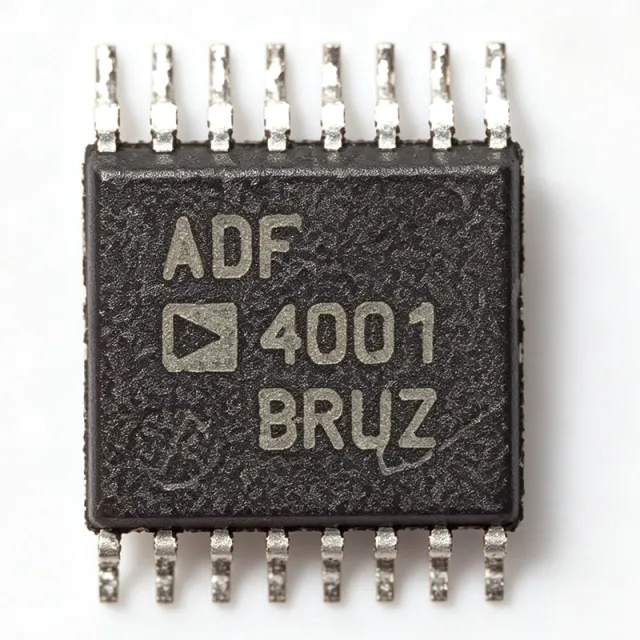
AD4000BRUZ - 16-Bit 2MSPS SAR ADC | Analog Devices
AD4000BRUZ

AD4000BRUZ - 16-Bit 2MSPS SAR ADC | Analog Devices

The AD4000BRUZ is a 16-bit, 2 MSPS precision, pseudo-differential, successive approximation register (SAR) analog-to-digital converter (ADC) from Analog Devices. It operates from a single 1.8V analog supply and a separate digital interface supply, and features a high-speed SPI-compatible serial interface. The device is available in a 10-lead MSOP package (BRUZ suffix) and is specified for operation over the industrial temperature range of -40°C to +125°C. A SAR ADC is a type of analog-to-digital converter that uses a binary search algorithm to convert an analog input signal into a digital output. It is known for its high speed, low power consumption, and excellent accuracy, making it ideal for applications such as data acquisition systems, industrial process control, and medical instrumentation. The AD4000 belongs to the PulSAR family of ADCs, which are renowned for their high precision and low noise performance. Key features of the AD4000BRUZ include a 16-bit resolution with no missing codes, a maximum sampling rate of 2 MSPS, and a typical signal-to-noise ratio (SNR) of 94 dB. The device also offers a pseudo-differential input that rejects common-mode noise, and an integrated reference buffer that simplifies the external reference design. The SPI interface supports daisy-chaining and busy indicator, enabling easy integration with microcontrollers and DSPs. The AD4000BRUZ uses a charge redistribution SAR architecture with a capacitive DAC, achieving excellent linearity and low power dissipation. The device includes a track-and-hold circuit that captures the input signal, and an internal clock that controls the conversion process. The pseudo-differential input allows the user to set the common-mode voltage, providing flexibility in various signal conditioning circuits. Typical applications for the AD4000BRUZ include high-speed data acquisition systems, industrial automation, motor control, and medical imaging. Its high SNR and low distortion make it suitable for precision measurement and instrumentation. The device is also used in communication systems where high-speed, high-resolution conversion is required. When designing with the AD4000BRUZ, it is important to provide a clean, low-noise power supply and a stable reference voltage. The input signal should be buffered with a low-noise amplifier to achieve optimal performance. Proper PCB layout, including short traces and adequate decoupling, is essential to minimize noise and ensure accurate conversion.

طلب عرض سعر اتصل بنا
AD4000BRUZ-RL7 - 16-Bit 2MSPS SAR ADC | Analog Devices
AD4000BRUZ-RL7

AD4000BRUZ-RL7 - 16-Bit 2MSPS SAR ADC | Analog Devices

The AD4000BRUZ-RL7 is a high accuracy, high speed, low power, 16-bit, precision successive approximation register (SAR) analog-to-digital converter (ADC) from Analog Devices. It features a pseudo differential input, Easy Drive technology, and operates at a throughput of 2 MSPS. The device is available in a 16-lead TSSOP package (BRUZ suffix) and is supplied in tape and reel packaging (RL7). It is part of the AD4000/AD4004/AD4008 family, which are pin-compatible and offer different resolution and speed options. An ADC (Analog-to-Digital Converter) is a device that converts an analog voltage or current into a digital number proportional to the magnitude of the signal. SAR (Successive Approximation Register) ADCs use a binary search algorithm to determine the digital output, offering a good balance of speed, resolution, and power consumption. They are widely used in data acquisition systems, industrial process control, medical instrumentation, and communication systems where precision and speed are required. Key features of the AD4000BRUZ-RL7 include 16-bit resolution, 2 MSPS sampling rate, pseudo differential input, and Easy Drive technology that reduces input drive requirements. The device operates from a single 1.8V analog supply and a separate digital supply, with a typical power dissipation of only 3.5 mW at 2 MSPS. It also features a high-Z mode for reduced input current and an extended acquisition phase, simplifying the front-end design. The AD4000BRUZ-RL7 uses a precision SAR architecture with an internal reference buffer and supports both SPI and daisy-chain interfaces. The Easy Drive feature allows direct connection to high-impedance sensors without an external driver amplifier, reducing component count and power consumption. The device also includes a temperature sensor and a 4-wire SPI interface for easy integration with microcontrollers and DSPs. Typical applications include data acquisition systems, industrial automation, medical imaging, and portable instrumentation. The high speed and low power make it suitable for battery-powered devices, while the precision and Easy Drive features enable accurate measurements in noisy environments. When designing with the AD4000BRUZ-RL7, ensure proper decoupling of the analog and digital supplies and use a low-impedance reference source. The device requires a conversion clock and a serial clock for data output; careful layout of the analog input and reference traces is essential to maintain accuracy.

طلب عرض سعر اتصل بنا
AD4001BRUZ - 16-Bit 2MSPS Differential SAR ADC | Analog Devices
AD4001BRUZ

AD4001BRUZ - 16-Bit 2MSPS Differential SAR ADC | Analog Devices

The AD4001BRUZ is a 16-bit, 2 MSPS precision successive approximation register (SAR) analog-to-digital converter (ADC) from Analog Devices. It features a fully differential input, a high-speed serial interface, and operates from a single 1.8 V supply. The device is available in a 16-lead TSSOP package, making it suitable for space-constrained precision data acquisition systems. An ADC (analog-to-digital converter) is an electronic component that converts continuous analog signals into discrete digital values. The AD4001BRUZ is a SAR ADC, which uses a binary search algorithm to determine the digital output. SAR ADCs are known for their high speed, low power, and excellent accuracy, making them ideal for applications such as industrial process control, medical instrumentation, and test and measurement equipment. The AD4001BRUZ is part of the precision ADC family, which includes other high-performance converters from Analog Devices. Key features of the AD4001BRUZ include a 2 MSPS throughput, 16-bit resolution, and a differential input range that can be configured via the reference voltage. The device offers a high signal-to-noise ratio (SNR) and low power consumption, typically 15 mW at 2 MSPS. It also includes an input overvoltage clamp that protects the ADC inputs from overvoltage events, minimizing disturbances on the reference pin and eliminating the need for external protection diodes. The serial interface is SPI-compatible and supports daisy-chaining for multiple ADCs. The AD4001BRUZ uses a precision capacitive DAC architecture with a track-and-hold circuit, ensuring accurate conversion of fast-changing signals. The device operates from a 1.8 V analog supply and a separate digital supply, allowing flexible interfacing with different logic levels. The reference input accepts a wide range of voltages, enabling the user to scale the input span to match the application requirements. The device also features a busy indicator and a conversion result readback that can be synchronized with an external clock. Typical applications for the AD4001BRUZ include industrial automation, data acquisition systems, medical imaging, and portable instrumentation. Its high speed and precision make it suitable for applications that require accurate measurement of dynamic signals, such as vibration analysis and motor control. The small TSSOP package and low power consumption make it ideal for battery-powered devices. When designing with the AD4001BRUZ, it is important to provide a clean, low-noise reference voltage and adequate decoupling on the power supply pins. The input signal should be driven by a low-impedance source, such as an operational amplifier, to ensure accurate conversion. The SPI interface should be configured for the correct clock polarity and phase to match the device's timing requirements.

USD $6.68 اتصل بنا
AD4002BRUZ - 18-Bit SAR ADC, 2 MSPS | Analog Devices
AD4002BRUZ

AD4002BRUZ - 18-Bit SAR ADC, 2 MSPS | Analog Devices

The AD4002BRUZ is a high accuracy, high speed, low power, 18-bit, Easy Drive, precision successive approximation register (SAR) analog-to-digital converter (ADC) from Analog Devices. It operates from a single power supply, VDD, and features a reference voltage, VREF, that sets the input range. The device is available in a 16-lead TSSOP package, making it suitable for space-constrained applications. A SAR ADC is a type of analog-to-digital converter that uses a successive approximation register to convert an analog input signal into a digital output. It works by comparing the input voltage against a series of binary-weighted reference voltages, refining the approximation with each clock cycle. SAR ADCs are known for their high speed, low power consumption, and ease of use, making them ideal for applications such as data acquisition, industrial process control, and medical instrumentation. Key features of the AD4002BRUZ include 18-bit resolution, a maximum sampling rate of 2 MSPS, and an Easy Drive architecture that simplifies the analog front-end design by reducing input drive requirements. The device also features input span compression, which eliminates the need for a negative supply to the ADC driver amplifier while preserving access to the full ADC code range. An input overvoltage clamp protects the ADC inputs against overvoltage events, minimizing disturbances on the reference pin and eliminating the need for external protection diodes. Technically, the AD4002BRUZ uses a precision SAR architecture with an internal reference buffer, ensuring high linearity and low noise. The device supports a wide input voltage range and operates from a single 1.8V to 5V supply, making it versatile for various system power rails. The Easy Drive feature reduces the settling time requirements of the driving amplifier, allowing for lower power and simpler front-end designs. Typical applications include high-speed data acquisition systems, industrial automation, medical imaging, and precision instrumentation. The AD4002BRUZ is also suitable for battery-powered devices due to its low power consumption. When designing with this ADC, ensure proper decoupling of the VDD and VREF pins and consider the input overvoltage clamp for robust operation in harsh environments.

طلب عرض سعر اتصل بنا
AD4003BRUZ - 18-Bit 2MSPS SAR ADC | Analog Devices
AD4003BRUZ

AD4003BRUZ - 18-Bit 2MSPS SAR ADC | Analog Devices

The AD4003BRUZ is a high accuracy, high speed, low power, 18-bit, Easy Drive, precision successive approximation register (SAR) analog-to-digital converter (ADC) from Analog Devices. It operates from a single power supply, VDD, and features a differential input with a throughput of 2 MSPS. The device is available in a 10-pin MSOP package, offering a compact solution for precision data acquisition systems. What is a SAR ADC? A successive approximation register (SAR) ADC is a type of analog-to-digital converter that uses a binary search algorithm to convert an analog input into a digital output. It is known for its high speed, low power consumption, and high accuracy, making it ideal for applications such as industrial process control, medical instrumentation, and test and measurement equipment. SAR ADCs are part of the broader category of data converters, which also includes delta-sigma and pipeline ADCs, and are essential components in mixed-signal systems. Key features of the AD4003BRUZ include its 18-bit resolution, 2 MSPS throughput, and Easy Drive technology, which simplifies the driving of the analog inputs by reducing the input current and settling time requirements. The device also offers a wide input voltage range, low power dissipation, and a serial interface that is compatible with SPI. These features make it suitable for high-performance applications where accuracy and speed are critical. Technically, the AD4003BRUZ uses a precision SAR architecture with an internal reference buffer and a high-speed serial interface. It supports both single-ended and differential input configurations, and includes a flexible power-down mode to reduce power consumption during idle periods. The device is specified over the industrial temperature range of -40°C to +125°C, ensuring reliable operation in harsh environments. Typical applications for the AD4003BRUZ include industrial automation, medical imaging, vibration analysis, and high-speed data acquisition systems. Its high resolution and speed make it ideal for capturing fast-changing signals with high fidelity, while its low power consumption is beneficial for battery-powered and portable instruments. When designing with the AD4003BRUZ, it is important to provide a clean, low-noise power supply and a stable reference voltage to achieve the specified performance. Proper PCB layout, including adequate decoupling and grounding, is essential to minimize noise and ensure accurate conversions.

طلب عرض سعر اتصل بنا
AD4004BRUZ - 16-Bit 1 MSPS SAR ADC | Analog Devices
AD4004BRUZ

AD4004BRUZ - 16-Bit 1 MSPS SAR ADC | Analog Devices

The AD4004BRUZ is a 16-bit, 1 MSPS successive approximation register (SAR) analog-to-digital converter (ADC) from Analog Devices, offered in a 16-lead TSSOP package. It features a pseudo-differential input, a serial interface compatible with SPI, and operates from a single 5V supply. The device is designed for high-precision data acquisition systems requiring low power and small footprint. An SAR ADC is a type of analog-to-digital converter that uses a binary search algorithm to convert an analog input into a digital output. It is known for its high speed, low power, and excellent accuracy, making it ideal for applications such as industrial process control, medical instrumentation, and portable battery-powered devices. The AD4004BRUZ belongs to the PulSAR family of ADCs, which are recognized for their high performance and ease of use. Key features of the AD4004BRUZ include a 16-bit resolution, a maximum sampling rate of 1 MSPS, and a pseudo-differential input that rejects common-mode noise. It also offers a high signal-to-noise ratio (SNR) and low power consumption, making it suitable for power-sensitive designs. The device includes an internal reference buffer and supports both external and internal reference options. The AD4004BRUZ uses a charge redistribution architecture with a capacitive DAC, ensuring high linearity and low noise. It provides a serial interface that is compatible with SPI, QSPI, and MICROWIRE protocols, allowing easy integration with microcontrollers and DSPs. The device also features a busy indicator and a conversion result readback function. Typical applications for the AD4004BRUZ include data acquisition systems, industrial automation, medical imaging, and scientific instrumentation. Its high accuracy and speed make it suitable for applications such as motor control, power monitoring, and vibration analysis. The device is also used in portable devices where low power consumption is critical. When designing with the AD4004BRUZ, it is important to provide a clean analog supply and a stable reference voltage. Proper decoupling and layout techniques should be used to minimize noise and ensure optimal performance. The device operates over a temperature range of -40°C to +125°C, making it suitable for harsh environments.

طلب عرض سعر اتصل بنا
AD4005BRUZ - 16-Bit 1MSPS SAR ADC | Analog Devices
AD4005BRUZ

AD4005BRUZ - 16-Bit 1MSPS SAR ADC | Analog Devices

The AD4005BRUZ is a 16-bit, 1 MSPS successive approximation register (SAR) analog-to-digital converter (ADC) from Analog Devices. It features a differential input, low noise, and low power consumption, making it ideal for precision data acquisition systems. The device operates from a single 5V supply and communicates via a high-speed SPI interface. It is available in a 16-lead TSSOP package, suitable for space-constrained designs. A SAR ADC is a type of analog-to-digital converter that uses a binary search algorithm to convert an analog input to a digital output. It offers a good balance of speed, resolution, and power consumption, making it widely used in industrial, medical, and instrumentation applications. The SAR architecture is preferred for applications requiring high accuracy at moderate sampling rates. Key features of the AD4005BRUZ include a 1 MSPS throughput, 16-bit resolution with no missing codes, and a typical signal-to-noise ratio (SNR) of 94 dB. It also features a low power dissipation of 15 mW at 1 MSPS, making it suitable for battery-powered devices. The device includes an internal reference buffer and supports a wide input voltage range, simplifying system design. The AD4005BRUZ uses a precision capacitive DAC and a high-speed comparator to achieve its performance. It includes a track-and-hold circuit that samples the analog input, and the conversion result is available via a 16-bit serial output. The device also features a busy indicator and a power-down mode to reduce power consumption during idle periods. Typical applications include industrial process control, medical instrumentation, and precision data acquisition systems. The device is also suitable for vibration analysis, motor control, and other applications requiring high-resolution analog-to-digital conversion. Its low power and small package make it ideal for portable and embedded systems. When designing with the AD4005BRUZ, ensure proper decoupling of the power supply and a clean reference voltage to achieve optimal performance. The SPI interface should be operated at the specified clock frequency to avoid timing errors. The device is specified for operation over the industrial temperature range of -40°C to +125°C.

طلب عرض سعر اتصل بنا
AD4006BRUZ - 18-Bit 1MSPS SAR ADC | Analog Devices
AD4006BRUZ

AD4006BRUZ - 18-Bit 1MSPS SAR ADC | Analog Devices

The AD4006BRUZ is a high accuracy, high speed, low power, 18-bit, Easy Drive, precision successive approximation register (SAR) analog-to-digital converter (ADC) from Analog Devices. It operates from a single 1.8 V power supply (VDD) and samples an analog input (IN+) between 0 V and VREF with respect to a ground sense (IN−). The reference voltage (VREF) can range from 2.4 V to 5.1 V, allowing flexible system design. The device is available in a 16-lead TSSOP package (BRUZ suffix) and is specified for the automotive temperature grade, making it suitable for demanding industrial and automotive applications. A SAR ADC is a type of analog-to-digital converter that uses a successive approximation register to perform a binary search through all possible quantization levels before converging on the final digital output. SAR ADCs are known for their excellent accuracy, low power consumption, and high speed, making them ideal for precision data acquisition systems. The AD4006 belongs to the SAR ADC family, which is a subset of analog-to-digital converters (ADCs) within the broader category of data converters and mixed-signal integrated circuits. Key features of the AD4006BRUZ include 18-bit resolution with guaranteed no missing codes, a maximum INL of ±3.2 LSB, and a signal-to-noise ratio (SNR) of 95 dB. It consumes only 7 mW at 1 MSPS, making it one of the most power-efficient 18-bit SAR ADCs in its class. The Easy Drive architecture reduces input drive requirements, simplifying the front-end amplifier design. The input overvoltage clamp protects the ADC inputs against overvoltage events, minimizing disturbances on the reference pin and eliminating the need for external protection diodes. The AD4006BRUZ features a high-speed serial interface (SPI) that supports daisy-chaining and multiple devices on a single bus. The device operates over a temperature range of -40°C to +125°C, ensuring reliable performance in harsh environments. The TSSOP-16 package is compact and suitable for space-constrained designs. Typical applications include precision data acquisition systems, industrial process control, medical instrumentation, and automotive battery management systems. The low power consumption and high accuracy make it ideal for portable and battery-powered devices. When designing with the AD4006BRUZ, ensure that the reference voltage is stable and well-decoupled, as it directly affects conversion accuracy. The input signal should be buffered with a low-noise amplifier to maintain the SNR performance.

طلب عرض سعر اتصل بنا
AD4007BRUZ - 18-Bit 2MSPS SAR ADC | Analog Devices
AD4007BRUZ

AD4007BRUZ - 18-Bit 2MSPS SAR ADC | Analog Devices

The AD4007BRUZ is an 18-bit, 2 MSPS successive approximation register (SAR) analog-to-digital converter (ADC) from Analog Devices, featuring Easy Drive technology for reduced input drive requirements. It operates from a single 1.8 V supply and supports a differential input range up to VREF. The device is available in a 16-lead TSSOP package, offering a compact solution for precision data acquisition systems. A SAR ADC is a type of analog-to-digital converter that uses a binary search algorithm to convert an analog input into a digital output. It is known for its high speed, low power, and excellent accuracy, making it ideal for applications such as industrial process control, medical instrumentation, and communication systems. The AD4007 belongs to the precision ADC family, which includes the AD4003 and AD4011, all sharing the same Easy Drive architecture. Key features of the AD4007BRUZ include a maximum sampling rate of 2 MSPS, an SNR of 94 dB, and a THD of -110 dB. It also offers a wide input bandwidth and a flexible serial interface (SPI) that supports multiple devices on a single bus. The device operates over a temperature range of -40°C to +125°C, ensuring reliable performance in harsh environments. The AD4007 uses a charge redistribution architecture with an internal reference buffer, simplifying the external component count. Its Easy Drive feature reduces the input current kickback, allowing direct connection to high-impedance sources without an external driver amplifier. This reduces system cost and board space while maintaining high accuracy. Typical applications include automatic test equipment, data acquisition systems, and medical imaging. The device is also suitable for vibration analysis and high-speed control loops where precise, fast conversions are required. When designing with the AD4007BRUZ, ensure that the reference voltage is stable and well-decoupled, as it directly affects the conversion accuracy. The SPI interface should be isolated from noisy digital lines to minimize coupling into the analog input.

طلب عرض سعر اتصل بنا
AD4008BRUZ - 16-Bit 500kSPS SAR ADC | Analog Devices
AD4008BRUZ

AD4008BRUZ - 16-Bit 500kSPS SAR ADC | Analog Devices

The AD4008BRUZ is a high accuracy, high speed, low power, 16-bit precision successive approximation register (SAR) analog-to-digital converter (ADC) from Analog Devices. It operates from a single 1.8V supply and features a pseudo-differential input, achieving a throughput of 500 kSPS. The device is available in a 16-lead TSSOP package, making it suitable for space-constrained applications. A SAR ADC is a type of analog-to-digital converter that uses a binary search algorithm to convert an analog input to a digital output. It is known for its high speed, low power consumption, and excellent accuracy, making it ideal for applications such as data acquisition, industrial process control, and medical instrumentation. The AD4008BRUZ is part of the AD4000/AD4004/AD4008 family, which incorporates Easy Drive features like high-Z mode and an extended acquisition phase to simplify the driving amplifier requirements. Key features of the AD4008BRUZ include a 16-bit resolution, 500 kSPS sampling rate, and a signal-to-noise ratio (SNR) of 94 dB. It also offers a low power consumption of 3.5 mW at 500 kSPS, making it suitable for battery-powered and portable devices. The device includes a high-Z mode that reduces the input current, allowing direct connection to sensors without an external buffer. Additionally, the extended acquisition phase enables the use of lower bandwidth amplifiers, reducing system cost and complexity. The AD4008BRUZ uses a charge redistribution SAR architecture with a precision internal reference buffer. It supports both SPI and daisy-chain modes for easy interfacing with microcontrollers and DSPs. The device operates over a temperature range of -40°C to +125°C, ensuring reliable performance in harsh environments. The TSSOP package provides a compact footprint while maintaining excellent thermal performance. Typical applications include data acquisition systems, industrial automation, medical imaging, and battery-powered instrumentation. The high accuracy and low power consumption make it ideal for portable and remote sensing applications. The Easy Drive features simplify the analog front-end design, reducing component count and board space. When designing with the AD4008BRUZ, ensure that the reference voltage is stable and well-decoupled. The device requires a 1.8V analog supply and a separate digital supply for the interface. Proper layout techniques, such as short traces and ground planes, are essential to achieve the specified performance.

طلب عرض سعر اتصل بنا
AD4010BRUZ - 18-Bit SAR ADC, 2 MSPS | Analog Devices
AD4010BRUZ

AD4010BRUZ - 18-Bit SAR ADC, 2 MSPS | Analog Devices

The AD4010BRUZ is a high accuracy, high speed, low power, 18-bit, Easy Drive, precision successive approximation register (SAR) analog-to-digital converter (ADC) from Analog Devices. It operates from a single power supply, VDD, and features a pseudo-differential input. The device is available in a 16-lead TSSOP package, making it suitable for space-constrained precision measurement applications. A SAR ADC is a type of analog-to-digital converter that uses a successive approximation register to convert an analog signal into a digital representation. It works by comparing the input voltage against a series of binary-weighted reference voltages, refining the approximation bit by bit until the conversion is complete. SAR ADCs are known for their high speed, low power consumption, and excellent accuracy, making them ideal for applications such as data acquisition systems, industrial process control, and medical instrumentation. Key features of the AD4010BRUZ include 18-bit resolution, a maximum sampling rate of 2 MSPS, and a pseudo-differential input that rejects common-mode noise. The Easy Drive architecture simplifies the driving amplifier requirements, reducing the need for external components. The device also features a high-speed serial interface (SPI) for easy integration with microcontrollers and DSPs. Technically, the AD4010BRUZ uses a precision capacitor-based DAC and a high-speed comparator to achieve its performance. The device includes an internal reference buffer and supports an external reference voltage, VREF, for flexibility. The ADC operates over a wide supply voltage range and features a power-down mode to conserve energy in battery-powered applications. Typical applications include precision data acquisition, industrial automation, medical imaging, and scientific instrumentation. The AD4010BRUZ is also suitable for use in high-speed control loops and vibration monitoring systems where accurate, fast conversions are required. When designing with the AD4010BRUZ, ensure that the reference voltage is stable and well-decoupled to achieve the specified performance. The input signal should be driven by a low-impedance source to minimize settling time errors. Proper PCB layout, including a solid ground plane and short traces, is essential for maintaining signal integrity.

طلب عرض سعر اتصل بنا
AD4020BRUZ - 20-Bit, 1.8 MSPS SAR ADC | Analog Devices
AD4020BRUZ

AD4020BRUZ - 20-Bit, 1.8 MSPS SAR ADC | Analog Devices

The AD4020BRUZ is a 20-bit, successive approximation register (SAR) analog-to-digital converter (ADC) from Analog Devices, offering a maximum throughput of 1.8 MSPS. It features Easy Drive technology, which reduces input drive requirements and simplifies front-end design. The device operates from a single 1.8 V supply and provides a logic interface from 1.7 V to 5.5 V, making it versatile for various digital host voltages. The AD4020BRUZ is available in a 10-pin MSOP package, suitable for space-constrained applications. A SAR ADC is a type of analog-to-digital converter that uses a binary search algorithm to convert an analog input into a digital output. It is known for its high speed and low power consumption, making it ideal for applications such as data acquisition, industrial process control, and medical instrumentation. The SAR architecture is a subset of the broader ADC family, which also includes delta-sigma and pipeline converters, each with distinct trade-offs in speed, resolution, and noise performance. Key features of the AD4020BRUZ include a maximum INL of ±3.1 ppm, guaranteed 20-bit no missing codes, and a signal-to-noise ratio (SNR) of 100.5 dB typical at 1 kHz and 99 dB typical at 100 kHz. The total harmonic distortion (THD) is -123 dB typical at 1 kHz. The device consumes low power, with a total power dissipation of [DATA_NEEDED: power dissipation] at 1.8 MSPS, making it suitable for battery-powered applications. The AD4020BRUZ uses a precision SAR architecture with an internal reference buffer and supports multiple serial interface modes, including SPI, QSPI, Microwire, and DSP-compatible interfaces. The Easy Drive feature reduces the input current kickback, allowing the use of lower-power amplifiers and simplifying the analog front-end design. The device also includes a busy indicator and a conversion result readback that can be synchronized with the host processor. Typical applications include high-speed data acquisition systems, medical imaging, industrial automation, and test and measurement equipment. The high SNR and low distortion make it ideal for precision measurement applications where signal integrity is critical. The wide logic voltage range allows direct interface with 1.8 V, 2.5 V, 3.3 V, or 5 V digital systems without level shifting. When designing with the AD4020BRUZ, ensure that the reference voltage is stable and well-decoupled, as the ADC's performance is directly dependent on the reference quality. Use a low-noise reference such as the ADR4550 and place decoupling capacitors close to the VREF pin. The input signal should be driven by a low-impedance source to minimize settling time errors.

طلب عرض سعر اتصل بنا