المنتجات (19,000+)

STM32F207VCT6 - 32-bit ARM Cortex-M3 MCU, 256KB Flash | STMicroelectronics
STM32F207VCT6

STM32F207VCT6 - 32-bit ARM Cortex-M3 MCU, 256KB Flash | STMicroelectronics

The STMicroelectronics STM32F207VCT6 is a high-performance 32-bit microcontroller based on the ARM Cortex-M3 core, operating at up to 120 MHz. It features 256 KB of Flash memory and 128 KB of SRAM, making it suitable for a wide range of embedded applications. The device is housed in a 100-pin LQFP package (14x14 mm) and supports a supply voltage range of 1.8V to 3.6V. A microcontroller (MCU) is a compact integrated circuit designed to govern a specific operation in an embedded system. It contains a processor core, memory, and programmable input/output peripherals. The STM32F207VCT6 belongs to the STM32F2 series, which is part of the broader STM32 family of 32-bit Flash microcontrollers. This family is widely used in industrial control, consumer electronics, and IoT devices due to its balance of performance, power efficiency, and peripheral integration. Key features include a rich set of peripherals: 3x SPI, 3x I2C, 4x USART, 2x UART, 2x CAN, 1x USB 2.0 OTG FS, 1x USB 2.0 OTG HS, 1x Ethernet MAC, 1x SDIO, 1x FSMC, 2x 12-bit DAC, 3x 12-bit ADC (up to 24 channels), and multiple timers including advanced-control timers. The device also includes a cryptographic/hash processor for AES, DES, and SHA-1/MD5, and a true random number generator (RNG). The STM32F207VCT6 is built on a 90nm process technology, offering a good balance of speed and power consumption. It supports a wide operating temperature range of -40°C to +85°C, making it suitable for industrial environments. The Cortex-M3 core includes a Nested Vectored Interrupt Controller (NVIC) for efficient interrupt handling, and a Memory Protection Unit (MPU) for enhanced system reliability. Typical applications include industrial automation, motor control, medical devices, smart meters, and IoT gateways. The Ethernet MAC and USB OTG HS interfaces enable connectivity in networked systems, while the advanced timers and ADC/DAC support precise analog control loops. When designing with this device, ensure proper decoupling of the power supply pins and a stable clock source. The internal RC oscillator can be used for basic operation, but an external crystal is recommended for applications requiring precise timing. The device supports in-circuit programming and debugging via SWD and JTAG interfaces.

USD $7.32 اتصل بنا
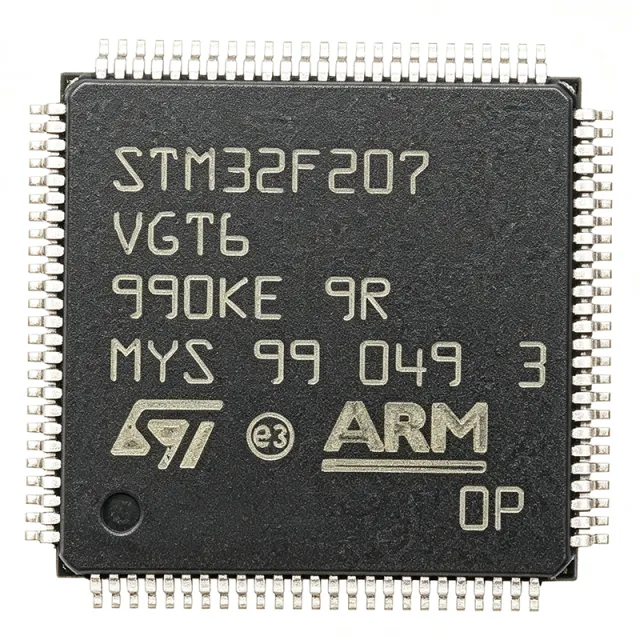
STM32F207VGT6 - 32-bit ARM Cortex-M3 MCU, 1MB Flash | STMicroelectronics
STM32F207VGT6

STM32F207VGT6 - 32-bit ARM Cortex-M3 MCU, 1MB Flash | STMicroelectronics

The STMicroelectronics STM32F207VGT6 is a high-performance 32-bit microcontroller based on the ARM Cortex-M3 core, operating at up to 120 MHz. It features 1 MB of Flash memory and 128 KB of SRAM, making it suitable for a wide range of embedded applications. The device is housed in a 100-pin LQFP package (LQFP100) and supports a supply voltage range of 1.8V to 3.6V. What is a microcontroller? A microcontroller (MCU) is a compact integrated circuit designed to govern a specific operation in an embedded system. It contains a processor core, memory (Flash and SRAM), and programmable input/output peripherals on a single chip. The STM32F207VGT6 belongs to the STM32F2 series, which is part of the broader STM32 family of 32-bit ARM Cortex-M microcontrollers. This family is widely used in industrial control, consumer electronics, and IoT devices due to its balance of performance, power efficiency, and peripheral integration. Key features of the STM32F207VGT6 include a 120 MHz ARM Cortex-M3 core with 1.25 DMIPS/MHz, 1 MB of Flash memory, 128 KB of SRAM, and a comprehensive set of peripherals. It integrates a 12-bit ADC with up to 24 channels, a 12-bit DAC, multiple timers, USART, SPI, I2C, USB 2.0 OTG, Ethernet MAC, and a camera interface. The device also supports a flexible memory controller (FMC) for external memory expansion, and a cryptographic/hash processor for security applications. Technically, the STM32F207VGT6 is built on a 90nm process technology, offering a good balance between performance and power consumption. It features a nested vectored interrupt controller (NVIC) for efficient interrupt handling, and a memory protection unit (MPU) for enhanced system reliability. The device supports a wide operating temperature range of -40°C to +85°C, making it suitable for industrial environments. Typical applications include industrial control systems, motor drives, medical devices, point-of-sale terminals, and IoT gateways. The Ethernet MAC and USB OTG interfaces enable connectivity in networked applications, while the rich analog peripherals support sensor interfacing and data acquisition. When designing with this MCU, ensure proper decoupling of the power supply pins and a stable clock source. The device supports multiple low-power modes, which can be leveraged to optimize energy consumption in battery-powered applications. Careful PCB layout is recommended to minimize noise and ensure reliable operation at high clock speeds.

USD $6.82 اتصل بنا
STM32F207ZET6 - 32-bit ARM Cortex-M3 MCU, 512KB Flash | STMicroelectronics
STM32F207ZET6

STM32F207ZET6 - 32-bit ARM Cortex-M3 MCU, 512KB Flash | STMicroelectronics

The STMicroelectronics STM32F207ZET6 is a high-performance 32-bit microcontroller based on the ARM Cortex-M3 core, operating at up to 120 MHz. It features 512 KB of Flash memory and 128 KB of SRAM, making it suitable for a wide range of embedded applications. The device is housed in a 144-pin LQFP package (LQFP144) with a 20x20 mm body, offering extensive I/O and connectivity options. What is a microcontroller? A microcontroller (MCU) is a compact integrated circuit designed to govern a specific operation in an embedded system. It integrates a processor core, memory (Flash and SRAM), and programmable input/output peripherals on a single chip. Microcontrollers are the brain of countless electronic products, from automotive engine control units to consumer appliances and IoT devices. The STM32F207ZET6 belongs to the STM32F2 series, which is part of the broader STM32 family of 32-bit ARM Cortex-M microcontrollers, positioned between the mainstream F1 series and the high-performance F4/H7 series. Key features of the STM32F207ZET6 include a 120 MHz ARM Cortex-M3 core with 1.25 DMIPS/MHz, 512 KB Flash, 128 KB SRAM, and a comprehensive set of peripherals: 3x 12-bit ADCs, 2x DACs, 4x USARTs, 2x UARTs, 3x SPI, 2x I2C, 2x CAN, 1x USB 2.0 OTG FS/HS, 1x Ethernet MAC, and a camera interface. It also includes a cryptographic/hash processor for AES, DES, and 3DES encryption, and a true random number generator (TRNG). The device operates from 1.8V to 3.6V supply and supports a temperature range of -40°C to +85°C (industrial grade). The STM32F207ZET6 is built on ST's advanced 90nm process technology, providing a balance of performance and power efficiency. The ART Accelerator™ (Adaptive Real-Time memory accelerator) enables zero-wait-state execution from Flash, maximizing the effective throughput of the Cortex-M3 core. The device also features a flexible memory controller (FMC) supporting external memory interfaces, including SRAM, PSRAM, NOR, and NAND Flash. Typical applications include industrial control systems, motor drives, PLCs, medical devices, point-of-sale terminals, networking equipment, and IoT gateways. The rich connectivity (Ethernet, USB, CAN) makes it ideal for applications requiring multiple communication interfaces. The cryptographic hardware accelerates secure communication protocols, enhancing data security in connected devices. When designing with this MCU, pay attention to power supply decoupling: place 100nF capacitors close to each VDD pin and a 4.7uF bulk capacitor. The VDDA analog supply should be filtered with a ferrite bead and 1uF capacitor to reduce noise for ADC accuracy. Also, configure the boot pins correctly to select the desired boot source (Flash, SRAM, or system memory).

طلب عرض سعر اتصل بنا
STM32F207ZGT6 - 32-bit ARM Cortex-M3 MCU, 1MB Flash | STMicroelectronics
STM32F207ZGT6

STM32F207ZGT6 - 32-bit ARM Cortex-M3 MCU, 1MB Flash | STMicroelectronics

The STM32F207ZGT6 is a high-performance 32-bit microcontroller from STMicroelectronics, based on the ARM Cortex-M3 core running at up to 120 MHz. It integrates 1 MB of Flash memory and 128 KB of SRAM, making it suitable for complex embedded applications requiring substantial code and data storage. The device is housed in a 144-pin LQFP package (LQFP144) with a 20x20 mm body, offering a rich set of peripherals and I/O capabilities. A microcontroller (MCU) is a compact integrated circuit designed to govern a specific operation in an embedded system. It contains a processor core, memory (Flash and SRAM), and programmable input/output peripherals. The STM32F207ZGT6 belongs to the STM32F2 series, which is part of the broader STM32 family of 32-bit Flash microcontrollers. This family is widely used in industrial control, consumer electronics, and IoT devices due to its balance of performance, power efficiency, and peripheral integration. Key features of the STM32F207ZGT6 include a 120 MHz ARM Cortex-M3 core with 1.25 DMIPS/MHz, 1 MB of Flash memory, 128 KB of SRAM, and a comprehensive set of peripherals: 3x 12-bit ADCs, 2x DACs, 4x USARTs, 2x UARTs, 3x SPI, 2x I2C, 2x CAN, 1x USB 2.0 OTG FS/HS, 1x Ethernet MAC, and a camera interface. It also features a flexible memory controller (FMC) for external memory expansion, a true random number generator (RNG), and a cryptographic acceleration cell for AES, DES, and 3DES. The STM32F207ZGT6 is built on a 90nm process technology, offering a good balance between performance and power consumption. It operates from a 1.8V to 3.6V power supply and supports a wide temperature range of -40°C to +85°C. The device includes multiple low-power modes (Sleep, Stop, Standby) to optimize energy consumption in battery-powered applications. Typical applications include industrial automation, motor control, medical devices, point-of-sale terminals, and IoT gateways. The Ethernet MAC and USB OTG support enable connectivity in networked systems, while the rich analog peripherals suit data acquisition and control loops. When designing with this MCU, ensure proper decoupling of the power supply pins and a stable clock source. The device supports external crystal oscillators (4-26 MHz) and an internal 16 MHz RC oscillator. For high-speed USB and Ethernet, an external 25 MHz crystal is recommended. The boot pins must be configured correctly for programming via USART or USB.

طلب عرض سعر اتصل بنا
STM32F217IGH6 - 120MHz Cortex-M3 MCU | STMicroelectronics
STM32F217IGH6

STM32F217IGH6 - 120MHz Cortex-M3 MCU | STMicroelectronics

The STMicroelectronics STM32F217IGH6 is an ARM Cortex-M3 32-bit microcontroller operating at up to 120 MHz, with 1 MB of Flash memory and a 176+25 UFBGA package measuring 10 mm by 10 mm. It combines embedded control performance with extensive connectivity, including USB OTG HS/FS and Ethernet. The part is identified by distributor data as an STM32F2-series MCU with 150 DMIPS, hardware crypto capability, 17 timers, three ADCs, 15 communication interfaces, and camera support. A microcontroller is a programmable semiconductor that integrates a CPU core, memory, peripherals, and communication interfaces on one device. Within the STM32 family, the STM32F217 belongs to the STM32F2 high-performance line. Its Cortex-M3 core is designed for embedded control, while USB, Ethernet, camera, timer, and analog resources reduce the need for companion chips in connected industrial, communications, imaging, and consumer products. Key features stated in the verified product data include a 120 MHz operating frequency, 1 MB Flash, 128+4 KB RAM, hardware crypto, USB OTG HS/FS, Ethernet, 17 timers, three ADCs, 15 communication interfaces, and camera capability. The ART Accelerator supports 0-wait operation according to the provided datasheet search result, helping reduce the performance penalty associated with Flash access in compatible instruction paths. The STM32F217IGH6 is positioned for applications requiring more connectivity and processing capacity than a basic Cortex-M microcontroller. Its integrated Ethernet and USB interfaces suit networked control equipment, while the camera interface supports image-acquisition designs. The three ADC blocks and extensive timer resources make it useful for sensor acquisition, motor control, industrial monitoring, and embedded communications systems. Typical applications include industrial Ethernet controllers, USB-connected data-acquisition units, security and access equipment, camera modules, motor-control boards, and gateway products. The 176+25 UFBGA package offers a compact solution for space-constrained assemblies, but its fine pitch requires careful PCB layout, assembly capability, and thermal management. A key design consideration is package verification: the exact pinout and exposed-ball assignment should be taken from the manufacturer datasheet for the STM32F217IGH6 ordering code. Power, decoupling, signal integrity, boot configuration, Ethernet magnetics, USB routing, and firmware peripheral configuration must be validated before production release. This page consolidates the verified distributor specifications, sourcing information, and design guidance for engineers evaluating the STM32F217IGH6. It also distinguishes confirmed features from parameters that were not supplied in the verified search data, avoiding unsupported assumptions while supporting initial design and procurement review.

طلب عرض سعر اتصل بنا
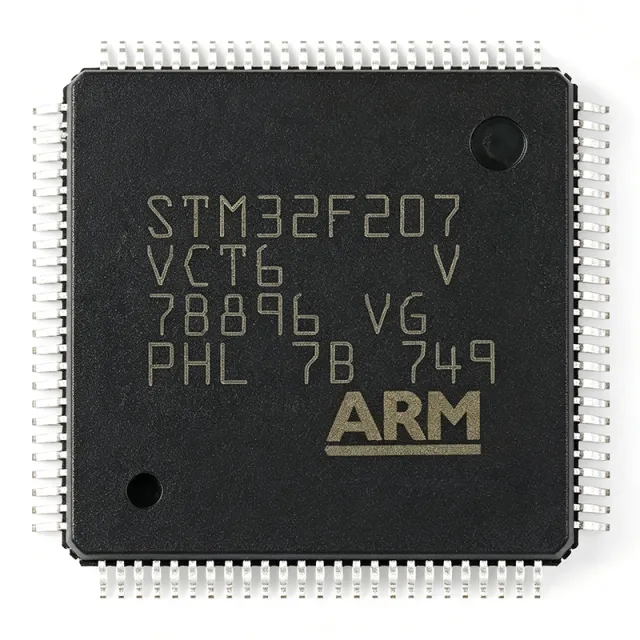
STM32F217ZGT6 - 120MHz Cortex-M3 MCU | STMicroelectronics
STM32F217ZGT6

STM32F217ZGT6 - 120MHz Cortex-M3 MCU | STMicroelectronics

The STMicroelectronics STM32F217ZGT6 is a 32-bit ARM Cortex-M3 microcontroller operating up to 120 MHz, with 1 MB of Flash memory, 128 KB of SRAM plus 4 KB of backup SRAM, and a 144-pin LQFP package measuring 20 x 20 mm. It combines an ART Accelerator, memory protection unit, Ethernet MAC, USB OTG HS/FS, cryptographic capability, camera interface, and extensive serial connectivity in a single device. A microcontroller is a programmable semiconductor that integrates a processor core, memory, and peripherals into one package. The STM32F2 family belongs to the hierarchy of ARM Cortex-M3 core > 32-bit RISC microcontroller > embedded processing system > semiconductor. STM32 devices are commonly programmed in embedded control systems where real-time execution, peripheral integration, and low-power operation are important. Key features include up to 120 MHz operation, 150 DMIPS at 1.25 DMIPS/MHz using Dhrystone 2.1, and zero-wait-state execution from Flash through the ART Accelerator. The device provides 17 timers, three ADCs, 15 communication interfaces, Ethernet support, USB OTG high-speed and full-speed operation, and camera connectivity. A memory protection unit supports isolated execution environments for more reliable embedded software. The Cortex-M3 architecture combines deterministic interrupt handling with Thumb-2 instruction support. The 1 MB Flash configuration provides room for substantial firmware, while the 128 KB SRAM supports working memory for communications, control loops, and peripheral data. The reported operating voltage options are 2.5 V and 3.3 V, matching common industrial, communications, and embedded-control system rails. Typical applications include industrial control and automation, Ethernet-connected equipment, USB data acquisition, camera-based imaging, medical monitoring, and real-time embedded control. Its combination of Ethernet, USB, timers, ADCs, and camera interfaces allows one controller to consolidate functions that might otherwise require several discrete components. The primary design consideration is PCB and firmware validation. Because the STM32F217ZGT6 uses a 144-pin LQFP, its 0.5 mm pitch, analog and digital supplies, clock circuitry, and high-speed communication routing require careful layout. Confirm the exact pin functions, decoupling requirements, and peripheral multiplexing against the manufacturer datasheet before layout release. This page consolidates distributor specifications, verified sourcing links, drop-in alternatives, application guidance, and package-specific design considerations. It also distinguishes documented facts from parameters that still require confirmation, providing engineers with a more useful basis for MCU selection and procurement.

طلب عرض سعر اتصل بنا
STM32F301C8T6 - 72MHz Cortex-M4 64KB MCU | STMicroelectronics
STM32F301C8T6

STM32F301C8T6 - 72MHz Cortex-M4 64KB MCU | STMicroelectronics

The STMicroelectronics STM32F301C8T6 is a 32-bit Arm Cortex-M4 microcontroller with FPU, operating up to 72 MHz, with 64 KB of Flash memory and 16 KB of SRAM in a 48-LQFP 7 x 7 mm package. It combines a high-performance RISC core, single-cycle multiplication, hardware division, DSP instructions, mixed-signal peripherals, and flexible power-management options for embedded control applications. A microcontroller is a programmable system-on-chip that integrates a CPU, memory, peripherals, and interfaces onto one package. The STM32F301C8T6 belongs to the STM32F301 mixed-signal MCU family, with the STM32F3 series positioned between general-purpose embedded control and higher-performance Cortex-M applications. Its Arm Cortex-M4 architecture supports efficient real-time execution while the floating-point unit accelerates numeric and control workloads without requiring an external processor. The verified device data identifies 64 KB of Flash, 16 KB of SRAM, a maximum operating frequency of 72 MHz, and a 48-LQFP package. The STM32F301 family also supports mixed-signal functions including ADC and DAC resources, a CRC calculation unit, reset and power-control capabilities, and DSP-oriented processing. These features make the device suitable for motor-control, industrial automation, sensor acquisition, communications, and compact embedded-control boards. The M4F core provides 32-bit RISC performance with single-cycle multiplication and hardware division, reducing the instruction overhead often encountered in control and signal-processing loops. The FPU supports floating-point calculations, while DSP instructions improve the implementation of filters, transforms, and digital control algorithms. This combination provides more processing headroom than a basic Cortex-M0-class controller without moving to a larger Cortex-M7-class design. Typical applications include programmable industrial equipment, motor and motion-control systems, building and access controls, instrumentation, communications modules, and compact consumer appliances. A 48-LQFP package also provides a practical transition path for prototypes and moderately populated production boards because it offers exposed peripheral routing and easier inspection than very-small leadless packages. Designers should verify the exact peripheral assignments, alternate-function mappings, clock configuration, and analog limits against the STMicroelectronics datasheet before PCB release. The 64 KB Flash and 16 KB SRAM budgets require attention to bootloader size, firmware growth, buffering, and debug support. Power sequencing, decoupling, exposed-pad layout, and clock stability should be evaluated for the final system rather than copied from a generic STM32 layout. This product page combines verified manufacturer and distributor information with practical selection criteria, procurement context, and design guidance. It distinguishes published STM32F301C8T6 facts from unverified parameters and avoids presenting cross-reference candidates as drop-in replacements unless their package, pinout, memory, and peripheral behavior are demonstrably compatible.

طلب عرض سعر اتصل بنا
STM32F301K6T7 - 32KB Flash Cortex-M4 MCU 32-LQFP | STMicroelectronics
STM32F301K6T7

STM32F301K6T7 - 32KB Flash Cortex-M4 MCU 32-LQFP | STMicroelectronics

The STMicroelectronics STM32F301K6T7 is a mainstream mixed-signal microcontroller built on the Arm Cortex-M4 32-bit RISC core with single-cycle hardware multiply, hardware divide, DSP instructions and an integrated single-precision Floating Point Unit (FPU), running up to 72 MHz. The device integrates 32 KB of Flash and 16 KB of SRAM on the data bus, packaged in a 32-pin LQFP. The supply voltage VDD/VDDA spans 2.0 V to 3.6 V, and the part includes an integrated voltage regulator and a CRC calculation unit. What is a mixed-signal MCU? A mixed-signal microcontroller integrates a digital processor core with on-chip analog peripherals such as ADCs, DACs, comparators and operational amplifiers, allowing one chip to interface directly with sensors and analog signal chains without external analog components. This category sits beneath the broader product hierarchy of microcontroller -> embedded MCU -> ARM Cortex-M device -> mixed-signal MCU -> semiconductor. Key features of the STM32F301K6T7 include up to two 12-bit fast ADCs (5 MSPS) with selectable resolution, one 12-bit DAC channel, four fast rail-to-rail analog comparators with programmable threshold, one 8 MHz operational amplifier with PGA capability, and advanced-control PWM timers for motor-control and digital-power topologies. Communication peripherals include one I2C, up to two SPI, up to three USART, and a CAN 2.0B interface. The device supports up to 21 fast GPIOs and embeds a 16-channel DMA controller. Architecturally the part leverages the Cortex-M4 core with FPU, enabling C-level DSP code without software emulation and accurate math for sensor fusion, while the on-chip analog front-end reduces BOM cost. Reset and power-management blocks include power-on reset, brown-out reset, programmable voltage detector, and a low-power RTC with backup-domain registers. Typical applications include digital power conversion (SMPS digital control loops), motor drives for low-voltage BLDC and PMSM systems, sensor-hub and signal-conditioning front-ends, factory-automation I/O modules, consumer appliance control boards, and low-cost instrumentation. When laying out the PCB, place the VDDA decoupling network within 5 mm of the VDDA pin, use an external ferrite or resistor between VDD and VDDA, and keep the analog ground plane separate from the switching-return path to preserve ADC SNR.

طلب عرض سعر اتصل بنا
STM32F301K6U7 - 72MHz Cortex-M4 32KB MCU | STMicroelectronics
STM32F301K6U7

STM32F301K6U7 - 72MHz Cortex-M4 32KB MCU | STMicroelectronics

The STMicroelectronics STM32F301K6U7 is a 32-bit mixed-signal microcontroller with a 72 MHz Arm Cortex-M4 processor, 32 KB of Flash memory, 16 KB of SRAM, and a 32-pin UFQFPN package. It integrates an FPU, DSP instructions, a 12-bit ADC rated at 5 MSPS, a comparator, and an operational amplifier for compact industrial control designs. A microcontroller is a programmable semiconductor that integrates a processor core, memory, and peripherals on one package. In the STM32 product hierarchy, this device belongs to the STM32F3 series of mixed-signal ARM microcontrollers. The STM32F301K6U7 combines general-purpose embedded processing with analog conversion and analog signal conditioning, allowing a compact design to control digital logic while monitoring or generating analog signals. The principal performance features include a maximum CPU frequency of 72 MHz, single-cycle multiplication, hardware division, and an Arm Cortex-M4 FPU. Its 32 KB Flash memory provides embedded firmware storage, while 16 KB of SRAM supports working data and stack requirements. A CRC calculation unit supports data-integrity checks, and the integrated analog peripherals include a 12-bit ADC, comparator, and operational amplifier. The mixed-signal architecture is particularly useful when a design must perform control, acquisition, and signal conditioning without relying on several separate analog and digital devices. The 5 MSPS ADC can acquire sampled analog data for monitoring and control loops, while the comparator supports threshold decisions and the operational amplifier can support analog signal conditioning. These functions must still be evaluated against the individual peripheral specifications and operating conditions in the manufacturer datasheet. Typical uses include industrial sensor nodes, compact motor and actuator controllers, medical monitoring equipment, laboratory instruments, and communication modules. The small 32-pin UFQFPN package supports space-constrained assemblies but requires careful PCB layout, exposed-pad thermal management, and adequate decoupling. Firmware development is supported by the STM32 ecosystem, including the Arm Cortex-M4 toolchain and STMicroelectronics development resources. A key design consideration is that board-level compatibility depends on exact package geometry, exposed-pad construction, pin assignment, electrical limits, and memory requirements. Related STM32F301K6 order codes may share the family architecture, but firmware, boot behavior, temperature grade, and packing codes must be checked before substitution. This page combines verified source data, pricing references, compatibility analysis, and application guidance to support engineering selection. The information provided here synthesizes distributor pricing, same-family alternatives, and practical design considerations that are not consolidated in a single manufacturer document.

طلب عرض سعر اتصل بنا
STM32F301K8U6 - 72MHz Cortex-M4 MCU | STMicroelectronics
STM32F301K8U6

STM32F301K8U6 - 72MHz Cortex-M4 MCU | STMicroelectronics

The STMicroelectronics STM32F301K8U6 is a 32-bit mixed-signal microcontroller built around a 72 MHz Arm Cortex-M4 processor with a floating-point unit, supplied in a 32-pin UFQFPN 5 x 5 mm package. Its headline specifications include a maximum core frequency of 72 MHz, 64 KB of Flash program memory and 16 KB of SRAM. The MCU also provides a CRC calculation unit and hardware division, supporting efficient data-integrity checks and control-oriented processing. A microcontroller is a programmable system-on-chip that integrates a CPU, memory, peripherals, and interface logic into one package. The STM32F301 belongs to the STM32F3 family of mainstream mixed-signal microcontrollers. Its Cortex-M4 core combines a 32-bit RISC architecture with single-cycle multiplication, hardware division, DSP instructions and an FPU, placing it above basic Cortex-M devices in computational and signal-processing capability. The STM32F301K8U6 combines 72 MHz processing with 64 KB of Flash and 16 KB of SRAM in a compact 32-pin UFQFPN package. This combination makes it useful for control systems that need responsive task execution without requiring a larger external-memory interface. The on-chip CRC unit provides an efficient way to detect transmission or storage errors, while the DSP instruction set and FPU improve the suitability of the device for digital filtering, control calculations and other mixed-signal workloads. The STM32F301x6/8 family architecture is centered on the Arm Cortex-M4 core, with the F301K8U6 configuration providing 64 KB of Flash and 16 KB of SRAM. Single-cycle multiplication and hardware division reduce instruction overhead in control and signal-processing loops. Compared with a general-purpose host processor, this dedicated microcontroller combines deterministic embedded execution with a compact package and integrated peripherals, while the 72 MHz operating limit defines the maximum supported core clock. Typical uses include industrial motor and motion control, compact sensor modules, digital power controllers, communication equipment and low-cost mixed-signal instruments. The 64 KB Flash capacity can store a focused application rather than a large operating system, while the Cortex-M4 FPU supports arithmetic-heavy control algorithms. The 32-pin UFQFPN package is particularly useful where board space is constrained but a full-featured 32-bit embedded processor is required. Designers should verify the complete pin assignment, power requirements, clock configuration, decoupling network and peripheral multiplexing against the manufacturer documentation before layout. Because the supplied product data confirms a 32-pin UFQFPN package but does not provide a complete public pin table, the package drawing and pin definitions should be checked directly in STMicroelectronics documentation. Firmware migration should also be reviewed for peripheral-instance and register differences within the STM32F301 family. This product record combines verified manufacturer and distributor information with package-focused selection guidance, sourcing questions, application-fit analysis and explicit identification of unavailable technical and pricing fields. It is intended to help engineers establish whether the STM32F301K8U6 matches their processing, memory, package and procurement requirements without implying that unverified electrical details or drop-in alternatives are available.

طلب عرض سعر اتصل بنا
STM32F301K8U7 - 72MHz Cortex-M4 64KB MCU | STMicroelectronics
STM32F301K8U7

STM32F301K8U7 - 72MHz Cortex-M4 64KB MCU | STMicroelectronics

STMicroelectronics STM32F301K8U7 is an Arm Cortex-M4 32-bit microcontroller operating at up to 72 MHz, with 64 KB of Flash memory, 16 KB of SRAM, an integrated floating-point unit, and a 32-pin UFQFPN 5x5 mm package with exposed pad. It belongs to the STM32F3 family of mixed-signal microcontrollers, combining a high-performance 32-bit RISC core with analog and digital peripherals for compact embedded control systems. An Arm Cortex-M4 microcontroller is a 32-bit embedded processing core designed around the Thumb instruction set. The STM32F3 family combines that core with a floating-point unit, single-cycle multiplication, hardware division, and DSP instructions. In the STM32F301K8U7, this processing capability is paired with 64 KB of Flash for firmware and 16 KB of SRAM for working data, making the device suitable for control-oriented designs that need deterministic real-time performance without an external memory interface. The verified device data identifies a maximum operating frequency of 72 MHz, 64 KB of Flash organized as 64K x 8, and 16 KB of SRAM. The single-cycle multiplier, hardware divider, DSP instructions, and integrated FPU accelerate filtering, control calculations, and other floating-point workloads. Its mixed-signal feature set also supports applications combining digital processing with analog measurement and output functions. The 32-pin UFQFPN package is only 5 x 5 mm, allowing a compact printed-circuit-board footprint while preserving access to the family’s GPIO, communications, timer, ADC, DAC, and other mixed-signal resources. The exposed thermal pad provides a direct heat-transfer path from the device to the PCB. Package dimensions, individual pin assignments, voltage limits, and detailed peripheral electrical characteristics require confirmation from the manufacturer documentation before PCB release or production use. Typical uses include industrial sensing and automation equipment, compact motor-control systems, embedded instrumentation, communication modules, and low-cost consumer controllers. The Cortex-M4 DSP and FPU features are particularly useful when the control loop must perform filtering or arithmetic operations beyond the capabilities of a basic Cortex-M0 or Cortex-M3 design. The 64 KB memory footprint is appropriate for moderately complex firmware without external storage. Designers should preserve the exposed-pad land pattern, follow the manufacturer’s recommended copper and thermal-via arrangement, and verify every peripheral pin against the official STM32F301x6/8 documentation. Firmware development can use the STM32F3 family ecosystem, while programming and debugging setups should be matched to the device’s supported debug and boot interfaces. Exact supply voltage, pin names, peripheral configuration, and environmental limits are marked for verification where the supplied source snippets do not state them. This product record combines verified distributor and manufacturer information with application analysis, selection guidance, and same-family replacement candidates. Unlike a distributor listing that mainly summarizes inventory, it also identifies what is known, what still requires datasheet verification, and which alternatives require firmware, timing, or qualification review before use.

طلب عرض سعر اتصل بنا
STM32F302C6T6 - 72MHz Cortex-M4 32KB MCU | STMicroelectronics
STM32F302C6T6

STM32F302C6T6 - 72MHz Cortex-M4 32KB MCU | STMicroelectronics

The STMicroelectronics STM32F302C6T6 is a 32-bit Arm Cortex-M4 microcontroller with an operating frequency up to 72 MHz, 32 KB of flash memory, 16 KB of SRAM, and a 48-pin LQFP package measuring 7 x 7 mm. The device also includes a floating-point unit, making it suitable for real-time embedded control, mixed-signal processing, motor control, and connected industrial equipment. A microcontroller is a programmable semiconductor that integrates a processor core, memory, timers, serial interfaces, analog conversion functions, and GPIO into one package. The STM32F302 belongs to the STM32F3 mixed-signal MCU family and sits within the hierarchy of Arm Cortex-M microcontrollers, embedded processors, and general-purpose semiconductor devices. Its integrated floating-point unit accelerates arithmetic operations commonly used in control algorithms and digital signal processing. The STM32F302C6T6 provides 32 KB of flash for firmware and 16 KB of SRAM for working data, while its Cortex-M4 core supports operation up to 72 MHz. A 12-bit ADC is identified in the verified distributor data, supporting mixed-signal applications where measured analog inputs must be processed locally. The 48-pin LQFP package also provides more I/O and peripheral connectivity than smaller 32-pin alternatives. The STM32F302x6/8 family combines a high-performance 32-bit RISC core with mixed-signal peripherals in STMicroelectronics’ STM32 architecture. The target is identified as a 32 KB flash, 16 KB SRAM device in the verified comparison data, while the family description confirms the Cortex-M4 core, floating-point unit, and maximum 72 MHz operating frequency. Package code C6 denotes the 48-pin configuration used by STM32F302C6T6. Typical uses include industrial sensor controllers, motor-control systems, compact instrumentation, digital power converters, and communication equipment. The 72 MHz processor provides timing margin for protocol handling and real-time control, while the floating-point unit simplifies implementation of PID loops, filtering, and transform calculations. The mixed-signal orientation is useful when analog measurements, timers, and serial communications must share one controller. Designers should verify the complete pinout, peripheral configuration, clock tree, and electrical limits against the manufacturer datasheet before layout release. The LQFP footprint is straightforward to assemble and inspect, but decoupling, grounding, analog-input routing, and unused-pin handling still require disciplined PCB implementation. Firmware must also be validated against the relevant STM32F3 reference manual and errata. This page consolidates the verified manufacturer and distributor information, same-family drop-in candidates, parameter comparisons, application guidance, and practical design cautions. It highlights where the STM32F302C6T6 fits and documents the uncertainties that require datasheet confirmation rather than presenting unsupported assumptions as production facts.

طلب عرض سعر اتصل بنا
STM32F302CBT6 - 32-Bit ARM Cortex-M4 MCU 72MHz 128KB Flash | STMicroelectronics
STM32F302CBT6

STM32F302CBT6 - 32-Bit ARM Cortex-M4 MCU 72MHz 128KB Flash | STMicroelectronics

The STM32F302CBT6 is a 32-bit ARM Cortex-M4 microcontroller from STMicroelectronics' STM32F3 series, featuring a 72 MHz CPU with DSP instructions and a floating-point unit (FPU). It integrates 128 KB of Flash memory and 32 KB of SRAM in a compact 48-pin LQFP (7x7 mm) package, making it suitable for a wide range of mixed-signal applications. A microcontroller (MCU) is a compact integrated circuit designed to govern a specific operation in an embedded system. It contains a processor core, memory, and programmable input/output peripherals. The STM32F302CBT6 belongs to the STM32F3 series, which is optimized for mixed-signal processing, combining an ARM Cortex-M4 core with advanced analog peripherals such as high-speed ADCs, operational amplifiers, and comparators. This positions it within the broader hierarchy of embedded processors, from general-purpose MCUs to application-specific system-on-chips. Key features include a 12-bit ADC with 5 MSPS sampling rate, programmable gain amplifiers (PGAs), and analog comparators, enabling precise analog signal conditioning without external components. The device also includes a memory protection unit (MPU) and a CCM (Core Coupled Memory) for real-time performance. The FPU accelerates floating-point calculations, which is critical for control algorithms and digital signal processing tasks. The STM32F302CBT6 is built on a high-performance ARM Cortex-M4 core with a 72 MHz clock, providing 90 DMIPS of processing power. The inclusion of DSP instructions and an FPU allows efficient execution of complex mathematical operations, making it ideal for motor control, power conversion, and audio processing. The device operates from a 2.0V to 3.6V supply and supports a temperature range of -40°C to +85°C. Typical applications include motor control for industrial drives, power management in renewable energy systems, and audio processing in consumer electronics. The high-speed ADC and analog peripherals make it particularly well-suited for applications requiring real-time analog signal acquisition and processing, such as digital power supplies and smart sensors. When designing with this device, ensure proper decoupling of the power supply pins and careful layout of the analog and digital grounds to minimize noise. The flexible clock tree allows the use of an external crystal or internal RC oscillator, providing design flexibility for cost-sensitive applications.

طلب عرض سعر اتصل بنا
STM32F302CCT6 - 72MHz Cortex-M4 256KB MCU | STMicroelectronics
STM32F302CCT6

STM32F302CCT6 - 72MHz Cortex-M4 256KB MCU | STMicroelectronics

The STMicroelectronics STM32F302CCT6 is a 32-bit mixed-signal microcontroller with an Arm Cortex-M4 core, DSP instructions, and an FPU, operating up to 72 MHz. It provides 256 KB of Flash memory and is packaged in a 48-LQFP (7x7 mm) package. The device is designed for industrial, motor-control, and embedded mixed-signal systems where performance, analog conversion, and compact packaging are important. A microcontroller is a programmable system-on-chip that integrates a CPU core, memory, peripherals, and interface controllers into one package. The STM32F302 belongs to the STM32F3 mixed-signal family, combining general-purpose embedded control with fast analog-to-digital conversion. This makes it more capable than a basic microcontroller while retaining a familiar Arm Cortex-M software ecosystem and peripheral architecture. Key features include a 72 MHz Cortex-M4 processor, 256 KB of Flash memory, an FPU and DSP support, a 12-bit ADC capable of 5 MSPS according to the manufacturer product page, programmable gain amplification, comparators, and an MPU. The mixed-signal resources allow the device to sample and process sensor signals while controlling timers, communications, and actuators without requiring a separate high-speed analog device. The STM32F302CCT6 is identified as an active mainstream product by STMicroelectronics. Its 48-LQFP package provides enough pins for mixed signal, motor-control, and general embedded connectivity while remaining compatible with conventional leaded assembly and inspection processes. The Cortex-M4 architecture supports efficient interrupt handling, deterministic real-time control, and floating-point or DSP calculations. Typical applications include industrial sensor nodes, motor and power-control systems, building automation, instrumentation, communications equipment, and compact embedded control platforms. Designers should verify the complete pin configuration, peripheral availability, operating-temperature grade, electrical limits, and package details against the manufacturer datasheet before releasing a production design. A key design consideration is preserving analog performance. The ADC and PGA resources should be used with appropriate input conditioning, reference-voltage stability, grounding, and layout separation from switching nodes. Firmware should also account for startup, calibration, and the timing relationship between the 72 MHz CPU and the available peripherals. This product page combines the verified manufacturer and distributor information with application guidance, selection trade-offs, and practical considerations that are not normally consolidated in a distributor catalog. It is intended to help engineers confirm package, memory, performance, sourcing, and replacement requirements before selecting the STM32F302CCT6.

طلب عرض سعر اتصل بنا
STM32F302K6U6 - 72MHz Cortex-M4 MCU, 32KB Flash | STMicroelectronics
STM32F302K6U6

STM32F302K6U6 - 72MHz Cortex-M4 MCU, 32KB Flash | STMicroelectronics

The STMicroelectronics STM32F302K6U6 is a 32-bit Arm Cortex-M4 microcontroller with an integrated floating-point unit, operating up to 72 MHz and housed in a 32-pin UFQFPN 5 x 5 mm package. The verified distributor listing identifies 32 KB of Flash memory and a 32-bit architecture, while the manufacturer product page confirms the STM32F302x6/8 family's Cortex-M4 core and FPU architecture. The STM32F302K6U6 is positioned as a compact general-purpose MCU for embedded control, industrial automation, consumer equipment, and connected products that require efficient real-time processing in a small surface-mount footprint. What is a microcontroller? A microcontroller is an integrated circuit that combines a processor core, memory, and peripheral interfaces on one device. In the STM32 family, the Cortex-M4 MCU architecture sits within the broader category of embedded processors and microcontrollers. The Cortex-M4 core uses a 32-bit RISC architecture and supports floating-point instructions, making it suitable for control loops and signal-processing tasks that require more computational capability than a basic 8-bit or 16-bit controller. The STM32F302K6U6 provides 72 MHz maximum operating frequency and 32 KB Flash memory according to the manufacturer and DigiKey product information. Its 32-pin UFQFPN package is suitable for compact PCB layouts, and the family is intended for designs requiring a balance of processing performance, memory capacity, and low board area. The available verified sources also identify the part as a general-purpose ARM Cortex-M4 MCU rather than a dedicated signal-processing or application-specific controller. The part is useful for motor-control and industrial automation systems, where a real-time microcontroller can coordinate sensors, communication interfaces, and control outputs. It can also serve as the control hub for compact consumer products, connected devices, communications equipment, and embedded instrumentation. The exact peripheral configuration, RAM size, voltage range, and timing characteristics should be confirmed from the official STM32F302x6/8 datasheet before finalizing a design. When designing a board around the STM32F302K6U6, verify the exposed-pad land pattern, pin multiplexing, supported power supply conditions, and peripheral alternate-function assignments against the manufacturer documentation. The UFQFPN package requires careful PCB layout and thermal management because its exposed pad is part of the electrical and thermal design. For firmware migration, confirm that the STM32CubeMX device database and the selected STM32Cube HAL or Standard Peripheral Library support the exact MPN. This page combines verified manufacturer and distributor information with practical guidance for component selection, procurement, firmware compatibility, and hardware implementation. It also identifies same-family alternatives for engineers who need to evaluate memory or package variations without assuming that every similarly named STM32 device is a drop-in replacement.

طلب عرض سعر اتصل بنا
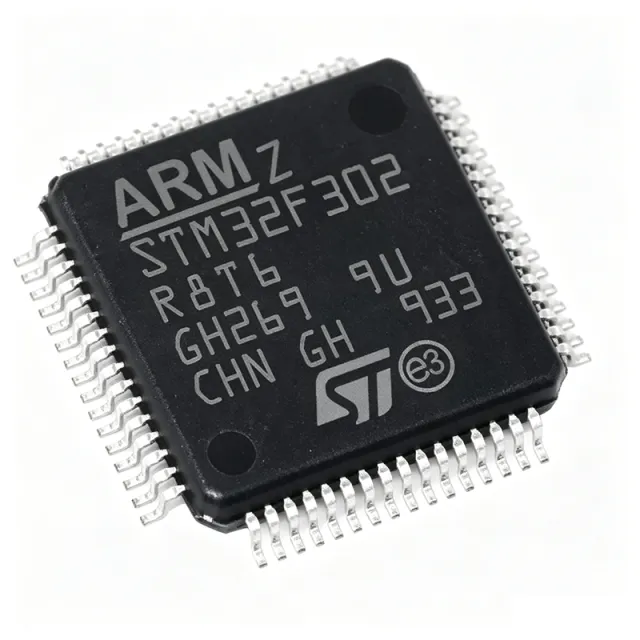
STM32F302R8T6 - 64MHz ARM Cortex-M4F MCU | STMicroelectronics
STM32F302R8T6

STM32F302R8T6 - 64MHz ARM Cortex-M4F MCU | STMicroelectronics

The STMicroelectronics STM32F302R8T6 is a 32-bit ARM Cortex-M4F microcontroller with floating-point unit (FPU), operating at up to 64 MHz. It is part of the STM32F3 series, designed for mixed-signal applications requiring high-performance analog peripherals. The device is housed in a 64-pin LQFP package and provides 64 KB of flash memory and 16 KB of SRAM. A microcontroller (MCU) is a compact integrated circuit designed to govern a specific operation in an embedded system. It contains a processor core, memory, and programmable input/output peripherals. The STM32F302R8T6 belongs to the STM32F3 family, which is optimized for analog and mixed-signal control applications, bridging the gap between general-purpose MCUs and digital signal processors (DSPs). Key features include a 64 MHz ARM Cortex-M4F core with FPU, 64 KB flash, 16 KB SRAM, and a rich set of analog peripherals: two 12-bit DACs, three 12-bit ADCs (up to 5 MSPS), and an operational amplifier. It also integrates a 16-bit advanced-control timer, multiple general-purpose timers, and a real-time clock. Communication interfaces include I2C, SPI, USART, and CAN, making it versatile for industrial and consumer applications. The STM32F302R8T6 leverages the ARM Cortex-M4F architecture with DSP instructions and a single-precision FPU, enabling efficient execution of complex algorithms. The device operates from a 2.0V to 3.6V power supply and supports a temperature range of -40°C to +85°C. Its advanced analog peripherals allow for high-resolution signal acquisition and generation, reducing external component count. Typical applications include motor control, power management, industrial automation, and consumer electronics. The combination of high-speed ADC, DAC, and op-amp makes it ideal for closed-loop control systems, such as field-oriented control (FOC) of brushless DC motors. The CAN interface supports robust communication in automotive and industrial networks. When designing with this MCU, ensure proper decoupling of the power supply pins and a stable clock source. The internal 8 MHz RC oscillator can be used for basic operation, but an external crystal is recommended for applications requiring precise timing. The device supports in-circuit programming and debugging via SWD, simplifying firmware development.

USD $5.41 اتصل بنا
STM32F302RBT6 - 72MHz Cortex-M4 128KB MCU | STMicroelectronics
STM32F302RBT6

STM32F302RBT6 - 72MHz Cortex-M4 128KB MCU | STMicroelectronics

STMicroelectronics STM32F302RBT6 is a 32-bit ARM Cortex-M4 mixed-signal microcontroller with DSP and FPU instructions, operating up to 72 MHz and integrating 128 KB of Flash memory in a 64-pin LQFP package measuring 10 mm by 10 mm. The device also includes an MPU, CCM memory, a 12-bit 5 MSPS ADC, programmable gain amplifiers, and comparators. Its combination of digital processing and integrated analog resources makes it suitable for industrial control, motor-control, and embedded signal-processing systems. An ARM Cortex-M4 microcontroller is a 32-bit embedded processor implemented under the Arm Cortex-M architecture. It combines deterministic interrupt-driven execution with DSP instructions for filtering and signal analysis and a single-precision floating-point unit for control calculations. Within the broader hierarchy, the STM32F302RBT6 belongs to the STM32 mixed-signal MCU family and combines a general-purpose microcontroller core with analog peripherals for real-world sensing and control. The verified manufacturer information identifies a maximum CPU frequency of 72 MHz, 128 Kbytes of Flash, an Arm Cortex-M4 core, DSP and FPU support, a memory protection unit, and CCM. A 12-bit ADC capable of 5 MSPS supports rapid analog acquisition, while the integrated PGA and comparators reduce the need for external signal-conditioning components. These resources make the MCU useful where high-speed sampling, numerical control, and embedded communications must coexist in a compact 64-pin package. The Harvard-style STM32F3 architecture supports parallel program-memory and data-memory access. The Cortex-M4 processor's DSP and floating-point capabilities accelerate control-loop mathematics, filtering, transformations, and sensor conditioning in software. The dedicated CCM provides an additional tightly coupled memory resource, while the MPU can enforce memory-region protection for more structured embedded designs. Exact RAM capacity, voltage limits, and peripheral operating details are not supplied in the verified source data and therefore require confirmation from the manufacturer documentation. Typical applications include industrial motor controllers, programmable logic and test equipment, sensor-processing systems, communications equipment, and compact embedded control platforms. The 12-bit 5 MSPS ADC is especially relevant to current sensing, position sensing, vibration monitoring, and process-control loops. The FPU supports real-time filtering and control calculations, while the 128 KB Flash capacity accommodates bootloader, application firmware, and configuration data. Designers should confirm the complete pin allocation, peripheral remapping, clock limits, analog input range, and electrical operating conditions before layout release. Because the verified excerpts do not provide a complete manufacturer pin table, a published pinout was not reconstructed here. PCB planning should also preserve analog grounding, supply decoupling, and clean routing around the ADC and comparator inputs. This page combines manufacturer specifications, distributor availability, package information, application guidance, and same-family replacement candidates to support faster component selection and PCB planning. It also distinguishes verified facts from parameters that still require confirmation from the official STM32F302RB documentation.

طلب عرض سعر اتصل بنا
STM32F302RCT6 - 256KB Flash ARM Cortex-M4F MCU | STMicroelectronics
STM32F302RCT6

STM32F302RCT6 - 256KB Flash ARM Cortex-M4F MCU | STMicroelectronics

The STM32F302RCT6 is a 32-bit ARM Cortex-M4F microcontroller from STMicroelectronics, featuring a floating-point unit (FPU) and running at up to 72 MHz. It integrates 256 KB of flash memory and 40 KB of SRAM, making it suitable for a wide range of embedded control applications. The device is housed in a 64-pin LQFP package (LQFP64) and operates over a supply voltage range of 2.0V to 3.6V. What is a microcontroller? A microcontroller (MCU) is a compact integrated circuit designed to govern a specific operation in an embedded system. It contains a processor core, memory (flash and SRAM), and programmable input/output peripherals on a single chip. Microcontrollers are the backbone of modern embedded systems, from automotive engine control units to consumer electronics and industrial automation. The STM32F302RCT6 belongs to the STM32F3 series, which is optimized for mixed-signal control applications, combining an ARM Cortex-M4F core with advanced analog peripherals. Key features of the STM32F302RCT6 include a 12-bit ADC with up to 5 MSPS, two 12-bit DACs, three operational amplifiers, and a 16-bit advanced-control timer. It also provides multiple communication interfaces: I2C, SPI, USART, CAN, and USB. The device supports a temperature range of -40°C to +85°C and is available in a 64-pin LQFP package, which is suitable for space-constrained designs. The STM32F302RCT6 leverages the ARM Cortex-M4F core with DSP instructions and a single-precision FPU, enabling efficient execution of complex algorithms such as digital signal processing and motor control. The device includes a memory protection unit (MPU) and a nested vectored interrupt controller (NVIC) for real-time performance. Its advanced analog peripherals, including a 5 MSPS ADC and fast comparators, make it ideal for applications requiring high-speed data acquisition and precise control. Typical applications include motor control, power conversion, industrial automation, and consumer electronics. The device's rich analog feature set and CAN interface make it particularly well-suited for automotive and industrial control systems. Its low-power modes and wide operating voltage range also support battery-powered portable devices. When designing with the STM32F302RCT6, ensure proper decoupling of the power supply pins with 100 nF capacitors placed close to each VDD pin. The VDDA pin should be connected to a clean analog supply, and the VREF+ pin should be decoupled with a 1 µF capacitor. For reliable operation, the NRST pin should be pulled high with a 10 kΩ resistor and a 100 nF capacitor to ground.

طلب عرض سعر اتصل بنا
STM32F302VEH6 - 72MHz Cortex-M4 512KB MCU | STMicroelectronics
STM32F302VEH6

STM32F302VEH6 - 72MHz Cortex-M4 512KB MCU | STMicroelectronics

The STMicroelectronics STM32F302VEH6 is a 32-bit ARM Cortex-M4 microcontroller with a 72 MHz operating frequency, 512 KB of flash memory, and a 100-UFBGA (7x7 mm) package. It belongs to the STM32F3 mixed-signal MCU family and is designed for embedded control applications requiring fast processing, integrated analog peripherals, and extensive serial connectivity. A microcontroller is a programmable semiconductor device that integrates a processor core, memory, and peripherals on one package. The STM32F3 family combines a real-time Cortex-M4 architecture with mixed-signal resources for industrial, communications, consumer, and instrumentation systems. In the system hierarchy, this MCU belongs to embedded processors, embedded controllers, and semiconductor devices. Verified source data identifies the device with an ARM Cortex-M4 core, 32-bit architecture, 72 MHz operation, and 512 KB flash. Mouser describes the device as a mainstream mixed-signal MCU with an Arm Cortex-M4 core, DSP and FPU capability, and 512 KB flash. The available listing data does not provide RAM size, ADC specifications, GPIO count, operating-temperature limits, or package dimensions, so those values require confirmation from the manufacturer datasheet. The STM32F3 platform is suited to motor-control and embedded-control systems because its Cortex-M4 core supports efficient real-time processing. The 100-UFBGA package provides a compact surface-mount option for high-density PCB layouts, although its fine ball pitch requires careful assembly and inspection. The part is also relevant to communication hubs, sensor nodes, and industrial controllers where multiple mixed-function peripherals can reduce external component count. For designs using STM32F302VEH6, engineers should confirm the exact pin multiplexing, power requirements, peripheral availability, and memory map against the official datasheet before layout release. Firmware migration between STM32 devices should be reviewed for differences in clock configuration, peripheral availability, pin assignments, and startup code. This page consolidates verified distributor availability, package information, technical source links, and selection guidance. It does not infer unverified electrical specifications, and it distinguishes sourced facts from parameters that still require manufacturer confirmation.

طلب عرض سعر اتصل بنا
STM32F302ZDT6 - 72MHz Cortex-M4 384KB MCU | STMicroelectronics
STM32F302ZDT6

STM32F302ZDT6 - 72MHz Cortex-M4 384KB MCU | STMicroelectronics

The STMicroelectronics STM32F302ZDT6 is a 32-bit ARM Cortex-M4 microcontroller with a 72 MHz operating frequency, 384 KB of Flash memory, and a 144-LQFP package measuring 20 mm by 20 mm. It also provides 64 KB of SRAM according to the verified product listing, along with 115 I/O pins for mixed-signal control, communication, and industrial embedded applications. The part belongs to the STM32F3 series and combines a high-performance 32-bit RISC core with an FPU. A microcontroller is a compact embedded-processing system that integrates a CPU, memory, peripherals, and interfaces on one semiconductor device. The STM32F3 family is positioned within the broader hierarchy of ARM Cortex-M microcontrollers, embedded processors, and semiconductor control devices. These components execute firmware for real-time measurement, actuation, communications, motor control, data acquisition, and safety-oriented industrial functions. The Cortex-M4 architecture supports efficient fixed-point and floating-point instruction execution while retaining a broad embedded-software ecosystem. The verified listing identifies the STM32F302ZDT6 as an ARM Cortex-M4 device operating at 72 MHz and storing 384 KB of Flash memory. Its 144-LQFP package exposes 115 I/O, enabling dense mixed-signal designs where analog and digital functions must share a single controller. The STM32F302xD/E family is described by STMicroelectronics as combining the Cortex-M4 core with an FPU. Exact peripheral assignments, voltage limits, temperature limits, and electrical characteristics are not fully present in the supplied data and must be confirmed in the manufacturer documentation. A 72 MHz clock rate supports responsive control loops and timely peripheral servicing. The 384 KB Flash capacity provides room for application firmware, configuration data, and boot logic, while the verified 64 KB SRAM figure supports working memory and data buffering. Compared with a smaller microcontroller package, the 144-LQFP format offers a large pin count and practical routing flexibility for boards requiring numerous external signals. Typical uses include industrial automation controllers, motor-control and digital power systems, data-acquisition equipment, communications gateways, and embedded measurement platforms. The 115-I/O count can be valuable when a design must connect sensors, actuators, converters, displays, and communication transceivers without using multiple controllers. The STM32F302ZDT6 is therefore appropriate where 72 MHz processing, substantial Flash memory, and a high pin count are more important than the smallest possible footprint. Designers should confirm the exact peripheral mix, alternate-function mappings, pin constraints, electrical limits, and startup requirements against the STMicroelectronics product documentation before layout. The large LQFP package is easy to inspect and solder relative to fine-pitch alternatives, but its 144 leads require careful fanout and ground-return planning. Firmware qualification, clock configuration, peripheral initialization, and package-level validation remain essential before production release. This page consolidates verified distributor and manufacturer information with package, procurement, comparison, and design guidance. It is intended to help engineers identify whether the STM32F302ZDT6's 72 MHz core, 384 KB Flash, 64 KB SRAM, and 144-LQFP package fit a new embedded design while clearly separating verified facts from unavailable parameters.

طلب عرض سعر اتصل بنا
STM32F303C8T6 - 72MHz Cortex-M4 MCU with 64KB Flash | STMicroelectronics
STM32F303C8T6

STM32F303C8T6 - 72MHz Cortex-M4 MCU with 64KB Flash | STMicroelectronics

STMicroelectronics STM32F303C8T6 is an Arm Cortex-M4 32-bit microcontroller with a 72 MHz operating frequency, 64 KB of Flash memory, 16 KB of SRAM, and a 48-LQFP package measuring 7 mm by 7 mm. The device integrates a floating-point unit, two ADCs, three DACs, and CAN connectivity, making it suitable for compact embedded control, industrial monitoring, and communications applications. A microcontroller is a programmable semiconductor that combines a processor core, memory, and peripheral interfaces on one integrated circuit. The STM32F303C8T6 belongs to the STM32F3 family of 32-bit microcontrollers and provides an Arm Cortex-M4 RISC core with hardware floating-point capability. This hierarchy places the device within embedded processors, microcontrollers, and industrial semiconductor control systems. Principal features include a 72 MHz Cortex-M4 core, 64 KB Flash, 16 KB SRAM, two analog-to-digital converters, and three digital-to-analog converters. Its CAN interface supports standard and extended data frames at bit rates up to 1 Mbit/s according to the manufacturer datasheet. The 48-pin LQFP package also provides access to mixed-signal, timer, communication, and general-purpose input/output resources. The Cortex-M4 architecture supports efficient digital signal processing while retaining a broad embedded-control feature set. Hardware floating-point instructions accelerate suitable math operations without requiring a separate DSP. Separate ADC and DAC resources can support measurement and controlled-output systems, while CAN provides a robust option for communication with industrial equipment, sensors, or distributed control nodes. Typical applications include motor and power-system controllers, industrial sensor nodes, CAN-connected machinery, data-acquisition systems, compact instrumentation, and embedded control platforms. The 72 MHz core provides useful timing headroom for concurrent peripheral operation, and the mixed-signal resources reduce the need for external converters in designs that require controlled analog input or output signals. Designers should verify power-supply requirements, decoupling, clock configuration, boot pins, and all 48 package assignments against the official STM32F303C6 datasheet before layout release. Because the supplied verification data confirms the family-level electrical capabilities but does not expose the complete package pin map, the pinout field is intentionally left null rather than reconstructing assignments from memory. Firmware migration should also be checked for peripheral, clock, and startup-support differences. This page consolidates verified manufacturer and distributor information, package details, procurement guidance, comparison fields, and practical engineering cautions. It distinguishes documented facts from unresolved data so engineers can evaluate the STM32F303C8T6 efficiently without mistaking generic cross-reference listings for verified drop-in replacements.

طلب عرض سعر اتصل بنا
STM32F303CBT6 - 32-bit ARM Cortex-M4 MCU, 256KB Flash | STMicroelectronics
STM32F303CBT6

STM32F303CBT6 - 32-bit ARM Cortex-M4 MCU, 256KB Flash | STMicroelectronics

The STMicroelectronics STM32F303CBT6 is a 32-bit ARM Cortex-M4F microcontroller with FPU, operating at up to 72 MHz. It features 256 KB of flash memory and 40 KB of SRAM, packaged in a 48-pin LQFP (7x7 mm) package. This device is part of the STM32F303x6/8/B family, designed for mixed-signal applications requiring high-performance analog peripherals. What is a microcontroller? A microcontroller (MCU) is a compact integrated circuit containing a processor core, memory, and programmable input/output peripherals on a single chip. It is the brain of embedded systems, executing firmware to control devices, process sensor data, and communicate with other systems. MCUs are categorized by their core architecture (e.g., ARM Cortex-M), memory size, and peripheral set, and are fundamental to applications ranging from consumer electronics to industrial automation. Key features of the STM32F303CBT6 include a 32-bit ARM Cortex-M4 core with FPU, 72 MHz maximum clock speed, 256 KB flash, 40 KB SRAM, and a rich set of analog peripherals: three 12-bit DACs, four 12-bit ADCs (up to 5 MSPS), seven fast comparators, and operational amplifiers. It also provides advanced timers, a 12-channel DMA controller, and multiple communication interfaces including I2C, SPI, USART, CAN, and USB. The device operates from 2.0V to 3.6V supply and over a -40°C to +85°C temperature range. The STM32F303CBT6 leverages the ARM Cortex-M4 core with single-precision FPU and DSP instructions, enabling efficient execution of complex algorithms such as motor control, digital signal processing, and sensor fusion. The high-speed ADCs (5 MSPS) and fast comparators (25 ns) make it particularly suited for real-time control loops and power conversion applications. Typical applications include motor control (field-oriented control of BLDC/PMSM motors), digital power conversion (SMPS, inverters), industrial automation (PLCs, sensors), medical devices (patient monitoring), and consumer electronics (audio processing, smart appliances). The combination of analog performance and digital processing capability allows designers to integrate multiple functions into a single MCU, reducing BOM cost and board space. When designing with this device, ensure proper decoupling of the VDD and VDDA pins with 100 nF and 4.7 uF capacitors, and connect the VCAP pin to ground with a 2.2 uF capacitor. The BOOT0 pin configuration determines boot source; leave it pulled low for normal flash boot. For high-speed ADC operation, use a stable reference voltage on VREF+ and minimize noise on the analog supply.

طلب عرض سعر اتصل بنا
STM32F303CCT6 - 256KB Flash, 72MHz ARM Cortex-M4F MCU | STMicroelectronics
STM32F303CCT6

STM32F303CCT6 - 256KB Flash, 72MHz ARM Cortex-M4F MCU | STMicroelectronics

The STM32F303CCT6 is a 32-bit ARM Cortex-M4F microcontroller from STMicroelectronics, featuring a 72 MHz CPU with FPU and DSP instructions, 256 KB of Flash memory, and 40 KB of SRAM. It is housed in a 48-pin LQFP package (7x7 mm) and operates over a supply voltage range of 2.0V to 3.6V. This device is part of the STM32F303x6/x8 family, designed for mixed-signal applications requiring high-performance analog peripherals. A microcontroller (MCU) is a compact integrated circuit designed to govern a specific operation in an embedded system. It contains a processor core, memory, and programmable input/output peripherals. The STM32F303CCT6 belongs to the STM32F3 series, which is optimized for analog-intensive applications such as motor control, industrial sensors, and power management. The Cortex-M4F core adds a floating-point unit (FPU) and DSP instructions, enabling efficient handling of complex mathematical operations. Key features include a 72 MHz ARM Cortex-M4F core with FPU, 256 KB Flash, 40 KB SRAM, and a rich set of analog peripherals: three 12-bit ADCs (up to 5 MSPS), four 12-bit DACs, seven fast comparators, and programmable gain amplifiers (PGA). It also integrates advanced timers (up to 8 timers), a real-time clock (RTC), and multiple communication interfaces including I2C, SPI, USART, CAN, and USB. The device supports a temperature range of -40°C to +85°C and is available in a 48-pin LQFP package. The STM32F303CCT6 leverages ST's advanced 90nm process technology, providing a balance of performance and power efficiency. The Cortex-M4F core with FPU accelerates signal processing tasks, while the extensive analog peripherals reduce the need for external components. The device includes a memory protection unit (MPU), DMA controller, and a nested vectored interrupt controller (NVIC) for real-time responsiveness. Typical applications include motor control (field-oriented control), industrial automation, medical devices, and consumer electronics. The high-resolution ADCs and fast comparators make it ideal for closed-loop control systems, while the CAN interface supports automotive and industrial networking. The USB interface enables connectivity for data logging and firmware updates. When designing with this device, ensure proper decoupling of the VDD and VDDA pins with 100nF capacitors placed close to the pins. The VDDA pin must be connected to a clean analog supply to achieve the specified ADC performance. Use the internal voltage regulator with external capacitors as recommended in the datasheet to ensure stable operation.

طلب عرض سعر اتصل بنا
STM32F303RCT6 - 256KB Flash, 72MHz Cortex-M4 MCU | STMicroelectronics
STM32F303RCT6

STM32F303RCT6 - 256KB Flash, 72MHz Cortex-M4 MCU | STMicroelectronics

The STMicroelectronics STM32F303RCT6 is a 32-bit ARM Cortex-M4F mixed-signal microcontroller delivering 72 MHz CPU performance with single-precision FPU and DSP instructions, 256 KB of Flash and 40 KB of SRAM, packaged in a 64-pin LQFP (10x10 mm). It operates from 2.0 V to 3.6 V and integrates four 12-bit 5 MSPS ADCs, three 12-bit DACs, four programmable gain amplifiers, seven fast comparators, and two operational amplifiers on-chip. What is a microcontroller? A microcontroller (MCU) is a compact integrated circuit that combines a processor core, non-volatile Flash memory, volatile SRAM, and programmable peripherals to govern a specific operation inside an embedded system. Within the broader component taxonomy, an MCU is a type of embedded processor, which is itself a subcategory of integrated circuits. The STM32F303 family further specializes as a mixed-signal MCU, layering high-performance analog front-end blocks (ADCs, DACs, op-amps, comparators) on top of a Cortex-M4 core. Key features of the STM32F303RCT6 include the Cortex-M4F core with FPU and DSP extensions, 256 KB single-bank Flash, 40 KB SRAM including 8 KB hardware-parity SRAM, four 12-bit ADCs capable of 5 MSPS with hardware oversampling, three 12-bit DAC channels, four PGA blocks, seven comparators with 25 ns propagation delay, two op-amps, a true random number generator (TRNG), and four 16-bit timers plus one 32-bit timer for advanced motor-control PWM. Communication interfaces include USB 2.0 Full-Speed, CAN 2.0B, three I2C, three SPI, four USART and two UART blocks. Technically, the STM32F303RCT6 is built on a low-power 90 nm CMOS process. The Cortex-M4F core delivers 1.25 DMIPS/MHz (Dhrystone 2.1) and supports single-cycle MAC plus single-precision IEEE-754 floating point. The interconnect matrix uses an AHB/APB bridge structure; peripherals are clock-gated for low-power modes (Sleep, Stop, Standby, VBAT). The memory protection unit and CCM SRAM (Core-Coupled Memory) enable deterministic zero-wait-state code execution for interrupt routines. Typical applications include field-oriented control (FOC) of brushless DC and permanent-magnet synchronous motors, industrial PLCs and sensor conditioning, digital power conversion (PFC, LLC, full-bridge), medical instrumentation, building automation, and consumer audio processing. The integrated op-amps and comparators eliminate external analog front-end components, lowering BOM cost in motor drive and power stages. When designing with the STM32F303RCT6, provide 100 nF decoupling on each VDD pin placed within 3 mm of the pad, separate VDDA/VDD analog and digital grounds joined at one point, and a 1 uF + 100 nF combination on the VCAP pin. Configure unused I/O as analog inputs to minimize leakage. The TRNG peripheral requires entropy accumulation; consult the RNG application note before cryptographic use.

طلب عرض سعر اتصل بنا