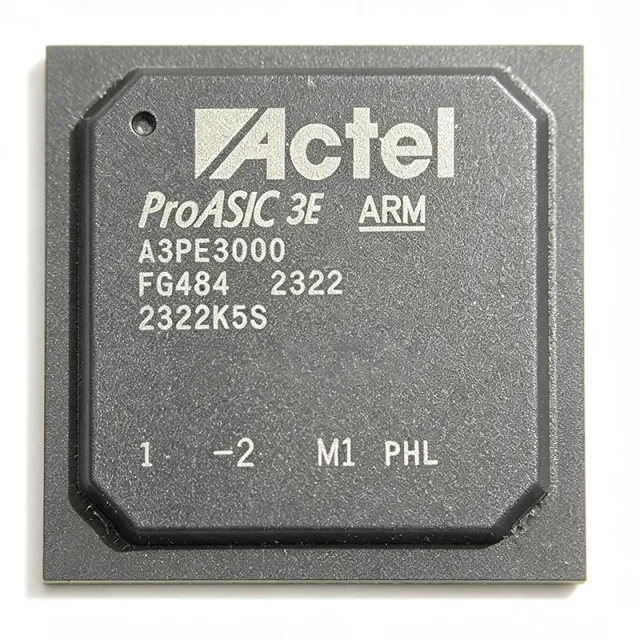
The A3PE3000-1FGG484 is a Microchip Technology ProASIC3E flash-based FPGA with 3 million system gates, 75,264 logic cells, 341 user I/O, and 516,096 bits of embedded memory in a 484-ball FBGA (23 x 23 mm, 1 mm ball pitch). The -1 speed grade device runs from a 1.5V core supply on a 130nm flash process and supports system performance up to 231 MHz. Because its configuration lives in on-chip non-volatile flash, it needs no external boot device and powers up instantly. The part is active in the lifecycle, RoHS compliant, and available on XAIPART with 99,999 units in stock, MOQ 1, priced from $1,782.14 at qty 1 down to $1,425.71 at qty 1,000 as of 2026-09-02.
A flash FPGA differs fundamentally from SRAM-based FPGAs: the bitstream is stored on-chip, so the fabric is active within microseconds of power application and there is no external configuration device to read, intercept, or fail. Within Microchip's (formerly Actel/Microsemi) programmable logic hierarchy, the ProASIC3E family sits above smaller ProASIC3 parts and is positioned as a single-chip, low-total-cost-of-ownership solution for industrial, aerospace and defense, medical, and communications designs.
What Are the Quick Answers Buyers and Engineers Need About the A3PE3000-1FGG484?
Before diving into design detail, here are the direct answers to the most common sourcing and engineering questions, all anchored to verified data.
What is it? A 3M-gate ProASIC3E flash FPGA from Microchip Technology, category FPGA & CPLD, in a 484-ball FBGA (FGG484) measuring 23 x 23 mm with a 1 mm pitch and 2.23 mm package height, surface-mount assembly.
Key specs? 75,264 logic cells, 341 user I/O, 516,096 bits embedded memory, 1.5V core, -1 speed grade, up to 231 MHz system frequency, 130nm flash process.
Availability and price? Lifecycle status: active. XAIPART stock: 99,999 units, MOQ 1. Tiered pricing as of 2026-09-02: $1,782.14 (qty 1+), $1,693.03 (qty 10+), $1,603.93 (qty 100+), $1,514.82 (qty 500+), $1,425.71 (qty 1,000+). The industrial variant A3PE3000-1FGG484I lists at roughly $1,782 per unit on distributor channels as of 2026-09-02.
Compliance? RoHS compliant and lead-free; the Kynix listing explicitly marks the part LEAD FREE, and the Xecor database records RoHS Code Yes for the FGG484 package. The package supports standard lead-free reflow profiles.
Temperature range? The base part is the commercial temperature grade; the exact operating temperature range is [DATA_NEEDED: exact operating temperature range]. For wide-temperature environments, specify the pin-identical industrial variant A3PE3000-1FGG484I.
Drop-in alternatives? Same-footprint Microchip parts: A3PE3000-1FGG484I, A3PE3000-FGG484, A3PE3000-FGG484I, A3PE3000-2FGG484I, A3PE3000L-1FGG484, and A3PE3000L-FGG484I. There is no true cross-brand pin-compatible equivalent.
How Do You Select and Design In the A3PE3000-1FGG484?
Selection: When Flash Beats SRAM
Choose the A3PE3000-1FGG484 when your design needs instant-on operation, single-chip configuration without an external boot flash, and resistance to bitstream interception. Unlike SRAM FPGAs that lose configuration at power-off, the ProASIC3E stores its bitstream in on-chip flash and becomes active within microseconds of power-up, eliminating the CPLD-plus-FPGA two-chip solution. Be honest about the trade-off: the 130nm fabric delivers 231 MHz-class performance, which trails modern SRAM families. If you need multi-gigabit transceivers or very high logic speeds, a Xilinx or Intel device is the better fit; if you need deterministic instant-on logic with secure non-volatile configuration, this part wins.
Speed grade selection matters for cost and timing closure. The -1 grade in A3PE3000-1FGG484 is the standard speed grade; A3PE3000-FGG484 is the slower baseline grade (lower maximum system frequency), and A3PE3000-2FGG484I offers the faster -2 grade. All share the same 484-ball package, 3M-gate density, 341 I/O, and 1.5V core, so they are drop-in compatible on the same PCB footprint.
Power Supply Design
The device operates from a 1.5V core supply, with separate I/O bank supplies (VCCI per bank) supporting the voltage standards your design selects. Dynamic power scales with clock frequency and toggle rate, so budget core current using Microchip's SmartPower power estimator in Libero before finalizing regulators. Decouple each supply ball group with ceramic capacitors placed close to the package, and sequence power so I/O banks are not driven externally before their supplies are established to avoid latch-up.
I/O and Package Integration
The 341 user I/O support multiple single-ended and differential standards, giving flexibility to span multiple voltage domains on the board. The 484-ball FBGA with 1 mm pitch balances I/O density with solderability on standard SMT assembly lines; the package is 23 x 23 mm and 2.23 mm tall. Constrain I/O placement in Microchip's Libero SoC design suite rather than copying ball assignments from another package variant — the complete ball map spanning power, ground, JTAG, configuration, and 341 user I/O is in the ProASIC3E family datasheet package section. Allocate I/O banks so analog-adjacent signals use the quietest banks, and follow Microchip's layout guidance for 1 mm-pitch FBGA escape routing.
Configuration, Security, and Updates
Configuration is stored in on-chip flash: non-volatile, single-chip, reprogrammable without a microprocessor. Flash cells are inherently immune to configuration readback, and no external boot flash exists to dump — which is why payment terminals, license-control hardware, and cryptographic accelerators choose this architecture. Field firmware updates are applied through JTAG using Microchip Libero tooling. For related designs, the Cortex-M1 soft processor is supported in the M1 ProASIC3 variants of the family.
Temperature Variant Decision
The base A3PE3000-1FGG484 is the commercial temperature grade. If the end environment exceeds commercial ranges, confirm the industrial variant A3PE3000-1FGG484I — electrically identical (3M gates, 341 I/O, 516,096 memory bits, 1.5V core, same footprint and pinout), so the PCB layout is unchanged. The industrial variant carries a premium of approximately $1,782 per unit on eBee as of 2026-09-02, so specify it only when the temperature envelope demands it. For space or extreme-temperature programs, Microchip offers military/screened variants of the ProASIC3 family; verify screening requirements against program specifications before final selection.
Which Parts Are Drop-In Alternatives to the A3PE3000-1FGG484?
All verified alternatives are same-family Microchip parts in the identical 484-ball FGG package. They preserve 3M-gate density and 341 I/O, so no PCB rework is required — only a firmware/toolchain recompile for the chosen speed grade or power variant. There is no true cross-brand drop-in equivalent: Lattice MachXO2/ECO families, Xilinx Spartan-6 (e.g., XC6SLX9), and Intel MAX 10 offer similar logic density but in different packages and pinouts, requiring PCB redesign. If your board is already laid out for the 484-ball ProASIC3E footprint, stay within the ProASIC3E/ProASIC3L family.
| Parameter | A3PE3000-1FGG484 | A3PE3000-1FGG484I | A3PE3000-FGG484 | A3PE3000-2FGG484I | A3PE3000L-1FGG484 | A3PE3000L-FGG484I |
|---|---|---|---|---|---|---|
| System gates | 3,000,000 | 3,000,000 | 3,000,000 | 3,000,000 | 3,000,000 | 3,000,000 |
| Logic cells | 75,264 | 75,264 | 75,264 | 75,264 | 75,264 | 75,264 |
| User I/O | 341 | 341 | 341 | 341 | 341 | 341 |
| Embedded memory (bits) | 516,096 | 516,096 | 516,096 | 516,096 | 516,096 | 516,096 |
| Core supply | 1.5 V | 1.5 V | 1.5 V | 1.5 V | 1.5 V | 1.5 V |
| Speed grade | -1 | -1 | Baseline (slower max frequency) | -2 (faster) | -1 class | Baseline |
| Temperature | Commercial | Industrial | Commercial | Industrial | Commercial | Industrial |
| Package | 484-ball FBGA | 484-ball FBGA | 484-ball FBGA | 484-ball FBGA | 484-ball FBGA | 484-ball FBGA |
| Pin compatibility | Reference | Identical pinout | Identical pinout | Identical pinout | Pin-compatible | Pin-compatible |
| Power profile | Standard ProASIC3E | Standard ProASIC3E | Standard ProASIC3E | Standard ProASIC3E | Low-power (lower static/dynamic power, slightly reduced max frequency) | Low-power |
Selection summary: Pick A3PE3000-1FGG484I for wide-temperature environments at identical electricals; A3PE3000-FGG484 when timing is relaxed and cost matters; A3PE3000-2FGG484I for maximum speed margin with industrial temperature; and the A3PE3000L variants when battery power or thermal constraints favor lower static and dynamic power at some cost in maximum frequency.
Where Does the A3PE3000-1FGG484 Fit in the Market, and What Is the Supply Situation?
Lifecycle status is active — Microchip continues to produce the ProASIC3E family on its 130nm flash process. Supply is healthy in absolute terms: XAIPART lists 99,999 units in stock with MOQ 1 as of 2026-09-02, and Octopart aggregates offers from 7 distributors, with DigiKey listing the part as in stock with same-day shipping. Lead times on mature Microchip ProASIC3E parts can vary; if primary distributors are depleted, authorized brokers such as Microchip USA typically quote 4-12 weeks. FPGA inventory in this family moves in spikes with defense and industrial demand, so confirm real-time stock at checkout and compare at least two distributors before ordering. [DATA_NEEDED: family-level lifecycle forecast / discontinuation notice status]
Pricing places this in the premium FPGA tier. XAIPART tiered pricing as of 2026-09-02: $1,782.14 at qty 1, $1,693.03 at qty 10, $1,603.93 at qty 100, $1,514.82 at qty 500, and $1,425.71 at qty 1,000 — roughly 5-20% volume discounts at 100+ piece quantities. Request quotes for large orders since availability fluctuates on this mature family.
What Should Buyers Watch: Trends and Outlook
1. Verify the temperature variant, not just the MPN stem. The commercial -1FGG484 and industrial -1FGG484I differ only in temperature grade on the identical die and package, but the industrial variant carries a premium (~$1,782/unit on eBee as of 2026-09-02). Specify deliberately.
2. Use the drop-in family for supply resilience. Because A3PE3000-FGG484, A3PE3000-2FGG484I, A3PE3000L-1FGG484, and A3PE3000L-FGG484I are all pin-compatible in the same 484-ball footprint, dual-source your design across speed grades or the low-power ProASIC3L variants to hedge allocation spikes — with only a Libero recompile.
3. Match speed grade to timing need, not habit. At 231 MHz-class fabric performance, many control-loop and bridging designs close timing on the baseline grade and save cost; reserve the -2 grade for genuine timing pressure.
4. Budget the 1.5V core rail early. Dynamic power scales with clock frequency and toggle rate; run SmartPower analysis in Libero before locking regulators, especially in fanless medical or sealed industrial enclosures where the 1.5V core is a thermal-design advantage.
5. Lean on non-volatility as a system feature. Instant-on operation (fabric active within microseconds) and single-chip flash configuration remove the external boot device — a qualification, BOM, and security win in aerospace, payment, and long-lifecycle medical instruments. Design your security policy enforcement to run from the first microsecond of power.
6. Do not expect cross-brand pin compatibility. Lattice, Xilinx Spartan-6, and Intel MAX 10 parts are functional alternatives only; any migration means PCB redesign. If long-term supply risk concerns you, weight the ProASIC3L pin-compatible siblings in your qualification plan rather than planning a cross-brand escape.
For current stock, tiered pricing, and the official datasheet, visit the A3PE3000-1FGG484 product page on XAIPART, explore the broader FPGA & CPLD catalog, and read our flash FPGA vs SRAM FPGA selection guide for architecture trade-off detail.
Comments
Be the first to comment.
🔐 Please sign in to post a comment.
Don't have an account? Sign up