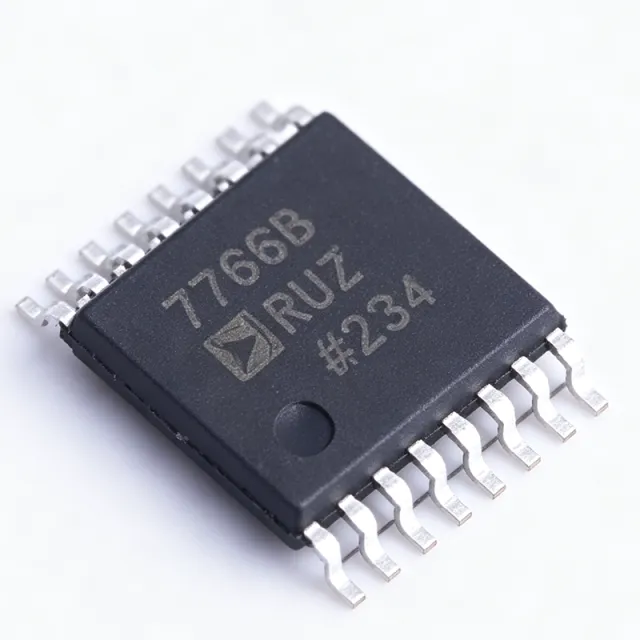
Quick Answers: What is the AD7766BRUZ and Why Does It Matter?
The AD7766BRUZ is a 24-bit oversampled successive approximation (SAR) analog-to-digital converter (ADC) from Analog Devices. It delivers a sample rate of 128 kSPS, a dynamic range of 109.5 dB, and a total harmonic distortion (THD) of -112 dB, all while consuming just 8.5 mW from a 2.5 V supply with a 5 V reference. As of 2026-08-23, the AD7766BRUZ is in stock at XAIPART with 99,999 units available, priced at $10.8182 per unit at 1000+ quantities. This device is housed in a 16-lead TSSOP package and supports daisy-chaining via its SDI pin, making it a versatile choice for precision data acquisition, medical instrumentation, and industrial process control.
The AD7766BRUZ combines the benefits of SAR architecture with oversampling to achieve high resolution and excellent noise performance. Its low power consumption and high dynamic range make it ideal for battery-powered and portable applications where signal integrity is critical.
Technical Guide: How to Select, Design In, and Use the AD7766BRUZ
When designing with the AD7766BRUZ, consider the following key specifications:
- Resolution: 24 bits
- Sample Rate: 128 kSPS
- Dynamic Range: 109.5 dB
- THD: -112 dB
- Power Consumption: 8.5 mW
- Supply Voltage: 2.5 V
- Reference Voltage: 5 V
- Package: 16-TSSOP
- Operating Temperature: -40°C to +105°C
For optimal performance, ensure proper decoupling of the power supply and reference pins. Use a clean, low-noise reference voltage to achieve the specified dynamic range. The input signal should be properly conditioned to avoid aliasing. The AD7766BRUZ supports daisy-chaining via the SDI pin, enabling multi-channel systems with minimal additional wiring.
When selecting this ADC, verify that the sample rate and dynamic range meet your application requirements. For higher dynamic range at lower sample rates, consider the AD7766BRUZ-1 (64 kSPS, 112.5 dB) or AD7766BRUZ-2 (32 kSPS, 115.5 dB).
Alternatives & Comparison: Drop-In Replacements and Cross-Brand Options
For drop-in replacements, the AD7766BRUZ-1 and AD7766BRUZ-2 share the same 16-TSSOP package and pinout, offering different performance trade-offs. The Texas Instruments ADS1271 is a functional equivalent but has a different package and pinout, so it is not a drop-in replacement.
| Parameter | AD7766BRUZ | AD7766BRUZ-1 | AD7766BRUZ-2 | ADS1271 |
|---|---|---|---|---|
| Resolution | 24 Bit | 24 Bit | 24 Bit | 24 Bit |
| Sample Rate | 128 kSPS | 64 kSPS | 32 kSPS | [DATA_NEEDED] |
| Dynamic Range | 109.5 dB | 112.5 dB | 115.5 dB | [DATA_NEEDED] |
| Power Consumption | 8.5 mW | 10.5 mW | 8.5 mW | [DATA_NEEDED] |
| Package | 16-TSSOP | 16-TSSOP | 16-TSSOP | [DATA_NEEDED] |
| Pinout Compatible | Yes | Yes | Yes | No |
For cross-brand options, the MAX11046 is a 16-bit ADC with lower resolution, and the LTC2380-24 is a 24-bit SAR ADC with higher speed, but neither is pin-compatible.
Industry Insight: Market Position, Lifecycle, and Supply Situation
The AD7766BRUZ has an active lifecycle status, indicating it is in production and widely available. As of 2026-08-23, XAIPART holds 99,999 units in stock, ensuring immediate availability for design and production needs. The pricing tiers range from $18.5455 at 1 unit to $10.8182 at 1000+ units, reflecting volume discounts. The device is RoHS compliant, meeting environmental standards. [DATA_NEEDED: Market share data for AD7766BRUZ in the precision ADC segment]
Trends & Outlook: What Buyers Should Watch
The demand for high-resolution, low-power ADCs continues to grow in portable and battery-powered applications. The AD7766BRUZ's 8.5 mW power consumption and 109.5 dB dynamic range position it well for emerging IoT and wearable medical devices. Its daisy-chain capability supports multi-channel systems, a trend in industrial monitoring. Buyers should monitor supply chain stability and consider the AD7766BRUZ-1 and AD7766BRUZ-2 for applications requiring higher dynamic range at lower sample rates. As of 2026-08-23, the AD7766BRUZ remains a strong choice for precision data acquisition.
Comments
Be the first to comment.
🔐 Please sign in to post a comment.
Don't have an account? Sign up