The AD9361BBCZ-REEL is a 2x2 RF Agile Transceiver from Analog Devices covering 70 MHz to 6 GHz with channel bandwidths from less than 200 kHz to 56 MHz, a 2 dB typical noise figure, and a 12-bit CMOS/LVDS digital baseband interface in a 144-ball CSPBGA (10 mm x 10 mm) package. It is designed for 3G/4G base stations, software-defined radios, small cells, military communications, and test equipment. The part is lifecycle-active, RoHS compliant, and currently in stock at XAIPART with 99,999 units available, MOQ 1, priced from $59.70 at 1,000 units as of 2026-09-02. [VERIFY_NEEDED: current stock count changes daily]
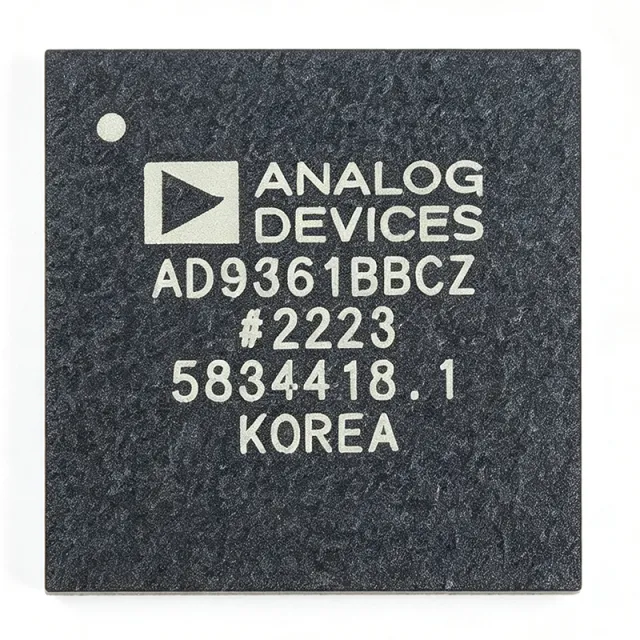
What Is the AD9361BBCZ-REEL and Why Does It Matter?
The AD9361BBCZ-REEL is a highly integrated radio frequency (RF) Agile Transceiver that combines a transmitter and receiver sharing common circuitry. As an agile transceiver, it can be dynamically reconfigured to support different frequency bands, channel bandwidths, and modulation schemes. This makes it a key building block of software-defined radio (SDR) systems, where the same hardware adapts to multiple communication standards without redesign. The device bridges the antenna and the digital baseband processor at the heart of the RF front-end.
Its architecture is direct conversion with advanced calibration algorithms that mitigate I/Q imbalance and DC offset. It supports both FDD and TDD modes, integrates fractional-N synthesizers, digital filters, and automatic gain control (AGC), and operates from a 1.3 V core supply with multiple power-down modes for efficient power management. The -REEL suffix indicates tape-and-reel packaging for automated assembly; the AD9361BBCZ tray version is electrically identical and a drop-in replacement.
What Are the Key Verified Specifications?
The following specifications are verified from the XAIPART product database:
| Parameter | Value |
|---|---|
| Frequency Range | 70 MHz to 6 GHz |
| Number of Channels | 2x2 (2 TX, 2 RX) |
| Channel Bandwidth | Less than 200 kHz to 56 MHz |
| Noise Figure | 2 dB (typical) |
| Digital Interface | 12-bit CMOS/LVDS |
| Core Supply Voltage | 1.3 V |
| Package | 144-ball CSPBGA (10 mm x 10 mm) |
| Mounting Type | Surface Mount |
| Operating Temperature Range | -40°C to +85°C |
| Modulation Support | FDD and TDD |
| Integrated Synthesizers | Fractional-N |
| Automatic Gain Control | Yes |
| Digital Filters | Yes |
| Power-Down Modes | Multiple |
| RoHS Status | Compliant |
| Lifecycle Status | Active |
[DATA_NEEDED: TX EVM numeric value, RX/TX gain ranges, power consumption figures, spurious and phase noise performance]
How Do You Design In the AD9361BBCZ-REEL?
Design success with the AD9361BBCZ-REEL depends on three areas: power integrity, RF layout, and baseband interface planning.
Power supply: The device requires a clean 1.3 V core supply. Careful attention to power supply decoupling is essential to achieve optimal RF performance; noisy supplies directly degrade the receiver's 2 dB typical noise figure advantage. Follow the decoupling network recommendations in the official AD9361 datasheet. [VERIFY_NEEDED: exact decoupling capacitor values and pin assignments from datasheet]
PCB layout: Proper grounding minimizes noise and interference. The 144-ball CSPBGA package measures only 10 mm x 10 mm, so plan for controlled-impedance RF traces on the receiver inputs (RX1A_P/N, RX2A_P/N) and transmitter outputs (TX1A_P/N, TX2A_P/N), all of which are differential. Place these RF balls at the board edge (row A of the ball map) for the shortest possible matching networks.
Digital interface: The 12-bit CMOS/LVDS baseband interface connects directly to FPGAs or baseband processors. Choose LVDS for high sample-rate SDR designs; CMOS mode suits lower-throughput systems. The programmable interface allows seamless integration with various baseband processors. [DATA_NEEDED: LVDS data rate limits]
Mode planning: Support for both FDD and TDD lets a single design serve paired and unpaired spectrum. Use the integrated digital filters and AGC to offload gain control and filtering from the baseband processor, reducing external component count.
Which Pins Are Most Important for RF and System Design?
The RF signal pins are concentrated in row A of the 144-ball map, simplifying differential RF routing. Key verified pins include RX1A_P (A3), RX1A_N (A4), RX2A_P (A6), RX2A_N (A7), TX1A_P (A9), TX1A_N (A10), TX2A_P (A12), TX2A_N (A13), surrounded by VSSA analog ground balls (A1, A2, A5, A8, A11, A14). The full 144-ball pinout is available on the AD9361BBCZ-REEL product page and in the datasheet.
What Are the Main Applications and Usage Scenarios?
3G/4G Base Stations: The 70 MHz to 6 GHz range covers all cellular bands, and bandwidths up to 56 MHz enable high-capacity LTE and WCDMA deployments. The 2 dB noise figure ensures excellent receiver sensitivity for macro, micro, and pico base stations.
Software-Defined Radio: The reconfigurable architecture and 12-bit CMOS/LVDS FPGA-facing interface make the AD9361 a cornerstone for cognitive radio, spectrum monitoring, and waveform development platforms. Integrated calibration algorithms keep performance consistent across temperature and frequency.
Small Cells: High integration reduces BOM count and PCB area—critical in femtocell, picocell, and microcell designs. FDD/TDD support and multiple power-down modes meet energy-efficiency targets for space-constrained deployments.
Military Communications: The 70 MHz to 6 GHz coverage supports tactical radios, electronic warfare, and satellite communications, with agile reconfigurability enabling frequency hopping and adaptive waveforms. The -40°C to +85°C operating range suits harsh environments.
Test and Measurement: Wide frequency coverage and programmable bandwidth suit spectrum analyzers, signal generators, and channel emulators; the 12-bit interface provides high-resolution data.
IoT and Smart Grid: Sub-GHz and 2.4 GHz ISM band coverage supports LoRa, Zigbee, and Wi-Fi protocols on one hardware platform, reducing inventory and development cost. [VERIFY_NEEDED: specific protocol certification for these bands]
What Are the Drop-In Alternatives and How Do They Compare?
Only three verified alternatives exist in our data: the AD9361BBCZ (tray), the AD9363BBCZ, and the GX9361 from GXSChip. The FAQ data also references the AD9364BBCZ-REEL (1x1, pin-compatible) and AD9371BBCZ-REEL (newer generation, not pin-compatible) as related options.
| Parameter | AD9361BBCZ-REEL | AD9361BBCZ | AD9363BBCZ | GX9361 |
|---|---|---|---|---|
| Manufacturer | Analog Devices | Analog Devices | Analog Devices | GXSChip |
| Channels | 2x2 (2 TX, 2 RX) | 2x2 (2 TX, 2 RX) | [DATA_NEEDED: channel count] | 2x2 |
| Frequency Range | 70 MHz to 6 GHz | 70 MHz to 6 GHz | 325 MHz to 3.8 GHz | [DATA_NEEDED: frequency range] |
| Channel Bandwidth | <200 kHz to 56 MHz | <200 kHz to 56 MHz | [DATA_NEEDED: bandwidth] | [DATA_NEEDED: bandwidth] |
| Noise Figure | 2 dB (typical) | 2 dB (typical) | [DATA_NEEDED: noise figure] | [DATA_NEEDED: noise figure] |
| Package | 144-ball CSPBGA | 144-ball CSPBGA | Same footprint as AD9361 | Pin-to-pin compatible with AD9361 |
| Compatibility | Reference part | Drop-in replacement (tray) | Same footprint, narrower frequency range | Pin-to-pin compatible alternative |
| Price (1,000 units) | $59.70 as of 2026-09-02 | [DATA_NEEDED: pricing] | [DATA_NEEDED: pricing] | [DATA_NEEDED: pricing] |
Selection guidance (verified): The AD9364BBCZ-REEL is a pin-compatible 1x1 variant; it suits single-channel SDRs by reducing BOM cost and power consumption, but some pins that are signal pins on the AD9361 are ground pins on the AD9364—verify the pinout before substitution. The AD9371BBCZ-REEL is a newer generation with wider bandwidth but is not pin-compatible and requires a different PCB layout. [DATA_NEEDED: AD9364BBCZ-REEL and AD9371BBCZ-REEL verified specifications on XAIPART]
What Is the Lifecycle, Stock, and Supply Situation?
The AD9361BBCZ-REEL is lifecycle active per the XAIPART product database. As of 2026-09-02, XAIPART lists 99,999 units in stock with MOQ of 1. Pricing tiers as of 2026-09-02: $89.50 at qty ≥1, $82.30 at ≥10, $74.10 at ≥100, $66.90 at ≥500, and $59.70 at ≥1,000. [VERIFY_NEEDED: manufacturer lifecycle roadmap and long-term supply commitment from Analog Devices; distributor stock snapshot as of 2026-08-23 showed 'ships today' status at DigiKey]
What Should Buyers Watch Next?
First, verify channel-count needs before ordering: if your roadmap adds MIMO, stay on the 2x2 AD9361BBCZ-REEL; if a single channel suffices, the pin-compatible AD9364BBCZ-REEL lowers cost and power. Second, match frequency needs carefully—the AD9363BBCZ offers the same footprint but a narrower 325 MHz to 3.8 GHz range, which excludes the 70 MHz–325 MHz and 3.8 GHz–6 GHz regions the AD9361 covers. Third, the GX9361 pin-to-pin alternative offers a second-source option for supply resilience—qualify it with the same verification rigor you apply to any second source. Fourth, with bandwidth programmable from less than 200 kHz up to 56 MHz, design your baseband data path for the full 56 MHz peak to remain future-proof against wider-channel standards. Finally, lock volume pricing early: the verified tier drops from $89.50 to $59.70 per unit at 1,000 units as of 2026-09-02, a 33% savings at the top tier. [VERIFY_NEEDED: demand trends and lead-time forecasts for RF transceivers]
Comments
Be the first to comment.
🔐 Please sign in to post a comment.
Don't have an account? Sign up