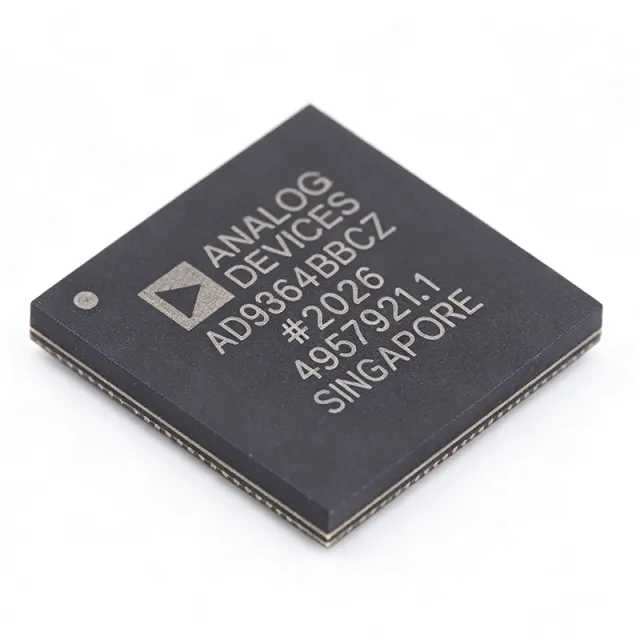
Quick Answers: What Is the AD9364BBCZ and What Do I Need to Know?
The AD9364BBCZ is a high-performance, highly integrated RF Agile Transceiver from Analog Devices designed for 3G and 4G base station applications, operating from 70 MHz to 6.0 GHz with programmable channel bandwidth from 200 kHz to 56 MHz. It is a 1x1 variant with 2 receive and 2 transmit paths, packaged in a 144-ball LFBGA/CSPBGA and RoHS compliant. As of 2026-08-25, the device is active in lifecycle with 99,999 units available at XAIPART, priced from $89.50 at qty 1 to $59.70 at qty 1000, with MOQ 1. This guide covers selection, design-in, alternatives, market status, and outlook based on verified product data. For live ordering, see the AD9364BBCZ product page.
Technical Guide: How to Select, Design In, and Use the AD9364BBCZ
The AD9364BBCZ sits between the antenna and the digital baseband processor, converting RF signals to digital baseband and vice versa. Its direct-conversion architecture integrates the RF front end, mixed-signal baseband, and frequency synthesizers in a single IC, which reduces external component count and board space in compact base station designs. Start by confirming that the frequency range meets your bands: the device operates from 70 MHz to 6.0 GHz, covering most licensed and unlicensed bands. Next, check the channel bandwidth: it supports from less than 200 kHz to 56 MHz, so you can handle narrowband to wideband standards.
For a typical design, power the AD9364BBCZ from three supply rails: 1.3V, 2.5V, and 3.3V. Pay close attention to power supply decoupling and sequencing, as the datasheet recommends. Use the programmable 3- or 4-wire SPI interface (SPI_CLK, SPI_ENB, SPI_DI, SPI_DO) to set frequency, gain, filter, and mode registers. The device also provides a flexible CMOS/LVDS digital interface to a processor or FPGA. The RF input and output are differential; connect RX1P/RX1N to the receive path and TX1P/TX1N to the transmit path. Ground VSSA pins (for example, A1 and A2) and ensure a clean reference clock.
The device supports FDD and TDD modes, and includes auxiliary ADC/DACs for monitoring and control. Because it is a 1x1 variant with 2 receive and 2 transmit paths, it is well suited for single-channel, compact radios. For MIMO, you can pair multiple AD9364BBCZ devices. Use a careful RF layout—proper grounding and shielding—to achieve optimal linearity and sensitivity. The operating temperature range is -40°C to +85°C, which fits most outdoor base station and test equipment environments.
Key verified specifications include: Type = RF Transceiver; Frequency Range = 70 MHz to 6 GHz; Channel Bandwidth = 200 kHz to 56 MHz; Number of Channels = 1x1 (2 receive, 2 transmit); Package = 144-LFBGA, CSPBGA; Mounting Type = Surface Mount; Operating Temperature Range = -40°C to +85°C; Supply Voltage = 1.3V, 2.5V, 3.3V; Interface = SPI, CMOS/LVDS; RF Input/Output = Differential; RoHS Status = Compliant.
For design-in, follow these steps: (1) Define the required frequency band and channel bandwidth—the AD9364 covers 70 MHz to 6 GHz and 200 kHz to 56 MHz respectively. (2) Plan the power supply architecture for 1.3V, 2.5V, and 3.3V rails. (3) Route differential lines for RX1P/RX1N and TX1P/TX1N. (4) Connect the SPI interface to the host controller. (5) Include sufficient decoupling and a low-noise reference clock. Refer to the AD9364BBCZ datasheet for detailed register maps and recommended layout.
For related parts, browse the RF transceivers category.
Alternatives & Comparison: Drop-In Replacements and Closest Options
From the verified data, the AD9364BBCZ has no exact drop-in replacement from another manufacturer. The closest alternative in the same family is the AD9363ABCZ, which has a lower frequency range of 325 MHz to 3.8 GHz and is not pin compatible. If you need the full 70 MHz to 6 GHz range, you must use the AD9364BBCZ itself or redesign the PCB for a different transceiver.
Another family member, the AD9361BBCZ, is frequently discussed as an alternative. According to XAIPART FAQ data, the AD9361BBCZ is a 2x2 variant (2 receive, 2 transmit) with more capabilities, but it is not pin compatible with the AD9364BBCZ. Some pins on the AD9364 must be grounded (e.g., A1, A2) that are signal pins on the AD9361, so PCB layout changes are required. Choose the AD9364 when you need lower complexity and cost; choose the AD9361 only if you can accommodate a different footprint and need the extra channel.
| Parameter | AD9364BBCZ | AD9363ABCZ |
|---|---|---|
| Frequency range | 70 MHz to 6.0 GHz | 325 MHz to 3.8 GHz |
| Pin compatibility | Reference | Not pin compatible |
For any drop-in replacement, verify pinout, supply voltages, and SPI register compatibility against the target datasheet. The AD9364BBCZ product page includes the complete verified pinout data.
Industry Insight: Market Position, Lifecycle, and Supply Situation
The AD9364BBCZ has an active lifecycle status, meaning Analog Devices continues to produce and support the part. As of 2026-08-25, XAIPART holds 99,999 units in stock, with a minimum order quantity of 1. The published price tiers are $89.50 at qty ≥1, $82.30 at qty ≥10, $74.10 at qty ≥100, $66.90 at qty ≥500, and $59.70 at qty ≥1000. This stock position indicates healthy availability for design-in and production. Buyers can also check authorized distributors such as DigiKey and Mouser, which in recent FAQ data show immediate or stocked availability for smaller quantities.
The AD9364 is part of the RF Agile Transceiver family that includes the AD9361 and AD9363. The family is designed for software-defined radio and 3G/4G base station applications, with the AD9364 positioned as the 1x1 variant for single-channel, cost-sensitive systems. Since it is an active part with substantial stock, supply risk is low compared to end-of-life RF components. Read more in the XAIPART blog.
Trends & Outlook: What Buyers Should Watch
Buyers should watch the AD9364BBCZ because its 70 MHz to 6.0 GHz frequency coverage and 200 kHz to 56 MHz programmable bandwidth make it relevant for evolving software-defined radio and 3G/4G small-cell designs. The 1x1 architecture with 2 receive and 2 transmit paths is suited to single-channel remote radio heads, and multiple devices can be combined for MIMO. The active lifecycle and large stock position indicate continued supply support, but pricing can shift with demand; as of 2026-08-25 the 1000-piece price is $59.70. Designers should also track the AD9363ABCZ as a lower-cost, lower-frequency alternative if their application does not require the full 6 GHz range. Finally, because the AD9364 uses a configurable digital interface and SPI control, it is well positioned for software-defined platforms that need to support multiple bands and bandwidths without hardware changes.
Comments
Be the first to comment.
🔐 Please sign in to post a comment.
Don't have an account? Sign up