What Is the ADS131M08IPBS and Why Should Designers Choose It?
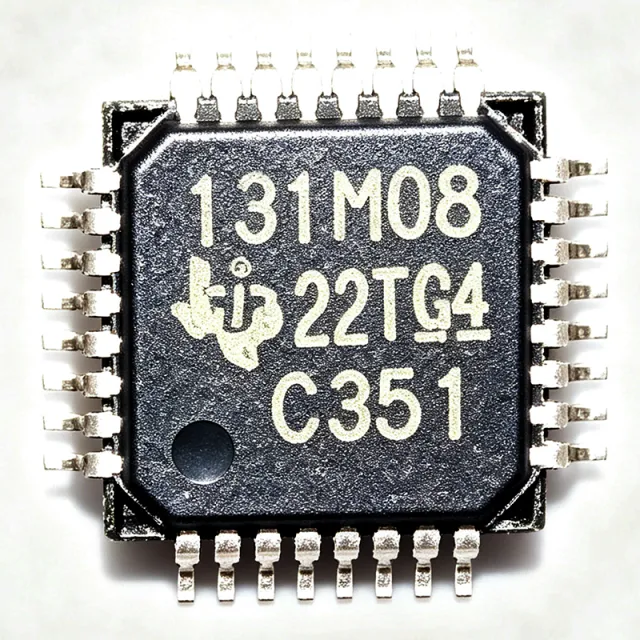
The Texas Instruments ADS131M08IPBS is an eight-channel, simultaneously-sampling, 24-bit delta-sigma ADC in a 32-pin TQFP (5x5 mm) surface-mount package, built for energy metering, power metrology, and circuit-breaker applications. All eight differential inputs sample at the same instant, preserving phase relationships across channels — a critical requirement for accurate three-phase power computation. Verified key specifications include a programmable output data rate up to 32 kSPS, 102-dB dynamic range at gain = 1 (4 kSPS), 80-dB dynamic range at gain = 64 (4 kSPS), programmable gain up to 128, a low-drift internal voltage reference, and an SPI-compatible interface with CRC options. The part is RoHS compliant and is in stock on XAIPART with 99,999 units available, MOQ of 1, priced at $2.3068 per unit at 1,000 pieces as of 2026-08-30. According to the TI datasheet, its inputs can directly interface to resistor dividers or current transformers, and the automotive ADS131M08QPBSRQ1 variant carries AEC-Q100 qualification at temperature grade 1 (-40°C to +125°C).
Within the signal chain, the ADS131M08 sits between front-end conditioning — resistor dividers or current transformers, which its inputs accept directly — and a host MCU over its SPI-compatible interface. The architecture uses a chopper-stabilized delta-sigma modulator per channel followed by a digital filter and decimation stage, the dominant architecture for precision power and metrology sensing because oversampling plus digital decimation delivers very high resolution.
How Do You Select and Design In the ADS131M08IPBS? (Technical Guide)
Designing in the ADS131M08 starts with three decisions: input network, gain setting, and output data rate.
Input network. The eight differential inputs directly interface to resistor-divider networks or power-monitoring current transformers per the TI datasheet. Because all channels sample simultaneously, inter-channel accuracy is dominated by your external network tolerances (divider ratio, shunt value) rather than ADC channel matching — budget external precision accordingly. Connect CT burden resistors across each differential input pair with anti-aliasing and input protection components.
Gain and noise budget. Set the PGA gain so the maximum sensor voltage uses the converter's full-scale range. At gain = 1 the device delivers 102-dB dynamic range at 4 kSPS; at gain = 64 it delivers 80 dB at 4 kSPS. Higher gain trades dynamic range for input headroom rather than adding external amplifier noise, so low-output CTs or millivolt-level shunt signals can use gain up to 128 without a discrete amplifier stage.
Data rate. The programmable output data rate reaches 32 kSPS on all eight channels simultaneously. For 50/60 Hz power metrology, 32 kSPS provides substantial oversampling for harmonics analysis — up to the 250th harmonic order of a 60 Hz fundamental with suitable digital post-processing. For lowest noise, program a lower data rate (102-dB dynamic range is specified at 4 kSPS).
Digital interface. The SPI-compatible interface uses SCLK (pin 19), MOSI (pin 20), MISO (pin 21), CS (pin 22, active low), with DRDY (pin 23) indicating data-ready. SYNC/RESET (pin 24) synchronizes or resets the device; MCLK (pin 25) accepts a master clock or the internal oscillator can be selected. CRC options on the SPI bus provide robust communication in electrically noisy environments such as motor drives and inverters.
Power and layout. Key power pins are AVDD (pin 1), AVSS (pin 2), DVDD (pin 28), DGND (pin 29), and VCAP (pin 30, internal LDO regulator capacitor). The exposed pad (pin 31) must connect to analog ground. [DATA_NEEDED: analog supply voltage range] and [DATA_NEEDED: power per channel] are not specified in the verified database — consult the TI datasheet PDF for exact supply requirements.
What Are the Verified Pin Functions of the ADS131M08IPBS?
The most functionally important pins from the verified pinout table are summarized below. The complete 32-pin table lives on the ADS131M08IPBS product page.
| Pin | Name | Function |
|---|---|---|
| 1 | AVDD | Analog power supply |
| 2 | AVSS | Analog ground |
| 3–18 | AINP0/AINN0 … AINP7/AINN7 | Eight differential input pairs (positive/negative per channel) |
| 19 | SCLK | SPI serial clock input |
| 20 | MOSI | SPI master data out / ADC data in |
| 21 | MISO | SPI master data in / ADC data out |
| 22 | CS | SPI chip select (active low) |
| 23 | DRDY | Data ready indicator |
| 24 | SYNC/RESET | Synchronization or reset input |
| 25 | MCLK | Master clock input (or internal oscillator selected) |
| 28 | DVDD | Digital power supply |
| 30 | VCAP | Internal LDO regulator capacitor |
| 31 | EP | Exposed pad — connect to analog ground |
What Are the Main Applications and Usage Scenarios for the ADS131M08?
Three-phase energy metering. Eight simultaneously-sampling differential inputs capture all three phase voltages and currents at the same instant — essential for accurate active, reactive, and apparent power computation where phase error directly impacts metering accuracy class. The 24-bit resolution and 102-dB dynamic range support wide-current-range meters, and the PGA (gain up to 128) allows direct shunt or CT connection without external amplifiers.
Circuit breakers and protective relays. Protective devices require simultaneous multi-channel sampling to correctly compute phase relationships and detect overcurrent, earth leakage, and phase loss. The ADS131M08QPBSRQ1 adds AEC-Q100 qualification (-40°C to +125°C) and functional-safety-capable documentation for safety-integrity arguments.
Solar inverter power metrology. Simultaneous DC bus and multi-phase AC sampling at 24 bits and up to 32 kSPS supports MPPT, grid compliance, and billing-grade metering with adequate oversampling for THD analysis. Differential inputs reject common-mode noise from the power stage, and the low-drift internal reference stabilizes gain accuracy over the inverter's temperature range.
Motor drive current sensing. Three-phase motor currents plus DC-link voltage are sampled simultaneously, giving the control MCU phase-accurate feedback for field-oriented control. The 32-kSPS rate fits typical PWM control loop update rates, and 80-dB dynamic range at gain = 64 resolves low-speed, low-current operation where shunt signals are in the millivolt range.
Bidirectional DC-DC converter control. TI's reference design for a bidirectional interleaved buck converter pairs the ADS131M08 with a C2000 MCU, closing high-accuracy control loops and monitoring efficiency with one device while the 24-bit resolution captures fine current ripple cycle by cycle.
Industrial power quality analyzers. Simultaneous 8-channel sampling preserves phase relationships for power-direction and unbalance calculations, and the 102-dB noise floor captures both the high-energy fundamental and small harmonic components in a single acquisition.
How Do You Design a Three-Phase Energy Meter with the ADS131M08IPBS? (Worked Design Solution)
Problem: Meter a three-phase service with billing-class accuracy across a wide dynamic current range, without external amplifier stages.
Approach: Use six of the eight differential inputs for three phase voltages (via resistor dividers) and three phase currents (via CTs with burden resistors), reserving the remaining channels for neutral/leakage sensing. Program the PGA to use the full-scale range for each sensor, and set the output data rate to 32 kSPS for harmonic oversampling or lower for minimum noise (102 dB dynamic range at 4 kSPS, gain = 1).
Calculations: Since the database does not provide the input full-scale voltage or supply range, exact divider ratio and burden-resistor calculations require datasheet values: [DATA_NEEDED: input full-scale range]. The verified design constraint is that PGA gain up to 128 accommodates low-output CTs without an external amplifier, and inter-channel accuracy is set by divider-ratio and shunt tolerances — select precision external components, since the ADC samples all channels at the same instant.
Results: One 32-TQFP device replaces per-channel converter/amplifier stages, the low-drift internal reference removes a precision external reference and eliminates reference-matching errors across channels, and simultaneous sampling preserves phase-angle accuracy for active/reactive/apparent power computation.
Which Components Are Drop-In Alternatives to the ADS131M08IPBS?
Based on verified database data, the drop-in and family alternatives are:
| Parameter | ADS131M08IPBS | ADS131M08QPBSRQ1 | ADS131M06IPBS | ADS131M04IPBS |
|---|---|---|---|---|
| Manufacturer | Texas Instruments | Texas Instruments | Texas Instruments | Texas Instruments |
| Resolution | 24 bit | 24 bit | 24 bit | 24 bit |
| Channels | 8 differential inputs | 8 differential inputs | 6 channels | 4 channels |
| Max data rate | 32 kSPS | 32 kSPS | 32 kSPS (same family) | 32 kSPS (same family) |
| Package | 32-TQFP (5x5 mm) | 32-TQFP (5x5 mm) | Same package, same footprint | Same package, same footprint |
| AEC-Q100 automotive | No (industrial/metering) | Yes, temperature grade 1 (-40°C to +125°C) | Not indicated | Not indicated |
| Functional safety | Not indicated | Functional-safety-capable with documentation | Not indicated | Not indicated |
| Drop-in compatible | — | Yes (same die and footprint) | Same footprint; use only if 6 channels suffice | Same footprint; use only if 4 channels suffice |
Summary: the ADS131M08QPBSRQ1 is the true drop-in replacement — the same die in the same 32-TQFP package with AEC-Q100 qualification. Within the TI ADS131M family, the ADS131M06IPBS and ADS131M04IPBS share the footprint and architecture but offer fewer channels, so they suit only designs needing 6 or 4 channels. No cross-brand pin-compatible equivalent is documented; ADI's AD7768 family offers functionally similar simultaneous-sampling delta-sigma conversion but in different packages and pinouts requiring PCB redesign.
What Is the Lifecycle, Market Position, and Supply Status of the ADS131M08IPBS?
Lifecycle status in the verified database is active. XAIPART shows 99,999 units in stock with MOQ of 1. Pricing as of 2026-08-30: $3.9545 at qty 1, $2.8561 at qty 10, $2.5265 at qty 100, $2.4167 at qty 500, and $2.3068 at qty 1,000. The device serves the energy metering, protective relay, solar inverter, and industrial power metrology markets through its energy-measurement-specific feature set. Distributor listings (DigiKey, Mouser) show both the IPBS and QPBSRQ1 variants as buy-now, ships-today items, indicating short lead times as of the last verification (2026-08-29). [DATA_NEEDED: manufacturer lifecycle forecast / NRND status details] are not in the verified database.
What Should Buyers Watch Next for the ADS131M08?
Anchored to verified specs, watch these factors in 2025–2026 sourcing decisions:
Volume pricing leverage. The step from $3.9545 (qty 1) to $2.3068 (qty 1,000) is roughly a 42% reduction, so consolidating orders above 1,000 units yields the best unit economics as of 2026-08-30.
Automotive dual-sourcing. Because the ADS131M08QPBSRQ1 is electrically and physically identical in the same footprint, industrial designers can qualify the Q1 part once and cover both industrial and automotive sockets, hedging supply risk across one SKU family.
Channel-count right-sizing. If a cost-down design needs only 6 or 4 channels, the ADS131M06IPBS and ADS131M04IPBS share the same footprint, letting you keep one PCB layout across product tiers.
Rate-versus-noise trade. The programmable 32-kSPS rate and the 102-dB / 80-dB dynamic range points at 4 kSPS mean firmware can trade data rate against noise without hardware change — verify your required harmonic order and accuracy class before fixing the ODR.
Availability volatility. Stock of 99,999 units at XAIPART and ships-today distributor status are strong signals today, but confirm live inventory before committing production schedules.
Comments
Be the first to comment.
🔐 Please sign in to post a comment.
Don't have an account? Sign up