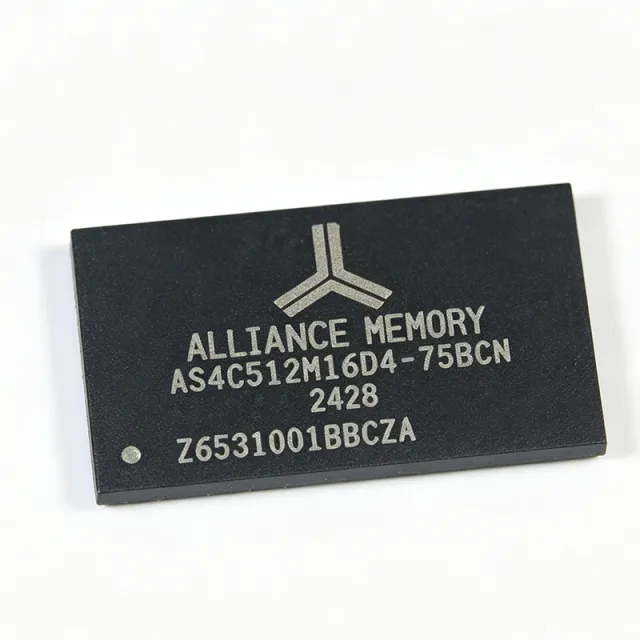
The AS4C512M16D4-75BCNTR is an 8-Gbit DDR4 SDRAM from Alliance Memory organized as 512M x 16, operating at a clock frequency of 1.333 GHz (DDR4-2666, 2666 Mbps per pin) from a 1.2V nominal supply (1.14V–1.26V) in a 96-ball FBGA package measuring 7.5x13 mm. It is rated for commercial temperatures of 0°C to 95°C (case), carries an 18 ns access time and 15 ns write cycle time, and is RoHS compliant and lead-free. As of 2026-09-02, the part is active in lifecycle status, in stock at XAIPART with 99,999 units, MOQ of 1, and tiered pricing from $12.50 (qty 1) down to $8.10 (qty 1,000+). This guide covers selection, design-in, alternatives, and market outlook for this high-density memory component.
What Is the AS4C512M16D4-75BCNTR and Why Does It Matter?
The AS4C512M16D4-75BCNTR is a high-performance 8-Gbit DDR4 SDRAM component from Alliance Memory, a Memory IC in the DDR4 SDRAM category. It transfers data on both edges of the clock signal using an 8n prefetch architecture, is internally configured as sixteen banks, and uses a parallel memory interface. Compared with DDR3, DDR4's lower 1.2V core supply reduces power consumption — the device's supply range of 1.14V to 1.26V delivers that efficiency in data centers, networking, and embedded systems. The die is built on a 20nm-class DRAM process, and the device includes a temperature sensor for thermal management plus pseudo-differential DQS for improved signal integrity. Key features include on-die termination (ODT), programmable read and write latencies, and auto-refresh and self-refresh modes. The -75BCNTR suffix denotes the tape-and-reel packaging variant of the AS4C512M16D4-75BCN: both share identical electrical specifications and the same 96-FBGA package, with TR optimized for automated surface-mount assembly.
How Do You Select and Design In This DDR4 SDRAM?
Start with four verified electrical parameters. First, capacity and organization: 8 Gbit organized as 512M x 16, giving a 16-bit wide data bus per device. Second, speed: a clock frequency of 1.333 GHz corresponding to DDR4-2666 with a data rate of 2666 Mbps per pin, an 18 ns access time, and a 15 ns word/page write cycle time. Third, power: a 1.2V nominal supply with an allowed window of 1.14V to 1.26V. Fourth, environment: a commercial case-temperature range of 0°C to 95°C — suitable for standard enterprise and consumer environments, but not extreme automotive or industrial conditions (for those, see the alternatives section).
For PCB design-in, follow the Alliance Memory datasheet layout guidelines to maintain signal integrity at 2666 Mbps. Place decoupling capacitors close to the power pins and provide a stable 1.2V rail within the 1.14V–1.26V window. Route the high-speed data and address buses carefully, taking advantage of the pseudo-differential DQS signaling for timing margin. The 96-ball FBGA (7.5x13 mm) is surface-mount only and suits high-density DIMM and embedded memory designs. The device supports ODT, programmable read and write latencies, and auto-refresh and self-refresh modes, which your memory controller must configure during initialization. Download the full datasheet PDF from the Alliance Memory website (linked on the XAIPART product page) for AC/DC timing tables and initialization sequences.
What Are the Drop-In Alternatives to AS4C512M16D4-75BCNTR?
According to the verified FAQ data, the best drop-in replacement is the AS4C512M16D4-75BIN — the industrial temperature variant (-40°C to 95°C) with the same package and pinout, so you can switch without PCB changes. A faster speed-grade option, the AS4C512M16D4A-62BCN, is also listed, as is the cross-brand MT40A512M16JY-075E from Micron. Both the AS4C512M16D4-75BCNTR and the MT40A512M16JY-075E are 8Gb DDR4-2666 SDRAMs in 96-FBGA packages, making them drop-in compatible; the Micron part is a well-established option in server applications, while the Alliance Memory part is a functionally equivalent, cost-effective alternative.
| Parameter | AS4C512M16D4-75BCNTR (Alliance Memory) |
|---|---|
| Memory Type | DDR4 SDRAM |
| Memory Size | 8 Gbit |
| Memory Organization | 512M x 16 |
| Clock Frequency | 1.333 GHz (DDR4-2666) |
| Data Rate | 2666 Mbps |
| Access Time | 18 ns |
| Write Cycle Time - Word, Page | 15 ns |
| Supply Voltage | 1.14 V ~ 1.26 V |
| Operating Temperature | 0°C ~ 95°C (TC) |
| Package / Case | 96-FBGA (7.5x13) |
| Mounting Type | Surface Mount |
| Memory Interface | Parallel |
| RoHS / Lead-Free | Compliant / Yes |
| Price (qty 1000+) | $8.10 as of 2026-09-02 |
Note: [DATA_NEEDED: verified specification tables for AS4C512M16D4-75BIN, AS4C512M16D4A-62BCN, and MT40A512M16JY-075E] — full numeric comparison of these alternatives requires their XAIPART product records, available via the linked product pages.
What Should Designers Know About Power and Signal Integrity?
A practical design calculation: at 1.2V nominal operation the device draws from a narrow 1.14V–1.26V window, so power-tree tolerance budgets must stay within ±5% of nominal. Because the device runs at DDR4-2666, every trace in the data and address bus must meet the datasheet layout guidelines; use the pseudo-differential DQS strobes for data capture and enable ODT per your controller's calibration algorithm. The integrated temperature sensor supports thermal management in dense DIMM stacks, and self-refresh mode allows low-power data retention during system idle. Exact idle/active current figures are not listed in the verified data: [DATA_NEEDED: IDD current specifications].
Where Is This Component Used? (Top Application Scenarios)
The verified application data maps the AS4C512M16D4-75BCNTR to six scenarios: server memory (8Gb capacity, DDR4-2666 speed for virtualization, database management, and cloud computing; 1.2V operation cuts data-center power), networking equipment (fast packet buffering and routing table storage with a 2666 Mbps data rate), industrial computing (machine vision and real-time data processing; the FBGA package withstands vibration), consumer electronics (gaming consoles, smart TVs, set-top boxes needing multimedia bandwidth), automotive infotainment (cabin environments; use the industrial-temperature -75BIN variant for under-hood applications), and data-center accelerators (AI and FPGA compute as a cost-effective alternative to HBM for many workloads).
What Is the Market Position and Supply Situation for AS4C512M16D4-75BCNTR?
The lifecycle status of the AS4C512M16D4-75BCNTR is active, per the verified database. On the supply side, XAIPART lists 99,999 units in stock with MOQ of 1 as of 2026-09-02, and per the verified FAQ the part has shown in stock at major distributors including DigiKey and Mouser. Typical factory lead time is 4–6 weeks from Alliance Memory, though in-stock distributors enable immediate shipment. Volume pricing as of 2026-09-02: $12.50 at qty 1, $11.20 at qty 10, $9.80 at qty 100, $8.90 at qty 500, and $8.10 at qty 1,000+. [DATA_NEEDED: long-term lifecycle forecast and manufacturer end-of-life policy].
What Trends Should Buyers Watch for DDR4 Memory Components?
Anchor your sourcing decisions to the verified specs: DDR4's 1.2V supply and 8n prefetch architecture remain the standard for servers, networking, and data-center accelerators where this part competes as a cost-effective alternative to HBM. Buyers should watch three things. First, price-break economics — the gap from $12.50 (qty 1) to $8.10 (qty 1,000+) means consolidating orders at 500 or 1,000 units saves 29–35% per unit. Second, temperature-grade fit — if designs drift toward harsher environments, the pin-compatible AS4C512M16D4-75BIN (-40°C to 95°C) removes the commercial-range limit without a PCB respin. Third, second-source coverage — the drop-in compatible Micron MT40A512M16JY-075E provides supply-chain flexibility for high-volume server builds, though the Alliance part is functionally equivalent. Verify current stock and pricing on the XAIPART product page before ordering, since availability changes.
Comments
Be the first to comment.
🔐 Please sign in to post a comment.
Don't have an account? Sign up