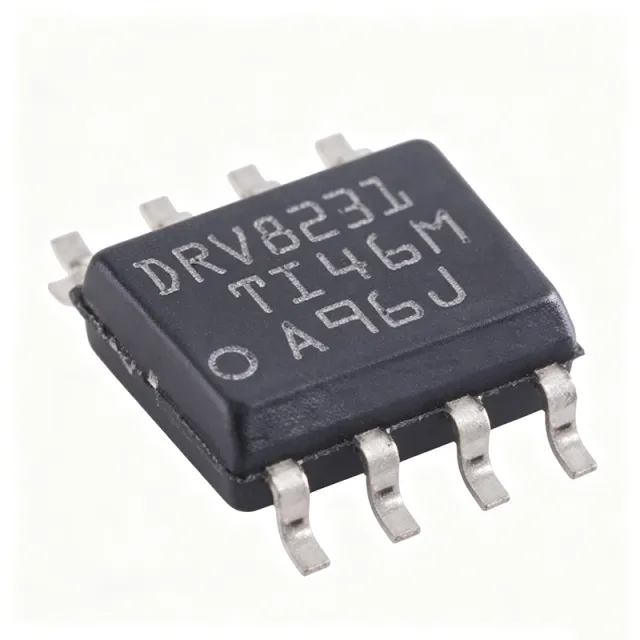
What Is the DRV8231DDAR and Why Should Engineers Choose It?
The Texas Instruments DRV8231DDAR is an integrated single H-bridge brushed DC motor driver rated for 35 V absolute maximum, operating from a 4.5-V to 33-V supply rail, and delivering up to 3.7 A peak output current. It integrates four N-channel MOSFETs with a 600 mOhm typical RDS(on) (high-side plus low-side), a charge pump that supports 100% duty cycle operation, and programmable current regulation via the ILIM pin — all in a compact 8-pin WSON (DSG) 2x2 mm surface-mount package. The part is active, RoHS compliant, and available now on XAIPART with 99,999 units in stock, MOQ of 1, priced from $1.85 for single units down to $0.89 at 1,000-piece quantities as of 2026-09-04.
A brushed DC motor driver IC like the DRV8231 sits between logic-level microcontroller outputs and the power stage. It switches power to a DC motor through an H-bridge of transistors, enabling forward, reverse, brake, and coast control. Integrated H-bridge drivers combine gate drive, power FETs, charge pump, and protection in a single device, replacing discrete MOSFET bridges and reducing board area and BOM cost. Two logic inputs control the bridge states: the DRV8231D variant (this part, DDAR suffix) uses a dual-PWM interface, while the DRV8231A variant uses PH/EN. Logic inputs accept both 3.3-V and 5-V controllers, so the DRV8231 connects directly to virtually any modern MCU or SoC without level shifting.
How Do You Select and Design In the DRV8231DDAR?
Step 1: Confirm Supply and Load Fit
Verify your motor rail falls within the 4.5-V to 33-V operating window — the DRV8231 covers 5-V, 12-V, and 24-V motor systems with headroom below the 35-V absolute maximum. For 24-V industrial rails, the 33-V operating ceiling absorbs typical supply tolerances. Check that your stall and startup current demands fit within the 3.7 A peak rating; the integrated current regulation lets you cap the limit below that peak to match your motor and PCB traces.
Step 2: Choose the Interface Variant
The DRV8231D (this part) uses two PWM inputs to set the bridge state — ideal when your MCU has spare PWM channels and you want fine speed control. The DRV8231A uses a PH/EN (phase/enable) interface, which suits MCUs where a single direction GPIO plus one PWM enable is more natural. Both variants share the same 35-V, 3.7-A ratings, 600 mOhm RDS(on), and 8-pin WSON (DSG) package, so the choice is purely an interface preference.
Step 3: Program the Current Limit
Set the current limit with a resistor on the ILIM pin, following the equation in the TI DRV8231 datasheet. When bridge current exceeds the programmed threshold, integrated current regulation trips and protects the motor and PCB — with no external shunt resistors or sense amplifiers required. This is a major advantage over discrete bridge designs in space-constrained printer PCAs and portable devices.
Step 4: Manage Thermals Through the PCB
Estimate conduction loss as I-squared times RDS(on) using the 600 mOhm typical value. At 1.5 A continuous, dissipation is about 1.35 W; at 2 A continuous, roughly 2.4 W. Generally, no external heatsink is needed for moderate loads — the WSON-8 DSG exposed pad dissipates heat into the PCB. Provide a solid power ground plane under the exposed pad with a generous copper pour and thermal vias per the TI datasheet layout guidance. Continuous current capability depends directly on this PCB thermal design.
Step 5: Rely on Integrated Protection
The DRV8231 includes overcurrent protection (OCP), undervoltage lockout (UVLO), and thermal shutdown. UVLO ensures clean behavior during brownouts and prevents misdriving at low battery voltage — valuable in battery-powered smart locks and medical dosing devices. Thermal shutdown protects against repeated stall events during commissioning of industrial actuators.
Which Components Are the Best Alternatives and Drop-in Replacements for the DRV8231?
The TI pin-to-pin scalable DRV8231/DRV8251 family lets you raise current capability or change interfaces without changing your PCB layout. Use the verified comparison below, and always confirm the control interface variant (PWM vs PH/EN) matches before substitution.
| Parameter | DRV8231DDAR | DRV8231ADSGR | DRV8251ADSGR | DRV8251DDAGR | DRV8870DDAR | DRV8871DDAR | A4950ELJTR-T |
|---|---|---|---|---|---|---|---|
| Manufacturer | TI | TI | TI | TI | TI | TI | Allegro |
| Interface | Dual PWM | PH/EN | PH/EN | Dual PWM | Same pinout style | Current regulation | Single-bridge |
| Peak Current | 3.7 A | 3.7 A (same die) | ~4.1 A class | Higher current | 3.6 A / 45 V | 3.6 A | ~3.5 A |
| Package | 8-WSON (DSG) 2x2 mm | Same footprint | Pin-to-pin | Family footprint | SO PowerPAD | Different package | Different pinout |
| Drop-in? | — | Yes | Yes | Yes | Confirm package | Confirm package | No — board mod required |
Selection guidance: choose the DRV8231A for PH/EN control on the identical die; choose the DRV8251A (~4.1 A class) or DRV8251D when your motor needs higher continuous current with lower resistive losses — both remain pin-to-pin compatible with the DRV8231 footprint. The DRV8870 (3.6 A / 45 V, SO PowerPAD) and DRV8871 (3.6 A, with an AEC-Q100 Q1 variant for automotive) serve when a different package or qualification is required. The Allegro A4950 is a functional cross-brand single-bridge brushed DC driver (~3.5 A), but it is not guaranteed drop-in — verify pinout and package before committing a layout.
What Is the Market Position, Lifecycle Status, and Supply Situation for the DRV8231?
Per XAIPART database records, the DRV8231DDAR lifecycle status is active — TI's current-generation integrated motor driver family, not a discontinued or not-recommended part. Supply is strong: XAIPART lists 99,999 units in stock with MOQ 1, priced at $1.85 (qty 1), $1.66 (qty 10), $1.29 (qty 100), $1.05 (qty 500), and $0.89 (qty 1000) as of 2026-09-04. Distributor availability supports this picture: as of 2026-08-29, DigiKey lists DRV8231ADSGR as in stock with ships-today availability. [DATA_NEEDED: manufacturer forecast/market-share data] — buyers should nonetheless qualify second sources within the pin-to-pin TI family (DRV8251A/DRV8251D) for long-product-lifetime programs, since these share the same footprint and allow migration without PCB changes.
What Trends Should Buyers Watch for Motor Driver ICs Like the DRV8231?
Three trends anchored to the DRV8231's verified specs deserve attention. First, integration continues to displace discrete bridges: with integrated FETs (600 mOhm typical RDS(on)), charge pump for 100% duty cycle, and ILIM-based current regulation, single-chip drivers like the DRV8231 reduce BOM count and assembly cost in printer, appliance, and actuator designs. Second, footprint scalability matters for product roadmaps: the pin-to-pin DRV8231/DRV8251 family lets one PCB serve multiple current tiers (3.7 A to ~4.1 A class), which is increasingly valuable for robotics lineups sharing a board. Third, packaging density keeps shrinking — the 2x2 mm WSON-8 enables per-axis motor control on dense PCAs, but thermal design through the exposed pad becomes the limiting factor at sustained currents, so budget PCB copper accordingly. Watch qualification status too: for automotive body applications, the AEC-Q100 qualified DRV8871-Q1 in the TI family is the designated path, while the standard DRV8231 targets industrial and consumer use. For procurement, lock volume pricing — the $0.89 @ 1k tier as of 2026-09-04 — and monitor stock on the DRV8231DDAR product page or related parts like the DRV8251ADSGR and DRV8871DDAR.
Comments
Be the first to comment.
🔐 Please sign in to post a comment.
Don't have an account? Sign up