The Intel (Altera) EP4CE10E22C8N is a low-cost Cyclone IV E FPGA featuring 10,320 logic elements (LEs), 46 embedded M9K memory blocks totaling 414 Kbit, up to 91 user I/O pins, and two PLLs, packaged in a 144-pin LQFP with exposed thermal pad (E22), speed grade 8, commercial 0C to +85C temperature range. It configures via JTAG, AS, AP, or PS modes and is supported by Quartus Prime from version 9.0 onward. The part is in active production and in stock at XAIPART with 99,999 units available, MOQ 1, priced from $18.50 (qty 1) down to $11.10 (qty 1000) as of 2026-09-12. Its 60 nm low-power process keeps static power among the lowest in its class, and its hand-solderable LQFP footprint makes it a favorite for industrial control, machine vision, protocol bridging, and education platforms.
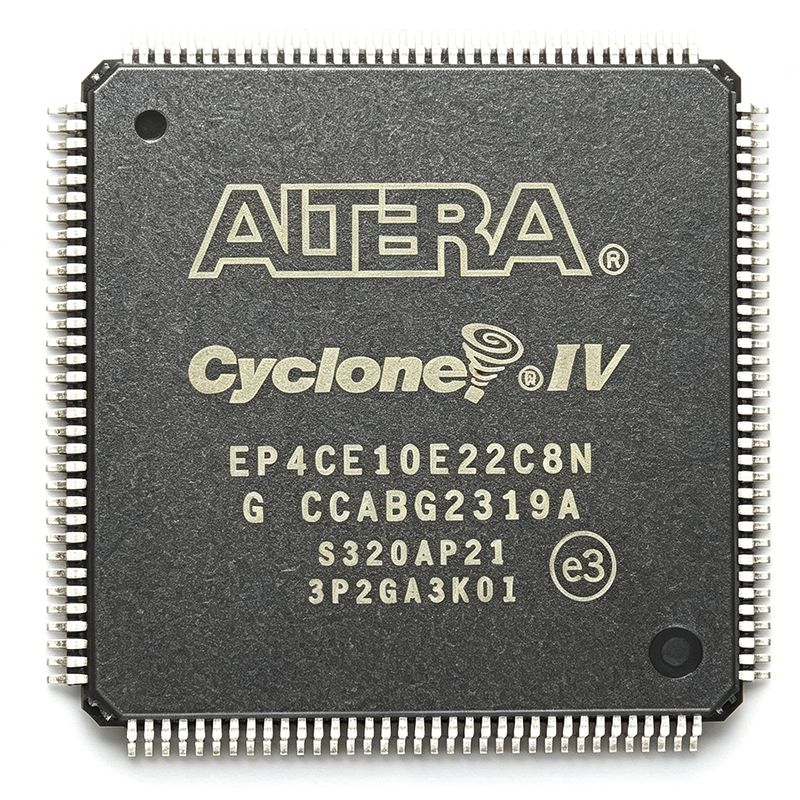
What Is the EP4CE10E22C8N and What Are Its Key Specifications?
The EP4CE10E22C8N belongs to Intel's Cyclone IV E family, targeting cost-sensitive, high-volume applications. It sits within the programmable logic device (PLD) hierarchy under logic ICs, offering post-fabrication reconfigurability between fixed-function microcontrollers and full-custom ASICs. Key verified specifications include:
| Parameter | Value |
|---|---|
| Series / Family | Cyclone IV E / EP4CE10 |
| Logic Elements | 10,320 |
| Embedded Memory | 46 M9K blocks, 414 Kbit total |
| Maximum User I/O | 91 |
| Package | 144-LQFP Exposed Pad (E22) |
| Speed / Temperature Grade | 8 / Commercial (C), 0C to +85C |
| PLLs | 2 |
| Configuration Modes | JTAG / AS / AP / PS |
| Core Supply Voltage | 1.0 V to 1.2 V |
| Process Technology | 60 nm low-power |
| RoHS / Lead-Free | Compliant / Yes |
Note that the E (Enhanced logic/memory) variants do not include integrated transceivers; the device supports LVDS, LVCMOS, SSTL, and HSTL I/O standards, and the hard PCI Express (PIPE) interface appears only on higher-density variants. [VERIFY_NEEDED: exact total power figure beyond the handbook power estimator's stated less than 1.5 W typical static power]
How Do You Design In and Program the EP4CE10E22C8N?
Design flow starts in Intel Quartus Prime (or legacy Quartus II 9.0+), which provides synthesis, place-and-route, timing analysis, Qsys/Platform Designer IP integration, and the Nios II soft-core processor. Programming is performed via JTAG using a USB-Blaster, ByteBlaster, or Ethernet-Blaster download cable, or from external flash in AS/AP/PS modes.
Practical design-in recommendations from the verified data:
- Power integrity: Allocate 100 nF + 10 µF decoupling per supply rail. Core supply (VCCINT, pins 119-122) requires 1.0 V to 1.2 V; each of the eight I/O banks has its own VCCIO pin (pins 14, 28, 46, 59, 75, 88, 107, 118), letting you mix voltage standards per bank.
- Clocking: Route global clocks to the four dedicated clock inputs CLK0-CLK3 (pins 135-138) for skew control, and use the two PLLs to synthesize derived clocks. PLL analog supplies sit on pins 140 (VCC_PLL1) and 141 (VCC_PLL2).
- Configuration: Set MSEL0-MSEL2 (pins 131-133) for your configuration scheme; monitor nCONFIG (124), nSTATUS (125), and CONF_DONE (126); use nCE (134) for multi-device chains, DATA0 (142) and DCLK (143) for AS/PS data and clock, and nCSO (144) for serial daisy chains. Keep the JTAG pins TCK/TMS/TDI/TDO (127-130) chain-intact for in-system programming.
- Thermal: Solder the exposed pad (EPAD) to a grounded copper pour for heat dissipation and electrical reference — essential when running near full logic utilization.
For prototype rework, the 144-LQFP footprint supports hand soldering, unlike BGA alternatives.
What Are the Key Pins of the EP4CE10E22C8N?
The full 144-pin table lives on the EP4CE10E22C8N product page. The functionally critical pins are:
| Pin | Name | Function |
|---|---|---|
| 119-122 | VCCINT | Core supply (1.0-1.2 V) |
| 14, 28, 46, 59, 75, 88, 107, 118 | VCCIO1-8 | Per-bank I/O supply |
| 124 | nCONFIG | Configuration control (active-low reset) |
| 125 | nSTATUS | Configuration status (active-low) |
| 126 | CONF_DONE | Configuration complete indicator |
| 127-130 | TCK/TMS/TDI/TDO | JTAG interface |
| 131-133 | MSEL0-MSEL2 | Configuration mode select |
| 134 | nCE | Chip enable (multi-device chain) |
| 135-138 | CLK0-CLK3 | Dedicated clock inputs |
| 142 / 143 / 144 | DATA0 / DCLK / nCSO | AS/PS configuration data, clock, chip-select |
| EP | EPAD | Exposed thermal pad — solder to grounded pour |
What Are the Best Drop-In Alternatives to the EP4CE10E22C8N?
Within the Cyclone IV E family, four verified alternatives share the same 144-LQFP (E22) footprint, enabling PCB reuse without layout changes:
| Part | Logic Elements | Memory | Key Difference vs EP4CE10E22C8N |
|---|---|---|---|
| EP4CE10E22C8N | 10,320 | 414 Kbit | Baseline: commercial, speed grade 8, lead-free |
| EP4CE10E22C8 | 10,320 | 414 Kbit | Same die; leaded vs lead-free solder finish only |
| EP4CE10E22I7N | 10,320 | 414 Kbit | Industrial -40C to +100C; speed grade 7 vs 8 |
| EP4CE10E22A7N | 10,320 | 414 Kbit | Automotive temperature grade; speed grade 7 vs 8 |
| EP4CE22E22C6N | 22,320 | [DATA_NEEDED: embedded memory] | +116% logic; speed grade 6 vs 8; higher cost |
The EP4CE10F17C8N (256-pin FineLine BGA) offers more I/O and routing density but is not a drop-in replacement — it requires a complete PCB redesign. The EP4CE6E22C8 shares the identical E22 footprint but offers only 6,272 LEs and 270 Kbit of memory; the EP4CE10 provides approximately 65% more logic capacity in the same footprint.
Which Applications Fit the EP4CE10E22C8N Best?
Verified application scenarios from the database:
- Industrial motor control: The 10,320 LEs and 46 M9K blocks implement encoder quadrature decoders, PID loops, and FOC state machines; two PLLs synthesize PWM carriers from a single 50 MHz crystal; the 60 nm process keeps board power below 1.5 W, simplifying thermal design in sealed IP65 cabinets.
- Machine vision pre-processing: 414 Kbit embedded memory and 91 user I/O connect directly to parallel-DVP CMOS sensors and LCDs; Nios II soft cores run algorithms while hardware accelerators handle pixel-rate convolution.
- Industrial protocol bridging: Flexible I/O banks support LVTTL, LVCMOS, RS-485, and differential signalling for Modbus RTU, Profibus, EtherCAT, CAN, and proprietary links; M9K buffers protocol frames without external SRAM, and JTAG in-system programming enables field firmware updates.
- Low-cost video processing: 10,320 LEs implement HDMI TMDS encoding or VGA timing; M9K blocks store scanline buffers for 720p output via LVDS.
- ASIC/glue-logic replacement: Replaces dozens of 74-series ICs and CPLDs; Quartus IP libraries provide drop-in I2C, SPI, UART, and PWM controllers.
- Education: Used in development boards such as the DE0-Nano for teaching VHDL/Verilog, Nios II, and basic DSP.
How Much Does the EP4CE10E22C8N Cost and Is It In Stock?
XAIPART verified tier pricing as of 2026-09-12:
| Quantity | Unit Price (USD) |
|---|---|
| 1+ | $18.50 |
| 10+ | $16.20 |
| 100+ | $13.85 |
| 500+ | $12.40 |
| 1000+ | $11.10 |
Stock is 99,999 units with MOQ 1. Distributor reports (DigiKey, Mouser) indicate the part is in stock with manufacturer lead times of 8-12 weeks for bulk orders; pricing on this mature line has remained stable through 2026.
What Is the Lifecycle and Supply Outlook for the Cyclone IV E Family?
Verified lifecycle status: active. However, the Cyclone IV E family is classified as a mature product line by Intel. For new designs requiring long-term availability, evaluate the Cyclone IV GX or Cyclone 10 LP families alongside the EP4CE10E22C8N. [DATA_NEEDED: Intel official discontinuation/not-new-designs notice date]
What Should Buyers Watch Going Forward?
Anchor your sourcing decisions to these verified facts: the commercial-grade EP4CE10E22C8N covers 0C to +85C — for harsher environments, the EP4CE10E22I7N extends to -40C to +100C in the identical footprint, so dual-footprint qualification costs nothing in layout. The speed grade 7 alternatives (I7N, A7N) trade a speed grade for temperature grade; verify your timing closure margin at grade 8 before downgrading. On pricing, the step from qty 100 ($13.85) to qty 1000 ($11.10) saves about 20%, so consolidating buys matters. Finally, because the family is mature, buffer stock for multi-year production programs and benchmark Cyclone 10 LP as a migration path — the 10,320-LE / 414 Kbit / 91-I/O resource profile of the EP4CE10E22C8N is the baseline against which any replacement must be measured.
Comments
Be the first to comment.
🔐 Please sign in to post a comment.
Don't have an account? Sign up