EPC1LI20N Quick Answers: What Is It and Why Does It Matter?
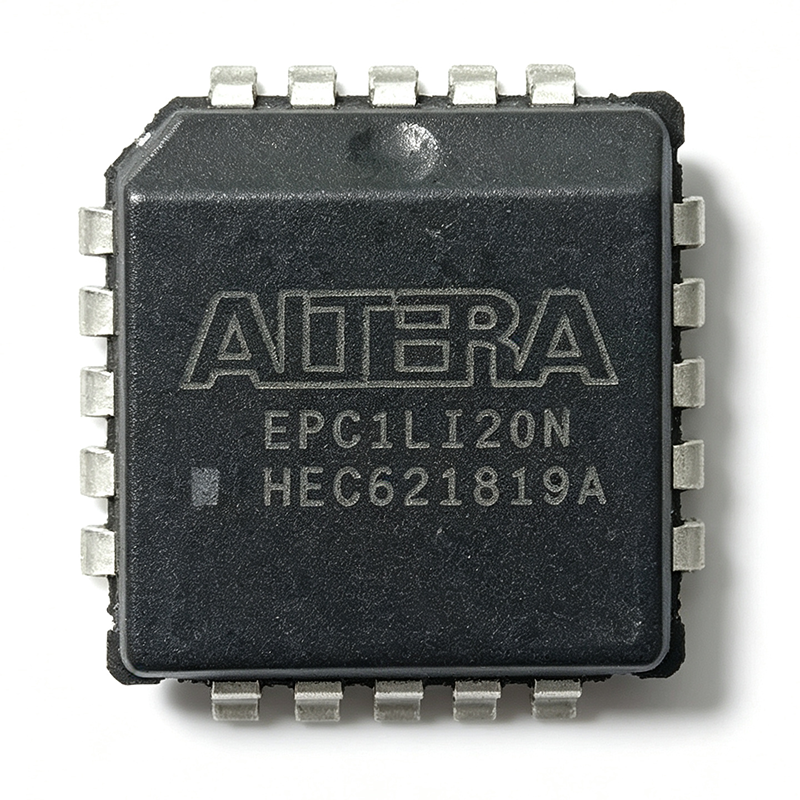
The EPC1LI20N is Altera's (Intel's) 1-Mbit one-time-programmable (OTP) configuration PROM that loads the bitstream into SRAM-based Altera FPGAs such as Cyclone, FLEX 10K, APEX, and ACEX 1K at every power-up. It ships in a 20-pin PLCC (J-lead) package measuring 9 mm x 9 mm, operates from dual supply rails of 3.0 V to 3.6 V (VCCINT) and 4.5 V to 5.5 V (VCCIO), and is rated for the industrial temperature range of -40C to +85C. The device implements Altera's proprietary serial configuration protocol with an IEEE 1149.1-compliant JTAG interface for in-system programming, and its programmable compression reduces configuration file size by 30-55%. As of 2026-09-14, the part is in last-time-buy (LTB) lifecycle status; XAIPART lists 99,999 units in stock with MOQ 1, priced from $10.50 at qty 1 down to $7.80 at qty 1,000. Buyers with legacy Cyclone or FLEX 10K platforms should secure inventory now, because LTB status means no new production beyond existing backlog.
This guide consolidates verified datasheet specifications, pinout details, application guidance, and drop-in replacement options into one authoritative resource for design engineers, procurement teams, and obsolescence managers.
How Do You Select and Design In the EPC1LI20N?
Selecting the EPC1LI20N starts with three questions: does your FPGA's compressed bitstream fit in 1 Mbit, is your bitstream truly fixed for the product lifetime, and does your environment match the industrial temperature rating?
Step 1 - Confirm bitstream capacity. The device stores exactly 1,048,576 bits of OTP data. With programmable compression enabled (30-55% reduction per the verified specs), most Cyclone-series designs fit comfortably. Larger APEX II and Stratix-class devices typically require the 2 Mb EPC2 or EPC4 PROMs instead, per Altera's configuration device compatibility guidance.
Step 2 - Plan the power architecture. The EPC1LI20N requires two supply rails: VCCINT at 3.0 V to 3.6 V and VCCIO at 4.5 V to 5.5 V. The dual-rail design is an advantage when interfacing directly to 5 V FLEX 10K I/O without level shifters, but you must budget both rails in your power tree.
Step 3 - Wire the serial configuration interface. The host FPGA needs only four configuration pins: nCONFIG, DCLK, DATA0, and CONF_DONE. The EPC1's internal oscillator and state machine implement Altera's serial configuration protocol and automatically detect the target FPGA density - no external glue logic is required.
Step 4 - Reserve the JTAG chain for programming. The device is programmed once through its IEEE 1149.1 boundary-scan interface using the Quartus or MAX+PLUS II software flow. Keep the FPGA's JTAG pins routed so the EPC1 can be programmed in-circuit during production, avoiding a separate standalone programmer fixture.
Step 5 - Choose socket or solder. The PLCC-20 J-lead package supports both surface-mount soldering and through-hole-compatible PLCC sockets. Sockets are valuable during pilot runs (allowing physical replacement of OTP devices between bitstream revisions); in volume production, direct soldering reduces cost. The identical PLCC-20 footprint across the EPC1/EPC2 family means you can migrate to the flash-based EPC2LI20N later without PCB rework.
Critical design warning: the device is one-time programmable. Any bitstream revision requires physical replacement of the PROM. If field upgrades are even remotely possible in your product roadmap, design in the reprogrammable EPC2LI20N from day one.
Which Pins Matter Most on the EPC1LI20N?
The PLCC-20 pinout follows Altera's standard EPC1/EPC2 family configuration. The functionally critical pins are the power pins, the four-wire serial configuration interface, the control/status pins, and the JTAG chain on pins 17-20:
| Pin | Name | Function |
|---|---|---|
| 1 | VCC | Core supply voltage (3.0-3.6 V) |
| 2 | nCS | Chip select (active low) |
| 3 | DCLK | Configuration clock to FPGA |
| 4 | DATA | Serial configuration data output |
| 5 | nCONFIG | Configuration control (active low) |
| 6 | nSTATUS | Configuration status (active low) |
| 7 | CONF_DONE | Configuration done indicator |
| 9 | OE | Output enable |
| 10 | nCE | Chip enable (active low) |
| 11 | MODE | Mode select |
| 12 | VCCIO | I/O supply voltage (4.5-5.5 V) |
| 17-20 | TDI/TDO/TMS/TCK | IEEE 1149.1 JTAG programming chain |
The full 20-pin table, including GND and no-connect pins, is available on the EPC1LI20N product page.
What Are the Best Drop-In Alternatives for the EPC1LI20N?
Because the part is in last-time-buy status, knowing your substitution options is essential. All verified pin-compatible alternatives share the same 20-PLCC J-lead footprint and pinout:
| Parameter | EPC1LI20N | EPC2LI20N (verified drop-in) |
|---|---|---|
| Manufacturer | Altera (Intel) | Altera (Intel) |
| Memory Type | OTP Configuration PROM | Reprogrammable flash-based configuration PROM |
| Memory Size | 1 Mbit (1,048,576 bits) | 2 Mbit |
| Package | 20-LCC (J-Lead), PLCC-20, 9 x 9 mm | Same 20-pin PLCC (J-lead), identical footprint and pinout |
| Field Upgradability | None - physical replacement required for any bitstream change | In-system reprogramming via JTAG |
| Lifecycle | last_time_buy | [DATA_NEEDED: EPC2LI20N lifecycle status] |
| Supply Voltage | VCCINT 3.0-3.6 V; VCCIO 4.5-5.5 V | [DATA_NEEDED: EPC2LI20N supply voltage] |
Recommendation: the EPC2LI20N is the most common modern replacement - it doubles capacity to 2 Mbit and adds field-upgrade capability with zero PCB changes. For designs that must retain OTP behavior, the EPC1LC20N, EPC1LI20, EPC1LC20HEC, EPC1LC20CEC, and EPC1441LC20N are pin-compatible 1 Mb alternatives listed in the Altera datasheet ordering table. Note that the EPC1LI20 (no N suffix) refers to the older SnPb lead finish, while the N suffix on EPC1LI20N indicates the RoHS-compliant matte-tin finish. For entirely new designs, Intel recommends migrating to a modern Cyclone or MAX-series configuration flow rather than continuing with the EPC family.
Where Does the EPC1LI20N Fit in Real-World Applications?
Cyclone factory configuration. The device is a textbook fit for factory-programmed Cyclone (EP1C3/6/12) and Cyclone II (EP2C5/8/20) designs with lifetime-fixed bitstreams. With compression, 1 Mbit loads most Cyclone I/II images without external glue logic, and in-circuit JTAG programming through the reserved FPGA chain eliminates a separate programmer in manufacturing.
FLEX 10K industrial controllers. The dual-rail 3.3 V/5 V supply interfaces directly to 5 V FLEX 10K I/O with no level shifters, and the -40C to +85C range covers factory-floor and outdoor cabinets. Verify compressed bitstream size in MAX+PLUS II first - EPF10K100 and larger may exceed 1 Mb compressed.
Telecom line cards. OTP behavior is actually desirable where per-card calibration is locked at test: it prevents accidental in-field reprogramming that could create regulatory or security exposure. The J-lead package withstands vibration and thermal cycling in telecom shelves.
Test and measurement instruments. Bench instruments rarely update FPGA firmware through the FPGA path, so OTP is acceptable. The vertical PLCC socket saves board area versus SOIC alternatives, and IEEE 1149.1 JTAG lets production use the instrument's existing test access port.
Mil/Aero SBC companion memory. For ground-system ACEX/APEX designs, the industrial temperature range and mechanically robust J-lead attachment work well - though the part is not qualified to full -55C to +125C Mil-PRF requirements and is not AEC-Q100 qualified for automotive. Vet any broker stock for counterfeit mitigation given LTB scarcity.
Education. The low single-piece price of $10.50 (as of 2026-09-14) suits teaching kits, and socketed boards can swap between pre-programmed EPC1s and reprogrammable EPC2s.
How Do You Budget Power and Configuration Timing in a Reference Design?
Problem: configure a 5 V-tolerant FLEX 10K industrial controller reliably at -40C with a fixed bitstream and no level-shifting logic.
Approach: use one EPC1LI20N as the sole configuration device. Connect DCLK (pin 3), DATA (pin 4), nCONFIG (pin 5), nSTATUS (pin 6), and CONF_DONE (pin 7) directly to the corresponding FPGA pins. Power VCCINT (pin 1) from a 3.3 V rail (within 3.0-3.6 V) and VCCIO (pin 12) from the 5 V system rail (within 4.5-5.5 V), enabling direct I/O compatibility with the 5 V FPGA. Route TDI/TDO/TMS/TCK (pins 17-20) into the board's IEEE 1149.1 JTAG chain for in-circuit programming.
Calculations: budget the bitstream against capacity. With compression reducing the configuration file by 30-55% (verified spec), a design must satisfy: compressed_bitstream_size <= 1,048,576 bits. For example, an uncompressed 1.8 Mb image compressed 45% yields approximately 0.99 Mb - a fit. An uncompressed 2.2 Mb image at 45% compression yields approximately 1.21 Mb - no fit; specify the 2 Mb EPC2LI20N instead.
Results: a single-PROM, four-FPGA-pin configuration path with no glue logic, full industrial temperature coverage, and JTAG production programming. Exact current consumption figures are not listed in the verified data - see [VERIFY_NEEDED: per-rail supply current values from EPC1 datasheet electrical tables] before finalizing the power budget.
What Is the Market and Supply Situation for the EPC1LI20N?
The verified lifecycle status is last_time_buy (LTB): the original production run has concluded and Intel/Altera is not accepting new orders beyond existing backlog. As of 2026-09-14, XAIPART shows 99,999 units available with MOQ 1 and tube packaging. Tiered pricing runs $10.50 (qty 1+), $9.95 (qty 10+), $9.20 (qty 100+), $8.50 (qty 500+), and $7.80 (qty 1,000+). [DATA_NEEDED: manufacturer PCN number and official LTB announcement date]. Given LTB dynamics, expect prices to firm and stock to deplete; treat unusually large-quantity broker offers with caution and verify date codes and traceability.
What Should Buyers Watch Next for FPGA Configuration Memory?
Three trends anchored to the verified data deserve attention. First, LTB depletion: with a finite 99,999-unit pool at XAIPART as of 2026-09-14, procurement teams supporting Cyclone/FLEX 10K/APEX/ACEX 1K platforms should calculate their lifetime buy now - the $7.80 1,000-piece tier is the lowest verified price point. Second, the drop-in path: qualifying the EPC2LI20N on the same PLCC-20 footprint converts an obsolescence emergency into a planned substitution while adding 2 Mbit capacity and JTAG reprogrammability. Third, RoHS and qualification boundaries: the EPC1LI20N is RoHS compliant with matte-tin plating per JEDEC J-STD-020, but it is neither AEC-Q100 qualified nor rated beyond -40C to +85C - automotive and full mil-temp programs must look elsewhere. For new designs, follow Intel's guidance and adopt a modern Cyclone or MAX-series configuration flow rather than starting on the EPC family in 2026.
Comments
Be the first to comment.
🔐 Please sign in to post a comment.
Don't have an account? Sign up