What Is the EPC4QI100N and Why Do Engineers Specify It?
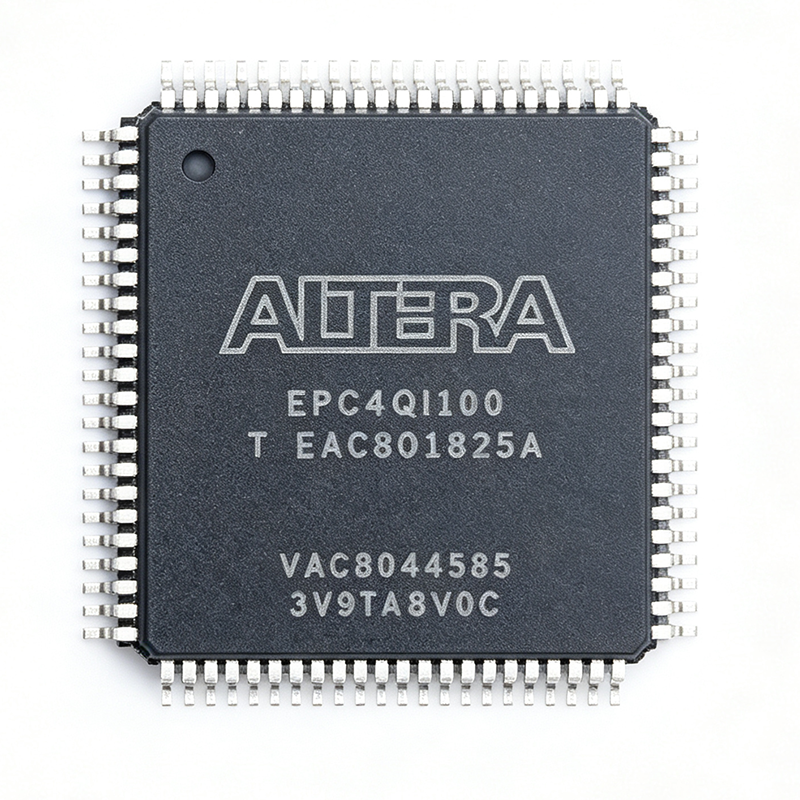
The EPC4QI100N is a 4-Mbit (4,194,304-bit) in-system programmable configuration PROM from Altera (now Intel Programmable Solutions Group) that stores an FPGA bitstream and clocks it into an Altera FPGA at power-up. It operates from a single 3.3 V supply (3.0 V to 3.6 V), works across an industrial -40C to +85C temperature range, and is programmed through an IEEE 1149.1 JTAG interface. The part ships in a 100-pin PowerPQFP (PQFP-100, 20x14 mm) surface-mount package and is in stock now: 99,999 units are available at XAIPART with pricing from $18.50 at qty-1 down to $10.40 at qty-1,000 as of 2026-09-12, MOQ 1.
As a boot-storage class non-volatile memory, the EPC4QI100N sits between the power-management ICs that bring up the rails and the FPGA fabric that will execute the design. Unlike general-purpose NOR flash, it implements Altera-specific JTAG-driven ISP and dedicated configuration handshaking signals — nCONFIG, nSTATUS, CONF_DONE, and DCLK — so the configuration sequence is deterministic and requires no software-driven bitstream loading code on the host. The flash array supports serial x1 or parallel x8 configuration modes, and multiple EPC devices can be cascaded in daisy-chain mode for higher-density bitstreams.
What Are the Verified Specifications of the EPC4QI100N?
| Parameter | Value |
|---|---|
| Manufacturer | Altera (Intel Programmable Solutions Group) |
| Memory Type | In-System Programmable Configuration PROM (NOR flash) |
| Memory Size | 4 Mbit (4,194,304 bits) |
| Programmable Type | In-System Programmable (ISP via JTAG, IEEE 1149.1) |
| Supply Voltage (VCC) | 3.0 V to 3.6 V |
| Interface | Altera serial (x1) configuration + JTAG |
| Operating Temperature | -40C to +85C (industrial) |
| Storage Temperature | -65C to +150C |
| Package | 100-pin PQFP (PowerPQFP, 20x14 mm), code QI100 |
| Mounting Type | Surface Mount |
| Cascading | Supported (multi-device daisy chain) |
| Target FPGAs | Altera Cyclone, Cyclone II, Stratix series |
| Lifecycle Status | Active |
| DCLK Maximum Frequency | [DATA_NEEDED: DCLK maximum frequency] |
| ICC Active / Standby | [DATA_NEEDED: ICC active typical value] / [DATA_NEEDED: ICC standby typical value] |
| MSL Rating | [DATA_NEEDED: MSL rating] |
| RoHS Status | [DATA_NEEDED: RoHS compliance] |
The part suffix 'N' historically indicates a lead-free terminal finish, but because RoHS compliance is not explicitly confirmed in the verified data, compliance-critical designs should cross-check the Certificate of Conformance from the distributor before BOM sign-off.
How Do You Design In the EPC4QI100N? A Practical Technical Guide
Power Supply Design
Power the EPC4QI100N from a single 3.3 V rail held within the 3.0 V to 3.6 V range. No separate programming voltage is required because ISP programming occurs through the JTAG port at the normal VCC rail. Provide a decoupling network of 0.1 uF and 10 uF capacitors close to the VCC pins per the manufacturer's recommendation.
Configuration Handshake Topology
Connect the 4-pin proprietary configuration interface — DATA, DCLK, nCONFIG, and nSTATUS — plus CONF_DONE to the target FPGA, and verify that the nCONFIG/nSTATUS pull-up topology matches the Altera reference schematic. The EPC4's internal state machine auto-orchestrates the power-up handshake, so no host software loader is needed. Confirm the nCONFIG, nSTATUS, and CONF_DONE resistor values against the latest Altera reference design before release [VERIFY_NEEDED: exact pull-up/pull-down resistor values not provided in verified data].
JTAG Chain and In-System Programming
Place the EPC4QI100N in the JTAG scan path together with the FPGA, and account for chain order when both devices share one JTAG header. This single-chain approach lets you program both the FPGA and the PROM with the same Quartus programming flow, accelerating bring-up on development boards and simplifying in-field firmware updates in production systems. Factory test routines can verify PROM contents against an expected CRC over JTAG before handing control to user logic.
Cascading for Larger Bitstreams
When a bitstream exceeds 4 Mb, cascade two or more EPC devices in daisy-chain mode to the same FPGA — for example, two EPC4QI100N devices support up to 8 Mb. Alternatively, move to the pin-compatible EPC8QI100N (8 Mb) or EPC16QI100N (16 Mb) with no PCB rework, since all family members share the identical 100-pin PQFP-100 footprint, 3.3 V supply, and configuration interface. Address pins on the PROM are used in multi-device cascading; refer to the manufacturer datasheet for exact pin-by-pin assignments.
Thermal and Assembly Considerations
The industrial -40C to +85C rating allows deployment in factory-floor enclosures and outdoor equipment without thermal screening, but extended-temperature variants (100C junction) are not offered in this family. The 100-pin PowerPQFP package with exposed lead frame supports standard IR-reflow profiles and is easy to inspect and rework during prototype iterations. Note that the EPC4QI100N does not pin-match the legacy EPC1LC20/EPC2LC20 footprints without PCB rework; direct pin-to-pin compatibility exists only within the PQFP-100 family (EPC4QC100, EPC8QI100N, EPC16QI100N).
What Are the Typical Applications for the EPC4QI100N?
The verified application data covers six deployment scenarios:
- Industrial controllers (Cyclone FPGA configuration): The canonical boot memory for Cyclone-based PLCs and motor-control designs. The 4 Mb capacity fits EP1C3, EP1C4, EP1C6, and most EP1C12 bitstreams in serial x1 mode, and the 3.0-3.6 V supply matches the Cyclone core rail directly.
- Telecommunications line cards: JTAG-chained remote firmware updates, low standby retention for always-on cards, and daisy-chaining two devices for up to 8 Mb.
- Prototyping and development boards: On-board boot PROM for Nios II evaluation kits and third-party Cyclone/Cyclone II boards, with one JTAG header programming both FPGA and PROM.
- Military and aerospace subsystems: Controlled die revisions and stable pinout suit non-flight-critical subsystems and ground equipment; verify lot and date code against the program's parts approval plan for flight hardware.
- Test and measurement instrumentation: Deterministic DCLK-driven configuration eliminates SPI-flash boot-loader code, reducing firmware complexity and BOM.
- Legacy design migration: The natural upgrade path from EPC1 (1 Mb) or EPC2 (2 Mb) designs that have outgrown their PROM, reusing existing JTAG programming tools and fixtures.
What Are the Alternatives and Drop-In Upgrades for the EPC4QI100N?
Within the verified data, the primary drop-in alternatives come from the same Altera EPC4 family and one newer configuration device:
| Parameter | EPC4QI100N | EPC8QI100N | EPC16QI100N | EPC4QC100N | EPCQ4ASI8N |
|---|---|---|---|---|---|
| Memory Size | 4 Mbit | 8 Mbit | 16 Mbit | 4 Mbit | [DATA_NEEDED: density] |
| Package | PQFP-100 (20x14 mm) | PQFP-100 (identical footprint) | PQFP-100 (identical footprint) | PQFP-100 | PQFP-100 footprint |
| Supply Voltage | 3.0-3.6 V | 3.3 V single supply | 3.3 V single supply | 3.3 V single supply | 3.3 V |
| Operating Temperature | -40C to +85C (industrial) | Industrial (QI suffix) | Industrial (QI suffix) | 0C to +70C (commercial) | [DATA_NEEDED: temperature range] |
| Interface | Altera serial x1 + JTAG ISP | Same Altera configuration interface | Same Altera configuration interface | Same Altera configuration interface | Same Altera configuration family |
| Pin Compatibility | Reference | Pin-to-pin drop-in | Pin-to-pin drop-in | Drop-in within commercial temp limits | Same footprint; verify bitstream compatibility before substitution |
Choose the EPC4QI100N when the bitstream fits within 4 Mb and you want the lowest unit cost. Move to the EPC8QI100N or EPC16QI100N when the design outgrows 4 Mb — no PCB rework is required, only reprogramming. Use the EPC4QC100N only if the application stays within 0C to +70C. For the EPCQ4ASI8N, verify bitstream compatibility before substituting, as its specific feature delta is not fully documented in the verified data.
How Much Does the EPC4QI100N Cost and Where Is It In Stock?
As of 2026-09-12, XAIPART lists the EPC4QI100N with 99,999 units in stock, MOQ 1, and the following tiered pricing:
| Quantity | Unit Price (USD) |
|---|---|
| 1+ | $18.50 |
| 10+ | $16.20 |
| 100+ | $13.85 |
| 500+ | $11.95 |
| 1000+ | $10.40 |
Base price is $10.40 as of 2026-09-12. For non-stocked factory orders from Altera/Intel, lead times typically run 6-12 weeks; in-stock parts ship in 1-3 business days. Because the EPC4 family is mature, we recommend placing annual buy contracts with franchised distributors to lock supply.
What Is the Market Position and Lifecycle Status of the EPC4QI100N?
The EPC4QI100N carries an active lifecycle status in the verified product database, and supply is currently deep: 99,999 units at XAIPART as of 2026-09-12, with additional distributor stock reported elsewhere (Infinity-Semiconductor reported 4,874 units at fetch time, per the verified FAQ data). The device serves long-lifecycle defense, aerospace, and industrial programs that historically standardized on the EPC4 family because of Altera's controlled die revisions and stable pinout. [DATA_NEEDED: formal lifecycle announcement, last-time-buy schedule, and end-of-life roadmap from Intel PSG].
What Should Buyers Watch Going Forward?
- Bitstream growth: If your FPGA design is trending above 4 Mb, qualify the pin-identical EPC8QI100N or EPC16QI100N now — dual-sourcing the footprint costs nothing at layout time.
- Compliance verification: RoHS status is not confirmed in verified data; obtain the CoC and material declaration before production sign-off, especially for EU-bound products.
- Mature-family supply: Active status plus deep stock is favorable today, but mature configuration PROMs can move to last-time-buy with limited notice — annual buy contracts mitigate this risk.
- Temperature grading: Do not substitute the commercial EPC4QC100N in industrial applications; the QI100 industrial variant (-40C to +85C) is the correct grade for factory-floor and outdoor enclosures, and no 100C-junction extended-temperature variant exists in this family.
- Migration paths: Teams still on EPC1/EPC2 should plan the jump to the PQFP-100 family, accepting PCB rework, to reuse the unchanged JTAG ISP flow and programming fixtures.
Key Engineering Takeaways
- The EPC4QI100N stores 4,194,304 bits of FPGA configuration data and auto-loads Altera Cyclone, Cyclone II, and Stratix FPGAs at power-up via nCONFIG/nSTATUS/CONF_DONE/DCLK handshaking — no boot-loader software required.
- Single 3.3 V supply (3.0-3.6 V), JTAG-based IEEE 1149.1 ISP with no separate programming voltage, industrial -40C to +85C operation.
- Drop-in compatible with EPC8QI100N (8 Mb) and EPC16QI100N (16 Mb) in the identical PQFP-100 (20x14 mm) footprint; cascading supports multi-device daisy chains for larger bitstreams.
- Priced from $18.50 (qty-1) to $10.40 (qty-1,000) as of 2026-09-12 with 99,999 units in stock at XAIPART, MOQ 1.
- Verify RoHS compliance via distributor CoC, and match nCONFIG/nSTATUS pull-up topology to the Altera reference schematic before release.
Comments
Be the first to comment.
🔐 Please sign in to post a comment.
Don't have an account? Sign up