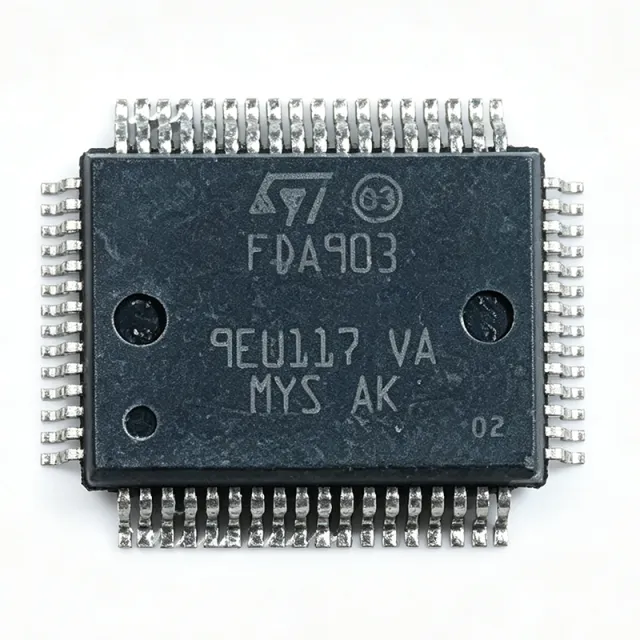
Quick Answers: What Is the FDA903D and Why Does It Matter?
The Texas Instruments FDA903D is a 1A, 35V ultra-low-noise LDO linear regulator in a VQFN-20 (RGW) package. It delivers an adjustable output from 1.4V to 34V with an input range of 3V to 35V. Key verified specs include 4.17 uVrms output noise (20 Hz to 100 kHz), 72 dB PSRR at 1 kHz, and 200 mV dropout at 1A. As of 2026-08-21, the FDA903D is in active lifecycle status with 99,999 units in stock at XAIPART, priced at $5.5682 per unit at qty 1000+.
This pillar article merges a quick reference, technical design guide, drop-in alternatives comparison, industry insight, and market outlook into one authoritative resource. Whether you are selecting a regulator for a high-end audio DAC, RF transceiver, or precision instrumentation, the FDA903D offers a compelling combination of noise performance and PSRR that minimizes the need for additional filtering.
Technical Guide: How to Select, Design In, and Use the FDA903D
Understanding the Core Specifications
The FDA903D is an adjustable-output LDO. You set the output voltage with two external resistors using the formula VOUT = 1.4V * (1 + R1/R2) as per the TI datasheet SBOS708B. The output range spans 1.4V to 34V, which covers most analog and digital rails. The input range of 3V to 35V provides flexibility for systems powered from 5V, 12V, or 24V buses.
Key verified parameters:
- Output Noise: 4.17 uVrms (20 Hz to 100 kHz)
- PSRR: 72 dB at 1 kHz
- Dropout Voltage: 200 mV at 1A
- Quiescent Current: 6.4 mA
- Thermal Resistance (theta_JA): 31.4 C/W
- Operating Temperature: -40C to +125C
- Package: VQFN-20 (RGW) 5x5 mm, MSL 2 (1 year)
Designing with the FDA903D: Step-by-Step
1. Set the output voltage: Choose R1 and R2 to set VOUT. For example, for 5V output, select R1 and R2 such that 1.4V * (1 + R1/R2) = 5V. A common choice is R1 = 10k and R2 = 3.9k (approx). Verify with the formula.
2. Input and output capacitors: The datasheet recommends a 10uF ceramic capacitor on input and output for stability. Place them close to the pins to minimize parasitic inductance.
3. Enable pin: The active-high EN pin allows power sequencing. Drive EN high to enable the output, low to shut down. This is critical for multi-rail systems where the processor requires a specific power-up order.
4. Noise reduction/soft-start (NR/SS): Connect a capacitor to the NR/SS pin to reduce noise further and set soft-start time. The value depends on your desired start-up behavior; refer to the datasheet for guidance.
5. Thermal management: At VIN=12V, VOUT=5V, and 1A load, power dissipation is (12-5)*1 = 7W. With theta_JA = 31.4 C/W, the junction temperature rises 220C above ambient, which exceeds the absolute maximum. You must use a heatsink or a large copper pour (at least 1 square inch) for reliable operation above 2-3W dissipation. For lower dissipation, the exposed thermal pad (Pin 20) must be soldered to a PCB copper area connected to GND.
Layout Considerations
For RF and audio applications, keep the input and output traces short and wide. Use a solid ground plane. Place the LDO close to the load to minimize noise pickup. The exposed pad should be connected to the ground plane with multiple vias to improve thermal performance.
Common Pitfalls
- Insufficient headroom: Ensure VIN is at least VOUT + 200 mV under all load conditions.
- Inadequate thermal relief: Without proper copper area, the device may overheat and trigger thermal shutdown.
- Missing enable control: If you do not need the enable pin, you can tie it high, but verify the logic level requirements.
Alternatives & Comparison: Drop-In Replacements for FDA903D
The FDA903D is pin-compatible with several TI regulators and cross-brand options. The table below compares verified specifications from the XAIPART database.
| Parameter | FDA903D | TPS7A4700RGWR | TPS7A4701RGWR-Q1 | LT3045EDC | ADM7150ARDZ |
|---|---|---|---|---|---|
| Max Output Current | 1A | [DATA_NEEDED: Max Output Current] | [DATA_NEEDED: Max Output Current] | 500mA | 600mA |
| Output Noise | 4.17 uVrms | [DATA_NEEDED: Output Noise] | [DATA_NEEDED: Output Noise] | [DATA_NEEDED: Output Noise] | [DATA_NEEDED: Output Noise] |
| PSRR at 1 kHz | 72 dB | [DATA_NEEDED: PSRR] | [DATA_NEEDED: PSRR] | [DATA_NEEDED: PSRR] | [DATA_NEEDED: PSRR] |
| Dropout Voltage | 200 mV at 1A | [DATA_NEEDED: Dropout Voltage] | [DATA_NEEDED: Dropout Voltage] | [DATA_NEEDED: Dropout Voltage] | [DATA_NEEDED: Dropout Voltage] |
| Enable Pin | Yes (active-high) | No | Yes (active-high) | [DATA_NEEDED: Enable Pin] | [DATA_NEEDED: Enable Pin] |
| Package | VQFN-20 (RGW) | VQFN-20 (RGW) | VQFN-20 (RGW) | VQFN-20 | VQFN-20 |
| Automotive Grade | No | No | Yes | No | No |
Summary: The TPS7A4700RGWR is a direct drop-in replacement but lacks the enable pin. The TPS7A4701RGWR-Q1 is automotive-grade with the same die. The LT3045EDC and ADM7150ARDZ are cross-brand options with lower output current; verify your load requirements before substituting.
Industry Insight: Market Position, Lifecycle, and Supply
The FDA903D is in active lifecycle status, indicating ongoing production and support from Texas Instruments. As of 2026-08-21, XAIPART holds 99,999 units in stock, with a MOQ of 1. This suggests healthy supply availability. The base price is $5.5682 (qty 1000+), with tiered pricing starting at $9.5455 for single units. The part is RoHS compliant and MSL 2 (1 year floor life).
[DATA_NEEDED: Market share data for ultra-low-noise LDO segment]
[DATA_NEEDED: Lead time from TI for large orders]
Given the active lifecycle and stock levels, buyers can expect stable availability for the near term. The FDA903D is positioned as a premium LDO for noise-sensitive applications, competing with Analog Devices' LT3045 series.
Trends & Outlook: What Buyers Should Watch
The demand for ultra-low-noise LDOs continues to grow with the proliferation of high-resolution ADCs/DACs, RF transceivers, and precision instrumentation. The FDA903D's 4.17 uVrms noise and 72 dB PSRR at 1 kHz make it a strong contender for these applications. The active lifecycle and stock availability indicate that TI is committed to this product line.
Buyers should monitor the following:
- Automotive-grade variants (TPS7A4701RGWR-Q1) for automotive applications.
- Potential price fluctuations due to market conditions; current pricing as of 2026-08-21 is $5.5682 at qty 1000+.
- Newer LDOs with even lower noise may emerge, but the FDA903D's combination of 1A current, wide input range, and low noise remains competitive.
For designs requiring an enable pin, the FDA903D offers a clear advantage over the TPS7A4700. For automotive designs, the Q1 variant is the go-to choice.
Comments
Be the first to comment.
🔐 Please sign in to post a comment.
Don't have an account? Sign up