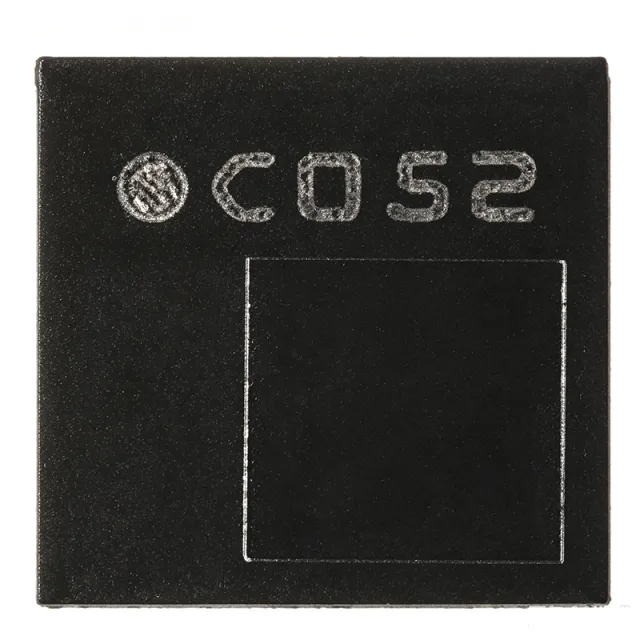
Quick Answers: What Is the LPS22HBTR and What Are Its Key Verified Specs?
The LPS22HBTR is a MEMS capacitive absolute pressure sensor from STMicroelectronics, measuring 260 to 1260 hPa with a resolution of 0.01 hPa (8 Pa) and accuracy of ±0.1 hPa (typical) at 25°C. It operates from 1.7V to 3.6V, draws only 12 µA at 1 Hz ODR, and supports I2C (up to 400 kHz) and SPI (up to 10 MHz). It is available now from XAIPART at $1.9091 per unit at 1000+ quantities (as of 2026-08-25).
Technical Guide: How to Select, Design In, and Use the LPS22HBTR
The LPS22HBTR is a digital output pressure sensor with an integrated 24-bit ADC and a 128-level FIFO, making it easy to interface with microcontrollers. Its small HLGA package (2.0 x 2.0 x 0.7 mm) suits space-constrained designs.
Selection Criteria
When selecting a pressure sensor, verify the pressure range, accuracy, resolution, supply voltage, current consumption, interface, and package. The LPS22HBTR covers 260-1260 hPa, which suits most barometric applications. Its ±0.1 hPa accuracy and 0.01 hPa resolution enable precise altitude measurements. The wide supply range (1.7-3.6V) allows direct battery operation.
Design-In Steps
1. Connect power (VDD, VDD_IO, GND) with decoupling capacitors. 2. Choose I2C or SPI interface and connect SCL/SPC, SDA/SDI, SA0/SDO, and CS accordingly. 3. Route the INT_DRDY pin to an MCU interrupt for data-ready or threshold events. 4. Provide a small pressure port opening to the environment, avoiding solder mask or conformal coating over the sensing element. 5. Configure ODR (1 Hz to 75 Hz) and FIFO via registers.
Power Consumption Optimization
At 1 Hz ODR, the LPS22HBTR draws only 12 µA. In power-down mode, it draws 1 µA. Use the FIFO to store data and wake the host less frequently, reducing overall system power.
PCB Layout Considerations
Ensure the pressure port is not blocked. Keep the sensing element exposed. Avoid placing components that generate heat nearby to minimize temperature-induced errors.
Alternatives & Comparison: Drop-In Replacements for LPS22HBTR
For a true drop-in replacement, the LPS22HHTR (same die and package) is the best choice. Cross-brand alternatives like BMP388 and MPL3115A2 are not pin-compatible and require PCB changes.
| Parameter | LPS22HBTR | LPS22HHTR | BMP388 | MPL3115A2 |
|---|---|---|---|---|
| Pressure Range | 260-1260 hPa | 260-1260 hPa | 300-1250 hPa | 20-110 kPa |
| Accuracy | ±0.1 hPa (typ) | ±0.1 hPa (typ) | ±0.1 hPa (typ) | ±0.1 hPa (typ) |
| Resolution | 0.01 hPa | 0.01 hPa | 0.016 hPa | 0.05 kPa |
| Supply Voltage | 1.7-3.6V | 1.7-3.6V | 1.71-3.6V | 1.95-3.6V |
| Current Consumption (1 Hz) | 12 µA | 12 µA | 3.4 µA | 40 µA |
| Interface | I2C/SPI | I2C/SPI | I2C/SPI | I2C |
| Package | HLGA 2x2x0.7mm | HLGA 2x2x0.7mm | LGA-10 2x2x0.8mm | LGA-8 3x3x1.1mm |
| Pin-Compatible | - | Yes | No | No |
Summary: The LPS22HHTR is the only pin-compatible drop-in replacement. BMP388 offers lower power but requires PCB rework. MPL3115A2 has a larger package and higher power.
Industry Insight: Market Position, Lifecycle, and Supply Situation
The LPS22HBTR has an active lifecycle status, indicating it is in production and available. XAIPART currently stocks 99,999 units, with a base price of $1.9091 at 1000+ quantities (as of 2026-08-25). Its wide adoption in drones, wearables, and IoT devices suggests strong market demand.
Trends & Outlook: What Buyers Should Watch
As IoT and wearable devices continue to demand lower power and smaller footprints, the LPS22HBTR's 12 µA consumption and 2x2x0.7mm package remain competitive. The trend toward higher accuracy and lower noise may drive adoption of the newer LPS22HH, but the LPS22HBTR remains a cost-effective choice. Buyers should monitor supply availability and consider the LPS22HHTR as a direct replacement.
Comments
Be the first to comment.
🔐 Please sign in to post a comment.
Don't have an account? Sign up