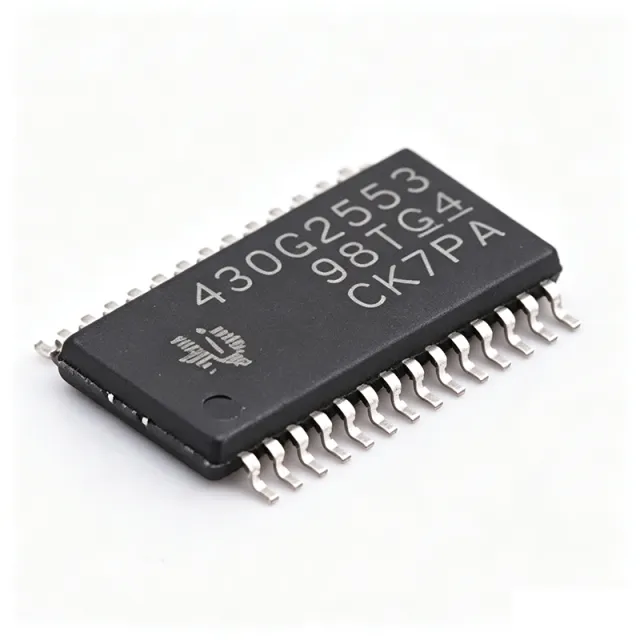
The Texas Instruments MSP430G2553IPW28R is a 16-bit ultra-low-power mixed-signal microcontroller with a 16MHz MSP430 CPU16 core, 16KB Flash, 512B SRAM, and 16 I/O pins. It operates from 1.8V to 3.6V and is available now through XAIPART with 99,999 units in stock and a base price of $0.8591 at qty >=1000 as of 2026-08-26. The 28-pin TSSOP package, -40°C to +85°C temperature range, and integrated 10-bit 8-channel ADC, comparator, and UART/SPI/I2C make it suitable for battery-powered sensors, wearables, smart home, industrial monitoring, portable medical, and consumer electronics. See the MSP430G2553IPW28R product page for the latest stock and datasheet.
Quick Answers
Engineers evaluating this device need five facts. The MSP430G2553IPW28R is an active, production-ready MCU from Texas Instruments with a 16-bit MSP430 CPU16 core running at 16MHz, 16KB Flash, and 512B SRAM. It operates from 1.8V to 3.6V, allowing two AA cells or a single Li-ion coin cell to power it directly. Its ultra-low-power modes are exceptional: standby current is 0.5 µA typical and off mode with RAM retention drops to 0.1 µA. The integrated 10-bit ADC has 8 channels, and the USCI supports UART, SPI, and I2C. Current XAIPART pricing as of 2026-08-26 is $1.4727 at qty 1, $1.0636 at qty 10, $0.9409 at qty 100, $0.9 at qty 500, and $0.8591 at qty 1000, with an active lifecycle and 99,999 units in stock.
Technical Guide
Select the right package, memory, and power envelope
For space-constrained PCB designs, the 28-pin TSSOP body width of 4.40mm is compact, and the device is specified for -40°C to +85°C. The 16KB Flash (16K x 8) and 512B SRAM handle moderate firmware and buffering. The wide 1.8-3.6V supply range is a first-order selection criterion for battery-powered systems because it removes the need for a separate regulator in many cases. The 16 I/O pins are capacitive-touch enabled, so you can build touch interfaces without external touch controller ICs.
Design the power supply and decoupling
Power DVCC (pin 1) and AVCC (pin 28) from the same rail whenever possible. Place a 0.1 µF capacitor close to each VCC pin and a 1 µF capacitor at the power entry point. Connect DVSS (pin 19) to a solid ground plane. The brownout reset circuit helps prevent unreliable operation at low voltage.
Use the ultra-low-power modes effectively
The MSP430G2553IPW28R provides five low-power modes, LPM0 through LPM4. The CPU can be disabled while peripherals continue to operate. Standby current is 0.5 µA typical, and off mode with RAM retention is 0.1 µA. For a low-duty-cycle sensor node that sleeps most of the time, these numbers translate directly into multi-year battery life.
Wire up analog and serial peripherals
The 10-bit ADC has 8 external channels and an internal temperature sensor, so it can digitize analog sensor outputs. The versatile analog comparator can condition signals or perform slope analog-to-digital conversion. The USCI supports UART, SPI, and I2C, which covers most sensor and radio modules. Whether you need to talk to a display, LoRa/Sigfox radio, or memory device, the interface configuration is flexible.
Program, debug, and update firmware
In-system programming is supported through Spy-Bi-Wire, a two-wire JTAG interface. The internal digitally controlled oscillator (DCO) can be calibrated to ±1% accuracy, and the flexible clock system supports internal oscillators up to 16MHz. That means many designs do not need external crystals. Configure unused I/O pins as outputs to avoid floating inputs, which can increase leakage current.
Alternatives & Comparison
For a true drop-in, the MSP430G2553IPW28 is the same die and package; only the shipping format differs (the R suffix = tape-and-reel, non-R = tube). The MSP430G2253IPW28R is pin-compatible but has 8KB Flash instead of 16KB. The MSP430G2452IPW28R drops to 8KB Flash and 256B SRAM and removes I2C. The automotive-grade MSP430G2553IPW28RQ1 provides the same die and package with AEC-Q100 qualification. See the verified differences in the table below.
| Parameter | MSP430G2553IPW28R | MSP430G2553IPW28 | MSP430G2253IPW28R | MSP430G2452IPW28R |
|---|---|---|---|---|
| Program Memory Size | 16KB (16K x 8) | 16KB (same die) | 8KB | 8KB |
| RAM Size | 512 x 8 | 512 x 8 (same die) | 512B | 256B |
| I2C | Yes (USCI supports UART/SPI/I2C) | Yes (same die) | Yes (same peripherals) | No |
| Package / Pinout | 28-TSSOP | 28-TSSOP (same) | 28-TSSOP (same pinout) | 28-TSSOP (same pinout) |
| Packaging | Tape-and-reel | Tube | Tape-and-reel | Tape-and-reel |
If your firmware fits in 8KB, the MSP430G2253IPW28R can reduce cost; if I2C is not required, the G2452 shrinks SRAM. For existing MSP430G2553 designs, keep the non-R G2553IPW28 as the lowest-risk drop-in because it is electrically identical.
Industry Insight
The MSP430G2553IPW28R is in active lifecycle status in the XAIPART database. Current inventory is 99,999 units with a MOQ of 1, indicating broad availability for prototyping and production. As of 2026-08-26, the verified XAIPART base price is $0.8591 at qty >=1000, with a single-unit price of $1.4727. This value-line MCU is described as a mature, widely available part with extensive community support, which is an important signal for long-term designs.
Trends & Outlook
Demand for battery-powered and energy-harvesting systems continues to emphasize ultra-low current consumption. The MSP430G2553IPW28R's 0.5 µA standby and 0.1 µA off-mode floor make it directly relevant for wireless sensor nodes, wearables, and portable medical devices. The 16MHz internal DCO reduces BOM cost by removing external crystals, and the 10-bit ADC plus UART/SPI/I2C covers common sensor-to-radio chains. Buyers should watch lifecycle status and stock levels before new designs; this part is currently active, but procurement teams should verify lead times with their distributor. The tape-and-reel variant remains assembly-friendly for automated SMT lines.
Comments
Be the first to comment.
🔐 Please sign in to post a comment.
Don't have an account? Sign up