Quick Answers: What is the PCM2705C and Why Does It Matter?
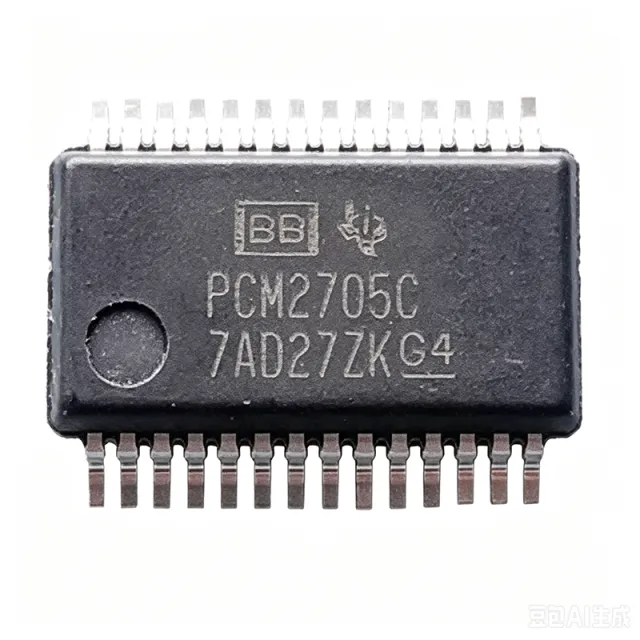
The Texas Instruments PCM2705C is a single-chip stereo audio digital-to-analog converter (DAC) with an integrated USB 2.0 full-speed protocol controller and S/PDIF output. It delivers a 98dB SNR, operates from a 3.3V supply, and supports both bus-powered and self-powered modes. The device is fully compliant with USB 2.0 and USB Audio Class, requiring no dedicated device driver, and comes in a compact 28-pin SSOP package. As of 2026-08-27, the PCM2705C is in active production with 99,999 units in stock at XAIPART, priced at $3.8182 per unit at 1000+ quantities. This guide provides a comprehensive technical overview, design considerations, alternatives, and market insights for engineers and buyers.
Technical Guide: How to Select, Design In, and Use the PCM2705C
Key Specifications and Features
The PCM2705C integrates a USB 2.0 full-speed transceiver, protocol controller, and a stereo DAC with 98dB SNR. It supports both bus-powered and self-powered operation, making it flexible for various applications. The device includes an S/PDIF digital output, allowing direct connection to external decoders or amplifiers. The SPI interface enables partial programming of USB descriptors, allowing customization of vendor ID and product ID. The operating temperature range is -25°C to +85°C, and it is RoHS compliant.
Selecting the PCM2705C for Your Design
When selecting the PCM2705C, consider the following:
- Power Supply: The device requires a 3.3V supply. Ensure proper decoupling with 0.1µF and 10µF capacitors close to the VCC pin.
- USB Interface: The integrated USB transceiver simplifies design. Route the D+ and D- traces as a differential pair with controlled impedance (90Ω) to maintain signal integrity.
- Clock Source: An external crystal (e.g., 12MHz) is required on XTAL_IN and XTAL_OUT. Place the crystal close to the pins and add load capacitors as specified in the datasheet.
- Output Configuration: The analog outputs (VOUTL, VOUTR) are line-level. Use AC coupling capacitors if driving a headphone amplifier or external ADC.
- SPI Descriptor Programming: If you need to customize USB descriptors, connect the SPI pins (SPI_CLK, SPI_CS, SPI_DIN, SPI_DOUT) to your microcontroller. Program the descriptors during initialization.
Designing with the PCM2705C: Step-by-Step
- Power Supply Design: Provide a clean 3.3V supply. For bus-powered operation, derive 3.3V from the USB VBUS using an LDO. For self-powered mode, use a regulated 3.3V supply.
- USB Connection: Connect D+ and D- directly to the USB connector. Add series resistors (e.g., 22Ω) if needed for impedance matching.
- Crystal Oscillator: Connect a 12MHz crystal between XTAL_IN and XTAL_OUT with appropriate load capacitors (typically 18-22pF).
- Analog Outputs: Connect VOUTL and VOUTR to your audio amplifier or line-out jack. Use 1µF coupling capacitors if DC blocking is required.
- S/PDIF Output: The S/PDIF pin provides a digital audio output. Connect it to an optical transmitter or coaxial driver for digital audio transmission.
- SPI Configuration: If using SPI descriptor programming, connect the SPI pins to your MCU. Set PSEL and HOST pins according to your power mode and host configuration.
Layout Best Practices
- Keep the USB differential pair traces short and parallel, with ground plane underneath.
- Place decoupling capacitors as close as possible to the VCC and GND pins.
- Isolate analog and digital ground planes to reduce noise coupling.
- Follow the layout guidelines in the datasheet for optimal performance.
Alternatives & Comparison: Drop-In Replacements for PCM2705C
The PCM2705C is part of TI's PCM270x family. The following alternatives are pin-compatible and offer similar performance. Use the comparison table to evaluate key differences.
| Parameter | PCM2705C | PCM2705 | PCM2704C | PCM2706C | PCM2707C |
|---|---|---|---|---|---|
| SNR (DAC) | 98 dB | 98 dB | 98 dB | 98 dB | [DATA_NEEDED: SNR] |
| USB Interface | USB 2.0 Full-Speed | USB 2.0 Full-Speed | USB 2.0 Full-Speed | USB 2.0 Full-Speed | [DATA_NEEDED: USB Interface] |
| Output Type | Line-out, S/PDIF | Line-out, S/PDIF | Line-out, S/PDIF | Line-out, S/PDIF | [DATA_NEEDED: Output Type] |
| Power Supply | 3.3 V | 3.3 V | 3.3 V | 3.3 V | [DATA_NEEDED: Power Supply] |
| Power Mode | Bus-powered or Self-powered | Bus-powered or Self-powered | Bus-powered or Self-powered | Bus-powered or Self-powered | [DATA_NEEDED: Power Mode] |
| Control Interface | SPI | Fixed descriptors | External ROM | External ROM | SPI |
| Package | SSOP-28 | SSOP-28 | SSOP-28 | SSOP-28 | [DATA_NEEDED: Package] |
| Operating Temperature | -25°C to +85°C | -25°C to +85°C | -25°C to +85°C | -25°C to +85°C | [DATA_NEEDED: Operating Temperature] |
Summary: The PCM2705C offers SPI-based descriptor programming, making it ideal for designs requiring flexible USB descriptor customization. The PCM2705 is a drop-in with fixed descriptors, while the PCM2704C and PCM2706C use external ROM. The PCM2707C is similar to the PCM2705C but may have different features. Verify pinout and software compatibility before substitution.
Industry Insight: Market Position, Lifecycle, and Supply
The PCM2705C is currently in active lifecycle status, indicating ongoing production and availability. As of 2026-08-27, XAIPART holds 99,999 units in stock, ensuring immediate availability for prototyping and production. The device is priced at $3.8182 at 1000+ quantities, with tiered pricing from $6.5455 at single-unit to $4.00 at 500+ units. This pricing structure supports both low-volume and high-volume procurement. The PCM2705C is a mature product in TI's audio converter portfolio, with a strong ecosystem of alternatives and long-term availability expected. [DATA_NEEDED: market share data, competitive landscape, and supply chain details]
Trends & Outlook: What Buyers Should Watch
The demand for USB audio DACs continues to grow with the proliferation of USB-C and mobile devices. The PCM2705C's plug-and-play capability and 98dB SNR make it a solid choice for consumer audio products. Buyers should monitor the following trends:
- USB Audio Class Compliance: The PCM2705C is fully compliant with USB Audio Class, ensuring compatibility with modern operating systems without drivers. This reduces development effort and time-to-market.
- SPI Descriptor Programming: The ability to customize USB descriptors via SPI allows OEMs to brand their products and differentiate in the market. This feature is increasingly important for custom applications.
- Power Efficiency: With support for bus-powered operation, the PCM2705C is suitable for battery-powered devices, aligning with the trend toward portable and low-power audio solutions.
- Supply Chain Stability: With active lifecycle status and substantial stock, the PCM2705C offers supply chain stability. However, buyers should monitor lead times and consider alternative sources if needed.
As audio technology evolves, the PCM2705C remains a reliable and cost-effective solution for USB audio applications. Its combination of performance, flexibility, and ease of use ensures its relevance in the market.
Comments
Be the first to comment.
🔐 Please sign in to post a comment.
Don't have an account? Sign up