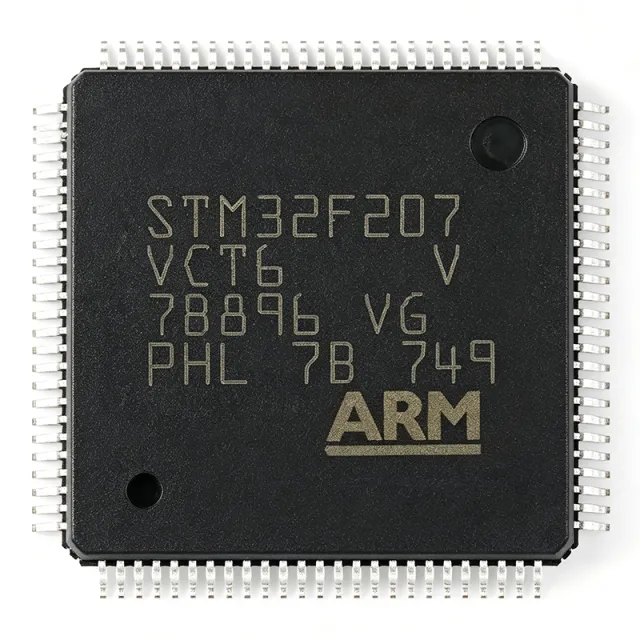
Quick Answers: What Is the STM32F207VCT6 and Why Does It Matter?
The STM32F207VCT6 is a high-performance 32-bit microcontroller from STMicroelectronics, built around the ARM Cortex-M3 core running at up to 120 MHz. It packs 256 KB of Flash and 128 KB of SRAM, and includes a rich set of peripherals such as Ethernet MAC, USB OTG HS, and cryptographic acceleration. As of 2026-08-23, it is in active lifecycle status with 99,999 units in stock at XAIPART, priced at $7.3182 per unit for quantities of 1000 or more. This guide covers everything you need to know to select, design in, and source this versatile MCU.
Technical Guide: How to Select, Design In, and Use the STM32F207VCT6
Core Architecture and Performance
The STM32F207VCT6 is based on the ARM Cortex-M3 core, which provides a balance of performance and power efficiency. With a maximum clock speed of 120 MHz, it can handle complex control algorithms and real-time data processing. The core includes a Nested Vectored Interrupt Controller (NVIC) for efficient interrupt handling and a Memory Protection Unit (MPU) for enhanced system reliability.
Memory and Storage
The device offers 256 KB of Flash memory for program storage and 128 KB of SRAM for data. This configuration is suitable for applications requiring moderate code size and data buffering. If you need more Flash, consider the STM32F207VET6, which offers 512 KB in the same package.
Power Supply and Decoupling
The STM32F207VCT6 operates from 1.8V to 3.6V, making it flexible for battery-powered designs. Ensure proper decoupling of the power supply pins (VDD/VSS) with 100 nF capacitors close to each pair, and a bulk capacitor (e.g., 4.7 µF) on the main supply. The analog supply (VDDA/VSSA) should be filtered separately to minimize noise for ADC accuracy.
Clock Sources
The device can use an internal RC oscillator for basic operation, but for precise timing, connect an external crystal to the OSC_IN/OSC_OUT pins (PF0/PF1). The maximum clock speed of 120 MHz requires a PLL; configure it according to the reference manual. For RTC operation, a 32.768 kHz crystal can be connected to PC14/PC15.
Programming and Debugging
The STM32F207VCT6 supports SWD and JTAG interfaces. For SWD, connect PA13 (SWDIO) and PA14 (SWCLK). For JTAG, use PA15 (JTDI), PB3 (JTDO), and PB4 (NJTRST). These pins are available on the LQFP-100 package. Use a standard ST-Link or J-Link debugger for programming and debugging.
Peripheral Configuration
The device includes 3x SPI, 3x I2C, 4x USART, 2x UART, 2x CAN, USB OTG FS/HS, Ethernet MAC, SDIO, FSMC, 2x 12-bit DAC, and 3x 12-bit ADC (up to 24 channels). When designing, map peripherals to specific pins using the alternate function table in the datasheet. For example, USART1 can be mapped to PA9 (TX) and PA10 (RX).
Design Considerations for Industrial Applications
For industrial environments, the operating temperature range of -40°C to +85°C ensures reliability. Use the cryptographic acceleration (AES, DES, SHA-1, MD5) and true RNG to secure communication. For motor control, leverage the advanced-control timers and multiple ADCs for FOC.
Alternatives & Comparison: Drop-In Replacements for STM32F207VCT6
When selecting a replacement, consider pin compatibility and feature differences. The following table compares the STM32F207VCT6 with verified alternatives from the XAIPART database.
| Parameter | STM32F207VCT6 | STM32F205VCT6 | STM32F207VET6 | STM32F207ZCT6 |
|---|---|---|---|---|
| Core | ARM Cortex-M3 | ARM Cortex-M3 | ARM Cortex-M3 | ARM Cortex-M3 |
| Max Clock Speed | 120 MHz | 120 MHz | 120 MHz | 120 MHz |
| Flash Memory | 256 KB | 256 KB | 512 KB | 256 KB |
| SRAM | 128 KB | 128 KB | 128 KB | 128 KB |
| Package | LQFP-100 | LQFP-100 | LQFP-100 | LQFP-144 |
| Ethernet MAC | Yes | No | Yes | Yes |
| Crypto Acceleration | Yes | No | Yes | Yes |
| GPIO Pins | 82 | 82 | 82 | 114 |
Summary: The STM32F205VCT6 is a pin-compatible drop-in but lacks Ethernet and crypto. The STM32F207VET6 offers double the Flash in the same package. The STM32F207ZCT6 is not pin-compatible due to a different package (LQFP-144) and offers more GPIOs.
Industry Insight: Market Position, Lifecycle, and Supply Situation
The STM32F207VCT6 is in an active lifecycle status, indicating ongoing production and availability. As of 2026-08-23, XAIPART holds 99,999 units in stock, suggesting a stable supply. The STM32F2 series is widely adopted in industrial and IoT applications, and the F207 variant with Ethernet and crypto acceleration is a popular choice for networked embedded systems. [DATA_NEEDED: market share data] [DATA_NEEDED: lead time from STMicroelectronics]
Trends & Outlook: What Buyers Should Watch
With the increasing demand for secure IoT devices, the STM32F207VCT6's cryptographic acceleration and Ethernet MAC position it well for future designs. However, the trend toward higher-performance Cortex-M4/M7 cores may shift some designs to the STM32F407VGT6, which offers a 168 MHz Cortex-M4 with FPU. Buyers should monitor pricing trends: as of 2026-08-23, the 1000-unit price is $7.3182, down from $12.5455 at single-unit quantity. This volume pricing makes the F207VCT6 cost-effective for production runs. [VERIFY_NEEDED: long-term availability commitment from ST]
Comments
Be the first to comment.
🔐 Please sign in to post a comment.
Don't have an account? Sign up