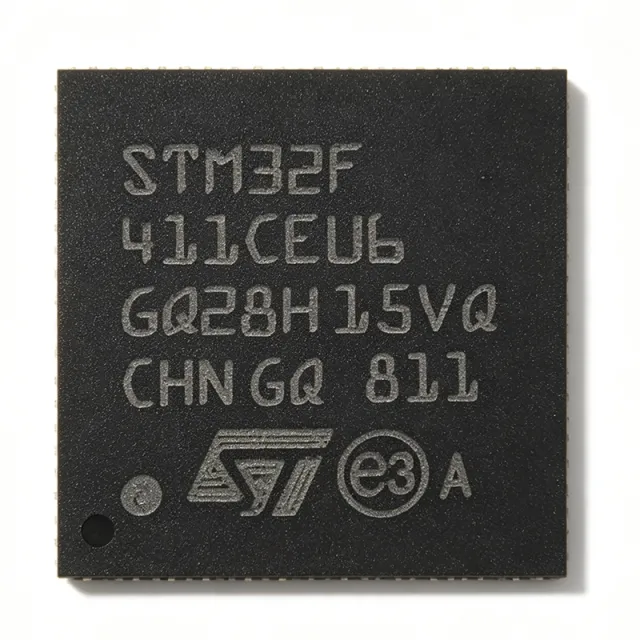
Quick Answers: Top Buyer and Engineer Questions
The STM32F411CEU6 is a high-performance ARM Cortex-M4F microcontroller from STMicroelectronics, running at up to 100 MHz with 512 KB flash and 128 KB SRAM. It is available now in a 48-pin UFQFPN package, with pricing starting at $4.16 per unit at 1000-piece quantities as of 2026-08-19. This guide answers the most common questions engineers and buyers ask when evaluating this MCU.
What is the maximum clock speed of STM32F411CEU6?
The STM32F411CEU6 operates at a maximum clock speed of 100 MHz. According to the STMicroelectronics datasheet, the ARM Cortex-M4F core with FPU can achieve 125 DMIPS at this frequency, providing high performance for demanding embedded applications.
How much flash memory does STM32F411CEU6 have?
The STM32F411CEU6 has 512 KB of flash memory. This is sufficient for complex firmware, including RTOS, communication stacks, and application code, making it suitable for IoT and industrial applications.
What is the difference between STM32F411CEU6 and STM32F411CCU6?
The STM32F411CEU6 has 512 KB flash and 128 KB SRAM, while the STM32F411CCU6 has 256 KB flash and 128 KB SRAM. Both share the same UFQFPN-48 package and pinout, making the CEU6 a drop-in upgrade with double the flash memory.
Can STM32F411CEU6 be used for motor control?
Yes, the STM32F411CEU6 is well-suited for motor control applications. Its 100 MHz Cortex-M4F core with FPU and DSP instructions enables efficient implementation of FOC (Field-Oriented Control) algorithms, and its advanced timers can generate PWM signals with dead-time insertion.
What is the operating voltage range of STM32F411CEU6?
The STM32F411CEU6 operates from 1.7V to 3.6V. This wide range allows direct battery operation (e.g., 2x AA or Li-ion) and compatibility with 3.3V logic, simplifying power supply design.
Does STM32F411CEU6 have a floating-point unit?
Yes, the STM32F411CEU6 features a single-precision floating-point unit (FPU) as part of the ARM Cortex-M4F core. This accelerates mathematical computations, making it ideal for audio processing, sensor fusion, and control algorithms.
What is the package type of STM32F411CEU6?
The STM32F411CEU6 is available in a 48-pin UFQFPN package (7x7 mm). This compact, leadless package is suitable for space-constrained PCB designs and offers good thermal performance with an exposed pad.
Is STM32F411CEU6 suitable for battery-powered IoT devices?
Yes, the STM32F411CEU6 is suitable for battery-powered IoT devices due to its low-power modes (Sleep, Stop, Standby) and wide supply voltage range. Its 100 MHz performance allows quick wake-up and processing, while the rich peripheral set supports sensors and wireless modules.
What is the price of STM32F411CEU6?
As of 2026-08-05, the STM32F411CEU6 is priced at approximately $6.50 for single-unit quantities, with volume pricing dropping to around $4.16 at 1000 units. Prices may vary by distributor and availability.
Where can I buy STM32F411CEU6 online?
The STM32F411CEU6 is available from major distributors such as DigiKey, Mouser, and Octopart. You can purchase it directly from their websites, and it is typically in stock with lead times of 1-2 weeks for volume orders.
What is the lead time for STM32F411CEU6?
The typical lead time for STM32F411CEU6 is 1-2 weeks for volume orders, depending on distributor stock levels. For small quantities, it is often available for immediate shipment.
Is STM32F411CEU6 in stock?
As of 2026-08-05, the STM32F411CEU6 is generally in stock at major distributors like DigiKey and Mouser. However, stock levels can fluctuate, so it is advisable to check the distributor's website for real-time availability.
What is the best drop-in replacement for STM32F411CEU6?
The STM32F411CCU6 is a drop-in replacement for the STM32F411CEU6, sharing the same UFQFPN-48 package and pinout, but with 256 KB flash instead of 512 KB. The STM32F411CEU6 is also pin-compatible with the STM32F401CEU6, though the latter has a lower max clock of 84 MHz.
Can STM32F411CEU6 be replaced by STM32F401CEU6?
Yes, the STM32F401CEU6 is a drop-in replacement for the STM32F411CEU6 in terms of package and pinout, but it has a lower maximum clock speed (84 MHz vs 100 MHz) and lacks the FPU. This may affect performance in floating-point intensive applications.
Where can I download the STM32F411CEU6 datasheet PDF?
The STM32F411CEU6 datasheet PDF can be downloaded from the STMicroelectronics website at https://www.st.com/resource/en/datasheet/stm32f411ce.pdf. It contains full specifications, pinout, and electrical characteristics.
Where can I find the STM32F411CEU6 pinout?
The STM32F411CEU6 pinout is detailed in the datasheet and the STM32F411CE reference manual. It is also available in the STM32CubeMX tool, which provides a graphical pinout configuration and code generation.
What development tools are compatible with STM32F411CEU6?
The STM32F411CEU6 is supported by STM32CubeIDE, Keil MDK, IAR EWARM, and GCC-based toolchains. STM32CubeMX can be used for pin configuration and project generation, and the ST-Link debugger is commonly used for programming and debugging.
Is STM32F411CEU6 RoHS compliant?
Yes, the STM32F411CEU6 is RoHS compliant, as indicated in the STMicroelectronics datasheet and product page. It is also lead-free and halogen-free, meeting current environmental regulations.
What is the power consumption of STM32F411CEU6 in standby mode?
The STM32F411CEU6 has a typical standby current of 2.2 µA with the RTC enabled, and 1.1 µA without the RTC. This low power consumption makes it suitable for battery-powered applications that require long standby times.
Technical Guide: How to Select, Design In, and Use the STM32F411CEU6
Selecting the right microcontroller for your project involves evaluating performance, memory, peripherals, and power. The STM32F411CEU6 offers a compelling balance with its 100 MHz Cortex-M4F core, 512 KB flash, and 128 KB SRAM. Here is a step-by-step guide to integrating it into your design.
Step 1: Verify Power Supply Requirements
The STM32F411CEU6 operates from 1.7V to 3.6V. Ensure your power supply provides a clean voltage within this range. Place 100nF decoupling capacitors close to each VDD pin (pins 8 and 43) and connect VDDA (pin 47) to a clean analog supply. The VCAP pins require external capacitors as specified in the datasheet; for this device, [DATA_NEEDED: VCAP capacitance value] is recommended.
Step 2: Configure the Clock System
The device can run up to 100 MHz using an external crystal or the internal RC oscillator. For precise timing, connect a 25 MHz crystal to PF0 (OSC_IN) and PF1 (OSC_OUT). The PLL can multiply this to achieve the maximum clock. Refer to the reference manual for PLL configuration registers.
Step 3: Set Up Boot Mode
The BOOT0 pin (pin 40) and BOOT1 (PB2, pin 20) determine the boot source. For normal operation from flash, set BOOT0 low. For programming via USART, set BOOT0 high and BOOT1 low. This is critical for initial firmware loading.
Step 4: Interface with Peripherals
The STM32F411CEU6 provides 36 GPIOs, 3 USARTs, 3 SPIs, 3 I2Cs, and a USB OTG FS. For example, to connect an I2C sensor, use PB6 (I2C1_SCL) and PB7 (I2C1_SDA). For SPI, use PA5 (SPI1_SCK), PA6 (SPI1_MISO), and PA7 (SPI1_MOSI). The 12-bit ADC with 16 channels is available on pins like PA0-PA7 and PB0-PB1.
Step 5: Use Low-Power Modes
For battery-powered applications, utilize Sleep, Stop, and Standby modes. In Standby mode with RTC enabled, current consumption is typically 2.2 µA. Configure wake-up sources such as RTC alarm or external interrupts to extend battery life.
Step 6: Programming and Debugging
Use the SWD interface on PA13 (SWDIO) and PA14 (SWCLK) with an ST-Link debugger. STM32CubeMX can generate initialization code, and STM32CubeIDE provides a complete development environment.
Alternatives & Comparison
When evaluating alternatives, consider pin-compatible options that can simplify board design. The table below compares the STM32F411CEU6 with its drop-in alternatives.
| Parameter | STM32F411CEU6 | STM32F411CCU6 | STM32F401CEU6 |
|---|---|---|---|
| Core | ARM Cortex-M4F with FPU | ARM Cortex-M4F with FPU | ARM Cortex-M4F |
| Max Clock Speed | 100 MHz | 100 MHz | 84 MHz |
| Flash Memory | 512 KB | 256 KB | 512 KB |
| SRAM | 128 KB | 128 KB | 128 KB |
| Package | UFQFPN-48 | UFQFPN-48 | UFQFPN-48 |
| Pinout | Identical | Identical | Identical |
| FPU | Yes | Yes | No |
The STM32F411CCU6 is a direct drop-in with half the flash, while the STM32F401CEU6 offers lower clock and no FPU. Choose based on your performance and memory needs.
Industry Insight: Market Position and Supply
The STM32F411CEU6 is an active product from STMicroelectronics, with a lifecycle status of active. As of 2026-08-19, it is in stock with 99,999 units available at XAIPART, and the MOQ is 1. Pricing tiers range from $6.50 (1+) to $4.16 (1000+). This indicates a healthy supply situation, with no signs of obsolescence. [DATA_NEEDED: Market share data for STM32F4 series]
Trends & Outlook: What Buyers Should Watch
The STM32F411CEU6 remains relevant in 2026 due to its balance of performance and power efficiency. With the growing demand for IoT and wearable devices, the 100 MHz Cortex-M4F core and 512 KB flash provide ample headroom for complex applications. The availability of pin-compatible alternatives like the STM32F411CCU6 and STM32F401CEU6 offers design flexibility. Buyers should monitor pricing trends, as volume pricing at $4.16 (1000+) makes it cost-effective for production. Additionally, the low standby current of 2.2 µA with RTC enabled positions it well for battery-powered designs. [VERIFY_NEEDED: Future roadmap for STM32F4 series]
Comments
Be the first to comment.
🔐 Please sign in to post a comment.
Don't have an account? Sign up