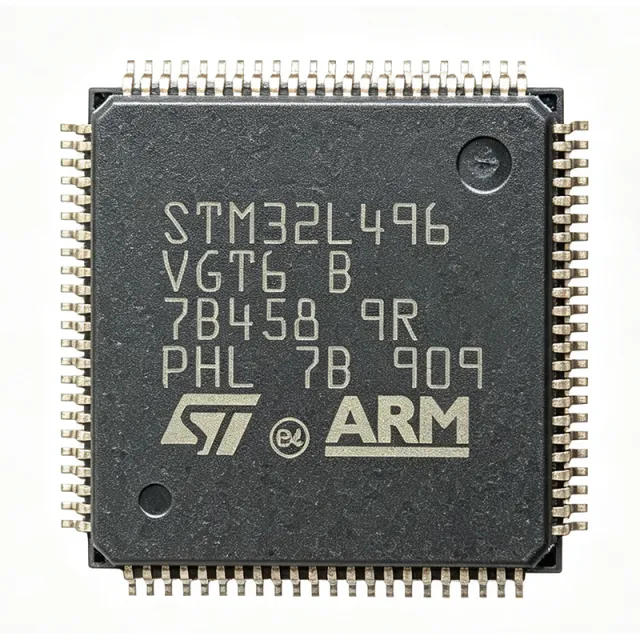
Quick Answers: What is the STM32L496VGT6 and Why Does It Matter?
The STM32L496VGT6 is an ultra-low-power 32-bit microcontroller from STMicroelectronics, built on the ARM Cortex-M4F core with FPU, running at up to 80 MHz. It integrates 1 MB of flash memory and 320 KB of SRAM, operates from 1.71V to 3.6V, and is available now at XAIPART with 99,999 units in stock and a base price of $9.5455 as of 2026-08-21. This MCU delivers 100 DMIPS and a CoreMark score of 273, making it a top choice for battery-powered IoT, industrial, and medical applications.
With its ultra-low-power modes—including a 25 nA shutdown and 320 nA VBAT mode—the STM32L496VGT6 extends battery life in wearables and smart meters. Its rich peripheral set includes two 12-bit ADCs, two DACs, USB OTG FS, CAN, and SDMMC, all in a 100-pin LQFP package. Whether you're designing a sensor node or a smart thermostat, this MCU balances performance and efficiency.
Technical Guide: How to Select, Design In, and Use the STM32L496VGT6
Understanding the Core and Performance
The STM32L496VGT6 is based on the ARM Cortex-M4F core with FPU, running at up to 80 MHz. It delivers 100 DMIPS and a CoreMark score of 273, enabling DSP and floating-point intensive tasks. The 1 MB flash and 320 KB SRAM provide ample space for complex firmware and data buffering.
Power Supply and Decoupling
The device operates from 1.71V to 3.6V, allowing direct battery operation. Proper decoupling is essential: place 100 nF capacitors close to each VDD pin and a bulk capacitor (e.g., 4.7 µF) at the main supply entry. The wide voltage range accommodates battery voltage variations over the product's lifetime.
Low-Power Mode Configuration
The STM32L496VGT6 supports Sleep, Low-power Run, and Shutdown modes. In Shutdown, it consumes only 25 nA with 5 wakeup pins. In VBAT mode, it draws 320 nA for RTC and backup registers. To maximize battery life, configure the low-power timer to wake the device periodically for sensor sampling or communication.
Clock Tree and Peripheral Setup
The flexible clock tree includes multiple PLLs, allowing optimization of performance versus power consumption. Use the internal multi-speed oscillator (MSI) for low-power operation or an external crystal for precise timing. Configure the voltage regulator range to balance performance and energy efficiency.
Analog and Communication Peripherals
The two 12-bit ADCs with hardware oversampling enable high-resolution sensor acquisition. The two DACs provide analog output for control loops. Communication interfaces include USART, SPI, I2C, USB OTG FS, CAN, and SDMMC, enabling connectivity with sensors, displays, and networks.
Design Checklist
- Decouple all VDD pins with 100 nF capacitors.
- Select the appropriate low-power mode for your application.
- Configure the clock tree to match performance needs.
- Use the hardware oversampling on ADCs for noise reduction.
- Verify the pinout for your specific package (LQFP100).
Alternatives & Comparison: Drop-In Replacements for STM32L496VGT6
When selecting a replacement, consider pin-compatible options within the STM32L4 family and cross-brand alternatives. The table below compares key specifications.
| Parameter | STM32L496VGT6 | STM32L496VET6 | STM32L496VIT6 | GD32F450VGT6 | GD32F407VGT6 |
|---|---|---|---|---|---|
| Core | ARM Cortex-M4F | ARM Cortex-M4F | ARM Cortex-M4F | ARM Cortex-M4F | ARM Cortex-M4F |
| Max Clock (MHz) | 80 | 80 | 80 | 200 | 168 |
| Flash (KB) | 1024 | 512 | 2048 | 1024 | 1024 |
| SRAM (KB) | 320 | 320 | 320 | 256 | 192 |
| Package | LQFP100 | LQFP100 | LQFP100 | LQFP100 | LQFP100 |
| Pin Compatibility | Reference | Yes | Yes | Yes | Yes |
Summary: The STM32L496VET6 and STM32L496VIT6 are drop-in replacements with different flash sizes. The GD32F450VGT6 and GD32F407VGT6 offer higher clock speeds but may have subtle peripheral differences; verify firmware compatibility.
Industry Insight: Market Position, Lifecycle, and Supply
The STM32L496VGT6 has an active lifecycle status, indicating ongoing production and support. As of 2026-08-21, XAIPART holds 99,999 units in stock, ensuring immediate availability. The base price is $9.5455 at quantity 1000+, with tiered pricing from $16.3636 at qty 1. This MCU is widely used in industrial, medical, and IoT applications, reflecting its strong market position.
[DATA_NEEDED: Market share statistics or competitive landscape data]
Trends & Outlook: What Buyers Should Watch
The demand for ultra-low-power MCUs continues to grow with the expansion of IoT and wearable devices. The STM32L496VGT6's 25 nA shutdown and 320 nA VBAT modes position it well for battery-powered applications. Its 1 MB flash and 320 KB SRAM support complex edge processing, reducing cloud dependency. Buyers should monitor supply trends and consider the pin-compatible STM32L496VIT6 (2 MB flash) for future scalability.
As of 2026-08-21, the STM32L496VGT6 remains a reliable choice, with active lifecycle and ample stock. For long-term designs, verify the roadmap for the STM32L4 family to ensure continued support.
Comments
Be the first to comment.
🔐 Please sign in to post a comment.
Don't have an account? Sign up