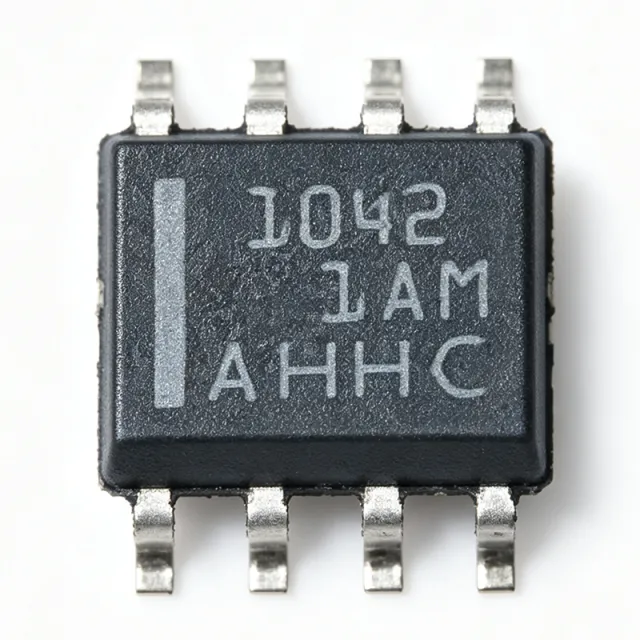
What Is the TCAN1042GVDRQ1 and Why Should Engineers Choose It?
The TCAN1042GVDRQ1 is an automotive fault-protected CAN transceiver from Texas Instruments that supports CAN FD data rates up to 5 Mbps with I/O level shifting, housed in an 8-pin SOIC (D) package and operating across -55°C to 125°C. It provides a 1/1 driver/receiver configuration with half-duplex operation and meets the requirements of ISO 11898-2 for automotive CAN physical layers. As of 2026-08-30, the part is active in the lifecycle, stocked at 99,999 units on XAIPART with MOQ of 1, priced at $0.509 for single units and $0.349 at 1,000 pieces.
A CAN transceiver is the physical layer interface between a CAN controller and the twisted-pair CAN bus. It converts differential CANH/CANL bus signals into single-ended logic levels for the controller, and vice versa. In automotive and industrial networks, the transceiver must survive harsh electrical environments, including voltage transients, ground offsets, and short-circuit conditions. The TCAN1042GVDRQ1 integrates a differential driver and receiver with fault protection against bus short circuits and high-voltage transients, plus I/O level shifting that allows direct connection to 3.3V or 5V microcontrollers without external level translators.
Typical applications include automotive body control modules, gateways, battery management systems, industrial automation, medical devices, and aerospace/UAV CAN buses. The wide -55°C to 125°C operating range and automotive designation (AEC-Q100 qualification: [DATA_NEEDED: AEC-Q100 Qualification]) make it suitable for under-hood and harsh-environment deployments.
How Do You Select and Design In the TCAN1042GVDRQ1?
Start by confirming the three headline parameters against your system requirements: the maximum data rate of 5 Mbps for CAN FD (with CAN 2.0 also supported), the supply voltage range ([DATA_NEEDED: Supply Voltage Range] — the TI product page for the TCAN1042GV-Q1 family typically lists 4.5V to 5.5V, but verify from the datasheet before design freeze), and the -55°C to 125°C operating temperature range. The I/O level shifting feature is the deciding factor if your controller runs at 3.3V logic; it eliminates external level-shift circuitry.
PCB Layout and External Components
Follow these design practices drawn from the verified component data:
- Decoupling: Place 100 nF and 10 µF decoupling capacitors close to the VCC pin to minimize noise.
- Bus termination: Use 120 Ω termination resistors at both ends of the bus.
- Package and layout: The SOIC-8 package allows compact PCB layouts, but consider thermal management in high-temperature environments. Thermal resistance (ΘJA) is [DATA_NEEDED: ThetaJA]; verify power dissipation margins for your bus load conditions.
Moisture sensitivity level is [DATA_NEEDED: MSL] and RoHS status is [DATA_NEEDED: RoHS Status]; confirm both for your assembly and compliance processes.
Driver/Receiver Configuration
The device integrates one driver and one receiver (1/1) in a half-duplex configuration, which is the standard architecture for CAN — the same pair of bus pins (CANH/CANL) is shared for transmit and receive. Fault protection safeguards the device and bus against short circuits, thermal stress, and voltage surges, ensuring reliable communication in noisy environments.
What Are the Best Alternatives to the TCAN1042GVDRQ1?
Drop-in alternatives exist within the same TI TCAN1042 family. All share the SOIC-8 package; the key differentiator is data rate and feature set. Only use the verified values below when comparing.
| Parameter | TCAN1042GVDRQ1 | TCAN1042HGDRQ1 | TCAN1042HGVDRQ1 | TCAN1042DRQ1 | TCAN1042HDR |
|---|---|---|---|---|---|
| Package | SOIC-8 (D) | SOIC-8 | SOIC-8 [VERIFY_NEEDED: package for TCAN1042HGVDRQ1] | SOIC-8 | SOIC-8 [VERIFY_NEEDED: package for TCAN1042HDR] |
| Max Data Rate | 5 Mbps | 5 Mbps | [DATA_NEEDED: TCAN1042HGVDRQ1 data rate] | 2 Mbps | [DATA_NEEDED: TCAN1042HDR data rate] |
| I/O Level Shifting | Yes | No (G variant includes it; H variant may differ in wake-up logic) | Possibly different VIO features [VERIFY_NEEDED] | [VERIFY_NEEDED: I/O level shifting for TCAN1042DRQ1] | [VERIFY_NEEDED] |
| Grade | Automotive | Automotive | Automotive | Automotive | Non-automotive grade |
| Pin Compatibility | — | Pin-compatible | [VERIFY_NEEDED] | Pin-compatible | [VERIFY_NEEDED] |
Selection guidance: Choose the TCAN1042GVDRQ1 when you need CAN FD rates up to 5 Mbps with I/O level shifting. If your network is limited to 2 Mbps (standard CAN 2.0), the TCAN1042DRQ1 is pin-compatible, so you can upgrade to the G variant later without PCB changes. For a cross-brand pin-compatible option, the NXP TJA1042 is also pin-compatible — verify electrical characteristics before production use. Full comparison detail lives on each product page; see the TCAN1042GVDRQ1 product page for current stock and pricing.
Where Is the TCAN1042GVDRQ1 Used? Real-World Application Scenarios
The verified application data maps the part to six environments. Each relies on the same core spec set: 5 Mbps CAN FD, fault protection, I/O level shifting, and -55°C to 125°C operation.
- Automotive body control modules: Reliable CAN between body MCUs and the vehicle network; fault protection handles voltage transients up to 40V and bus short circuits while meeting ISO 11898-2. I/O level shifting interfaces directly with 3.3V MCUs such as the TMS320F28035-Q1.
- Gateways and telematics: 5 Mbps CAN FD supports high-bandwidth firmware updates and sensor aggregation; direct connection to 3.3V processors such as the AM62A1-Q1.
- Industrial CAN networks: 5 Mbps over twisted-pair between PLCs, sensors, and actuators; fault protection guards against surges typical in factory environments.
- Battery management systems: Fault protection guards against high-voltage transient events in EV battery packs; pairs with TI's BQ79616PAPRQ1 cell monitor for rapid cell voltage and temperature data exchange.
- Medical devices: Fault protection supports safe operation under electrical fault conditions; I/O level shifting simplifies 3.3V controller integration in infusion pumps and diagnostic equipment.
- Aerospace/UAV: Handles voltage spikes and bus shorts in aircraft electrical systems; the SOIC-8 package withstands vibration and mechanical stress common in UAVs.
Is the TCAN1042GVDRQ1 Active, In Stock, and Safe to Design In?
Yes. The verified lifecycle status is active, and XAIPART shows 99,999 units in stock with MOQ 1 as of 2026-08-30. Pricing tiers are $0.509 (qty ≥ 1), $0.479 (qty ≥ 10), $0.429 (qty ≥ 100), $0.389 (qty ≥ 500), and $0.349 (qty ≥ 1,000) as of 2026-08-30. Distributors such as DigiKey, Mouser, and LCSC also carry stock. Before committing to production, close the outstanding data gaps: supply voltage range, AEC-Q100 qualification status, RoHS status, MSL, and ΘJA — all marked [DATA_NEEDED] in this article and verifiable from the official TI datasheet. Long-term supply outlook and market share data for this family are [DATA_NEEDED: lifecycle forecast and supply trend data].
What Should Buyers Watch Next for CAN FD Transceivers?
Anchor your roadmap to the verified capabilities of this part. First, CAN FD at 5 Mbps is the differentiator over the 2 Mbps TCAN1042DRQ1 — as automotive gateways, BMS platforms, and industrial controllers migrate to CAN FD, pin-compatible upgrades within the TCAN1042 series let you re-use existing layouts. Second, I/O level shifting is increasingly relevant as 3.3V logic dominates new MCU and processor designs (TMS320F28035-Q1, AM62A1-Q1), removing BOM cost from level translation. Third, the -55°C to 125°C range and fault protection align with under-hood, factory-floor, and aerospace deployment trends. Watch for [VERIFY_NEEDED: next-generation TCAN1042 family variants and roadmap announcements] and confirm compliance data (RoHS, MSL) at procurement time, since these fields remain unverified in the current database.
Comments
Be the first to comment.
🔐 Please sign in to post a comment.
Don't have an account? Sign up