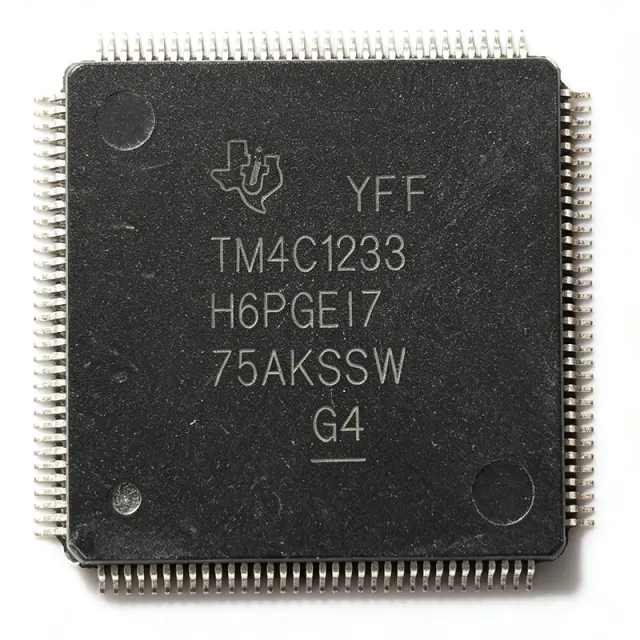
The Texas Instruments TM4C1233H6PGE is a 32-bit Arm Cortex-M4F microcontroller running at 80 MHz with 256 KB flash, 32 KB SRAM, dual CAN 2.0 controllers, USB 2.0 device support, and a battery-backed RTC hibernate module, packaged in a 144-pin LQFP (20x20 mm). It is an active, in-production part. As of 2026-09-04, XAIPART lists 99,999 units in stock with pricing from $10.95 at quantity 1 down to $7.15 at 1,000 units, MOQ 1. This guide consolidates verified specifications, drop-in alternatives within the TM4C123x family, application design notes, and sourcing guidance in one authoritative resource.
What Are the Quick Answers About the TM4C1233H6PGE?
The TM4C1233H6PGE belongs to TI's Tiva C Series TM4C123x family. Its defining verified specifications are: ARM Cortex-M4F core (32-bit) at a maximum 80 MHz clock; 256 KB flash with in-system programming; 32 KB SRAM; up to 2 CAN 2.0 controllers; USB 2.0 device; single-precision FPU; MPU; 12-bit ADCs; PWM generators; RTC via battery-backed hibernate module; and a surface-mount 144-LQFP (20x20 mm) package. TI cites applications in remote monitoring, electronic point-of-sale, test and measurement, network appliances, factory automation, HVAC and building control, and fire and security systems. Supply voltage and operating temperature are not specified in the verified database: [DATA_NEEDED: Supply Voltage], [DATA_NEEDED: Operating Temperature]. Confirm the temperature-grade suffix (commercial TM4C1233H6PGE vs industrial TM4C1233H6PGEI) before ordering.
How Do You Select and Design In the TM4C1233H6PGE?
Core and Memory Budgeting
The 80 MHz Cortex-M4F adds a hardware single-precision FPU, DSP instructions, and an MPU to the standard Cortex-M core, so PI loops and FFT-based processing run without software float overhead. Memory budgeting is the single most important design decision: the 256 KB flash comfortably holds protocol stacks and bootloader firmware, but the 32 KB SRAM must absorb application data, USB stacks, and RTOS overhead. If your middleware footprint is large, evaluate the TM4C123GH6PGE variant or the TM4C129x class instead of forcing the 1233 to fit.
Peripheral Integration
Use the dual CAN 2.0 controllers for fieldbus connectivity (CANopen, J1939-style gateways); hardware message objects offload the CPU. An external CAN transceiver, such as a TI SN65HVD230-class part, is required on the physical layer. USB 2.0 device connectivity eliminates external bridge chips for PC-connected instruments and POS terminals. The 12-bit ADCs and PWM generators cover analog sensing and actuator drive, while the hibernate module's battery-backed RTC preserves time-stamping through power interruptions.
Bootloader and Field Updates
The flash supports in-system programming, and CAN or UART bootloaders enable field firmware updates — critical for deployed remote monitoring and building control equipment where physical access is costly.
Development Tools
Supported toolchains include TI Code Composer Studio with TivaWare for C Series libraries, ARM Keil MDK, IAR Embedded Workbench, and GCC-based toolchains. Debugging uses JTAG or SWD via TI XDS100/XDS110 or the ICDI interface. TivaWare provides peripheral driver libraries, a USB stack, and bootloader source code.
Clocking
Per the TI datasheet (SPMS350E), the core clock derives from the main oscillator or internal precision oscillator through the system clock configuration, with the CAN modules clocked from the system clock using programmable bit timing.
What Are the Best Alternatives and How Do They Compare?
The following same-family alternatives are pin-to-pin compatible in the LQFP-144 footprint per TI's TM4C123x family pinout documentation. All verified values come from the XAIPART database.
| Parameter | TM4C1233H6PGE | TM4C1233H6PGEI | TM4C123GH6PGE | TM4C1231H6PGE | TM4C123BH6PGE | TM4C123FH6PGE |
|---|---|---|---|---|---|---|
| Core / Clock | Cortex-M4F / 80 MHz | Cortex-M4F / 80 MHz | Cortex-M4F / 80 MHz | Cortex-M4F / 80 MHz | Cortex-M4F / 80 MHz | Cortex-M4F / 80 MHz |
| Flash | 256 KB | 256 KB | 256 KB | 256 KB | 256 KB | 256 KB |
| SRAM | 32 KB | 32 KB | 32 KB | 32 KB | 32 KB | 32 KB |
| Package | 144-LQFP (20x20 mm) | 144-LQFP | 144-LQFP | 144-LQFP | 144-LQFP | 144-LQFP |
| Distinguishing feature | Dual CAN 2.0, USB device | Industrial temperature grade (I suffix) | Full peripheral set revision | Reduced peripheral set | Different peripheral mix — verify CAN instance count | USB host/device capability variant |
| Swap effort | — | None (same die) | Firmware-level peripheral check | Firmware-level check | Verify CAN count before swap | Firmware-level check |
Summary: For identical silicon with industrial temperature range, choose the TM4C1233H6PGEI. For new designs wanting the fullest 123x peripheral set, choose the TM4C123GH6PGE. No true cross-brand pin-to-pin equivalent exists — the LQFP-144 pinout is TI-proprietary; STM32F446VCT6 or STM32F407-class parts are functionally comparable but require PCB redesign. [VERIFY_NEEDED: STM32 equivalent spec values not in verified database]
What Is the Market Position, Lifecycle Status, and Supply Situation?
The TM4C1233H6PGE is an active part in Texas Instruments' portfolio — the TI product page lists it with current ordering and quality information, not as discontinued. As of 2026-09-04, XAIPART holds 99,999 units in stock with MOQ 1, indicating no near-term allocation constraint on this channel. The Tiva C line is mature; TI often points engineers toward newer MSPM0 or Sitara class devices for brand-new designs, so plan long-term sourcing accordingly. [DATA_NEEDED: industry-wide supply/allocation data beyond XAIPART stock]
What Trends and Developments Should Buyers Watch?
First, pricing: as of 2026-09-04 the tier structure runs $10.95 (qty 1), $9.86 (qty 10), $8.80 (qty 100), $7.92 (qty 500), $7.15 (qty 1,000) — a 35% unit-price reduction at 1k volume, so consolidating orders captures real savings. MCU pricing fluctuates with allocation cycles; always verify current stock. Second, temperature grade: order the PGEI suffix for factory-floor, outdoor, or automotive-adjacent environments. Third, roadmap maturity: because TI steers new designs toward MSPM0 and Sitara, lock in a second-source strategy — the pin-compatible TM4C123GH6PGE and TM4C1231H6PGE provide same-socket fallbacks within the family. Fourth, anchor decisions to the verified spec set: the dual CAN 2.0 controllers remain the differentiator versus mainstream Cortex-M parts that omit CAN, keeping this part relevant for fieldbus-oriented automation and building control nodes.
Which Applications Benefit Most From the TM4C1233H6PGE?
Verified application scenarios from the TI product page and database include factory automation and PLC nodes (dual CAN fieldbus plus deterministic control loops), remote monitoring and telemetry (hibernate RTC with battery backup, DSP-accelerated analytics), test and measurement equipment (USB 2.0 device connectivity, 12-bit ADCs), electronic point-of-sale machines (USB, multiple UARTs and SSI, RTC timestamping through power interruptions), HVAC and building control (CAN fieldbus segments, PID via hardware FPU, PWM damper/valve actuation), and fire and security systems (event time-stamping, panel-to-panel CAN networking). For motor control, the 80 MHz FPU core, PWM generators, 12-bit ADCs, and quadrature encoder inputs support field-oriented control; pair with gate drivers such as the TI DRV8305. [VERIFY_NEEDED: quadrature encoder interface and DRV8305 pairing details beyond FAQ-level claims]
For full pin assignments, ordering codes, and live stock, see the TM4C1233H6PGE product page. Download the official datasheet PDF (SPMS350E) directly from TI. For higher-performance gateway designs, compare the TM4C1294NCPDT (120 MHz, 1 MB flash, 256 KB SRAM, Ethernet MAC/PHY) — a higher-performance, higher-cost class — against the TM4C1233H6PGE's cost-effective 80 MHz / dual CAN / 32 KB SRAM profile.
Comments
Be the first to comment.
🔐 Please sign in to post a comment.
Don't have an account? Sign up