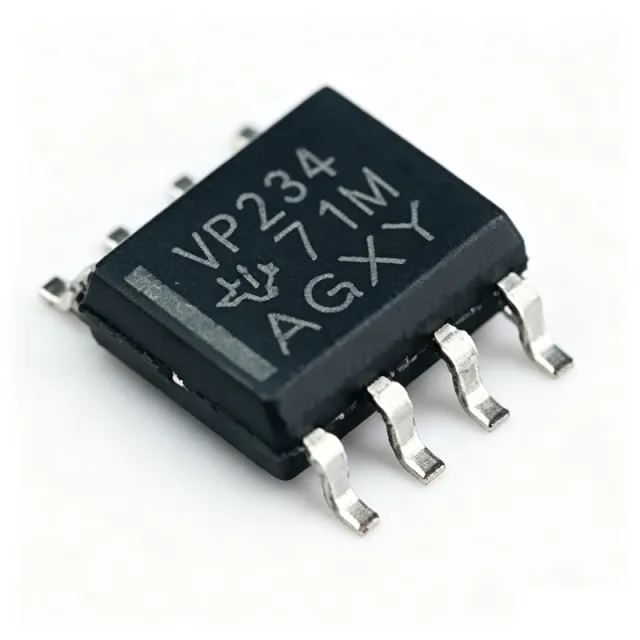
SN65HVD24D
SN65HVD24D Extended Common-Mode RS-485 Transceiver | Texas Instruments
Texas Instruments SN65HVD24D is an extended common-mode RS-485 transceiver with one driver and one receiver, supplied in an 8-pin SOIC package. The device belongs to the SN65HVD2x family, which is designed for long-cable industrial links and exceeds typical RS-485 performance. Its stated features include high ESD protection, wide receiver hysteresis, failsafe operation, and operation across an extended common-mode voltage range. The SN65HVD24D is intended for bidirectional and unidirectional data transmission where robust differential signaling is required.
An RS-485 transceiver is an interface IC that combines a differential line driver with a differential receiver. It converts logic-level signals to and from balanced RS-485 bus signals, placing the transmitted information onto a pair of conductors while rejecting common-mode noise picked up along the cable. Within the interface hierarchy, the SN65HVD24D is a differential bus transceiver, an interface circuit, and a semiconductor designed to connect logic-level equipment to industrial communication networks.
The SN65HVD2x family's key features include compliance with the TIA/EIA-485-A standard, extended common-mode operation, high electrostatic-discharge protection, wide receiver hysteresis, and failsafe behavior. Extended common-mode tolerance is particularly useful when communicating through electrically noisy or long installations where ground-potential differences can appear between connected systems. Wide receiver hysteresis improves decision reliability around the differential threshold, while failsafe operation defines the receiver output when the bus is idle or a driver is disconnected.
The SN65HVD24D integrates one half-rate RS-485 driver and one receiver in an 8-SOIC package. According to the manufacturer datasheet, the family is designed for long-cable applications and provides performance beyond typical RS-485 devices. These features make the device suitable for industrial automation, factory equipment, building controls, and other systems that distribute commands or measurements over substantial cable distances. The exact supply range, data rate, output-current limits, common-mode limits, and channel timing must be confirmed in the device specifications before a new design is released.
Typical uses include motor-drive command links, industrial controller networks, remote sensor interfaces, inverters, and supervisory control systems. In these applications, the transceiver places a balanced signal onto a twisted pair, while its receiver converts the differential voltage back into a logic signal for a microcontroller or field-programmable gate array. System designers should preserve the recommended biasing, termination, protection, and grounding arrangements because these external circuit decisions determine much of the achieved bus immunity and signal quality.
A primary design consideration is the relationship between cable length, data rate, topology, termination, and common-mode voltage. The SN65HVD24D's extended common-mode capability helps with ground-potential differences, but it does not remove the need for surge protection, cable routing discipline, or correct common-mode range analysis. Use the manufacturer datasheet pin-description and application information when assigning PCB tracks, and verify that protection devices do not distort the differential signal or exceed the transceiver's absolute-maximum limits.
This product page organizes the available SN65HVD24D information around the device function, package, application role, design considerations, and documented family features. It also identifies the limits of the current technical record: exact electrical ratings, pin functions, lifecycle details, and a qualified drop-in replacement set must be established from the complete manufacturer documentation before production release.
RFQ
যোগাযোগ