পণ্য (20,000+)

MSP430F449IPZ - 8MHz 16-Bit MCU with 60KB Flash | TI
MSP430F449IPZ

MSP430F449IPZ - 8MHz 16-Bit MCU with 60KB Flash | TI

The Texas Instruments MSP430F449IPZ is an ultra-low-power, mixed-signal 16-bit microcontroller operating at up to 8 MHz, with 60 KB of flash memory, 2 KB of SRAM, a 12-bit ADC, and a 100-pin LQFP package. It integrates SPI, UART, a comparator, and support for a 160-segment LCD, making it suitable for compact embedded control and measurement systems. A mixed-signal microcontroller combines digital processing with analog measurement and interface functions on one device. The MSP430 belongs to the microcontroller hierarchy, where its 16-bit RISC core executes control software while integrated ADC, comparator, serial interfaces, and LCD capability reduce the number of external components. This integration is especially useful in instruments, meters, industrial controls, and portable products where board area, response time, and low standby power are important. Key features include 60 KB of flash for firmware, 2 KB of SRAM for working data, an 8 MHz CPU clock, and a 12-bit ADC for analog measurements. Two UART channels and SPI connectivity support external sensors, transceivers, displays, and data acquisition components. The integrated comparator can perform threshold detection and monitor fast or low-current signals, while the 160-segment LCD capability targets meter and human-interface applications without requiring a separate display controller. The MSP430 architecture uses a 16-bit RISC core with 16-bit registers and constant generators to improve code efficiency. Its mixed-signal feature set places acquisition, control, communications, and display handling in a single package. The MSP430F449IPZ therefore supports a consolidated control architecture in which sensor inputs, operator displays, and communications peripherals can operate around a central low-power processor. Typical applications include handheld and bench-top measurement instruments, industrial panel meters, data loggers, low-power environmental monitors, and embedded systems requiring segmented LCD displays. Its 48 I/Os provide additional connectivity for sensors, switches, indicators, and external interface components. SPI and UART links allow the controller to communicate with transceivers, memory devices, converters, or service interfaces without requiring several dedicated peripheral chips. Design the PCB with attention to analog grounding, ADC input conditioning, and LCD glass routing. Keep analog and digital return paths disciplined, place bypass capacitance close to the supply pins, and follow the manufacturer pin description and layout guidance when assigning the 100 package pins. The -40 °C to +85 °C temperature range supports industrial-temperature designs, while final operating limits should be checked against all electrical and timing requirements. This product page combines the manufacturer specifications, a same-package replacement comparison, application guidance, and PCB-oriented design notes. It is intended to help engineers assess the MSP430F449IPZ for mixed-signal control designs, verify interface compatibility, and plan a low-power embedded architecture before requesting a quote.

RFQ যোগাযোগ
MSP430F477IPN - 8MHz 16-Bit Sensing MCU | Texas Instruments
MSP430F477IPN

MSP430F477IPN - 8MHz 16-Bit Sensing MCU | Texas Instruments

Texas Instruments MSP430F477IPN is an 8-MHz ultra-low-power sensing microcontroller with one 16-bit sigma-delta ADC, one 12-bit DAC, 128-segment LCD support, 32KB Flash, and 2KB RAM in an 80-pin LQFP package. The device operates from 2.5V or 3.3V and is specified over -40°C to +85°C. A microcontroller is a programmable semiconductor that integrates a CPU, memory, and peripherals into a single device. The MSP430F477 belongs to the MSP430 family, whose 16-bit RISC architecture, 16-bit registers, and five low-power modes are optimized for portable measurement systems. It combines a general-purpose MCU with precision conversion and segmented-display resources, reducing the number of discrete components needed in sensing instruments. Principal features include an 8-MHz maximum clock, 32KB of program Flash with an additional 256 bytes, and 2KB of RAM. The sensing subsystem provides a 16-bit sigma-delta ADC and a 12-bit DAC, while the integrated LCD controller supports displays with up to 128 segments. Up to 48 I/O pins provide external connections for sensors, controls, communications, and display elements. The MSP430 architecture uses a 16-bit RISC CPU with 16-bit registers and five low-power modes for portable measurement applications. Its mixed-signal resources allow an analog input to be digitized without adding a separate high-resolution ADC package. The 12-bit DAC provides an analog output, making the MCU applicable to control loops, excitation, calibration, and signal-generation systems where the required resolution does not demand a dedicated converter. Typical uses include industrial panel meters, portable environmental monitors, laboratory instruments, connected sensing nodes, data-acquisition modules, and low-power display products. The 128-segment LCD capability is especially useful for human-readable measurement displays, while the sigma-delta ADC supports precision sensor acquisition and the DAC supports analog control outputs. Designers should preserve the analog and digital grounding strategy required by the sensing peripherals, provide the specified bypass and reference-network components, and validate LCD and external-signal routing in the target enclosure. Component choices should also be checked against the exact ordering information, temperature range, package, and converter requirements in the manufacturer documentation. This page consolidates verified manufacturer, distributor, and distributor-search information for the MSP430F477IPN, including practical application guidance, parameter comparisons, sourcing links, and explicit uncertainty markers where price, full pinout, and verified drop-in replacements were not available.

RFQ যোগাযোগ
MSP430F478IPN - 16-Bit 8MHz Sensing MCU | Texas Instruments
MSP430F478IPN

MSP430F478IPN - 16-Bit 8MHz Sensing MCU | Texas Instruments

The Texas Instruments MSP430F478IPN is a 16-bit, 8 MHz mixed-signal sensing microcontroller with 48 KB of Flash memory, 2 KB of RAM, one 16-bit Sigma-Delta ADC, one 12-bit DAC, and a 128-segment LCD controller in an 80-LQFP 12 x 12 mm package. It combines the MSP430 CPU16 architecture with integrated analog conversion and LCD drive functions for compact, low-power sensing systems. An MCU is an integrated circuit containing a processor core, memory, peripherals, and interfaces on one die. The MSP430F478 belongs to the mixed-signal microcontroller category within the broader embedded-controller and semiconductor hierarchy. Its sensing-oriented feature set allows a design to acquire analog measurements, process them in software, and present information through an LCD without requiring several separate discrete components. Key features include an 8 MHz maximum clock, 48 KB of Flash program memory, 2 KB of RAM, one 16-bit Sigma-Delta ADC, one 12-bit DAC, support for a 128-segment LCD, and 48 I/O pins. The industrial temperature grade and 80-LQFP package make the device suitable for compact embedded products that require both digital control and analog measurement functions. The MSP430 CPU16 architecture uses a 16-bit register-oriented design intended for low-power embedded control. Flash memory provides 48 KB for firmware, while 2 KB of RAM supports working data. The Sigma-Delta ADC is suited to measurement channels where integrated conversion is useful, and the 12-bit DAC provides an analog output for control or reference applications. The LCD controller can reduce the component count in segment-display designs. Typical applications include industrial panel meters, portable environmental monitors, laboratory instruments, digital thermometers, data loggers, and compact control panels. These uses benefit from combining an ADC, DAC, LCD drive, and microcontroller in a single package while limiting board area and external component count. Designers should verify the complete pin assignment, operating limits, ADC and DAC electrical characteristics, and recommended decoupling directly from the manufacturer datasheet before layout. The supplied verified data identifies the 80-LQFP package but does not provide a public pin-by-pin mapping, so this record does not infer one. This page consolidates verified manufacturer and distributor information, current sourcing data, structured specification gaps, and practical application guidance. It also distinguishes documented facts from unavailable pin-level, pricing-tier, and drop-in replacement data so engineers can make sourcing and design decisions without unsupported assumptions.

RFQ যোগাযোগ
MSP430F479IPN - 8MHz 16-Bit Sensing MCU | Texas Instruments
MSP430F479IPN

MSP430F479IPN - 8MHz 16-Bit Sensing MCU | Texas Instruments

The Texas Instruments MSP430F479IPN is an 8 MHz, 16-bit RISC sensing microcontroller with 60 KB of flash memory, 2 KB of RAM, one 16-bit Sigma-Delta ADC, a 12-bit DAC, and a 128-segment LCD controller in an 80-pin LQFP package. It combines mixed-signal measurement, programmable LCD drive, and low-power embedded control on a single device. A microcontroller is a programmable semiconductor that executes application software, reads sensors, controls peripherals, and interfaces with a wider electronic system. The MSP430 belongs to the ultra-low-power MCU hierarchy, combining a 16-bit RISC core with mixed-signal peripherals. The MSP430F479 targets instrument, meter, sensor-node, and human-interface applications where measured signals must be converted, displayed, and processed locally. Principal features include 60 KB of program flash configured as 60K × 8 bytes plus 256 bytes, 2 KB of RAM, and 48 I/O pins. Its analog subsystem includes one 16-bit Sigma-Delta ADC and a 12-bit DAC. The integrated 128-segment LCD controller reduces external display-driver requirements, while the 8 MHz CPU supports responsive control and measurement processing. The device operates from -40°C to +85°C and is supplied in an LQFP package with 80 pins. The MSP430 architecture is designed around low-power operation, making the MCU suitable for battery-operated instruments and embedded sensing systems. Analog conversion, LCD multiplexing, general-purpose I/O, and serial communications are integrated around the same CPU. This consolidation can reduce board area and simplify firmware when compared with a system assembled from separate microcontroller, ADC, DAC, and LCD-controller devices. Typical uses include industrial panel meters, portable environmental monitors, laboratory instruments, programmable logic controllers, medical monitoring equipment, and energy-metering products. The LCD controller suits products with segment displays, while the Sigma-Delta ADC supports high-resolution measurement of slowly varying or differential sensor signals. Design around the exact pin assignments, analog input limits, LCD segment mapping, and peripheral multiplexing documented in the Texas Instruments datasheet. Keep analog and LCD routing separated from sensitive timing paths, and verify the external-component values required by the selected reference circuit. This product page combines manufacturer specifications, package details, sourcing guidance, design considerations, and verified drop-in candidates. It also identifies where firmware, board-layout, and qualification checks remain necessary before an MSP430F479IPN is released into production equipment.

RFQ যোগাযোগ
MSP430F5152IDAR - 25MHz MCU, 16KB Flash, 38-TSSOP | Texas Instruments
MSP430F5152IDAR

MSP430F5152IDAR - 25MHz MCU, 16KB Flash, 38-TSSOP | Texas Instruments

The Texas Instruments MSP430F5152IDAR is a 16-bit mixed-signal microcontroller with 16KB Flash, 2KB SRAM, a 25 MHz CPU, 10-bit ADC, comparator, DMA, and a 16-bit High-Resolution timer, housed in a 38-pin TSSOP (DA) package rated for the industrial -40C to +85C range. The CPU executes the MSP430 RISC instruction set at up to 25 MIPS, and five low-power modes (LPM0-LPM4) keep active-mode current to roughly 180 uA/MHz and standby current in the single-digit microamp range, which is the core value proposition of the MSP430 family. A microcontroller (MCU) is an integrated circuit that combines a processor core, program memory, data memory, and configurable peripherals on a single silicon die. The MSP430 architecture belongs to the 16-bit RISC microcontroller hierarchy, sits under the broader class of embedded microcontrollers, and is widely used in ultra-low-power applications where battery life and standby current dominate the design trade-off. Within TI's portfolio, the F5xx series targets mixed-signal measurement and motor-control applications, distinguishing it from the F1xx/F2xx general-purpose and F6xx LCD-driver families. Key features of the MSP430F5152 include the integrated 10-bit SAR ADC with sample-and-hold, an analog comparator, a 16-bit High-Resolution Timer (HRT) suitable for precision timing and capture, a 4-channel DMA controller, and up to 31 general-purpose I/O pins. The supply range is 2.4V to 3.6V, an internal oscillator supports low-cost clocking, and the part supports JTAG and Spy-Bi-Wire (2-wire JTAG) in-system programming and debug. Technically, the device combines a 16-bit RISC core, on-chip Flash, on-chip SRAM, and a flexible clock system with multiple internal DCO and VLO sources plus external crystal support. The DMA engine offloads peripheral-to-memory transfers, allowing the CPU to remain in a low-power mode during data acquisition - a key enabler for battery-powered sensor nodes. Typical applications include portable instrumentation, energy-harvesting sensor nodes, smart metering, motor control, low-end medical devices, and battery-powered industrial sensor hubs where the 16-bit HRT improves timing resolution. The TSSOP-38 footprint is friendly to hand-solder prototypes and compact production PCBs alike. When designing with the MSP430F5152, leave adequate ground copper near the exposed pad area to support the device's low-noise analog blocks, and ensure the AVCC/AVSS pair is filtered with a ferrite bead if the ADC and digital I/O coexist on the same rail. This page synthesizes current distributor pricing, verified drop-in alternatives, and practical design notes that go beyond the manufacturer datasheet, giving engineers a one-stop reference for sourcing and qualifying the MSP430F5152IDAR.

RFQ যোগাযোগ
MSP430F5172IYFF - 25MHz Mixed-Signal MCU | Texas Instruments
MSP430F5172IYFF

MSP430F5172IYFF - 25MHz Mixed-Signal MCU | Texas Instruments

The Texas Instruments MSP430F5172IYFF is a 25 MHz mixed-signal microcontroller with 32 KB of Flash memory, 2 KB of SRAM, and a 10-bit ADC, supplied in a 40-ball DSBGA package for the indicated ordering variant. It integrates a comparator, three DMA channels, and a 16-bit high-resolution timer, giving embedded designs a compact platform for low-power control and analog measurement. The verified distributor listing identifies the related MSP430F5172IYFFR as a 16-bit MSP430 CPUXV2 MCU with 32K x 8 Flash memory in a 40-DSBGA package. A mixed-signal MCU combines a digital microcontroller core with analog peripherals, allowing a single device to control logic and measure external analog signals. In the broader hierarchy, the MSP430F5172IYFF is a microcontroller, or MCU, and belongs to the semiconductor-based embedded control and power-management ecosystem. This integration can reduce component count in sensor, instrumentation, industrial-control, and low-power consumer systems. The main verified features are a 25 MHz maximum operating frequency, 32 KB Flash, 2 KB SRAM, a 10-bit ADC, and a comparator. The search data also identifies three timers and three DMA channels, plus two SPI interfaces and I2C connectivity in the MSP430F5172YFF description. The ADC and comparator support mixed-signal front ends, while DMA can move peripheral data with less CPU intervention. The 16-bit high-resolution timer is useful for precise timing and capture functions. The MSP430 CPUXV2 architecture targets efficient embedded control, while the mixed-signal peripherals allow analog sensing and digital control to share one package. This is useful when a design needs periodic measurements, control-loop timing, and serial connectivity without relying on several discrete components. Exact ADC resolution, voltage limits, GPIO count, temperature range, and current specifications are not included in the supplied verified excerpts and should be confirmed in the manufacturer datasheet before design release. Typical uses include industrial sensor nodes, low-power measurement instruments, building-control equipment, battery-operated portable products, and communication-enabled embedded controllers. I2C and SPI interfaces can connect sensors, displays, transceivers, or memory devices. The 10-bit ADC is appropriate for basic process monitoring, while the comparator supports threshold detection and signal conditioning. The principal design consideration is package and software verification: the supplied distributor data confirms a 40-DSBGA package for MSP430F5172IYFFR, while the exact ball map and exposed-pad details for MSP430F5172IYFF must be checked in the TI datasheet. PCB layout, decoupling, firmware configuration, memory constraints, and peripheral pin multiplexing should be reviewed together. Use the exact orderable MPN when purchasing and programming support. This page consolidates manufacturer specifications, distributor package details, and design guidance while clearly separating verified values from parameters requiring datasheet confirmation. It is intended to support component selection, sourcing, and early architecture planning without inventing electrical limits or pin assignments.

RFQ যোগাযোগ
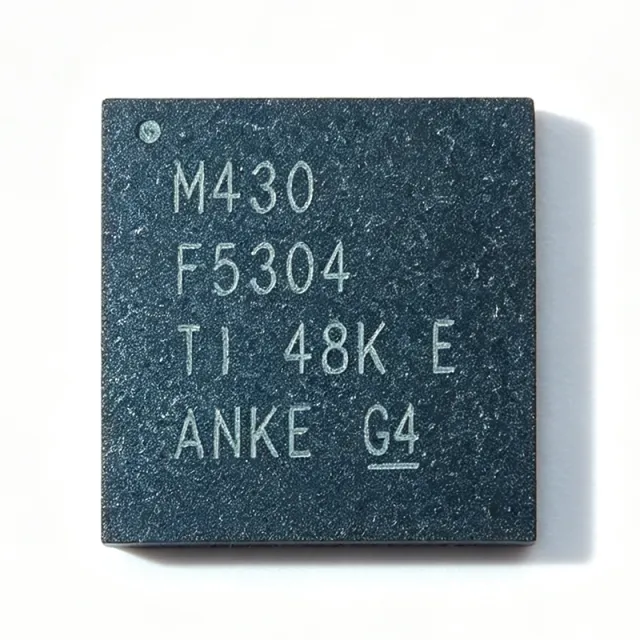
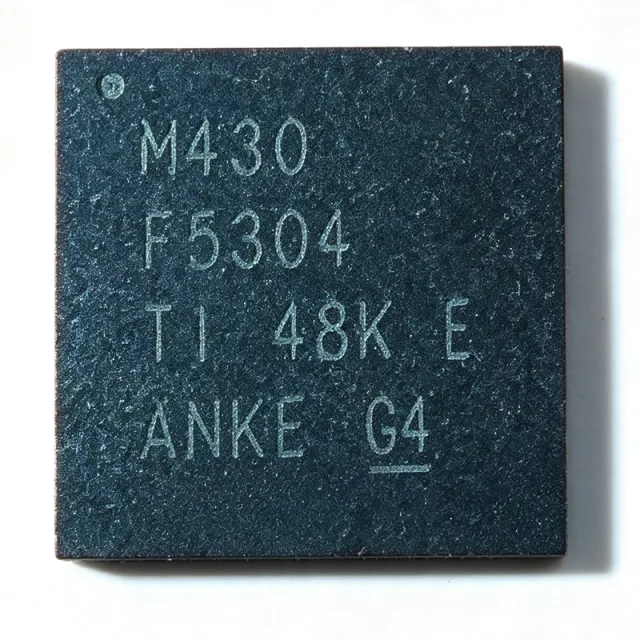
MSP430F5304IPTR - 16-bit 25MHz 8KB Flash MCU | Texas Instruments
MSP430F5304IPTR

MSP430F5304IPTR - 16-bit 25MHz 8KB Flash MCU | Texas Instruments

The Texas Instruments MSP430F5304IPTR is a 16-bit ultra-low-power mixed-signal microcontroller based on the MSP430 CPUXV2 core, running at up to 25 MHz with 8KB Flash and 6KB SRAM in a 48-pin LQFP (7x7 mm) package. On-chip peripherals include an integrated 3.3V LDO, four 16-bit timers, a 10-bit ADC, one USCI (UART/SPI/I2C), a hardware multiplier, DMA, an RTC with alarm capabilities, and 31 I/O pins. An ultra-low-power microcontroller (MCU) is a single-chip processor optimized to minimize active and standby current draw, essential for battery-operated and energy-harvesting systems. The MSP430 family sits within the broader hierarchy of 16-bit microcontrollers -> mixed-signal MCUs -> embedded processors, and is widely recognized as an industry benchmark for low-power design. Key features include the flexible clock system (5 selectable low-power modes), a hardware 32x32 multiplier that offloads arithmetic from the CPU, and DMA for peripheral-to-memory transfers without CPU intervention. The integrated LDO simplifies power tree design by generating the core supply from a single external rail, while the RTC with alarm supports timekeeping during standby. The 10-bit ADC provides general-purpose analog acquisition for sensor front ends. The MSP430F5xx architecture pairs the von Neumann CPUXV2 core with a clock system supporting a VLO, REFO, XT1, and DCO sources, allowing designers to trade clock accuracy against current consumption. Interrupt-driven operation with fast wake-up keeps average current in the microamp range in duty-cycled applications. Typical applications include battery-powered metering, portable medical monitoring, industrial sensor nodes, and consumer appliances where the combination of 25 MHz performance, one USCI serial port, and 31 GPIO covers most moderate-complexity control tasks. Design consideration: the family shares the MSP430F5xx/F6xx User's Guide peripheral set, so code migrates freely between family members; verify Flash/SRAM sizing and package pinout before board reuse, as memory-density variants exist in identical footprints.

USD $2.10 যোগাযোগ
MSP430F5304IPTR - 16-bit 25MHz 8KB Flash MCU | Texas Instruments
MSP430F5304IPTR

MSP430F5304IPTR - 16-bit 25MHz 8KB Flash MCU | Texas Instruments

The Texas Instruments MSP430F5304IPTR is a 16-bit ultra-low-power mixed-signal microcontroller based on the MSP430 CPUXV2 RISC core, running at up to 25 MHz with 8KB Flash and 6KB SRAM in a 48-pin LQFP (7x7 mm) package. On-chip peripherals include an integrated 3.3V LDO, four 16-bit timers, a high-performance 10-bit ADC, one USCI supporting UART/SPI/I2C, a hardware multiplier, DMA, an RTC with alarm capabilities, and 31 I/O pins. An ultra-low-power microcontroller (MCU) is a single-chip processor optimized to minimize active and standby current draw, essential for battery-operated and energy-harvesting systems. The MSP430 family sits within the broader hierarchy of 16-bit microcontrollers -> mixed-signal MCUs -> embedded processors, and is widely recognized as an industry benchmark for low-power design. Key features include the flexible clock system with five selectable low-power modes, a hardware 32x32 multiplier that offloads arithmetic from the CPU, and DMA for peripheral-to-memory transfers without CPU intervention. Active-mode consumption is approximately 195 uA/MHz at 8 MHz and 3V during Flash execution, with supply voltage supported from 2.4V to 3.6V. The MSP430F5xx architecture pairs the von Neumann CPUXV2 core with a clock system supporting VLO, REFO, XT1, and DCO sources, allowing designers to trade clock accuracy against current consumption. Interrupt-driven operation with fast wake-up keeps average current in the microamp range in duty-cycled applications. The integrated LDO simplifies the power tree by generating the core supply from a single external rail. Typical applications include battery-powered metering, portable medical monitoring, industrial sensor nodes, and consumer appliances where the combination of 25 MHz performance, one USCI serial port, and 31 GPIO covers most moderate-complexity control tasks. Design consideration: the family shares the MSP430F5xx/F6xx User's Guide peripheral set, so code migrates freely between family members; verify Flash/SRAM sizing and package pinout before board reuse, as memory-density variants exist in identical 48-LQFP footprints. This page synthesizes distributor pricing, drop-in alternatives, and practical design notes not found in the manufacturer datasheet, with data verified as of 2026-09-01.

USD $2.40 যোগাযোগ
MSP430F5329IPN - 25MHz MCU 128KB Flash 80-LQFP | TI MSP430
MSP430F5329IPN

MSP430F5329IPN - 25MHz MCU 128KB Flash 80-LQFP | TI MSP430

The Texas Instruments MSP430F5329IPN is a 25 MHz ultra-low-power 16-bit mixed-signal microcontroller from the MSP430F5xx family, integrating 128 KB of Flash and 10 KB of SRAM in an 80-pin LQFP (PN) 12x12 mm footprint. The device is built on the MSP430 CPUXV2 core, operates from 2.4 V to 3.6 V, and is rated for industrial temperature ranges of -40C to +85C. Per the TI product page, the device targets applications requiring an integrated 3.3-V LDO, four 16-bit timers, a high-performance 12-bit ADC, two USCIs, a hardware multiplier, DMA, and an RTC module with alarm capabilities. An MCU (microcontroller) is a single-chip computer that integrates a CPU core, program and data memory, peripherals, and I/O on one die, intended for embedded control where deterministic low-power operation matters. Within the wider taxonomy, the MSP430 family sits under 16-bit microcontrollers, then general-purpose microcontrollers, then embedded processors, then semiconductors. The F5xx sub-family is positioned for mixed-signal, ultra-low-power applications and shares a common toolchain (CCS, IAR) and a unified datasheet family document. Key features include an integrated 12-bit SAR ADC, an analog comparator, a 32-bit hardware multiplier, a multi-channel DMA controller, and serial interfaces covering UART, SPI, and I2C. The on-chip Flash supports in-system programming through JTAG or Spy-Bi-Wire, while 10 KB SRAM provides working memory for real-time tasks. The PN package exposes 63 GPIO pins per TI's product page summary. Five low-power modes (LPM0 through LPM4 plus LPMx.5) reduce standby current to sub-microamp levels at 3 V, while active-mode current is approximately 180 uA/MHz at 3 V. The 12-bit ADC supports 200 ksps conversion, and the DMA controller offloads data movement without CPU intervention. Typical applications include smart-grid metering and AMI endpoints, industrial sensor transmitters, portable medical and fitness devices, building automation nodes, ultra-low-power wireless sensor network base stations, and battery-powered HVAC controllers. The 128 KB Flash supports full LWM2M or proprietary wireless stacks in connected nodes, and the 12-bit ADC pin count suits multi-channel sensor acquisition. When designing with this device, follow the MSP430 hardware user's guide for decoupling: one 100 nF plus one 4.7 uF bulk capacitor on DVCC, separate AVCC filtering for the ADC reference, and a 32.768 kHz crystal on LFXTIN/LFXTOUT for RTC accuracy. JTAG pins must be pulled high during reset for proper operation. This page synthesizes distributor pricing, drop-in alternatives, and practical design notes not found in the manufacturer datasheet, enabling engineers to evaluate compatibility without consulting multiple sources.

RFQ যোগাযোগ
MSP430F5336IPZ - 20MHz 128KB Mixed-Signal MCU | Texas Instruments
MSP430F5336IPZ

MSP430F5336IPZ - 20MHz 128KB Mixed-Signal MCU | Texas Instruments

Texas Instruments MSP430F5336IPZ is a 20 MHz, 16-bit mixed-signal microcontroller with 128 KB of Flash memory, 10 KB of SRAM, a 12-bit ADC, and a 12-bit DAC in a 100-pin LQFP package measuring 14 x 14 mm. It also integrates a comparator, DMA, UART, SPI, and I2C peripherals for compact embedded control systems. A mixed-signal microcontroller combines a digital processing core with analog measurement and conversion functions in one device. In the MSP430 hierarchy, this part belongs to the MSP430F5xx family of ultra-low-power RISC microcontrollers. Its integrated ADC, DAC, comparator, and DMA reduce external component requirements in sensor, industrial control, and data-acquisition designs while retaining a compact 14 x 14 mm footprint. The MSP430F5336's defining resources include 128 KB of Flash for firmware and constants, 10 KB of SRAM for working data, and a CPU clock of 20 MHz. The 12-bit ADC supports analog measurement, while the 12-bit DAC provides an analog output without requiring a separate converter. DMA transfers data between memory and peripherals, reducing CPU involvement in routine data movement. The integrated communication peripherals provide practical connectivity without external serial controllers. UART supports asynchronous serial communication, SPI accommodates synchronous peripheral buses, and I2C connects the microcontroller to sensors and other low-speed devices. The comparator adds another independent thresholding function for alarm, protection, or signal-conditioning applications. Typical uses include industrial sensor controllers, building automation equipment, smart meters, laboratory instruments, data loggers, power-conversion controllers, and compact embedded monitoring systems. Its combination of ADC, DAC, comparator, DMA, and serial interfaces is particularly useful when the design needs local signal acquisition and output alongside digital control. PCB design should preserve the pin assignments and analog layout guidance in the manufacturer datasheet. Keep analog inputs and DAC outputs away from high-current switching paths, provide the specified bypass capacitance, and route communications and control signals away from noisy power-conversion nodes. Confirm thermal performance at the intended ambient temperature and operating frequency before production release. This page consolidates the exact MSP430F5336IPZ specifications, verified-source links, pin-compatible family options, and practical mixed-signal design guidance into one engineering reference for component selection, schematic planning, and BOM review.

RFQ যোগাযোগ
MSP430F5338IZQWR - 20MHz 256KB Flash MCU 113-BGA | Texas Instruments
MSP430F5338IZQWR

MSP430F5338IZQWR - 20MHz 256KB Flash MCU 113-BGA | Texas Instruments

The Texas Instruments MSP430F5338IZQWR is a 16-bit ultra-low-power mixed-signal microcontroller based on the MSP430 CPUXV2 core, delivering up to 20 MHz CPU clock with 256 KB on-chip Flash and 18 KB SRAM in a 113-ball Microstar Junior BGA (7x7 mm) package. It integrates a 12-bit ADC, 12-bit DAC, comparator, DMA controller, and hardware multiplier alongside standard serial interfaces (UART, SPI, I2C), making it well suited for battery-powered measurement applications. An MCU (microcontroller unit) is a single-chip computer that integrates a CPU core, memory, and configurable peripherals. Within the broader taxonomy, the MSP430F5338 is a mixed-signal MCU (combining analog peripherals with digital logic) in the ultra-low-power class (prioritizing microamp standby currents over raw performance). It belongs to the MSP430 family of 16-bit RISC cores and is positioned in the F5xx sub-family for portable measurement and instrumentation. Key features include active-mode current of 270 uA/MHz at 8 MHz and 3.0 V during Flash program execution, five low-power modes with sub-uA standby currents, and a supply voltage range of 1.8 V to 3.6 V. The 12-bit ADC supports up to 8 input channels and the integrated 12-bit DAC allows analog output without external components. DMA channels reduce CPU wake-up frequency, directly lowering average system power. The device is built around the MSP430 CPUXV2 16-bit RISC architecture with a 16-bit register file and 27 instructions, supported by a 32-bit hardware multiplier. Compared with 8-bit MCUs, the 16-bit datapath and DMA engine enable efficient sensor-fusion loops and signal processing at lower average power. Five software-selectable low-power modes (LPM0-LPM4) plus RTC-only retention give designers precise control over wake/sleep trade-offs. Typical applications include portable medical and fitness instruments, industrial sensor transmitters, smart metering, data loggers, and human-machine interface controllers. The integrated ADC, DAC, and comparator also suit closed-loop control and battery monitoring subsystems in IoT edge nodes. When designing with this part, populate unused BGA balls with NC (no-connect) and follow TI's BGA PCB layout guide for microvia stack-up to avoid signal-integrity issues. For ultra-low standby, disable unused peripherals and enter LPM4 with the RTC as the only wake source. This page synthesizes distributor pricing, same-family drop-in alternatives, and practical design notes not found on the manufacturer product page, giving engineers a faster sourcing and design-start path.

RFQ যোগাযোগ
MSP430F5438ACY - 25MHz 256KB Flash MCU | Texas Instruments
MSP430F5438ACY

MSP430F5438ACY - 25MHz 256KB Flash MCU | Texas Instruments

The Texas Instruments MSP430F5438ACY is a 16-bit, 25 MHz mixed-signal microcontroller with 256 KB of flash memory, 16 KB of SRAM, and a 12-bit ADC in a 40-pin WQFN package. It integrates UART, SPI, I2C, timers, DMA, and a hardware multiplier for embedded control and sensor-processing systems. A microcontroller is a programmable integrated circuit that combines a processor core, memory, and peripherals on one semiconductor die. The MSP430 belongs to the mixed-signal MCU category and is commonly used for low-power embedded systems because its architecture supports multiple operating modes and peripheral resources while integrating analog conversion functions. The MSP430F5438ACY provides a 25 MHz CPU clock, 256 KB flash, and 16 KB SRAM. Its 12-bit ADC supports applications that require measured analog inputs, while the hardware multiplier improves multiplication-intensive signal processing. Four communication interfaces are identified in the verified product data, supporting UART, SPI, and I2C connectivity. The MSP430F5438ACY is suitable for industrial measurement, data acquisition, communications, embedded control, and low-power sensor systems. DMA can move peripheral data with less processor intervention, while the integrated timers and communication peripherals reduce the need for additional discrete interface components. The device operates from a 2.4 V to 3.6 V supply according to the verified distributor specification, and the listed industrial operating range is -40°C to 85°C. Its 40-pin WQFN package supports compact surface-mount layouts while exposing the MCU’s analog, digital, and communication resources. PCB designers should follow the manufacturer’s package and pinout documentation, provide appropriate decoupling near the supply pins, and verify signal levels and peripheral multiplexing before firmware configuration. This product combines a 25 MHz processor, 256 KB flash, and integrated analog and serial peripherals for compact embedded control designs. This page combines verified manufacturer and distributor information with practical engineering context for selecting the MSP430F5438ACY and understanding its role in embedded systems.

RFQ যোগাযোগ
MSP430F5438AIPZ - 25MHz 16-bit MCU 256KB Flash | Texas Instruments
MSP430F5438AIPZ

MSP430F5438AIPZ - 25MHz 16-bit MCU 256KB Flash | Texas Instruments

The Texas Instruments MSP430F5438AIPZ is a 16-bit RISC mixed-signal microcontroller built on the MSP430 CPUXV2 core, delivering up to 25 MHz performance with 256 KB of embedded Flash and 16 KB of SRAM, packaged in a 100-pin LQFP (14x14 mm). It integrates a 12-bit SAR ADC with 14 channels, a 32-bit hardware multiplier, a 4-channel DMA controller, and four universal serial communication interfaces that support UART, SPI, and I2C protocols. An MCU (Microcontroller Unit) is a single-chip computer that integrates a CPU, memory, and programmable peripherals around a common bus. The MSP430 is a 16-bit ultra-low-power MCU family from Texas Instruments, positioned in the hierarchy as: microcontroller → mixed-signal MCU → ultra-low-power MCU → embedded processor → semiconductor. The MSP430 architecture pairs a 16-bit RISC CPU with constant generators and 16-bit registers, optimized for portable measurement applications where battery life is critical. Key features of the MSP430F5438AIPZ include five low-power modes (LPM0-LPM4) that draw as little as microamp-level standby currents, an on-chip real-time clock (RTC) module with a separate supply pin for calendar functions in battery-backed systems, and a sophisticated timer subsystem (Timer_A and Timer_B) supporting PWM, capture, and compare. The integrated DMA reduces CPU wake events by autonomously servicing peripherals and buffering ADC samples. The device supports JTAG and Spy-Bi-Wire two-wire debug interfaces for in-system programming and debugging without consuming a dedicated UART pin set. Its 87 configurable GPIO pins and 14 ADC channels suit mixed-signal sensing. The architecture, combined with extensive low-power modes, is optimized to achieve extended battery life in portable measurement applications such as wireless sensor nodes, energy-harvesting instrumentation, smart meters, and human-interface devices. Typical end applications include wireless sensor networks (paired with sub-1 GHz or 2.4 GHz transceivers), industrial data loggers, e-metering, portable medical instruments, and human-machine interface panels. Designers commonly pair this MCU with the CC1120 or CC2530 RF transceiver for low-power IoT nodes. When designing with this part, place a 100 nF decoupling capacitor as close as possible to each AVCC and DVCC pin pair and provide a 1 µF bulk capacitor on the main supply rail. Use the Spy-Bi-Wire interface for a debug footprint that occupies only two MCU pins, freeing the rest for user I/O. This page synthesizes distributor pricing, same-brand drop-in alternatives from the MSP430F5xx family, parameter-by-parameter comparisons, and practical design notes not found in the manufacturer datasheet alone.

RFQ যোগাযোগ
MSP430F5438AIPZR - 25MHz 16-bit MCU 256KB Flash | Texas Instruments (Tape & Reel)
MSP430F5438AIPZR

MSP430F5438AIPZR - 25MHz 16-bit MCU 256KB Flash | Texas Instruments (Tape & Reel)

The Texas Instruments MSP430F5438AIPZR is a 16-bit RISC mixed-signal microcontroller built on the MSP430 CPUXV2 core, delivering up to 25 MHz performance with 256 KB of embedded Flash and 16 KB of SRAM, packaged in a 100-pin LQFP (14x14 mm). It integrates a 12-bit SAR ADC with 14 channels, a 32-bit hardware multiplier, a 4-channel DMA controller, and four universal serial communication interfaces that support UART, SPI, and I2C protocols. An MCU (Microcontroller Unit) is a single-chip computer that integrates a CPU, memory, and programmable peripherals around a common bus. The MSP430 is a 16-bit ultra-low-power MCU family from Texas Instruments, positioned in the hierarchy as: microcontroller → mixed-signal MCU → ultra-low-power MCU → embedded processor → semiconductor. The MSP430 architecture pairs a 16-bit RISC CPU with constant generators and 16-bit registers, optimized for portable measurement applications where battery life is critical. Key features of the MSP430F5438AIPZR include five low-power modes (LPM0-LPM4) that draw as little as microamp-level standby currents, an on-chip real-time clock (RTC) module with a separate supply pin for calendar functions in battery-backed systems, and a sophisticated timer subsystem (Timer_A and Timer_B) supporting PWM, capture, and compare. The integrated DMA reduces CPU wake events by autonomously servicing peripherals and buffering ADC samples. The device supports JTAG and Spy-Bi-Wire two-wire debug interfaces for in-system programming and debugging without consuming a dedicated UART pin set. Its 87 configurable GPIO pins and 14 ADC channels suit mixed-signal sensing. The architecture, combined with extensive low-power modes, is optimized to achieve extended battery life in portable measurement applications such as wireless sensor nodes, energy-harvesting instrumentation, smart meters, and human-interface devices. Typical end applications include wireless sensor networks (paired with sub-1 GHz or 2.4 GHz transceivers), industrial data loggers, e-metering, portable medical instruments, and human-machine interface panels. Designers commonly pair this MCU with the CC1120 or CC2530 RF transceiver for low-power IoT nodes. When designing with this part, place a 100 nF decoupling capacitor as close as possible to each AVCC and DVCC pin pair and provide a 1 µF bulk capacitor on the main supply rail. Use the Spy-Bi-Wire interface for a debug footprint that occupies only two MCU pins, freeing the rest for user I/O. This page synthesizes distributor pricing, same-brand drop-in alternatives from the MSP430F5xx family, parameter-by-parameter comparisons, and practical design notes not found in the manufacturer datasheet alone.

RFQ যোগাযোগ
MSP430F5438AIZCAR - 25MHz 256KB MCU | Texas Instruments
MSP430F5438AIZCAR

MSP430F5438AIZCAR - 25MHz 256KB MCU | Texas Instruments

The Texas Instruments MSP430F5438AIZCAR is a 25 MHz, 16-bit mixed-signal microcontroller with 256 KB of flash memory, 16 KB of SRAM, and a 12-bit ADC in a 113-pin NFBGA (ZCA) package. It integrates UART, SPI, I2C, DMA, timers, and a hardware multiplier, making it suitable for embedded control, industrial measurement, communications, and low-power sensing systems. Its MSP430 CPUXV2 architecture emphasizes efficient operation in resource-constrained applications. A microcontroller is a programmable integrated circuit that combines a CPU core, memory, and peripheral interfaces into one compact device. The MSP430F5438A belongs to the MSP430 family of low-power mixed-signal microcontrollers. The ADC provides analog-to-digital conversion for sensor inputs, while the serial interfaces connect the device to sensors, displays, data converters, and external controllers. DMA reduces CPU involvement during data transfers, improving responsiveness in measurement and communications systems. Key verified features include a 25 MHz operating frequency, 256 KB flash, 16 KB SRAM, a 12-bit ADC, hardware multiplier, DMA, UART, SPI, I2C, and timers. The 113-pin NFBGA package provides a high pin count for systems requiring substantial mixed-signal and digital connectivity. The manufacturer product page lists the operating temperature range as -40 °C to 85 °C for this ordering code. The MSP430F5438AIZCAR is positioned between general-purpose embedded control and more specialized signal-processing designs. Its integrated ADC and mixed-signal peripherals can simplify designs that otherwise require separate analog components. The hardware multiplier supports efficient arithmetic in control, signal-processing, and communications algorithms, while DMA helps move peripheral data with less processor overhead. Typical applications include industrial sensor acquisition, building and energy-monitoring equipment, communications modules, portable instruments, data loggers, and embedded control systems. Designers should verify pin multiplexing, peripheral availability, clock configuration, and power requirements against the datasheet before layout. The 113-pin NFBGA also requires careful PCB layout, exposed-pad thermal management, and manufacturing process controls. This product page combines verified distributor and manufacturer information with application guidance and design considerations. For a proposed system, confirm the complete electrical limits, pin functions, package dimensions, thermal requirements, and lifecycle status in the current Texas Instruments documentation before committing to a production design.

RFQ যোগাযোগ
MSP430F5438AIZCAT - 25MHz 256KB MCU | Texas Instruments
MSP430F5438AIZCAT

MSP430F5438AIZCAT - 25MHz 256KB MCU | Texas Instruments

The Texas Instruments MSP430F5438AIZCAT is a 25 MHz, 16-bit mixed-signal microcontroller with 256 KB flash memory, 16 KB SRAM, a 12-bit ADC, DMA, UART, SPI, I2C, timers, and a hardware multiplier. It is packaged in a 113-pin NFBGA measuring 7 x 7 mm. The device combines low-power MSP430 operation with substantial memory and integrated analog acquisition resources for embedded control, industrial measurement, communications, and sensor-processing systems. What is a mixed-signal microcontroller? A mixed-signal microcontroller combines a digital processor core with analog or mixed-signal peripherals, allowing a single embedded device to measure real-world inputs and execute control logic. The MSP430 family belongs to the broader embedded-controller hierarchy: MCU, microprocessor, embedded semiconductor, and electronic component. In this MSP430F5438AIZCAT, the 16-bit CPUXV2 architecture is supported by flash, SRAM, serial interfaces, timers, direct memory access, and ADC resources. The verified product data identifies a maximum CPU frequency of 25 MHz, 256 KB of flash organized as 256K x 8, and 16 KB of SRAM. Its listed peripherals include a 12-bit ADC, DMA, UART, SPI, I2C, timer resources, and a hardware multiplier. This combination makes the MCU suitable for applications requiring moderate computation, data acquisition, and multiple serial interfaces without relying on a separate analog front end. The part is identified by Texas Instruments under the MSP430F5438A family and is supplied in a 113-pin NFBGA package. The package is a surface-mount ball-grid-array format, with a stated size of 7 x 7 mm. The exact pin names, voltage limits, temperature range, ADC performance, clock options, and power characteristics are not present in the supplied verified extracts and therefore require confirmation from the manufacturer datasheet before schematic or PCB sign-off. Typical use cases include industrial sensor acquisition, low-power monitoring nodes, UART, SPI, or I2C-connected equipment, data loggers, actuator control, and compact embedded controllers. The MCU can supervise several digital peripherals while its ADC supports analog measurements. Designers should define the required serial interfaces and memory allocation first, then verify timing and electrical details against the complete datasheet. For a new design, confirm the MSP430F5438AIZCAT pin assignment, BGA ball map, power sequencing, decoupling requirements, and maximum operating conditions before layout. A drop-in alternative should not be selected from a family name alone; package, ballout, clock rating, memory, peripheral set, and firmware assumptions must all match. This page distinguishes verified information from missing technical parameters rather than estimating them. This page consolidates the verified distributor and manufacturer extracts for the MSP430F5438AIZCAT, including memory, CPU speed, package, major peripherals, sourcing context, and application guidance. Pricing, complete pinout, compliance status, lifecycle detail, and validated substitutes should be confirmed from current manufacturer or distributor documentation before purchase or production release.

RFQ যোগাযোগ
MSP430F5438AIZQWR - 25MHz 256KB MCU | Texas Instruments
MSP430F5438AIZQWR

MSP430F5438AIZQWR - 25MHz 256KB MCU | Texas Instruments

The Texas Instruments MSP430F5438AIZQWR is a 25 MHz, 16-bit mixed-signal microcontroller with 256 KB of flash memory, 16 KB of SRAM, and a 12-bit ADC in a 113-ball Microstar Junior BGA package. It integrates DMA, UART, SPI, I2C, timers, and a hardware multiplier for compact embedded control and sensor-processing designs. A mixed-signal microcontroller combines a digital processor core with peripherals designed to acquire and process analog signals. The MSP430F5438AIZQWR belongs to the MSP430 family of ultra-low-power 16-bit RISC microcontrollers, where CPU processing, communication, timing, and data acquisition are integrated into one device. This makes it suitable for embedded systems that require local sensing, control, and serial communications while keeping component count low. The device provides 256 KB of flash, 16 KB of SRAM, a 25 MHz clock, and a high-performance 12-bit ADC. Its communication peripherals include UART, SPI, and I2C, while DMA supports efficient transfers without repeatedly involving the CPU. The integrated hardware multiplier accelerates suitable arithmetic operations, and three 16-bit timers support periodic events, timing, and control-loop functions. These peripherals make the MCU appropriate for industrial instrumentation, data acquisition, building automation, and low-power embedded control. The MSP430 architecture supports low-power-oriented embedded designs, particularly when the firmware can use its timers, interrupts, and serial interfaces to avoid continuous processor activity. Peripheral integration reduces the need for separate interface or conversion ICs, while DMA can improve responsiveness when moving ADC, communication, or memory data. The 113-ball package provides substantial I/O connectivity, but its fine-pitch BGA construction requires careful PCB layout, inspection, and assembly capability. Typical applications include sensor nodes, industrial measurement systems, building-control equipment, portable instruments, communication modules, and embedded data loggers. UART, SPI, and I2C allow connection to sensors, transceivers, displays, storage devices, and external controllers. The 12-bit ADC supports analog measurement, while DMA and timers help implement responsive acquisition and control tasks. When designing around this MCU, validate the complete 113-ball pinout and power requirements against the manufacturer datasheet before layout. Confirm that the PCB assembly process supports the package, provide suitable decoupling and analog routing around the ADC, and verify all unused BGA balls according to the device guidelines. Pricing and availability should be checked for the exact orderable MPN. This page combines verified manufacturer and distributor information with package, application, comparison, and design guidance intended to make component selection more practical. It is not a substitute for the complete datasheet, which remains the authoritative source for electrical limits, timing, pin definitions, and errata.

RFQ যোগাযোগ
MSP430F5438AIZQWT - 25MHz 256KB Mixed-Signal MCU | TI
MSP430F5438AIZQWT

MSP430F5438AIZQWT - 25MHz 256KB Mixed-Signal MCU | TI

The Texas Instruments MSP430F5438AIZQWT is a 25 MHz, 16-bit mixed-signal microcontroller with 256 KB flash memory, 16 KB SRAM, and a 113-ball Microstar Junior BGA package. According to the verified product data, it combines an MSP430 RISC core, 31 I/O ports, a 12-bit ADC, DMA, UART, SPI, I2C, timers, and a hardware multiplier in an industrial-temperature ultra-low-power design. A mixed-signal microcontroller is a semiconductor that combines a digital processor, memory, and analog or communication peripherals on one device. The MSP430 belongs to the low-power MCU hierarchy and is designed for embedded control, measurement, communications, and battery-operated systems where efficient code execution and multiple low-power operating modes are important. This part is positioned between a general-purpose microcontroller and a dedicated signal-processing controller. Verified features include a 2.4 V to 3.6 V supply range, 25 MHz clock speed, 256 KB flash, 16 KB SRAM, 31 I/O ports, and a 12-bit ADC. The datasheet search data also identifies ultra-low-power modes including LPM3 with watchdog timer and LPM4 with RAM retention/off-related operation. The available product information further confirms UART, SPI, I2C, DMA, timers, and hardware-multiplier support, making the MCU suitable for connected industrial, sensor, and embedded-control designs. The device uses a mixed-signal architecture rather than a dedicated analog signal-processing front end. Its ADC supports embedded measurements, while serial interfaces allow connection to sensors, transceivers, memories, and human-interface modules. The 256 KB flash capacity provides substantially more program storage than smaller MSP430 devices, while the 16 KB SRAM supports working state, buffers, stacks, and peripheral data handling. Typical applications include industrial sensor nodes, low-power data loggers, building-control equipment, battery-powered monitors, communications equipment, and compact embedded systems. The 113-ball Microstar Junior package supports dense PCB layouts, but its ball pitch, exposed thermal requirements, assembly process, and layout rules must be checked against the official package drawing before layout. For a robust design, confirm the exact package pinout, power sequencing, decoupling requirements, clock configuration, ADC reference, and low-power wake-up behavior in the manufacturer datasheet. This page distinguishes verified values from parameters requiring project-specific confirmation and avoids treating distributor snippets as complete electrical specifications.

RFQ যোগাযোগ
MSP430F5438IPZ - 25MHz, 256KB MCU with 12-bit ADC | TI
MSP430F5438IPZ

MSP430F5438IPZ - 25MHz, 256KB MCU with 12-bit ADC | TI

The Texas Instruments MSP430F5438IPZ is a 16-bit ultra-low-power mixed-signal microcontroller with a 25 MHz MSP430 CPU, 256 KB flash memory, 16 KB SRAM, and a 12-bit ADC in a 100-LQFP package. It combines a RISC processor, hardware multiplier, DMA, four UART/USCI peripherals, SPI, and I2C support for embedded control, measurement, and communication systems. A microcontroller is a programmable integrated circuit that combines a CPU, memory, peripherals, and I/O in one device. The MSP430 family uses a 16-bit RISC architecture with 16-bit registers and constant generators, supporting efficient control and signal-processing workloads. The MSP430F5438 belongs to the MSP430F5xx family of mixed-signal MCUs, combining digital control with analog measurement and low-power operating modes. Key features include 256 KB of flash, 16 KB of SRAM, a 12-bit ADC, a hardware multiplier, DMA, four USCI peripherals, timers, and a real-time clock. The device is suitable for industrial instrumentation, sensor acquisition, low-power embedded control, communications, and signal-processing applications. Its 14 x 14 mm 100-LQFP package provides a conventional surface-mount footprint with numerous external peripheral connections. The MSP430F5438 product page identifies a 25 MHz operating speed and 256 KB flash, while the MSP430F5438IPZ distributor listing specifies the 100-LQFP (14 x 14) package and 16-bit MCU architecture. The mixed-signal design allows firmware to acquire analog inputs and control digital peripherals without requiring separate analog or communications devices. Typical designs use the ADC for sensor and analog signal measurement, UART or SPI for external devices, I2C for sensors and memory, DMA for efficient peripheral transfers, and timers for precise event control. The MSP-EXP430F5438 experimenter-board ecosystem provides a relevant development context, while the MSP430 hardware tools user guide is identified as a reference for supported target devices. When designing a board around this MCU, verify the exact pin functions, power requirements, clock configuration, and peripheral multiplexing in the MSP430F5438 datasheet. Place decoupling close to the power pins and route sensitive analog inputs away from high-current switching nodes. The verified distributor listing identifies an 18 MHz CPU entry, while the manufacturer product page identifies a 25 MHz MCU; these values should be reconciled against the exact device revision and operating conditions before release. This page synthesizes verified manufacturer and distributor specifications, package information, application guidance, and procurement references for engineers evaluating the MSP430F5438IPZ.

RFQ যোগাযোগ
MSP430F5438IPZR - 25MHz, 256KB Flash MCU | Texas Instruments
MSP430F5438IPZR

MSP430F5438IPZR - 25MHz, 256KB Flash MCU | Texas Instruments

The Texas Instruments MSP430F5438IPZR is a 16-bit mixed-signal microcontroller operating at up to 25 MHz, with 256 KB of flash memory, 16 KB of SRAM, and a 12-bit ADC, supplied in a 100-pin LQFP package. It integrates DMA, UART, SPI, I2C, timers, and a hardware multiplier for embedded control and low-power applications. A mixed-signal microcontroller combines a digital processor core with analog and communication peripherals, allowing one device to control sensors, communications, timers, and power sequencing. The MSP430 belongs to the microcontroller -> embedded processor -> semiconductor hierarchy and is designed for battery-powered and industrial systems that require efficient computation and broad peripheral integration. The verified manufacturer and distributor information identifies the MSP430F5438 family with 25-MHz operation, 256-KB flash, 16-KB SRAM, a 12-bit ADC, DMA, UART, SPI, I2C, timers, and a hardware multiplier. These resources support mixed-signal acquisition, data movement, motor and timer control, sensor conditioning, and low-power embedded products. The MSP430F5438IPZR ordering code identifies the 100-LQFP, 14 x 14 mm package and the IPZR package/reel ordering variant. The distributor listing also identifies the CPUXV2 MSP430F5xx microcontroller class. The available verified data does not include the complete electrical limits, ADC timing, memory-map details, GPIO count, or pin names, so those values must be confirmed in the manufacturer datasheet before design release. Typical uses include industrial sensor nodes, portable measurement equipment, data-acquisition systems, communications controllers, low-power industrial controls, and embedded motor or timer systems. The integrated ADC and communication peripherals can reduce external component count, while the large flash and SRAM footprint supports firmware, protocol stacks, buffering, and application logic. Design with the MSP430F5438IPZR by confirming the exact pinout, power-supply limits, clock configuration, reset behavior, and peripheral multiplexing in the TI datasheet. Keep analog inputs, supply returns, and high-speed communications appropriately routed on the PCB, and validate low-power modes against the application’s wake-up and measurement requirements. This page consolidates verified manufacturer and distributor information, package data, commercial search results, and engineering-oriented application guidance. It intentionally identifies missing electrical details rather than estimating them, helping engineers distinguish documented facts from values that require final datasheet verification.

RFQ যোগাযোগ
MSP430F5507IRGZR - 25MHz MCU, 32KB Flash, USB 2.0 | Texas Instruments
MSP430F5507IRGZR

MSP430F5507IRGZR - 25MHz MCU, 32KB Flash, USB 2.0 | Texas Instruments

The Texas Instruments MSP430F5507IRGZR is a 16-bit ultra-low-power mixed-signal microcontroller from the MSP430F5xx family, integrating a 25 MHz MSP430 CPUXV2 core with 32KB Flash, 6KB SRAM (one source quotes 4KB), a 10-bit ADC, DMA, UART/SPI/I2C serial interfaces, hardware multiplier, multiple timers, and a USB 2.0 full-speed peripheral. The device is housed in a 48-pin VQFN (RGZ) package measuring 7x7 mm with an exposed thermal pad. An MSP430 microcontroller is a 16-bit RISC mixed-signal MCU platform from Texas Instruments that occupies the low-power and battery-aware tier of the embedded MCU hierarchy. Within that platform hierarchy the device sits as: MSP430F5xx -> MSP430F55xx (USB sub-family) -> MSP430F550x -> MSP430F5507. The 'F' prefix indicates in-system programmable Flash, the '5' indicates the F5xx generation with the CPUXV2 core and 25 MHz operation, and the trailing digits indicate memory size and feature set. The platform is widely used where deterministic low power and integrated analog matter more than raw MHz. Key differentiating features include active-mode current of 180-195 uA/MHz at 3V, standby current of a few uA, a 1.4 V to 3.6 V wide core supply range (3.6 V absolute max), a true hardware USB 2.0 full-speed transceiver on-chip, a 10-bit successive-approximation ADC with up to 12 external input channels and sample-and-hold, a 32-bit hardware multiplier that accelerates DSP routines, and 31 general-purpose I/O pins. The internal oscillator removes an external crystal in many designs, and the DMA controller offloads data movement between peripherals and memory. At the architectural level, the device uses TI's von-Neumann unified memory map with a 16-bit CPUXV2 core, a 3-stage pipeline, and four hardware multiplier operating modes. The integrated USB peripheral includes an on-chip PHY and pull-up resistors; code can implement HID, CDC, or vendor-class stacks directly. The 10-bit ADC is shared across eight internal and up to twelve external channels through the analog mux, while the DMA engine can stream ADC conversions directly into memory without CPU intervention. Typical applications include USB human-interface devices such as keyboards, mice, and game controllers; portable medical and wellness peripherals; industrial sensor nodes and data loggers; low-power metering; and battery-powered instrumentation that needs an MCU + USB in a single chip. The wide I/O count and integrated analog make it a good fit when an external ADC or signal-conditioning chain would otherwise inflate the BOM. When designing with this part, follow the TI MSP430x5xx Family User's Guide for power-management sequencing, especially the wake-from-LPM transitions and the USB suspend current budget. Reserve the exposed thermal pad for soldering to a ground copper pour to meet the package's thermal-resistance spec and to reduce EMI on the USB DP/DM lines. Use TI's USB Descriptor Tool and MSP430 USB Developers Package firmware to accelerate stack bring-up. This page synthesizes distributor pricing from DigiKey/Mouser/LCSC, verified same-family drop-in alternatives, and practical design notes for USB-aware embedded systems that are not always consolidated in the manufacturer datasheet.

RFQ যোগাযোগ
MSP430F5510CY - 25MHz 16-Bit MCU with 32KB Flash | TI
MSP430F5510CY

MSP430F5510CY - 25MHz 16-Bit MCU with 32KB Flash | TI

The Texas Instruments MSP430F5510CY is a 25 MHz, 16-bit mixed-signal microcontroller with 32KB of Flash memory, 4KB of SRAM, a 10-bit ADC, comparator, DMA, UART, SPI, I2C, USB, and a hardware multiplier. The MSP430F5510CY ordering code identifies a die-sale form of the MSP430F5510 family rather than a leaded or surface-mount package. A mixed-signal microcontroller is an integrated circuit that combines a programmable digital controller with analog measurement or comparison functions. In the product hierarchy, the MSP430F5510 belongs to the MSP430 mixed-signal microcontroller family, which is a type of 16-bit embedded processor and system-on-chip. Its combination of low-power-oriented control, serial interfaces, USB connectivity, and analog peripherals allows sensing and control tasks to be consolidated in compact embedded systems. The principal verified specifications are a 25 MHz maximum clock, 32KB Flash organized as 32K x 8, 4KB SRAM, and a 10-bit ADC. The device also provides a comparator, DMA controller, UART, SPI, I2C, USB interface, and hardware multiplier. These resources support applications that require periodic analog sampling, event-driven data transfer, low-rate communication, or multiplication-intensive control without requiring a separate analog front end for every function. The MSP430F5510 uses the MSP430 CPUXV2 architecture and belongs to the MSP430F5xx mixed-signal family. DMA can move data independently of the CPU, while the hardware multiplier accelerates multiplication tasks. The parallel availability of UART, SPI, and I2C permits a designer to connect sensors, displays, storage devices, and other embedded modules while retaining USB for a host-oriented interface. Exact ADC timing, USB details, clock configuration, and electrical limits should be confirmed in the manufacturer datasheet before final design release. Typical uses include industrial sensor nodes, compact USB-connected data collectors, building and equipment controls, low-power monitoring equipment, and mixed-signal instruments. In an analog-monitoring design, the 10-bit ADC can acquire sensor signals while the comparator handles threshold events and DMA transfers results into SRAM. UART, SPI, or I2C can then connect the controller to local peripherals, while USB provides a higher-level connection when required. The most important design consideration for the MSP430F5510CY is that CY is a die-sale device rather than a finished, pin-defined package. Its footprint, assembly process, bonding method, die orientation, and exposed features therefore require direct coordination with the assembly provider. Engineers must also verify clock, memory, USB, analog, and power requirements against the MSP430F5510 datasheet and validate the assembled board before production. This page consolidates the verified manufacturer specifications, current distributor pricing reference, die-sale packaging information, application guidance, and the documented absence of a confirmed drop-in replacement. It also distinguishes verified facts from package-specific information that cannot be inferred from the bare-die ordering code.

RFQ যোগাযোগ
MSP430F5519IPN - 25MHz 128KB Flash USB MCU | Texas Instruments (Tape & Reel)
MSP430F5519IPN

MSP430F5519IPN - 25MHz 128KB Flash USB MCU | Texas Instruments (Tape & Reel)

The Texas Instruments MSP430F5519IPN is a 25 MHz, 16-bit mixed-signal microcontroller with 128KB of flash memory, 8KB of SRAM, USB, and extensive serial connectivity in an 80-pin LQFP package. It operates from a low 1.8 V to 3.6 V supply range and supports temperatures from -40°C to +85°C, making it suitable for compact embedded systems that need low power consumption and multiple communication interfaces. The MSP430 is an ultra-low-power RISC microcontroller family designed around a 16-bit CPU, efficient register architecture, and multiple low-power operating modes. These characteristics make the MSP430F5519 appropriate for battery-powered measurement, communications, industrial control, and portable equipment where energy efficiency is a primary design constraint. Key features include a 25 MHz CPU, 128KB flash, 8KB SRAM, 63 I/O pins, a comparator, DMA, UART, SPI, I²C, USB, timers, and a hardware multiplier. The integrated connectivity and mixed-signal resources reduce the need for external peripheral devices while providing flexible interface options for sensors, actuators, and communication modules. The device uses the MSP430 CPUXV2 core, a 16-bit RISC architecture with 16-bit registers and constant generators intended to improve code efficiency. Its operating range of 1.8 V to 3.6 V supports low-voltage embedded designs, while the 80-LQFP package provides a conventional surface-mount footprint with a large number of accessible I/O pins. Typical applications include USB-connected control systems, low-power data acquisition, industrial instrumentation, sensor networks, portable measurement equipment, and embedded communications products. The combination of USB, UART, SPI, I²C, DMA, timers, comparator, and hardware multiplier allows designers to connect sensors, storage, displays, and host systems without building a complex peripheral network. When designing around the MSP430F5519IPN, verify the complete pinout, supply requirements, clock configuration, and peripheral multiplexing against the manufacturer datasheet. Decoupling, USB routing, and low-power mode entry require careful PCB and firmware planning, especially when the system combines USB connectivity with battery-operated operation.

RFQ যোগাযোগ
MSP430F5519IPNR - 25MHz 128KB Flash USB MCU | Texas Instruments
MSP430F5519IPNR

MSP430F5519IPNR - 25MHz 128KB Flash USB MCU | Texas Instruments

The Texas Instruments MSP430F5519IPNR is a 25 MHz, 16-bit mixed-signal microcontroller with 128KB of flash memory, 8KB of SRAM, USB, and extensive serial connectivity in an 80-pin LQFP package. It operates from a low 1.8 V to 3.6 V supply range and supports temperatures from -40°C to +85°C, making it suitable for compact embedded systems that need low power consumption and multiple communication interfaces. The MSP430 is an ultra-low-power RISC microcontroller family designed around a 16-bit CPU, efficient register architecture, and multiple low-power operating modes. These characteristics make the MSP430F5519 appropriate for battery-powered measurement, communications, industrial control, and portable equipment where energy efficiency is a primary design constraint. Key features include a 25 MHz CPU, 128KB flash, 8KB SRAM, 63 I/O pins, a comparator, DMA, UART, SPI, I²C, USB, timers, and a hardware multiplier. The integrated connectivity and mixed-signal resources reduce the need for external peripheral devices while providing flexible interface options for sensors, actuators, and communication modules. The device uses the MSP430 CPUXV2 core, a 16-bit RISC architecture with 16-bit registers and constant generators intended to improve code efficiency. Its operating range of 1.8 V to 3.6 V supports low-voltage embedded designs, while the 80-LQFP package provides a conventional surface-mount footprint with a large number of accessible I/O pins. Typical applications include USB-connected control systems, low-power data acquisition, industrial instrumentation, sensor networks, portable measurement equipment, and embedded communications products. The combination of USB, UART, SPI, I²C, DMA, timers, comparator, and hardware multiplier allows designers to connect sensors, storage, displays, and host systems without building a complex peripheral network. When designing around the MSP430F5519IPNR, verify the complete pinout, supply requirements, clock configuration, and peripheral multiplexing against the manufacturer datasheet. Decoupling, USB routing, and low-power mode entry require careful PCB and firmware planning, especially when the system combines USB connectivity with battery-operated operation.

RFQ যোগাযোগ