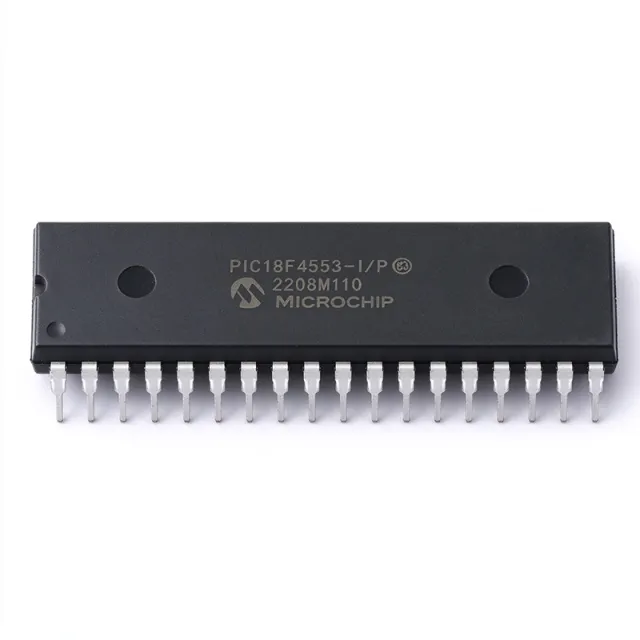
PIC18F4553-I/P
PIC18F4553-I/P - 8-Bit 40MHz USB MCU | Microchip Technology
The Microchip Technology PIC18F4553-I/P is an 8-bit PIC18 enhanced-flash microcontroller with a 40 MHz maximum clock, 32 KB of Flash program memory, 2,048 bytes of SRAM, a 12-bit ADC, and full-speed USB 2.0 connectivity. It is packaged in a 40-pin plastic through-hole package. Three serial interfaces provide practical connectivity for embedded control systems: full-speed USB at 12 Mbit/s, I²C, and SPI at up to 10 Mbit/s.
A PIC18 microcontroller is a programmable integrated circuit that combines a CPU core, program Flash, data memory, general-purpose I/O, and peripherals in one package. Within the semiconductor hierarchy, PIC18F4553 belongs to the 8-bit microcontroller class, which sits below the broader microcontroller and embedded-processing categories. Its combination of legacy-compatible through-hole packaging, USB connectivity, and mixed-signal measurement supports cost-sensitive designs that require external USB connectivity without a separate interface controller.
The device provides 32 KB of high-endurance enhanced Flash memory and 2,048 bytes of SRAM for firmware, configuration data, and working variables. Its 12-bit ADC is more precise than a conventional 10-bit conversion module, while 36 I/O pins support digital control and peripheral functions. The manufacturer identifies the family for low-power nanoWatt and connected applications, including instrumentation, USB data acquisition, industrial control, human-interface equipment, and embedded USB peripherals.
The PIC18F4553 architecture combines an 8-bit RISC-oriented processor core with interrupt-driven peripheral modules. Full-speed USB operating at 12 Mbit/s is suitable for control data, configuration data, and moderate-rate instrument traffic rather than high-throughput storage. SPI operation up to 10 Mbit/s supports faster external peripherals, while I²C is appropriate for sensors, EEPROMs, and other low-to-moderate-rate devices. The 4.2 V to 5.5 V operating range places the device in conventional 5 V embedded systems.
Typical uses include USB-connected measurement instruments, laboratory interfaces, programmable control panels, data loggers, and industrial accessories. In these systems, the internal ADC can acquire analog sensor inputs while the MCU evaluates control logic and communicates with a host through USB. SPI and I²C can extend the design with displays, memory, sensors, or communications transceivers without requiring another general-purpose controller.
A key design consideration is the relationship between Flash endurance, USB interrupt handling, and the chosen development toolchain. Firmware should use the device programming and USB implementation documented by Microchip, and the PCB should provide clean analog and digital grounding, adequate bypass capacitance, and controlled routing for USB and external serial interfaces. The 40-pin through-hole package also simplifies prototyping and inspection compared with fine-pitch surface-mount variants.
This page combines the manufacturer product information, lifecycle status, interface capabilities, package details, and practical replacement analysis in one engineering-focused reference. It also distinguishes true same-package drop-in candidates from pin-compatible parts available in other package formats, helping designers reduce redesign risk before committing a PCB footprint.
USD $8.20
যোগাযোগ