Audio Codecs
Products (9)

AD1938YSTZ - 4ADC/8DAC 192kHz 24-Bit Audio CODEC LQFP-48 | ADI
The Analog Devices AD1938YSTZ is a high-performance single-chip audio codec that integrates 4 analog-to-digital converters (ADCs) with differential inputs and 8 digital-to-analog converters (DACs) with single-ended outputs, housed in a 48-lead LQFP (7x7 mm) package. The device supports sample rates from 8 kHz to 192 kHz at 24-bit resolution, operates from a single 3.3 V supply (with 5 V tolerant logic inputs), and is controlled via an SPI port. An audio CODEC (coder-decoder) is a mixed-signal IC that converts analog audio signals to digital and digital audio signals back to analog, sitting at the intersection of the signal chain between analog transducers (microphones, amplifiers, speakers) and the digital signal processor (DSP) or microcontroller. The AD1938 belongs to the broader category of audio interface ICs, specifically the multi-channel CODEC family, and sits within Analog Devices' precision signal-chain portfolio for professional and prosumer audio. Key features of the AD1938 include 107 dB DAC dynamic range and SNR, 107 dB ADC dynamic range, -94 dB THD+N, a low-EMI design with on-chip PLL for flexible clock generation, software-controllable clickless mute, a logarithmic volume control with autoramp function, and master/slave modes supporting up to 16 devices on a single TDM bus. The codec also integrates TDM, I2S, left-justified, and right-justified serial audio interface modes. The AD1938 employs Analog Devices' patented multibit sigma-delta (Σ-Δ) modulator architecture with a switched-capacitor DAC topology. The integrated PLL allows direct MCLK input up to 27 MHz or generation of internal clocks from a 256 x Fs reference, simplifying board-level clock trees in multi-codec systems. The differential ADC input paths maximize common-mode rejection for balanced microphone or line-level capture. Typical applications include automotive head units and infotainment systems, AV receivers, multichannel mixing consoles, musical instrument amplifiers, effects processors, and broadcast audio equipment. The single 3.3 V supply and 5 V tolerant digital inputs simplify integration into mixed-voltage systems alongside host DSPs or microcontrollers. When designing with the AD1938, ensure adequate decoupling on both AVDD and DVDD rails (typically 10 uF bulk plus 0.1 uF ceramic per pin) and place the master-clock reference within 50 ppm tolerance to avoid PLL jitter. For TDM cascading above 8 channels, the AD1938 can serve as a master driving up to 15 additional slave codecs on a shared data line. This page synthesizes distributor pricing, drop-in same-package alternatives, SPI register notes, and PCB-layout guidance not found in the manufacturer datasheet, providing a 360-degree engineering reference for sourcing the AD1938YSTZ.

AK4621EF - 24-bit 192kHz Stereo Audio CODEC | Asahi Kasei Microdevices
The Asahi Kasei Microdevices AK4621EF is a high-performance 24-bit stereo audio CODEC supporting up to 192 kHz recording and playback, housed in a 30-pin VSOP (LSSOP) surface-mount package. It integrates two channels of ADC and two channels of DAC on a single die, with 115 dB dynamic range on both ADC and DAC paths and supports sample rates from 8 kHz to 192 kHz. An audio CODEC is a single integrated circuit that combines an analog-to-digital converter (ADC), digital-to-analog converter (DAC), and the necessary clocking, filtering, and serial interface logic to move bidirectional audio between the analog and digital domains. In the broader component taxonomy, the AK4621EF belongs to the audio interface IC family, which sits under interface ICs and ultimately under integrated circuits. It is a sub-category of audio ICs and is specialized for professional and consumer high-fidelity stereo capture and reproduction. Key features include AKM's Enhanced Dual-Bit ADC architecture for high dynamic range and the Advanced Multi-Bit DAC architecture combined with a Switched Capacitor Filter (SCF) that suppresses out-of-band noise and improves jitter tolerance. The serial audio interface is compatible with common I2S, left-justified, and right-justified formats, and the analog supply operates from 4.75 V to 5.25 V while the digital supply operates from 3.0 V to 3.6 V. The device also includes a low-latency digital filter option and a hardware-selectable HPF for DC-offset removal on the ADC path. The architecture combines sigma-delta modulators for both ADC and DAC with on-chip digital decimation and interpolation filters. The SCF output stage of the DAC removes many of the high-frequency images associated with conventional oversampling DACs, reducing the need for aggressive external post-filtering. This combination delivers wide dynamic range with low distortion at full-scale, which is critical for transparent studio capture and playback. Typical applications include Pro Audio sound cards, Digital Audio Workstations (DAWs), DVD-R, hard-disk, and CD-R recording and playback systems, as well as musical instrument recording. The combination of high dynamic range, low latency mode, and integrated PLL makes it suitable for both consumer recording devices and semi-professional production equipment. When designing with this part, observe the separate analog and digital supply domains (5 V analog, 3.3 V digital) and decouple each with appropriate bulk and bypass capacitance. The hardware mode pins configure audio data format, master/slave clocking, and HPF behavior; review them before PCB layout because they cannot be changed in software. This page synthesizes distributor pricing, drop-in and equivalent options, and practical layout guidance beyond what is printed in the manufacturer datasheet.

ALC5660-CG - 106dB SNR Stereo Audio Codec w/ HP Amp | Realtek
The Realtek ALC5660-CG is a high-performance, low-power stereo audio codec with an integrated Class-G headphone amplifier, packaged in a surface-mount QFN and specified for 106 dB SNR with a 24-bit I2S/PCM digital interface. It accepts stereo digital audio over I2S/PCM and drives line outputs, headphone loads, and microphone inputs through on-board ADCs, DACs, and a flexible analog mixing block. The device targets portable and embedded designs where board space, BOM cost, and audio fidelity must coexist with strict power budgets. An audio codec is a mixed-signal integrated circuit that bridges the digital audio domain (typically I2S, PCM, TDM, or S/PDIF streams) and the analog audio domain (headphones, line-level outputs, microphones, and line-level inputs). Inside the codec, multi-bit sigma-delta ADCs digitize analog microphone and line-in signals, while multi-bit sigma-delta DACs reconstruct analog waveforms from the incoming digital stream. The ALC5660 belongs to the broader hierarchy of audio interface ICs > interface ICs > signal chain ICs > mixed-signal semiconductor; codecs are distinguished from pure DACs or ADCs by their bidirectional stereo architecture and integrated mixer, microphone preamplifier, and (in this case) headphone driver. Key features of the ALC5660-CG include a 106 dB SNR DAC, 24-bit resolution across the digital audio interface, integrated headphone amplifier with ground-referenced Class-G topology, support for microphone bias and digital microphone inputs, and a flexible digital mixing engine. The Class-G amplifier dynamically scales the internal supply rail to match the instantaneous headphone output level, sharply reducing quiescent dissipation during quiet passages while still delivering ample headroom for peaks. Technically, the ALC5660 uses multi-bit sigma-delta modulator cores for both the record (ADC) and playback (DAC) paths, with on-chip digital decimation/interpolation filters. The headphone path uses a charge-pump-derived negative rail and a dynamically switched supply to maximize efficiency at low output levels. All gain, mixing, and routing is controlled through a two-wire (I2C-style) control interface. Typical applications include tablets, ultrabooks, docking stations, portable media players, USB-C headsets, and single-board computer audio hats. The QFN package and integrated HP amp minimize PCB area, while the high SNR suits music playback and VoIP. Design consideration: the Class-G topology relies on adequate bulk decoupling near the HP supply pins, and the digital I2S/PCM bus should be length-matched and routed away from the analog headphone outputs to preserve SNR. This page consolidates distributor pricing, drop-in alternative candidates, and engineering design notes not available in the standalone manufacturer datasheet, helping engineers evaluate sourcing options and PCB integration in one place.
CS3308-CQZR - 8-Ch Analog Volume Control, 48-LQFP | Cirrus Logic
The Cirrus Logic CS3308-CQZR is a high-performance, low-power, 8-channel digitally controlled analog volume control IC designed for high-end audio systems, housed in a 48-pin LQFP (7x7 mm) package with surface-mount mounting. Key specifications include 8 independent volume channels, configurable zero-crossing detection for glitch-free level changes, a serial control interface compatible with I2C and SPI, a supply voltage range of 3.1 V to 5.25 V, and the ability to address up to 128 CS3308 devices on a single 2-wire I2C or 3-wire SPI bus for high-channel-count systems. The device targets professional audio equipment and consumer electronics that demand clean, click-free volume transitions. A digital volume control IC is an integrated circuit that performs attenuation or amplification of analog audio signals under the command of a microcontroller or DSP, replacing mechanical potentiometers in modern equipment. Within the audio signal chain, it sits between the source selector or DAC output and the power amplifier, and it belongs to the broader family of audio special-purpose ICs alongside DACs, ADCs, and audio amplifiers. Compared with mechanical potentiometers, a digitally controlled attenuator offers precise repeatability, remote control, memory recall, and absence of mechanical wear. Key features of the CS3308-CQZR include 8 independent channels with 0.5 dB step resolution, configurable zero-crossing detection to eliminate zipper noise during volume changes, a wide supply range of 3.1 V to 5.25 V suitable for 3.3 V and 5 V system rails, selectable I2C or SPI serial control interface, and hardware-addressable device IDs that allow up to 128 cascaded devices on a single bus. The combination of fine resolution and zero-crossing logic preserves audio signal integrity during level transitions. Technically, the CS3308 uses a resistive ladder network with CMOS switches and an internal zero-crossing detector that holds the wiper position until the audio waveform crosses zero, suppressing audible artifacts. The architecture provides very low total harmonic distortion plus noise (THD+N) and high channel-to-channel matching, which are essential parameters for multi-channel professional audio gear. Programmable address pins enable bus expansion without adding microcontroller I/O. Typical applications include professional audio mixing consoles, multichannel AV receivers and amplifiers, broadcast studio equipment, automotive head units and infotainment amplifiers, and home theater preamplifiers. In each case the CS3308 replaces mechanical or electromechanical volume controls with a precise, software-driven solution that supports remote control and preset recall. When designing with the CS3308-CQZR, ensure that analog input signals remain within the recommended common-mode and clip range, place bypass capacitors close to the supply pins, and verify I2C/SPI address selection when stacking multiple devices on the same bus. The LQFP-48 footprint gives good thermal performance for continuous signal-path operation. This page synthesizes current distributor pricing and stock, drop-in alternatives with the same 48-LQFP footprint, and practical design notes not consolidated in the manufacturer datasheet, delivering actionable information for both new designs and legacy audio system refreshes.

CS4207-CNZR - 4-In/6-Out HD Audio Codec w/ HP Amp | Cirrus Logic
The Cirrus Logic CS4207-CNZR is a highly integrated, multi-channel, low-power HD Audio Codec combining 192 kHz DACs, 96 kHz ADCs, 192 kHz S/PDIF transmitter and receiver, microphone preamp with bias voltage, and a ground-centered headphone driver, all in a 48-pin QFN (6x6 mm) package. The device operates from a single 3.3 V digital supply and a 5 V analog supply, delivers 24-bit serial audio data, and supports both HDA (HD Audio) and I2S serial interfaces to host controllers. An HD Audio Codec (High Definition Audio Codec) is a mixed-signal IC that converts digital audio streams from a PC/system chipset into line out the headphone, line stage, and microphone signals using internal DACs, ADCs, and headphone amplifiers. The codec sits in the audio signal chain between the host controller (e.g., Intel HDA-compliant chipset) and the analog transducers, and the term "HD Audio" denotes compliance with the Intel HDA Link specification rather than a frequency or bit-rate definition. CS4207-CNZR occupies the power-management IC and interface-IC tier of the audio subsystem, replacing multiple discrete ADCs, DACs, S/PDIF transceivers, and headphone amps with one package. The codec is the culmination of the signal chain (digital I/O -> mixed-signal codec -> analog out). Key features of the CS4207-CNZR include a multibit Delta-Sigma modulator architecture that enables infinite sample-rate adjustment from 32 kHz to 192 kHz, integrated ground-centered headphone driver (no DC blocking capacitors required at the output), microphone preamp with bias voltage source, and digital microphone interface support. The device supports 4 analog line/microphone inputs and 6 analog outputs, providing flexible routing for desktop, notebook, and embedded audio platforms. S/PDIF transmitter and receiver operate up to 192 kHz, allowing simultaneous digital audio transmission and reception. Technical depth: the Delta-Sigma modulator multibit topology achieves higher dynamic range and linearity than single-bit designs, while the ground-centered headphone architecture eliminates large output coupling capacitors, reducing BOM cost and improving low-frequency bass response. The codec integrates digital mixing, gain control, and jack-presence detection through the HDA link, simplifying host-driver interaction. Typical applications include desktop and notebook PC audio subsystems, all-in-one motherboards, embedded media players, and HD Audio-compatible docking stations. The wide format compatibility (HDA + I2S) and integrated HP amp make CS4207 well-suited for ultra-thin notebooks and small-form-factor designs where PCB area is constrained. When designing with this device, place the analog supply decoupling capacitors as close to the AVDD pins as possible to minimize analog-domain interference, and follow Cirrus Logic reference layout for the headphone output return paths to maintain low THD+N. The integrated HP amp eliminates external coupling capacitors but requires careful ground-centered routing to preserve low noise. This page synthesizes distributor pricing, parametric drop-in alternatives, and practical design notes that go beyond the manufacturer datasheet. Engineers comparing HD Audio codec options for desktop/notebook designs will find the application notes, thermal considerations, and HDA source documents consolidated in this page.

ISD17240SYI - 240s Multi-Message Voice Record/Playback IC | Nuvoton
The Nuvoton ISD17240SYI is a single-chip, multi-message voice record and playback IC providing 160 to 480 seconds of audio storage with 4 kHz/5.3 kHz/6.4 kHz/8 kHz selectable sampling rates, housed in a 28-pin SOIC package rated for industrial temperature operation. A multi-message voice record and playback IC (often abbreviated "voice recorder IC" or "ChipCorder") is a self-contained digital audio subsystem that integrates non-volatile storage, an analog microphone preamplifier with Automatic Gain Control, an anti-aliasing filter, a sigma-delta codec, smoothing output filter, and a Class-D-compatible PWM/speaker driver on a single silicon die. In the broader component taxonomy, the ISD1700 family belongs to the audio processor / audio DSP IC category, which itself sits under interface ICs and signal-chain semiconductors used in embedded systems. Because storage is on-chip (no external SPI/I2C EEPROM required), designers eliminate BOM cost and PCB area. Key features include 2.4 V to 5.5 V single-supply operation, on-chip 160 kΩ microphone bias resistor, pushbutton and SPI control interfaces, selectable sampling rates, and message management that supports up to 8 segments. The device supports both standalone pushbutton operation (no MCU required) and SPI-driven operation for microcontroller-managed playback sequencing. Power-down current is sub-microamp, enabling battery-friendly operation in always-on voice prompt designs. The ISD17240SYI uses Nuvoton's proprietary zero-power-on multilevel storage technology, which stores audio samples directly in on-chip non-volatile cells rather than converting to a compressed digital stream. This eliminates codec delay and provides instant-on playback in less than 25 ms from trigger, with no software audio stack. The architecture trades bit-depth and noise floor for ultra-low quiescent power and BOM simplification. Typical applications include industrial voice prompt modules, elevator floor announcers, security alarm voice warnings, medical device audio prompts, vending machine announcements, and consumer appliance voice feedback. The wide 2.4 V to 5.5 V supply range lets the same part serve 3.3 V MCU rails or 5 V industrial buses. When designing with this device, include a decoupling capacitor of at least 0.1 µF directly across VCC and VSSA pins placed within 5 mm, route the analog ground (VSSA) separately back to the regulator, and ensure speaker traces are short and balanced to minimize click/pop artifacts on playback start. This page synthesizes distributor pricing, pin-compatible Nuvoton alternatives in the ISD1700 family, and practical design notes not consolidated in the manufacturer datasheet alone.
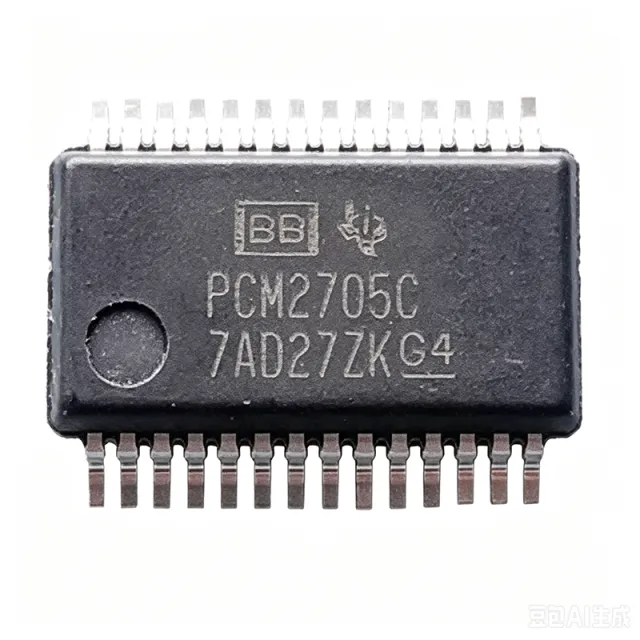
PCM2705C - 98dB SNR Stereo USB DAC with S/PDIF | Texas Instruments
The Texas Instruments PCM2705C is a single-chip stereo audio digital-to-analog converter (DAC) with an integrated USB 2.0 full-speed protocol controller and S/PDIF output. It delivers 98dB SNR and supports both bus-powered and self-powered operation with software control. The device is fully compliant with USB 2.0 specifications and USB Audio Class, requiring no dedicated device driver. It comes in a 28-pin SSOP package, making it ideal for compact audio applications. A USB audio DAC is a digital-to-analog converter that receives digital audio data from a USB host and converts it to analog audio signals. It integrates the USB interface, protocol controller, and DAC core into a single chip, simplifying system design. The PCM2705C sits in the hierarchy of audio converters, specifically as a USB audio interface IC, which is a subset of audio data converters within the broader category of mixed-signal ICs. Key features include a 98dB SNR stereo DAC, S/PDIF output, and support for both bus-powered and self-powered modes. The device also features partially programmable USB descriptors, allowing customization of vendor ID and product ID via an external SPI host. The integrated USB transceiver eliminates the need for external PHY, reducing BOM cost and board space. Technically, the PCM2705C uses adaptive isochronous transfer for audio data, ensuring synchronized playback. The S/PDIF output supports digital audio transmission to external decoders or amplifiers. The device operates from a 3.3V supply and includes an internal PLL for clock generation, minimizing external components. The SSOP-28 package provides a compact footprint suitable for portable and space-constrained designs. Typical applications include USB sound cards, docking stations, gaming headsets, and portable audio interfaces. The device's plug-and-play capability makes it ideal for consumer audio products where driver installation is undesirable. Its low power consumption and small size also suit battery-powered devices. When designing with the PCM2705C, ensure proper decoupling of the 3.3V supply and careful layout of the USB differential pair to maintain signal integrity. The SPI interface for descriptor programming should be configured during initial setup, and the PSEL and HOST pins must be set correctly for the desired operating mode.

TLV320AC37CN - 3V Voice-Band Audio Processor | Texas Instruments
The TLV320AC37CN is a voice-band audio processor (VBAP) from Texas Instruments, designed for single 3-V operation with low power consumption. It integrates a combined A/D, D/A converter and filters, supporting sample rates up to 16 kHz and a pass-band to 7.2 kHz. The device is housed in a 20-pin PDIP package, making it suitable for through-hole assembly in telecommunication and audio applications. A voice-band audio processor (VBAP) is a specialized mixed-signal IC that combines analog-to-digital and digital-to-analog conversion with filtering and signal processing optimized for the 300 Hz to 3.4 kHz voice band. It sits within the broader category of audio codecs, which are essential in telephony, intercoms, and voice-controlled systems. The TLV320AC37CN specifically targets low-power, battery-operated voice applications, offering a complete analog front-end and codec in a single package. Key features include a low operating power of 20 mW typical, standby mode at 5 mW, and power-down mode at 2 mW. The device supports extended variable-frequency operation with sample rates up to 16 kHz and a pass-band to 7.2 kHz. It includes an electret microphone interface, making it ideal for direct connection to electret condenser microphones. The combined A/D, D/A, and filters simplify system design by reducing external components. Technically, the TLV320AC37CN employs a CMOS process and operates from a single 3-V supply, which is critical for portable and battery-powered equipment. The device features a PCM codec interface with A-law companding, suitable for digital telephony standards. The through-hole PDIP-20 package ensures easy prototyping and manual assembly, though it limits high-density applications compared to surface-mount alternatives. Typical applications include digital telephone answering machines, speakerphones, intercom systems, and voice recorders. The low power consumption and 3-V operation make it particularly suited for battery-powered devices where efficiency is paramount. The integrated filters and codec reduce BOM cost and board space. When designing with this device, ensure proper decoupling of the 3-V supply and careful layout of the analog and digital sections to minimize noise coupling. The device is now obsolete, so consider pin-compatible alternatives for new designs.

TLV320AIC3110IRHBT - Low-Power Audio Codec with Class-D Amp | TI
The TLV320AIC3110IRHBT is a low-power, highly integrated audio codec from Texas Instruments, featuring a stereo audio DAC and a mono audio ADC, along with a 1.3W stereo Class-D speaker amplifier. It supports 32-bit audio data and communicates via I2C or serial interface. The device is housed in a 32-pin VQFN (5x5 mm) package, making it suitable for space-constrained portable applications. An audio codec is a device that encodes and decodes digital audio data, converting between analog and digital domains. It typically includes ADCs and DACs, along with signal processing and amplification stages. In a system hierarchy, an audio codec sits between the digital audio processor (e.g., DSP or SoC) and the analog audio output (speakers, headphones) or input (microphones). It is a critical component in portable electronics, automotive infotainment, and IoT devices. Key features of the TLV320AIC3110 include a 1.3W stereo Class-D speaker amplifier, which provides high efficiency for battery-powered devices. The device supports a wide analog supply range of 2.7V to 3.6V, a digital core supply of 1.525V to 1.95V, and a digital I/O supply of 1.1V to 3.6V. It also includes a programmable digital sine-wave generator and extensive register-based power control for optimizing power consumption. Technically, the TLV320AIC3110 integrates a low-power stereo DAC with 32-bit resolution and a mono ADC, supporting sample rates up to 96 kHz. The Class-D amplifier delivers 1.3W per channel into 8 ohms with low distortion. The device features a 5x5 mm VQFN package with exposed thermal pad for improved heat dissipation. It operates over the industrial temperature range of -40°C to +85°C. Typical applications include portable audio players, smartphones, tablets, and IoT devices requiring high-quality audio playback and recording. The integrated Class-D amplifier eliminates the need for an external amplifier, reducing BOM cost and board space. The I2C control interface allows easy integration with microcontrollers and DSPs. When designing with this device, ensure proper decoupling of the analog and digital supplies, and place the Class-D amplifier output filters close to the device to minimize EMI. The thermal pad should be soldered to a copper pour for effective heat dissipation.