بەرهەمەکان (48,000+)

STM32L151ZET6 - 32MHz Cortex-M3 512KB MCU | STMicroelectronics
STM32L151ZET6

STM32L151ZET6 - 32MHz Cortex-M3 512KB MCU | STMicroelectronics

The STMicroelectronics STM32L151ZET6 is an ultra-low-power 32-bit ARM Cortex-M3 microcontroller operating at up to 32 MHz, with 512 KB of embedded Flash memory, 80 KB of SRAM, USB, and two operational amplifiers, housed in a 144-LQFP 20 x 20 mm package. The verified distributor data identifies a 2.5 V to 3.3 V supply arrangement, 115 GPIO, 12-bit and 12-bit conversion resources, and an industrial temperature range of -40 °C to +85 °C. A microcontroller is a programmable semiconductor that integrates a processor core, memory, peripherals, and communication interfaces on one device. The STM32L1 family belongs to the broader hierarchy of microcontroller, embedded processor, semiconductor, and electronic-component categories. The STM32L151ZET6 is intended for designs that require substantial embedded memory, a large pin count, low-power operation, USB connectivity, and analog signal conditioning in a single package. The STM32L151ZET6 combines a 32 MHz ARM Cortex-M3 processor with 512 KB of Flash and 80 KB of SRAM. Its 144-pin LQFP package provides 115 GPIO according to the verified listing, enabling extensive connections to sensors, actuators, human-interface interfaces, communications equipment, and external memory or peripheral devices. The integrated USB interface and dual operational amplifiers reduce the need for separate support components in suitable USB-enabled and analog designs. The STM32L1 architecture is positioned for low-power embedded systems where energy efficiency and control capability are both important. Its supply range, conversion resources, GPIO count, and memory capacity make it suitable for industrial control, data acquisition, USB peripherals, communications equipment, and embedded instrumentation. The large 144-LQFP footprint is useful when the design requires many discrete I/O connections and offers straightforward assembly in through-hole-compatible production processes. Because the verified data does not include the complete electrical limits, peripheral map, watchdog details, clock-tree configuration, or a manufacturer-authoritative pinout, those values should be confirmed in the STMicroelectronics device documentation before schematic capture or PCB release. The 115-GPIO figure, 512 KB Flash, 80 KB SRAM, 32 MHz maximum CPU frequency, USB capability, dual operational amplifiers, and -40 °C to +85 °C range are directly reflected in the supplied distributor information. Pricing shown here reflects the quoted distributor unit price as of 2026-10-30 and may change with quantity and market conditions. This page combines verified sourcing data, practical application fit, package information, and a conservative comparison of available drop-in information. The replacement search identified STM32L152ZET6 as the closest documented same-package family alternative, while the broader cross-reference results caution that pin compatibility alone does not guarantee code, timing, or peripheral equivalence.

RFQ پەیوەندی
STM32L152C8T6 - 32MHz Cortex-M3 64KB MCU | STMicroelectronics
STM32L152C8T6

STM32L152C8T6 - 32MHz Cortex-M3 64KB MCU | STMicroelectronics

STMicroelectronics STM32L152C8T6 is an ultra-low-power, 32-bit ARM Cortex-M3 microcontroller rated at up to 32 MHz, with 64 KB of embedded Flash memory and a 48-pin LQFP package measuring 7 x 7 mm. It is designed for compact embedded systems that require efficient control processing, low-power operation, and integrated communications or analog functions. A microcontroller is a programmable semiconductor device that combines a processor core, memory, and peripherals on one integrated circuit. Within the product hierarchy, the STM32L152C8T6 is an ARM Cortex-M3 microcontroller, an ultra-low-power MCU, and a member of STMicroelectronics' STM32L1 family. This positioning makes it suitable for battery-powered instruments, industrial sensing nodes, portable medical devices, and connected products that need more capability than an 8-bit MCU without requiring a high-performance application processor. The verified product information identifies a 32-bit architecture, 32 MHz operating frequency, and 64 KB Flash configuration. The STM32L1 family information also identifies LCD, USB, ADC, DAC, 128 KB Flash, 16 KB SRAM, and 4 KB EEPROM capabilities for the broader family; applicability of every family-level function to this exact 64 KB device must be confirmed in the manufacturer datasheet and reference manual before design release. The STM32L152C8T6 combines a 48-LQFP surface-mount footprint with an ARM Cortex-M3 instruction set. Its 64 KB Flash configuration is intended for firmware, boot code, and embedded application logic, while the ultra-low-power family architecture supports designs in which average energy consumption matters more than sustained processing throughput. The 32 MHz clock rating provides additional performance margin for control loops, communication protocols, and human-machine interface work. Typical uses include low-energy sensor acquisition systems, compact data loggers, medical monitoring equipment, industrial control modules, LCD-equipped user interfaces, and USB-connected embedded products. The LCD and USB capabilities are particularly relevant where a compact display or wired data connection is required without adding a separate interface IC. PCB design should preserve the 48-pin LQFP land pattern, maintain adequate power and decoupling distribution, and follow the manufacturer's pin, voltage, and peripheral multiplexing instructions. Because several STM32L1 functions can share pins, verify the exact alternate-function assignment for USB, LCD, ADC, DAC, and communication interfaces against the device pinout. This page combines verified manufacturer and distributor information with practical replacement guidance, package-focused comparisons, and design considerations. It distinguishes exact 64 KB variants from related memory configurations so engineers can evaluate compatibility without treating every STM32L1 part as a true drop-in replacement.

RFQ پەیوەندی
STM32L152C8U6 - 32MHz Cortex-M3 64KB MCU | STMicroelectronics
STM32L152C8U6

STM32L152C8U6 - 32MHz Cortex-M3 64KB MCU | STMicroelectronics

The STMicroelectronics STM32L152C8U6 is an ultra-low-power 32-bit ARM Cortex-M3 microcontroller rated at 32 MHz, with 64 KB of Flash memory and 48-pin UFQFPN packaging at 7 mm by 7 mm. The listing identifies an MCU rather than a discrete power device, so its main design value is integrated control, communication, analog conversion, and low-power management. A microcontroller is a semiconductor that executes embedded firmware from nonvolatile Flash memory and coordinates a system’s sensors, communications, timers, and actuators. The STM32L1 series belongs to the ARM Cortex-M3 microcontroller hierarchy and combines processor performance, memory, serial interfaces, analog peripherals, and power-management functions on one integrated circuit. This makes the STM32L152C8U6 suitable for compact embedded products that need several peripherals without a discrete processor. Verified distributor information identifies a 32-bit architecture, 32 MHz operating frequency, 64 KB Flash, and 48-pin UFQFPN package. Search results also describe the family as ultra-low power and list RTC, LCD, USB, USART, I2C, SPI, timers, ADC, DAC, and comparators. A secondary result snippet additionally reports 128 KB Flash, 16 KB SRAM, and 4 KB EEPROM for STM32L152-family documentation, but that conflicts with the exact-part DigiKey result identifying this orderable MPN as 64 KB; the exact MPN listing is therefore used. The peripheral mix makes the device useful for USB-connected sensing, industrial data acquisition, meter and instrument control, low-power monitoring, and LCD-based user interfaces. Its 32 MHz Cortex-M3 core provides a common ARM software ecosystem, while ADC, DAC, and comparator resources can reduce the need for external signal-conditioning or conversion components. Firmware compatibility, peripheral availability, and electrical limits must still be checked against the exact STM32L152C8U6 datasheet. A critical design consideration is that the 48-pin UFQFPN package exposes an exposed thermal and electrical pad whose connection requirements must follow the manufacturer land pattern. Decoupling, exposed-pad soldering, clock stability, and analog grounding should be planned before PCB release. Because the supplied source snippets do not provide a complete verified pin list, no guessed pin assignments are used here. This page consolidates exact distributor and manufacturer-source facts, identifies uncertainty where snippets conflict, and avoids treating generic STM32L1 family features as exact specifications unless the provided evidence identifies them for STM32L152C8U6. It also distinguishes verified sourcing information from parameters requiring confirmation in the full manufacturer datasheet.

RFQ پەیوەندی
STM32L152CBT6 - 32MHz Cortex-M3 128KB MCU | STMicroelectronics
STM32L152CBT6

STM32L152CBT6 - 32MHz Cortex-M3 128KB MCU | STMicroelectronics

STMicroelectronics STM32L152CBT6 is a 32-bit ARM Cortex-M3 microcontroller with 128KB of flash memory, a 32MHz maximum clock, and a 48-pin LQFP package measuring 7 x 7 mm. It belongs to the STM32L1 ultra-low-power MCU family and combines an energy-efficient 32-bit core with 12-bit peripheral capabilities for battery-powered, industrial, sensor, and low-power embedded systems. An ultra-low-power microcontroller is a semiconductor designed to complete embedded control tasks while consuming as little energy as practical. The STM32L1 family belongs to the broader hierarchy of embedded processors, microcontrollers, 32-bit ARM microcontrollers, and power-management-oriented embedded devices. This combination makes the STM32L152CBT6 suitable for systems that must monitor sensors, control actuators, and manage communications over long operating periods between maintenance cycles. The device provides 128KB of flash memory for program storage and operates at up to 32MHz. Its 48-LQFP package exposes the GPIO, communication, debug, clock, and power functions required by a medium-complexity embedded design. The STM32L152CBT6 also belongs to the STM32L152 device family, which is identified in the product listing as an ultra-low-power Cortex-M3 MCU with LCD-oriented features. Confirm the complete peripheral and electrical details against the manufacturer datasheet before finalizing a design. The principal architectural benefit is the combination of a 32-bit ARM Cortex-M3 processing core with low-power-oriented design in a conventional 7 x 7 mm LQFP footprint. This architecture is useful when firmware requires more general computation than an 8-bit MCU while the product must still operate from a constrained energy budget. The package offers enough pin count for external sensors, displays, communication transceivers, and general-purpose control signals. Typical applications include low-power sensor nodes, industrial monitoring equipment, compact data-acquisition devices, battery-powered controllers, LCD-equipped human-interface equipment, and embedded systems requiring multiple peripheral functions around a single microcontroller. The target device can also support connected measurement systems where its flash capacity accommodates application firmware, configuration data, and protocol handling. For PCB implementation, follow the manufacturer pin-description and land-pattern tables when assigning tracks and decoupling. Pay particular attention to supply-voltage limits, oscillator connections, reset behavior, boot configuration, and exposed ground requirements. Firmware changes should also account for the STM32L152 family option-byte and low-power-mode behavior rather than assuming the behavior of a general-purpose STM32 device. This page combines package, memory, clock, lifecycle, sourcing, and replacement information with application guidance and engineering-oriented comparisons. It also identifies which substitute candidates have documented package and memory compatibility, helping designers distinguish a mechanically similar MCU from a part that can actually be considered for a drop-in redesign.

RFQ پەیوەندی
STM32L152CBU6 - 32MHz Cortex-M3 MCU, 128KB Flash | STMicroelectronics
STM32L152CBU6

STM32L152CBU6 - 32MHz Cortex-M3 MCU, 128KB Flash | STMicroelectronics

The STMicroelectronics STM32L152CBU6 is an ultra-low-power 32-bit ARM Cortex-M3 microcontroller with 32 MHz maximum clock frequency, 128 KB of Flash memory, and a 48-UFQFPN 7 x 7 mm package with an exposed pad. It belongs to the STM32L1 series and is designed for connected, low-power embedded systems that require USB connectivity, LCD support, and a broad set of serial peripherals. An ultra-low-power microcontroller is a semiconductor device optimized to minimize energy consumption during active operation, sleep, and standby modes. The STM32L1 family combines a 32-bit ARM Cortex-M3 processor with embedded Flash, RAM, USB, LCD-controller resources, and low-power peripherals. This makes the device useful for battery-powered instruments, industrial sensors, portable measurement equipment, and compact human-interface systems where average current and standby behavior are central design constraints. The STM32L152CBU6 provides 128 KB of Flash, a 32-bit Cortex-M3 core, and a maximum operating frequency of 32 MHz. Its 48-UFQFPN package is a compact surface-mount option with an exposed thermal pad. The STM32L152 family also incorporates USB connectivity and LCD-oriented resources, allowing designers to consolidate communications and display control into one microcontroller rather than using separate interface devices. The STM32L152CBU6 is suited to USB-connected embedded controllers, low-power sensor nodes, industrial measurement products, medical and laboratory instruments, and compact consumer devices. USB can simplify firmware updates, data transfer, and connection to a host computer, while the low-power feature set supports designs that spend substantial time in reduced-power states. The exposed pad should be connected to the appropriate ground plane according to the package land pattern and thermal design guidance. When designing the PCB, place the decoupling capacitors and oscillator components close to their associated pins, preserve the exposed-pad copper area, and follow the manufacturer’s recommended land pattern. USB routing requires short differential traces, continuous reference planes, controlled impedance, and careful separation from noisy switching nodes. Firmware configuration should be checked against the selected clock, USB, LCD, and low-power modes before production release. This product page combines the manufacturer’s STM32L152CB series information with distributor package, memory, frequency, availability, and ordering references. It also provides practical guidance for USB power integrity, decoupling, firmware portability, and drop-in replacement evaluation, making it useful to engineers designing a new board as well as teams maintaining an existing STM32L152CBU6 design.

RFQ پەیوەندی
STM32L152CCT6 - 32MHz Cortex-M3 256KB MCU | STMicroelectronics
STM32L152CCT6

STM32L152CCT6 - 32MHz Cortex-M3 256KB MCU | STMicroelectronics

The STMicroelectronics STM32L152CCT6 is an ultra-low-power 32-bit microcontroller built around an ARM Cortex-M3 core operating up to 32 MHz. It provides 256 Kbytes of Flash memory, 32 Kbytes of SRAM, 8 Kbytes of EEPROM, USB connectivity, LCD support, ADC, DAC and two operational amplifiers, and is supplied in a 48-LQFP 7 x 7 mm package. An ultra-low-power microcontroller is a semiconductor device designed to maintain useful processing performance while minimizing energy consumption during active operation, sleep modes, and standby states. The STM32L1 family combines an Arm Cortex-M3 processor with power-management features intended for battery-operated, portable, industrial, medical, and sensor-based products. STM32L152CCT6 is positioned for designs requiring USB connectivity and a relatively large memory configuration without moving to a higher-performance MCU family. The principal features include 32 MHz maximum CPU frequency, 256 Kbytes of embedded Flash, 32 Kbytes of SRAM, 8 Kbytes of EEPROM, USB, LCD interface capability, 12-bit ADC and DAC resources, and two operational amplifiers. The 48-LQFP package provides a conventional leaded surface-mount format suitable for industrial control boards, instruments, gateways, and compact embedded equipment. Its combination of USB, analog peripherals, and low-power processing makes it useful for portable data-acquisition and connected-control designs. The STM32L152CCT6 uses the Arm Cortex-M3 architecture and supports a broad peripheral set for embedded control. USB connectivity allows the MCU to act as a USB device, while the LCD interface supports display-oriented products. The ADC and DAC provide analog measurement and output capability, and the integrated operational amplifiers can reduce external analog component count in suitable signal-conditioning circuits. Firmware can be organized around standard embedded-control tasks, USB connectivity, display updates, and sensor acquisition rather than requiring separate peripheral devices. Typical applications include industrial sensor nodes, USB-to-serial data acquisition modules, compact instrumentation, medical monitoring equipment, battery-powered handheld products, USB-connected control panels, and low-energy embedded gateways. The 32 MHz core and 256 Kbytes of Flash provide useful headroom for protocol stacks and application firmware. The integrated analog resources are especially helpful where board area, standby power, and component count are important design constraints. When laying out a design, place decoupling capacitors close to each supply pin and route USB differential pairs as a controlled-impedance, tightly coupled pair on a multilayer PCB. Confirm the exact pin assignment and alternate-function requirements in the manufacturer pinout table before assigning LCD, USB, ADC, DAC, or operational-amplifier functions. The MCU also requires the appropriate clock, reset, boot, and programming connections specified by STMicroelectronics. This product summary combines manufacturer family information, distributor attributes, package details, connectivity features, and application-specific design guidance. It is intended to help engineers evaluate STM32L152CCT6 for USB-enabled, low-power embedded systems while separating confirmed device characteristics from parameters that still require review against the complete manufacturer datasheet.

RFQ پەیوەندی
STM32L152CCU6 - 32-Bit Cortex-M3 USB MCU | STMicroelectronics
STM32L152CCU6

STM32L152CCU6 - 32-Bit Cortex-M3 USB MCU | STMicroelectronics

The STMicroelectronics STM32L152CCU6 is an ultra-low-power 32-bit ARM Cortex-M3 microcontroller with a 32 MHz CPU, 256 KB of Flash memory, and 32 KB of SRAM, housed in a 48-pin UFQFPN 7 x 7 mm package. It combines an ARM Cortex-M3 core with USB connectivity and two operational amplifiers in a compact surface-mount package designed for energy-conscious embedded systems. An ultra-low-power microcontroller is a semiconductor designed to minimize energy consumption during active operation, sleep, standby, and low-power run modes. The STM32L152 belongs to the STM32L1 microcontroller family, combining a general-purpose ARM Cortex-M3 processor with power-management peripherals, real-time-clock capability, analog interfaces, and serial connectivity. This hierarchy places the device between a basic microcontroller and a connected, low-power embedded-control platform. Principal features include 256 KB of Flash for firmware and data, 32 KB of SRAM, a maximum CPU frequency of 32 MHz, and an operating performance stated as 1.25 DMIPS/MHz. The device includes USB, two operational amplifiers, a 1-to-24 MHz crystal oscillator path, and a 32 kHz oscillator for the real-time clock. Reset and supply management include an ultra-safe low-power brown-out reset and an ultra-low-power power-on reset/power-down reset. The Cortex-M3 architecture supports an efficient interrupt-driven control model and makes the MCU suitable for connected, portable, and industrial products that must balance processing capability with low standby demand. A programmable voltage detector supports additional power supervision, while the RTC oscillator architecture allows accurate timekeeping from a low-frequency crystal. These functions permit consolidation of functions that might otherwise require separate analog, timing, and interface devices. Typical uses include USB-connected sensors, compact industrial controllers, low-power data loggers, medical monitoring equipment, smart accessories, and energy-management instruments. The integrated operational amplifiers can condition low-level analog signals, while USB provides a convenient interface for configuration, data transfer, and firmware updating. The small 48-pin package also supports space-constrained portable products. PCB design should preserve the exposed-pad thermal and electrical requirements of the UFQFPN package and provide the decoupling network specified by the manufacturer datasheet. Firmware and boot behavior must be validated against the USB clock, oscillator, brown-out reset, and low-power mode requirements. Before release, verify production programming, wake sources, analog settling, and USB enumeration across the intended voltage and temperature conditions. This page combines manufacturer-oriented device characteristics, package and memory details, family drop-in candidates, pricing evidence, and practical design guidance. The comparison material focuses on exact package compatibility and identifies memory or interface differences that engineers should evaluate before approving a substitution.

RFQ پەیوەندی
STM32L152QCH6 - 32MHz 256KB Flash USB MCU | STMicroelectronics
STM32L152QCH6

STM32L152QCH6 - 32MHz 256KB Flash USB MCU | STMicroelectronics

The STMicroelectronics STM32L152QCH6 is an ultra-low-power 32-bit ARM Cortex-M3 microcontroller operating at 32 MHz with 256 KB of Flash memory in a 132-UFBGA package measuring 7 x 7 mm. It is designed for embedded applications that require USB connectivity, low-power operation, and a compact surface-mount footprint. What is an ultra-low-power microcontroller? An ultra-low-power MCU is a semiconductor controller designed to complete its processing function while consuming minimal energy, especially during sleep, stop, and standby modes. The STM32L1 MCU family combines an ARM Cortex-M3 processor, embedded memory, peripheral interfaces, and power-management capabilities into one device. STM32L152QCH6 belongs to the STM32L15 low-power MCU family and is suited to portable, industrial, sensor, and connected embedded systems. Verified product information identifies a 32-bit ARM Cortex-M3 core, a maximum stated operating frequency of 32 MHz, 256 KB of Flash, USB connectivity, and an 8 microsecond wake-up time. These features support responsive low-power operation while retaining sufficient processing capability for protocol handling, control logic, data acquisition, and low-power communications. The 132-UFBGA package provides a compact 7 x 7 mm solution for space-constrained boards. The STM32L152QCH6 is part of the STM32L15 ultra-low-power platform. Its USB capability makes it relevant to devices requiring a standards-based USB interface, while the microcontroller architecture supports real-time embedded control. Compared with a general-purpose microcontroller, the low-power focus is useful when the duty cycle is intermittent or when battery life, standby consumption, and wake-up behavior are important design objectives. Typical applications include USB-connected sensor nodes, compact industrial controllers, low-power data loggers, medical and diagnostic equipment, portable monitoring devices, and embedded systems that need a small Cortex-M3 controller. The device can serve as a system controller when the application requires USB connectivity and low-power behavior rather than high multimedia processing. Designers should verify the exact pinout, power requirements, clock configuration, USB routing, decoupling, and programming workflow against the STMicroelectronics datasheet before layout or firmware deployment. Because the supplied verified data does not include a complete manufacturer pin table, package dimensions beyond the stated 7 x 7 mm package, or a verified unit-price schedule, those details should not be inferred. The part should be selected only after checking the complete electrical and mechanical requirements for the target design.

RFQ پەیوەندی
STM32L152R6T6A - 32KB Flash Cortex-M3 MCU w/ USB & LCD
STM32L152R6T6A

STM32L152R6T6A - 32KB Flash Cortex-M3 MCU w/ USB & LCD

The STMicroelectronics STM32L152R6T6A is an ultra-low-power 32-bit ARM Cortex-M3 microcontroller with 32 KB of Flash, 32 MHz CPU, integrated LCD driver and full-speed USB 2.0 connectivity, housed in a 64-pin LQFP (10x10 mm) package. It is part of the STM32L1 ultra-low-power family with the "-A" automotive suffix, supporting 1.65 V to 3.6 V supply operation and embedding up to 10 KB of SRAM plus 4 KB of true EEPROM. An ARM Cortex-M3 microcontroller is a 32-bit RISC processor core designed for embedded applications that require deterministic real-time response, low interrupt latency, and high code density through the Thumb-2 instruction set. In the broader taxonomy, the STM32L152 sits at the intersection of microcontroller (MCU), ultra-low-power MCU, mixed-signal MCU (with LCD + USB), and 32-bit MCU. The STM32L1 family is the silicon ancestor of the STM32L0, L4, L4+, U5 and H5 lines, all sharing ST's ultra-low-power工艺 philosophy and the Cortex-M lineage. Key differentiating features include five low-power modes (Sleep, Low-Power Sleep, Stop with RTC, Standby with RTC, and Stop without RTC) reaching 1.4 µA in Stop-with-RTC, an integrated LCD driver for up to 8x40 segments directly driving glass, a 12-bit ADC and 12-bit DAC, multiple timers, and a USB 2.0 full-speed device/host/OTG controller. The embedded voltage regulator, multiple DMA controllers, and the standard STM32 peripheral set (USART, SPI, I2C, USB, GPIO) make it a system-in-package for many battery-powered designs. Architecturally, the Cortex-M3 core runs up to 32 MHz with 1.25 DMIPS/MHz, paired with ST's ultra-low-power工艺 and a 1.8 V internal core domain. The ART Accelerator (no instruction-cache pre-fetch on L1, but a flash-accelerator block) keeps execution deterministic from Flash, and the MPU supports up to 8 regions. Compared with the older STM32F1 series, the L1 trades raw MHz for dramatically lower active and standby power. Typical applications include battery-powered metering (gas/water/heat) with direct LCD readout, portable medical sensors, fitness wearables, GPS asset trackers, and industrial sensor nodes requiring USB-CDC for service. The integrated LCD driver saves a costly external charge-pump driver and lets a single chip display digits on a static, multiplexed or capacitive-effect glass. When designing with this device, choose the LQFP-64 (R suffix in the line-up) over QFN if you need hand-rework-friendly pins or expect hand-prototype workflows; QFN variants are footprint-compatible at the die level but require careful PCB thermal design. Verify the LCD glass type (static, 1/2, 1/3, 1/4 duty, and bias) and segment count early in the schematic phase - the LCD peripheral supports up to 8 commons, but pin budget and alternate-function remap must be planned. This page synthesizes distributor pricing, drop-in alternatives across the STM32L1 line, automotive-grade sibling MPNs, and practical low-power design notes that go beyond what is on the ST datasheet alone.

RFQ پەیوەندی
STM32L152R8T6 - 32MHz Cortex-M3 64KB MCU | STMicroelectronics
STM32L152R8T6

STM32L152R8T6 - 32MHz Cortex-M3 64KB MCU | STMicroelectronics

STMicroelectronics STM32L152R8T6 is an ultra-low-power, 32-bit ARM Cortex-M3 microcontroller operating at up to 32 MHz, with 64 KB of Flash memory and a 64-pin LQFP package measuring 10 mm by 10 mm. The device is positioned for compact embedded systems that require efficient processing, USB connectivity, and low-power operation without the resource demands of a high-performance MCU. A microcontroller is a programmable semiconductor that integrates a processor core, nonvolatile program memory, data memory, peripherals, and communication interfaces on one device. The STM32L1 series belongs to the ARM Cortex-M microcontroller hierarchy and is designed for embedded control, sensing, human-interface, and connected applications where energy efficiency and peripheral integration are central design requirements. The STM32L152R8T6 combines a 32 MHz ARM Cortex-M3 core with 64 KB of Flash, according to the manufacturer product listing. Its L152 family position incorporates USB connectivity, while the product family is specifically described as ultra-low-power. These characteristics make the device suitable for instruments, portable equipment, USB-connected sensors, industrial controllers, and LCD-based human-interface systems that need to remain active for long periods without excessive energy use. The ARM Cortex-M3 architecture supports compact instruction encoding, deterministic interrupt handling, and a broad embedded software ecosystem. The 64 KB Flash capacity is appropriate for moderate control code, boot logic, USB firmware, and application routines. Designers should treat the exact RAM size, peripheral set, voltage limits, clock configuration, and low-power current ratings as design-critical parameters and confirm them against the manufacturer datasheet before schematic capture or firmware deployment. Because the STM32L152R8T6 supports USB, it can bridge a host or peripheral to a control system without requiring a separate USB interface IC. The LQFP package exposes a broad pin count for external peripherals and debugging, making it suitable for prototypes, medium-complexity control boards, and applications that benefit from a generous package rather than a minimal lead count. Power-budget decisions should begin with the selected operating mode, peripheral activity, clock frequency, and USB state. Decoupling, grounding, clock stability, USB signal routing, and programming or debug access require careful PCB planning. Review the package pin-definition table, recommended application circuit, decoupling requirements, and maximum operating conditions in the manufacturer documentation before releasing a layout. This page combines manufacturer-defined device characteristics, package and sourcing information, replacement analysis, comparison parameters, and implementation guidance for engineers evaluating the STM32L152R8T6. It also distinguishes confirmed drop-in options from variants that require firmware, memory-capacity, or qualification review before substitution.

RFQ پەیوەندی
STM32L152RBT6 - 32MHz Cortex-M3 USB MCU | STMicroelectronics
STM32L152RBT6

STM32L152RBT6 - 32MHz Cortex-M3 USB MCU | STMicroelectronics

The STMicroelectronics STM32L152RBT6 is a 32-bit Arm Cortex-M3 microcontroller operating at 32 MHz, with 128 KB of Flash memory, 32 KB of SRAM, and USB connectivity in a 64-LQFP 10 x 10 mm package. The STM32L152 series combines an ultra-low-power design with LCD, ADC, DAC, and USB capabilities for compact embedded systems. A microcontroller is a semiconductor that integrates a processor core, memory, peripherals, and communication interfaces on one device. The STM32L152 belongs to the STM32L1 ultra-low-power MCU family and the broader Arm Cortex-M embedded ecosystem. This hierarchy gives designers a compact platform for battery-powered sensors, industrial controls, human-machine interfaces, and USB-connected portable equipment without requiring a separate processor and supporting ICs. The STM32L152RBT6 provides 128 KB of Flash for firmware and 32 KB of SRAM for working memory. Its feature set includes USB, an LCD interface, ADC, and DAC. USB connectivity supports direct peripheral-to-host or peripheral-to-peripheral data exchange, while the LCD interface reduces the component count of display-based products. The ADC and DAC support analog measurement and signal-generation functions around the digital control core. Based on the Arm Cortex-M3 architecture, the device delivers 32-bit processing at 32 MHz. The STM32L152 family is positioned for designs that need more connectivity and analog resources than a basic low-power MCU while retaining a compact 64-pin package. The 64-LQFP package also exposes more I/O than smaller leaded packages, simplifying direct connections to displays, sensors, USB transceivers, and external analog circuitry. Typical uses include low-power data loggers, compact environmental monitors, USB-connected instruments, industrial control modules, and display terminals. The LCD interface is particularly useful for local status displays, while USB can simplify configuration, firmware exchange, or communication with a host computer. The ADC supports sensor conditioning, and the DAC can generate controlled analog output where the application requires it. PCB design should preserve short USB differential traces, provide solid ground-plane continuity, and place decoupling capacitors close to the device power pins. Signal integrity on USB, LCD, and analog interfaces should be checked against the clock, load, and cable requirements of the selected application. Firmware, peripheral configuration, and package-level pin assignments must be reviewed before substituting any electrically related device. This product page consolidates the manufacturer device information, distributor records, package details, comparison parameters, and practical integration guidance into one engineering reference. It also distinguishes exact drop-in candidates from related STM32 variants so engineers can review compatibility rather than relying on package similarity alone.

RFQ پەیوەندی
STM32L152RCT6 - 32MHz Cortex-M3 256KB MCU | STMicroelectronics
STM32L152RCT6

STM32L152RCT6 - 32MHz Cortex-M3 256KB MCU | STMicroelectronics

STMicroelectronics STM32L152RCT6 is an ultra-low-power 32-bit microcontroller based on the Arm Cortex-M3 core, operating at up to 32 MHz with 256 KB of Flash memory in a 64-LQFP 10 x 10 mm package. The device integrates 32 KB SRAM, 8 KB EEPROM, USB, LCD, ADC, DAC, and three operational amplifiers for compact embedded designs. An ultra-low-power microcontroller is an embedded semiconductor that balances processing capability, standby current, active current, and integrated peripherals to serve battery-powered and energy-conscious equipment. The STM32L1 series belongs to the Arm Cortex-M microcontroller family and combines general-purpose control, data acquisition, communications, and low-power operation in one package. The STM32L152RCT6 provides 256 KB of Flash for firmware, 32 KB of SRAM for working memory, and 8 KB of EEPROM for nonvolatile data. Its 32 MHz Cortex-M3 core supports deterministic real-time control, while USB and LCD connectivity broaden its use in portable instruments, human-interface devices, and connected embedded products. Integrated ADC, DAC, and three op-amps reduce the need for external analog components. The STM32L152 family combines conventional embedded-control capabilities with low-power operating modes suited to battery-operated equipment. Its integrated analog resources can support sensor conditioning, signal generation, and direct monitoring of physical inputs, while USB connectivity can simplify attachment to a host computer or USB-powered peripheral. Typical uses include portable medical and industrial measurement equipment, USB-connected data loggers, compact human-interface panels, low-power sensor nodes, and general embedded-control boards. The 64-LQFP package provides enough I/O for mixed analog and digital designs while remaining compatible with standard surface-mount manufacturing. When laying out the board, follow the manufacturer pin-definition and alternate-function tables, place decoupling capacitors close to the supply pins, and preserve the recommended analog-ground and USB-routing topology. Firmware replacement should also account for differences in clock setup, low-power modes, peripheral pin assignments, and USB initialization. This page combines the STM32L152RCT6's core specifications with practical selection guidance, package considerations, and same-footprint replacement analysis for engineers evaluating 64-LQFP STM32L1 designs.

RFQ پەیوەندی
STM32L152RDT6 - 32MHz ARM Cortex-M3 MCU | STMicroelectronics
STM32L152RDT6

STM32L152RDT6 - 32MHz ARM Cortex-M3 MCU | STMicroelectronics

The STMicroelectronics STM32L152RDT6 is a 32-bit ARM Cortex-M3 microcontroller operating at up to 32 MHz, with 384 KB of Flash memory and USB connectivity in a 64-pin LQFP package measuring 10 x 10 mm. The device combines an Arm Cortex-M3 processor with low-power design features and a broad set of embedded peripherals, making it suitable for connected, battery-powered, industrial, medical, and control applications. An ultra-low-power microcontroller is a semiconductor device designed to maintain useful processing and sensing performance while minimizing energy consumption during idle, sleep, and low-duty-cycle operation. The STM32L1 series belongs to the hierarchy of embedded microcontrollers, embedded processors, programmable controllers, and semiconductors. Within this family, the STM32L152RD devices add USB connectivity to the performance and power-management capabilities of the STM32L151RD family. The STM32L152RDT6 provides a maximum CPU frequency of 32 MHz, 384 KB of Flash program memory, and operation from 1.8 V, 2.5 V, or 3.3 V supplies. Its 64-LQFP package exposes a broad external peripheral interface while retaining a compact 10 x 10 mm body size. USB connectivity permits the controller to appear as a USB device for configuration, data transfer, logging, firmware update, or direct interface to a host computer. The Arm Cortex-M3 core uses the Thumb instruction set and provides a conventional interrupt-driven embedded-control architecture. Program storage is sufficient for drivers, application logic, communications stacks, and update-oriented firmware, while the STM32L152 family is specifically designed around energy-efficient operation. Detailed RAM capacity, peripheral inventories, clock-tree settings, and electrical limits should be confirmed in the manufacturer datasheet before final schematic and firmware design. Typical uses include USB-connected data loggers, industrial sensing nodes, compact medical-instrument controllers, low-power environmental monitors, and USB-to-serial or USB-to-custom-interface products. The combination of 384 KB Flash and USB connectivity is especially useful when a designer needs more firmware space than a basic low-end USB controller while retaining the STM32 ecosystem, development tools, and peripheral integration. Designers should confirm all 64 package connections against the manufacturer pin-description table, place required decoupling close to the supply pins, and validate the PCB footprint dimensions before production. USB routing also requires controlled impedance and compliant signal-path layout. This page combines the exact manufacturer and distributor facts for the STM32L152RDT6 with practical design considerations and same-package replacement options.

RFQ پەیوەندی
STM32L152VBT6 - 32MHz Cortex-M3 USB MCU | STMicroelectronics
STM32L152VBT6

STM32L152VBT6 - 32MHz Cortex-M3 USB MCU | STMicroelectronics

The STMicroelectronics STM32L152VBT6 is an ultra-low-power 32-bit ARM Cortex-M3 microcontroller operating at 32 MHz, with 128 KB of Flash memory, 32 KB of SRAM, 4 KB of EEPROM, USB connectivity, and integrated LCD, ADC, and DAC resources in a 100-LQFP 14 x 14 mm package. Its combination of a 2.5 V or 3.3 V supply range, extensive peripheral integration, and low-power operating modes suits compact embedded systems that need USB, data acquisition, display control, or mixed-signal output without an external peripheral controller. An ultra-low-power microcontroller is an embedded semiconductor designed to complete control, measurement, communications, and interface tasks while minimizing energy consumption. The STM32L1 family combines an ARM Cortex-M3 processor, embedded Flash and SRAM, low-power sleep modes, and peripherals such as USB, LCD, ADC, and DAC. This places the STM32L152VBT6 in the hierarchy of microcontroller, embedded processor, and power-efficient control semiconductor rather than a general-purpose desktop processor. Principal features include 128 KB of Flash for firmware and constants, 32 KB of SRAM for working memory, and 4 KB of EEPROM for nonvolatile data. The 32 MHz Cortex-M3 core supports efficient interrupt-driven control, while USB connectivity removes the need for a separate USB interface controller. Integrated 12-bit ADC and DAC functions also reduce board area and simplify designs that measure analog inputs or generate analog outputs. The STM32L152VBT6 belongs to the STM32L152 device family, whose emphasis is low-power operation across embedded control, sensing, display, and USB-enabled applications. Its 100-LQFP package provides a large pin count for peripheral assignment and supports prototype layouts based on a 14 x 14 mm body. Device selection should consider the exact pin assignments, peripheral instances, clock configuration, power rails, and software support required by the finished design rather than treating all family members as interchangeable. Typical applications include USB-connected portable instruments, industrial sensor nodes, low-power data loggers, LCD-equipped control panels, battery-powered monitors, and precision measurement equipment. The internal ADC supports analog sensing, the DAC supports programmable analog output, and the LCD controller can reduce the component count in display-based products. Firmware can use the Cortex-M3 architecture and STM32 peripheral libraries to implement control, communications, and low-power state management. A critical design consideration is the separation of analog and digital supply domains. Follow the manufacturer datasheet for VDDA, VREF+, analog input filtering, decoupling, and exposed-pad connections. Confirm every 100-pin net against the package pin-description table before layout, and validate firmware behavior across the selected voltage range and low-power modes. This product record combines the manufacturer family description with distributor-confirmed package, core, frequency, Flash, and connectivity details. It also adds drop-in alternatives, application guidance, package-level comparison, and practical PCB notes to support component selection, schematic review, sourcing, and hardware design.

RFQ پەیوەندی
STM32L152VCH6 - 32MHz Cortex-M3 256KB MCU | STMicroelectronics
STM32L152VCH6

STM32L152VCH6 - 32MHz Cortex-M3 256KB MCU | STMicroelectronics

STMicroelectronics STM32L152VCH6 is a 32-bit ARM Cortex-M3 microcontroller with a 32 MHz maximum CPU frequency, 256 KB of Flash memory, and a 100-UFBGA 7 x 7 mm package. It combines an embedded MCU core, program memory, SRAM, and low-power peripherals in a compact surface-mount package suited to space-constrained embedded systems. A microcontroller is a semiconductor device that integrates a CPU, memory, and peripherals into one programmable component. The STM32L152 belongs to STMicroelectronics' STM32L1 family, where low-power design requirements are combined with a 32-bit Cortex-M3 processing architecture. Its position between a general-purpose microcontroller and a dedicated application controller makes it suitable for products that need flexible firmware, low standby power, and multiple communication or sensing functions. The verified device specification identifies a 32-bit Cortex-M3 core, 32 MHz operating frequency, and 256 KB of Flash organized as 256K x 8. The exact SRAM capacity, operating-voltage range, ADC resolution, interface inventory, and detailed timing ratings should be confirmed in the manufacturer datasheet before schematic capture or firmware configuration. The LCD-related description associated with this device further indicates suitability for embedded human-interface applications. The STM32L152VCH6 uses a 100-UFBGA package measuring 7 x 7 mm. This dense land-grid array requires a multilayer PCB with vias, fine-pitch routing, and careful escape routing from the package balls. Unlike a leaded package, the UFBGA has no protruding leads, which supports compact designs but increases assembly and inspection complexity. Typical applications include low-power sensor nodes, industrial monitoring equipment, portable data loggers, medical and health monitoring products, compact control modules, and connected embedded products. The 32 MHz Cortex-M3 core can execute control logic, protocol handling, and display-related tasks, while the low-power STM32L1 platform is appropriate for products that spend substantial time in low-energy operating states. Design work should begin with the manufacturer pin-description table and reference design for the 100-UFBGA footprint. Confirm exposed-pad or thermal-array requirements, power pins, decoupling, programming access, reset behavior, and all peripheral multiplexing before layout release. PCB assembly also requires suitable stencil, paste, reflow, and X-ray inspection plans because the 100-ball geometry can hide solder-joint defects. This product page combines the exact ordering code and verified catalog description with focused guidance on package complexity, low-power design checks, and sourcing workflow. It is intended to help engineers identify the correct MCU, assess board-level implications, and request a quote without replacing the manufacturer datasheet as the final design authority.

RFQ پەیوەندی
STM32L152VCT6 - 32MHz Cortex-M3 MCU 256KB Flash | STMicroelectronics
STM32L152VCT6

STM32L152VCT6 - 32MHz Cortex-M3 MCU 256KB Flash | STMicroelectronics

The STMicroelectronics STM32L152VCT6 is an ultra-low-power 32-bit ARM Cortex-M3 microcontroller with 256KB Flash memory, 32KB SRAM, 8KB EEPROM, a 32MHz CPU, USB connectivity, LCD support, and integrated analog peripherals. It is packaged in a 100-lead LQFP package. The STM32L152VCT6 combines low-power operation with the connectivity and analog capabilities required for compact embedded systems, portable instruments, human-interface devices, and USB-connected equipment. An ultra-low-power microcontroller is a semiconductor device designed to minimize energy consumption while maintaining responsive application performance. The STM32L152 series belongs to the ARM Cortex-M3 microcontroller family within the broader embedded-processor and power-management ecosystem. Its combination of sleep modes, fast wake-up capability, USB, LCD support, ADC, DAC, timers, and communication peripherals allows a design to replace several discrete components while conserving board area. Key features include a 32-bit Cortex-M3 processor operating up to 32MHz, 256KB of embedded Flash for firmware, 32KB of SRAM, and 8KB of EEPROM. The device includes USB connectivity, LCD controller support, ADC and DAC resources, and multiple communication interfaces suited to embedded control systems. Its 100-lead LQFP package provides a high pin count for analog, communication, debug, and general-purpose I/O access. The Cortex-M3 architecture provides a compact instruction set, deterministic interrupt handling, and efficient execution of embedded control code. Programmable peripherals and direct memory access support responsive sensor acquisition, communication, display updates, and motor or actuator control. The STM32L152VCT6 is therefore suitable for designs that need more processing capability and connectivity than a basic 8-bit controller while retaining a low-power-oriented platform. Typical applications include USB-connected data loggers, low-power industrial sensor nodes, portable measurement equipment, LCD-based user interfaces, medical monitoring devices, security and access-control terminals, and energy-conscious consumer products. The LCD interface is useful for local status displays, while USB simplifies connection to a host computer or charging and configuration environment. Designers should use the manufacturer pin-description table and reference manual when assigning the 100 LQFP leads, planning power, grounding, clock, and debug connections, and confirming peripheral alternate functions. The 1.8V, 2.5V, and 3.3V supply options support multiple embedded platforms, but the selected regulator, decoupling strategy, and operating voltage must be coordinated with the device's electrical limits. PCB layout should preserve clean analog grounding and controlled clock routing. This product page combines manufacturer specifications, searchable MPN details, application guidance, design notes, and a careful comparison with related STM32L-series devices. It is intended to help engineers identify whether the STM32L152VCT6's balance of Flash memory, USB, LCD support, analog resources, low-power behavior, and LQFP-100 footprint fits the target design.

RFQ پەیوەندی
STM32L152VDT6 - 32MHz Cortex-M3 384KB MCU | STMicroelectronics
STM32L152VDT6

STM32L152VDT6 - 32MHz Cortex-M3 384KB MCU | STMicroelectronics

The STMicroelectronics STM32L152VDT6 is an ultra-low-power 32-bit microcontroller built around a 32 MHz Arm Cortex-M3 processor, with 384 KB of Flash memory and USB connectivity in a 100-lead LQFP package measuring 14 x 14 mm. It combines an economical general-purpose MCU platform with low-power operation and a broad set of serial peripherals for embedded control designs. A microcontroller is a programmable semiconductor that integrates a processor core, memory, and peripherals into one device. In the product hierarchy, the STM32L152VDT6 is a 32-bit ARM microcontroller, a member of the STM32L1 low-power family, and therefore an embedded processing device rather than a simple logic IC or analog component. Its integrated USB interface makes it useful for designs that exchange data with a host computer or USB-equipped peripheral. The principal selection parameters are a 32 MHz Cortex-M3 core, 384 KB of Flash program memory, and a 100-LQFP 14 x 14 mm package. The STM32L152 family also supports low-power-oriented designs intended for battery-powered equipment, connected sensors, industrial controls, and human-interface systems. A 32-bit architecture provides sufficient address space and processing capability for protocol handling, control loops, data acquisition, and supervisory logic while retaining the resource efficiency expected from an embedded MCU. Its integrated connectivity power distinguishes the STM32L152xD family from basic Cortex-M3 devices. USB can simplify a wired data path without requiring a separate USB controller, while the STM32L1 family's low-power emphasis supports applications in which the average operating current is as important as peak processing performance. Exact SRAM capacity, voltage limits, timer counts, and analog peripheral details should be confirmed against the manufacturer datasheet for the selected ordering code. Typical applications include USB-connected data loggers, compact industrial controllers, low-power sensor nodes, access-control terminals, and compact human-interface devices. In these systems, the MCU can collect external data, execute application logic, manage peripheral interfaces, and provide a common firmware platform across multiple boards. PCB planning should preserve the 100-pin LQFP land pattern, provide adequate power and decoupling, and route USB differential signals as a controlled impedance pair. Confirm the exact pin assignments, exposed support components, clock configuration, and startup requirements against the manufacturer datasheet before layout release. This product page combines the exact ordering-code identity and package information with application guidance, selection criteria, design notes, and same-family drop-in alternatives. It is intended to help engineers confirm footprint, memory capacity, core architecture, peripheral requirements, and sourcing suitability before integrating the STM32L152VDT6 into a new embedded design.

RFQ پەیوەندی
STM32L152VET6 - 32MHz Cortex-M3 512KB MCU | STMicroelectronics
STM32L152VET6

STM32L152VET6 - 32MHz Cortex-M3 512KB MCU | STMicroelectronics

The STMicroelectronics STM32L152VET6 is an ultra-low-power 32-bit Arm Cortex-M3 microcontroller with a 32 MHz CPU, 512 KB of flash memory, USB, two operational amplifiers, and a 100-LQFP 14 x 14 mm package. It belongs to the STM32L1 family of low-power microcontrollers, combining general-purpose embedded processing with analog and connectivity functions in one device. An ultra-low-power microcontroller is an embedded controller designed to maintain accurate operation while minimizing energy consumption during active processing, standby, and low-power modes. Within the product hierarchy, the STM32L152VET6 is a 32-bit microcontroller, a microcontroller IC, a semiconductor, and a member of the Arm Cortex-M and STM32L1 ecosystems. This positioning makes it suitable for portable, industrial, medical, and connected products where energy efficiency and integrated peripherals matter. The 512 KB flash capacity supports substantially larger firmware than smaller STM32L1 variants, while the 32 MHz Cortex-M3 core handles real-time control, communications, and supervisory tasks. Integrated USB, two operational amplifiers, and a 100-pin package reduce the number of discrete components required on the PCB. The broad pin count also exposes more general-purpose I/O than packages with fewer leads, supporting parallel interfaces, analog signals, and multiple peripheral connections. STMicroelectronics positions the STM32L152VE family as an active ultra-low-power Arm Cortex-M3 MCU with 512 KB flash. Its combination of 32-bit processing, integrated analog features, USB connectivity, and a large LQFP footprint supports designs that need both control capability and flexible external interfacing. The STM32L152VET6 suffix identifies the specific ordering configuration, while the functional family designation is STM32L152VE. Typical uses include industrial sensor controllers, USB-connected data loggers, medical monitoring equipment, portable instruments, and low-power embedded systems. The integrated USB is particularly useful for configuration, firmware update, and data transfer, while the operational amplifiers can support analog front ends without adding separate amplifier packages. PCB design should preserve the manufacturer-recommended decoupling and signal-routing layout. USB differential routing requires controlled impedance and minimized branch length, while analog inputs connected to the operational amplifiers should use short traces and a quiet ground reference. Confirm the exact pin assignments, voltage limits, and peripheral multiplexing in the manufacturer datasheet before final routing. This product page consolidates the core MCU specifications, package information, sourcing path, practical application guidance, and verified drop-in alternatives. It also highlights the meaningful distinctions between same-footprint STM32L1 options so engineers can select the correct device without assuming that every 100-LQFP member provides identical USB, analog, or peripheral features.

RFQ پەیوەندی
STM32L152ZCT6 - 32MHz Cortex-M3 256KB MCU | STMicroelectronics
STM32L152ZCT6

STM32L152ZCT6 - 32MHz Cortex-M3 256KB MCU | STMicroelectronics

STMicroelectronics STM32L152ZCT6 is a 32-bit ARM Cortex-M3 microcontroller with a 32 MHz operating frequency, 256 KB of flash memory, and a 144-pin LQFP package measuring 20 mm by 20 mm. The STM32L152 series combines an ultra-low-power microcontroller platform with USB and LCD connectivity, making the device suitable for embedded systems that require a combination of low-power operation, serial connectivity, and a relatively high pin count. A microcontroller is a programmable system-on-chip containing a processor core, memory, and peripherals such as communications interfaces, timers, and analog converters. The STM32L152 belongs to the STM32L1 low-power MCU family, with the Cortex-M3 core providing a 32-bit RISC processing architecture. Its 256 KB program memory is organized as 256K by 8 bits, while the 144-pin package provides access to a broad selection of GPIO and peripheral functions. The verified product data identifies a maximum core frequency of 32 MHz, an operating supply value of 3 V, USB and LCD support, and a fast 8 microsecond wake-up time. These features distinguish the part for portable instruments, connected embedded controls, industrial data-acquisition equipment, and human-machine-interface designs. The USB interface can support direct host or device connectivity, while LCD connectivity reduces the component count required for display-based products. The Cortex-M3 core executes 32-bit instructions and operates at 32 MHz. The STM32L152 is positioned as an ultra-low-power platform, making power-conscious operation a central design consideration alongside processing performance. The manufacturer datasheet should be consulted for detailed clock-tree limits, peripheral electrical characteristics, GPIO alternate-function assignments, current consumption, and operating-temperature limits that are not included in the supplied distributor summaries. Typical uses include USB-connected portable measurement devices, industrial control panels with LCD feedback, data loggers, low-power sensor nodes, and embedded human-machine interfaces. The 144-pin LQFP package offers extensive I/O capacity compared with smaller MCU packages, although its 20 mm by 20 mm footprint requires more PCB area than QFN alternatives. The package also provides exposed leads that simplify visual inspection and rework compared with fine-pitch no-lead packages. Designers should verify every assigned pin against the STM32L152ZCT6 pinout and alternate-function tables before PCB release. Pay particular attention to USB signal routing, analog inputs, oscillator connections, supply pins, and debugging functions. Because only summarized source data is available here, voltage tolerances, RAM capacity, GPIO count, ADC channels, and package-specific thermal limits must be confirmed from the manufacturer datasheet rather than inferred from the product family. This product page consolidates verified distributor specifications, pricing, package information, practical design guidance, and same-footprint family alternatives. It also distinguishes confirmed values from parameters that still require datasheet verification, helping engineers make procurement and design decisions without relying on unsupported assumptions.

RFQ پەیوەندی
STM32L152ZDT6 - 32MHz Cortex-M3 USB MCU | ST
STM32L152ZDT6

STM32L152ZDT6 - 32MHz Cortex-M3 USB MCU | ST

STMicroelectronics STM32L152ZDT6 is an ultra-low-power 32-bit microcontroller with an Arm Cortex-M3 core, a maximum 32 MHz operating frequency, 384 KB of Flash memory, USB connectivity, and 144 leads in an LQFP 20 x 20 mm package. It combines an 8 μs wake-up time with low-power operating modes for responsive, energy-conscious embedded systems. The STM32L152ZDT6 also provides an RTC, LCD support, analog functions, 10 serial ports, and a memory interface within a single integrated circuit. What is an ultra-low-power microcontroller? An ultra-low-power microcontroller is a semiconductor controller designed to execute firmware while minimizing energy consumption, particularly during idle, sleep, and standby periods. In the device hierarchy, the STM32L152ZDT6 is an Arm Cortex-M3 microcontroller, a 32-bit reduced-instruction-set processor platform, within the STM32 family of embedded processors and the broader category of embedded semiconductors. Its combination of USB connectivity, real-time-clock capability, analog functions, and low-power wake-up makes it suitable for connected embedded equipment that must balance responsiveness with restricted energy budgets. Key features include the 32 MHz Arm Cortex-M3 processor, 384 KB of Flash memory, and integrated USB connectivity. The 10 serial ports support multiple communication tasks without requiring a separate protocol controller. An RTC provides timekeeping for data logging, alarms, and scheduled operations, while LCD support can simplify instrument and human-interface designs. The manufacturer material also identifies analog functions, a memory interface, seven low-power modes, and an 8 μs wake-up time as defining characteristics of the STM32L152xD family. Technically, the STM32L152ZDT6 belongs to the STM32L1 low-power microcontroller family and supports operation at up to 32 MHz. Its extensive peripheral integration reduces the number of external devices required in USB-connected embedded products. The 144-LQFP package also provides a large pin count, supporting the family connectivity, analog, timing, and memory-interface functions. The supplied source data confirms the 384 KB Flash configuration but does not specify RAM capacity, exact analog converter performance, pin assignments, or detailed absolute maximum ratings; these values must be confirmed in the manufacturer documentation. Typical applications include low-power USB data loggers, industrial sensing nodes, battery-powered instruments, LCD-equipped control panels, and connected embedded accessories. In each case, the combination of USB, RTC, serial interfaces, analog functions, and fast wake-up can reduce board complexity. Designers should also evaluate whether the 384 KB Flash configuration is sufficient for the firmware image, USB stack, bootloader, diagnostics, and application data before committing to a PCB layout. A key design consideration is that firmware, USB enumeration, clock configuration, and low-power state transitions must be coordinated to obtain the intended energy profile. USB connection can influence whether the device remains in a low-power state, so the application should use the manufacturer's clock, GPIO, and low-power recommendations. Decoupling, exposed-pad or thermal considerations, and signal routing should be designed from the complete package documentation rather than inferred from the distributor summaries. This page consolidates verified distributor and manufacturer information, a 144-LQFP package identity, pricing evidence, application guidance, and a documented scarcity of verified drop-in alternatives. It also separates confirmed STM32L152ZDT6 characteristics from parameters that still require engineering verification, helping procurement and design teams make traceable engineering decisions without treating generic STM32 alternatives as automatic replacements.

RFQ پەیوەندی
STM32L152ZET6 - 32MHz Cortex-M3 MCU, 512KB Flash | STMicroelectronics
STM32L152ZET6

STM32L152ZET6 - 32MHz Cortex-M3 MCU, 512KB Flash | STMicroelectronics

The STMicroelectronics STM32L152ZET6 is an ultra-low-power, 32-bit microcontroller based on the Arm Cortex-M3 core, operating at up to 32 MHz with 512 KB of Flash memory in a 144-LQFP package. The STM32L152ZET6 integrates USB connectivity and two operational amplifiers, making it suitable for connected low-power instruments, sensor controllers, industrial acquisition systems, and USB-powered data-acquisition equipment. A microcontroller is a programmable system-on-chip that combines a CPU core, Flash program memory, RAM, peripheral interfaces, and clock circuitry on one semiconductor device. The STM32L1 family belongs to the hierarchy of embedded microcontrollers, low-power Arm Cortex-M processors, and connected embedded systems. Its low-power design makes it appropriate for battery-operated equipment that must balance responsive processing with restricted current consumption. The STM32L152ZET6 provides a 32 MHz Arm Cortex-M3 processor, 512 KB of Flash organized as 512K x 8, and USB connectivity. The manufacturer identifies the STM32L152xE group as an ultra-low-power family combining USB with a high-performance Cortex-M3 core. Two integrated operational amplifiers can support analog signal conditioning, current monitoring, filtering, and sensor-interface functions without requiring separate amplifier packages when the common-mode and output limits meet the application requirements. The 144-LQFP package provides 144 external pins and measures 20 mm by 20 mm, giving the design ample I/O access in a surface-mount production format. The device is specified for 2.5 V and 3.3 V operation in the available technical documentation. Its combination of USB, analog amplifiers, and a high pin count supports compact peripheral-rich designs without moving the MCU into a smaller package that would reduce available I/O. Typical uses include USB-connected laboratory instruments, industrial sensor gateways, low-power environmental monitors, current-sense measurement systems, and compact control boards. The two operational amplifiers are especially useful when the signal chain includes sensor amplification or active filtering close to the microcontroller. When laying out a board, route USB D+ and D- as a controlled-impedance differential pair, provide the required low-value series resistors at the controller, and keep sensitive analog inputs away from high-current switching paths. Verify every pin assignment, alternate function, and analog operating limit against the manufacturer pin-description table before releasing the PCB design.

RFQ پەیوەندی
STM32L162QCH6 - 32MHz Cortex-M3 MCU | STMicroelectronics
STM32L162QCH6

STM32L162QCH6 - 32MHz Cortex-M3 MCU | STMicroelectronics

The STMicroelectronics STM32L162QCH6 is an ultra-low-power, 32-bit ARM Cortex-M3 microcontroller with 256 KB of Flash memory, 32 MHz processing, and a 132-pin UFBGA package. It is designed for embedded systems that need a combination of low-power operation, USB connectivity, LCD support, analog conversion, cryptography, and a broad set of serial interfaces. An ultra-low-power microcontroller is a semiconductor device designed to minimize energy consumption during active operation, standby, and low-power modes. STM32L1 devices belong to the broader hierarchy of ARM Cortex-M3 microcontrollers, embedded processors, and semiconductor control components. This makes the STM32L162QCH6 relevant to battery-powered instruments, industrial controls, medical equipment, connected sensors, and compact human-interface systems. Verified listing data identifies a 32-bit Cortex-M3 core operating at 32 MHz, 256 KB Flash, 32 KB SRAM, and 8 KB EEPROM. The device also includes USB, LCD, ADC, DAC, and AES-128 hardware acceleration according to the available technical summaries. Its 2.5 V to 3.3 V supply description reflects a low-voltage embedded platform intended for efficient digital control and mixed-signal designs. The STM32L162QCH6 provides 132 package connections, allowing integration of multiple I/O resources and communication peripherals on a compact surface-mount footprint. The verified distributor listing identifies the package as 132-UFBGA, while another result describes the same device as a 132-pin package. The package pinout and exact electrical limits should be confirmed against the manufacturer datasheet before PCB release. Typical applications include USB-connected portable instruments, low-power sensor nodes, LCD-based user interfaces, industrial monitoring systems, and secure embedded controllers. Compared with a general-purpose Cortex-M3 MCU, the STM32L162 family is positioned around low-power operation and integrated features such as LCD, USB, DAC, and AES-128 support. Designers should preserve the manufacturer-recommended decoupling, clock, reset, and exposed-power connections. USB signal routing requires controlled impedance and short traces, while low-power and analog sections should be separated carefully to reduce noise coupling. Validate final firmware against the exact order code and package variant. This page consolidates verified distributor specifications, sourcing information, application guidance, and drop-in-alternative validation limits for STM32L162QCH6. It is intended to support engineering comparison, procurement review, and preliminary design work rather than replace the manufacturer datasheet or qualification process.

RFQ پەیوەندی
STM32L162QDH6TR - 384KB Flash Cortex-M3 MCU | STMicroelectronics
STM32L162QDH6TR

STM32L162QDH6TR - 384KB Flash Cortex-M3 MCU | STMicroelectronics

The STMicroelectronics STM32L162QDH6TR is an ultra-low-power ARM Cortex-M3 microcontroller with 384 Kbytes of Flash and 32 Kbytes of SRAM, housed in a 132-ball UFBGA (7x7 mm) package. It runs at up to 32 MHz, integrates an integrated LCD controller (up to 8x40 segments), USB 2.0 Full-Speed, AES-128 hardware encryption, and a rich analog/digital peripheral set, making it well suited to mid-RAM-profile battery-powered sensing and control applications. A Cortex-M3 microcontroller is a 32-bit ARM processor core (ARMv7-M architecture) with Thumb-2 instruction support, designed for deterministic embedded workloads with low interrupt latency. It sits in a hierarchy of MCU -> 32-bit MCU -> ARM Cortex-M -> low-power MCU, and the STM32L1 family specifically targets ultra-low-power applications consuming as little as sub-uA in standby while integrating rich analog peripherals that would normally require external ICs. Key features include ARM Cortex-M3 core running up to 32 MHz, 384 KB Flash, 32 KB SRAM, 12 KB EEPROM (true data EEPROM, emulated), an integrated USB 2.0 FS device/host/OTG controller, AES-128 hardware crypto block, two operational amplifiers, two 12-bit DACs, two 12-bit ADCs (1 Msps), two comparators, RTC, and seven low-power modes (Low-power Run, Sleep, Low-power Sleep, Stop with RTC, Standby with RTC, Standby). Operating voltage is 1.8 V to 3.6 V with BOR enable. The architecture combines a Cortex-M3 core, integrated voltage regulator with multiple low-power domains, an ART Accelerator-style flash front-end, and a flexible DMA matrix (7 channels). The peripheral set - timers (general-purpose, basic, systick), SPIs (3x), I2C (2x), USARTs (3x), USB, CAN, SDIO, and FSMC - is coherently mapped to a 132-pin BGA footprint that exposes up to 106 fast GPIOs. Typical applications include portable medical and health-monitoring devices, smart-metering and industrial sensor hubs, wearables, USB peripherals running from battery, secure IoT end-nodes leveraging the AES engine, and LCD-panel human-machine interfaces (HMIs). The 132-ball UFBGA is preferred over LQFP for space-constrained handhelds and wearables where every square millimeter matters. When designing with this part, pay close attention to decoupling: a 100 nF ceramic must sit within 2 mm of each VDD/VDDA pin pair, and the integrated regulator requires its own bulk + bypass network. The datasheet's application circuit shows a typical ultra-low-power sensor node with the MCU spending most of its time in Stop-mode with RTC, waking on a comparator interrupt for sub-uW average draw. This page synthesizes distributor pricing, drop-in alternatives in the same STM32L1 family, and practical design notes not consolidated on any individual manufacturer or distributor page.

RFQ پەیوەندی
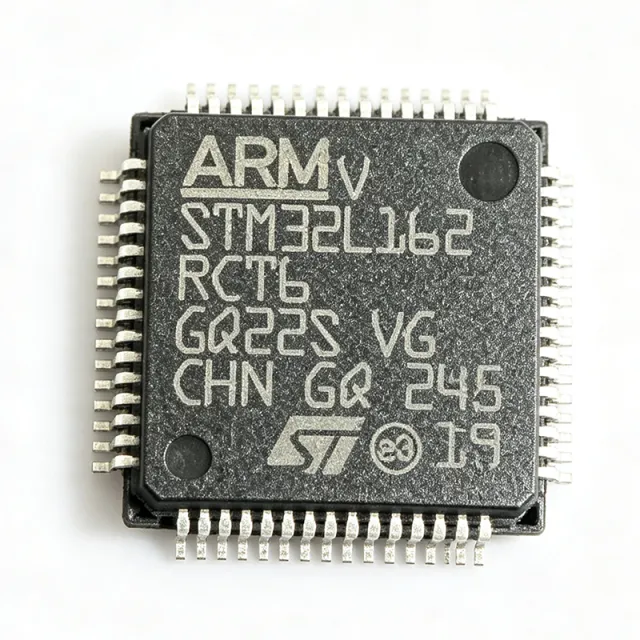
STM32L162RCT6 - Ultra-Low-Power ARM Cortex-M3 MCU | STMicroelectronics
STM32L162RCT6

STM32L162RCT6 - Ultra-Low-Power ARM Cortex-M3 MCU | STMicroelectronics

The STMicroelectronics STM32L162RCT6 is an ultra-low-power 32-bit microcontroller based on the ARM Cortex-M3 core, operating at frequencies up to 32 MHz. It features 256 KB of Flash memory and 32 KB of SRAM, along with a rich set of peripherals including USB, LCD, and AES encryption. The device is housed in a 64-pin LQFP package, making it suitable for space-constrained applications. An ultra-low-power microcontroller (MCU) is a system-on-chip that integrates a processor core, memory, and peripherals, designed to minimize energy consumption while maintaining computational capability. The STM32L1 series is STMicroelectronics' flagship low-power family, targeting battery-powered and energy-harvesting applications. It sits within the broader hierarchy of embedded microcontrollers, which are the building blocks of IoT devices, portable medical equipment, and smart sensors. Key features of the STM32L162RCT6 include multiple low-power modes (Sleep, Low-power Run, Low-power Sleep, Stop with RTC, Standby with RTC), a 12-bit ADC with 1 Msps, a 12-bit DAC, and an embedded AES-128 encryption engine. The device also integrates a real-time clock (RTC) with calendar and alarm functions, and supports a wide supply voltage range from 1.8V to 3.6V. The ultra-low-power design achieves a typical current consumption of 3.4 µA in Stop mode with RTC, and 0.27 µA in Standby mode. The STM32L162RCT6 is built on a 130nm low-leakage process technology, which is optimized for minimal static power consumption. The architecture includes a flexible clock tree with multiple internal and external oscillators, allowing designers to trade off performance for power. The AES hardware accelerator offloads cryptographic operations from the CPU, reducing energy consumption for secure communication. Typical applications include smart meters, medical devices (e.g., glucose monitors, hearing aids), industrial sensors, and portable consumer electronics. The integrated LCD controller supports up to 8x40 segments, making it ideal for battery-powered displays. The USB 2.0 full-speed device interface enables direct connectivity to hosts for data logging and firmware updates. When designing with this device, careful attention should be paid to the power supply decoupling and the selection of low-power modes to maximize battery life. The use of the internal low-speed oscillator (LSI) for the RTC can reduce external component count, but an external 32.768 kHz crystal provides better accuracy for timekeeping applications.

USD $2.86 پەیوەندی