بەرهەمەکان (48,000+)

STM32L496QEI6 - 80MHz Cortex-M4 512KB MCU | STMicroelectronics
STM32L496QEI6

STM32L496QEI6 - 80MHz Cortex-M4 512KB MCU | STMicroelectronics

The STMicroelectronics STM32L496QEI6 is an ultra-low-power 32-bit Arm Cortex-M4 microcontroller with a maximum clock frequency of 80 MHz, 512 KB of embedded Flash memory, and a 132-UFBGA 7 x 7 mm package. Designed for energy-sensitive embedded systems, it combines real-time processing capability with integrated connectivity, security, and low-power features. The verified distributor data identifies a single-core Cortex-M4 architecture and USB OTG, LCD, and DSP-related capabilities. Its combination of performance, memory, and package density suits compact industrial controllers, connected sensors, human-interface systems, and low-power edge devices. An ultra-low-power microcontroller is a semiconductor device designed to complete control, sensing, communications, and data-processing tasks while minimizing energy consumption. The STM32L496 belongs to the STM32L4 family of low-power microcontrollers, combining a high-performance Arm Cortex-M4 core with peripherals for security, connectivity, analog measurement, timing, and human-machine-interface functions. This places it within the embedded-processing hierarchy: microcontroller, 32-bit RISC processor, semiconductor, and embedded-control platform. Key verified features include an 80 MHz Arm Cortex-M4 core, 512 KB Flash, a 132-UFBGA package, and ultra-low-power positioning. Distributor listings also identify USB OTG and LCD support, while the STMicroelectronics product family page describes the STM32L496xx devices as ultra-low-power Cortex-M4 MCUs operating up to 80 MHz. These features make the device suitable when an engineer needs substantial processing performance without moving to a larger general-purpose MCU architecture. The STM32L496QEI6 is manufactured in a 132-UFBGA 7 x 7 mm package, requiring careful PCB layout, fine-pitch routing, and assembly validation. Unlike a simple through-hole microcontroller, its dense package can reduce board area but increases sensitivity to solderability, via placement, thermal performance, and manufacturing capability. A complete design should follow the manufacturer pinout, recommended land pattern, decoupling strategy, and PCB guidelines in the STM32L496 documentation. Typical applications include industrial control and automation, USB-connected data acquisition, low-power sensor nodes, LCD-equipped user interfaces, building and energy systems, and compact embedded products. For battery- or energy-harvesting designs, the STM32L496 family is attractive because its low-power architecture can reduce the energy required between task wake-ups. The exact low-power current figures and peripheral specifications should be confirmed in the manufacturer datasheet before final design sign-off. A key design consideration is package and power-rail integrity. Place all required decoupling capacitors close to the device supply pins, route sensitive signals away from high-current switching paths, and preserve the manufacturer-defined exposed-pad and thermal layout. Verify pin multiplexing, alternate-function conflicts, clock configuration, USB requirements, and firmware support before releasing a PCB for production. This page combines verified distributor information with engineering guidance intended to make the STM32L496QEI6 selection process more transparent.

RFQ پەیوەندی
STM32L496QGI3 - 80MHz 1MB Cortex-M4 MCU | STMicroelectronics
STM32L496QGI3

STM32L496QGI3 - 80MHz 1MB Cortex-M4 MCU | STMicroelectronics

STMicroelectronics STM32L496QGI3 is an ultra-low-power 32-bit Arm Cortex-M4 microcontroller with floating-point unit, operating up to 80 MHz, with up to 1 MB Flash and 320 KB SRAM in a 132-UFBGA 7 x 7 mm package. A microcontroller is a programmable system-on-chip that integrates a CPU core, memory, peripherals, and communication interfaces into one component. In the hierarchy, STM32L496QGI3 is an Arm Cortex-M4 MCU, an embedded microcontroller, and a semiconductor within the broader STM32L4 family. Its combination of processing performance, low-power modes, and extensive connectivity supports compact embedded systems. Key features include an Arm Cortex-M4 processor with FPU, 100 DMIPS performance, 1 MB Flash, and 320 KB SRAM. The device also supports USB OTG FS, audio, HASH, and an external SMPS. Its operating supply range is 1.71 V to 3.6 V, while the documented temperature options span -40 °C to 85 °C, 105 °C, or 125 °C, depending on the ordering variant. The STM32L496 architecture combines a high-performance 32-bit RISC core with low-power FlexPowerControl operating modes. Low-power behavior includes 320 nA in VBAT mode for the RTC and 32 x 32-bit backup registers, plus 25 nA shutdown consumption with five wakeup pins. These characteristics suit battery-operated and always-on products where standby current matters as much as active processing speed. Typical uses include industrial control, USB-connected data acquisition, human-interface equipment, sensor hubs, portable instruments, and low-power embedded gateways. The USB OTG FS interface can simplify host or device connectivity, while the large memory footprint supports firmware, data buffering, and application logic. The external SMPS option is useful when system power architecture requires more flexibility than a fixed internal regulator arrangement. For PCB design, use the manufacturer pin and package guidance for the 132-UFBGA land pattern, and verify ball assignments before routing. Decoupling, ground-plane continuity, and high-speed signal return paths are critical because a compact BGA package leaves limited routing space. Confirm the exact peripheral pin multiplexing, power sequencing, and exposed-pad connection from the manufacturer datasheet. This product page combines verified distributor identification and manufacturer datasheet specifications with package, sourcing, and design context. It is intended to help engineers compare the STM32L496QGI3 with same-package alternatives and plan a compliant, thermally sound implementation without treating unrelated MCUs as drop-in replacements.

RFQ پەیوەندی
STM32L496RGT3 - Ultra-Low-Power ARM Cortex-M4 MCU 80MHz 1MB Flash | STMicroelectronics
STM32L496RGT3

STM32L496RGT3 - Ultra-Low-Power ARM Cortex-M4 MCU 80MHz 1MB Flash | STMicroelectronics

The STMicroelectronics STM32L496RGT3 is an ultra-low-power 32-bit ARM Cortex-M4 microcontroller with FPU operating up to 80 MHz (100 DMIPS), integrating 1 MB of Flash and 320 KB of SRAM in a 64-pin LQFP (10x10 mm) package. It supports a wide 1.71 V to 3.6 V supply range with FlexPowerControl, delivering 320 nA VBAT mode current for RTC and backup registers, and 25 nA Shutdown mode current with 5 wakeup pins. An ultra-low-power microcontroller (MCU) is a class of microcontrollers engineered to minimize active and standby power consumption, typically using sub-threshold transistor design, multiple low-power modes (Sleep, Stop, Standby, Shutdown), and integrated DC-DC converters. The STM32L4 family sits in the broader hierarchy of ARM Cortex-M microcontrollers (Cortex-M0/M0+/M3/M4/M7/M33) under the STMicroelectronics STM32 product line, which serves industrial, IoT, medical, and consumer embedded applications where battery life is critical. Key features of the STM32L496RGT3 include the Cortex-M4 core with single-precision FPU and DSP instructions, 1 MB Flash and 320 KB SRAM, integrated USB OTG FS, an LCD-TFT controller (8x40 or 4x44 with step-up), AES-256 hardware encryption, a true random number generator (TRNG), DFSDM (digital filter for sigma-delta modulators), and an external SMPS support interface for direct connection to an integrated switching mode power supply. The architecture combines an ART Accelerator (Adaptive Real-Time memory accelerator) for 0-wait-state execution from Flash, a Chrom-ART Accelerator for 2D graphics offload, and 12-bit ADC and DAC peripherals. The 80 MHz Cortex-M4 core delivers 100 DMIPS / 273 CoreMark performance while the L4 series achieves an industry-leading ULPBench score of 245, reflecting its ultra-low-power efficiency. Typical applications include wearable health devices, smart sensors, industrial HMI panels with LCD displays, USB-powered portable instruments, secure IoT endpoints with AES-256, low-power RF transceivers, and battery-backed metering systems. The 64-pin LQFP package provides ample GPIO and is suitable for hand-solderable prototypes. When designing with the STM32L496RGT3, select the appropriate low-power mode per the application duty cycle (Shutdown for idle months, Stop for sub-second wake, Standby for RTC-only operation), and follow ST's AN4621 reference for SMPS external inductor selection. The QFP64 footprint enables easy migration to other STM32L4-series devices in the same package. This page synthesizes distributor pricing, drop-in alternatives, and practical design notes not found in the manufacturer datasheet. Engineers should cross-check the QFP64 pinout against the STM32L496RG reference manual (RM0354) before board bring-up.

RFQ پەیوەندی
STM32L496RGT6 - 80MHz Cortex-M4 MCU, 1MB Flash | STMicroelectronics
STM32L496RGT6

STM32L496RGT6 - 80MHz Cortex-M4 MCU, 1MB Flash | STMicroelectronics

The STMicroelectronics STM32L496RGT6 is an ultra-low-power 32-bit ARM Cortex-M4 microcontroller with FPU, operating at up to 80 MHz (100 DMIPS) and integrating 1 MB of Flash memory and 320 KB of SRAM in a 64-pin LQFP (10x10 mm) package. The device targets battery-powered and always-on applications where microamp sleep currents and a 1.71 V to 3.6 V supply range are decisive design constraints. An ultra-low-power microcontroller (MCU) is a single-chip embedded processor that combines a CPU core, non-volatile Flash memory, SRAM, and a rich set of analog and digital peripherals, optimized for minimal energy consumption. Within the power-management hierarchy of embedded systems, MCUs such as the STM32L4 series sit at the application-control layer, executing user firmware while managing sensors, displays, and connectivity with microamp-scale sleep currents. They are commonly contrasted with general-purpose Cortex-M parts and with low-power variants from competing vendors such as NXP, Microchip, and Renesas. Key features include ST's FlexPowerControl with 320 nA in VBAT mode and 25 nA Shutdown mode (5 wakeup pins), USB OTG Full-Speed, an integrated LCD controller (segment LCD up to 8x40), DFSDM (digital filter for sigma-delta modulators), hardware AES-256 and a HASH accelerator, and support for an external SMPS to reduce core dynamic power. Analog peripherals include a 12-bit ADC, 12-bit DAC, comparators, and operational amplifiers. Technically, the Cortex-M4 with single-precision FPU and DSP instructions executes DSP-heavy workloads such as audio filtering and sensor fusion, while the proprietary ART Accelerator (Adaptive Real-Time) keeps the 80 MHz core fed from Flash with zero-wait-state access for most code paths. The peripheral set includes multiple USART/UART, SPI, I2C, CAN, timers, 16-channel 12-bit ADC, DAC, comparators, op-amps, and low-power timers, plus the integrated DFSDM for high-resolution sigma-delta input chains. Typical applications include battery-powered metering, IoT sensor nodes, portable medical and wearable devices, industrial sensor transmitters, and consumer products with segment LCD displays. The combination of USB OTG, LCD, and DFSDM gives it particular traction in mid-tier IoT endpoints and handheld instrumentation. For design, leverage the DFSDM with external sigma-delta modulators for 16+ bit effective sensing, and size the power supply for the 100 mA-class peak core plus USB load currents. Use ST's STM32CubeMX and STM32CubeIDE plus the HAL/LL drivers to configure the ultra-low-power modes, and reserve PCB area for an optional external SMPS inductor. The 64-LQFP footprint is shared across the STM32L4 family, easing pin-compatible upgrades to higher-density variants such as the STM32L496ZGT6 (144-LQFP). This page synthesizes distributor pricing, drop-in family alternatives, and practical design notes not found in the manufacturer datasheet.

RFQ پەیوەندی
STM32L496VET6 - 80MHz 512KB Cortex-M4 | STMicroelectronics
STM32L496VET6

STM32L496VET6 - 80MHz 512KB Cortex-M4 | STMicroelectronics

The STMicroelectronics STM32L496VET6 is an ultra-low-power 32-bit microcontroller built around an Arm Cortex-M4 processor with FPU, operating up to 80 MHz. It provides 512 KB of Flash memory, USB OTG FS connectivity, LCD support, audio peripherals, HASH capability, and external SMPS support in a 100-pin LQFP package measuring 14 x 14 mm. A microcontroller is a programmable semiconductor that integrates a CPU, memory, and peripherals into one compact device. The STM32L4 family belongs to the embedded-processing hierarchy of 32-bit MCU, Arm Cortex-M core, RISC processor, and embedded semiconductor. Its combination of processing performance and low-power operating modes suits products that need local control, communications, data acquisition, and user-interface support without a separate processor. Key features include an 80 MHz Arm Cortex-M4 core with FPU, 512 KB of Flash, a 1.71 V to 3.6 V operating supply range, and FlexPowerControl for low-power operation. The device also supports USB OTG FS, 12-bit ADC channels, LCD interfaces, audio functions, HASH, and external switched-mode power-supply support. These resources consolidate several embedded functions into one package while reducing external component count. The STM32L496VET6 provides up to 100 DMIPS through the STM32L496xx architecture. Its low-power modes are important for battery-operated and intermittently powered equipment: shutdown consumption reaches 25 nA, while VBAT mode consumes 320 nA while maintaining RTC operation and 32 x 32-bit backup registers. The processor's FPU accelerates floating-point calculations used in control loops, signal processing, and data formatting without requiring a separate DSP. Typical applications include industrial sensor controllers, USB-connected data-acquisition equipment, LCD-equipped human-interface panels, low-power edge instruments, portable measurement products, and compact embedded control systems. USB OTG FS is particularly useful for configuration, data transfer, and USB-hosted peripheral connectivity, while the LCD and audio interfaces support human-facing products. Design the power tree around the 1.71 V to 3.6 V operating range and account for startup, sleep, and shutdown current when estimating battery life. Place decoupling capacitors close to the supply pins, route USB differential signals with controlled impedance, and consult the manufacturer pin-definition table before assigning every 100-pin LQFP connection. This product page combines the manufacturer's core electrical specifications, package details, application guidance, qualified same-family alternatives, and practical PCB considerations. It supports faster part selection by organizing memory, core performance, low-power modes, interface capabilities, and replacement considerations in one engineering-focused reference.

RFQ پەیوەندی
STM32L496VGT3 - 80MHz Cortex-M4 MCU | STMicroelectronics
STM32L496VGT3

STM32L496VGT3 - 80MHz Cortex-M4 MCU | STMicroelectronics

The STMicroelectronics STM32L496VGT3 is an ultra-low-power 32-bit Arm Cortex-M4 microcontroller with floating-point unit, operating at up to 80 MHz and delivering 100 DMIPS. It integrates 1 MB of flash memory, 320 KB of SRAM, USB OTG FS, audio interfaces, and analog peripherals in a 100-LQFP 14 x 14 mm package. Its operating supply range is 1.71 V to 3.6 V. An ultra-low-power microcontroller is a semiconductor controller designed to balance processing capability with minimum energy consumption. The STM32L496 belongs to the STM32L4 family and combines the Arm Cortex-M4 processor with embedded memory, communication interfaces, analog conversion functions, and low-power operating modes. This hierarchy places it within embedded processing, microcontroller, and power-management-aware system design. Principal device features include 1 MB of flash, 320 KB of SRAM, an Arm Cortex-M4 FPU core, and operation up to 80 MHz. The device also provides USB OTG 2.0 full-speed connectivity, two 12-bit DAC channels, two operational amplifiers with programmable gain, and two ultra-low-power comparators. Low-power characteristics include 320 nA consumption in VBAT mode and 25 nA consumption in shutdown mode with five wakeup pins. The peripheral set includes four I2C interfaces supporting FM+ operation at 1 Mbit/s, five USARTs, one LPUART, three SPIs, a Quad-SPI capability, two serial audio interfaces, and other communication resources. The 100-pin LQFP package provides enough external connectivity for industrial controllers, audio equipment, data-acquisition systems, and USB-enabled embedded products while supporting a broad operating-temperature option. Typical applications include USB-connected industrial data loggers, audio control systems, portable instruments, sensor-hub controllers, and low-power monitoring equipment. Engineers can use the Cortex-M4 FPU for DSP-oriented control loops, the DAC and operational amplifiers for analog signal conditioning, and the USB interface for configuration or data transfer. Power design must account for the 1.71 V to 3.6 V operating range, peripheral load current, and the difference between active and low-power consumption. Decoupling, controlled startup, unused-pin treatment, and thermal management should follow the pin definitions and application guidance in the manufacturer datasheet. This page combines the STM32L496VGT3 electrical characteristics, pin-oriented engineering guidance, same-family drop-in alternatives, and application comparisons to help designers evaluate integration, firmware constraints, and board-level implementation before releasing a PCB.

RFQ پەیوەندی
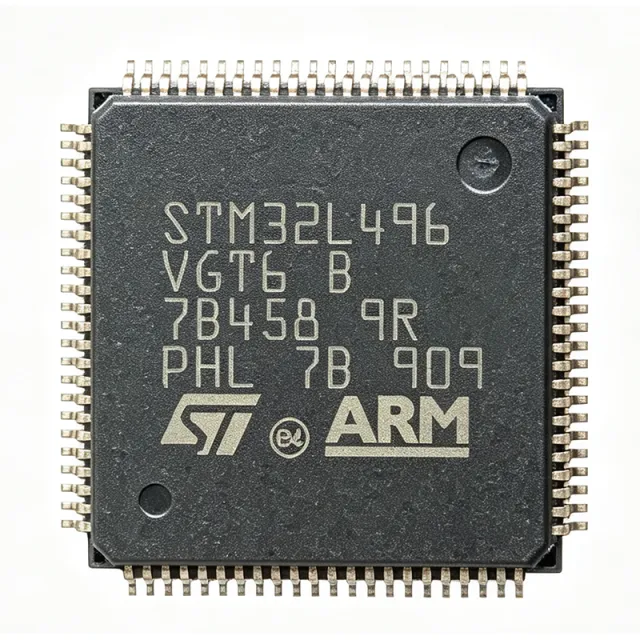
STM32L496VGT6 - Ultra-Low-Power ARM Cortex-M4F MCU | STMicroelectronics
STM32L496VGT6

STM32L496VGT6 - Ultra-Low-Power ARM Cortex-M4F MCU | STMicroelectronics

The STM32L496VGT6 is an ultra-low-power 32-bit microcontroller from STMicroelectronics, based on the ARM Cortex-M4F core with FPU, running at up to 80 MHz. It integrates 1 MB of flash memory and 320 KB of SRAM, making it suitable for complex embedded applications requiring significant code and data storage. The device operates from a 1.71V to 3.6V supply and features a rich set of peripherals including multiple USARTs, SPIs, I2Cs, USB OTG FS, CAN, SDMMC, and advanced analog capabilities with two 12-bit ADCs, two DACs, and an internal voltage reference. What is an ultra-low-power microcontroller? An ultra-low-power microcontroller is a type of embedded processor designed to minimize energy consumption while maintaining computational performance. It belongs to the broader category of microcontrollers, which are integrated circuits containing a processor core, memory, and programmable peripherals on a single chip. In the system hierarchy, an ultra-low-power MCU sits above basic 8-bit controllers but below application processors, offering a balance of efficiency and capability for battery-powered and energy-harvesting devices. The STM32L496VGT6 exemplifies this class with multiple low-power modes, including Sleep, Low-power Run, and Shutdown, enabling extended battery life in portable and IoT applications. Key features of the STM32L496VGT6 include its 80 MHz ARM Cortex-M4F core with DSP instructions and single-precision FPU, 1 MB flash, 320 KB SRAM, and a comprehensive set of communication interfaces. It also features a Chrom-ART Accelerator for enhanced graphic performance, a true random number generator, and a cryptographic acceleration unit supporting AES, DES, and 3DES. The device is manufactured using ST's 40 nm process technology, contributing to its low power consumption and high integration density. Technically, the STM32L496VGT6 offers up to 100 DMIPS performance, with a CoreMark score of 273. It includes a flexible memory controller supporting external memory, and a large number of GPIOs (up to 114) in the LQFP100 package. The analog subsystem includes two 12-bit ADCs with hardware oversampling, two 12-bit DACs, and an internal voltage reference buffer. The device also supports a wide range of timers, including advanced-control timers for motor control and a low-power timer for wake-up from low-power modes. Typical applications include industrial sensors, smart meters, medical devices, wearable electronics, and IoT nodes. Its ultra-low-power modes and rich analog peripherals make it ideal for battery-powered data acquisition systems, while its connectivity options enable seamless integration into industrial networks and cloud platforms. When designing with this device, pay attention to the power supply decoupling and the selection of the appropriate low-power mode for your application. The STM32L496VGT6 supports a flexible clock tree with multiple PLLs, allowing optimization of performance versus power consumption. Ensure proper configuration of the voltage regulator range to balance performance and energy efficiency.

USD $9.55 پەیوەندی
STM32L496VGY6TR - 80MHz Cortex-M4 MCU 1MB Flash WLCSP-100
STM32L496VGY6TR

STM32L496VGY6TR - 80MHz Cortex-M4 MCU 1MB Flash WLCSP-100

The STMicroelectronics STM32L496VGY6TR is an ultra-low-power 32-bit ARM Cortex-M4 microcontroller with FPU, operating at up to 80 MHz and delivering 100 DMIPS, housed in a 100-ball WLCSP (4.62 x 4.14 mm) package. It integrates 1 MB of flash memory and 320 KB of SRAM, plus USB OTG FS, an LCD interface, and a digital filter for sigma-delta modulators (DFSDM). The device is part of the STM32L4 family and features an AES-256 hardware crypto accelerator and a hardware hash accelerator. An ARM Cortex-M4 microcontroller is a 32-bit RISC processor core designed for embedded applications, featuring low power consumption, deterministic interrupt response, and optional single-precision floating-point unit (FPU). The M4 sits within the broader Cortex-M family hierarchy: Cortex-M0/M3/M4 -> ARMv7-M architecture -> 32-bit MCU -> embedded processor -> semiconductor. The STM32L4 series specifically targets ultra-low-power applications, balancing processing performance with energy efficiency through multiple low-power modes including Shutdown at 25 nA. Key differentiating features include 1 MB flash, 320 KB SRAM, integrated SMPS step-down converter for dynamic voltage scaling, USB OTG FS, MIPI-DSI or parallel LCD interface support, two 12-bit ADCs at 5 Msps, two 12-bit DACs, DFSDM for audio/sensor applications, AES-256 and Hash accelerators, and the standard STM32 ecosystem (HAL/LL libraries, STM32CubeMX, IDE support). The WLCSP-100 package enables compact wearable and IoT designs where PCB area is critical. The Cortex-M4F core includes a single-precision FPU that accelerates DSP operations and floating-point math. The internal SMPS regulator improves efficiency over the traditional LDO regulator approach during active mode, enabling higher performance at lower power. The device supports multiple low-power modes (Stop, Standby, Shutdown) with the Shutdown mode consuming only 25 nA for battery-backed IoT endpoints. Typical applications include wearable fitness trackers, portable medical sensors, industrial IoT sensor nodes, USB-C powered accessories, LCD-based HMI panels, smart home sensor hubs, and audio interfaces leveraging the digital microphone support. The combination of USB OTG, LCD, and ultra-low power makes it particularly suited for battery-powered consumer and medical devices. When designing with this device, verify that the WLCSP-100 footprint matches your PCB capability (WLCSP requires advanced PCB process for routing and inspection). For prototypes or hand-assembly, consider the LQFP-64 or UFBGA-169 variants of the STM32L496 family instead. Provide a stable VDD and consider the SMPS inductor selection per ST application note AN4621. This page synthesizes distributor pricing, drop-in alternatives, and practical design notes not found in the manufacturer datasheet, providing actionable intelligence beyond standard spec repetition.

RFQ پەیوەندی
STM32L496ZET6 - 80MHz Cortex-M4 512KB MCU | STMicroelectronics
STM32L496ZET6

STM32L496ZET6 - 80MHz Cortex-M4 512KB MCU | STMicroelectronics

STMicroelectronics STM32L496ZET6 is an ultra-low-power 32-bit Arm Cortex-M4 microcontroller with a floating-point unit, operating up to 80 MHz, 512 KB of flash memory, and 320 KB of SRAM in a 144-LQFP 20 x 20 mm package. It combines high processing performance with 100 DMIPS capability and supports USB OTG FS, audio, HASH, and an external switched-mode power supply interface. An ultra-low-power microcontroller is a semiconductor designed to balance useful processing performance with minimal energy consumption during active operation, sleep, and shutdown. The STM32L4 product family belongs to the hierarchy of embedded processing: Arm Cortex-M microcontroller, 32-bit microcontroller, embedded microcontroller, and semiconductor. This combination makes the STM32L496ZET6 suitable for connected industrial equipment, portable instruments, low-power controllers, and systems requiring a broad set of serial and analog peripherals. Key features include an 80 MHz Arm Cortex-M4 processor with FPU, 512 KB of program flash, and 320 KB of SRAM. The device operates from a 3.3 V supply as identified in the product listing, supports USB OTG FS, and includes hardware capabilities associated with audio and cryptographic HASH operations. Its 144-pin LQFP package provides a high pin count suitable for designs requiring extensive external connectivity. The STM32L4 architecture combines a 32-bit RISC core with integrated flash, SRAM, clock management, communication peripherals, and low-power modes. The manufacturer describes the STM32L496xx family as operating up to 80 MHz and delivering 100 DMIPS. Its integrated feature set can reduce the need for external interface or signal-conditioning components, although the exact peripheral mix and electrical limits for the selected device must be confirmed in the manufacturer pin-description and electrical-characteristics tables. Typical applications include industrial control modules, USB-connected data acquisition units, low-power embedded gateways, portable measurement equipment, and audio-capable embedded systems. The 80 MHz core supports responsive control and communication tasks, while 320 KB of SRAM provides useful working memory for protocol stacks, buffering, and real-time application code. PCB design should use the manufacturer recommended decoupling, clock, reset, and USB layout practices. Confirm all 144 pin assignments in the package pinout before routing, especially power, ground, analog, debug, and USB signals. Because LQFP lead pitch and pad geometry constrain assembly, verify the recommended land pattern and manufacturing rules before releasing artwork. This product record combines manufacturer and distributor technical information, lifecycle status, packaging details, application guidance, and a parameter comparison framework. It also highlights where engineering data must be confirmed in the STM32L496xx datasheet, helping designers evaluate the STM32L496ZET6 before schematic capture and PCB layout.

RFQ پەیوەندی
STM32L496ZGT3 - 80MHz Cortex-M4 1MB MCU | STMicroelectronics
STM32L496ZGT3

STM32L496ZGT3 - 80MHz Cortex-M4 1MB MCU | STMicroelectronics

STMicroelectronics STM32L496ZGT3 is an ultra-low-power 32-bit Arm Cortex-M4 microcontroller with FPU operating at up to 80 MHz, offering up to 1 MB Flash, 320 KB SRAM, USB OTG FS, and audio support in a 144-LQFP 20 x 20 mm package. It is designed for embedded systems that need substantial memory, low-power operation, and broad peripheral connectivity. A microcontroller is a programmable semiconductor device that integrates a processor core, memory, and peripherals into one compact component. The STM32L4 series belongs to the Arm Cortex-M4 microcontroller family, combining real-time control capability with energy-saving operating modes. This hierarchy makes the STM32L496ZGT3 suitable for industrial controls, connected equipment, human-interface systems, and compact embedded platforms. Key features include an operating frequency of up to 80 MHz, a 100 DMIPS processing capability, and a floating-point unit. The device provides up to 1 MB of Flash configured as 1M x 8 and 320 KB of SRAM. Its USB OTG FS interface supports USB-connected data exchange, while integrated audio and digital signal processing resources suit mixed-signal and communication-oriented products. The STM32L496xx family uses STMicroelectronics FlexPowerControl for low-power operation. Supply operation is specified from 1.71 V to 3.6 V. Shutdown current is 25 nA with five wakeup pins, and VBAT mode consumes 320 nA while supporting the real-time clock and 32 x 32-bit backup registers. Available temperature options span -40 °C to 85 °C, 105 °C, or 125 °C depending on the selected orderable variant. Typical uses include industrial sensor controllers, USB-connected data loggers, audio-capable embedded equipment, low-power edge devices, and compact human-interface panels. The 144-pin LQFP package provides extensive I/O access compared with smaller microcontroller packages, making it useful where multiple communications, display, control, or analog interfaces are required. When laying out the board, follow the manufacturer pin and package guidance for the 144-LQFP footprint, place decoupling capacitors close to the appropriate supply pins, and confirm the selected external crystal, USB routing, and low-power peripherals against the datasheet. The large pin count also requires careful fan-out and assembly planning to avoid routing congestion. This page combines manufacturer specifications, exact-orderable-part identification, sourcing guidance, drop-in comparison points, and practical design considerations. It also highlights the distinction between true pin-compatible alternatives and parts that are only functionally similar, helping engineers make a board-level replacement decision without treating a different package or peripheral arrangement as a drop-in solution.

RFQ پەیوەندی
STM32L496ZGT6 - 80MHz Cortex-M4 1MB MCU | STMicroelectronics
STM32L496ZGT6

STM32L496ZGT6 - 80MHz Cortex-M4 1MB MCU | STMicroelectronics

STMicroelectronics STM32L496ZGT6 is an ultra-low-power Arm Cortex-M4 32-bit microcontroller with FPU, operating at up to 80 MHz and delivering up to 100 DMIPS, with 1 MB of embedded Flash, 320 KB of SRAM, USB OTG FS, audio, HASH, and external SMPS support in a 144-pin LQFP package measuring 20 x 20 mm. An ultra-low-power microcontroller is a semiconductor designed to balance substantial processing capability with minimized energy consumption. The STM32L4 series belongs to the hierarchy of Arm Cortex-M4 MCU, 32-bit RISC microcontroller, embedded controller, and low-power system-on-chip. STM32L496ZGT6 combines that processing capability with sleep, low-power, shutdown, and RTC-oriented operating modes, making it suitable for battery-powered and energy-conscious embedded systems. Principal features include a 1.71 V to 3.6 V operating supply, a 32-bit Cortex-M4 processor with floating-point unit, 1 MB Flash, 320 KB SRAM, and USB OTG full-speed connectivity. The analog subsystem provides up to three fast 12-bit ADCs sampling at 5 Msps, two comparators, two operational amplifiers, two DAC channels, and an internal voltage-reference buffer. These resources reduce the need for external signal-conditioning and conversion components. The device also integrates two general-purpose 32-bit timers, two 16-bit PWM timers dedicated to motor control, seven general-purpose 16-bit timers, and two low-power timers. USB OTG FS, audio support, HASH, DFSD, and external SMPS capability broaden its use across data acquisition, secure control, industrial communication, and low-power consumer equipment. Its low-power architecture includes FlexPowerControl, 320 nA VBAT operation for the RTC and backup registers, and a 25 nA shutdown mode with five wakeup pins. Typical applications include industrial sensor nodes, USB-connected instrumentation, battery-powered data loggers, medical monitoring equipment, motor-control systems, and portable measurement products. The 144-pin LQFP provides ample external peripheral connectivity while supporting designs that need more I/O than smaller MCU packages. Designers should review the complete pin-description table, power-supply requirements, decoupling recommendations, clock configuration, and low-power constraints in the manufacturer datasheet before finalizing the PCB. In particular, preserve the external SMPS interface layout and assign wakeup pins carefully so shutdown-mode entry does not interfere with required system behavior. This page organizes the STM32L496ZGT6 core specifications, package information, design guidance, qualification factors, and same-footprint alternatives. It also distinguishes orderable temperature-grade variants from the selected STM32L496ZGT6 configuration so engineers can assess replacement compatibility without changing the LQFP-144 board footprint.

RFQ پەیوەندی
STM32L4A6AGI6 - 80MHz Cortex-M4 MCU | STMicroelectronics
STM32L4A6AGI6

STM32L4A6AGI6 - 80MHz Cortex-M4 MCU | STMicroelectronics

The STMicroelectronics STM32L4A6AGI6 is an ultra-low-power 32-bit microcontroller built around the Arm Cortex-M4 processor, operating up to 80 MHz with 1 MB Flash and 320 KB SRAM in a 169-UFBGA 7 x 7 mm package. It combines 100 DMIPS, a floating-point unit, USB OTG FS, LCD support, AES hardware acceleration, audio peripherals, DFSDM, and an external switched-capacitor power-supply controller. A microcontroller is a programmable integrated circuit that combines a CPU core, memory, communication interfaces, timers, analog conversion blocks, and GPIO in one device. In the system hierarchy, the STM32L4A6AGI6 is a Cortex-M4 MCU, an embedded microcontroller, a semiconductor, and a member of the STM32L4 family. This integration lets a compact product perform control, communications, data acquisition, security, and low-power management without separate discrete controllers. Verified headline features include an Arm Cortex-M4 core with FPU at up to 80 MHz, 100 DMIPS, 1 MB of Flash organized as 1M x 8, and 320 KB of SRAM. The part also provides USB OTG FS, audio support, AES plus HASH, digital filtering for sigma-delta modulators, an LCD interface, and a high-performance external SMPS controller. These resources support firmware consolidation while keeping the board area below that of several discrete processors. The STM32L4A6xG family emphasizes ultra-low-power operation and performance efficiency. Its Cortex-M4 processing core, fast GPIO, communication peripherals, analog functions, and security hardware make it suitable for connected sensing, industrial equipment, human-interface systems, and compact control platforms. The exact package pin assignments and electrical limits should be checked against the official 169-ball data before layout release. Typical applications include USB-connected data acquisition, industrial sensor hubs, low-power gateways, audio-control systems, security-aware embedded controllers, and LCD-based human-interface devices. The 80 MHz Cortex-M4 core provides useful processing headroom, while 1 MB Flash and 320 KB SRAM reduce pressure on external memory for moderate firmware and data workloads. A key design consideration is BGA assembly: the 169-UFBGA package is not a hobbyist-friendly footprint and benefits from careful escape routing, controlled impedance, adequate thermal vias, and manufacturing capability. Firmware and peripheral assignments must also be validated because unused balls, power balls, and special-function balls are package-specific. This page consolidates verified manufacturer and distributor information, exact source links, practical design guidance, pricing data, and replacement analysis that are not presented as a single connected engineering resource on ordinary distributor listings.

RFQ پەیوەندی
STM32L4A6QGI6 - 80MHz Cortex-M4 1MB MCU | STMicroelectronics
STM32L4A6QGI6

STM32L4A6QGI6 - 80MHz Cortex-M4 1MB MCU | STMicroelectronics

The STMicroelectronics STM32L4A6QGI6 is an ultra-low-power 32-bit Arm Cortex-M4 microcontroller rated up to 80 MHz, with 1 MB of Flash memory and a 132-ball UFBGA package measuring 7 x 7 mm. The device also includes USB OTG, LCD, and AES capabilities, as identified in the supplied manufacturer and distributor listings. An ultra-low-power microcontroller is an embedded processing component designed to balance compute performance, energy consumption, and peripheral integration. The STM32L4A6 belongs to the STM32L4 family of 32-bit RISC microcontrollers. Its Arm Cortex-M4 core places it above basic 8-bit and 16-bit embedded controllers in processing capability while retaining a compact, low-power architecture suitable for battery-powered and industrial systems. The principal verified specifications are an 80 MHz operating frequency, 1 MB of Flash, a 32-bit Arm Cortex-M4 processor, and a 132-UFBGA package. Distributor listings also identify USB OTG, LCD support, and AES functionality. One distributor source additionally lists 114 I/O. These integrated features can reduce the number of external devices required in designs that need USB connectivity, display control, or hardware-assisted secure data processing. Technically, the STM32L4A6QGI6 is intended for low-power embedded control. Its Cortex-M4 architecture supports efficient interrupt-driven firmware, while the integrated communications and security-oriented features broaden its applicability beyond basic sensor reading or actuator control. The exact RAM size, voltage range, ADC characteristics, GPIO current ratings, and detailed power-consumption figures are not included in the supplied verified excerpts and should be confirmed in the manufacturer documentation before design release. Typical uses include compact USB-connected control equipment, low-power industrial sensor nodes, display-oriented embedded controls, and security-conscious portable products. The 7 x 7 mm UFBGA package supports dense PCB layouts, although exposed-pad layout, escape routing, assembly profile, and pin-level connectivity require careful review before layout signoff. The primary design consideration is that a 132-ball package demands disciplined PCB layout and manufacturing controls. Place decoupling capacitors close to supply pins, preserve the package thermal and electrical land pattern specified by STMicroelectronics, and validate USB impedance, power sequencing, and signal routing against the relevant device documentation. This page consolidates the verified manufacturer and distributor facts, distinguishes documented capabilities from unavailable parameters, and provides package-aware replacement guidance and practical integration notes rather than presenting unsupported specifications as confirmed facts.

RFQ پەیوەندی
STM32L4A6RGT6 - Cortex-M4 80MHz 1MB Flash MCU | STMicroelectronics
STM32L4A6RGT6

STM32L4A6RGT6 - Cortex-M4 80MHz 1MB Flash MCU | STMicroelectronics

The STMicroelectronics STM32L4A6RGT6 is an ultra-low-power 32-bit ARM Cortex-M4 microcontroller with FPU, operating at up to 80 MHz and delivering 100 DMIPS (1.25 DMIPS/MHz), with 1 Mbyte of flash memory and 320 Kbytes of SRAM, housed in a 64-pin LQFP (10x10 mm) package. An ultra-low-power microcontroller (MCU) is a system-on-chip that integrates a processor core, memory, and analog/digital peripherals on a single die, designed to minimize energy consumption in battery-powered and energy-harvesting systems. Within the power-management IC hierarchy, the STM32L4A6RGT6 belongs to the STM32L4 series of the STM32 family, which spans from low-power to high-performance ARM Cortex-M devices, and is positioned among the most energy-efficient Cortex-M MCUs on the market. Key differentiating features include a rich analog subsystem - two 12-bit DACs, two operational amplifiers, two ultra-low-power comparators, and a 16-bit ADC with hardware oversampling - plus a shutdown mode drawing as little as 28 nA. Digital connectivity covers USB OTG full-speed, two CAN 2.0B controllers, SDMMC, LCD controller, and multiple USART, SPI, and I2C ports, all supported across a 1.71V to 3.6V supply range. The device is manufactured on a 40 nm process and includes an AES cryptographic accelerator, a true random number generator (TRNG), a flexible memory protection unit (MPU), the Chrom-ART Accelerator (DMA2D) for graphics, and a 16-bit advanced motor-control timer. These blocks enable secure, GUI-enabled, and motor-driven products without external co-processors. Typical applications include industrial sensors, smart meters, medical and wearable devices, and IoT endpoints, where the combination of 28 nA shutdown, 80 MHz processing, and 1 MB flash removes the need for external memory or power-management companion ICs. Designers should carefully plan power-supply decoupling and PCB layout to realize the specified low-power figures, and should leverage the internal LDO or SMPS step-down options plus the graded low-power modes to maximize battery life. This page adds information gain beyond the manufacturer datasheet: drop-in alternatives with package and parameter matching, distributor pricing as of 2026-09-06, practical design notes, and a selection guide comparing the STM32L4A6RGT6 against same-footprint parts.

USD $9.56 پەیوەندی
STM32L4A6RGT7 - 80MHz 1MB Ultra-Low-Power MCU | ST
STM32L4A6RGT7

STM32L4A6RGT7 - 80MHz 1MB Ultra-Low-Power MCU | ST

The STMicroelectronics STM32L4A6RGT7 is an ultra-low-power 32-bit microcontroller built around the Arm Cortex-M4 core, operating at up to 80 MHz with 1 MB of embedded Flash memory in a 64-LQFP package measuring 10 mm by 10 mm. It is designed for compact embedded products that require efficient processing, substantial program storage, and low-power operation. An ultra-low-power microcontroller is a semiconductor that balances processing capability with energy efficiency. The STM32L4 family sits within the hierarchy of embedded processor, microcontroller, 32-bit RISC processor, and Arm Cortex-M microcontroller. This combination makes the STM32L4A6RGT7 suitable for battery-powered equipment, connected sensors, industrial controllers, and human-interface systems where both code density and low standby consumption are important. Key features include an Arm Cortex-M4 processor operating at 80 MHz, 1 MB of Flash, 320 KB of RAM, and 32-bit processing. The manufacturer listing also identifies USB OTG, LCD support, and AES hardware capability. These features reduce the need for external USB controllers, display interface circuitry, or software-based encryption in suitable designs. The 64-LQFP package provides a conventional leaded surface-mount format that is easier to inspect and assemble than a very fine-pitch package. The STM32L4A6RG device family combines a performance-oriented Cortex-M4 core with ultra-low-power positioning. Its 80 MHz operating point provides useful performance for protocol handling, local control, data acquisition, and user-interface logic. The 1 MB Flash capacity allows embedded applications to retain code, configuration data, and firmware update logic on the MCU itself, while 320 KB of RAM supports buffers and working data. Typical applications include low-power sensor nodes, industrial automation modules, USB-connected equipment, LCD-based control panels, and secure embedded controllers. AES acceleration is especially relevant when firmware must protect stored or transmitted information. For designs using a display, the LCD capability can simplify the connection between the MCU and a supported panel, although the complete electrical interface must follow the manufacturer reference documentation. When laying out the PCB, place decoupling capacitors close to the supply and ground pins, preserve the LQFP-64 land pattern, and route high-speed or sensitive signals away from switching nodes. Firmware validation should include the intended clock configuration, USB operating mode, display timing, and low-power transitions because peripheral behavior can vary with voltage and clock settings. This product overview combines manufacturer device information with practical package, sourcing, comparison, and design guidance. It highlights the verified 80 MHz Cortex-M4 performance, 1 MB Flash, 320 KB RAM, USB OTG, LCD, and AES features while helping engineers evaluate whether the 64-LQFP STM32L4A6RGT7 fits their PCB, firmware, and application requirements.

RFQ پەیوەندی
STM32L4A6VGT6 - 80MHz Cortex-M4 MCU | STMicroelectronics
STM32L4A6VGT6

STM32L4A6VGT6 - 80MHz Cortex-M4 MCU | STMicroelectronics

STMicroelectronics STM32L4A6VGT6 is an ultra-low-power 32-bit microcontroller based on the Arm Cortex-M4 RISC core, operating up to 80 MHz with 1 MB of embedded Flash memory in a 100-pin LQFP package. The device combines a 320 KB SRAM configuration, a floating-point unit, USB OTG, LCD support, and AES hardware encryption for compact embedded-control designs. A microcontroller is a programmable semiconductor that integrates a processor core, nonvolatile program memory, volatile data memory, peripherals, and communication interfaces on one package. The STM32L4 belongs to the MCU hierarchy within embedded processors and semiconductor control devices. Its Cortex-M4 architecture executes firmware efficiently while programmable timers, communication peripherals, and analog interfaces support real-time sensing, communications, and actuator control. Principal features include an 80 MHz operating frequency, 1 MB of Flash program storage, 320 KB of SRAM, 32-bit processing, and a hardware floating-point unit. USB OTG supports connected USB device and host-oriented designs, while the LCD interface targets embedded human-machine interfaces. AES hardware acceleration improves encrypted-data throughput without assigning cryptography to the central processing unit. The STM32L4A6VGT6 is especially useful when moderate processing performance and energy-conscious operation are required without moving to a larger package. Its 100-pin LQFP (14x14 mm) format exposes substantially more I/O than smaller MCU packages, supporting multiple external peripherals and mixed-signal interfaces. The Arm Cortex-M4 core and integrated floating-point hardware also provide a practical balance between computational capability, embedded software ecosystem, and board complexity. Typical applications include industrial sensor controllers, USB-connected data acquisition units, secure access-control equipment, low-power environmental monitors, compact human-machine interfaces, and connected battery-powered instruments. In these systems, the microcontroller can execute control logic, process sensor data, operate timers, and manage communications while retaining a broad set of peripheral interfaces. PCB design should follow the manufacturer pinout and reference-manual guidance for decoupling, clock stability, reset circuitry, and exposed interface routing. Confirm every peripheral assignment, power-domain requirement, and alternate-function selection in the STM32L4A6xG documentation before finalizing the schematic and PCB footprint. This product page combines manufacturer device positioning, distributor identification, package and memory details, drop-in same-family options, application guidance, and design-focused engineering notes to support faster component evaluation and sourcing decisions.

RFQ پەیوەندی
STM32L4A6ZGT6 - 80MHz 1MB Flash Cortex-M4 MCU | STMicroelectronics
STM32L4A6ZGT6

STM32L4A6ZGT6 - 80MHz 1MB Flash Cortex-M4 MCU | STMicroelectronics

The STMicroelectronics STM32L4A6ZGT6 is an ultra-low-power 32-bit microcontroller built around the Arm Cortex-M4 processor with floating-point unit, operating at up to 80 MHz and providing 1 MB of Flash memory, 320 KB of SRAM, USB OTG FS, AES and HASH acceleration, audio support, and an external SMPS in a 144-LQFP 20 x 20 mm package. An ultra-low-power microcontroller is an embedded semiconductor designed to execute firmware while minimizing energy consumption during active processing, standby, and low-power operating states. The STM32L4 family belongs to the embedded-processing hierarchy: microcontroller, 32-bit RISC processor, Arm Cortex-M4 core, and energy-efficient MCU platform. This combination makes it appropriate for connected products that must balance responsive application processing, peripheral connectivity, and constrained power budgets. The headline capabilities include an 80 MHz Arm Cortex-M4F core, 1 MB of program Flash, and 320 KB of SRAM. The MCU also integrates a floating-point unit, USB OTG full-speed connectivity, AES and HASH cryptographic hardware, audio capabilities, and an external switched-mode power-supply interface. These resources support demanding control tasks while reducing the need for discrete peripherals in compact embedded systems. Technically, the STM32L4A6xG architecture combines a high-performance 32-bit RISC core with extensive low-power peripherals and multiple connectivity options. The Cortex-M4F processor includes hardware floating-point acceleration for suitable control and signal-processing workloads. Its memory organization provides substantial code and working space for protocol stacks, human-machine interfaces, data acquisition, and connected industrial or medical equipment. Typical applications include USB-connected portable instruments, industrial sensor hubs, low-power data loggers, human-machine interface controllers, and embedded audio systems. The 144-pin package provides a high peripheral count for designs that need parallel communication, analog input, display control, storage interfaces, and USB in one device. Developers can prototype with the STM32 NUCLEO-L4A6ZG platform before moving to a production board. Design considerations center on power configuration, decoupling, clock planning, and pin multiplexing. Confirm the external SMPS topology, supported operating ranges, and peripheral pin assignments in the STM32L4A6xG datasheet. Keep high-current and analog-sensitive routing separated where practical, and validate the final power budget in sleep, stop, and standby modes. This page combines the key specifications, practical application guidance, drop-in comparison, pin and power-design considerations, and sourcing information for engineers evaluating the STM32L4A6ZGT6 as a compact, low-power Cortex-M4 platform.

RFQ پەیوەندی
STM32L4P5AGI6 - 120MHz Cortex-M4 1MB Flash MCU | ST
STM32L4P5AGI6

STM32L4P5AGI6 - 120MHz Cortex-M4 1MB Flash MCU | ST

STMicroelectronics STM32L4P5AGI6 is an ultra-low-power 32-bit Arm Cortex-M4 microcontroller with a maximum clock frequency of 120 MHz, 1 MB of Flash memory, and a 169-UFBGA package measuring 7 mm by 7 mm. The STM32L4P5AG family combines the Cortex-M4 processor with floating-point capability, USB OTG, and DFSD support for compact embedded systems that need efficient control, connectivity, and data acquisition. An ultra-low-power microcontroller is a semiconductor designed to execute firmware while minimizing energy consumption during active operation and low-power states. In the product hierarchy, this MCU belongs to the STM32L4+ Series, combines a 32-bit Arm Cortex-M4 RISC processor with 150 DMIPS processing capability, and provides dedicated USB OTG and DFSD functionality. These characteristics place it between general-purpose embedded control and applications requiring low-power operation, USB connectivity, or efficient file-based data transfer. The headline configuration combines a 120 MHz Arm Cortex-M4 core, 1 MB of Flash memory, and a 7 mm by 7 mm UFBGA package. The Cortex-M4 architecture provides a 32-bit execution environment with hardware floating-point capability for control loops, signal processing, and other workloads that benefit from efficient arithmetic. USB OTG support extends the design beyond standalone control by enabling USB-connected peripherals, configuration tools, data acquisition systems, and human-interface devices. DFSD support is another defining feature for designs that need to manage external storage through the dedicated storage interface. Depending on the memory and board implementation, this capability can support recording, firmware resources, logs, or buffered application data without assigning those transfers to general-purpose GPIO pins. The combination of 1 MB of internal Flash, USB OTG, DFSD, and the Cortex-M4 processor supports a broad range of embedded control tasks in a compact package. Typical uses include low-power USB data-acquisition equipment, industrial control modules, portable measurement instruments, connected sensors, compact consumer devices, and embedded systems that store data on external media. The 169-UFBGA package minimizes board area, but its fine-pitch ball grid and exposed thermal-management requirements make careful PCB layout and assembly essential. Engineers should assign every UFBGA ball and exposed-pad connection according to the manufacturer's pinout and land-pattern guidance before layout release. Because this package has 169 balls and no publicly listed ball-by-ball pin map appears in the available product references, use the official package drawing and pin-description tables when defining the footprint, power planes, and manufacturing constraints. This product record combines the core STM32L4P5AGI6 specifications, sourcing guidance, application context, and design cautions. It also distinguishes verified technical facts from package information that must be taken directly from the manufacturer datasheet, helping engineers plan schematic capture, PCB layout, firmware support, and supply-chain decisions with fewer preventable integration errors.

RFQ پەیوەندی
STM32L4P5CET6 - 120MHz Cortex-M4 512KB MCU | STMicroelectronics
STM32L4P5CET6

STM32L4P5CET6 - 120MHz Cortex-M4 512KB MCU | STMicroelectronics

The STMicroelectronics STM32L4P5CET6 is an ultra-low-power 32-bit Arm Cortex-M4 microcontroller with a floating-point unit, 120 MHz maximum CPU frequency, and 512 KB of Flash memory in a 48-LQFP 7 x 7 mm package. The device integrates USB OTG and DFSDM peripherals for connected, low-power data-acquisition designs. Its STM32L4+ architecture supports multiple low-power operating modes for portable, industrial, medical, and connected applications. An ultra-low-power microcontroller is a semiconductor device designed to execute firmware while minimizing energy consumption during both active and inactive operation. The STM32L4 family belongs to the hierarchy of 32-bit MCU, embedded processor, microcontroller, and semiconductor. Flexible power management lets firmware match clock, peripheral, and sleep states to workload conditions, extending operating time in battery-powered equipment. Key features include a 120 MHz Arm Cortex-M4F core, 150 DMIPS processing capability, 512 KB of Flash, and a supply range of 1.71 V to 3.6 V. The family also supports LCD-TFT control and an external switched-mode power supply as listed in the manufacturer datasheet. Low-power characteristics include 150 nA in VBAT mode for the real-time clock and backup registers and 22 nA shutdown current. USB OTG and DFSDM expand the device's utility for connected sensors, data loggers, and human-interface systems. The Cortex-M4F architecture combines a 32-bit RISC instruction set with single-precision floating-point hardware, allowing efficient control-loop and signal-processing calculations. FlexPowerControl provides multiple performance and power-consumption modes, while Stop and Standby modes reduce activity when the application does not require continuous processing. The external SMPS option can support more demanding power-management arrangements when the board design requires it. Typical applications include low-power USB data loggers, industrial sensor nodes, portable medical monitoring equipment, connected industrial controls, and compact LCD-based human-interface panels. The USB OTG interface supports USB-connected data transfer, while DFSDM supports applications that need specialized digital-to-analog signal acquisition or filtering. The 48-LQFP package remains inspectable and serviceable for prototypes and medium-volume assemblies. Design around the 1.71 V to 3.6 V operating range and verify every external pin's analog, USB, debug, and supply requirements against the manufacturer pin-definition table. Decoupling, VDDA filtering, BOOT configuration, clock stability, and programming-test access must be planned before PCB routing. Firmware changes can affect wake behavior, USB enumeration, and low-power measurements even when the replacement uses the same package. This page combines device specifications, practical power-management guidance, application fit, package constraints, and drop-in alternative analysis. It is intended to help engineers determine whether the STM32L4P5CET6 provides the required memory, timing, peripheral mix, and thermal operating margin for compact embedded systems.

RFQ پەیوەندی
STM32L4P5CEU6 - 120MHz Cortex-M4 MCU | STMicroelectronics
STM32L4P5CEU6

STM32L4P5CEU6 - 120MHz Cortex-M4 MCU | STMicroelectronics

STMicroelectronics STM32L4P5CEU6 is an ultra-low-power 32-bit Arm Cortex-M4 microcontroller with a 120 MHz operating frequency, 512 KB of Flash memory, USB OTG, DFSDM support, and a 48-pin UFQFPN package measuring 7 x 7 mm. It belongs to the STM32L4+ Series and is designed for compact, low-power embedded systems requiring substantial Flash capacity and a high-performance 32-bit processing core. An ultra-low-power microcontroller is an embedded processing device optimized to minimize energy consumption during active operation, sleep, standby, and shutdown states. The STM32L4+ family combines an Arm Cortex-M4 processor, embedded memory, analog and digital peripherals, and low-power management into one integrated device. This MCU hierarchy connects microcontrollers to embedded processors, embedded controllers, and semiconductor solutions for battery-powered and always-on equipment. Key features of the STM32L4P5CEU6 include a maximum CPU frequency of 120 MHz, 512 KB of Flash memory, a 32-bit Arm Cortex-M4 core, USB OTG support, and DFSDM capability. The 48-pin UFQFPN package reduces board area compared with leaded packages while supporting the high pin count needed for mixed-signal and connectivity functions. The manufacturer describes the STM32L4P5xx family as an ultra-low-power MCU and FPU platform within the STM32L4+ Series. The Arm Cortex-M4 architecture provides a balanced combination of processing performance, efficient interrupt handling, and embedded software support. At 120 MHz, the STM32L4P5CEU6 is suitable for control loops, human-interface processing, sensor aggregation, and connected embedded products that need more memory and peripheral connectivity than a basic low-end microcontroller. Its USB OTG capability also supports USB-connected data acquisition, configuration, and control applications. Typical uses include industrial sensor nodes, medical monitoring equipment, USB data loggers, building-control modules, energy meters, compact instrumentation, and portable diagnostic products. DFSDM support is especially relevant to designs using sigma-delta converters, while the 512 KB Flash allocation accommodates larger firmware images and application logic than many entry-level MCUs. Designers should confirm all peripheral pin assignments, exposed-pad connections, decoupling requirements, clock limits, and voltage-domain constraints in the STM32L4P5xx manufacturer datasheet. Because this exact 48-pin UFQFPN variant is not represented in the available package-diagram library, use a manufacturer pinout and land-pattern drawing when assigning PCB tracks. This page combines the verified STM32L4P5CEU6 product identity, a practical application map, purchasing guidance, and engineering-focused comparisons. It also identifies where pin-compatible replacement certainty is limited, helping engineers avoid treating a similar microcontroller specification as proof of drop-in electrical and software compatibility.

RFQ پەیوەندی
STM32L4P5CGT6 - 120MHz 1MB Flash MCU | STMicroelectronics
STM32L4P5CGT6

STM32L4P5CGT6 - 120MHz 1MB Flash MCU | STMicroelectronics

The STMicroelectronics STM32L4P5CGT6 is an ultra-low-power 32-bit microcontroller built around a 120 MHz Arm Cortex-M4 processor, with 1 MB of Flash memory in a 48-pin LQFP package measuring 7 x 7 mm. It supports a 1.71 V to 3.6 V power supply and combines a low-power operating architecture with extensive connectivity for embedded, industrial, medical, and IoT equipment. An ultra-low-power microcontroller is an embedded controller optimized to complete its workload while minimizing energy consumption during active operation, standby, shutdown, and battery-backed states. The STM32L4P5CG family belongs to the STM32L4+ Series and combines an Arm Cortex-M4 RISC core with integrated memory, security, analog, communications, and low-power peripherals. This hierarchy places it between general-purpose microcontrollers and highly integrated embedded processors. Principal features include 120 MHz maximum processing frequency, 1 MB of Flash memory, USB OTG and DFSD support, and a 1.71 V to 3.6 V operating supply range. The family also offers Batch Acquisition Mode for selected analog conversions and exceptionally low standby-oriented current: 150 nA in VBAT mode for the real-time clock and backup registers, plus 22 nA in Shutdown mode with five wakeup pins. The Cortex-M4 architecture provides 32-bit arithmetic, single-precision floating-point capability, and efficient event-driven control suitable for real-time signal acquisition and protocol handling. Integrated low-power features let a design remain responsive without continuously running the main processor. USB OTG expands the peripheral set for direct connectivity, while DFSD support is relevant to storage-oriented embedded systems that require efficient external data transfer. Typical uses include battery-powered medical sensors, industrial condition-monitoring terminals, compact data loggers, USB-connected instruments, and low-power IoT gateways. The MCU is especially useful when a design needs deterministic control, moderate Flash capacity, and several low-energy operating states without adding a separate external memory or interface controller. Designers should follow the manufacturer's pin, decoupling, clock, and low-power configuration guidance in the STM32L4P5CG datasheet. In particular, verify the power budget across Run, Stop, Standby, Shutdown, and VBAT modes, and confirm analog or USB signal conditioning when those interfaces are enabled. Start-up firmware should also configure debug access and unused pins before deployment. This page consolidates the manufacturer's family specifications, exact-package sourcing details, practical power-mode guidance, and a focused replacement assessment. It helps engineers distinguish genuine same-footprint options from devices that are only functionally similar before committing to an LQFP-48 redesign.

RFQ پەیوەندی
STM32L4P5CGU6 - 120MHz 1MB Cortex-M4 MCU | STMicroelectronics
STM32L4P5CGU6

STM32L4P5CGU6 - 120MHz 1MB Cortex-M4 MCU | STMicroelectronics

The STMicroelectronics STM32L4P5CGU6 is an ultra-low-power 32-bit Arm Cortex-M4 microcontroller with FPU, a 120 MHz operating frequency, 1 MB of internal Flash memory, and a 48-pin UFQFPN 7 x 7 mm package. It is designed for embedded systems that require substantial code and data storage, low-power operation, and integrated connectivity. The STM32L4+ family combines a high-performance Cortex-M4 core with energy-conscious peripherals for balanced industrial, medical, and consumer designs. An ultra-low-power microcontroller is a semiconductor device designed to maintain useful processing capability while minimizing energy consumption. The STM32L4+ series belongs to the hierarchy of microcontrollers, embedded processors, and low-power semiconductor devices. It is particularly suitable for battery-powered equipment, portable instruments, connected sensors, and control systems that spend substantial time in sleep or low-power modes while retaining fast response when processing is required. The STM32L4P5CGU6 provides up to 1 MB of Flash for firmware, 320 KB of SRAM for working memory, and operation up to 120 MHz. According to the STMicroelectronics product family information, the device family supports up to 150 DMIPS and includes USB OTG, DFSD, LCD-TFT, and external SMPS capabilities. Its operating supply range extends from 1.71 V to 3.6 V, while the specified temperature range covers -40°C to +85°C. Its Arm Cortex-M4 processor includes a floating-point unit for efficient handling of real-valued calculations used in signal processing, measurement, and control algorithms. The combination of 120 MHz performance and 1 MB of Flash separates application code from time-critical routines, allowing larger protocol stacks, user interfaces, logging functions, and safety-oriented control logic to be integrated without immediately exceeding memory constraints. Typical uses include connected medical monitors, industrial data loggers, low-power sensor hubs, USB-connected embedded equipment, small TFT human-interface systems, and compact battery-powered controllers. USB OTG can simplify direct host or device connectivity, while DFSD support is useful for designs requiring external storage operation through compatible card interfaces. The external SMPS option can support systems requiring a regulated internal supply for external components. Power configuration is a central design consideration because the device operates from a maximum of 3.6 V. Decoupling, exposed-pad connection, clock planning, firmware run modes, and low-power peripheral assignments should be reviewed together. Keep the exposed thermal pad connected to the ground plane, route high-current and sensitive signals carefully, and confirm all peripheral operating limits against the manufacturer datasheet. This product summary consolidates the processor, memory, package, environmental, and interface characteristics into a design-oriented reference. It also supports direct comparison with same-family options, application-based selection, and identification of the points that require confirmation in the complete STM32L4P5 hardware documentation before a PCB or firmware release.

RFQ پەیوەندی
STM32L4P5VET6 - 120MHz Cortex-M4 MCU, 512KB Flash | STMicroelectronics
STM32L4P5VET6

STM32L4P5VET6 - 120MHz Cortex-M4 MCU, 512KB Flash | STMicroelectronics

The STMicroelectronics STM32L4P5VET6 is an ultra-low-power 32-bit microcontroller based on the Arm Cortex-M4 processor, operating at up to 120 MHz with 512 KB of embedded Flash memory in a 100-pin LQFP package measuring 14 mm by 14 mm. The device integrates USB OTG, DFSDM, and 12-bit conversion capabilities for connected, low-power industrial and embedded systems. An ultra-low-power microcontroller is an integrated semiconductor that combines a processor core, memory, peripherals, and communication interfaces on one device. The STM32L4+ family belongs to the Arm Cortex-M4 microcontroller hierarchy and targets applications where responsive real-time processing must coexist with low standby current, efficient active-mode operation, and compact embedded control. The STM32L4P5VET6 provides a 120 MHz Arm Cortex-M4 core, 32-bit architecture, and 512 KB of Flash for firmware and application code. Its 100-pin LQFP package supports a broad peripheral complement for sensor acquisition, communications, human-machine interfaces, and connected industrial equipment. The listed feature set includes USB OTG and DFSDM, while the 12-bit ADC and DAC resources support precision measurement and signal generation. The high-performance Cortex-M4 architecture uses a reduced instruction set and includes floating-point capability for efficient digital signal processing and control-loop calculations. USB OTG supports direct USB connectivity for configuration, data transfer, and peripheral interfacing, while DFSDM provides a dedicated path for high-rate digital signal acquisition from external converters. These integrated functions reduce reliance on external interface devices in compact designs. Typical applications include industrial sensor hubs, building automation controllers, USB-connected data-acquisition systems, portable medical or test equipment, low-power edge nodes, and compact motor-control or measurement products. The combination of 512 KB Flash, USB connectivity, and 120 MHz processing is particularly useful when local control logic, communications, and signal processing must share one microcontroller. PCB design should preserve clean separation between analog and digital signals, route high-speed or USB interfaces with controlled impedance, and place decoupling capacitors close to the supply pins. Firmware must also be validated against the device pin definitions and peripheral requirements in the manufacturer datasheet before PCB routing or production release. This page combines device specifications, practical application guidance, and engineering-focused comparisons to support MCU selection, schematic review, PCB planning, and sourcing decisions for the STM32L4P5VET6.

RFQ پەیوەندی
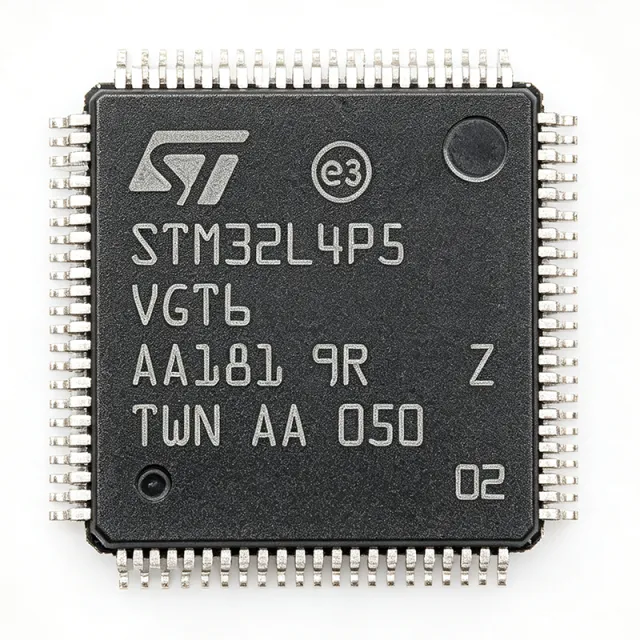
STM32L4P5VGT6 - Ultra-Low-Power Cortex-M4 MCU | STMicroelectronics
STM32L4P5VGT6

STM32L4P5VGT6 - Ultra-Low-Power Cortex-M4 MCU | STMicroelectronics

The STMicroelectronics STM32L4P5VGT6 is an ultra-low-power 32-bit microcontroller based on the ARM Cortex-M4 core with FPU, operating at up to 120 MHz. It delivers 213 DMIPS and 550 CoreMark, making it suitable for a wide range of battery-powered and energy-efficient applications. The device is housed in a 100-pin LQFP package (14x14 mm) and offers up to 1 MB of flash memory and 320 KB of SRAM. What is an ARM Cortex-M4 microcontroller? It is a 32-bit processor core designed for embedded systems, featuring a single-cycle multiply-accumulate (MAC) unit, hardware divide, and optional single-precision floating-point unit (FPU). The Cortex-M4 is part of the ARM Cortex-M family, which includes the M0, M0+, M3, M4, and M7 cores, each optimized for different performance and power trade-offs. In the system hierarchy, a microcontroller (MCU) integrates the processor core, memory, and peripherals on a single chip, serving as the central processing unit in embedded systems such as IoT devices, industrial controllers, and consumer electronics. Key features include a rich set of analog peripherals: two 12-bit DACs, three 12-bit ADCs with hardware oversampling, two operational amplifiers, two comparators, and an internal voltage reference buffer. The device also integrates advanced digital peripherals: two CAN FD controllers, one USB 2.0 OTG FS/HS, one SDMMC interface, and a flexible memory controller (FMC) for external memory expansion. The STM32L4P5VGT6 supports multiple low-power modes, including Sleep, Low-power Run, Low-power Sleep, Stop 0/1/2, and Standby, with a typical current consumption of 100 nA in Standby mode with backup domain. The STM32L4P5VGT6 is built on ST's ultra-low-power technology, featuring a dynamic voltage scaling (DVS) capability that adjusts the core voltage to optimize power consumption at different operating frequencies. The device includes a hardware cryptographic accelerator (AES, DES, 3DES) and a true random number generator (TRNG), enhancing security for connected applications. The rich set of timers includes two advanced-control timers, six general-purpose timers, two basic timers, and two low-power timers, providing precise timing and PWM generation. Typical applications include IoT nodes, smart meters, portable medical devices, industrial sensors, and wearable devices. The ultra-low-power modes and high integration make it ideal for battery-powered systems requiring long operational life. The device also supports a wide operating temperature range of -40°C to +85°C, suitable for industrial environments. When designing with this MCU, pay attention to the power supply decoupling: place a 100 nF capacitor close to each VDD pin and a 4.7 uF capacitor at the main power input. For low-power operation, configure the GPIOs to analog mode when unused to reduce leakage current. The STM32L4P5VGT6 is supported by STM32CubeMX and STM32CubeL4 firmware package, simplifying development.

USD $11.14 پەیوەندی