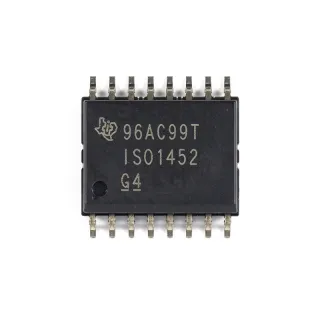
ISO1042QDWVQ1 - 5Mbps Isolated CAN FD | Texas Instruments
MPN: ISO1042QDWVQ1 ✓ چالاکISO1042QDWVQ1 گشتی
A CAN transceiver is the physical-layer interface between a CAN controller and a two-wire differential bus. ISO1042-family devices combine bus-driver and receiver functions with digital isolation, allowing a controller-side logic domain to communicate with a bus-side domain while reducing common-mode and ground-potential hazards. This transceiver belongs to the CAN interface IC, interface IC, and semiconductor hierarchy used in automotive and industrial networks.
Key features include operation up to 5 Mbps in CAN FD mode, ±70-V DC bus fault protection, and a ±30-V common-mode range. The isolation barrier separates logic-side and bus-side circuits, while flexible data rate support permits substantially faster payload transfer than classical CAN. These characteristics suit systems that must combine high-speed data transfer with robust protection against automotive electrical transients.
The ISO1042-Q1 family meets the ISO11898-2:2016 specification and is positioned for automotive and industrial CAN networks. Its primary interface functions include transmit, receive, bus-fault handling, and isolation. The 16-pin wide-body SOIC package supports surface-mount assembly while providing enough lead spacing for inspection and rework in demanding electronics manufacturing processes.
Typical applications include electric-vehicle powertrain and body networks, industrial automation equipment, robotics controllers, diagnostic systems, and isolated CAN links between high-voltage systems and low-voltage controllers. In these systems, the isolated transceiver can link a CAN FD-capable controller to a protected network while helping maintain functional separation between circuit domains.
Designers should pay close attention to bus termination, common-mode range, grounding, isolation-capacitor placement, and the exact pin assignments in the manufacturer datasheet. The 5-Mbps operating rate also requires controlled printed-circuit-board layout, short differential routing, and compliant CAN physical-layer timing. Automotive programs should additionally verify qualification, traceability, and sourcing requirements with the manufacturer.
This page combines the manufacturer specifications, practical isolation-interface guidance, a same-package replacement comparison, and selection criteria that help engineers distinguish electrical protection, automotive qualification, and interface compatibility before committing a board design.
جێگرەوەکانی جێگۆڕکێ بۆ ISO1042QDWVQ1 — هەمان پاکەت، پین بە پین گونجاو. ئەو بەشانەی پاکەتی جیاوازیان هەیە و پێویستیان بە چاککردنەوەی PCB هەیە لابراون.
جۆرەکان لەم زنجیرەیەدا
مۆدێلەکانی هەمان زنجیرە کە بە شێوەی ڕاستەوخۆ گونجاون لەگەڵ ISO1042QDWVQ1 (هەمان شێوە و پێکهاتەی شوێن) — جیاوازە لە Package, Product Type, Common-Mode Voltage Range, Isolation Type, Bus Fault Protection.
ISO1042BDWV
✅ جێگرەوەی ڕاستەوخۆ✓ بەردەستە
$1.58 / یەکە
بینینی داتاشیت →ISO1042QDWVQ1 تایبەتمەندییەکان
| Product Type | Galvanically isolated CAN FD transceiver |
| CAN Standard | ISO11898-2:2016 |
| Maximum CAN FD Data Rate | 5 Mbps |
| DC Bus Fault Protection | -70 V to +70 V |
| Common-Mode Voltage Range | -30 V to +30 V |
| Isolation Type | Galvanic isolation |
| Automotive Qualification | Automotive product designation |
| پاکێج | 16-pin wide-body SOIC |
| جۆری دامەزراندن | Surface mount |
| CAN Transceiver Mode | 1/1 isolated half CAN bus |
ڕێنمایی ڕێکخستنی پینی ISO1042QDWVQ1 16-pin wide-body soic
ڕێکخستنی پین بۆ ISO1042QDWVQ1 (پاکێجی 16-pin wide-body soic). ژمارەدانی پین، فەنکشنەکان و نەخشەکانی پەیوەندی لە داتاشیتی بەرھەمھێنەردا پێناسە کراون. سەرنجی بدە بۆ شوێنپێی ورد و ڕێنمایییەکانی لەحیمکردن.

هیچ داتای وردی پینئاوت بەردەست نییە بۆ ISO1042QDWVQ1.
سەرنج بدە بە داتاشیت بۆ ڕێکخستنی تەواوی پینەکان.
بەکارهێنانە باوەکان
ISO1042QDWVQ1 گونجاوە بۆ 6 بەکارھێنانs: Electric Vehicle Powertrain Networks, Industrial Automation and Robotics, Automotive Diagnostic Systems, Battery Energy Storage Systems, Vehicle Body and Comfort Networks, Isolated Test and Control Equipment.
Electric Vehicle Powertrain Networks
The ISO1042QDWVQ1 fits isolated CAN FD links connecting an automotive controller to powertrain, battery-management, or inverter communications. Its 5-Mbps CAN FD rate supports demanding control traffic, while ±70-V DC bus fault protection strengthens tolerance to wiring faults in a vehicle environment. The galvanically isolated interface helps separate low-voltage logic from the bus domain. PCB design must preserve the differential CAN routing, provide correct termination, and follow the manufacturer’s isolation-component placement guidance.
پێشنیارکراو
Industrial Automation and Robotics
The ISO1042QDWVQ1 is suitable for industrial controllers that require a fast, isolated CAN FD physical interface. A 5-Mbps rate can shorten the time required to transfer production data and diagnostic information, while the ±30-V common-mode range provides operating margin in electrically noisy environments. Galvanic isolation supports safer partitioning between equipment-side logic and the CAN network. Use controlled impedance routing, appropriate bus termination, and verified isolation-capacitor placement to retain signal and isolation performance.
پێشنیارکراو
Automotive Diagnostic Systems
The ISO1042QDWVQ1 can provide the isolated physical layer between a diagnostic controller and an automotive CAN FD network. Its 5-Mbps capability allows rapid transfer of diagnostic information, while ±70-V DC bus fault protection helps the interface withstand fault conditions encountered in vehicle wiring. The isolation barrier lets the controller maintain a defined ground relationship rather than sharing the bus ground directly. Firmware timing, bus termination, and system-level fault handling must be validated together.
پێشنیارکراو
Battery Energy Storage Systems
The ISO1042QDWVQ1 is appropriate for battery-management systems requiring isolated communication between a control computer and battery modules. CAN FD operation up to 5 Mbps supports timely collection of voltage, temperature, current, and state-of-charge information, while galvanic isolation helps manage the separation between control electronics and battery-side circuitry. The ±30-V common-mode range and ±70-V DC fault protection support robust field wiring. System designers should still evaluate surge paths, grounding strategy, and long-cable behavior.
پێشنیارکراو
Vehicle Body and Comfort Networks
The ISO1042QDWVQ1 can interface CAN FD nodes responsible for body, lighting, climate, and access functions. The 5-Mbps data rate accommodates modern body-electronics traffic while retaining compatibility with classical CAN nodes on the same network design. Its automotive Q1 designation makes it relevant to vehicle programs, and ±70-V DC bus-fault protection improves robustness against wiring disturbances. Correct termination, common-mode behavior, and fault-recovery settings must be confirmed for the network topology.
پێشنیارکراو
Isolated Test and Control Equipment
The ISO1042QDWVQ1 can serve as the CAN FD network interface in automated test equipment that must connect a controller to equipment located on another electrical domain. The isolated transceiver supports data rates up to 5 Mbps and provides a ±30-V common-mode operating range, helping the receiver interpret signals on systems with ground offsets. The ±70-V DC fault protection is useful during test wiring transitions. Lab users should configure bus termination appropriately and use controlled cable routing to minimize reflections.
پێشنیارکراو
کورتەی بەرهەمە پێشنیارکراوەکان
داتای سەرچاوەی ئەندازیاری بۆ ISO1042QDWVQ1 — بەراوردکردن، ڕێنمایی دیزاین و زانیاری پابەندبوون.
ڕێنمایی هەڵبژاردن
بەراوردکردن لەگەڵ جێگرەوەکان
| پارامەتر | ئەم بەرهەمە | ISO1042BDWV |
|---|---|---|
| Product Type | Automotive galvanically isolated CAN FD transceiver | Galvanically isolated CAN FD transceiver |
| Manufacturer | Texas Instruments | Texas Instruments |
| Package | SOIC-16 | SOIC-16 |
| Maximum CAN FD Data Rate | 5 Mbps | 5 Mbps |
| DC Bus Fault Protection | ±70 V | Up to 70 V |
| Isolation Rating | Basic and reinforced isolation | Basic and reinforced isolation |
| CAN Standard | ISO11898-2:2016 | ISO11898-2 family |
| Automotive Ordering Designation | ISO1042-Q1 | Standard ISO1042 catalog designation |
جیاکەرەوە سەرەکییەکان
- Automotive Q1 ordering designation (بەراورد بەISO1042BDWV)
- 5-Mbps isolated CAN FD performance (بەراورد بەISO1042BDWV)
- Up to 70-V DC bus fault protection (بەراورد بەISO1042BDWV)
تێبینییەکانی دیزاین
Route the CANH and CANL pair as a short, tightly coupled differential pair on the bus side of the PCB. Minimize stubs, vias, test pads, and impedance discontinuities between the transceiver and external connector. Place the protection components specified by the manufacturer close to the connector so surge current is diverted before reaching the transceiver. Maintain symmetric geometry to minimize radiated emissions and susceptibility to external noise.
Separate the logic-side and bus-side supply networks according to the isolation boundary in the manufacturer application circuit. Install the required bypass capacitors close to their associated supply pins, and keep the isolated supply and return paths within the proper isolation region. Verify capacitor voltage ratings, isolation creepage, clearance, and the permitted working voltage for the final automotive or industrial environment rather than relying only on package dimensions.
Choose termination for the actual CAN network topology. Two termination resistors are normally placed at the physical ends of the bus, while excessive termination can reduce signal amplitude and drain power. Confirm propagation delay, loop delay, and timing against the controller and transceiver before operating at 5 Mbps. Long cables, stubs, and connector transitions should be evaluated for reflections because acceptable bus fault and common-mode ratings do not guarantee correct high-speed signaling.
Do not treat the ISO1042-Q1 as pin-compatible with an ISO1050 merely because both families may use an SOIC package. Texas Instruments identifies RXD and TXD arrangement differences between those families, so a mechanical fit can still produce incorrect communication. Likewise, do not approve an 8-pin ISO1042 ordering code as a drop-in replacement for this 16-pin device. Verify the complete ordering code, package drawing, pin table, qualification, and operating limits before substitution.
زانیاری پابەندبوون
The ISO1042-Q1 family is identified as an automotive product, but explicit RoHS, REACH, AEC-Q100, lead-free, halogen-free, and conflict-minerals declarations are not stated in the product-page text. Verify these attributes for the exact ordering code with Texas Instruments.