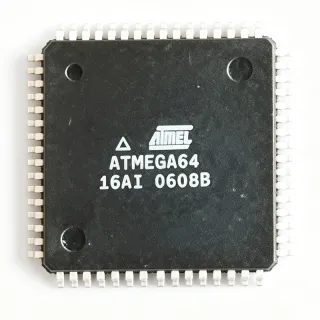
PIC16F727-I/PT - 8-Bit 20MHz XLP Flash MCU, 44-TQFP | Microchip
MPN: PIC16F727-I/PT ✓ چالاکPIC16F727-I/PT گشتی
An 8-bit microcontroller is a programmable integrated circuit that executes a fixed, compact instruction set from on-chip Flash memory and operates on a single power rail. Within the product hierarchy, a microcontroller sits above simple logic ICs, inside the broader class of embedded processors, and is the heart of most embedded control products: it executes firmware, reads sensors, drives actuators and manages communication links. The PIC16F727-I/PT is specifically designed for cost-sensitive, low-power embedded control.
Key features include a 16 MHz internal oscillator, an RISC core delivering 200 nanosecond instruction execution with only 35 single-word instructions, and Microchip's nanoWatt XLP (Extreme Low Power) technology, which places this device in the manufacturer's low-power MCU family. The -I/PT suffix denotes the industrial temperature grade supplied in a 44-lead TQFP tray package, and the manufacturer lists the device as In Production.
Architecturally, the PIC16F7xx family combines a Harvard-style Flash program memory with a separate data EEPROM region and a set of integrated analog and digital peripherals, so a design does not need external memory or a separate ADC. Because the core is RISC with 35 single-word instructions, compiled code executes quickly for an 8-bit part, and the familiar PIC16 peripheral set means most development tools and code patterns transfer directly from related PIC16 devices.
Typical applications include industrial control and instrumentation panels, motor and pump controllers, sensor conditioning nodes, HVAC and building-control endpoints, low-cost data loggers, and consumer appliance sub-systems where low standby current and a single-supply operation matter more than raw processing speed.
When designing around this device, budget the I/O pins against your peripheral needs and confirm the ADC, comparator and timer channel allocation in the pin-description table before assigning PCB tracks. Keep the decoupling network tight at VDD and AVSS, and note that high-current outputs on the same port can disturb analogue measurements taken on adjacent channels.
This page combines the manufacturer product information, distributor availability and a practical set of drop-in alternatives, comparison data and engineering notes that are not consolidated in a single place on the datasheet, helping engineers shortlist and qualify the part faster.
جێگرەوەکانی جێگۆڕکێ بۆ PIC16F727-I/PT — هەمان پاکەت، پین بە پین گونجاو. ئەو بەشانەی پاکەتی جیاوازیان هەیە و پێویستیان بە چاککردنەوەی PCB هەیە لابراون.
جۆرەکان لەم زنجیرەیەدا
مۆدێلەکانی هەمان زنجیرە کە بە شێوەی ڕاستەوخۆ گونجاون لەگەڵ PIC16F727-I/PT (هەمان شێوە و پێکهاتەی شوێن) — جیاوازە لە Package, Core Architecture, ADC, Timers, Operating Temperature.
PIC16F727-E/PT
✅ جێگرەوەی ڕاستەوخۆ ⚠️ تایبەتمەندییەکان پشتڕاست نەکراونەتەوەپەیوەندی بۆ نرخ
بینینی داتاشیت →PIC16F737-I/PT
✅ جێگرەوەی ڕاستەوخۆ ⚠️ تایبەتمەندییەکان پشتڕاست نەکراونەتەوە📋 جێگرەوەی سەرچاوە (لە کاتالۆگدا نییە)
PIC16F767-I/PT
✅ جێگرەوەی ڕاستەوخۆ ⚠️ تایبەتمەندییەکان پشتڕاست نەکراونەتەوە📋 جێگرەوەی سەرچاوە (لە کاتالۆگدا نییە)
PIC16F887-I/PT
✅ جێگرەوەی ڕاستەوخۆ ⚠️ تایبەتمەندییەکان پشتڕاست نەکراونەتەوەپەیوەندی بۆ نرخ
بینینی داتاشیت →PIC16F785-I/PT
✅ جێگرەوەی ڕاستەوخۆ ⚠️ تایبەتمەندییەکان پشتڕاست نەکراونەتەوە📋 جێگرەوەی سەرچاوە (لە کاتالۆگدا نییە)
PIC16F727-I/PT زۆرترین ڕێژە و تایبەتمەندییە کارەباییەکان
| Device Type | 8-bit Flash Microcontroller (MCU) |
| Core Architecture | PIC RISC, 200 ns instruction execution |
| Instruction Set | 35 single-word instructions |
| Maximum CPU Frequency | 20 MHz |
| Internal Oscillator Frequency | 16 MHz |
| Program Memory (Flash) | 14 KB (8K x 14 words) |
| پاکێج | 44-TQFP (10 x 10 mm) |
| ژمارەی پین | 44 pins |
| جۆری دامەزراندن | Surface Mount |
| Low Power Technology | nanoWatt XLP (Extreme Low Power) |
| Product Family | PIC XLP 16F mid-range Flash MCU family |
| Device Variants in Family | 28/40/44-pin Flash microcontrollers with nanoWatt XLP Technology |
| Product Status | In Production |
ڕێنمایی ڕێکخستنی پینی PIC16F727-I/PT 44-tqfp (10 x 10 mm)
ڕێکخستنی پین بۆ PIC16F727-I/PT (پاکێجی 44-tqfp (10 x 10 mm)). ئەم IC ی دیجیتاڵە GPIO، ڕووکارەکانی پەیوەندی (UART، SPI، I2C) و پینی وزە لەخۆدەگرێت. سەرنج بدە بە داتاشیتی بەرھەمھێنەر بۆ فەنکشنەکانی پینی جێگرەوە و ھەڵبژاردنەکانی ڕێکخستن. پێویستە بۆ دیزاینی سیستەمی جێگیر و ڕێکخستنی PCB.

هیچ داتای وردی پینئاوت بەردەست نییە بۆ PIC16F727-I/PT.
سەرنج بدە بە داتاشیت بۆ ڕێکخستنی تەواوی پینەکان.
بەکارهێنانە باوەکان
PIC16F727-I/PT گونجاوە بۆ 6 بەکارھێنانs: Industrial Sensor and Data Acquisition Node, Motor and Pump Control Controller, Building and HVAC Control Endpoint, Instrumentation and Measurement Front Panel, Low-Cost Consumer Appliance Sub-System, Communications and Gateway Interface Board.
Industrial Sensor and Data Acquisition Node
The PIC16F727-I/PT suits distributed sensing nodes because it combines a 16 MHz internal oscillator with a 20 MHz maximum CPU frequency, so no external crystal or resonator is needed for stable timing in the field. The 14 KB (8K x 14 words) of on-chip Flash is enough for calibration tables, filtering routines and a local data log, while the RISC core executing in 200 nanoseconds per instruction leaves headroom for oversampling and digital filtering of slow analog inputs. Because the device belongs to the nanoWatt XLP Extreme Low Power family, a battery or harvested-power installation can spend long periods in a low-current state and wake to sample. A PCA9534PWR or PCA9554PWR I/O expander can be added when the base I/O budget is not enough, keeping the MCU pin count unchanged.
پێشنیارکراو
Motor and Pump Control Controller
In motor, pump and valve control boards, the PIC16F727-I/PT provides the timing density and I/O flexibility needed to run PWM-driven actuators without adding a second processor. The 35 single-word instruction set and 200 nanosecond instruction execution time let the firmware service multiple timers, capture inputs and apply closed-loop updates within a single loop, which is essential when the same controller also handles interlocks and fault reporting. Operating from a 44-pin TQFP (10 x 10 mm) footprint keeps the control board compact enough to sit inside a motor terminal box, and the industrial-grade ordering code suits the temperature swings found near pumps and gearboxes. A gate driver such as an SP490EEN-L/TR interface can be used where isolated RS-485 telemetry is needed on the same board.
پێشنیارکراو
Building and HVAC Control Endpoint
HVAC and building-control endpoints demand long standby current, reliable timing and enough peripheral capacity for multiple sensors, so the PIC16F727-I/PT fits well as the terminal controller. Its 16 MHz internal oscillator and 20 MHz CPU ceiling support timer-based scheduling, hysteresis control of actuators and periodic reporting over a serial link, all from a single 14 KB Flash budget that leaves space for protocol stacks alongside application logic. The 44-pin TQFP (10 x 10 mm) package is compact for a wall-plate or ceiling-mounted electronics module, and the XLP low-power heritage is exactly what battery-backed or energy-harvested building sensors need between transmissions. An I/O expander such as the PCA9555PWR can add dry-contact inputs without consuming additional MCU pins.
پێشنیارکراو
Instrumentation and Measurement Front Panel
For instrumentation front panels and bench instruments, the PIC16F727-I/PT acts as the supervisory controller that handles display refresh, keypad scanning, alarm management and host communication. Its 200 nanosecond instruction execution and 20 MHz ceiling give enough throughput to multiplex a display and service a UART link while keeping measurement timing deterministic. The 44-pin TQFP (10 x 10 mm) land pattern is straightforward to route on a densely populated panel PCB, and the mid-range 14 KB Flash budget is practical for menus, calibration constants and logging buffers. A MAX138EPL+ SPI EEPROM extends record capacity for captured measurements, and an LT1030CDR or similar level-shifting RS-232 device handles legacy host connectivity when the panel must talk to older instrumentation.
پێشنیارکراو
Low-Cost Consumer Appliance Sub-System
In consumer appliances such as small kitchen equipment, water heaters or fan controllers, the PIC16F727-I/PT provides enough Flash and I/O for a complete sub-system at low component cost. The 14 KB program memory fits a state machine, temperature control loop and self-test routine, and the 16 MHz internal oscillator removes two external components and the associated board area, which matters in appliances where the enclosure volume is tightly constrained. The 44-pin TQFP (10 x 10 mm) package is a mainstream footprint with broad assembly support, and the nanoWatt XLP low-power heritage limits standby consumption in devices that sit unplugged for long periods. Simple LED and relay indication can be driven directly, with a PCA9554PWR added when more discrete outputs are needed.
پێشنیارکراو
Communications and Gateway Interface Board
Gateway and protocol-conversion boards benefit from a microcontroller that can service several serial interfaces while staying in the low-power envelope. The PIC16F727-I/PT's 20 MHz ceiling and 35-instruction RISC core are sufficient to run a bridging firmware loop between a host UART and a downstream network interface, with the 14 KB Flash budget accommodating framing, retries and a small protocol stack. Sitting in a 44-pin TQFP (10 x 10 mm) package, it fits comfortably alongside an Ethernet controller such as the LAN9353T/PT on a gateway PCB and consumes little standby current when the link is idle. A SP3232-series transceiver provides RS-232 port protection where legacy field equipment still connects.
پێشنیارکراو
کورتەی بەرهەمە پێشنیارکراوەکان
داتای سەرچاوەی ئەندازیاری بۆ PIC16F727-I/PT — بەراوردکردن، ڕێنمایی دیزاین و زانیاری پابەندبوون.
ڕێنمایی هەڵبژاردن
Choose the PIC16F727-E/PT if you need the same part in the extended temperature grade; nothing else changes, so the PCB stays identical. Choose the PIC16F737-I/PT or PIC16F767-I/PT when firmware has outgrown 14 KB of Flash, since both keep the same footprint and core and only add code space. Choose the PIC16F887-I/PT when you need the richer peripheral set of the higher-resource member of the family, again in the same 44-pin package, and the PIC16F785-I/PT when its comparator and timer mix better fits the design.
No cross-manufacturer part is pin-compatible with this 10 x 10 mm 44-pin footprint, so a brand change would require a new layout. For a platform change entirely, evaluate an 8-bit alternative from another vendor only if you can accept PCB rework and a firmware rewrite.
بەراوردکردن لەگەڵ جێگرەوەکان
| پارامەتر | ئەم بەرهەمە | PIC16F727-E/PT | PIC16F737-I/PT | PIC16F767-I/PT | PIC16F887-I/PT | PIC16F785-I/PT |
|---|---|---|---|---|---|---|
| Package | 44-TQFP (10 x 10 mm) | 44-TQFP (10 x 10 mm) - same | 44-TQFP (10 x 10 mm) - same | 44-TQFP (10 x 10 mm) - same | 44-TQFP (10 x 10 mm) - same | 44-TQFP (10 x 10 mm) - same |
| Brand | Microchip Technology | Microchip Technology | Microchip Technology | Microchip Technology | Microchip Technology | Microchip Technology |
| CPU Type | 8-bit PIC RISC, 200 ns instruction execution | 8-bit PIC RISC | 8-bit PIC RISC | 8-bit PIC RISC | 8-bit PIC RISC | 8-bit PIC RISC |
| Temperature Grade Code | -I (industrial) | -E (extended) | -I (industrial) | -I (industrial) | -I (industrial) | -I (industrial) |
جیاکەرەوە سەرەکییەکان
- Broadest drop-in upgrade path in the same 44-TQFP land pattern (بەراورد بەPIC16F737-I/PT)
- Single-board temperature qualification without layout change (بەراورد بەPIC16F727-E/PT)
- Mixed-silicon architecture avoids an external clock component (بەراورد بەPIC16F767-I/PT)
- Part of the low-power XLP programme rather than a general-purpose member (بەراورد بەPIC16F785-I/PT)
تێبینییەکانی دیزاین
The PIC16F727-I/PT is a 44-lead TQFP on a 10 x 10 mm footprint with a fine 0.5 mm pitch, so treat it as a fine-pitch assembly and plan a dedicated fan-out of vias from the pad rows to the routing layers. Place the decoupling capacitor for each supply pin directly adjacent to its pad rather than relying on a bulk capacitor placed elsewhere, and keep the analog ground and digital ground return paths short and separated as shown in the manufacturer layout guidance. Keep the antenna-cleared keep-out around any board-mounted RF section away from the MCU clock and supply pins to avoid coupling noise into the 16 MHz oscillator network.
Estimated: for a design running the internal 16 MHz oscillator with a 3.3 V rail and a typical active current in the low-milliampere range, the dominant supply burden is the switching of the digital I/O, not the core itself. Budget the regulator for the sum of the MCU current plus the worst-case digital output current on all simultaneously driven pins, and specify the supply with headroom for the internal regulator dropout. If the board also powers an external sensor through a port pin, include that load in the calculation and confirm the port's total current rating in the pin-description table before committing to a topology.
A frequent mistake is migrating a PIC16F727-I/PT design to a 40-pin or 28-pin sibling without re-checking the layout, since the number of I/O pins and the analog channel allocation change with the package. Another common error is assuming the 14 KB of Flash is the only memory resource; confirm RAM and Data EEPROM sizes for the exact ordering code in the manufacturer datasheet before sizing buffers. Finally, note that the -I/PT part ships in a tray, so automated pick-and-place lines and factory programming flows need the appropriate tray-handling and in-circuit programming steps.
When driving long ribbon cables or switching noisy loads from a port pin, add series damping close to the driver and keep the return path close to the signal trace to limit radiated emissions. Because the internal oscillator is referenced to the supply and ground pins, any switching current on those nets appears directly as jitter in the timebase; isolate the MCU supply with its own local capacitor network and avoid sharing high-current return paths with sensitive analogue sections of the board.
زانیاری پابەندبوون
Compliance status for this ordering code is not stated on the manufacturer product page or the distributor listings; confirm RoHS, REACH and lead-free status with the manufacturer or via a Request a Quote enquiry before release. The part is an industrial-grade microcontroller and is not marketed as an AEC-Q100 automotive-qualified device.