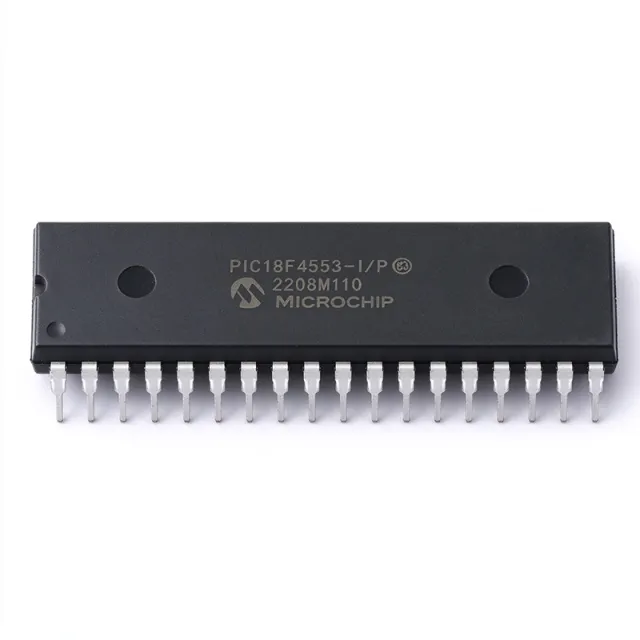
PIC18F4553-I/P - 8-Bit 40MHz USB MCU | Microchip Technology
MPN: PIC18F4553-I/P ✓ چالاک| بڕ | نرخی یەکە | کۆی گشتی |
|---|---|---|
| 1 | $14.0625 | $14.06 |
| 10 | $10.1563 | $101.56 |
| 100 | $8.9844 | $898.44 |
| 500 | $8.5938 | $4,296.90 |
| 1,000 | $8.2031 | $8,203.10 |
PIC18F4553-I/P گشتی
A PIC18 microcontroller is a programmable integrated circuit that combines a CPU core, program Flash, data memory, general-purpose I/O, and peripherals in one package. Within the semiconductor hierarchy, PIC18F4553 belongs to the 8-bit microcontroller class, which sits below the broader microcontroller and embedded-processing categories. Its combination of legacy-compatible through-hole packaging, USB connectivity, and mixed-signal measurement supports cost-sensitive designs that require external USB connectivity without a separate interface controller.
The device provides 32 KB of high-endurance enhanced Flash memory and 2,048 bytes of SRAM for firmware, configuration data, and working variables. Its 12-bit ADC is more precise than a conventional 10-bit conversion module, while 36 I/O pins support digital control and peripheral functions. The manufacturer identifies the family for low-power nanoWatt and connected applications, including instrumentation, USB data acquisition, industrial control, human-interface equipment, and embedded USB peripherals.
The PIC18F4553 architecture combines an 8-bit RISC-oriented processor core with interrupt-driven peripheral modules. Full-speed USB operating at 12 Mbit/s is suitable for control data, configuration data, and moderate-rate instrument traffic rather than high-throughput storage. SPI operation up to 10 Mbit/s supports faster external peripherals, while I²C is appropriate for sensors, EEPROMs, and other low-to-moderate-rate devices. The 4.2 V to 5.5 V operating range places the device in conventional 5 V embedded systems.
Typical uses include USB-connected measurement instruments, laboratory interfaces, programmable control panels, data loggers, and industrial accessories. In these systems, the internal ADC can acquire analog sensor inputs while the MCU evaluates control logic and communicates with a host through USB. SPI and I²C can extend the design with displays, memory, sensors, or communications transceivers without requiring another general-purpose controller.
A key design consideration is the relationship between Flash endurance, USB interrupt handling, and the chosen development toolchain. Firmware should use the device programming and USB implementation documented by Microchip, and the PCB should provide clean analog and digital grounding, adequate bypass capacitance, and controlled routing for USB and external serial interfaces. The 40-pin through-hole package also simplifies prototyping and inspection compared with fine-pitch surface-mount variants.
This page combines the manufacturer product information, lifecycle status, interface capabilities, package details, and practical replacement analysis in one engineering-focused reference. It also distinguishes true same-package drop-in candidates from pin-compatible parts available in other package formats, helping designers reduce redesign risk before committing a PCB footprint.
جێگرەوەکانی جێگۆڕکێ بۆ PIC18F4553-I/P — هەمان پاکەت، پین بە پین گونجاو. ئەو بەشانەی پاکەتی جیاوازیان هەیە و پێویستیان بە چاککردنەوەی PCB هەیە لابراون.
جۆرەکان لەم زنجیرەیەدا
مۆدێلەکانی هەمان زنجیرە کە بە شێوەی ڕاستەوخۆ گونجاون لەگەڵ PIC18F4553-I/P (هەمان شێوە و پێکهاتەی شوێن) — جیاوازە لە Package.
ئامرازی بەراوردکردنی خێرا — بەشە جێگرەوەکان هەڵبژێرە بۆ بەراوردکردنی لایەن بە لایەن:
PIC18F4550-I/PT
✓ بەردەستە
$4.95 / یەکە
بینینی داتاشیت →PIC18F4455-I/PT
پەیوەندی بۆ نرخ
بینینی داتاشیت →PIC18F2455-I/P
📋 جێگرەوەی سەرچاوە (لە کاتالۆگدا نییە)
PIC18F4553-I/P زۆرترین ڕێژە و تایبەتمەندییە کارەباییەکان
| Architecture | 8-bit PIC18 enhanced-flash microcontroller |
| زۆرترین فرێکوێنسیی کاتژمێر | 40 MHz |
| Program Memory | 32 KB Flash |
| Program Memory Organization | 16K x 16 words |
| Data Memory | 2048 bytes RAM |
| ADC Resolution | 12 bit |
| General-Purpose I/O Pins | 36 pins |
| USB Version | USB 2.0 full-speed |
| USB Maximum Data Rate | 12 Mbit/s |
| SPI Maximum Data Rate | 10 Mbit/s |
| ڤۆڵتاژی دابینکردنی کارکردن | 4.2 V to 5.5 V |
| پاکێج | 40-pin plastic through-hole package |
| جۆری دامەزراندن | Through-hole |
| Program Memory Type | Enhanced Flash |
| Low-Power Technology | nanoWatt |
| Lifecycle Stage | Active |
| Programming Interface | ICSP |
ڕێنمایی ڕێکخستنی پینی PIC18F4553-I/P 40-pin plastic through-hole package
ڕێکخستنی پین بۆ PIC18F4553-I/P (پاکێجی 40-pin plastic through-hole package). ئەم IC ی دیجیتاڵە GPIO، ڕووکارەکانی پەیوەندی (UART، SPI، I2C) و پینی وزە لەخۆدەگرێت. سەرنج بدە بە داتاشیتی بەرھەمھێنەر بۆ فەنکشنەکانی پینی جێگرەوە و ھەڵبژاردنەکانی ڕێکخستن. پێویستە بۆ دیزاینی سیستەمی جێگیر و ڕێکخستنی PCB.

هیچ داتای وردی پینئاوت بەردەست نییە بۆ PIC18F4553-I/P.
سەرنج بدە بە داتاشیت بۆ ڕێکخستنی تەواوی پینەکان.
بەکارهێنانە باوەکان
PIC18F4553-I/P گونجاوە بۆ 6 بەکارھێنانs: USB Data-Acquisition Instruments, Industrial Control and Monitoring, Programmable Test and Measurement, USB-to-Serial Protocol Bridge, Sensor Node with Local Processing, Human-Interface and Configuration Controller.
USB Data-Acquisition Instruments
The PIC18F4553-I/P fits USB measurement instruments because its 12-bit ADC acquires analog sensor signals while the full-speed USB controller at 12 Mbit/s handles configuration, samples, and status data with a host computer. Thirty-six I/O pins can operate relays, indicators, and front-panel controls without requiring a separate programmable logic device. Its 32 KB Flash and 2,048 bytes RAM provide useful firmware and working space, although applications must budget RAM carefully for buffers and acquisition stacks.
پێشنیارکراو
Industrial Control and Monitoring
The PIC18F4553-I/P is appropriate for compact industrial controls that combine digital inputs, analog monitoring, and a host-side service interface. Its 4.2 V to 5.5 V operating range fits conventional 5 V control electronics, while the 12-bit ADC supports readings from pressure, temperature, and level sensing stages. Full-speed USB provides a service port for configuration, diagnostics, and firmware-aware control interfaces without occupying the SPI or I²C buses used by external sensors.
پێشنیارکراو
Programmable Test and Measurement
The PIC18F4553-I/P can serve as the control processor in programmable test equipment that coordinates analog measurements, digital fixtures, and USB command traffic. Its 40 MHz clock supports responsive interrupt-driven control, and the enhanced-Flash program memory is useful for firmware that includes calibration tables, command handlers, and device self-tests. The 12-bit ADC offers better resolution than a 10-bit converter, although front-end design must keep sensor noise below the converter’s useful resolution.
پێشنیارکراو
USB-to-Serial Protocol Bridge
The PIC18F4553-I/P can bridge legacy serial equipment to a USB host by translating commands between USB and SPI or I²C peripherals. The USB interface runs at 12 Mbit/s, while SPI can operate up to 10 Mbit/s for faster local devices and I²C supports lower-rate sensors and memory. Its 36 I/O pins also provide handshake, fault, and status signals, making the controller suitable for compact protocol converters that need more connectivity than a basic USB-UART bridge.
پێشنیارکراو
Sensor Node with Local Processing
The PIC18F4553-I/P fits local sensor-processing modules that gather analog and digital measurements, apply configuration, and expose results through USB. The 12-bit ADC supports direct connection to suitable sensor outputs, while I²C accommodates sensors, EEPROMs, and low-speed peripherals. SPI can connect higher-speed converters or memory when needed. Its 40-pin through-hole package is particularly useful for prototypes, although production designs should optimize the circuit for the required connectors and environmental limits.
پێشنیارکراو
Human-Interface and Configuration Controller
The PIC18F4553-I/P can manage a connected control panel containing displays, buttons, indicator LEDs, and configuration storage. Its 36 I/O pins support direct digital interfaces, while SPI or I²C can connect serial displays and nonvolatile memory. Full-speed USB provides a modern connection to a host for configuration transfer and diagnostics. The 32 KB Flash accommodates structured firmware for menus, calibration, USB descriptors, and peripheral control, while 2,048 bytes RAM is the principal constraint for display and buffering routines.
پێشنیارکراو
کورتەی بەرهەمە پێشنیارکراوەکان
داتای سەرچاوەی ئەندازیاری بۆ PIC18F4553-I/P — بەراوردکردن، ڕێنمایی دیزاین و زانیاری پابەندبوون.
ڕێنمایی هەڵبژاردن
بەراوردکردن لەگەڵ جێگرەوەکان
| پارامەتر | ئەم بەرهەمە | PIC18F4550-I/P | PIC18F4455-I/P | PIC18F2455-I/P |
|---|---|---|---|---|
| Brand | Microchip Technology | Microchip Technology | Microchip Technology | Microchip Technology |
| Package | 40-pin plastic through-hole package | 40-pin plastic through-hole package - same footprint | 40-pin plastic through-hole package - same footprint | 40-pin plastic through-hole package - same footprint |
| CPU Architecture | 8-bit PIC18 | 8-bit PIC18 | 8-bit PIC18 | 8-bit PIC18 |
| Maximum Clock Frequency | 40 MHz | 40 MHz | 40 MHz | 40 MHz |
| Program Memory | 32 KB Flash | 32 KB Flash | 16 KB Flash | 16 KB Flash |
| Data Memory | 2048 bytes RAM | 2048 bytes RAM | 256 bytes RAM | 256 bytes RAM |
| ADC Resolution | 12 bit | 10 bit | 10 bit | 10 bit |
| USB Support | USB 2.0 full-speed at 12 Mbit/s | USB 2.0 full-speed | USB 2.0 full-speed | Not specified for substitution |
| General-Purpose I/O Pins | 36 pins | 36 pins | 35 pins | 35 pins |
| Operating Supply Voltage | 4.2 V to 5.5 V | 4.2 V to 5.5 V | 4.2 V to 5.5 V | 2.0 V to 5.5 V |
جیاکەرەوە سەرەکییەکان
- Higher ADC resolution than the closest family alternative (بەراورد بەPIC18F4550-I/P)
- Twice the Flash capacity of lower-memory same-package alternatives (بەراورد بەPIC18F4455-I/P)
- Larger RAM allocation for USB and acquisition buffers (بەراورد بەPIC18F2455-I/P)
- Combines USB, precision conversion, and through-hole assembly (بەراورد بەPIC18F4550-I/P)
تێبینییەکانی دیزاین
Place the device supply pins and decoupling capacitors according to the manufacturer pin-description table and layout guidance. Keep the short capacitor return path close to the corresponding VDD and VSS pins, and provide the voltage range required by the selected PIC18F4553 operating configuration. When USB is active, coordinate supply settling and VBUS detection with the firmware so the host does not enumerate the device before its clock and peripheral configuration are valid.
Use the 40-pin -I/P footprint rather than the 44-pin PLCC or 44-pin TQFP footprint associated with related ordering codes. Preserve pin-1 orientation and socket or connector clearance, and route USB D+ and D- as a controlled impedance pair. Place the USB transceiver support network and connector near the controller where practical, while keeping switching nodes and high-current loads away from analog inputs and the 12-bit ADC reference network.
Treat the 12-bit ADC as a mixed-signal subsystem: use a quiet reference, short analog traces, and a single grounding strategy that minimizes return paths through switching currents. SPI traces should have a continuous ground reference and controlled edge-rate behavior, while I²C pull-ups must be sized for the bus voltage, capacitance, and maximum clock rate. USB differential routing should follow the device and connector implementation guidance rather than generic digital routing practice.
Do not substitute a PIC18F4553-I/PT or PIC18F4553-I/ML part into the 40-pin through-hole PCB without a mechanical and electrical redesign; those package suffixes use different footprints. Likewise, the lower-memory alternatives can require firmware partition and linker changes. Before substitution, review the exact pin multiplexing, USB peripheral configuration, ADC resolution assumptions, interrupt vectors, and application code that depends on register-level behavior.
زانیاری پابەندبوون
The manufacturer product page identifies the PIC18F4553 family, while the retrieved excerpts do not state RoHS, REACH, lead-free, halogen-free, or conflict-minerals status. AEC-Q100 is not applicable because the specified ordering code is not identified as an automotive-qualified variant.







