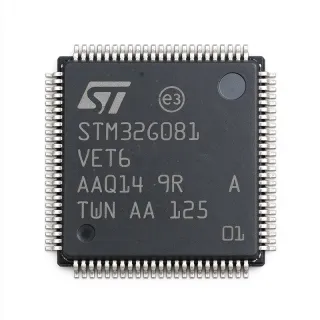
STM32F750V8T6 - 216MHz Cortex-M7 64KB Flash | STMicroelectronics
MPN: STM32F750V8T6 ✓ چالاکSTM32F750V8T6 گشتی
An STM32F7-series microcontroller is a 32-bit RISC embedded-processing device that combines an Arm Cortex-M7 core with Flash, RAM, peripherals, communication interfaces, and timer resources in one package. The STM32F7 family belongs to the broader microcontroller and embedded-processing hierarchy, making it suitable for industrial control, communications equipment, audio and signal processing, test systems, and connected embedded products.
The STM32F750V8T6 operates at up to 216 MHz and includes a hardware floating-point unit for efficient handling of floating-point calculations. Its 64 KB Flash memory is organized as 64K x 8 bits according to the manufacturer listing. The device also provides 320 KB plus 16 KB plus 4 KB of additional memory resources in the STM32F750x8 family configuration, subject to the specific peripheral and memory map defined by the manufacturer datasheet.
The Cortex-M7 architecture provides a 32-bit RISC instruction set and supports efficient real-time control workloads. The 462 DMIPS figure associated with the STM32F750x8 family reflects the processor’s high-performance positioning, while the hardware FPU reduces the computational burden for filtering, control, and audio-related algorithms. The device is suitable for designs where deterministic embedded control and higher arithmetic throughput are important.
Typical applications include industrial automation, motor and motion control, communications infrastructure, audio and DSP modules, test and measurement equipment, and connected sensor systems. In these systems, the microcontroller can manage real-time inputs while using its Cortex-M7 performance for control loops, data filtering, protocol handling, and user-interface support.
When designing a PCB around the STM32F750V8T6, follow the manufacturer package pinout, power-supply requirements, decoupling recommendations, and clock configuration guidance. The 100-pin LQFP footprint is relatively easy to inspect and rework, but its 0.5 mm lead pitch still requires careful land-pattern design, clean soldering practices, and adequate thermal planning for sustained high-frequency operation.
This product page combines the manufacturer specification, package information, sourcing context, practical design notes, and compatible STM32F7-family references to support faster engineering decisions while preserving the distinction between verified device data and application-specific guidance.
جێگرەوەکانی جێگۆڕکێ بۆ STM32F750V8T6 — هەمان پاکەت، پین بە پین گونجاو. ئەو بەشانەی پاکەتی جیاوازیان هەیە و پێویستیان بە چاککردنەوەی PCB هەیە لابراون.
جۆرەکان لەم زنجیرەیەدا
مۆدێلەکانی هەمان زنجیرە کە بە شێوەی ڕاستەوخۆ گونجاون لەگەڵ STM32F750V8T6 (هەمان شێوە و پێکهاتەی شوێن) — جیاوازە لە Package, Product Type, Core, Core Architecture, Flash Organization.
STM32F730V8T6
✅ جێگرەوەی ڕاستەوخۆ ⚠️ تایبەتمەندییەکان پشتڕاست نەکراونەتەوەپەیوەندی بۆ نرخ
بینینی داتاشیت →STM32F765VGT6TR
✅ جێگرەوەی ڕاستەوخۆ ⚠️ تایبەتمەندییەکان پشتڕاست نەکراونەتەوەپەیوەندی بۆ نرخ
بینینی داتاشیت →STM32F765VGH6TR
✅ جێگرەوەی ڕاستەوخۆ ⚠️ تایبەتمەندییەکان پشتڕاست نەکراونەتەوەپەیوەندی بۆ نرخ
بینینی داتاشیت →STM32F746VET6TR
✅ جێگرەوەی ڕاستەوخۆ ⚠️ تایبەتمەندییەکان پشتڕاست نەکراونەتەوەپەیوەندی بۆ نرخ
بینینی داتاشیت →STM32F745VEH6TR
✅ جێگرەوەی ڕاستەوخۆ ⚠️ تایبەتمەندییەکان پشتڕاست نەکراونەتەوەپەیوەندی بۆ نرخ
بینینی داتاشیت →STM32F750V8T6 زۆرترین ڕێژە و تایبەتمەندییە کارەباییەکان
| Product Type | 32-bit ARM Cortex-M7 microcontroller |
| Core | Arm Cortex-M7 |
| Maximum CPU Frequency | 216 MHz |
| Instruction Set | 32-bit RISC |
| Internal Flash Memory | 64 KB (64K x 8 bits) |
| Additional Memory Resources | 320 KB + 16 KB + 4 KB |
| DSP Performance | 462 DMIPS |
| FPU | Hardware floating-point unit |
| Supply Voltage Options | 1.8 V, 2.5 V, 3.3 V |
| پاکێج | 100-pin LQFP |
| Package Body Size | 14 x 14 mm |
| جۆری دامەزراندن | Surface mount |
| Lead Pitch | 0.5 mm |
ڕێنمایی ڕێکخستنی پینی STM32F750V8T6 14 x 14 mm
ڕێکخستنی پین بۆ STM32F750V8T6 (پاکێجی 14 x 14 mm). ئەم IC ی دیجیتاڵە GPIO، ڕووکارەکانی پەیوەندی (UART، SPI، I2C) و پینی وزە لەخۆدەگرێت. سەرنج بدە بە داتاشیتی بەرھەمھێنەر بۆ فەنکشنەکانی پینی جێگرەوە و ھەڵبژاردنەکانی ڕێکخستن. پێویستە بۆ دیزاینی سیستەمی جێگیر و ڕێکخستنی PCB.

هیچ داتای وردی پینئاوت بەردەست نییە بۆ STM32F750V8T6.
سەرنج بدە بە داتاشیت بۆ ڕێکخستنی تەواوی پینەکان.
بەکارهێنانە باوەکان
STM32F750V8T6 گونجاوە بۆ 6 بەکارھێنانs: Industrial Automation Control, Motor and Motion Control, Audio and Signal Processing, Communications Equipment, Test and Measurement Equipment, Connected Sensor and IoT Gateways.
Industrial Automation Control
The STM32F750V8T6 fits industrial automation controllers that require a 216 MHz Cortex-M7 core, a hardware floating-point unit, and 64 KB Flash in a 100-pin LQFP. The processor can execute real-time control logic while handling sensor acquisition and actuator timing through its integrated peripherals. Its 462 DMIPS family positioning provides computational headroom for filtering and supervisory functions. Design engineers should preserve the manufacturer supply and decoupling layout, validate digital I/O levels against the selected voltage option, and review peripheral assignments in the STM32F750x8 pin table before committing the PCB footprint.
پێشنیارکراو
Motor and Motion Control
For motor-control and motion-control equipment, the STM32F750V8T6 combines a 216 MHz Arm Cortex-M7 core with hardware floating-point acceleration, making it appropriate for current-control loops, speed calculations, and digital filtering. The 64 KB Flash capacity supports embedded control firmware and bootloader logic, while the STM32F7 peripheral set supports integration with timers and communication resources. Use the manufacturer pin mapping to select timer channels for PWM and encoder functions, and place sensitive analog and clock connections according to the recommended layout to reduce switching-induced errors.
پێشنیارکراو
Audio and Signal Processing
The STM32F750V8T6 is suitable for compact audio and digital signal-processing modules because its Cortex-M7 architecture reaches 216 MHz and includes a hardware floating-point unit. These features support real-time sample-rate handling, filtering, mixing, and control functions without relying on a separate DSP when the workload fits the available memory and peripheral bandwidth. Designers should budget Flash for code and SRAM for buffers, review DMA requirements, and keep clocks and data interfaces away from noisy switching paths. The manufacturer’s electrical and application guidance should define supported clock, DAC, SAI, and interface configurations.
پێشنیارکراو
Communications Equipment
The STM32F750V8T6 can serve as the main controller in communications equipment requiring deterministic real-time execution and a moderate embedded code footprint. Its 216 MHz Cortex-M7 core can manage protocol stacks, packet processing, diagnostics, and user-facing control tasks, while 64 KB Flash provides storage for application firmware. Ethernet, USB, and serial interfaces should be selected from the exact device pin map rather than assumed across the STM32F7 family. For reliable implementation, follow the manufacturer recommendations for transceiver isolation, impedance-controlled routing, clock jitter control, and peripheral decoupling.
پێشنیارکراو
Test and Measurement Equipment
The STM32F750V8T6 is appropriate for test and measurement front ends that combine real-time sampling, control, calibration, and communications in one embedded platform. Its hardware FPU supports arithmetic-heavy calibration and filtering, while the 216 MHz core provides scheduling capacity for acquisition and instrument-control tasks. The 100-pin LQFP package offers a manageable production footprint, but the design must follow the complete pin assignment and power requirements for the selected STM32F750x8 variant. Pay particular attention to analog-reference grounding, input protection, clock jitter, and separation between sensitive measurement and digital switching sections.
پێشنیارکراو
Connected Sensor and IoT Gateways
The STM32F750V8T6 supports connected sensor gateways that must aggregate measurements, execute local algorithms, and maintain communications without a separate processor. The 216 MHz Cortex-M7 core and hardware FPU allow local filtering or condition calculation before data is transmitted, potentially reducing upstream processing requirements. Its 64 KB Flash must be budgeted against gateway firmware and update requirements, while the larger SRAM resources provide working space for buffers. Engineers should verify the required serial, USB, Ethernet, and connectivity pins in the manufacturer documentation and reserve boot and recovery paths for dependable field operation.
پێشنیارکراو
کورتەی بەرهەمە پێشنیارکراوەکان
داتای سەرچاوەی ئەندازیاری بۆ STM32F750V8T6 — بەراوردکردن، ڕێنمایی دیزاین و زانیاری پابەندبوون.
ڕێنمایی هەڵبژاردن
Consider the STM32F730V8T6 when the STM32F7 architecture and same physical package are sufficient but the exact F730x8 memory, peripheral, and performance configuration meets the application. Consider STM32F765VGT6TR or STM32F765VGH6TR when the higher-tier STM32F765 feature set is preferable. STM32F746VET6TR and STM32F745VEH6TR are useful same-package STM32F7 design references for other performance or temperature configurations.
A shared package alone does not prove a drop-in replacement. Before substitution, compare every pin, power domain, clock source, peripheral mapping, boot behavior, memory capacity, and software-support requirement against the manufacturer datasheets. For production purchasing, use the Request a Quote form to confirm the exact ordering code, availability, and delivery schedule.
بەراوردکردن لەگەڵ جێگرەوەکان
| پارامەتر | ئەم بەرهەمە | STM32F730V8T6 | STM32F765VGT6TR | STM32F765VGH6TR | STM32F746VET6TR | STM32F745VEH6TR |
|---|---|---|---|---|---|---|
| Package | 100-LQFP (14x14) | 100-LQFP (14x14) | 100-LQFP (14x14) | 100-LQFP (14x14) | 100-LQFP (14x14) | 100-LQFP (14x14) |
| Brand | STMicroelectronics | STMicroelectronics | STMicroelectronics | STMicroelectronics | STMicroelectronics | STMicroelectronics |
| CPU Core | Arm Cortex-M7, 32-bit RISC | Arm Cortex-M7 | Arm Cortex-M7 | Arm Cortex-M7 | Arm Cortex-M7 | Arm Cortex-M7 |
| FPU | Hardware floating-point unit | Hardware FPU | Hardware FPU | Hardware FPU | Hardware FPU | Hardware FPU |
جیاکەرەوە سەرەکییەکان
- Specified 216 MHz Cortex-M7 performance with a hardware FPU (بەراورد بەSTM32F730V8T6)
- 64 KB Flash in the STM32F750x8 configuration (بەراورد بەSTM32F765VGT6TR)
- 100-pin 14 x 14 mm LQFP footprint (بەراورد بەSTM32F746VET6TR)
- Dedicated STM32F750x8 family documentation (بەراورد بەSTM32F745VEH6TR)
تێبینییەکانی دیزاین
Use the STM32F750x8 manufacturer land pattern for the 100-pin LQFP package and place all required bypass capacitors close to their power pins. The 0.5 mm lead pitch requires a narrow, controlled fanout that preserves solderability and inspection access. Route high-current and switching-node connections away from clock, reset, and analog inputs, and maintain the recommended ground-plane continuity beneath the device.
Choose the STM32F750V8T6 supply configuration for 1.8 V, 2.5 V, or 3.3 V operation according to the manufacturer requirements. Confirm that every peripheral, external transceiver, and pull network supports the selected rail. When multiple voltage domains are present, sequence and monitor them as required by the reference design, while ensuring that I/O levels are not driven above the permitted limits.
Estimated thermal design: power dissipation scales with the selected core voltage, operating frequency, and enabled peripheral activity. Use the manufacturer power-consumption characteristics for the final operating mode and calculate junction temperature using the package thermal data and actual PCB copper area. Avoid presenting a generic 216 MHz figure as a worst-case thermal condition, because duty cycle and power-management state materially affect dissipation.
Follow the STM32F750x8 clock-tree and external-component recommendations, especially when using a crystal, oscillator, or external clock source. Keep oscillator and clock traces short, symmetrical, and isolated from switching outputs. Validate startup, frequency tolerance, and peripheral clock requirements in hardware because incorrect source configuration or loading can cause timing failures even when the CPU itself is correctly powered.
زانیاری پابەندبوون
Compliance attributes were not stated in the manufacturer and distributor information used for this product. Verify the current declarations and material documentation before regulatory qualification.