Produkte (31123)

STM32F103ZFT6 - 32-Bit 72MHz 768KB MCU | STMicroelectronics
STM32F103ZFT6

STM32F103ZFT6 - 32-Bit 72MHz 768KB MCU | STMicroelectronics

The STMicroelectronics STM32F103ZFT6 is a 32-bit ARM Cortex-M3 microcontroller with a 72 MHz maximum clock, 768 KB of Flash memory, and a 144-LQFP package measuring 20 mm by 20 mm. It belongs to the STM32F1 performance-line family and combines embedded control, communications, analog conversion, timer, and motor-control resources in one surface-mount device. An ARM Cortex-M3 microcontroller is a reduced-instruction-set embedded processor designed for real-time control systems. The Cortex-M3 core supplies deterministic instruction execution and interrupt handling, while the STM32F103 family integrates peripherals such as timers, communication interfaces, ADCs, USB, and CAN around that core. This hierarchy places the MCU above the processor core and into the broader embedded-control and semiconductor categories. The verified source data identifies the STM32F103ZFT6 as an XL-density member with 768 KB of Flash and a maximum frequency of 72 MHz. The same source states 1.25 DMIPS/MHz, supporting use in demanding embedded-control designs without requiring an external processor. Its large pin count also accommodates extensive I/O and peripheral connectivity compared with smaller STM32 packages. The manufacturer family description associates STM32F103 devices with USB, CAN, six timers, two ADCs, and six communication interfaces. These resources make the MCU suitable for gateways, motor controllers, industrial communication equipment, CAN or LIN-connected nodes, and embedded systems that require both control and communications. The verified data also lists vehicle gateway nodes and CAN/LIN networks as relevant use cases. A key engineering consideration is that the LQFP-144 footprint exposes substantially more interface pins than a compact MCU, enabling parallel I/O and multiple peripheral assignments while demanding careful PCB escape routing. Firmware and peripheral assignments should be validated against the manufacturer pinout and reference documentation before layout release. Alternate clock, memory, and analog behavior must also be checked when evaluating any substitute. This page combines verified distributor and manufacturer-linked source information, practical sourcing context, and structured MCU application guidance. It distinguishes the device’s confirmed 72 MHz and 768 KB attributes from parameters that remain unavailable, avoiding unsupported claims about electrical limits, temperature range, or compliance.

USD $17,81 Auf Lager
STM32F103ZGT6 - 72MHz Cortex-M3 1MB Flash MCU | ST | Industrial
STM32F103ZGT6

STM32F103ZGT6 - 72MHz Cortex-M3 1MB Flash MCU | ST | Industrial

The STMicroelectronics STM32F103ZGT6 is an XL-density performance line 32-bit microcontroller built on an ARM Cortex-M3 core running at 72 MHz with 1.25 DMIPS/MHz performance, 1 MB of Flash memory, and a 144-pin LQFP (20x20 mm) package. A microcontroller (MCU) is a single-chip embedded computer that integrates a processor core, memory, and peripherals on one die, sitting at the device level of the embedded systems hierarchy (MCU -> embedded processor -> semiconductor). The STM32F103 family, based on the ARM Cortex-M3 RISC architecture, is one of the most widely adopted 32-bit MCU platforms in industrial and consumer electronics, supported by an extensive tool ecosystem including STM32CubeIDE, Keil MDK, and IAR Embedded Workbench. Key features include 1 MB on-chip Flash with 96 KB SRAM, three 12-bit ADCs, ten general-purpose 16-bit timers plus two advanced PWM timers (17 timers in total), and 13 communication interfaces covering USB 2.0 full-speed, CAN 2.0B, multiple USARTs, SPI and I2C ports. According to the STMicroelectronics datasheet, the Cortex-M3 core delivers 1.25 DMIPS/MHz (Dhrystone 2.1), enabling deterministic real-time control. Technically, the XL-density devices add a FSMC (flexible static memory controller) for external memories and LCDs, a dual-SPI and SDIO interface, and an extensive DMA controller that offloads data movement from the CPU. The nested vectored interrupt controller (NVIC) provides low-latency interrupt handling essential for motor control and real-time I/O. Typical applications include industrial motor control, communication boards and gateways, medical instrumentation, and consumer appliances. The rich timer and PWM resources fit three-phase inverter drives, while USB and CAN interfaces suit fieldbus nodes and HID devices. Design consideration: power the MCU from a 2.0 V to 3.6 V supply and decouple each VDD pin with 100 nF ceramics; Flash wait states must be set to two at 72 MHz for 3.3 V operation. This page synthesizes distributor pricing, pin-to-pin alternatives (including GD32F103), and practical design notes not found in the manufacturer datasheet.

USD $5,40 Auf Lager
STM32F105RCT6 - 32-bit Cortex-M3 256KB Flash MCU | STMicroelectronics
STM32F105RCT6

STM32F105RCT6 - 32-bit Cortex-M3 256KB Flash MCU | STMicroelectronics

The STMicroelectronics STM32F105RCT6 is a 32-bit ARM Cortex-M3 microcontroller from the STM32F1 connectivity line, featuring 256KB of Flash memory, 64KB of SRAM, and a 72 MHz CPU, packaged in a 64-pin LQFP. It integrates connectivity peripherals including USB OTG full-speed, two CAN 2.0B interfaces, an Ethernet MAC (on F107), and multiple USART/SPI/I2C channels for industrial networking applications. The device operates from a 2.0V to 3.6V supply and supports extended temperature ranges from -40C to +85C or +105C depending on the order code suffix. What is a Cortex-M3 microcontroller? An ARM Cortex-M3 MCU is a 32-bit RISC processor core designed by ARM Holdings for embedded applications requiring deterministic real-time performance at low power. Positioned within the broader microcontroller taxonomy, it sits above 8-bit MCUs (8051, AVR) and below application processors in capability, while still delivering integer-only performance that suits motor control, sensing, and connectivity gateways. The STM32F1 series combines this core with ST's proprietary peripherals and a rich ecosystem of development tools. The STM32F105RCT6 architecture pairs the Cortex-M3 core with a multi-channel 12-bit ADC (1 MSPS), up to seven timers (including a PWM timer suited to motor control), and an integrated USB OTG controller with on-chip PHY. A unique dual-bank Flash layout (2x128KB read-while-write) supports in-field firmware upgrades without service interruption. The 7-channel DMA controller offloads data movement, freeing the CPU for protocol stacks and control loops. Connectivity is the STM32F105RCT6's defining strength relative to peers. The two CAN 2.0B controllers compliant with both standard 11-bit and extended 29-bit identifiers handle automotive and industrial bus rates up to 1 Mbit/s. Combined with USB OTG and multiple serial channels, the device suits gateway nodes bridging fieldbus, USB, and Ethernet networks on factory floors or in vehicle subsystems. The 72 MHz Cortex-M3 delivers 90 DMIPS (1.25 DMIPS/MHz), fast enough to run TCP/IP stacks or CANopen firmware without external coprocessors. Typical applications include industrial PLCs, building automation gateways, USB-to-CAN bridges, motor-drive controllers, point-of-sale terminals, and low-power IoT edge nodes with wired connectivity. Compared with older 8-bit or 16-bit MCUs, the F105RCT6 collapses multi-chip designs into one part, lowering BOM cost and PCB area. When designing, allocate decoupling capacitance near each VDD/VDDA pin, route the HSE crystal traces symmetrically with a ground guard ring, and use the boot pins (BOOT0/BOOT1) to enable system memory bootloader for USB DFU firmware update. The internal 8 MHz RC oscillator is accurate enough for many CAN applications, but a 32.768 kHz external crystal is recommended for RTC accuracy. This page synthesizes distributor pricing, drop-in pin-compatible alternatives, and practical design notes not found in the manufacturer datasheet alone, including same-family variants such as STM32F107RCT6 and cross-brand substitutes from GigaDevice.

USD $4,85 Auf Lager
STM32F105VCT7 - 72MHz Cortex-M3 MCU 256KB Flash | STMicroelectronics
STM32F105VCT7

STM32F105VCT7 - 72MHz Cortex-M3 MCU 256KB Flash | STMicroelectronics

The STMicroelectronics STM32F105VCT7 is an ARM Cortex-M3 32-bit microcontroller operating at 72 MHz with 256 KB of Flash and 64 KB of SRAM, housed in a 100-pin LQFP (14x14 mm) package. Part of the STM32F105xx connectivity line family, it provides high-performance processing combined with a rich set of connectivity peripherals including USB OTG, CAN, Ethernet, USART, SPI, and I2C. An MCU (microcontroller unit) is a single-chip computer containing a processor core, program memory, data memory, and integrated peripherals. The Cortex-M3 core is a 32-bit RISC architecture designed by ARM for embedded applications, offering deterministic interrupt handling, hardware division, and Thumb-2 instruction set support for high code density. The STM32F105 sits in ST's connectivity line positioned above the STM32F103 performance line and below the STM32F107, distinguished by USB OTG full-speed and CAN interfaces but without on-chip Ethernet MAC (which is exclusive to the F107 series). Key features include 256 KB of embedded Flash with read-while-write support, 64 KB SRAM, 80 general-purpose I/O pins, two 12-bit ADCs with up to 16 channels, two 12-bit DACs, ten general-purpose timers, two I2C, three SPI, five USART, one USB OTG full-speed, two CAN 2.0B interfaces, and an SDIO interface. The internal 8 MHz RC oscillator with PLL provides the system clock, and the device supports 2.0 V to 3.6 V operating voltage. Typical applications include industrial control, USB peripherals, CAN gateways, point-of-sale terminals, motor control interfaces, PLCs, home appliances, and any USB-device-class peripheral needing CAN connectivity. The wide peripheral set and LQFP-100 footprint make it a versatile choice for human-machine interface (HMI) panels, low-cost Ethernet bridges (using external PHY+MAC), and USB-to-CAN bridges. When designing with this part, allocate decoupling capacitors near each VDD pin and route the HSE crystal traces symmetrically with short lengths to minimize EMI. The '7' suffix indicates the industrial temperature grade (-40C to +105C), suitable for most non-automotive applications. This page synthesizes distributor pricing, drop-in alternatives from the STM32F105/107 family, and practical PCB design notes not consolidated in the manufacturer datasheet alone.

USD $7,65 Auf Lager
STM32F107RCT6 - 256KB Flash Ethernet ARM MCU | STMicroelectronics
STM32F107RCT6

STM32F107RCT6 - 256KB Flash Ethernet ARM MCU | STMicroelectronics

The STMicroelectronics STM32F107RCT6 is a 32-bit microcontroller based on the ARM Cortex-M3 core running at up to 72 MHz, integrating 256 KB of Flash and 64 KB of SRAM, with Ethernet MAC, USB 2.0 OTG, two CAN 2.0B controllers, and a 64-pin LQFP (LQFP64, 10x10 mm, 0.5 mm pitch) package. What is a microcontroller (MCU)? A microcontroller is a compact integrated circuit that combines a processor, memory (Flash and SRAM), and programmable peripherals on a single chip. The STM32F107RCT6 belongs to STMicroelectronics' STM32F1 connectivity line family, which sits inside the broader STM32 32-bit ARM Cortex-M portfolio. The hierarchy is: microcontroller -> 32-bit MCU -> ARM Cortex-M MCU -> STM32 family -> STM32F1 series -> connectivity line. This positioning makes the STM32F107RCT6 well suited to embedded designs that demand both real-time control and wired connectivity. Key features include 1.25 DMIPS/MHz performance, 10/100 Mbps Ethernet MAC with MII/RMII, USB 2.0 OTG full-speed, two CAN 2.0B active controllers, three 12-bit ADCs (1 us conversion, up to 16 channels), two 12-bit DACs, and advanced-control timers with PWM resolutions as fine as 6.25 ns. Supply range is 2.0 V to 3.6 V with -40 C to +85 C operating temperature. Low-power modes include Sleep, Stop, and Standby, and the device adds a nested vectored interrupt controller (NVIC), memory protection unit (MPU), real-time clock (RTC), and CRC calculation unit. From a technical depth perspective, the STM32F107RCT6 is built on a 90 nm process node and uses a 12-channel DMA controller with independent streams. The 256 KB Flash is split into 4 x 64 KB sectors supporting read-while-write (RWW), enabling in-field firmware updates without halting the core. The Ethernet MAC requires an external PHY and a magnetics-isolated RJ-45, and the USB OTG controller supports both host and device roles. Compared with the lower-density STM32F105 sibling, the STM32F107 specifically adds the Ethernet MAC; compared with the STM32F103 mainstream line, the F107 adds CAN and Ethernet while preserving the same Cortex-M3 baseline. Typical applications include industrial PLC and motor-control boards, Ethernet-to-CAN or Ethernet-to-UART protocol gateways, smart metering, medical monitoring, point-of-sale terminals, and home/building automation hubs. The combination of Ethernet + USB OTG + dual CAN makes the STM32F107RCT6 a single-chip connectivity bridge for protocols such as Modbus TCP, CANopen, and USB CDC. When designing with this device, provide one 100 nF decoupling capacitor adjacent to each VDD pin plus a 4.7 uF bulk capacitor. Tie VDDA to a filtered analog rail and decouple VREF+ with 1 uF. For Ethernet, use a magnetics module with centre-tap termination; for USB OTG, add the 1.5 kohm pull-up on DP+ for full-speed device mode. Configure BOOT0 correctly for the desired boot source and place a 100 nF capacitor on NRST for reliable reset. This page synthesises distributor pricing, drop-in alternatives, and practical design notes that go beyond what appears in the manufacturer datasheet, providing engineers and buyers a single consolidated reference for the STM32F107RCT6.

USD $5,55 Auf Lager
STM32F107VCT6 - 256KB Flash 72MHz Cortex-M3 MCU | STMicroelectronics
STM32F107VCT6

STM32F107VCT6 - 256KB Flash 72MHz Cortex-M3 MCU | STMicroelectronics

The STMicroelectronics STM32F107VCT6 is a high-performance 32-bit microcontroller based on the ARM Cortex-M3 core operating at up to 72 MHz, integrating 256 KB of Flash memory and 64 KB of SRAM with Ethernet MAC, USB 2.0 OTG, and dual CAN 2.0B interfaces, housed in a 100-pin LQFP (14x14) package. What is a microcontroller? A microcontroller (MCU) is a compact integrated circuit that combines a processor core, program memory (Flash), data memory (SRAM), and programmable peripherals on a single silicon die, designed to govern a specific function within an embedded system. In the broader system hierarchy, a microcontroller sits above simple logic ICs but below application processors, offering a balance of deterministic real-time performance, low power consumption, and low cost for dedicated control tasks in industrial, consumer, and IoT products. Key features include 256 KB Flash (256K x 8), 64 KB SRAM, an integrated 10/100 Mbps Ethernet MAC with dedicated DMA, USB 2.0 OTG full-speed with on-chip PHY, two CAN 2.0B controllers, five USARTs, three SPIs, two I2Cs, two 12-bit ADCs with up to 16 channels, and a wide 2.0V to 3.6V supply range. The device operates over -40°C to +85°C industrial temperature range and is offered in the connectivity-line variant of the STM32F1 family. Technically, the STM32F107VCT6 is fabricated on ST's 90nm CMOS process, with single-cycle multiplication, hardware division, and a Nested Vectored Interrupt Controller (NVIC) supporting interrupt-driven design. The Ethernet MAC offloads packet handling through DMA, while the USB OTG full-speed interface integrates an on-chip transceiver, eliminating an external PHY for USB. Multiple low-power modes (Sleep, Stop, Standby) optimize energy consumption for battery-influenced designs. Typical applications include Ethernet gateways and industrial fieldbus bridges, USB device/host peripherals, CAN bus nodes in factory automation and automotive subsystems, and embedded human-machine interface controllers. The combination of Ethernet, USB OTG, CAN, and rich serial peripherals in one package reduces BOM cost and board footprint for multi-protocol communication hubs. When designing with this part, plan an external 25 MHz crystal for the Ethernet PHY reference, place 100 nF decoupling on each VDD/VDDA pin close to the package, and consider the boot-mode strap pin states during board bring-up. Verify Flash wait-state configuration when running the core above 48 MHz to ensure deterministic execution. This page synthesizes distributor pricing, drop-in alternatives, and practical design notes not found in the manufacturer datasheet alone, supporting both new design-in and supply-chain risk mitigation.

USD $6,95 Auf Lager
STM32F205RCT6 - 120MHz Cortex-M3 MCU 256KB Flash | ST
STM32F205RCT6

STM32F205RCT6 - 120MHz Cortex-M3 MCU 256KB Flash | ST

The STMicroelectronics STM32F205RCT6 is a 32-bit ARM Cortex-M3 microcontroller operating at up to 120 MHz with 256 KB of Flash memory and 64 KB of SRAM, housed in a 64-pin LQFP (10 x 10 mm) package. A microcontroller (MCU) is a single integrated circuit that combines a processor core, memory, and peripherals such as timers, communication interfaces, and analog-to-digital converters into one chip. Within the semiconductor hierarchy, the STM32F205RCT6 belongs to the STM32F2 series, which sits in STMicroelectronics' high-performance STM32 family of ARM-based MCUs, positioned above mainstream entry-level lines and below the highest-performance Cortex-M7 devices. Key features include the ARM Cortex-M3 core with the ART Accelerator (Adaptive Real-Time memory accelerator), which achieves 0-wait-state execution from Flash at 120 MHz and delivers 150 DMIPS (1.25 DMIPS/MHz per Dhrystone 2.1). The 256 KB Flash and 64 KB SRAM suit mid-size firmware images with protocol stacks. The device operates from a 1.8 V to 3.6 V supply (2.5 V/3.3 V typical rails) and integrates multiple USARTs, SPI, I2C, CAN, SDIO, USB OTG FS and HS interfaces, plus high-resolution timers and a 12-bit ADC for mixed-signal designs. Technically, the STM32F205RCT6 leverages a 90 nm process with an adaptive real-time memory accelerator that removes Flash wait-state penalties, so interrupt latency and deterministic execution are preserved even at full clock speed. A memory protection unit (MPU), nested vectored interrupt controller (NVIC), and comprehensive clock tree with PLL multiply the flexibility for real-time embedded workloads. Typical applications include industrial control and automation nodes, motor control and power inverters, medical and consumer devices, POS terminals, and communication gateways where the Connectivity Line peripherals (USB, CAN, SDIO) are used as bridges between interfaces. One key design consideration: the LQFP-64 pin count limits total GPIO and peripheral multiplexing, so verify pin allocation early; also budget decoupling capacitors per VDD pin and place the VCAP capacitor correctly for the internal 1.2 V regulator. This page synthesizes distributor pricing, same-family drop-in alternatives, pinout, and practical design notes not found in the manufacturer datasheet, with pricing as of 2026-09-06.

USD $4,15 Auf Lager
STM32F205RET6 - ARM Cortex-M3 MCU 120MHz 512KB | STMicroelectronics
STM32F205RET6

STM32F205RET6 - ARM Cortex-M3 MCU 120MHz 512KB | STMicroelectronics

The STMicroelectronics STM32F205RET6 is an ARM 32-bit Cortex-M3 microcontroller (MCU) in the STM32F2 connectivity line, integrating 512 KB of Flash and approximately 128+4 KB of SRAM in a 64-pin LQFP (10x10 mm) package. It runs at up to 120 MHz with 150 DMIPS / 1.25 DMIPS per MHz Dhrystone performance and pairs the core with ST's Adaptive Real-Time (ART) Accelerator that enables 0-wait-state execution from Flash. The device exposes up to 51 GPIOs, three 12-bit ADCs, two 12-bit DACs, 17 timers, USB OTG full- and high-speed, 10/100 Ethernet MAC, CAN 2.0B, plus multiple USART/UART/SPI/I2C controllers for high-mix industrial and consumer connectivity applications. An ARM Cortex-M3 microcontroller is a 32-bit RISC core (Cortex-M3 -> ARM Cortex-M family -> ARM 32-bit MCU -> embedded microcontroller -> semiconductor) optimized for deterministic real-time interrupt response and low power, complementing Cortex-M0/M0+ (cost) and Cortex-M4/M7 (DSP/FP) in the broader Cortex-M product tree. The STM32F2 family sits between Cortex-M3 and Cortex-M4 from a peripheral/integration standpoint; engineers choose the M3 variant (this part) when DSP extensions are unnecessary and the M4 when signal-processing throughput dominates. Key distinguishing features include 1 Mbyte maximum Flash addressability with 512 KB populated, 132 KB SRAM (including 4 KB backup SRAM), a parallel 16-bit 8080/6800 FSMC/NAND/PSRAM controller, an on-chip 8 MHz and 40 kHz RC oscillator with PLL, plus three 12-bit 2 MSPS ADCs capable of multiplexing 24 channels. Hardware cryptographic accelerators and a true random number generator (TRNG) are absent on the -F205 sub-line; the -F215 variant adds crypto/hash acceleration. Power domains include a 1.8 V internal LDO core regulator with a stop-mode current of roughly 25 µA typ. Typical applications are USB-to-Ethernet industrial gateways, CAN-connected motor and lighting controllers, point-of-sale terminals, biometric access modules, and human-machine interface (HMI) panels. The 10x10 mm LQFP-64 with 0.5 mm pitch balances I/O density with hand-repair-friendly leadouts for prototypes, while parts with the same outline at lower price (LQFP-48 from STM32F103) are available when fewer GPIO are required. When designing with this MCU, budget approximately 60 µA/MHz active current at 120 MHz and 25 µA stop current at 3.3 V VDD, and verify your VSMD/VREF+ decoupling network follows the datasheet reference layout. Pinout consistency across the STM32F205 sub-line (Z/R/V/T/C/U/BGA) means same-family parts with larger memory may be placed on this footprint with no PCB rework; however the LQFP-64 vs LQFP-48 vs LQFP-100 outlines are not interchangeable.

USD $7,95 Auf Lager
STM32F205RGT6 - 120MHz ARM Cortex-M3 MCU, 1MB Flash | STMicroelectronics
STM32F205RGT6

STM32F205RGT6 - 120MHz ARM Cortex-M3 MCU, 1MB Flash | STMicroelectronics

The STMicroelectronics STM32F205RGT6 is a high-performance ARM Cortex-M3 based microcontroller operating at up to 120 MHz, with 1 MB of flash memory and 128 KB of SRAM. It is housed in a 64-pin LQFP package (LQFP64) and is part of the STM32F2 series, which is designed for applications requiring high processing power, rich connectivity, and advanced analog features. What is a microcontroller? A microcontroller (MCU) is a compact integrated circuit designed to govern a specific operation in an embedded system. It contains a processor core, memory (flash for program storage and SRAM for data), and programmable input/output peripherals. In the system hierarchy, a microcontroller is a type of embedded processor, which falls under the broader category of integrated circuits. The STM32F205RGT6 is a mid-range MCU in the STM32 portfolio, positioned between the value-line STM32F1 series and the high-performance STM32F4/F7 series, offering a balance of performance, power efficiency, and peripheral integration. Key features of the STM32F205RGT6 include a 32-bit ARM Cortex-M3 core with a maximum clock speed of 120 MHz, 1 MB of flash memory, and 128 KB of SRAM. It supports a wide range of communication interfaces: 3x I2C, 4x USART, 2x UART, 3x SPI, 2x CAN, 1x USB 2.0 OTG FS/HS, 1x SDIO, and 1x Ethernet MAC. The device also integrates a 12-bit ADC with 16 channels, a 12-bit DAC with 2 channels, advanced timers, and a true random number generator (RNG). The operating voltage range is 1.8V to 3.6V, and the temperature range is -40°C to +85°C (industrial grade). The STM32F205RGT6 is built on a 90nm process technology, enabling high performance with low power consumption. It features a nested vectored interrupt controller (NVIC), a memory protection unit (MPU), and a flexible memory controller (FMC) for external memory expansion. The device supports a comprehensive set of low-power modes, including Sleep, Stop, and Standby, making it suitable for battery-powered applications. Typical applications include industrial control systems, motor drives, medical devices, consumer electronics, IoT gateways, and communication modules. Its rich connectivity and high processing power make it ideal for applications requiring real-time control and data processing. When designing with this MCU, ensure proper decoupling of the power supply pins with 100nF capacitors placed close to each VDD pin, and a 4.7uF bulk capacitor. The VDDA pin should be connected to a clean analog supply, and the VREF+ pin should be decoupled with a 1uF capacitor. For high-speed USB and Ethernet, follow the layout guidelines in the STM32F2xx reference manual (RM0033) to ensure signal integrity.

USD $8,10 Auf Lager
STM32F205VCT6TR - 120MHz Cortex-M3 MCU 256KB LQFP-100 | STMicroelectronics
STM32F205VCT6TR

STM32F205VCT6TR - 120MHz Cortex-M3 MCU 256KB LQFP-100 | STMicroelectronics

The STMicroelectronics STM32F205VCT6TR is a high-performance ARM Cortex-M3 32-bit microcontroller in the STM32F2 family, offered in a 100-pin LQFP package (tape-and-reel packaging variant) with 256 KB of Flash and 96 KB of SRAM. The Cortex-M3 core runs up to 120 MHz delivering 150 DMIPS, paired with a flexible ART Accelerator that provides 0-wait-state execution from Flash at the maximum CPU speed, equivalent to the throughput of a MIPS-class core running at 225 MHz on a 0-wait-state memory. An ARM Cortex-M3 microcontroller is a 32-bit RISC processor core built around the Thumb-2 instruction set and tightly integrated with NVIC (Nested Vectored Interrupt Controller), SysTick, and optionally MPU and ETM blocks. In the broader taxonomy, the Cortex-M3 sits under Cortex-M -> ARM -> 32-bit MCU -> microcontroller, and the STM32F2 specifically targets high-performance connectivity applications. The Cortex-M3 brings deterministic interrupt latency, hardware divide, single-cycle multiply, and atomic bit-band regions, all of which translate into predictable code execution and tight real-time behavior. Key features include 256 KB of Flash program memory, 96 KB of SRAM, three 12-bit ADCs with up to 24 channels, two 12-bit DACs, up to 17 timers (including motor-control PWM and general-purpose 16/32-bit timers), three I2C, four USART, two UART, three SPI, plus USB OTG Full-Speed and High-Speed with on-chip PHY, CAN 2.0B, SDIO, and 10/100 Ethernet MAC with dedicated DMA. The part operates from a 1.8 V to 3.6 V supply and provides multiple low-power modes (Sleep, Stop, Standby) with battery-domain RTC. Architecturally, the STM32F205 integrates the ART Accelerator, a 7-channel general-purpose DMA, a CRC engine, and a 96-bit unique device ID. The combination of hardware encryption support (AES, RNG, USB OTG, and external FSMC/SDIO access) makes it well suited for industrial gateways, smart-meter and building-automation controllers that require Ethernet and USB at the same time. Typical applications for the STM32F205VCT6TR include industrial motor drives and variable-frequency drives (VFD), barcode scanners and printers, home appliances with TFT/LCD HMIs, USB-connected medical instrumentation, alarm panels with Ethernet backhaul, and protocol converters bridging CAN, USB and Ethernet. The LQFP-100 footprint also makes it a strong fit for hand-soldered prototypes and medium-volume industrial designs. When designing with this part, fit decoupling per VDD/VBAT/VDDA pin, place a 32.768 kHz crystal on PC14/PC15 if RTC accuracy is needed, and route the HSE oscillator traces short. Always verify USB OTG HS PHY biasing (external resistor on DP pull) when the high-speed USB port is used. This page synthesizes distributor pricing, drop-in alternatives, and practical design notes not typically compiled inside the manufacturer datasheet PDF.

USD $7,95 Auf Lager
STM32F205VET6 - 120MHz ARM Cortex-M3 MCU, 512KB Flash | STMicroelectronics
STM32F205VET6

STM32F205VET6 - 120MHz ARM Cortex-M3 MCU, 512KB Flash | STMicroelectronics

The STMicroelectronics STM32F205VET6 is a high-performance ARM Cortex-M3 32-bit microcontroller operating at up to 120 MHz with 150 DMIPS performance, integrating 512KB of Flash memory and 132KB of SRAM in a 100-pin LQFP (14x14 mm) package. The device provides 82 user I/O pins and is qualified over the industrial -40C to +85C temperature range, making it suitable for demanding embedded designs. According to the STMicroelectronics STM32F205xx datasheet, this part is part of the STM32F2 family and supports supply voltages of 1.8V to 3.6V. A microcontroller (MCU) is a compact integrated circuit that combines a processor core, volatile and non-volatile memory, and programmable peripherals to govern a specific operation within an embedded system. MCUs sit in the hierarchy of embedded processors between simple 8-bit controllers and high-end application processors, and are optimized for deterministic real-time control and signal processing. The STM32F205VET6 specifically belongs to the ARM Cortex-M3 lineage (32-bit RISC core), positioning it above 8/16-bit microcontrollers in compute density while remaining below Cortex-A application processors in both cost and power. Key features include 120 MHz maximum CPU frequency, 512KB on-chip Flash (512K x 8 organization), 132KB SRAM, 17 general-purpose and advanced-control timers, 3x 12-bit ADCs, USB OTG High-Speed and Full-Speed, on-chip 10/100 Ethernet MAC, 2x CAN, 3x SPI, 3x I2C, 5x USART/UART plus UART, and a digital camera interface. The adaptive real-time (ART) memory accelerator reduces Flash wait states to deliver close-to-zero penalty execution from on-chip code, and the part supports cryptographic features such as the unique 96-bit device ID and RNG in this density. Technically, the STM32F205VET6 is fabricated on a low-power CMOS process and offers multiple low-power modes (Sleep, Stop, Standby) with fast wakeup times for battery-driven applications. The 100-pin LQFP package exposes 82 GPIOs tolerating 5V on most pins, includes an integrated voltage regulator for single-supply operation, and supports JTAG and SWD interfaces for in-circuit debug. Independent and window watchdog timers, a SysTick timer, and a real-time clock (RTC) with calendar and backup registers round out the on-chip resources. Typical applications include industrial automation and motor control, building and home automation gateways, consumer HMI with TFT or camera input, USB peripherals, Ethernet-connected IoT nodes, medical instrumentation, and point-of-sale terminals. Its combination of high CPU throughput, on-chip Ethernet and USB OTG HS makes it especially attractive when designers need wired connectivity without an external PHY companion MCU. When designing with this MCU, place decoupling capacitors (typically 100 nF + 4.7 uF) on each VDDA/VSS pair as close to the pins as the PCB layout allows, and route VBAT7 (VBAT) directly to a coin cell or supercap if RTC backup retention is required. Carefully observe BOOT0 pin configuration to select the correct boot source (main Flash, system memory bootloader, or embedded SRAM) and verify HSE/HSI clock tree values against the RM0033 reference manual before locking the firmware. This page synthesizes distributor pricing snapshots, drop-in alternatives, and design guidance that are not collected in any single place in the manufacturer datasheet, providing a faster procurement and design start than reading the full RM0033 reference manual from scratch.

USD $7,25 Auf Lager
STM32F205VET7 - ARM Cortex-M3 MCU, 512KB Flash, 120MHz | STMicroelectronics
STM32F205VET7

STM32F205VET7 - ARM Cortex-M3 MCU, 512KB Flash, 120MHz | STMicroelectronics

The STMicroelectronics STM32F205VET7 is a high-performance ARM Cortex-M3 32-bit microcontroller with 512KB of Flash memory, 120MHz CPU clock, and 100KB of SRAM, housed in a 100-pin LQFP (14x14) package. It integrates the ART Accelerator allowing 0-wait-state execution from Flash memory, achieving 150 DMIPS / 1.25 DMIPS/MHz (Dhrystone 2.1). The device operates from a 1.8V to 3.6V supply and includes an MPU for memory protection. A microcontroller (MCU) is a single-chip computer that integrates a CPU core, memory, and programmable I/O peripherals. The STM32 family sits within the ARM Cortex-M ecosystem — specifically Cortex-M3, which is a Harvard-architecture core optimized for deterministic real-time performance with low interrupt latency. Within STMicroelectronics' portfolio, the STM32F2 series targets high-performance embedded applications requiring rich connectivity (USB OTG, CAN, Ethernet MAC) combined with substantial on-chip memory, sitting between the mainstream F1 and the more advanced F4 lines. Key features include up to 1 Mbyte addressable Flash (512KB on this variant), 100KB SRAM with CCM (Core-Coupled Memory), three 12-bit ADCs (1 MSPS / 24 channels), two 12-bit DACs, and 17 timers. Communication peripherals include USB OTG full-speed/high-speed, two CAN 2.0B interfaces, an Ethernet MAC (with MII/RMII), three I2C, three SPI, four USART and two UART interfaces. The 100-pin LQFP package provides 82 user I/O pins with 5V-tolerant I/Os. The ART Accelerator paired with the 120MHz Cortex-M3 delivers efficient deterministic execution, allowing code to run from Flash at full speed without wait states — critical for DSP-style routines, motor-control loops, and protocol stacks. The integrated Ethernet MAC and dual CAN buses enable industrial networking and fieldbus applications, while the high-speed USB OTG supports device, host, and OTG modes for embedded peripherals. Typical applications include industrial control and PLC modules, motor drives and inverter control, USB peripherals and HID devices, CAN-based automotive body and chassis ECUs, Ethernet-connected IoT gateways, and human-machine interface (HMI) panels. The combination of memory density and peripheral mix suits it to multi-protocol industrial nodes. When designing with this device, ensure the regulator providing VDD/VDDA supplies clean 3.3V with adequate decoupling (typically 100nF per VDD pin plus 4.7uF bulk). The boot configuration pins (BOOT0/BOOT1) must be set correctly for the chosen boot source — main Flash, system memory (bootloader), or embedded SRAM. This page synthesizes distributor pricing, drop-in alternatives, and practical design notes not found in the manufacturer datasheet. Engineers can use the FAQ and design_notes sections below to accelerate schematic review and BOM validation.

USD $8,95 Auf Lager
STM32F205VGT6 - 120MHz ARM Cortex-M3 MCU 1MB Flash | STMicroelectronics
STM32F205VGT6

STM32F205VGT6 - 120MHz ARM Cortex-M3 MCU 1MB Flash | STMicroelectronics

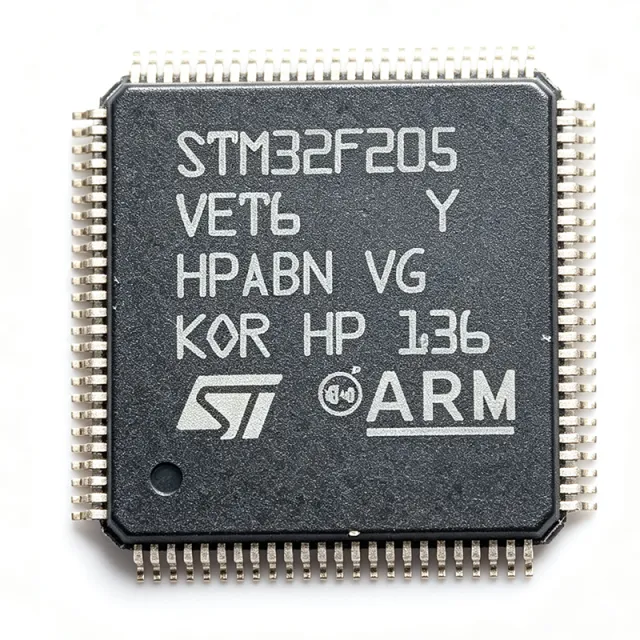
The STMicroelectronics STM32F205VGT6 is a high-performance ARM Cortex-M3 32-bit RISC microcontroller operating at up to 120 MHz, delivering 150 DMIPs, with 1 MB of embedded Flash and 132 KB of SRAM in a 100-pin LQFP (14x14 mm) package. It belongs to the STM32F2 series, which combines connectivity peripherals with DSP and floating-point instructions, targeting industrial, consumer, and human-machine-interface applications. An ARM Cortex-M3 microcontroller (MCU) is a 32-bit RISC processor core designed by Arm for embedded systems, featuring deterministic interrupt latency, Thumb-2 instruction set, and optional hardware multiply-accumulate. Within the broader taxonomy, the Cortex-M3 sits under Arm Cortex-M → 32-bit MCU → embedded microcontroller → semiconductor IC. The STM32F2 family specifically targets applications that require high computational throughput plus rich connectivity (USB OTG, Ethernet, CAN, SDIO) without the higher cost of Cortex-M4 parts. Key features include 82 GPIO pins, three 12-bit ADCs (up to 2.4 MSPS), two 12-bit DACs, 17 timers, USB OTG Full-Speed and High-Speed, 10/100 Ethernet MAC, two CAN 2.0B controllers, an SDIO interface, and a camera interface. The integrated 4 KB backup SRAM retains data in standby mode while consuming only a few microamperes, and the part supports four low-power modes (Sleep, Stop, Standby, and VBAT) for battery-powered designs. The architecture uses a multi-AHB bus matrix with separate buses for SRAM, Flash, and peripherals, allowing parallel DMA transfers and Cortex-M3 core execution without contention. The 120 MHz clock is sourced from an internal 16 MHz RC oscillator (with PLL) or an external 4-26 MHz crystal, enabling flexible system clock trees. Cryptographic and FSMC functions are NOT included on the F205 sub-line (those land on the F207 sub-line), which keeps this part cost-optimized for non-crypto applications. Typical applications include industrial control (PLCs, motor drives, factory automation), medical equipment (patient monitors, diagnostic peripherals), consumer electronics (home appliances, audio devices with USB), networking (Ethernet-enabled IoT gateways, smart sensors), and human-machine interfaces (touchscreen controllers, graphical displays). The 1 MB Flash and 132 KB SRAM also suit firmware-over-the-air (FOTA) updates with rollback image storage. When designing with the STM32F205VGT6, ensure your PCB layout places the 100-pin LQFP's exposed pad (if present on the variant) onto a ground copper pour for thermal dissipation, and follow ST's application note AN2867 for oscillator PCB layout. Decouple VDD/VDDA/VBAT with 100 nF ceramic capacitors placed within 2 mm of each supply pin, and add a 4.7 uF bulk capacitor per supply rail. VDD operating range is 1.8-3.6 V (the V suffix), so verify your LDO selection covers this range with adequate transient response. This page synthesizes distributor pricing, drop-in pin-compatible alternatives, and practical design notes not found in the manufacturer datasheet alone, helping engineers evaluate second-source options and PCB migration paths for the STM32F205VGT6.

USD $8,10 Auf Lager
STM32F205ZET6 - 32-bit ARM Cortex-M3 MCU, 512KB Flash | STMicroelectronics
STM32F205ZET6

STM32F205ZET6 - 32-bit ARM Cortex-M3 MCU, 512KB Flash | STMicroelectronics

The STMicroelectronics STM32F205ZET6 is a high-performance 32-bit microcontroller based on the ARM Cortex-M3 core, operating at up to 120 MHz. It features 512 KB of Flash memory and 128 KB of SRAM, making it suitable for a wide range of embedded applications. The device is housed in a 144-pin LQFP package (LQFP144) with a 20x20 mm body and 0.5 mm pitch, providing ample GPIOs and connectivity options. What is a microcontroller? A microcontroller (MCU) is a compact integrated circuit designed to govern a specific operation in an embedded system. It integrates a processor core, memory (Flash and SRAM), and programmable input/output peripherals on a single chip. Microcontrollers are the backbone of embedded systems, enabling control, monitoring, and communication in applications ranging from consumer electronics to industrial automation. The STM32F205ZET6 belongs to the STM32F2 series, which is part of the broader STM32 family of 32-bit Flash microcontrollers based on the ARM Cortex-M processor. This family hierarchy positions the STM32F205ZET6 as a high-performance MCU with advanced connectivity and rich analog peripherals. Key features of the STM32F205ZET6 include a 32-bit ARM Cortex-M3 CPU with adaptive real-time accelerator (ART) allowing 0-wait state execution from Flash, a memory protection unit (MPU), and a comprehensive set of peripherals. It offers up to 114 I/O ports, 3x 12-bit ADCs, 2x DACs, 12-bit timers, and advanced communication interfaces including USB 2.0 OTG HS/FS, Ethernet MAC, CAN, SPI, I2C, USART, and SDIO. The device operates from a 1.8V to 3.6V power supply and supports a temperature range of -40°C to +85°C (industrial grade). Technically, the STM32F205ZET6 is built on a 90nm process technology, enabling high clock speeds with low power consumption. It includes a nested vectored interrupt controller (NVIC) for efficient interrupt handling, a DMA controller with 16 channels, and a true random number generator (RNG). The device also features a real-time clock (RTC) with calendar and alarm functions, and a flexible static memory controller (FSMC) for external memory expansion. Typical applications include industrial control systems, motor drives, medical devices, consumer electronics, and IoT gateways. Its rich connectivity and high processing power make it ideal for applications requiring real-time control and communication, such as PLCs, robotics, and smart home hubs. When designing with the STM32F205ZET6, ensure proper decoupling of the power supply pins with 100nF capacitors placed close to each VDD pin, and a 4.7uF bulk capacitor. The VDDA pin should be connected to a clean analog supply to minimize noise in ADC conversions. Also, configure the boot pins correctly to select the desired boot mode (Flash, SRAM, or system memory) for programming and debugging.

USD $8,10 Auf Lager
STM32F207VCT6 - 32-bit ARM Cortex-M3 MCU, 256KB Flash | STMicroelectronics
STM32F207VCT6

STM32F207VCT6 - 32-bit ARM Cortex-M3 MCU, 256KB Flash | STMicroelectronics

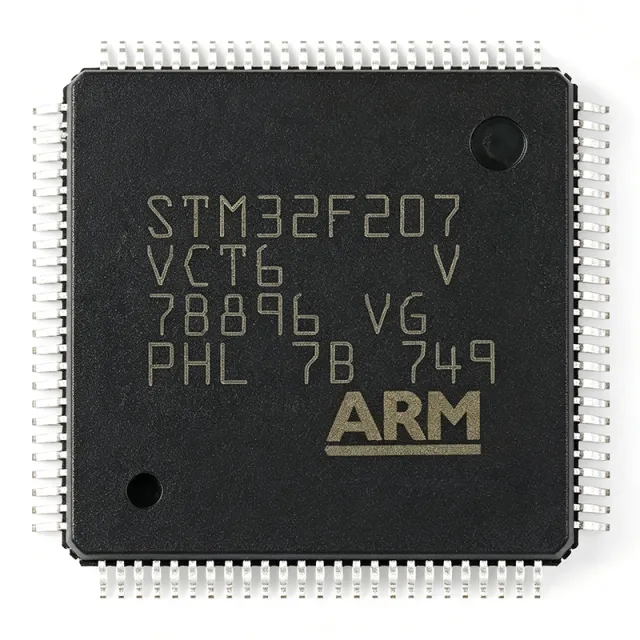
The STMicroelectronics STM32F207VCT6 is a high-performance 32-bit microcontroller based on the ARM Cortex-M3 core, operating at up to 120 MHz. It features 256 KB of Flash memory and 128 KB of SRAM, making it suitable for a wide range of embedded applications. The device is housed in a 100-pin LQFP package (14x14 mm) and supports a supply voltage range of 1.8V to 3.6V. A microcontroller (MCU) is a compact integrated circuit designed to govern a specific operation in an embedded system. It contains a processor core, memory, and programmable input/output peripherals. The STM32F207VCT6 belongs to the STM32F2 series, which is part of the broader STM32 family of 32-bit Flash microcontrollers. This family is widely used in industrial control, consumer electronics, and IoT devices due to its balance of performance, power efficiency, and peripheral integration. Key features include a rich set of peripherals: 3x SPI, 3x I2C, 4x USART, 2x UART, 2x CAN, 1x USB 2.0 OTG FS, 1x USB 2.0 OTG HS, 1x Ethernet MAC, 1x SDIO, 1x FSMC, 2x 12-bit DAC, 3x 12-bit ADC (up to 24 channels), and multiple timers including advanced-control timers. The device also includes a cryptographic/hash processor for AES, DES, and SHA-1/MD5, and a true random number generator (RNG). The STM32F207VCT6 is built on a 90nm process technology, offering a good balance of speed and power consumption. It supports a wide operating temperature range of -40°C to +85°C, making it suitable for industrial environments. The Cortex-M3 core includes a Nested Vectored Interrupt Controller (NVIC) for efficient interrupt handling, and a Memory Protection Unit (MPU) for enhanced system reliability. Typical applications include industrial automation, motor control, medical devices, smart meters, and IoT gateways. The Ethernet MAC and USB OTG HS interfaces enable connectivity in networked systems, while the advanced timers and ADC/DAC support precise analog control loops. When designing with this device, ensure proper decoupling of the power supply pins and a stable clock source. The internal RC oscillator can be used for basic operation, but an external crystal is recommended for applications requiring precise timing. The device supports in-circuit programming and debugging via SWD and JTAG interfaces.

USD $7,32 Auf Lager
STM32F207VGT6 - 32-bit ARM Cortex-M3 MCU, 1MB Flash | STMicroelectronics
STM32F207VGT6

STM32F207VGT6 - 32-bit ARM Cortex-M3 MCU, 1MB Flash | STMicroelectronics

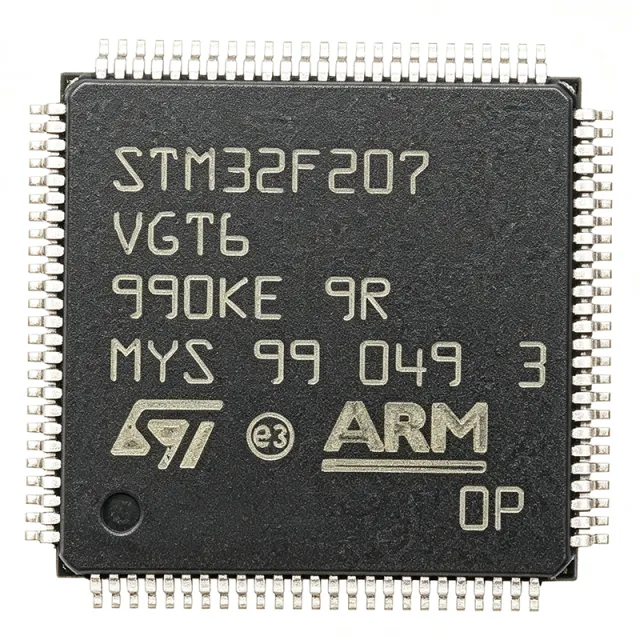
The STMicroelectronics STM32F207VGT6 is a high-performance 32-bit microcontroller based on the ARM Cortex-M3 core, operating at up to 120 MHz. It features 1 MB of Flash memory and 128 KB of SRAM, making it suitable for a wide range of embedded applications. The device is housed in a 100-pin LQFP package (LQFP100) and supports a supply voltage range of 1.8V to 3.6V. What is a microcontroller? A microcontroller (MCU) is a compact integrated circuit designed to govern a specific operation in an embedded system. It contains a processor core, memory (Flash and SRAM), and programmable input/output peripherals on a single chip. The STM32F207VGT6 belongs to the STM32F2 series, which is part of the broader STM32 family of 32-bit ARM Cortex-M microcontrollers. This family is widely used in industrial control, consumer electronics, and IoT devices due to its balance of performance, power efficiency, and peripheral integration. Key features of the STM32F207VGT6 include a 120 MHz ARM Cortex-M3 core with 1.25 DMIPS/MHz, 1 MB of Flash memory, 128 KB of SRAM, and a comprehensive set of peripherals. It integrates a 12-bit ADC with up to 24 channels, a 12-bit DAC, multiple timers, USART, SPI, I2C, USB 2.0 OTG, Ethernet MAC, and a camera interface. The device also supports a flexible memory controller (FMC) for external memory expansion, and a cryptographic/hash processor for security applications. Technically, the STM32F207VGT6 is built on a 90nm process technology, offering a good balance between performance and power consumption. It features a nested vectored interrupt controller (NVIC) for efficient interrupt handling, and a memory protection unit (MPU) for enhanced system reliability. The device supports a wide operating temperature range of -40°C to +85°C, making it suitable for industrial environments. Typical applications include industrial control systems, motor drives, medical devices, point-of-sale terminals, and IoT gateways. The Ethernet MAC and USB OTG interfaces enable connectivity in networked applications, while the rich analog peripherals support sensor interfacing and data acquisition. When designing with this MCU, ensure proper decoupling of the power supply pins and a stable clock source. The device supports multiple low-power modes, which can be leveraged to optimize energy consumption in battery-powered applications. Careful PCB layout is recommended to minimize noise and ensure reliable operation at high clock speeds.

USD $6,82 Auf Lager
STM32F207ZET6 - 32-bit ARM Cortex-M3 MCU, 512KB Flash | STMicroelectronics
STM32F207ZET6

STM32F207ZET6 - 32-bit ARM Cortex-M3 MCU, 512KB Flash | STMicroelectronics

The STMicroelectronics STM32F207ZET6 is a high-performance 32-bit microcontroller based on the ARM Cortex-M3 core, operating at up to 120 MHz. It features 512 KB of Flash memory and 128 KB of SRAM, making it suitable for a wide range of embedded applications. The device is housed in a 144-pin LQFP package (LQFP144) with a 20x20 mm body, offering extensive I/O and connectivity options. What is a microcontroller? A microcontroller (MCU) is a compact integrated circuit designed to govern a specific operation in an embedded system. It integrates a processor core, memory (Flash and SRAM), and programmable input/output peripherals on a single chip. Microcontrollers are the brain of countless electronic products, from automotive engine control units to consumer appliances and IoT devices. The STM32F207ZET6 belongs to the STM32F2 series, which is part of the broader STM32 family of 32-bit ARM Cortex-M microcontrollers, positioned between the mainstream F1 series and the high-performance F4/H7 series. Key features of the STM32F207ZET6 include a 120 MHz ARM Cortex-M3 core with 1.25 DMIPS/MHz, 512 KB Flash, 128 KB SRAM, and a comprehensive set of peripherals: 3x 12-bit ADCs, 2x DACs, 4x USARTs, 2x UARTs, 3x SPI, 2x I2C, 2x CAN, 1x USB 2.0 OTG FS/HS, 1x Ethernet MAC, and a camera interface. It also includes a cryptographic/hash processor for AES, DES, and 3DES encryption, and a true random number generator (TRNG). The device operates from 1.8V to 3.6V supply and supports a temperature range of -40°C to +85°C (industrial grade). The STM32F207ZET6 is built on ST's advanced 90nm process technology, providing a balance of performance and power efficiency. The ART Accelerator™ (Adaptive Real-Time memory accelerator) enables zero-wait-state execution from Flash, maximizing the effective throughput of the Cortex-M3 core. The device also features a flexible memory controller (FMC) supporting external memory interfaces, including SRAM, PSRAM, NOR, and NAND Flash. Typical applications include industrial control systems, motor drives, PLCs, medical devices, point-of-sale terminals, networking equipment, and IoT gateways. The rich connectivity (Ethernet, USB, CAN) makes it ideal for applications requiring multiple communication interfaces. The cryptographic hardware accelerates secure communication protocols, enhancing data security in connected devices. When designing with this MCU, pay attention to power supply decoupling: place 100nF capacitors close to each VDD pin and a 4.7uF bulk capacitor. The VDDA analog supply should be filtered with a ferrite bead and 1uF capacitor to reduce noise for ADC accuracy. Also, configure the boot pins correctly to select the desired boot source (Flash, SRAM, or system memory).

USD $8,10 Auf Lager
STM32F207ZGT6 - 32-bit ARM Cortex-M3 MCU, 1MB Flash | STMicroelectronics
STM32F207ZGT6

STM32F207ZGT6 - 32-bit ARM Cortex-M3 MCU, 1MB Flash | STMicroelectronics

The STM32F207ZGT6 is a high-performance 32-bit microcontroller from STMicroelectronics, based on the ARM Cortex-M3 core running at up to 120 MHz. It integrates 1 MB of Flash memory and 128 KB of SRAM, making it suitable for complex embedded applications requiring substantial code and data storage. The device is housed in a 144-pin LQFP package (LQFP144) with a 20x20 mm body, offering a rich set of peripherals and I/O capabilities. A microcontroller (MCU) is a compact integrated circuit designed to govern a specific operation in an embedded system. It contains a processor core, memory (Flash and SRAM), and programmable input/output peripherals. The STM32F207ZGT6 belongs to the STM32F2 series, which is part of the broader STM32 family of 32-bit Flash microcontrollers. This family is widely used in industrial control, consumer electronics, and IoT devices due to its balance of performance, power efficiency, and peripheral integration. Key features of the STM32F207ZGT6 include a 120 MHz ARM Cortex-M3 core with 1.25 DMIPS/MHz, 1 MB of Flash memory, 128 KB of SRAM, and a comprehensive set of peripherals: 3x 12-bit ADCs, 2x DACs, 4x USARTs, 2x UARTs, 3x SPI, 2x I2C, 2x CAN, 1x USB 2.0 OTG FS/HS, 1x Ethernet MAC, and a camera interface. It also features a flexible memory controller (FMC) for external memory expansion, a true random number generator (RNG), and a cryptographic acceleration cell for AES, DES, and 3DES. The STM32F207ZGT6 is built on a 90nm process technology, offering a good balance between performance and power consumption. It operates from a 1.8V to 3.6V power supply and supports a wide temperature range of -40°C to +85°C. The device includes multiple low-power modes (Sleep, Stop, Standby) to optimize energy consumption in battery-powered applications. Typical applications include industrial automation, motor control, medical devices, point-of-sale terminals, and IoT gateways. The Ethernet MAC and USB OTG support enable connectivity in networked systems, while the rich analog peripherals suit data acquisition and control loops. When designing with this MCU, ensure proper decoupling of the power supply pins and a stable clock source. The device supports external crystal oscillators (4-26 MHz) and an internal 16 MHz RC oscillator. For high-speed USB and Ethernet, an external 25 MHz crystal is recommended. The boot pins must be configured correctly for programming via USART or USB.

USD $8,10 Auf Lager
STM32F301K6T7 - 32KB Flash Cortex-M4 MCU 32-LQFP | STMicroelectronics
STM32F301K6T7

STM32F301K6T7 - 32KB Flash Cortex-M4 MCU 32-LQFP | STMicroelectronics

The STMicroelectronics STM32F301K6T7 is a mainstream mixed-signal microcontroller built on the Arm Cortex-M4 32-bit RISC core with single-cycle hardware multiply, hardware divide, DSP instructions and an integrated single-precision Floating Point Unit (FPU), running up to 72 MHz. The device integrates 32 KB of Flash and 16 KB of SRAM on the data bus, packaged in a 32-pin LQFP. The supply voltage VDD/VDDA spans 2.0 V to 3.6 V, and the part includes an integrated voltage regulator and a CRC calculation unit. What is a mixed-signal MCU? A mixed-signal microcontroller integrates a digital processor core with on-chip analog peripherals such as ADCs, DACs, comparators and operational amplifiers, allowing one chip to interface directly with sensors and analog signal chains without external analog components. This category sits beneath the broader product hierarchy of microcontroller -> embedded MCU -> ARM Cortex-M device -> mixed-signal MCU -> semiconductor. Key features of the STM32F301K6T7 include up to two 12-bit fast ADCs (5 MSPS) with selectable resolution, one 12-bit DAC channel, four fast rail-to-rail analog comparators with programmable threshold, one 8 MHz operational amplifier with PGA capability, and advanced-control PWM timers for motor-control and digital-power topologies. Communication peripherals include one I2C, up to two SPI, up to three USART, and a CAN 2.0B interface. The device supports up to 21 fast GPIOs and embeds a 16-channel DMA controller. Architecturally the part leverages the Cortex-M4 core with FPU, enabling C-level DSP code without software emulation and accurate math for sensor fusion, while the on-chip analog front-end reduces BOM cost. Reset and power-management blocks include power-on reset, brown-out reset, programmable voltage detector, and a low-power RTC with backup-domain registers. Typical applications include digital power conversion (SMPS digital control loops), motor drives for low-voltage BLDC and PMSM systems, sensor-hub and signal-conditioning front-ends, factory-automation I/O modules, consumer appliance control boards, and low-cost instrumentation. When laying out the PCB, place the VDDA decoupling network within 5 mm of the VDDA pin, use an external ferrite or resistor between VDD and VDDA, and keep the analog ground plane separate from the switching-return path to preserve ADC SNR.

USD $1,92 Auf Lager
STM32F302CBT6 - 32-Bit ARM Cortex-M4 MCU 72MHz 128KB Flash | STMicroelectronics
STM32F302CBT6

STM32F302CBT6 - 32-Bit ARM Cortex-M4 MCU 72MHz 128KB Flash | STMicroelectronics

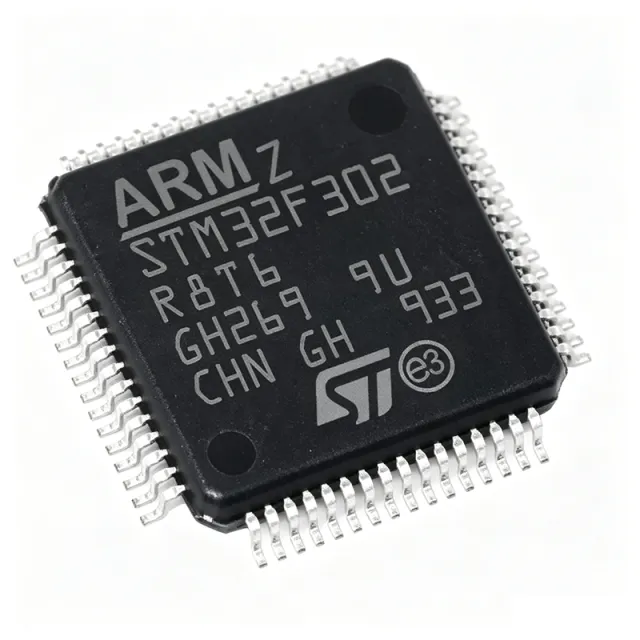
The STM32F302CBT6 is a 32-bit ARM Cortex-M4 microcontroller from STMicroelectronics' STM32F3 series, featuring a 72 MHz CPU with DSP instructions and a floating-point unit (FPU). It integrates 128 KB of Flash memory and 32 KB of SRAM in a compact 48-pin LQFP (7x7 mm) package, making it suitable for a wide range of mixed-signal applications. A microcontroller (MCU) is a compact integrated circuit designed to govern a specific operation in an embedded system. It contains a processor core, memory, and programmable input/output peripherals. The STM32F302CBT6 belongs to the STM32F3 series, which is optimized for mixed-signal processing, combining an ARM Cortex-M4 core with advanced analog peripherals such as high-speed ADCs, operational amplifiers, and comparators. This positions it within the broader hierarchy of embedded processors, from general-purpose MCUs to application-specific system-on-chips. Key features include a 12-bit ADC with 5 MSPS sampling rate, programmable gain amplifiers (PGAs), and analog comparators, enabling precise analog signal conditioning without external components. The device also includes a memory protection unit (MPU) and a CCM (Core Coupled Memory) for real-time performance. The FPU accelerates floating-point calculations, which is critical for control algorithms and digital signal processing tasks. The STM32F302CBT6 is built on a high-performance ARM Cortex-M4 core with a 72 MHz clock, providing 90 DMIPS of processing power. The inclusion of DSP instructions and an FPU allows efficient execution of complex mathematical operations, making it ideal for motor control, power conversion, and audio processing. The device operates from a 2.0V to 3.6V supply and supports a temperature range of -40°C to +85°C. Typical applications include motor control for industrial drives, power management in renewable energy systems, and audio processing in consumer electronics. The high-speed ADC and analog peripherals make it particularly well-suited for applications requiring real-time analog signal acquisition and processing, such as digital power supplies and smart sensors. When designing with this device, ensure proper decoupling of the power supply pins and careful layout of the analog and digital grounds to minimize noise. The flexible clock tree allows the use of an external crystal or internal RC oscillator, providing design flexibility for cost-sensitive applications.

USD $3,10 Auf Lager
STM32F302R8T6 - 64MHz ARM Cortex-M4F MCU | STMicroelectronics
STM32F302R8T6

STM32F302R8T6 - 64MHz ARM Cortex-M4F MCU | STMicroelectronics

The STMicroelectronics STM32F302R8T6 is a 32-bit ARM Cortex-M4F microcontroller with floating-point unit (FPU), operating at up to 64 MHz. It is part of the STM32F3 series, designed for mixed-signal applications requiring high-performance analog peripherals. The device is housed in a 64-pin LQFP package and provides 64 KB of flash memory and 16 KB of SRAM. A microcontroller (MCU) is a compact integrated circuit designed to govern a specific operation in an embedded system. It contains a processor core, memory, and programmable input/output peripherals. The STM32F302R8T6 belongs to the STM32F3 family, which is optimized for analog and mixed-signal control applications, bridging the gap between general-purpose MCUs and digital signal processors (DSPs). Key features include a 64 MHz ARM Cortex-M4F core with FPU, 64 KB flash, 16 KB SRAM, and a rich set of analog peripherals: two 12-bit DACs, three 12-bit ADCs (up to 5 MSPS), and an operational amplifier. It also integrates a 16-bit advanced-control timer, multiple general-purpose timers, and a real-time clock. Communication interfaces include I2C, SPI, USART, and CAN, making it versatile for industrial and consumer applications. The STM32F302R8T6 leverages the ARM Cortex-M4F architecture with DSP instructions and a single-precision FPU, enabling efficient execution of complex algorithms. The device operates from a 2.0V to 3.6V power supply and supports a temperature range of -40°C to +85°C. Its advanced analog peripherals allow for high-resolution signal acquisition and generation, reducing external component count. Typical applications include motor control, power management, industrial automation, and consumer electronics. The combination of high-speed ADC, DAC, and op-amp makes it ideal for closed-loop control systems, such as field-oriented control (FOC) of brushless DC motors. The CAN interface supports robust communication in automotive and industrial networks. When designing with this MCU, ensure proper decoupling of the power supply pins and a stable clock source. The internal 8 MHz RC oscillator can be used for basic operation, but an external crystal is recommended for applications requiring precise timing. The device supports in-circuit programming and debugging via SWD, simplifying firmware development.

USD $5,41 Auf Lager
STM32F302RCT6 - 256KB Flash ARM Cortex-M4F MCU | STMicroelectronics
STM32F302RCT6

STM32F302RCT6 - 256KB Flash ARM Cortex-M4F MCU | STMicroelectronics

The STM32F302RCT6 is a 32-bit ARM Cortex-M4F microcontroller from STMicroelectronics, featuring a floating-point unit (FPU) and running at up to 72 MHz. It integrates 256 KB of flash memory and 40 KB of SRAM, making it suitable for a wide range of embedded control applications. The device is housed in a 64-pin LQFP package (LQFP64) and operates over a supply voltage range of 2.0V to 3.6V. What is a microcontroller? A microcontroller (MCU) is a compact integrated circuit designed to govern a specific operation in an embedded system. It contains a processor core, memory (flash and SRAM), and programmable input/output peripherals on a single chip. Microcontrollers are the backbone of modern embedded systems, from automotive engine control units to consumer electronics and industrial automation. The STM32F302RCT6 belongs to the STM32F3 series, which is optimized for mixed-signal control applications, combining an ARM Cortex-M4F core with advanced analog peripherals. Key features of the STM32F302RCT6 include a 12-bit ADC with up to 5 MSPS, two 12-bit DACs, three operational amplifiers, and a 16-bit advanced-control timer. It also provides multiple communication interfaces: I2C, SPI, USART, CAN, and USB. The device supports a temperature range of -40°C to +85°C and is available in a 64-pin LQFP package, which is suitable for space-constrained designs. The STM32F302RCT6 leverages the ARM Cortex-M4F core with DSP instructions and a single-precision FPU, enabling efficient execution of complex algorithms such as digital signal processing and motor control. The device includes a memory protection unit (MPU) and a nested vectored interrupt controller (NVIC) for real-time performance. Its advanced analog peripherals, including a 5 MSPS ADC and fast comparators, make it ideal for applications requiring high-speed data acquisition and precise control. Typical applications include motor control, power conversion, industrial automation, and consumer electronics. The device's rich analog feature set and CAN interface make it particularly well-suited for automotive and industrial control systems. Its low-power modes and wide operating voltage range also support battery-powered portable devices. When designing with the STM32F302RCT6, ensure proper decoupling of the power supply pins with 100 nF capacitors placed close to each VDD pin. The VDDA pin should be connected to a clean analog supply, and the VREF+ pin should be decoupled with a 1 µF capacitor. For reliable operation, the NRST pin should be pulled high with a 10 kΩ resistor and a 100 nF capacitor to ground.

USD $5,44 Auf Lager
STM32F303CBT6 - 32-bit ARM Cortex-M4 MCU, 256KB Flash | STMicroelectronics
STM32F303CBT6

STM32F303CBT6 - 32-bit ARM Cortex-M4 MCU, 256KB Flash | STMicroelectronics

The STMicroelectronics STM32F303CBT6 is a 32-bit ARM Cortex-M4F microcontroller with FPU, operating at up to 72 MHz. It features 256 KB of flash memory and 40 KB of SRAM, packaged in a 48-pin LQFP (7x7 mm) package. This device is part of the STM32F303x6/8/B family, designed for mixed-signal applications requiring high-performance analog peripherals. What is a microcontroller? A microcontroller (MCU) is a compact integrated circuit containing a processor core, memory, and programmable input/output peripherals on a single chip. It is the brain of embedded systems, executing firmware to control devices, process sensor data, and communicate with other systems. MCUs are categorized by their core architecture (e.g., ARM Cortex-M), memory size, and peripheral set, and are fundamental to applications ranging from consumer electronics to industrial automation. Key features of the STM32F303CBT6 include a 32-bit ARM Cortex-M4 core with FPU, 72 MHz maximum clock speed, 256 KB flash, 40 KB SRAM, and a rich set of analog peripherals: three 12-bit DACs, four 12-bit ADCs (up to 5 MSPS), seven fast comparators, and operational amplifiers. It also provides advanced timers, a 12-channel DMA controller, and multiple communication interfaces including I2C, SPI, USART, CAN, and USB. The device operates from 2.0V to 3.6V supply and over a -40°C to +85°C temperature range. The STM32F303CBT6 leverages the ARM Cortex-M4 core with single-precision FPU and DSP instructions, enabling efficient execution of complex algorithms such as motor control, digital signal processing, and sensor fusion. The high-speed ADCs (5 MSPS) and fast comparators (25 ns) make it particularly suited for real-time control loops and power conversion applications. Typical applications include motor control (field-oriented control of BLDC/PMSM motors), digital power conversion (SMPS, inverters), industrial automation (PLCs, sensors), medical devices (patient monitoring), and consumer electronics (audio processing, smart appliances). The combination of analog performance and digital processing capability allows designers to integrate multiple functions into a single MCU, reducing BOM cost and board space. When designing with this device, ensure proper decoupling of the VDD and VDDA pins with 100 nF and 4.7 uF capacitors, and connect the VCAP pin to ground with a 2.2 uF capacitor. The BOOT0 pin configuration determines boot source; leave it pulled low for normal flash boot. For high-speed ADC operation, use a stable reference voltage on VREF+ and minimize noise on the analog supply.

USD $4,16 Auf Lager
STM32F303CCT6 - 256KB Flash, 72MHz ARM Cortex-M4F MCU | STMicroelectronics
STM32F303CCT6

STM32F303CCT6 - 256KB Flash, 72MHz ARM Cortex-M4F MCU | STMicroelectronics

The STM32F303CCT6 is a 32-bit ARM Cortex-M4F microcontroller from STMicroelectronics, featuring a 72 MHz CPU with FPU and DSP instructions, 256 KB of Flash memory, and 40 KB of SRAM. It is housed in a 48-pin LQFP package (7x7 mm) and operates over a supply voltage range of 2.0V to 3.6V. This device is part of the STM32F303x6/x8 family, designed for mixed-signal applications requiring high-performance analog peripherals. A microcontroller (MCU) is a compact integrated circuit designed to govern a specific operation in an embedded system. It contains a processor core, memory, and programmable input/output peripherals. The STM32F303CCT6 belongs to the STM32F3 series, which is optimized for analog-intensive applications such as motor control, industrial sensors, and power management. The Cortex-M4F core adds a floating-point unit (FPU) and DSP instructions, enabling efficient handling of complex mathematical operations. Key features include a 72 MHz ARM Cortex-M4F core with FPU, 256 KB Flash, 40 KB SRAM, and a rich set of analog peripherals: three 12-bit ADCs (up to 5 MSPS), four 12-bit DACs, seven fast comparators, and programmable gain amplifiers (PGA). It also integrates advanced timers (up to 8 timers), a real-time clock (RTC), and multiple communication interfaces including I2C, SPI, USART, CAN, and USB. The device supports a temperature range of -40°C to +85°C and is available in a 48-pin LQFP package. The STM32F303CCT6 leverages ST's advanced 90nm process technology, providing a balance of performance and power efficiency. The Cortex-M4F core with FPU accelerates signal processing tasks, while the extensive analog peripherals reduce the need for external components. The device includes a memory protection unit (MPU), DMA controller, and a nested vectored interrupt controller (NVIC) for real-time responsiveness. Typical applications include motor control (field-oriented control), industrial automation, medical devices, and consumer electronics. The high-resolution ADCs and fast comparators make it ideal for closed-loop control systems, while the CAN interface supports automotive and industrial networking. The USB interface enables connectivity for data logging and firmware updates. When designing with this device, ensure proper decoupling of the VDD and VDDA pins with 100nF capacitors placed close to the pins. The VDDA pin must be connected to a clean analog supply to achieve the specified ADC performance. Use the internal voltage regulator with external capacitors as recommended in the datasheet to ensure stable operation.

USD $5,60 Auf Lager