Produkte (31127)

STM32F405VGT6 - 168MHz ARM Cortex-M4F MCU | STMicroelectronics
STM32F405VGT6

STM32F405VGT6 - 168MHz ARM Cortex-M4F MCU | STMicroelectronics

The STM32F405VGT6 is a high-performance 32-bit microcontroller from STMicroelectronics, based on the ARM Cortex-M4F core with floating-point unit (FPU). It operates at up to 168 MHz, delivering 210 DMIPS and 1.25 DMIPS/MHz, making it suitable for demanding applications such as motor control, medical equipment, and industrial automation. The device integrates 1 MB of flash memory and 192 KB of SRAM, along with a rich set of peripherals including multiple 12-bit ADCs, DACs, timers, and communication interfaces. What is a microcontroller? A microcontroller (MCU) is a compact integrated circuit designed to govern a specific operation in an embedded system. It contains a processor core, memory (flash and SRAM), and programmable input/output peripherals on a single chip. Microcontrollers are the brain of countless electronic devices, from automotive engine control units to consumer electronics. The STM32F405VGT6 belongs to the STM32F4 series, which is part of the broader STM32 family of 32-bit ARM Cortex-M based MCUs. This family is widely used in industrial, consumer, and IoT applications due to its performance, low power consumption, and extensive ecosystem. Key features of the STM32F405VGT6 include a 168 MHz ARM Cortex-M4F core with FPU, 1 MB flash, 192 KB SRAM, and a comprehensive set of peripherals: three 12-bit ADCs (up to 24 channels), two DACs, 12 general-purpose timers, and multiple communication interfaces (USART, SPI, I2C, CAN, USB OTG, Ethernet). The device also features a memory protection unit (MPU), a true random number generator (RNG), and a cryptographic acceleration cell for AES, DES, and 3DES. These features make it a versatile choice for complex embedded applications. The STM32F405VGT6 is manufactured using a 90nm process technology, which balances performance and power efficiency. The core operates at 1.8V to 3.6V, with a wide temperature range of -40°C to +85°C (or +105°C for the VGT6 variant). The device supports various low-power modes, including Sleep, Stop, and Standby, enabling battery-powered applications. The rich peripheral set and high clock speed allow for real-time control and signal processing, making it ideal for applications such as motor control, power conversion, and audio processing. Typical applications include industrial motor control, medical monitoring devices, consumer electronics, and IoT gateways. The STM32F405VGT6 is also popular in drone flight controllers and robotics, where its processing power and peripheral integration are essential. The device is supported by ST's comprehensive development ecosystem, including the STM32CubeMX configuration tool, HAL libraries, and a wide range of development boards. When designing with the STM32F405VGT6, ensure proper decoupling of the power supply pins with 100nF capacitors placed close to each VDD pin, and a 4.7uF bulk capacitor. The VDDA pin should be filtered with a ferrite bead and a 1uF capacitor to reduce analog noise. The BOOT0 pin must be configured correctly for the desired boot mode, and the NRST pin should have a 100nF capacitor to ground for reliable reset. Pay attention to the maximum junction temperature (125°C) and ensure adequate thermal management for high-current applications.

USD $8,10 Auf Lager
STM32F405VGT6TR - 168MHz ARM Cortex-M4F MCU | STMicroelectronics (Tape & Reel)
STM32F405VGT6TR

STM32F405VGT6TR - 168MHz ARM Cortex-M4F MCU | STMicroelectronics (Tape & Reel)

The STM32F405VGT6TR is a high-performance 32-bit microcontroller from STMicroelectronics, based on the ARM Cortex-M4F core with floating-point unit (FPU). It operates at up to 168 MHz, delivering 210 DMIPS and 1.25 DMIPS/MHz, making it suitable for demanding applications such as motor control, medical equipment, and industrial automation. The device integrates 1 MB of flash memory and 192 KB of SRAM, along with a rich set of peripherals including multiple 12-bit ADCs, DACs, timers, and communication interfaces. What is a microcontroller? A microcontroller (MCU) is a compact integrated circuit designed to govern a specific operation in an embedded system. It contains a processor core, memory (flash and SRAM), and programmable input/output peripherals on a single chip. Microcontrollers are the brain of countless electronic devices, from automotive engine control units to consumer electronics. The STM32F405VGT6TR belongs to the STM32F4 series, which is part of the broader STM32 family of 32-bit ARM Cortex-M based MCUs. This family is widely used in industrial, consumer, and IoT applications due to its performance, low power consumption, and extensive ecosystem. Key features of the STM32F405VGT6TR include a 168 MHz ARM Cortex-M4F core with FPU, 1 MB flash, 192 KB SRAM, and a comprehensive set of peripherals: three 12-bit ADCs (up to 24 channels), two DACs, 12 general-purpose timers, and multiple communication interfaces (USART, SPI, I2C, CAN, USB OTG, Ethernet). The device also features a memory protection unit (MPU), a true random number generator (RNG), and a cryptographic acceleration cell for AES, DES, and 3DES. These features make it a versatile choice for complex embedded applications. The STM32F405VGT6TR is manufactured using a 90nm process technology, which balances performance and power efficiency. The core operates at 1.8V to 3.6V, with a wide temperature range of -40°C to +85°C (or +105°C for the VGT6 variant). The device supports various low-power modes, including Sleep, Stop, and Standby, enabling battery-powered applications. The rich peripheral set and high clock speed allow for real-time control and signal processing, making it ideal for applications such as motor control, power conversion, and audio processing. Typical applications include industrial motor control, medical monitoring devices, consumer electronics, and IoT gateways. The STM32F405VGT6TR is also popular in drone flight controllers and robotics, where its processing power and peripheral integration are essential. The device is supported by ST's comprehensive development ecosystem, including the STM32CubeMX configuration tool, HAL libraries, and a wide range of development boards. When designing with the STM32F405VGT6TR, ensure proper decoupling of the power supply pins with 100nF capacitors placed close to each VDD pin, and a 4.7uF bulk capacitor. The VDDA pin should be filtered with a ferrite bead and a 1uF capacitor to reduce analog noise. The BOOT0 pin must be configured correctly for the desired boot mode, and the NRST pin should have a 100nF capacitor to ground for reliable reset. Pay attention to the maximum junction temperature (125°C) and ensure adequate thermal management for high-current applications.

USD $8,10 Auf Lager
STM32F405ZGT6 - ARM Cortex-M4F MCU 168MHz 1MB Flash | STMicroelectronics
STM32F405ZGT6

STM32F405ZGT6 - ARM Cortex-M4F MCU 168MHz 1MB Flash | STMicroelectronics

The STMicroelectronics STM32F405ZGT6 is a high-performance ARM Cortex-M4F based microcontroller with floating-point unit (FPU) operating at up to 168 MHz. It features 1 MB of Flash memory and 192 KB of SRAM, making it suitable for complex real-time applications. The device is housed in a 144-pin LQFP package (LQFP144) with a 20x20 mm body and 0.5 mm pitch, providing ample I/O for connectivity and control. A microcontroller (MCU) is a compact integrated circuit designed to govern a specific operation in an embedded system. It contains a processor core, memory, and programmable input/output peripherals. The STM32F405ZGT6 belongs to the STM32F4 series, which is part of the broader STM32 family of 32-bit ARM Cortex-M microcontrollers. These devices are widely used in industrial control, consumer electronics, and IoT applications due to their balance of performance, power efficiency, and peripheral integration. Key features include a 168 MHz CPU with DSP instructions and FPU, 1 MB Flash, 192 KB SRAM, and a comprehensive set of peripherals: three 12-bit ADCs, two DACs, multiple timers, USART, SPI, I2C, USB OTG FS/HS, Ethernet MAC, and camera interface. The device supports a supply voltage range of 1.8V to 3.6V and operates over -40°C to +85°C. It includes a memory protection unit (MPU), embedded trace macrocell (ETM), and a wide range of communication interfaces. The STM32F405ZGT6 is built on a 90nm process technology, offering high performance with low power consumption. The ART Accelerator™ enables zero-wait-state execution from Flash, maximizing throughput. The FPU accelerates mathematical computations, which is critical for digital signal processing and motor control algorithms. The device also features a true random number generator (RNG) and a cryptographic acceleration cell for secure applications. Typical applications include industrial motor control, medical equipment, consumer electronics, IoT gateways, and audio processing. The rich peripheral set and high clock speed make it ideal for applications requiring real-time responsiveness and complex algorithms. For example, in motor control, the advanced timers generate PWM signals with dead-time insertion, while the ADCs sample current and voltage feedback for closed-loop control. When designing with this MCU, ensure proper decoupling of the power supply pins with 100nF capacitors close to each VDD pin and a bulk capacitor. The VDDA pin must be connected to a clean analog supply, and VREF+ should be filtered to achieve accurate ADC conversions. The BOOT0 pin configuration determines the boot source, and NRST requires a pull-up resistor and capacitor for reliable reset.

USD $8,10 Auf Lager
STM32F407IEH6 - 168MHz Cortex-M4 512KB MCU | STMicroelectronics
STM32F407IEH6

STM32F407IEH6 - 168MHz Cortex-M4 512KB MCU | STMicroelectronics

The STMicroelectronics STM32F407IEH6 is a 32-bit Arm Cortex-M4 microcontroller with FPU and DSP support, operating up to 168 MHz and packaged in a 176-ball-plus-25-ball UFBGA measuring 10 mm by 10 mm. It provides 512 KB of Flash memory and 192 KB of SRAM for firmware, control logic, communications, and real-time signal processing. The MCU also integrates an Ethernet MAC and camera interface according to the verified product references. A microcontroller is a programmable semiconductor system that integrates a processor core, memory, peripherals, and communication interfaces on one device. The STM32F4 MCU family belongs to the embedded-microcontroller hierarchy, where an Arm Cortex-M4 RISC core executes real-time control algorithms. Its hardware peripherals offload tasks that would otherwise burden the CPU, making the platform suitable for connected industrial, communications, audio, and embedded control products. Key features include the 168 MHz maximum core frequency, single-cycle multiplication, DSP instructions, an FPU, and the ART Accelerator for zero-wait-state Flash execution. The verified references also identify a memory protection unit and up to 210 DMIPS, or 1.25 DMIPS/MHz with Dhrystone 2.1. These features support responsive control loops and arithmetic-intensive firmware while preserving deterministic peripheral access. The STM32F407IEH6 belongs to the STM32F407 high-performance family. Its integrated Ethernet MAC supports network-connected equipment, while the camera interface suits embedded imaging and vision systems. The combination of large embedded memory and a high-speed CPU is also valuable for audio processing, industrial gateways, and multifunction control boards that need fewer external components. Typical uses include industrial automation, Ethernet gateways, camera-based inspection, audio controllers, communications equipment, and real-time embedded systems. Firmware portability requires checking peripheral assignments, pin multiplexing, startup support, clock configuration, and memory-map compatibility whenever moving between STM32 variants. The manufacturer product page and datasheet should govern final design decisions. When designing the PCB, follow the manufacturer's land pattern, ball assignment, decoupling, and routing guidance. Keep high-speed clocks and communication signals short, provide clean references for analog interfaces, and validate power sequencing before production. Because the exact pin list, electrical limits, and package drawing are not included in the supplied search extract, consult the official STM32F407IEH6 documentation before layout release. This page consolidates the verified distributor identity, memory and processor specifications, procurement links, family context, and practical replacement considerations. It adds engineering guidance beyond a basic distributor listing while clearly separating verified values from documentation that must still be checked during design qualification.

Angebot Auf Lager
STM32F407IEH6TR - 168MHz Cortex-M4 512KB MCU | STMicroelectronics (Tape & Reel)
STM32F407IEH6TR

STM32F407IEH6TR - 168MHz Cortex-M4 512KB MCU | STMicroelectronics (Tape & Reel)

The STMicroelectronics STM32F407IEH6TR is a 32-bit Arm Cortex-M4 microcontroller with FPU and DSP support, operating up to 168 MHz and packaged in a 176-ball-plus-25-ball UFBGA measuring 10 mm by 10 mm. It provides 512 KB of Flash memory and 192 KB of SRAM for firmware, control logic, communications, and real-time signal processing. The MCU also integrates an Ethernet MAC and camera interface according to the verified product references. A microcontroller is a programmable semiconductor system that integrates a processor core, memory, peripherals, and communication interfaces on one device. The STM32F4 MCU family belongs to the embedded-microcontroller hierarchy, where an Arm Cortex-M4 RISC core executes real-time control algorithms. Its hardware peripherals offload tasks that would otherwise burden the CPU, making the platform suitable for connected industrial, communications, audio, and embedded control products. Key features include the 168 MHz maximum core frequency, single-cycle multiplication, DSP instructions, an FPU, and the ART Accelerator for zero-wait-state Flash execution. The verified references also identify a memory protection unit and up to 210 DMIPS, or 1.25 DMIPS/MHz with Dhrystone 2.1. These features support responsive control loops and arithmetic-intensive firmware while preserving deterministic peripheral access. The STM32F407IEH6TR belongs to the STM32F407 high-performance family. Its integrated Ethernet MAC supports network-connected equipment, while the camera interface suits embedded imaging and vision systems. The combination of large embedded memory and a high-speed CPU is also valuable for audio processing, industrial gateways, and multifunction control boards that need fewer external components. Typical uses include industrial automation, Ethernet gateways, camera-based inspection, audio controllers, communications equipment, and real-time embedded systems. Firmware portability requires checking peripheral assignments, pin multiplexing, startup support, clock configuration, and memory-map compatibility whenever moving between STM32 variants. The manufacturer product page and datasheet should govern final design decisions. When designing the PCB, follow the manufacturer's land pattern, ball assignment, decoupling, and routing guidance. Keep high-speed clocks and communication signals short, provide clean references for analog interfaces, and validate power sequencing before production. Because the exact pin list, electrical limits, and package drawing are not included in the supplied search extract, consult the official STM32F407IEH6TR documentation before layout release. This page consolidates the verified distributor identity, memory and processor specifications, procurement links, family context, and practical replacement considerations. It adds engineering guidance beyond a basic distributor listing while clearly separating verified values from documentation that must still be checked during design qualification.

Angebot Auf Lager
STM32F407IEH7 - 168MHz Cortex-M4 512KB MCU | STMicroelectronics
STM32F407IEH7

STM32F407IEH7 - 168MHz Cortex-M4 512KB MCU | STMicroelectronics

The STMicroelectronics STM32F407IEH7 is an Arm Cortex-M4 32-bit microcontroller with a 168 MHz maximum operating frequency, 512 KB of Flash memory, and a 176+25 UFBGA package measuring 10 mm by 10 mm. The device belongs to the STM32F4 high-performance microcontroller family and combines a floating-point unit, DSP-oriented processing, extensive connectivity, and analog peripherals for demanding embedded systems. A microcontroller is a compact computer integrated onto one semiconductor package. It executes firmware from embedded Flash memory, reads inputs, controls outputs, and manages communications and timing functions. The STM32F4 family is positioned above basic general-purpose MCUs because its Cortex-M4 core, high clock rate, memory, and peripheral set support more computationally intensive control, communications, audio, and data-acquisition systems. Key verified features include an Arm Cortex-M4 CPU with FPU, operation up to 168 MHz, 512 KB Flash, and support for USB, Ethernet, camera interfaces, and multiple communication peripherals. One secondary datasheet result lists up to 1 MB Flash and 192+4 KB RAM for the broader STM32F407 family, but those values are not treated as target-MPN specifications without device-specific confirmation. The result identifies the STM32F407IEH7 as a 32-bit MCU with 512 KB Flash and a 176+25 UFBGA package. Architecturally, the Cortex-M4 core uses a 32-bit RISC instruction set and includes DSP and floating-point capabilities. The verified STM32F407IE family page confirms the Cortex-M4 core and 168 MHz maximum frequency. This combination supports control-loop work, protocol handling, signal processing, and embedded applications requiring substantially more performance than an entry-level Cortex-M microcontroller. Typical applications include industrial automation, networked control equipment, USB-connected peripherals, Ethernet-enabled embedded systems, motor and motion control, sensor acquisition, and camera or image-oriented designs. The device is particularly suitable when a design requires substantial processing capability and a broad peripheral set in a compact surface-mount package. The key design consideration is package and firmware verification. The target is supplied in a 176+25 UFBGA configuration, so the PCB footprint, exposed-ball assignments, pin multiplexing, and decoupling network must be checked against the exact STMicroelectronics package documentation before layout is released. This page distinguishes the target MPN from related STM32F405, STM32F407, and STM32F417 variants rather than assuming that all family members are interchangeable. This product data consolidates the verified manufacturer identification, distributor specifications, package information, interface references, and source links into an engineering-oriented resource. It is designed to support preliminary component selection while leaving unverified electrical, thermal, pin-level, and lifecycle details explicitly marked for further datasheet confirmation.

Angebot Auf Lager
STM32F407IET6 - 168MHz Cortex-M4 512KB MCU | STMicroelectronics
STM32F407IET6

STM32F407IET6 - 168MHz Cortex-M4 512KB MCU | STMicroelectronics

The STMicroelectronics STM32F407IET6 is a 32-bit ARM Cortex-M4 microcontroller with FPU operating up to 168 MHz, 512 KB of Flash memory, and 192 KB of SRAM, housed in a 176-pin LQFP package measuring 24 x 24 mm. It belongs to the STM32F4 high-performance microcontroller family and combines real-time control, communications, and connectivity in one device. A microcontroller is a programmable system-on-chip that integrates a CPU, memory, peripherals, and communication interfaces into a single package. STM32F4 devices provide higher processing performance than basic Cortex-M microcontrollers while retaining low-power embedded-control characteristics. The STM32F407IET6 is therefore positioned between simple microcontrollers and more complex application processors for industrial, communications, audio, and embedded-control designs. The verified data identifies an ARM Cortex-M4 core with FPU, operation up to 168 MHz, 512 KB of Flash, and 192 KB of SRAM. The device also belongs to the STM32F4 series and supports communication and peripheral functions referenced in the retrieved family information. Its 32-bit architecture and floating-point capability suit real-time control loops, signal processing, network-connected equipment, and human-interface systems. The 176-LQFP package provides a large pin count compared with small-outline MCUs, supporting a broader selection of alternate-function, power, ground, debug, and communications connections. Its 24 x 24 mm body is physically larger than compact 48-pin or 64-pin devices, so PCB land patterns and assembly tooling must be designed for the 176-pin package rather than a smaller STM32 variant. Typical applications include industrial automation, Ethernet-connected control systems, USB or serial communications equipment, audio and signal-processing systems, and embedded gateways. The 168 MHz Cortex-M4 core provides more compute headroom than lower-frequency general-purpose MCUs, while the 192 KB SRAM allows larger buffers than basic devices. Designers should still verify clock tree, power, pin multiplexing, memory, and peripheral requirements against the relevant STM32F407 datasheet before layout. This page combines verified distributor and manufacturer-search data, explicit data-gap markers, application guidance, and replacement criteria. It does not infer unverified electrical limits, pin assignments, pricing tiers, or lifecycle claims from generic STM32 family descriptions.

Angebot Auf Lager
STM32F407IGH6 - 168MHz 1MB Cortex-M4 MCU | STMicroelectronics
STM32F407IGH6

STM32F407IGH6 - 168MHz 1MB Cortex-M4 MCU | STMicroelectronics

STMicroelectronics STM32F407IGH6 is an ARM Cortex-M4 32-bit microcontroller with a maximum operating frequency of 168 MHz, 1 MB of Flash memory, and up to 192 KB of SRAM in a 176-ball UFBGA package. The STM32F407 family combines real-time signal-processing capability with extensive connectivity and peripheral integration for embedded control designs. A microcontroller is a semiconductor device that integrates a processor core, memory, peripherals, and communication interfaces into one compact component. The STM32F4 series belongs to the MCU hierarchy and uses the ARM Cortex-M4 core with floating-point and DSP capabilities. Its architecture is suited to industrial, communications, consumer, and embedded-control systems where deterministic control and multiple peripheral functions are required. Key verified features include an ARM Cortex-M4 processor, 168 MHz maximum frequency, 1 MB Flash, and 192 KB SRAM. The manufacturer family information also identifies an FPU, ART Accelerator, memory protection unit, DSP instructions, and up to 210 DMIPS. These features support responsive control loops, signal processing, and code execution from Flash memory. The STM32F407IGH6 is designed for applications requiring a high-performance 32-bit MCU and substantial embedded memory. Its integrated MCU architecture can consolidate control logic and peripheral functions while reducing the number of discrete components in a design. Exact peripheral counts, voltage limits, temperature ranges, and package pin assignments should be confirmed against the manufacturer datasheet for the selected variant. Typical applications include industrial automation, communications equipment, audio and signal-processing systems, motor-control platforms, and connected embedded devices. The 1 MB Flash capacity provides room for larger firmware, while the 192 KB SRAM supports buffering and real-time workloads. The 168 MHz operating frequency provides additional processing headroom for multitasking and control algorithms. When designing a board around the STM32F407IGH6, verify power sequencing, decoupling, clock configuration, exposed-pad or thermal requirements, and the exact UFBGA land pattern before layout release. Because this is a high-pin-count ball-grid package, careful BGA routing, via-in-pad strategy, and assembly process selection are important. Do not infer pin compatibility from the family name alone; use the manufacturer pinout and package drawing. This page summarizes verified distributor and manufacturer information, including the Cortex-M4 core, 168 MHz frequency, 1 MB Flash, 192 KB SRAM, UFBGA package information, pricing references, and application guidance. It is intended to support component identification, engineering selection, and informed sourcing of the STM32F407IGH6.

Angebot Auf Lager
STM32F407IGH6TR - 168MHz 1MB Cortex-M4 MCU | STMicroelectronics (Tape & Reel)
STM32F407IGH6TR

STM32F407IGH6TR - 168MHz 1MB Cortex-M4 MCU | STMicroelectronics (Tape & Reel)

STMicroelectronics STM32F407IGH6TR is an ARM Cortex-M4 32-bit microcontroller with a maximum operating frequency of 168 MHz, 1 MB of Flash memory, and up to 192 KB of SRAM in a 176-ball UFBGA package. The STM32F407 family combines real-time signal-processing capability with extensive connectivity and peripheral integration for embedded control designs. A microcontroller is a semiconductor device that integrates a processor core, memory, peripherals, and communication interfaces into one compact component. The STM32F4 series belongs to the MCU hierarchy and uses the ARM Cortex-M4 core with floating-point and DSP capabilities. Its architecture is suited to industrial, communications, consumer, and embedded-control systems where deterministic control and multiple peripheral functions are required. Key verified features include an ARM Cortex-M4 processor, 168 MHz maximum frequency, 1 MB Flash, and 192 KB SRAM. The manufacturer family information also identifies an FPU, ART Accelerator, memory protection unit, DSP instructions, and up to 210 DMIPS. These features support responsive control loops, signal processing, and code execution from Flash memory. The STM32F407IGH6TR is designed for applications requiring a high-performance 32-bit MCU and substantial embedded memory. Its integrated MCU architecture can consolidate control logic and peripheral functions while reducing the number of discrete components in a design. Exact peripheral counts, voltage limits, temperature ranges, and package pin assignments should be confirmed against the manufacturer datasheet for the selected variant. Typical applications include industrial automation, communications equipment, audio and signal-processing systems, motor-control platforms, and connected embedded devices. The 1 MB Flash capacity provides room for larger firmware, while the 192 KB SRAM supports buffering and real-time workloads. The 168 MHz operating frequency provides additional processing headroom for multitasking and control algorithms. When designing a board around the STM32F407IGH6TR, verify power sequencing, decoupling, clock configuration, exposed-pad or thermal requirements, and the exact UFBGA land pattern before layout release. Because this is a high-pin-count ball-grid package, careful BGA routing, via-in-pad strategy, and assembly process selection are important. Do not infer pin compatibility from the family name alone; use the manufacturer pinout and package drawing. This page summarizes verified distributor and manufacturer information, including the Cortex-M4 core, 168 MHz frequency, 1 MB Flash, 192 KB SRAM, UFBGA package information, pricing references, and application guidance. It is intended to support component identification, engineering selection, and informed sourcing of the STM32F407IGH6TR.

USD $9,80 Auf Lager
STM32F407IGH7 - 168MHz Cortex-M4 MCU | STMicroelectronics
STM32F407IGH7

STM32F407IGH7 - 168MHz Cortex-M4 MCU | STMicroelectronics

The STMicroelectronics STM32F407IGH7 is a 32-bit Arm Cortex-M4 microcontroller with a 168 MHz maximum CPU frequency, 1 MB of Flash memory, and a 176-ball plus 25-ball UFBGA package measuring 10 mm by 10 mm. It combines the Cortex-M4 processor with floating-point capability, extensive connectivity, and substantial embedded memory for demanding control and communications systems. The verified distributor listing identifies the device as an STM32F4-series MCU with a 1 M x 8 Flash organization. A microcontroller is a programmable system-on-chip that integrates a processor core, memory, peripherals, and communication interfaces into one component. Within the embedded-computing hierarchy, this device combines an Arm Cortex-M4 core, STM32F4 performance peripherals, embedded Flash and RAM, and industrial connectivity functions. Its 168 MHz operating point supports real-time control workloads, while the integrated networking and communications peripherals reduce the need for external interface devices. Key verified features include the 32-bit Arm Cortex-M4 core, operation up to 168 MHz, 1 MB Flash, and the stated 210 DMIPS performance class in the retrieved family documentation. The family description also identifies an adaptive real-time accelerator, a memory protection unit, DSP capability, three ADCs, 17 timers, USB, Ethernet, and multiple communication interfaces. These features position the part for networked gateways, industrial equipment, motor-control systems, data acquisition, and embedded audio applications. The device uses a compact 176+25 UFBGA package, making board-layout and assembly planning more demanding than a leaded package. Its dense ball array requires careful PCB escape routing, controlled power distribution, and inspection during manufacture. Verify the exact pin allocation, exposed-ball functions, electrical limits, and package drawing from the manufacturer datasheet before layout or a replacement decision. Typical designs use the MCU as the central controller for Ethernet-connected equipment, sensor aggregation, motor control, USB peripherals, camera or image-related control, and industrial automation. The 168 MHz core is useful when the control loop or communications workload exceeds the requirements of a simpler microcontroller, while the 1 MB Flash capacity provides room for application code and data. Interface count and memory availability should still be checked against the exact ordering code. A key design consideration is that a pin-compatible-looking alternative is not automatically a drop-in replacement. Confirm the BGA ball map, power pins, peripheral mapping, clock configuration, memory organization, and package drawing. Also account for software compatibility, peripheral differences, and any changes in electrical characteristics. This page consolidates verified distributor specifications, a strict data-authenticity assessment, practical application guidance, and drop-in alternative qualification. The exact electrical limits, pin map, lifecycle details, pricing tiers, and regulatory declarations are explicitly marked when the supplied evidence does not establish them.

Angebot Auf Lager
STM32F407IGT6 - 168MHz Cortex-M4 MCU 1MB Flash | STMicroelectronics
STM32F407IGT6

STM32F407IGT6 - 168MHz Cortex-M4 MCU 1MB Flash | STMicroelectronics

The STMicroelectronics STM32F407IGT6 is a high-performance 32-bit ARM Cortex-M4 microcontroller with FPU, 1MB of Flash, and 192KB of SRAM, housed in a 176-pin LQFP package. It operates at a maximum 168MHz clock with 210 DMIPS / 1.25 DMIPS/MHz (Dhrystone 2.1) performance and integrates DSP instructions plus a single-precision floating-point unit. The device includes an Adaptive Real-Time (ART) Accelerator that enables 0-wait-state execution from Flash, plus a memory protection unit (MPU). An LQFP, or Low-Profile Quad Flat Pack, is a surface-mount IC package with gull-wing leads on all four sides, optimized for high pin density. Microcontrollers (MCUs) like the STM32F407IGT6 belong to the embedded controller family within the broader semiconductor taxonomy: MCU -> microcontroller -> embedded processor -> integrated circuit. These devices combine a CPU core, memory, and peripherals on a single die, enabling standalone embedded systems in industrial, consumer, and automotive products. Key features of the STM32F407IGT6 include three 12-bit ADCs (2.4 MSPS), two 12-bit DACs, 17 timers, USB OTG HS and FS, an Ethernet MAC with IEEE 1588 support, a CAN 2.0B controller, an SDMMC interface for SD cards, FSMC for external memory, a hardware crypto/hash block, and a camera interface. Up to 140 GPIO pins are exposed across the LQFP-176 footprint. Operating voltage range is 1.8V-3.6V with -40C to +85C industrial temperature range. The Cortex-M4 core with FPU accelerates single-precision math, while the ART Accelerator eliminates Flash wait-states so CPU-bound code runs at full speed. The integrated crypto/hash accelerators (AES, Triple DES, SHA, HMAC) and true random-number generator (TRNG) support secure connectivity without external ICs. The Ethernet MAC with IEEE 1588 hardware timestamping enables industrial-grade real-time networking. Typical applications include industrial motor control, PLCs and industrial gateways, building automation, medical instrumentation, point-of-sale terminals, multi-axis CNC, UAV flight controllers, and graphics-rich HMIs. The combination of high performance, large memory, and rich peripherals makes the STM32F407IGT6 a frequent choice for designs that outgrow Cortex-M3 resources. When designing with this MCU, plan the clock tree carefully because the 168MHz SYSCLK requires careful PLL configuration, and ensure your debugger supports the SWD/JTAG interface. Use the STM32CubeMX tool and the HAL/LL libraries to accelerate firmware bring-up. The 176-pin LQFP is large; routing 140+ GPIOs and the Ethernet/USB differential pairs will dominate PCB area. Plan PCB layers and stackup accordingly. This page synthesizes current distributor pricing, same-brand and cross-brand drop-in alternatives, and practical design notes not found in the manufacturer datasheet alone, helping procurement and engineering teams evaluate the STM32F407IGT6 for new designs and second-source decisions.

USD $8,40 Auf Lager
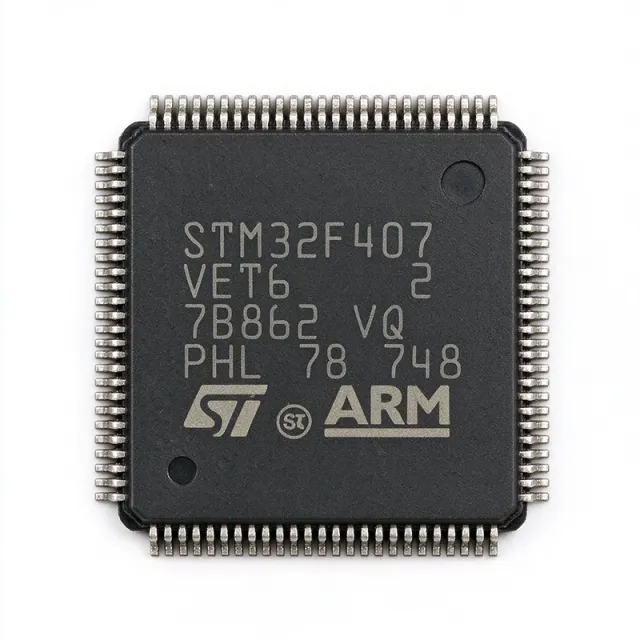
STM32F407VET6 - 168MHz Cortex-M4 MCU 512KB Flash LQFP-100 | ST
STM32F407VET6

STM32F407VET6 - 168MHz Cortex-M4 MCU 512KB Flash LQFP-100 | ST

The STMicroelectronics STM32F407VET6 is a high-performance ARM Cortex-M4 32-bit RISC microcontroller operating at up to 168 MHz with single-precision FPU and DSP instructions, integrating 512 KB on-chip program Flash and 192 KB SRAM in a 100-pin LQFP (14x14 mm) surface-mount package. What is a microcontroller? A microcontroller (MCU) is a single-chip integrated circuit that combines a processor core, non-volatile program memory (Flash), volatile working memory (SRAM), and programmable peripherals to govern specific operations in embedded systems. The STM32F407VET6 belongs to the STM32F4 series built on the ARM Cortex-M4 core with FPU, positioned within the broader hierarchy of 32-bit MCUs - microcontroller in the embedded semiconductor taxonomy used in supply chains. Key features include an on-chip 10/100 Ethernet MAC with IEEE 1588v2, USB 2.0 OTG Full-Speed and High-Speed with PHY, a digital camera interface (DCMI), three 12-bit ADCs with up to 24 channels and 2.4 MSPS, dual 12-bit DACs, an SDIO interface, FSMC for external memory, a crypto/hash peripheral, and a rich set of timers, USART, SPI, I2C, and CAN interfaces. The supply range is 1.8V to 3.6V with operation from -40C to +85C. Technically, the STM32F407VET6 uses a Harvard bus architecture with separate instruction and data buses enabling simultaneous fetch and access, an ART Accelerator with 128-bit Flash prefetch eliminating wait states from Flash, a memory protection unit (MPU), and a nested vectored interrupt controller (NVIC) supporting deterministic real-time behavior. The single-precision FPU accelerates math-intensive firmware for control loops and DSP. Typical applications include industrial motor control and PLCs, networked IoT gateways using the on-chip Ethernet MAC, USB device and host designs, and machine-vision or imaging systems using the DCMI camera interface. Design tip: decouple every VDD pin with 100 nF ceramics plus bulk capacitance, route VDDA/VSSA on a clean analog plane to minimize ADC noise, and place the HSE crystal as close as possible with proper guard rings for stable clocking. This page synthesizes distributor pricing, drop-in alternatives, and practical design considerations not found in the standalone manufacturer datasheet, including LQFP-100 same-footprint cross references and companion MPNs for reference designs.

USD $3,61 Auf Lager
STM32F407VET6TR - 168MHz Cortex-M4 MCU 512KB Flash LQFP-100 | ST (Tape & Reel)
STM32F407VET6TR

STM32F407VET6TR - 168MHz Cortex-M4 MCU 512KB Flash LQFP-100 | ST (Tape & Reel)

The STMicroelectronics STM32F407VET6TR is a high-performance ARM Cortex-M4 32-bit RISC microcontroller operating at up to 168 MHz with single-precision FPU and DSP instructions, integrating 512 KB on-chip program Flash and 192 KB SRAM in a 100-pin LQFP (14x14 mm) surface-mount package. What is a microcontroller? A microcontroller (MCU) is a single-chip integrated circuit that combines a processor core, non-volatile program memory (Flash), volatile working memory (SRAM), and programmable peripherals to govern specific operations in embedded systems. The STM32F407VET6TR belongs to the STM32F4 series built on the ARM Cortex-M4 core with FPU, positioned within the broader hierarchy of 32-bit MCUs - microcontroller in the embedded semiconductor taxonomy used in supply chains. Key features include an on-chip 10/100 Ethernet MAC with IEEE 1588v2, USB 2.0 OTG Full-Speed and High-Speed with PHY, a digital camera interface (DCMI), three 12-bit ADCs with up to 24 channels and 2.4 MSPS, dual 12-bit DACs, an SDIO interface, FSMC for external memory, a crypto/hash peripheral, and a rich set of timers, USART, SPI, I2C, and CAN interfaces. The supply range is 1.8V to 3.6V with operation from -40C to +85C. Technically, the STM32F407VET6TR uses a Harvard bus architecture with separate instruction and data buses enabling simultaneous fetch and access, an ART Accelerator with 128-bit Flash prefetch eliminating wait states from Flash, a memory protection unit (MPU), and a nested vectored interrupt controller (NVIC) supporting deterministic real-time behavior. The single-precision FPU accelerates math-intensive firmware for control loops and DSP. Typical applications include industrial motor control and PLCs, networked IoT gateways using the on-chip Ethernet MAC, USB device and host designs, and machine-vision or imaging systems using the DCMI camera interface. Design tip: decouple every VDD pin with 100 nF ceramics plus bulk capacitance, route VDDA/VSSA on a clean analog plane to minimize ADC noise, and place the HSE crystal as close as possible with proper guard rings for stable clocking. This page synthesizes distributor pricing, drop-in alternatives, and practical design considerations not found in the standalone manufacturer datasheet, including LQFP-100 same-footprint cross references and companion MPNs for reference designs.

USD $3,45 Auf Lager
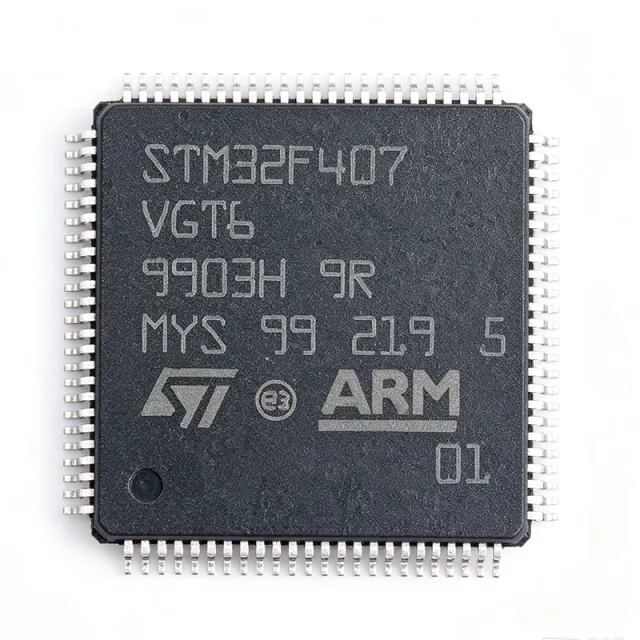
STM32F407VGT6 - 1MB Flash, 168MHz ARM Cortex-M4 MCU | STMicroelectronics
STM32F407VGT6

STM32F407VGT6 - 1MB Flash, 168MHz ARM Cortex-M4 MCU | STMicroelectronics

The STMicroelectronics STM32F407VGT6 is a high-performance 32-bit microcontroller with an ARM Cortex-M4F core running at up to 168 MHz, integrating 1 MB of Flash memory and 192 KB of SRAM (plus 4 KB backup SRAM), housed in a 100-pin LQFP (14x14 mm) package. It delivers 210 DMIPS with single-precision FPU and DSP instructions. What is a microcontroller? A microcontroller (MCU) is a compact integrated circuit that governs a specific operation in an embedded system, combining a processor core, memory, and programmable peripherals on a single chip. The STM32F407VGT6 belongs to the STM32F4 series within the broader STM32 family of ARM Cortex-M microcontrollers, positioned in the high-performance Cortex-M4 segment of the power/performance hierarchy below Cortex-M7 devices such as the STM32F7 and STM32H7. Key features include the ART Accelerator enabling 0-wait-state Flash execution, a memory protection unit (MPU), 3x 12-bit ADCs, 2x 12-bit DACs, 17 timers including two advanced motor-control timers, and a rich communication set: USART, SPI, I2C, CAN, USB OTG FS/HS, and an Ethernet MAC with IEEE 1588 support. A camera interface (DCMI) and true random number generator (RNG) round out the peripheral portfolio. Technically, the device operates from a 1.8V to 3.6V supply, with an internal 1.2V core regulator (VCAP bypass), 5V-tolerant I/O pins, and an internal 16 MHz RC oscillator plus external crystal support up to 26 MHz. It is specified from -40C to +85C (industrial grade) and is RoHS compliant. Typical applications include motor control using the advanced timers and ADCs, audio processing leveraging the FPU and DACs, and industrial automation using CAN and Ethernet. The camera interface also suits embedded vision nodes. Design tip: ensure adequate decoupling on all VDD pins, provide a clean analog supply for the ADCs, and place the 1.2V bypass capacitors close to the VCAP pins for regulator stability. This page synthesizes distributor pricing, drop-in alternatives including the GigaDevice GD32F407VGT6, and practical design notes not found in the ST datasheet, providing a comprehensive resource for engineers evaluating the STM32F407VGT6. Prices are as of 2026-09-06.

USD $7,55 Auf Lager
STM32F407VGT6TR - 1MB Flash, 168MHz ARM Cortex-M4 MCU | STMicroelectronics (Tape & Reel)
STM32F407VGT6TR

STM32F407VGT6TR - 1MB Flash, 168MHz ARM Cortex-M4 MCU | STMicroelectronics (Tape & Reel)

The STMicroelectronics STM32F407VGT6TR is a high-performance 32-bit microcontroller with an ARM Cortex-M4F core running at up to 168 MHz, integrating 1 MB of Flash memory and 192 KB of SRAM (plus 4 KB backup SRAM), housed in a 100-pin LQFP (14x14 mm) package. It delivers 210 DMIPS with single-precision FPU and DSP instructions. What is a microcontroller? A microcontroller (MCU) is a compact integrated circuit that governs a specific operation in an embedded system, combining a processor core, memory, and programmable peripherals on a single chip. The STM32F407VGT6TR belongs to the STM32F4 series within the broader STM32 family of ARM Cortex-M microcontrollers, positioned in the high-performance Cortex-M4 segment of the power/performance hierarchy below Cortex-M7 devices such as the STM32F7 and STM32H7. Key features include the ART Accelerator enabling 0-wait-state Flash execution, a memory protection unit (MPU), 3x 12-bit ADCs, 2x 12-bit DACs, 17 timers including two advanced motor-control timers, and a rich communication set: USART, SPI, I2C, CAN, USB OTG FS/HS, and an Ethernet MAC with IEEE 1588 support. A camera interface (DCMI) and true random number generator (RNG) round out the peripheral portfolio. Technically, the device operates from a 1.8V to 3.6V supply, with an internal 1.2V core regulator (VCAP bypass), 5V-tolerant I/O pins, and an internal 16 MHz RC oscillator plus external crystal support up to 26 MHz. It is specified from -40C to +85C (industrial grade) and is RoHS compliant. Typical applications include motor control using the advanced timers and ADCs, audio processing leveraging the FPU and DACs, and industrial automation using CAN and Ethernet. The camera interface also suits embedded vision nodes. Design tip: ensure adequate decoupling on all VDD pins, provide a clean analog supply for the ADCs, and place the 1.2V bypass capacitors close to the VCAP pins for regulator stability. This page synthesizes distributor pricing, drop-in alternatives including the GigaDevice GD32F407VGT6, and practical design notes not found in the ST datasheet, providing a comprehensive resource for engineers evaluating the STM32F407VGT6TR. Prices are as of 2026-09-06.

USD $7,55 Auf Lager
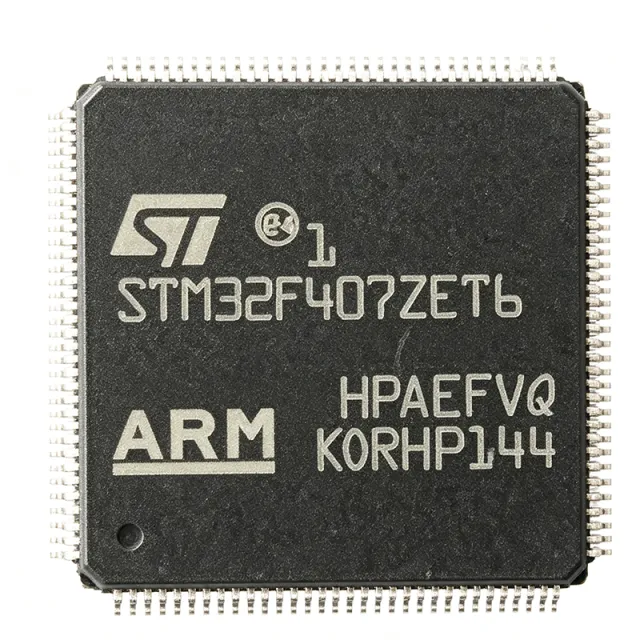
STM32F407ZET6 - 32-bit ARM Cortex-M4F MCU, 512KB Flash | STMicroelectronics
STM32F407ZET6

STM32F407ZET6 - 32-bit ARM Cortex-M4F MCU, 512KB Flash | STMicroelectronics

The STMicroelectronics STM32F407ZET6 is a high-performance 32-bit microcontroller based on the ARM Cortex-M4F core with floating-point unit (FPU), operating at up to 168 MHz. It integrates 512 KB of flash memory and 192 KB of SRAM, along with a rich set of peripherals including advanced connectivity, analog, and control interfaces. The device is housed in a 144-pin LQFP package (LQFP144, 20x20 mm) and is part of the STM32F4 series, designed for demanding embedded applications requiring high computational throughput and low power consumption. What is a microcontroller? A microcontroller (MCU) is a compact integrated circuit designed to govern a specific operation in an embedded system. It contains a processor core, memory (flash and SRAM), and programmable input/output peripherals on a single chip. Microcontrollers are the brains of countless electronic products, from automotive engine control units to industrial automation systems, consumer electronics, and IoT devices. The STM32F407ZET6 belongs to the STM32F4 family, which is part of the broader STM32 32-bit ARM Cortex-M microcontroller portfolio from STMicroelectronics, a leading semiconductor manufacturer. Key features of the STM32F407ZET6 include a 168 MHz ARM Cortex-M4F core with FPU and DSP instructions, 512 KB flash, 192 KB SRAM, and a comprehensive set of peripherals: 3x 12-bit ADCs, 2x DACs, 12x general-purpose 16-bit timers, 2x 32-bit timers, and a true random number generator (RNG). It also offers advanced connectivity with 2x CAN, 6x USART, 3x SPI, 3x I2C, 1x SDIO, 1x USB 2.0 OTG FS/HS, 1x Ethernet MAC, and a camera interface (DCMI). The device supports a wide supply voltage range of 1.8V to 3.6V and operates over a temperature range of -40°C to +85°C (or +105°C for the suffix 'I' variant). Technically, the STM32F407ZET6 leverages the ARM Cortex-M4F core with a single-precision FPU, enabling efficient handling of floating-point arithmetic for signal processing and control algorithms. The memory architecture includes a 64 KB CCM (Core Coupled Memory) RAM for time-critical data, and the flash supports read-while-write for firmware updates. The device features a sophisticated clock tree with a PLL capable of generating up to 168 MHz from an external 8 MHz crystal, and includes multiple low-power modes (Sleep, Stop, Standby) for energy-sensitive applications. Typical applications include industrial motor control, medical equipment, consumer electronics, IoT gateways, and audio processing. The combination of high clock speed, rich peripherals, and connectivity options makes it suitable for complex real-time control and data acquisition systems. For example, in a drone flight controller, the STM32F407ZET6 can handle sensor fusion, PID control loops, and communication with ground stations simultaneously. When designing with this device, ensure proper decoupling of the power supply pins with 100 nF capacitors placed close to each VDD pin, and a 4.7 uF bulk capacitor. The VDDA analog supply should be filtered with a ferrite bead and a 1 uF capacitor to minimize noise for ADC accuracy. Also, consider the thermal dissipation: the LQFP144 package has a thermal resistance of 40°C/W (theta_JA), so for high clock speeds and heavy peripheral usage, adequate PCB copper area is recommended.

USD $6,60 Auf Lager
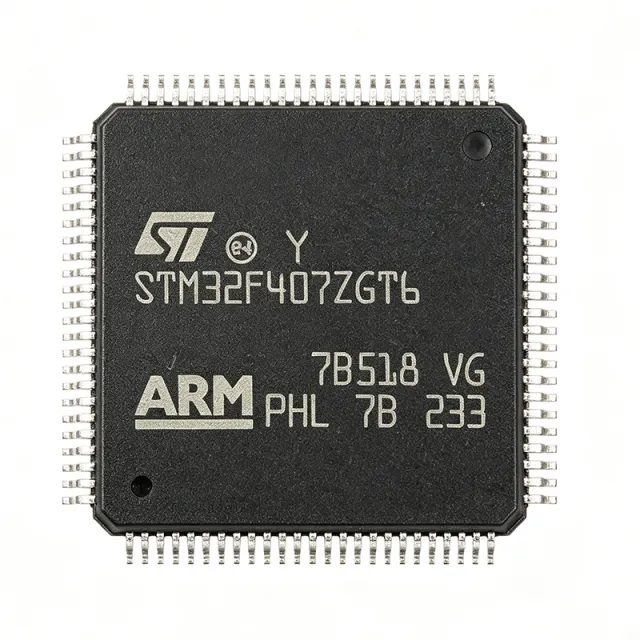
STM32F407ZGT6 - 168MHz Cortex-M4F MCU, 1MB Flash | STMicroelectronics
STM32F407ZGT6

STM32F407ZGT6 - 168MHz Cortex-M4F MCU, 1MB Flash | STMicroelectronics

The STMicroelectronics STM32F407ZGT6 is a high-performance 32-bit microcontroller with an ARM Cortex-M4F core with FPU running at 168 MHz, integrating 1 MB of Flash and 192 KB of SRAM (+4 KB backup SRAM), housed in a 144-pin LQFP (20x20 mm) package. A microcontroller (MCU) is a compact integrated circuit that governs a specific operation in an embedded system, combining a processor core, memory, and programmable peripherals on a single chip. Within the component hierarchy, the STM32F407ZGT6 belongs to the STM32F4 series of 32-bit ARM Cortex-M MCUs, part of the broader STM32 family and the wider ARM Cortex-M microcontroller ecosystem used as the central control unit in industrial and consumer electronics. Key features include 210 DMIPS of performance (1.25 DMIPS/MHz) with DSP instructions and single-precision FPU, 1 MB Flash with 0-wait-state execution via the ART Accelerator, 3x 12-bit ADCs with 24 channels, 2x 12-bit DACs, and 17 timers. Connectivity is extensive: up to 4 USARTs, 3 SPIs, 3 I2Cs, 2 CANs, USB OTG FS/HS, and an Ethernet MAC. Built on a 90 nm process, the device features the adaptive real-time accelerator (ART) for zero-wait-state Flash execution and a memory protection unit (MPU) for RTOS designs. The DCMI camera interface and true random number generator (RNG) support vision and security designs. Multiple low-power modes (Sleep, Stop, Standby) enable battery-powered operation, and VBAT operation keeps the RTC alive in the deepest sleep. Typical applications include motor control drives, industrial automation PLCs, medical instrumentation, audio processing, IoT gateways, and data acquisition systems. The 15+ communication interfaces make it ideal for multi-protocol nodes, and the high-speed ADCs suit real-time control loops. Design consideration: place 100 nF decoupling capacitors on every VDD/VSS pair and follow ST layout guidelines; budget GPIO carefully, as 144 pins still get consumed quickly by the Ethernet and USB OTG HS functions. This page synthesizes verified distributor data, drop-in alternatives, and practical design notes not found in the manufacturer datasheet.

USD $5,25 Auf Lager
STM32F407ZGT6TR - 168MHz Cortex-M4F MCU, 1MB Flash | STMicroelectronics (Tape & Reel)
STM32F407ZGT6TR

STM32F407ZGT6TR - 168MHz Cortex-M4F MCU, 1MB Flash | STMicroelectronics (Tape & Reel)

The STMicroelectronics STM32F407ZGT6TR is a high-performance 32-bit microcontroller with an ARM Cortex-M4F core with FPU running at 168 MHz, integrating 1 MB of Flash and 192 KB of SRAM (+4 KB backup SRAM), housed in a 144-pin LQFP (20x20 mm) package. A microcontroller (MCU) is a compact integrated circuit that governs a specific operation in an embedded system, combining a processor core, memory, and programmable peripherals on a single chip. Within the component hierarchy, the STM32F407ZGT6TR belongs to the STM32F4 series of 32-bit ARM Cortex-M MCUs, part of the broader STM32 family and the wider ARM Cortex-M microcontroller ecosystem used as the central control unit in industrial and consumer electronics. Key features include 210 DMIPS of performance (1.25 DMIPS/MHz) with DSP instructions and single-precision FPU, 1 MB Flash with 0-wait-state execution via the ART Accelerator, 3x 12-bit ADCs with 24 channels, 2x 12-bit DACs, and 17 timers. Connectivity is extensive: up to 4 USARTs, 3 SPIs, 3 I2Cs, 2 CANs, USB OTG FS/HS, and an Ethernet MAC. Built on a 90 nm process, the device features the adaptive real-time accelerator (ART) for zero-wait-state Flash execution and a memory protection unit (MPU) for RTOS designs. The DCMI camera interface and true random number generator (RNG) support vision and security designs. Multiple low-power modes (Sleep, Stop, Standby) enable battery-powered operation, and VBAT operation keeps the RTC alive in the deepest sleep. Typical applications include motor control drives, industrial automation PLCs, medical instrumentation, audio processing, IoT gateways, and data acquisition systems. The 15+ communication interfaces make it ideal for multi-protocol nodes, and the high-speed ADCs suit real-time control loops. Design consideration: place 100 nF decoupling capacitors on every VDD/VSS pair and follow ST layout guidelines; budget GPIO carefully, as 144 pins still get consumed quickly by the Ethernet and USB OTG HS functions. This page synthesizes verified distributor data, drop-in alternatives, and practical design notes not found in the manufacturer datasheet.

USD $5,25 Auf Lager
STM32F411CCU6 - 100MHz Cortex-M4 MCU 256KB Flash | STMicroelectronics
STM32F411CCU6

STM32F411CCU6 - 100MHz Cortex-M4 MCU 256KB Flash | STMicroelectronics

The STMicroelectronics STM32F411CCU6 is a 32-bit ARM Cortex-M4 microcontroller with FPU and DSP instructions, operating at up to 100 MHz and delivering 125 DMIPS / 273 CoreMark performance. It integrates 256 KB of Flash and 128 KB of SRAM in a 48-pin UFQFPN (7x7 mm) package, and operates from 1.7 V to 3.6 V. An MCU (microcontroller unit) is a single-chip computer that integrates a CPU core, program and data memory, peripherals, and I/O. The Cortex-M4 family adds a single-precision FPU and DSP extensions, making it suitable for signal-processing tasks such as audio codecs, motor control, and sensor fusion. Within ST's portfolio, the STM32F4 series sits in the high-performance tier above Cortex-M0/M3 devices and below the Cortex-M7 STM32F7/H7 lines. Key features of the STM32F411CCU6 include a 12-bit ADC (up to 2.4 MSPS in interleaved mode), USB 2.0 OTG full-speed with on-chip PHY, one SDIO/SDMMC interface, SPI/I2C/UART peripherals, a real-time clock, and 11 timers including motor-control PWM timers. The Dynamic Efficiency line (the "E"-suffix philosophy) provides batch acquisition for power savings and ART Accelerator (4 KB instruction cache + 4 KB data cache) for zero-wait-state Flash execution. Architecturally, the device uses ST's 90 nm embedded Flash process, integrates an 8 MHz factory-trimmed HSI and 32.768 kHz LSI for low-power modes, and supports Sleep, Stop, and Standby modes with RTC retention. DMA is provided via two 8-stream DMA controllers, and a 16-channel DMA matrix keeps peripheral servicing off the core. Typical applications include consumer electronics (wearable fitness bands, audio docks), USB peripherals (HID, CDC, mass-storage composites), small TFT display HMI boards, drone flight controllers, and low-cost motor-control BLDC boards. It also fits generic 32-bit replacements of 8-bit PIC/AVR designs needing USB or CAN-style connectivity. When designing with the STM32F411CCU6, ensure each VDD pin has its own 100 nF decoupling capacitor placed as close as possible to the IC; the UFQFPN exposed pad must be soldered to a continuous ground plane for thermal and electrical performance. Pin count (48) is the main constraint - designs needing more I/O should step up to STM32F411RE (64-pin) or STM32F411VE (100-pin). This page synthesizes distributor pricing, drop-in alternatives from the same STM32F4 family, and PCB layout notes that complement the official RM0383 reference manual and DS9826 datasheet, providing information not consolidated in any single source.

USD $2,96 Auf Lager
STM32F411CCU6TR - 100MHz Cortex-M4 MCU 256KB Flash | STMicroelectronics (Tape & Reel)
STM32F411CCU6TR

STM32F411CCU6TR - 100MHz Cortex-M4 MCU 256KB Flash | STMicroelectronics (Tape & Reel)

The STMicroelectronics STM32F411CCU6TR is a 32-bit ARM Cortex-M4 microcontroller with FPU and DSP instructions, operating at up to 100 MHz and delivering 125 DMIPS / 273 CoreMark performance. It integrates 256 KB of Flash and 128 KB of SRAM in a 48-pin UFQFPN (7x7 mm) package, and operates from 1.7 V to 3.6 V. An MCU (microcontroller unit) is a single-chip computer that integrates a CPU core, program and data memory, peripherals, and I/O. The Cortex-M4 family adds a single-precision FPU and DSP extensions, making it suitable for signal-processing tasks such as audio codecs, motor control, and sensor fusion. Within ST's portfolio, the STM32F4 series sits in the high-performance tier above Cortex-M0/M3 devices and below the Cortex-M7 STM32F7/H7 lines. Key features of the STM32F411CCU6TR include a 12-bit ADC (up to 2.4 MSPS in interleaved mode), USB 2.0 OTG full-speed with on-chip PHY, one SDIO/SDMMC interface, SPI/I2C/UART peripherals, a real-time clock, and 11 timers including motor-control PWM timers. The Dynamic Efficiency line (the "E"-suffix philosophy) provides batch acquisition for power savings and ART Accelerator (4 KB instruction cache + 4 KB data cache) for zero-wait-state Flash execution. Architecturally, the device uses ST's 90 nm embedded Flash process, integrates an 8 MHz factory-trimmed HSI and 32.768 kHz LSI for low-power modes, and supports Sleep, Stop, and Standby modes with RTC retention. DMA is provided via two 8-stream DMA controllers, and a 16-channel DMA matrix keeps peripheral servicing off the core. Typical applications include consumer electronics (wearable fitness bands, audio docks), USB peripherals (HID, CDC, mass-storage composites), small TFT display HMI boards, drone flight controllers, and low-cost motor-control BLDC boards. It also fits generic 32-bit replacements of 8-bit PIC/AVR designs needing USB or CAN-style connectivity. When designing with the STM32F411CCU6TR, ensure each VDD pin has its own 100 nF decoupling capacitor placed as close as possible to the IC; the UFQFPN exposed pad must be soldered to a continuous ground plane for thermal and electrical performance. Pin count (48) is the main constraint - designs needing more I/O should step up to STM32F411RE (64-pin) or STM32F411VE (100-pin). This page synthesizes distributor pricing, drop-in alternatives from the same STM32F4 family, and PCB layout notes that complement the official RM0383 reference manual and DS9826 datasheet, providing information not consolidated in any single source.

USD $2,96 Auf Lager
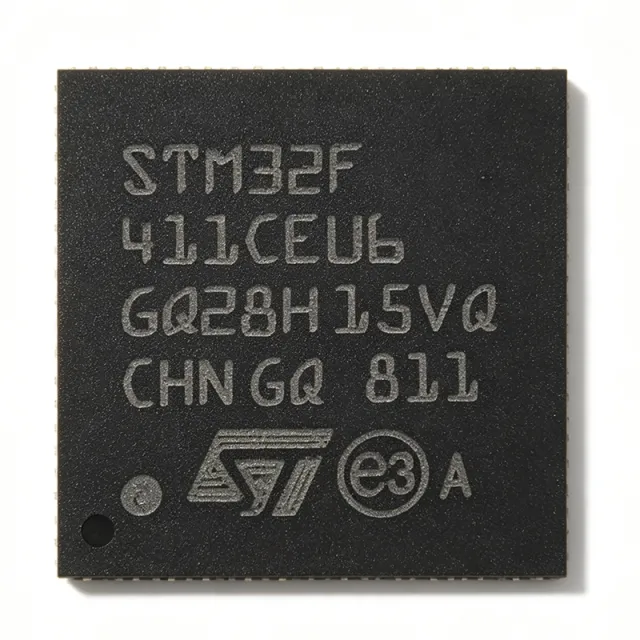
STM32F411CEU6 - 100MHz Cortex-M4F 512KB MCU | STMicroelectronics
STM32F411CEU6

STM32F411CEU6 - 100MHz Cortex-M4F 512KB MCU | STMicroelectronics

The STMicroelectronics STM32F411CEU6 is a 32-bit ARM Cortex-M4F microcontroller running at up to 100 MHz with 512 KB flash memory and 128 KB SRAM, housed in a 48-pin UFQFPN (7x7 mm) package. A microcontroller (MCU) is a compact integrated circuit that combines a processor core, memory, and programmable peripherals to govern a specific operation in an embedded system. MCUs sit within the broader hierarchy of ARM Cortex-M processors, flash microcontrollers, and power management/embedded control semiconductors. The STM32F411 belongs to the STM32F4 'Dynamic Efficiency' series from STMicroelectronics, part of the wider STM32 32-bit MCU family built on the ARM Cortex-M architecture. Key features include the Cortex-M4F core with single-precision FPU and DSP instructions delivering 125 DMIPS (1.25 DMIPS/MHz), 512 KB flash with 128 KB SRAM, a wide 1.7 V to 3.6 V supply range, and ST's Batch Acquisition Mode (BAM) for reduced power consumption during data conversion. Peripherals include USB OTG FS/HS, SDIO, I2S, multiple SPI/I2C/USART interfaces, 12-bit ADC, general-purpose timers, RTC, and a memory protection unit (MPU). Technically, the device is fabricated on ST's 90 nm process and features dynamic voltage scaling with multiple low-power modes (Sleep, Stop, Standby), enabling battery-powered designs with excellent performance-per-milliamp. The ART accelerator and 128-bit wide flash interface allow zero-wait-state execution at this clock speed tier. Typical applications include IoT end nodes, wearable electronics, motor control, audio processing, drones, and industrial automation, where the FPU and DSP instructions accelerate sensor fusion and control algorithms. Design-wise, decouple each VDD pin with 100 nF capacitors placed close to the pins, keep VDDA on a clean analog supply, and configure BOOT0 correctly for the desired boot source. This page synthesizes distributor pricing, drop-in alternatives, and practical design notes not found in the STMicroelectronics datasheet.

USD $3,48 Auf Lager
STM32F411CEU6TR - 100MHz Cortex-M4F 512KB MCU | STMicroelectronics (Tape & Reel)
STM32F411CEU6TR

STM32F411CEU6TR - 100MHz Cortex-M4F 512KB MCU | STMicroelectronics (Tape & Reel)

The STMicroelectronics STM32F411CEU6TR is a 32-bit ARM Cortex-M4F microcontroller running at up to 100 MHz with 512 KB flash memory and 128 KB SRAM, housed in a 48-pin UFQFPN (7x7 mm) package. A microcontroller (MCU) is a compact integrated circuit that combines a processor core, memory, and programmable peripherals to govern a specific operation in an embedded system. MCUs sit within the broader hierarchy of ARM Cortex-M processors, flash microcontrollers, and power management/embedded control semiconductors. The STM32F411 belongs to the STM32F4 'Dynamic Efficiency' series from STMicroelectronics, part of the wider STM32 32-bit MCU family built on the ARM Cortex-M architecture. Key features include the Cortex-M4F core with single-precision FPU and DSP instructions delivering 125 DMIPS (1.25 DMIPS/MHz), 512 KB flash with 128 KB SRAM, a wide 1.7 V to 3.6 V supply range, and ST's Batch Acquisition Mode (BAM) for reduced power consumption during data conversion. Peripherals include USB OTG FS/HS, SDIO, I2S, multiple SPI/I2C/USART interfaces, 12-bit ADC, general-purpose timers, RTC, and a memory protection unit (MPU). Technically, the device is fabricated on ST's 90 nm process and features dynamic voltage scaling with multiple low-power modes (Sleep, Stop, Standby), enabling battery-powered designs with excellent performance-per-milliamp. The ART accelerator and 128-bit wide flash interface allow zero-wait-state execution at this clock speed tier. Typical applications include IoT end nodes, wearable electronics, motor control, audio processing, drones, and industrial automation, where the FPU and DSP instructions accelerate sensor fusion and control algorithms. Design-wise, decouple each VDD pin with 100 nF capacitors placed close to the pins, keep VDDA on a clean analog supply, and configure BOOT0 correctly for the desired boot source. This page synthesizes distributor pricing, drop-in alternatives, and practical design notes not found in the STMicroelectronics datasheet.

USD $3,48 Auf Lager
STM32F411RET6 - 512KB Flash 100MHz Cortex-M4F MCU | STMicroelectronics
STM32F411RET6

STM32F411RET6 - 512KB Flash 100MHz Cortex-M4F MCU | STMicroelectronics

The STMicroelectronics STM32F411RET6 is a high-performance ARM Cortex-M4F based 32-bit microcontroller with floating-point unit (FPU) operating at up to 100 MHz, featuring 512 KB of flash memory and 128 KB of SRAM, housed in a 64-pin LQFP (LQFP64) package with a 10x10 mm body and 0.5 mm pitch. A microcontroller (MCU) is a compact integrated circuit that combines a processor core, memory, and programmable input/output peripherals on a single chip to govern a specific operation in an embedded system. The STM32F411RET6 belongs to the STM32F4 series within the broader STM32 family of 32-bit flash microcontrollers based on ARM Cortex-M cores, a family widely used across industrial, consumer, and IoT systems thanks to its balance of performance, power efficiency, and peripheral integration. Key features include the 100 MHz ARM Cortex-M4F core with single-cycle FPU and DSP instructions delivering 125 DMIPS, 512 KB flash, 128 KB SRAM, and a rich peripheral set: 3 USARTs, 5 SPIs, 3 I2Cs, 1 SDIO, 1 USB 2.0 OTG FS, 1 CAN, a 12-bit ADC with 16 channels, and multiple timers including advanced-control timers. A true random number generator (RNG), real-time clock (RTC), and CRC calculation unit are also integrated. The device is fabricated on ST's 90 nm process technology and operates from a 1.7V to 3.6V supply over an industrial temperature range of -40C to +85C. Several low-power modes (Sleep, Stop, Standby) support battery-operated designs, while the FPU accelerates DSP and control algorithms. The large embedded memory enables complex applications without external storage components. Typical applications include industrial control systems, motor drives, IoT gateways, consumer electronics, and USB/CAN-connected devices where the USB OTG FS and CAN interfaces provide native connectivity. When designing with this MCU, decouple each VDD pin with 100nF close to the pin, keep the VDDA supply clean for ADC accuracy, and exploit Stop/Standby modes with appropriate wake-up sources in power-sensitive designs. This page synthesizes distributor pricing, drop-in alternatives, pinout, and practical design notes not found in the manufacturer datasheet alone.

USD $4,02 Auf Lager
STM32F411RET6TR - 512KB Flash 100MHz Cortex-M4F MCU | STMicroelectronics (Tape & Reel)
STM32F411RET6TR

STM32F411RET6TR - 512KB Flash 100MHz Cortex-M4F MCU | STMicroelectronics (Tape & Reel)

The STMicroelectronics STM32F411RET6TR is a high-performance ARM Cortex-M4F based 32-bit microcontroller with floating-point unit (FPU) operating at up to 100 MHz, featuring 512 KB of flash memory and 128 KB of SRAM, housed in a 64-pin LQFP (LQFP64) package with a 10x10 mm body and 0.5 mm pitch. A microcontroller (MCU) is a compact integrated circuit that combines a processor core, memory, and programmable input/output peripherals on a single chip to govern a specific operation in an embedded system. The STM32F411RET6TR belongs to the STM32F4 series within the broader STM32 family of 32-bit flash microcontrollers based on ARM Cortex-M cores, a family widely used across industrial, consumer, and IoT systems thanks to its balance of performance, power efficiency, and peripheral integration. Key features include the 100 MHz ARM Cortex-M4F core with single-cycle FPU and DSP instructions delivering 125 DMIPS, 512 KB flash, 128 KB SRAM, and a rich peripheral set: 3 USARTs, 5 SPIs, 3 I2Cs, 1 SDIO, 1 USB 2.0 OTG FS, 1 CAN, a 12-bit ADC with 16 channels, and multiple timers including advanced-control timers. A true random number generator (RNG), real-time clock (RTC), and CRC calculation unit are also integrated. The device is fabricated on ST's 90 nm process technology and operates from a 1.7V to 3.6V supply over an industrial temperature range of -40C to +85C. Several low-power modes (Sleep, Stop, Standby) support battery-operated designs, while the FPU accelerates DSP and control algorithms. The large embedded memory enables complex applications without external storage components. Typical applications include industrial control systems, motor drives, IoT gateways, consumer electronics, and USB/CAN-connected devices where the USB OTG FS and CAN interfaces provide native connectivity. When designing with this MCU, decouple each VDD pin with 100nF close to the pin, keep the VDDA supply clean for ADC accuracy, and exploit Stop/Standby modes with appropriate wake-up sources in power-sensitive designs. This page synthesizes distributor pricing, drop-in alternatives, pinout, and practical design notes not found in the manufacturer datasheet alone.

USD $4,02 Auf Lager