Produkte (39.000+)

IPQ8072 - Quad-core Wi-Fi 6 SoC, 2.2GHz, Networking Pro 1200 | Qualcomm
IPQ8072

IPQ8072 - Quad-core Wi-Fi 6 SoC, 2.2GHz, Networking Pro 1200 | Qualcomm

The Qualcomm IPQ8072 is a quad-core 64-bit ARM Cortex-A53 networking system-on-chip (SoC) operating up to 2.2 GHz, integrated into Qualcomm's Networking Pro 1200 platform for premium Wi-Fi 6 (802.11ax) routers, gateways, and mesh systems. It supports up to 12 spatial streams across 2.4 GHz, 5 GHz, and 6 GHz bands when paired with QCN9074 or QCN9024 companion radios, delivers up to 5.4 Gbps aggregate PHY rate, and ships in a 772-ball FCBGA package. The die integrates a quad-core CPU subsystem, dual-band MAC/BB blocks, dedicated packet engine hardware, and security acceleration. A Wi-Fi 6 SoC is a system-on-chip that consolidates the application processor, Wi-Fi baseband/MAC, networking offloads, and crypto engines into a single die, replacing what was historically a CPU-plus-discrete-Wi-Fi-chipset architecture. Within the platform hierarchy, the IPQ8072 sits at the premium tier of Qualcomm's Networking Pro family, between the mid-range IPQ6018/IPQ6024 series and the Wi-Fi 7 flagship IPQ9574. It is intended for carrier-grade CPE, enterprise access points, and retail tri-band/quad-band routers that demand deterministic MU-MIMO and OFDMA scheduling. Key differentiating features include 12-stream 8x8 + 4x4 MU-MIMO with OFDMA, hardware-accelerated encryption (IPSec/L2TP/SSL/TLS) via dedicated engines, a quad-core A53 CPU at 2.2 GHz for control plane and SDK extensibility, support for up to 2.5 Gbps Ethernet (HSGMII/PSGMII), and integrated RF/PHY for simultaneous tri-band operation. The 14 nm process node and 772-ball FCBGA package enable compact router designs with reduced BOM. Architecturally, the IPQ8072 pairs a quad-core CPU cluster with hardware packet processing accelerators, offloading NAT, QoS, and crypto from the CPU to maintain wire-speed throughput. The integrated Wi-Fi subsystem supports 1024-QAM, MU-MIMO uplink/downlink, OFDMA, BSS coloring, target wake time (TWT), and dynamic frequency selection (DFS) for global regulatory compliance. The Networking Pro 1200 platform framing also brings platform-level features like Qualcomm's Wi-Fi SON (Self-Organizing Network) for mesh. Typical applications include Wi-Fi 6 tri-band/quad-band consumer routers, carrier-grade gateways, enterprise access points, mesh nodes, and small-business firewalls. The wide temperature range and carrier-grade SDK make it suitable for industrial deployments and outdoor CPE. When designing with IPQ8072, allocate at least 6 layers of PCB stack-up with continuous ground planes beneath the FCBGA, follow Qualcomm's reference thermal solution (heat spreader plus 1 oz copper pour), and validate PCIe/NSS pin assignments against the QSDK BSP for your chosen QCN radio companion. Use M.2 or mPCIe slots to attach QCN9074 5 GHz or 6 GHz radio cards. This page synthesizes distributor stock, package-level drop-in alternatives, and reference design considerations beyond the raw datasheet - including the IPQ8072A stepping upgrade and the sibling IPQ8074 (higher-end) / IPQ6018 (mid-range) alternatives.

Angebot Kontakt
IR4301MTRPBF - 160W Mono Class D Audio Amplifier | Infineon
IR4301MTRPBF

IR4301MTRPBF - 160W Mono Class D Audio Amplifier | Infineon

The Infineon IR4301MTRPBF is a 1-Channel (Mono) Class D integrated digital audio amplifier that delivers up to 160W into a 4 ohm load from a 22-pin PowerVQFN (5x6 mm) package. The part integrates a PWM controller, a high-voltage gate driver, and two low-RDS(on) MOSFETs into a single multichip module, and it accepts a fully differential or single-ended analog input with no DSP required. According to the Infineon IR4301M datasheet, the device achieves a typical output noise floor of 250 uVrms and operates from a split or single power supply. A Class D audio amplifier is a switching amplifier topology that drives the loudspeaker with pulse-width modulated square waves at hundreds of kHz, then low-passes them in the speaker itself. The IR43x1 family therefore belongs to the audio amplifier IC class of products, which itself sits inside the broader amplifier IC and integrated circuit hierarchy. Compared with classic linear (Class AB) amplifiers, Class D designs reach efficiencies above 90 percent, which lets the IR4301M deliver high peak music power without a mechanical heatsink in typical music playback use. Key features include integrated analog input with no MCU code required, high peak music power output, no mechanical heatsink requirement, split or single supply operation, and differential or single-ended input. Integrated protections cover over-current, over-temperature, and under-voltage conditions. The 5 mm by 6 mm PQFN22 footprint exposes the die to a thermal pad that conducts waste heat to the PCB copper, which is the primary cooling path in compact audio products. The IR4301M multichip module uses an optimized co-packed MOSFET pair driven by a dedicated controller, so the gate drive and dead time are matched to the output stage. High voltage ratings and noise immunity in the controller IC ensure reliable operation over a wide range of environmental conditions. The amplifier is specified for industrial temperature grade and supports both bridge-tied-load and single-ended output configurations through the same pinout. Typical applications include soundbars, subwoofers, mini-component stereo systems, portable Bluetooth speakers, and integrated active speaker modules. The device is also used in automotive aftermarket amplifiers and pro-sumer desktop audio. Designers choose this part when they need a small, thermally friendly mono Class D stage that can be driven directly from an analog audio source. When designing with the IR4301M, place the LC output filter components close to the device and provide a substantial copper pour on the exposed pad to dissipate the idle losses. The datasheet recommends a ferrite-core inductor around 10 to 22 uH and an X7R film or ceramic filter capacitor matched to the load impedance. This page synthesizes distributor pricing, drop-in alternatives, and practical design notes not found in the manufacturer datasheet alone. The IR43x1 family covers the IR4301M, IR4311M, and IR4321M, which differ mainly in output power and supply voltage rating.

Angebot Kontakt
IR4302MTRPBF - 2-Ch Class D 130W Stereo Amp | Infineon
IR4302MTRPBF

IR4302MTRPBF - 2-Ch Class D 130W Stereo Amp | Infineon

The Infineon IR4302MTRPBF is a 2-channel integrated analog-input Class D audio amplifier IC that combines a dual-channel PWM controller, a high-voltage gate driver, and four low-RDS(on) digital audio MOSFETs in a single 44-pin PQFN (7x7 mm) package. According to manufacturer datasheet, it delivers up to 130 W peak music output per channel into 4 ohm loads, operates from a split or single ±21 V (or single 10 V to 42 V) supply, and provides differential or single-ended analog inputs. Differential analog noise floor is specified at 250 uVrms, and the part integrates standard Class D protections including over-current, over-temperature, and under-voltage lockout. A Class D audio amplifier is a switching-mode power amplifier that uses pulse-width modulation (PWM) at hundreds of kHz to drive the output stage, achieving efficiencies typically above 90% - compared with 50-65% for Class AB designs - by ensuring the output transistors are either fully on or fully off. This topology minimizes quiescent dissipation, eliminates the need for large mechanical heatsinks, and allows much smaller form-factor designs. The IR4302MTRPBF exemplifies the integrated Class D trend: rather than discrete controller + MOSFET half-bridges, the silicon and the power stage are co-packaged and co-optimized, which reduces parasitic loop inductance, EMI, and PCB layout effort. Key features that distinguish this part include: no mechanical heatsink required for typical music playback, selectable single or split supply operation, differential or single-ended analog inputs, integrated protection features (over-current, over-temperature, under-voltage), small 7x7 mm PQFN-44 footprint, and high peak music power output versus its physical size. The IR4302 family shares the same PQFN-44 package across its variants (IR4302 and IR4312), simplifying PCB reuse. Typical applications include consumer home-theater receivers, soundbars, powered desktop speakers, musical instrument amplifiers, automotive head-unit subwoofer channels, and multichannel AVR systems. In each case the device's high efficiency, small PCB footprint, and integrated protection reduce total BOM and thermal-management complexity versus discrete Class D solutions. Design consideration: layout the output LC filter with low-ESR ferrite or powdered-iron inductors and film or ceramic capacitors placed close to the amplifier outputs, and keep the analog input ground return separated from the high-current power ground until they join at the bulk-decoupling capacitor. Use an RC snubber across the output to reduce EMI if required by the standard in your region (e.g., FCC Part 15, EN55032). This page synthesizes distributor pricing, drop-in alternatives, and practical design notes not found in the manufacturer datasheet.

Angebot Kontakt
IRS20124C Audio Digital Driver IC | Infineon
IRS20124C

IRS20124C Audio Digital Driver IC | Infineon

Infineon Technologies IRS20124C is an integrated-circuit audio digital driver described by the verified distributor data as “IC AUDIO DVR DGTL HI/LO DIE.” The device is listed by DigiKey as an audio channel device and is positioned for digital audio signal-driving applications. Its verified package, channel count, electrical ratings, timing characteristics, thermal limits, and exact pin assignments are not included in the supplied records, so those details remain identified as data-needed rather than inferred. An audio digital driver is a signal-path integrated circuit, or interface IC, that converts or conditions digital-audio signals for connection to downstream audio circuitry. In the broader hierarchy, it belongs to digital signal conditioning, then interface ICs, then semiconductor components. Compared with a passive line driver, an integrated audio driver can consolidate multiple digital channels and associated protection or interface functions, but its exact implementation must be confirmed from the manufacturer datasheet. The verified data specifically identifies the IRS20124C as an audio special-purpose device with high-side and low-side digital drive circuitry. This description suggests that the part is intended to provide controlled digital output behavior rather than serving as an analog audio amplifier. The distributor wording also references “die,” but it does not disclose die dimensions, process technology, clocking requirements, or isolation details. Potential uses include digital audio links, audio equipment, powered speaker or headphone systems, and other systems requiring a dedicated audio digital-drive interface. The correct application cannot be finalized without the electrical limits, package drawing, logic thresholds, timing, and pinout. Engineers should compare those verified values against the target system before selecting the part. When integrating the IRS20124C, verify supply voltage, input and output logic levels, propagation delay, channel configuration, and exposed-pad requirements in the manufacturer documentation. Do not assume SOIC, QFN, leadless, or other package options solely from the suffix. Distributor ECAD records can contain multiple package interpretations, making the exact manufacturer part document controlling. This page consolidates distributor classification, sourcing links, and the precise limitations of the available records. It deliberately avoids invented electrical specifications, package assumptions, pricing, pin assignments, or replacement claims while identifying what must be obtained before design release.

Angebot Kontakt
IRS20124CD - 200V Digital Audio Driver | Infineon
IRS20124CD

IRS20124CD - 200V Digital Audio Driver | Infineon

Infineon Technologies IRS20124CD is a digital audio driver IC designed for Class D amplifier output stages, with verified source information identifying a 200 V high-voltage rating and support for programmable dead-time generation. It is associated with the IRS20124S family, whose manufacturer description identifies integrated dead-time generation and bidirectional over-current sensing for simplified output-stage design. The device is intended to drive discrete power transistors rather than directly delivering loudspeaker current, making external MOSFET or IGBT selection an important part of amplifier design. A digital audio driver is a gate-drive IC used between a Class D controller and the power switching transistors in an audio amplifier. It translates control signals into high-voltage gate drive, manages timing between complementary switching devices, and can provide protection functions. This places the IRS20124CD in the broader power-management and audio-amplifier hierarchy: Class D amplifier controller, digital audio driver, discrete power stage, loudspeaker output. The verified family information highlights programmable dead-time through the DT/SD pin, allowing external resistor-based timing adjustment with only two external resistors. Proper dead-time prevents simultaneous conduction in the complementary output devices, while bidirectional over-current sensing helps the amplifier react to abnormal output-stage conditions. These features are central to designing a robust discrete switching stage rather than relying on uncontrolled gate timing. The IRS20124CD is associated with up to 1000 W output-power capability in Class D audio applications according to the supplied IRS20124S family source snippet. The exact electrical ratings, thermal limits, package dimensions, and pin assignments for the CD suffix were not present in the verified data, so those values must be confirmed against the Infineon manufacturer datasheet before layout or production use. The family is particularly relevant to powered speakers, subwoofers, PA systems, and automotive or industrial audio equipment where a discrete MOSFET output stage is preferred. Designers should treat the IRS20124CD as a high-voltage gate driver, not as a complete audio amplifier. External switching transistors, DC-link voltage, current sensing, dead-time components, gate resistors, heat sinking, and output filtering must be designed together. The family’s programmable dead-time and bidirectional current sensing reduce control complexity, but exact component values and protection thresholds require the manufacturer datasheet. This page distinguishes verified family-level information from CD-suffix-specific data that is unavailable in the supplied results. It also emphasizes practical selection criteria, including package confirmation, voltage rating, gate-drive compatibility, current limits, thermal performance, and amplifier topology before treating any substitute as a true drop-in replacement.

Angebot Kontakt
IRS2052MTRPBF - 2-Ch 200V Class D Audio Driver | Infineon
IRS2052MTRPBF

IRS2052MTRPBF - 2-Ch 200V Class D Audio Driver | Infineon

The Infineon IRS2052MTRPBF is a 2-channel (stereo) high-voltage Class D audio amplifier driver IC integrating dual PWM modulators, gate drivers, and comprehensive protection features in a 48-pin MLPQ (7x7 mm) package. It supports an analog audio input and drives external complementary power MOSFETs in a half-bridge or full-bridge output stage, delivering high-efficiency amplification suitable for subwoofer, two-channel, and bridge-tied load (BTL) Class D topologies. A Class D audio amplifier is a switching amplifier topology that uses pulse-width modulation (PWM) to drive the output stage fully on or fully off, dramatically reducing power dissipation compared to a linear (Class A/B) amplifier. The IRS2052M occupies the 'controller + gate driver' layer of the audio amplifier hierarchy (Class D controller -> audio amplifier -> amplifier IC -> signal chain IC -> semiconductor), making it the brain and gate-drive interface between the analog audio front end and the high-current MOSFET output stage. Key features include a 200 V high-voltage rating (suitable for ±100 V rails), programmable dead-time, integrated over-current and over-temperature protection, clipping detection output for dynamic speaker management, and a versatile shutdown control that supports latched, non-latched, or host-controlled modes. The IRS2052M operates from a logic supply and a high-voltage bootstrap supply, enabling self-powered gate drive for the high-side MOSFETs of each half-bridge. The device integrates proprietary PWM modulation with adjustable switching frequency (typically 400 kHz to 800 kHz range) to balance audio band noise rejection against switching losses. An external thermal sensor input allows system-level thermal monitoring beyond the on-chip thermal shutdown, critical in space-constrained multi-channel amplifiers and automotive audio systems. Typical applications include powered subwoofers, home theater receivers, automotive head units and external amplifiers, professional powered speakers, and marine/PA systems. Its 200 V rating enables high-power designs (several hundred watts per channel) with appropriate output MOSFET selection and output filter design. When designing with the IRS2052M, prioritize gate-drive loop layout to minimize parasitic inductance on the high-current path, and carefully select bootstrap capacitor values based on switching frequency and high-side MOSFET gate charge. Always pair the IRS2052M with logic-level or standard-threshold MOSFETs whose total gate charge supports the programmed switching frequency without exceeding the IC's drive capability. This page synthesizes distributor pricing, drop-in alternatives, and practical design notes not found in the manufacturer datasheet alone.

Angebot Kontakt
IRS2053MPBF - 3-Channel 6.2W Class-D Amplifier | Infineon
IRS2053MPBF

IRS2053MPBF - 3-Channel 6.2W Class-D Amplifier | Infineon

The Infineon Technologies IRS2053MPBF is a three-channel Class-D digital audio power amplifier rated for a 10 V to 15 V supply and 6.2 W output power, housed in a 48-pin MLPQ package measuring 7 mm by 7 mm. It integrates the modulator, power-stage, and protection functions needed to drive three audio channels efficiently. Programmable bidirectional current sensing protects the high-side and low-side MOSFETs from overcurrent conditions. Its surface-mount MLPQ construction supports compact Class-D audio systems where reduced board area and efficient power conversion are important. A Class-D audio amplifier is a switching power amplifier that uses pulse-width modulation to represent an audio waveform. Unlike a linear audio amplifier, it spends less time between the positive and negative supply rails, improving power-conversion efficiency and reducing heat in many listening-power applications. The IRS2053MPBF sits within the hierarchy of audio amplifiers, power amplifiers, switching amplifiers, and power-management semiconductors. The verified product information identifies three amplification channels, Class-D operation, a 6.2 W output-power rating, and a 10 V to 15 V supply-voltage range. Its integrated current-sensing function is a key protection feature for the output power stage. The small MLPQ48 package is specifically associated with the smaller physical footprint made possible by Class-D topology, although exact output power per channel, efficiency, modulation frequency, thermal resistance, and load limits require confirmation from the manufacturer datasheet. Typical uses include compact powered speakers, multimedia speaker systems, consumer audio equipment, and other multi-channel sound systems powered from a 10 V to 15 V source. A three-channel device is useful when one board must drive multiple speakers or separate audio zones. System designers should account for supply headroom, speaker impedance, filtering, amplifier stability, PCB thermal performance, and the protection requirements of each output stage. For layout, the exposed thermal and electrical features of the MLPQ package require careful copper and via treatment according to the manufacturer recommendations. The audio output filter should be selected for the switching characteristics and load, while input and supply routing should be kept compact. Because verified thermal, frequency, protection-delay, and electrical-limit details are unavailable in the supplied excerpts, those values must be checked against the complete manufacturer datasheet before release to production. This page consolidates the verified distributor and datasheet-index information, separates confirmed specifications from missing technical data, and provides practical guidance for evaluating this amplifier. It does not infer substitute pinouts or claim drop-in compatibility without manufacturer or web evidence.

Angebot Kontakt
IRS2053MTRPBF 3-Ch 10-15V 6.2W Class D Driver | Infineon
IRS2053MTRPBF

IRS2053MTRPBF 3-Ch 10-15V 6.2W Class D Driver | Infineon

The Infineon IRS2053MTRPBF is a three-channel, high-performance Class D audio amplifier driver with integrated PWM modulators and protection, designed for a 10 V to 15 V supply and a 48-pin MLPQ (7 x 7 mm) package. The verified data identifies it as a 3-channel device associated with 6.2 W output and 60 dB gain, making it suitable for external-MOSFET automotive audio power stages. Its 0.50 mm package pitch supports compact layouts, while its -40 °C to 125 °C operating range addresses harsh automotive environments. The device is RoHS compliant according to the provided source. A Class D audio driver is a controller or gate-drive device that uses pulse-width modulation to drive external power MOSFETs in an audio half-bridge or full-bridge output stage. Unlike a conventional linear audio amplifier, the switching output stage can deliver audio with lower power dissipation than a comparable linear stage, although EMI filtering and careful layout remain important. The IRS2053 integrates three channels so a complete three-channel amplifier can be formed with external MOSFETs and passive components. Key verified features include three audio channels, a 10 V to 15 V supply range, 6.2 W output capability in the cited series description, 60 dB gain, a 48-MLPQ package measuring 7 x 7 mm, and 0.50 mm pitch. The package also has an exposed pad according to the supplied product-page description. The -40 °C to 125 °C temperature range supports automotive and industrial audio systems, while RoHS compliance supports regulated manufacturing and product-environment requirements. The IRS2053 uses floating analog inputs and a protection-control interface intended for external MOSFET half-bridge stages. In implementation, the three PWM outputs drive external power devices, while input conditioning, gate resistors, supply decoupling, output filtering, and protection components complete the power stage. Exact output power, modulation details, pin names, current limits, and timing values were not included in the provided verified data and must be confirmed in the manufacturer datasheet before layout or production use. Typical applications include automotive head units, three-channel infotainment systems, seat or console audio, and compact external Class D power modules. A three-channel arrangement can support front left, front right, and a center, subwoofer, or rear channel, depending on the amplifier architecture. The 10 V to 15 V supply range is suitable for automotive battery-derived rails after suitable regulation and filtering, but the exact automotive transient and operating requirements are not provided here. Designers should follow the manufacturer datasheet for exposed-pad thermal design, input filtering, power-supply decoupling, MOSFET selection, gate-loop layout, EMI control, and protection configuration. Because the provided data does not include complete pin-level definitions or verified electrical limits, no pin-level substitute should be assumed merely because it uses a nominally similar package.

Angebot Kontakt
IRS2092PBF - 500W Protected Class D Driver | Infineon
IRS2092PBF

IRS2092PBF - 500W Protected Class D Driver | Infineon

The Infineon Technologies IRS2092PBF is a protected, high-voltage, mono Class D audio amplifier driver with an integrated PWM modulator, operating from a 10 V to 18 V supply and supporting a 500 W audio power stage. It is packaged in a 16-lead PDIP package and requires two external MOSFETs plus a few external components to realize a complete protected Class D power amplifier. A Class D audio amplifier driver is a controller for a switching audio power stage. It accepts an analog audio signal, generates the required PWM drive signals, and controls external power transistors that deliver current efficiently to a loudspeaker. Within the power-management and audio hierarchy, the IRS2092 sits between the audio source and discrete output MOSFETs rather than directly driving a speaker. Key features include a high-voltage, high-performance Class D architecture, integrated PWM modulation, floating inputs for straightforward half-bridge implementation, and programmable bidirectional over-current protection. The 16-lead PDIP package supports through-hole assembly. The verified distributor listing identifies the device as a one-channel mono Class D amplifier IC and describes its operating supply as 10 V to 18 V. The device is intended for high-power audio systems where external power MOSFETs provide the speaker current. Its modulator determines the switching command delivered to those devices, while the protection function helps prevent excessive current during abnormal output conditions. The exact output-power conditions, switching frequency, propagation delay, quiescent current, and thermal limits were not supplied in the retrieved data and should be confirmed from the manufacturer datasheet before final design release. Typical uses include mono subwoofer amplifiers, professional audio power stages, high-current speaker drivers, and compact Class D amplifier modules. The architecture is particularly relevant where a bridge-tied half-bridge output is desired and where two external MOSFETs are acceptable. Designers should treat MOSFET selection, gate-loop layout, heat-sink sizing, dead time, output filtering, and protection thresholds as system-level engineering tasks. The driver IC does not eliminate the need for a correctly rated power stage, and its published 500 W capability is not an all-load guarantee. This page combines verified distributor specifications, datasheet links, replacement-screening constraints, and practical implementation guidance. It distinguishes confirmed IRS2092PBF facts from parameters that remain unavailable in the supplied source set.

Angebot Kontakt
IRS2092SPBF - Protected 100V Class-D Driver | Infineon
IRS2092SPBF

IRS2092SPBF - Protected 100V Class-D Driver | Infineon

The Infineon Technologies IRS2092SPBF is a protected, high-voltage, mono Class-D audio amplifier driver rated for a 100 V maximum supply and 500 ns gate-drive timing, integrated with an 800 kHz PWM modulator and protection functions. It is packaged in a narrow 16-lead SOIC. The device works with two external power MOSFETs and a small number of passive components to implement a complete protected Class-D audio power stage. A Class-D audio amplifier driver is a specialized gate-drive IC that converts an analog audio input into high-frequency PWM signals for external half-bridge MOSFETs. The IRS2092SPBF belongs to the audio-amplifier-driver hierarchy, combining modulator, gate-driver, and protection functions in one controller. Unlike a finished audio output amplifier, it requires external power transistors, gate resistors, passive networks, and an appropriate output filter. The verified product information identifies the device as a mono, analog-input Class-D amplifier with digital audio amplification behavior. Its stated 100 V voltage class, 500 ns timing value, and 800 kHz associated switching specification are useful for evaluating gate-drive bandwidth and system architecture. The integrated protection is intended to improve robustness in external-MOSFET audio power stages, although exact protection thresholds and conditions must be confirmed from the manufacturer datasheet. Typical uses include compact stereo or multichannel audio systems, powered speakers, automotive audio infrastructure, home-theater equipment, and industrial audio products. The device is most appropriate when the designer wants controller-level flexibility with discrete MOSFET selection rather than a fixed integrated power amplifier. The 16-SOIC package also makes it compatible with conventional surface-mount PCB assembly processes. A critical design consideration is that controller ratings do not determine the final speaker power. Output power depends on external MOSFET selection, supply voltage, modulation strategy, output filter, transformer or speaker impedance, and thermal design. Use the manufacturer datasheet and application circuits for gate-drive timing, dead-time behavior, fault handling, bootstrap or high-side supply requirements, and PCB layout. This product record consolidates the verified manufacturer and distributor descriptions with practical application guidance and explicitly identifies parameters that require confirmation before layout or production release.

Angebot Kontakt
IRS2092STRPBF - 200V Mono Class D Audio Driver | Infineon
IRS2092STRPBF

IRS2092STRPBF - 200V Mono Class D Audio Driver | Infineon

Infineon Technologies IRS2092STRPBF is a high-voltage, high-performance mono Class D audio amplifier driver with an integrated PWM modulator and protection functions. It operates from a 200 V supply according to the Mouser product listing, uses an integrated analog input, and drives external MOSFETs to form a complete audio power stage. The device is packaged in a narrow 16-lead SOIC. Its architecture supports floating inputs for convenient half-bridge implementation, programmable bidirectional over-current protection with self-reset, and programmable preset deadtime. These characteristics position the IRS2092STRPBF as a gate-driver-class audio IC rather than a conventional line-output amplifier: it accepts a low-level audio signal and controls the switching of external power MOSFETs that deliver energy to a loudspeaker. The external MOSFET selection remains central to output power, switching loss, and thermal performance. Use the manufacturer datasheet for the complete electrical limits, truth tables, timing characteristics, protection behavior, pin descriptions, and recommended application circuit. The supplied search results also identify the device as a 16-SOIC, single-channel Class D amplifier driver and describe the IRS2092 family as intended for high-voltage audio systems. In a typical implementation, the IRS2092STRPBF drives a self-oscillating or externally controlled half-bridge stage, while protection logic helps contain overload conditions. Board layout, gate-loop layout, and the high-voltage power stage deserve careful review because the driver interfaces directly with fast-switching external MOSFETs.

Angebot Kontakt
IRS20954SPBF - Class D Audio Driver, 2-Ch, 16-SOIC | Infineon
IRS20954SPBF

IRS20954SPBF - Class D Audio Driver, 2-Ch, 16-SOIC | Infineon

The Infineon IRS20954SPBF is a 2-channel protected digital audio driver designed for Class D audio amplifier applications, housed in a 16-pin SOIC package with surface-mount mounting. The device combines high-voltage gate-drive capability with integrated analog protection features, targeting single-ended or bridge-tied-load (BTL) Class D output stages in consumer and prosumer audio equipment. The PBF suffix indicates lead-free (Pb-free) terminal finish per RoHS requirements. A Class D audio driver is a specialized gate-driver / controller that translates low-level PWM or analog audio inputs into the high-current, high-voltage switching signals required by the output MOSFETs in a Class D amplifier. The IRS20954 belongs to the audio-special-purpose IC family, sitting hierarchically between a DSP/modulator front-end and a discrete power-MOSFET output stage, and is itself a member of the broader switch-mode power semiconductor driver category. Key features include a floating PWM input that enables easy half-bridge implementation, integrated programmable bi-directional over-current protection with a self-reset function, programmable compensated preset dead-time for improved THD performance, and high noise immunity. The 2-channel architecture supports stereo BTL or single-ended mono output configurations, and the integrated protection block reduces external component count compared to discrete gate-driver + comparator solutions. The IRS20954 uses a high-side/low-side gate-driver topology with internal level shifting, allowing direct interface to a PWM modulator or analog front-end. The bidirectional OC protection monitors load current through the low-side FET R_DS(on) without an external shunt resistor, simplifying layout and reducing conduction loss. Preset dead-time is trimmed at the factory to optimize shoot-through immunity versus THD at the switching node. Typical applications include home theater receivers, powered subwoofers, multimedia speakers, automotive head-unit amplifiers, and pro-sound active loudspeakers. The 16-SOIC footprint is footprint-compatible with the related IRS20955 and IRS20957 family members, allowing PCB reuse across product variants. When designing with this part, observe the absolute maximum ratings on VCC and bootstrap voltages, and follow the application note for output-stage MOSFET selection to ensure OC trip thresholds remain within the safe operating area under all load conditions.

Angebot Kontakt
IRS20954STRPBF - 2-Channel Protected Audio Driver | Infineon
IRS20954STRPBF

IRS20954STRPBF - 2-Channel Protected Audio Driver | Infineon

The Infineon Technologies IRS20954STRPBF is a 2-channel protected digital audio line driver in a 16-pin SOIC package. It accepts floating PWM inputs for straightforward half-bridge implementation and incorporates programmable, bidirectional over-current protection with a self-reset function. The device also provides programmable compensated preset dead time to improve total harmonic distortion, making it suited to class-D audio output stages and other protected PWM power-stage drivers. A digital audio driver is an interface and protection IC positioned between a PWM controller or digital signal processor and a power-converter stage. Within the signal chain, this category combines logic-level command processing with protection and gate-drive support. The resulting device belongs to the broader power-management IC hierarchy while providing the timing and fault-handling functions needed to operate external half-bridge power switches safely. The principal verified features include two-channel operation, floating PWM inputs, programmable bidirectional over-current protection, automatic self-reset after a protected fault, and compensated preset dead time. Compensation of the preset dead time can reduce distortion introduced when the bridge switches between its output states. The self-reset behavior also allows the driver to recover without requiring an external system reset after the protected condition has cleared. Because the IRS20954STRPBF is a driver rather than the audio output power stage itself, its operation depends on appropriately rated external switching devices. Its protected digital-drive architecture supports the implementation of half-bridge arrangements commonly used in audio amplification. Detailed electrical limits, propagation delays, drive-current capability, thermal ratings, and recommended external components must be confirmed in the manufacturer datasheet before layout or production use. Typical uses include digitally controlled class-D audio amplifiers, speaker-drive power stages, compact consumer-audio systems, and industrial amplification equipment where fault recovery and controlled switching transitions are important. The floating PWM input arrangement can simplify use with systems that drive each channel using complementary or single-ended PWM information. The appropriate external MOSFETs and passive network remain application-specific. The primary design consideration is MOSFET selection. The external devices must satisfy the application voltage, current, switching-loss, and thermal requirements, while their gate characteristics must remain compatible with the driver. PCB layout should minimize gate-loop inductance and keep switching-node copper compact. Protection settings, dead-time programming, and fault-response behavior must also be checked against the intended speaker impedance and amplifier architecture. This page consolidates verified distributor availability, exact catalog identifiers, the documented feature set, and engineering-focused application guidance. It distinguishes confirmed data from parameters that still require the official datasheet, providing a useful starting point for sourcing and design review without assigning unsupported electrical values.

Angebot Kontakt
IRS20955STRPBF - 2-Channel Audio Line Driver | Infineon
IRS20955STRPBF

IRS20955STRPBF - 2-Channel Audio Line Driver | Infineon

Infineon Technologies IRS20955STRPBF is a two-channel audio line driver and peripheral driver IC designed for Class D audio power-amplifier applications. The device supports a supply voltage described as 12 V in the verified technical listing, operates from -40 C to +125 C, and is packaged in a 16-pin SOIC-16 package using the MS-012AC outline. Its verified feature set includes a floating PWM input for straightforward half-bridge implementation, programmable bidirectional over-current protection with self-reset, and programmable preset behavior. The IRS20955 family is identified as a 120 W x 2-channel Class D audio power-amplifier driver, while an alternative manufacturer listing describes the IRS20955STRPBF as a 100 V, 1.2 A, two-output high-side/low-side half-bridge driver. The device is therefore positioned between low-power control logic and the output stage of a robust audio amplifier. Its 16-pin surface-mount construction supports compact audio products while retaining the thermal and assembly characteristics expected of an SOIC package. Infineon’s IRS20955 family also appears in the verified cross-reference data as closely related to IRS20953, IRS20956, and IRS20957, with application-dependent distinctions. Because exact pin-level compatibility, electrical limits, pricing, and some package details were not supplied for every candidate or parameter in the retrieved data, those items are marked for engineering verification rather than inferred. This page combines verified distributor descriptions, datasheet references, and practical design guidance for engineers evaluating IRS20955STRPBF in audio amplifier designs.

Angebot Kontakt
IRS20965STRPBF - 500W Mono Class D Driver | Infineon
IRS20965STRPBF

IRS20965STRPBF - 500W Mono Class D Driver | Infineon

The Infineon Technologies IRS20965STRPBF is a high-voltage, high-speed MOSFET driver for mono Class D audio amplifier applications, rated by the manufacturer for operation up to 500 W output power in a 16-pin SOIC package. The device provides high-side and low-side floating PWM inputs, programmable bidirectional over-current detection with self-reset, an over-current sensing output, and shoot-through prevention logic. Its operating supply range is listed as 10 V to 15 V, and its high-voltage and high-speed architecture positions it for demanding audio power-stage designs. A Class D audio driver is a gate-drive controller used between a PWM command signal and the power MOSFETs of an audio output stage. The IRS20965STRPBF belongs to the MOSFET-driver hierarchy, where a MOSFET driver controls power transistors rather than directly delivering audio output to a speaker. By supporting independently floating high-side and low-side PWM inputs, the driver can operate the two output transistors from a single low-voltage control domain while the power stage switches a substantially higher bus voltage. The verified manufacturer features include bidirectional over-current protection, self-reset behavior, a dedicated over-current sensing output, and shoot-through prevention. These functions are particularly relevant to speaker systems in which abnormal DC, load mismatch, or transistor faults can increase power-device stress. Bidirectional current sensing also allows detection conditions to be evaluated in both switching directions, while the self-reset function can return the protection circuit toward its normal operating state after the monitored fault condition is removed. The device is a 16-pin SOIC and supports high-side and low-side floating PWM inputs. This integration allows a compact Class D amplifier controller to be placed near the output MOSFETs while separating the high-voltage switching environment from the low-voltage command circuitry. Independent floating inputs can also support timing adjustments, but board-level propagation delays and mismatched gate-drive paths should be reviewed before a design is released for production. Typical uses include mono Class D speaker amplifiers, high-power consumer-audio systems, professional audio output stages, and industrial audio systems operating from a high-voltage bus. The 10 V to 15 V supply range and 500 W capability make the part most relevant where a compact controller is preferred over discrete high-voltage gate-drive circuitry. Infineon presents it as an audio-amplifier driver rather than a complete power amplifier, so external output MOSFETs, passive protection networks, gate resistors, and a suitable output filter remain required. For robust implementation, use low-inductance gate-drive layouts, keep the high-voltage switching loop compact, and place current-sense and protection components where their sensing relationships are clear. The verified sources do not provide the complete pin mapping, timing limits, thermal ratings, or detailed application-circuit values, so those items must be confirmed in the manufacturer datasheet before layout release. This page distinguishes documented facts from parameters that still require datasheet verification while adding practical selection and implementation guidance.

Angebot Kontakt
IRS2461SXUMA1 - 1-Channel Class-D Audio Amp | Infineon
IRS2461SXUMA1

IRS2461SXUMA1 - 1-Channel Class-D Audio Amp | Infineon

The Infineon Technologies IRS2461SXUMA1 is a discrete 1-channel Class-D audio amplifier IC with an analog audio input and a 20-lead SOIC package. The verified manufacturer listing identifies the IRS2461S family as a discrete Class-D audio amplifier, while the distributor results classify IRS2461SXUMA1 as an audio amplifier IC. Its defined role is to drive a single speaker channel from an analog source, making it relevant to compact consumer audio, portable speakers, soundbars, and other single-channel amplification systems. A Class-D audio amplifier is a switching power amplifier that uses transistor switching stages to deliver audio energy to a speaker. Compared with a linear audio amplifier, the Class-D category is associated with high conversion efficiency, but the verified data supplied for IRS2461SXUMA1 does not state output power, efficiency, switching frequency, THD+N, load impedance, or thermal limits. Those parameters must therefore be confirmed in the manufacturer datasheet before sizing a speaker, selecting a heatsink, or setting gain. The verified package information is specific: Infineon lists the IRS2461S family in a 20-lead SOIC package. The 20-lead package is suitable for conventional surface-mount PCB assembly, while the exact exposed-pad arrangement and pin functions are not present in the supplied data. The LCSC result reports availability from $2.4487, and Heisener reports a reference unit price of $3.4419 with 7,536 pieces in stock; these commercial figures are retained as separate source observations and are not treated as a universal price quote. Typical design use places the analog audio input at the amplifier, with speaker-drive connections and bypass or support networks selected according to the manufacturer reference design. The exact input sensitivity, gain settings, filter values, supply limits, and pin mapping are unavailable in the provided sources. Engineers should use the official Infineon IRS2461S documentation and validate acoustic output, distortion, thermal behavior, and EMI performance in the final enclosure. This page emphasizes verified sourcing information and clearly identifies missing technical fields rather than estimating them. It combines the manufacturer product classification, distributor observations, package information, application context, and engineering caveats for engineers evaluating an audio amplifier IC.

Angebot Kontakt
IS43QR16512B-062AABL - 8Gb DDR4 SDRAM 512Mx16 | ISSI
IS43QR16512B-062AABL

IS43QR16512B-062AABL - 8Gb DDR4 SDRAM 512Mx16 | ISSI

The IS43QR16512B-062AABL is an 8Gb DDR4 SDRAM organized as 512Mx16, operating from a 1.2V supply. It supports data transfer rates up to 3200 MT/s with a CAS latency of 22-22-22, and is housed in a 96-ball TWBGA package (7.5mm x 13.5mm). This memory IC is designed for high-performance computing, networking, and industrial applications requiring high bandwidth and low power consumption. DDR4 SDRAM (Double Data Rate 4 Synchronous Dynamic Random-Access Memory) is a type of volatile memory that transfers data on both edges of the clock signal, doubling the data rate compared to DDR3. It uses an 8n prefetch architecture, enabling high-speed data transfer while maintaining lower power consumption through a reduced supply voltage of 1.2V. DDR4 is the industry standard for main memory in servers, desktops, and embedded systems, offering improved speed, density, and reliability over previous generations. Key features include a 1.2V power supply, 3200 MT/s data rate, 19ns tRCD (RAS-to-CAS delay), and a 96-ball TWBGA package. The device supports on-die termination (ODT), programmable read/write latencies, and auto-refresh and self-refresh modes. It is RoHS compliant and operates over a temperature range of 0°C to +95°C (case temperature). The IS43QR16512B uses a high-speed CMOS process and an 8n prefetch architecture, which allows two data words to be transferred per clock cycle at the I/O pins. This design achieves high bandwidth while minimizing power consumption. The device includes a mode register for programming various operating modes, including burst length, CAS latency, and test modes. It also supports error correction code (ECC) for enhanced data integrity in critical applications. Typical applications include high-performance servers, networking equipment (routers, switches), data centers, and industrial computing systems. The high density and speed make it suitable for memory-intensive tasks such as virtualization, real-time analytics, and high-frequency trading. Its low power consumption is beneficial for power-constrained embedded systems. When designing with this DDR4 SDRAM, ensure proper signal integrity by maintaining controlled impedance traces and using appropriate termination. The device requires a stable 1.2V supply and a separate VTT termination voltage. Follow the manufacturer's layout guidelines for the 96-ball TWBGA package to minimize crosstalk and ensure reliable operation at 3200 MT/s.

Angebot Kontakt
IS43TR16256A-125KBL - 4Gb DDR3 SDRAM 256Mx16 | ISSI
IS43TR16256A-125KBL

IS43TR16256A-125KBL - 4Gb DDR3 SDRAM 256Mx16 | ISSI

The IS43TR16256A-125KBL is a 4Gbit DDR3 SDRAM organized as 256M x 16, manufactured by Integrated Silicon Solution Inc (ISSI). It operates at a standard voltage of 1.5V (VDD and VDDQ) with a data rate of 1600MT/s (800 MHz clock), and is available in a 96-ball TWBGA (9x13mm) package. This memory IC is designed for high-speed data transfer in computing, networking, and industrial applications. DDR3 SDRAM (Double Data Rate Type 3 Synchronous Dynamic Random-Access Memory) is a type of volatile memory that transfers data on both edges of the clock signal, effectively doubling the data rate compared to DDR2. It is a key component in systems requiring high bandwidth and low latency, such as servers, routers, and embedded processors. DDR3 operates at lower voltages (1.5V or 1.35V for DDR3L) than previous generations, reducing power consumption. Key features include a 4Gbit density, 16-bit I/O width, 800 MHz clock frequency, and a CAS latency of 11 (CL=11) at 1600MT/s. The device supports on-die termination (ODT), programmable CAS latency, and burst lengths of 8 and 4 (with burst chop). It also features auto refresh and self refresh modes for power saving. The 96-ball TWBGA package provides a compact footprint suitable for space-constrained designs. The IS43TR16256A-125KBL uses a high-performance CMOS process and includes a DLL (Delay-Locked Loop) for precise timing alignment. It supports a burst length of 8 with a burst chop of 4, and features programmable read and write latencies. The device also includes a temperature-compensated self-refresh (TCSR) mode to reduce power consumption at high temperatures. Typical applications include main memory for embedded systems, networking equipment (routers, switches), industrial PCs, and high-performance computing modules. Its 1.5V operation and 1600MT/s speed make it suitable for a wide range of DDR3-based designs. When designing with this device, ensure proper decoupling capacitors near the VDD and VDDQ pins, and follow the PCB layout guidelines for DDR3 routing to maintain signal integrity. The device requires a 1.5V supply and a separate VDDQ supply, both with tight tolerance (±0.075V).

USD $19,09 Kontakt
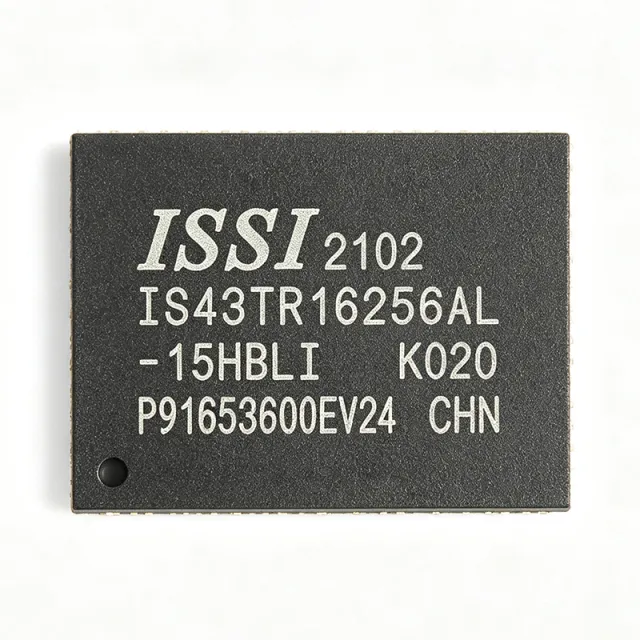
IS43TR16256A-15HBL-TR - 4Gb DDR3 SDRAM 667MHz | ISSI
IS43TR16256A-15HBL-TR

IS43TR16256A-15HBL-TR - 4Gb DDR3 SDRAM 667MHz | ISSI

The IS43TR16256A-15HBL-TR is a 4Gbit DDR3 SDRAM organized as 256M x 16, operating at a clock frequency of 667 MHz (data rate 1333 Mbps) with a CAS latency of 20 ns. It is housed in a 96-ball TWBGA (9x13 mm) package and operates from a 1.5V power supply. This memory IC is designed for high-bandwidth applications requiring reliable, high-speed data storage and retrieval. DDR3 SDRAM (Double Data Rate Type 3 Synchronous Dynamic Random-Access Memory) is a type of synchronous dynamic random-access memory with a high bandwidth interface, double the data rate of DDR2. It achieves higher transfer rates by transferring data on both edges of the clock signal, effectively doubling the data rate without increasing the clock frequency. DDR3 is part of the SDRAM family, which includes DDR, DDR2, DDR4, and DDR5, and is widely used in computing, networking, and embedded systems. Key features include a 4Gbit density, 16-bit I/O organization, 667 MHz clock speed, and a 20 ns CAS latency. The device supports programmable CAS latency, burst lengths of 8 and 4 (with burst chop), and on-die termination (ODT) for improved signal integrity. It also features auto-refresh and self-refresh modes for power saving, and a temperature-compensated self-refresh (TCSR) option. The IS43TR16256A-15HBL-TR utilizes a high-performance CMOS process and a bank architecture with 8 internal banks, enabling efficient interleaving and high throughput. The device includes DLL (Delay-Locked Loop) for precise timing alignment and supports write leveling and read leveling for system timing calibration. Its low power consumption and high speed make it suitable for a wide range of applications. Typical applications include networking equipment (routers, switches), industrial computing, embedded systems, and consumer electronics such as set-top boxes and smart TVs. The 1.5V operation and 96-ball TWBGA package allow for compact PCB designs with good thermal performance. When designing with this device, ensure proper decoupling capacitors near the power pins and follow the layout guidelines in the datasheet to minimize signal integrity issues. The device requires a stable 1.5V supply and a reference voltage (VREF) for the I/O.

USD $10,34 Kontakt
IS43TR16256AL-107MBL - 4Gb DDR3L SDRAM 256Mx16 | ISSI
IS43TR16256AL-107MBL

IS43TR16256AL-107MBL - 4Gb DDR3L SDRAM 256Mx16 | ISSI

The IS43TR16256AL-107MBL is a 4Gb DDR3L SDRAM organized as 256Mx16, operating at 1.35V with a data rate of 1866MT/s. It is housed in a 96-ball TWBGA (9x13mm) package, offering high density and low power consumption for a wide range of computing and embedded applications. DDR3L (Low Voltage DDR3) is a type of synchronous dynamic random-access memory that operates at 1.35V, reducing power consumption by about 15% compared to standard 1.5V DDR3. It is part of the DDR3 SDRAM family, which uses double data rate architecture to transfer data on both edges of the clock, achieving high bandwidth. DDR3L is commonly used in mobile devices, networking equipment, and industrial computing where power efficiency is critical. Key features include a parallel interface with 933 MHz clock speed, 20 ns access time, and support for 1866MT/s data rate. The device supports various burst lengths (8 and 4 with burst chop), on-die termination (ODT), and programmable CAS latency. It operates over a temperature range of 0°C to +95°C (case) and is RoHS compliant. The IS43TR16256AL-107MBL utilizes advanced DRAM process technology, providing high reliability and performance. It features auto-refresh and self-refresh modes, which are essential for low-power standby operation. The 96-ball TWBGA package ensures excellent thermal and electrical performance, making it suitable for space-constrained designs. Typical applications include networking routers and switches, enterprise storage systems, industrial PCs, and embedded computing platforms. Its low voltage and high density make it ideal for memory-intensive applications where power efficiency is a priority. When designing with this device, ensure proper decoupling capacitors are placed near the power pins to minimize noise. The DDR3L interface requires careful PCB layout to maintain signal integrity at high speeds, including matched trace lengths and controlled impedance.

Angebot Kontakt
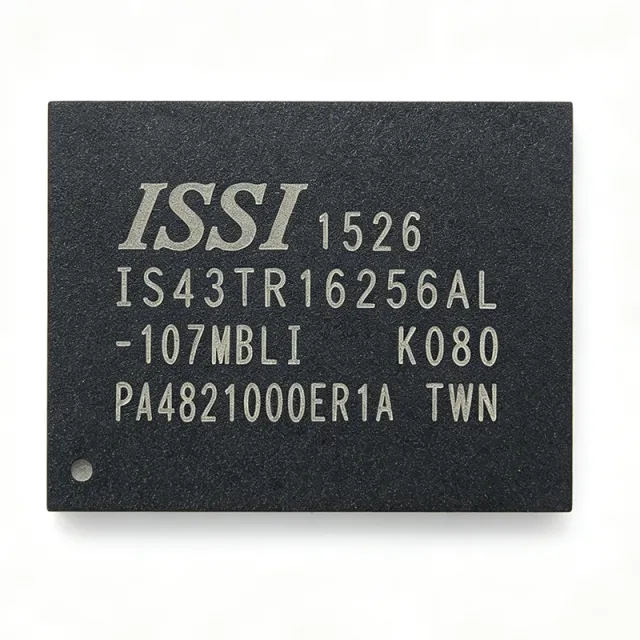
IS43TR16256AL-107MBLI - 4Gb DDR3L SDRAM 256Mx16 | ISSI
IS43TR16256AL-107MBLI

IS43TR16256AL-107MBLI - 4Gb DDR3L SDRAM 256Mx16 | ISSI

The IS43TR16256AL-107MBLI is a 4Gb DDR3L SDRAM organized as 256M x 16 bits, operating at a clock speed of 933 MHz (data rate 1866 Mbps) with a supply voltage of 1.35V. It is housed in a 96-ball TWBGA (9x13mm) package, making it suitable for high-density memory applications in computing, networking, and industrial systems. DDR3L SDRAM (Double Data Rate 3 Low Voltage) is a type of synchronous dynamic random-access memory that operates at a lower voltage (1.35V) compared to standard DDR3 (1.5V), reducing power consumption by up to 20% while maintaining backward compatibility with 1.5V operation. It is part of the DDR3 memory family, which uses double data rate signaling to transfer data on both edges of the clock, achieving high bandwidth for demanding applications. Key features include a 16-bit I/O interface, 4Gbit density, 20ns access time, and support for 1.35V operation with backward compatibility to 1.5V. The device offers high-speed data transfer rates, low power consumption, and is RoHS compliant. The 96-ball TWBGA package provides a compact footprint suitable for space-constrained designs. Technically, the IS43TR16256AL-107MBLI utilizes a 4-bank architecture with 8 internal banks, supporting burst lengths of 8 and 4, and features on-die termination (ODT) for improved signal integrity. It includes programmable CAS latency, additive latency, and write latency, allowing system designers to optimize timing for their specific memory controller. The device also supports auto-refresh and self-refresh modes for power saving. Typical applications include servers, networking equipment, industrial PCs, and embedded systems where high memory density and low power are critical. The 1.35V operation makes it ideal for power-sensitive designs, while the 1866 Mbps data rate supports high-bandwidth workloads. When designing with this device, ensure proper decoupling capacitors near the power pins and follow the layout guidelines in the datasheet to minimize signal integrity issues. The device requires a stable 1.35V supply and careful attention to termination for the address/control and data lines.

Angebot Kontakt
IS43TR16256AL-107MBLI-TR - 4Gb DDR3L SDRAM 256Mx16 | ISSI
IS43TR16256AL-107MBLI-TR

IS43TR16256AL-107MBLI-TR - 4Gb DDR3L SDRAM 256Mx16 | ISSI

The IS43TR16256AL-107MBLI-TR is a 4Gb DDR3L SDRAM organized as 256Mx16, operating at 1.35V with a data rate of 1866 Mbps (933 MHz clock). It is housed in a 96-ball TWBGA (9x13mm) package and is designed for low-power applications requiring high memory density. This device is backward compatible with 1.5V DDR3, allowing flexible system design. DDR3L SDRAM is a type of double data rate synchronous dynamic random-access memory that operates at a lower voltage (1.35V) compared to standard DDR3 (1.5V), reducing power consumption by about 20%. It is part of the memory hierarchy in computing systems, serving as main memory for processors, and is widely used in servers, networking equipment, and embedded systems where power efficiency is critical. Key features include a parallel interface with 16-bit data bus, 20ns access time, and support for on-die termination (ODT) and DLL-off mode for power saving. The device supports burst lengths of 8 and 4, and includes programmable CAS latency and additive latency. It operates over a temperature range of 0°C to +95°C (case temperature) for standard operation. The IS43TR16256AL-107MBLI-TR utilizes advanced DRAM process technology to achieve high density and low power. It features auto-refresh and self-refresh modes, with a typical self-refresh current of [DATA_NEEDED: self-refresh current]. The device includes a mode register set (MRS) for configuration, and supports write leveling and read leveling for signal integrity in high-speed systems. Typical applications include servers, networking equipment, industrial computing, and embedded systems where high memory density and low power are required. The 1.35V operation makes it ideal for battery-powered devices and energy-efficient data centers. When designing with this device, ensure proper decoupling capacitors near the power pins and follow the PCB layout guidelines in the datasheet to maintain signal integrity at 1866 Mbps. The device requires a stable 1.35V supply and a separate VDDQ supply for the I/O.

USD $5,60 Kontakt
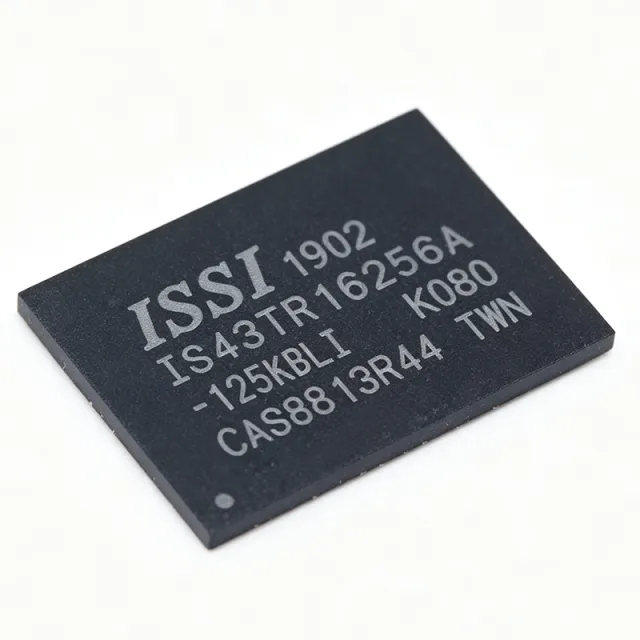
IS43TR16256AL-125KBL - 4Gb DDR3L SDRAM 256Mx16 | ISSI
IS43TR16256AL-125KBL

IS43TR16256AL-125KBL - 4Gb DDR3L SDRAM 256Mx16 | ISSI

The IS43TR16256AL-125KBL is a 4Gbit DDR3L SDRAM organized as 256M x 16, operating from a 1.35V supply with backward compatibility to 1.5V. It is housed in a 96-ball TWBGA (9x13mm) package and supports data rates up to 1600Mbps (800 MHz clock). This memory IC is designed for high-performance computing, networking, and embedded systems requiring low power and high bandwidth. DDR3L (Double Data Rate 3 Low Voltage) is a type of synchronous dynamic random-access memory (SDRAM) that operates at a lower voltage (1.35V) compared to standard DDR3 (1.5V), reducing power consumption by about 20-30% while maintaining similar performance. It is part of the DDR3 family, which uses double data rate signaling to transfer data on both edges of the clock, and is widely used in laptops, servers, and industrial applications where energy efficiency is critical. Key features include a parallel interface with 16-bit data bus, 800 MHz clock frequency, 20 ns access time, and support for 1.35V operation. The device is RoHS compliant and lead-free, making it suitable for environmentally conscious designs. The 96-TWBGA package offers a compact footprint with a 9x13mm body, ideal for space-constrained PCB layouts. Technically, the IS43TR16256AL-125KBL uses a high-density DRAM process, achieving 4Gbit capacity in a single package. It supports standard DDR3L features such as on-die termination (ODT), programmable CAS latency, and burst lengths of 8. The low voltage operation reduces I/O power, while the 20ns access time ensures fast random access for demanding applications. Typical applications include embedded computing, networking equipment (routers, switches), industrial automation, and automotive infotainment systems. Its low power and high density make it ideal for memory-intensive tasks in portable and battery-powered devices. When designing with this component, ensure proper decoupling capacitors near the power pins and follow the layout guidelines in the datasheet to minimize signal integrity issues at high speeds. The 1.35V supply must be regulated accurately to maintain reliable operation.

Angebot Kontakt
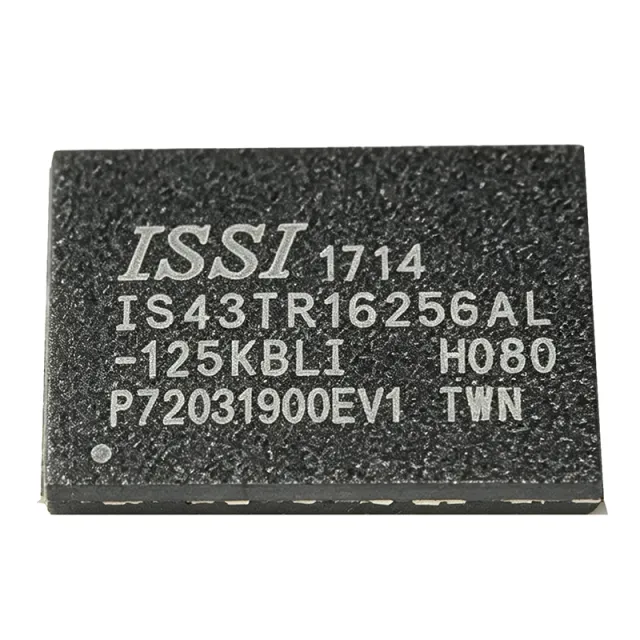
IS43TR16256AL-125KBLI-TR - 4Gbit DDR3L SDRAM 256Mx16 | ISSI
IS43TR16256AL-125KBLI-TR

IS43TR16256AL-125KBLI-TR - 4Gbit DDR3L SDRAM 256Mx16 | ISSI

The IS43TR16256AL-125KBLI-TR is a 4Gbit DDR3L SDRAM organized as 256M x 16, operating at a clock frequency of 800 MHz (data rate 1600 Mbps) with a CAS latency of 11. It is supplied in a 96-ball TWBGA (9x13 mm) package and is designed for low-voltage operation at VDD and VDDQ = 1.35V, with backward compatibility to 1.5V. This memory IC is part of ISSI's DDR3L family, offering high density and bandwidth for a wide range of applications. DDR3L (Double Data Rate 3 Low Voltage) SDRAM is a type of synchronous dynamic random-access memory that transfers data on both edges of the clock signal, effectively doubling the data rate. The 'L' designation indicates low-voltage operation at 1.35V, reducing power consumption by about 20% compared to standard DDR3 at 1.5V. DDR3L is widely used in mobile devices, embedded systems, and industrial computing where power efficiency is critical. It is backward compatible with 1.5V DDR3, allowing flexible system design. Key features include a 4Gbit density, 16-bit data bus, 800 MHz clock speed, and a burst length of 8. The device supports on-die termination (ODT), programmable CAS latency, and auto-refresh and self-refresh modes. It operates over a temperature range of -40°C to +95°C (TC), making it suitable for industrial environments. The 96-ball TWBGA package provides a compact footprint with excellent thermal and electrical performance. Technically, the IS43TR16256AL-125KBLI-TR uses a 1.35V power supply for both core and I/O, reducing power dissipation. It features a 20ns row cycle time (tRC) and a 20ns row active time (tRAS). The device supports a data transfer rate of 1600 Mbps per pin, delivering high bandwidth for memory-intensive applications. The low-voltage operation and industrial temperature range make it ideal for embedded systems that require reliable performance in harsh conditions. Typical applications include industrial automation, networking equipment, embedded computing, and automotive infotainment systems. The 4Gbit density and x16 organization are well-suited for applications requiring moderate memory capacity with a wide data bus. The low-voltage operation helps extend battery life in portable devices and reduces thermal load in dense systems. When designing with this component, ensure proper decoupling capacitors are placed near the power pins to minimize noise. The DDR3L interface requires careful PCB layout to maintain signal integrity at 1600 Mbps. Refer to the ISSI datasheet for detailed timing parameters and layout guidelines.

USD $8,25 Kontakt