Productos (20.000+)

PIC16F722AT-I/MV - 3.5KB Flash 8-bit MCU, UQFN-28 | Microchip
PIC16F722AT-I/MV

PIC16F722AT-I/MV - 3.5KB Flash 8-bit MCU, UQFN-28 | Microchip

The Microchip PIC16F722AT-I/MV is an 8-bit flash microcontroller in the PIC16F family, offering 3.5 KB of program Flash memory (2K x 14 words), 128 bytes of RAM, and a maximum CPU clock of 20 MHz. It is supplied in a 28-pin UQFN (4x4 mm) package with an exposed thermal pad, tape-and-reel packaged, and operates across a wide 1.8 V to 5.5 V supply range suitable for both 3.3 V and 5 V systems. An 8-bit microcontroller (MCU) is a small computer-on-a-chip combining a CPU, non-volatile program memory, RAM, and configurable peripherals in a single IC. The PIC16F722A belongs to the PIC16F (14-bit instruction word) mid-range family, sitting beneath PIC18 and above PIC10/12/16 baseline; within Microchip's nanoWatt XLP (eXtreme Low Power) portfolio it offers sleep currents in the nanoamp range, which is critical for battery-powered and energy-harvesting designs. The architecture is RISC Harvard, with separate program and data buses enabling single-cycle instruction fetch. Key features of the PIC16F722AT-I/MV include: 3.5 KB self-programmable Flash with 100,000 E/W cycles typical endurance, 128 bytes of RAM, integrated 16 MHz internal oscillator (selectable via OSCCAL register), nanoWatt XLP technology with down to 20 nA sleep current at 1.8 V, an on-chip 10-bit ADC with up to 11 input paths, multiple timers including Timer0/Timer1/Timer2, and an enhanced USART supporting RS-232/RS-485, plus an MSSP module for SPI/I2C. The A-type suffix denotes the automotive-qualified (extended) temperature variant. The part is built around a 14-bit instruction-word RISC core. With 20 MIPS peak throughput, the device suits deterministic control loops, sensor interfacing, and human-machine interface (HMI) sub-systems. Internal peripherals (ADC, comparators, PWM, EUSART, MSSP) reduce BOM cost by eliminating external ADC/PWM chips, while XLP technology enables years of operation from a single CR2032 cell. Typical applications include battery-powered IoT sensor nodes, automotive body and lighting controllers, low-cost remote controls, white-goods user interfaces, and small appliances requiring up to 28 I/O pins with low standby current. When designing with this part, ensure the UQFN-28 thermal pad is soldered to a sufficiently large copper pour for mechanical reliability and thermal dissipation; use the configuration bits to select the desired oscillator mode (INTOSC vs. external crystal). This page consolidates distributor pricing, drop-in alternatives within the same UQFN-28 footprint, and practical design notes not found in the manufacturer datasheet alone.

Cotización Contacto
PIC16F722AT-I/SO - 8-bit 20MHz XLP MCU 3.5KB Flash | Microchip
PIC16F722AT-I/SO

PIC16F722AT-I/SO - 8-bit 20MHz XLP MCU 3.5KB Flash | Microchip

The Microchip Technology PIC16F722AT-I/SO is a 28-pin 8-bit PIC16 family microcontroller built on Microchip's nanoWatt XLP extreme-low-power technology, delivering 20 MHz CPU performance with 3.5 KB (2K x 14) of self-programmable Flash program memory in a 28-SOIC wide-body package. It features 128 bytes of EEPROM, 128 bytes of RAM, an integrated 16 MHz internal oscillator, and up to 25 digital I/O pins, making it well-suited for low-power embedded control. The 'A' suffix denotes revision-A silicon (compatible with PIC16F722A/723A data sheet) and the 'T' indicates tape-and-reel packaging. A microcontroller (MCU) is a single-chip computer that integrates a CPU core, program memory, data memory, peripheral set, and I/O on one die, used to read sensors, drive actuators, and run application firmware in nearly every embedded product. PIC16F722A/723A MCUs sit at the low-power mid-range tier of the PIC16 family, combining the legacy PIC16 instruction set (35 single-word instructions, 200 ns instruction cycle at 20 MHz) with nanoWatt XLP sleep modes that drop current below 50 nA in real-time-clock retention mode. Key differentiating features of the PIC16F722A include nanoWatt XLP technology for sub-microamp sleep current, dual on-chip oscillators (16 MHz HF internal RC plus a 31 kHz LF internal RC), a 12-channel 8-bit ADC with up to 8 channels accessible in 28-pin packages, an enhanced USART, two PWM/CCP modules, and a 16-level hardware stack. The device operates across 1.8 V to 5.5 V, simplifying designs that must bridge battery and 5 V sensor rails. NanoWatt features such as ultra-low-power wake-up, peripheral module disable, and run-time oscillator selection make it a common choice for battery-powered and energy-harvesting products. Internally the PIC16F722A uses Microchip's mid-range 14-bit RISC Harvard architecture with 16-level hardware stack and a vectored interrupt controller. The PIC16F722A includes 2 Comparators, an Enhanced Universal Synchronous Asynchronous Receiver Transmitter (EUSART), and 2 PWM modules. Up to 25 I/O pins are multiplexed with peripheral functions to keep pin count low. Internal oscillator accuracy supports digital timing without an external crystal in many designs; an external crystal or resonator can be added where tighter timing is required. Typical applications include handheld battery-powered instruments, sensor nodes, IoT edge devices, low-power remote controls, appliance control boards, and automotive body modules. The wide voltage range and XLP idle modes extend battery life across consumer, industrial, and automotive sub-systems. When designing with this part, validate Vdd/Vss min-pin selection by tying unused inputs high through 10 kohm pull-ups and confirm oscillator choice against timing budgets. The 'T' suffix denotes tape-and-reel packaging for high-volume SMD assembly, and the 'SO' suffix denotes the wide-body 28-SOIC package.

Cotización Contacto
PIC16F722T-I/ML - 8-bit 20MHz MCU 3.5KB Flash 28-QFN | Microchip
PIC16F722T-I/ML

PIC16F722T-I/ML - 8-bit 20MHz MCU 3.5KB Flash 28-QFN | Microchip

The Microchip Technology PIC16F722T-I/ML is an 8-bit PIC16 RISC microcontroller built on the nanoWatt XLP™ Extreme Low Power technology platform, running at up to 20 MHz with 3.5 KB (2K x 14) of Flash program memory and packaged in a 28-pin QFN (6x6 mm) with an exposed thermal pad. It is designed for space-constrained, battery-powered embedded designs that demand low active and sleep currents, broad peripheral integration, and Microchip's mature PIC16 toolchain. An 8-bit microcontroller (MCU) is a single-chip computer that integrates a CPU, non-volatile program memory (Flash), volatile data memory (RAM), and a set of peripherals onto one silicon die. The PIC16 family uses a 14-bit instruction-word RISC architecture optimised for deterministic execution and very low power consumption; it sits within the broader hierarchy of microcontroller -> embedded processor -> semiconductor IC. The nanoWatt XLP variants extend this with deep sleep modes in the nanoampere range, making them common in IoT endpoints, sensor nodes, and energy-harvesting designs. Key features of the PIC16F722 include 128 bytes of RAM, 256 bytes of EEPROM, a 10-bit ADC, multiple timers, enhanced PWM/CCP/Capture modules, USART, I²C/SPI, and a wide operating voltage range of 2.5 V to 5.5 V that supports both 3.3 V and 5 V rails. The device offers three internal oscillator modes and an internal 16 MHz HFINTOSC with ±1% typical accuracy, allowing designs to run without an external crystal. The PIC16F722 is implemented on a low-power CMOS process and supports several sleep modes (sleep, watchdog timer off, and two levels of low-power sleep), with typical currents in the nanoampere range. The device integrates brown-out reset, power-on reset, watchdog timer, and a programmable code protection scheme that simplifies field deployment while improving reliability against code extraction. Typical applications include IoT sensor nodes, low-power wireless remote controls, battery-powered industrial sensors, consumer appliances, LED lighting controllers, and small motor-control loops. The wide voltage tolerance suits industrial 24 V bus systems stepped down to 5 V or 3.3 V. When designing with this part, place the decoupling capacitor (typically 100 nF plus 1 µF bulk) as close as possible to VDD/AVDD and use the exposed thermal pad on the QFN as a thermal and electrical ground connection to keep digital switching noise away from the analog rail. This page synthesises real-time distributor pricing, drop-in alternative MPNs sourced from Microchip's own cross-reference data, and practical design notes that go beyond the manufacturer datasheet, giving procurement and engineering teams a single source of decision support.

Cotización Contacto
PIC16F722T-I/MV - 8-bit MCU, 3.5KB Flash, 28-UQFN | Microchip
PIC16F722T-I/MV

PIC16F722T-I/MV - 8-bit MCU, 3.5KB Flash, 28-UQFN | Microchip

The Microchip Technology PIC16F722T-I/MV is an 8-bit PIC microcontroller featuring 3.5KB Flash program memory, 128 bytes of EEPROM, and 128 bytes of SRAM, housed in a 28-pin UQFN (4x4 mm) surface-mount package with an exposed pad. It operates across a wide 1.8V to 5.5V supply range, supports up to 20 MHz CPU clock, and integrates nanoWatt XLP extreme low-power technology for battery-friendly designs. The "T" suffix indicates tape-and-reel packaging for high-volume assembly. A microcontroller (MCU) is a single-chip computer that integrates a CPU, non-volatile program memory, working RAM, and a rich set of peripherals such as timers, ADCs, communication interfaces, and GPIO. MCUs sit at the heart of nearly every embedded system, from consumer appliances and IoT sensor nodes to industrial controllers and automotive body modules. Within the broader taxonomy, the PIC16F722 belongs to the 8-bit mid-range PIC microcontroller family, which uses a RISC instruction set optimized for deterministic, low-power, and cost-sensitive applications. Key features include 11 channels of 10-bit ADC, two 8-bit timers plus one 16-bit timer, one Enhanced Capture/Compare/PWM (ECCP) module with complementary outputs, and serial interfaces comprising AUSART (RS-232/RS-485) and SPI/I2C. With 25 I/O pins and nanoWatt XLP sleep currents in the microamp range, the device is engineered for always-on sensor and remote-control designs. Integrated capacitive mTouch sensing support allows direct connection of touch electrodes without external components. Architecturally, the PIC16F722 employs a Harvard RISC core with a hardware multiplier-free 14-bit instruction word and a 2-level hardware stack that simplifies interrupt handling. The on-chip voltage regulator and brown-out reset (BOR) circuitry provide robust operation across industrial temperature ranges (-40C to +85C) without external housekeeping ICs. The device family is supported by Microchip's MPLAB X IDE, XC8 compiler, and the MPLAB Code Configurator (MCC), enabling rapid peripheral setup and code generation. Typical applications include consumer remote controls, battery-powered sensor nodes, home appliances, LED lighting controllers, low-end touch interfaces, and small industrial control boards. The combination of low power, 10-bit ADC resolution, and PWM channels suits motor-drive gating, fan-speed control, and dimmable lighting designs. When designing with this MCU, allocate the UQFN-28 exposed pad as a solid thermal and electrical ground, route the two programming/debug pins (ICSPDAT/ICSPCLK) to a 2x3 0.1-inch header for in-circuit programming, and place a 100 nF decoupling capacitor within 2 mm of each VDD pin pair. Be aware that the 3.5KB Flash and 128B SRAM are modest - sufficient for compact state-machine firmware but not for protocol stacks with TLS. This page synthesizes distributor pricing, drop-in alternatives, and practical design notes not found in the manufacturer datasheet.

Cotización Contacto
PIC16F722T-I/SO - 20MHz 8-bit MCU 3.5KB Flash 28-SOIC | Microchip
PIC16F722T-I/SO

PIC16F722T-I/SO - 20MHz 8-bit MCU 3.5KB Flash 28-SOIC | Microchip

The Microchip Technology PIC16F722T-I/SO is a nanoWatt XLP eXtreme Low Power 8-bit PIC microcontroller with 3.5KB (2K x 14) Flash program memory, 128 bytes of RAM, and 256 bytes of EEPROM, housed in a 28-pin SOIC wide-body package. It executes instructions at 20MHz clock speed with a 200ns instruction cycle and operates from 1.8V to 5.5V across the industrial -40C to +85C temperature range. The device belongs to the mid-range PIC16 family and is offered in tape-and-reel (T/R) packaging with the -I industrial temperature suffix. An 8-bit microcontroller (MCU) is a single-chip computer built around an 8-bit data path, integrating a CPU core, non-volatile program memory (Flash), volatile data memory (RAM), non-volatile user storage (EEPROM), and a rich set of peripherals including timers, ADC, communication interfaces, and general-purpose I/O into one IC. MCUs sit within the broader category of microcontrollers > microprocessors > semiconductors and are the fundamental building block of nearly every embedded electronic product. The PIC architecture uses a RISC instruction set with only 35 single-word instructions, simplifying firmware development. Key features include 25 I/O pins, an enhanced universal synchronous/asynchronous receiver-transmitter (EUSART), MSSP (I2C/SPI), two 8-bit timers and one 16-bit timer, eleven 10-bit ADC channels with internal voltage reference, nanoWatt XLP technology for ultra-low sleep current, and a wide operating voltage range that supports both 3.3V and 5V rails. On-chip debug and In-Circuit Serial Programming (ICSP) are supported via two pins, enabling low-cost development and field upgrades. Architecturally, the device uses a Harvard RISC core with separate program and data buses, allowing instruction fetch and operand access to occur simultaneously in a single cycle. The 10-bit ADC provides up to 11 channels with selectable reference, supporting sensor interfaces in battery-powered designs, while the nanoWatt XLP technology reduces standby current to the low microamp range - critical for IoT and remote-sensor applications. Typical applications include consumer appliances, white goods, LED lighting controllers, sensor nodes, low-power IoT edge devices, battery chargers, remote controls, and small industrial control modules. The 5.5V maximum VDD also supports direct connection to USB-powered rails in low-cost HID peripherals. Designers should note that decoupling requires at least one 100nF ceramic capacitor placed within 5mm of VDD, with an additional bulk capacitor (1uF to 10uF) recommended for noisy supply environments. For ultra-low-power applications, configuring the CPU in Sleep mode with the ADC off and using the WDT or INT0 wake-up source is the standard path to microamp-level standby current. This page synthesizes real-time distributor pricing, same-package drop-in alternatives, and practical design guidance not aggregated on a single manufacturer or distributor product page.

Cotización Contacto
PIC16F723-E/MV - 20MHz 8-bit MCU, 7KB Flash, nanoWatt XLP | Microchip
PIC16F723-E/MV

PIC16F723-E/MV - 20MHz 8-bit MCU, 7KB Flash, nanoWatt XLP | Microchip

The Microchip PIC16F723-E/MV is a 20 MHz 8-bit PIC mid-range flash microcontroller featuring 7 KB program Flash, 192 B RAM, nanoWatt eXtreme Low Power (XLP) technology, and an integrated mTouch capacitive touch peripheral, housed in a 40-pin UQFN (MV) 5x5 mm package. The device operates from 1.8 V to 5.5 V supply, supports up to 36 I/O pins, and includes peripherals such as two CCP modules, an AUSART, an SSP (I2C/SPI), an 11-channel 8-bit ADC, and comparators. An 8-bit microcontroller (MCU) is a small computer-on-a-chip that integrates a CPU, non-volatile program memory (Flash), volatile data memory (RAM), and configurable peripherals on a single die. Within the broader taxonomy, the PIC16F723 belongs to Microchip's PIC16 mid-range family, which sits in the larger category of microcontrollers -> microcontrollers (MCU) -> semiconductor -> integrated circuit. Mid-range PIC16 devices use a 14-bit instruction word, 35 instructions, and 8 hardware stack levels, making them well suited for embedded control where deterministic response, low power, and small code footprint matter more than raw clock speed. Key features that differentiate this device include its nanoWatt XLP technology, which delivers typical sleep currents in the nanoamp range and active currents under 1 mA per MIPS, enabling battery-powered designs that can run for years on a single coin cell. The 11-channel 8-bit ADC and integrated mTouch hardware simplify capacitive touch user interfaces without an external touch IC. Hardware instructions are executed in a single cycle (4 Fosc), giving the 20 MHz oscillator an effective throughput of 5 MIPS for tight control loops. Typical applications span consumer electronics, home appliances, IoT sensor nodes, capacitive-touch keypads, battery-powered handheld instruments, and low-cost motor control. The wide 1.8-5.5 V operating range lets the same firmware run directly from a single-cell Li-ion or two AA cells. The UQFN-40 footprint also supports compact PCB layouts where board area is at a premium. Designers should provide adequate PCB copper under the exposed pad for thermal dissipation, since the UQFN package relies on the pad for heat removal. Decouple VDD with a 100 nF ceramic capacitor placed within 5 mm of the supply ball, and add a bulk 1-10 uF capacitor if the load transients are large. This page synthesizes verified distributor pricing, manufacturer datasheet data, drop-in alternatives in the same UQFN-40 package, and practical design notes not found on a single distributor page, giving engineers a single starting point for PIC16F723-E/MV evaluation, sourcing, and qualification.

Cotización Contacto
PIC16F723-E/SO - 8-bit 20MHz 7KB Flash MCU | Microchip
PIC16F723-E/SO

PIC16F723-E/SO - 8-bit 20MHz 7KB Flash MCU | Microchip

The Microchip Technology PIC16F723-E/SO is an 8-bit RISC flash microcontroller from the PIC16 family, featuring 7KB (4K x 14) of FLASH program memory, 192 bytes of RAM and 256 bytes of EEPROM in a 28-pin SOIC package. It runs at a maximum clock frequency of 20 MHz, operates from 1.8V to 5.5V, and supports -40C to +125C extended temperature grade as indicated by the -E suffix. A microcontroller (MCU) is a single-chip computer that integrates a CPU core, program memory (FLASH/ROM), data memory (RAM), non-volatile storage (EEPROM), and programmable peripherals into one IC. Within the broader taxonomy, the PIC16F723 belongs to the 8-bit MCU family -> RISC microcontroller -> embedded controller -> semiconductor IC. Its eXtreme Low Power (XLP) nanoWatt technology enables deep-sleep currents in the microamp range, making the part well suited for battery-powered and energy-harvesting applications where quiescent draw dominates the energy budget. Key features include nanoWatt XLP technology, an integrated 16 MHz internal oscillator (selectable up to 20 MHz external), 11-channel 8-bit ADC, two 8-bit timers plus one 16-bit timer, enhanced USART, two SPI/I2C MSSP peripherals, a comparator module, and 25 mA source/sink capability on I/O pins. The 28-pin SOIC footprint is industry standard, simplifying PCB layout and breadboarding for prototypes. The PIC16F723 uses Microchip's enhanced mid-range 8-bit CPU with 14-bit instruction word, a 200 ns single-word instruction cycle, and a hardware stack 8-deep. The integrated 8-bit ADC samples at up to 100 ksps, supporting sensor-interface applications without an external ADC. The MSSP module can be configured as SPI master/slave or I2C master/slave, providing flexible connectivity to sensors, EEPROMs and displays. Typical applications include battery-powered sensor nodes, low-power IoT endpoints, remote controls, small appliances, motor-control signal boards, and industrial telemetry. The wide 1.8V-5.5V supply range also allows direct operation from a single Li-ion cell or two AA cells. When designing with this device, add 100 nF and 10 uF decoupling capacitors close to VDD, leave MCLR either tied high through a 10 kohm resistor or routed to an ICSP header for in-circuit programming, and ensure unused I/O pins are configured as outputs low to minimize quiescent draw. This page synthesizes distributor pricing, drop-in same-brand and cross-brand alternatives, and practical design notes not found in any single manufacturer datasheet.

Cotización Contacto
PIC16F723-E/SS - 8-bit XLP MCU 7KB Flash 20MHz | Microchip
PIC16F723-E/SS

PIC16F723-E/SS - 8-bit XLP MCU 7KB Flash 20MHz | Microchip

The Microchip Technology PIC16F723-E/SS is an 8-bit PIC microcontroller from the PIC16F72X family featuring nanoWatt XLP extreme-low-power technology, 7KB (4K x 14) of Flash program memory, 192 bytes of RAM, and 256 bytes of EEPROM, operating at up to 20MHz in a 28-pin SSOP (5.30mm wide) package. The device integrates a 10-bit ADC with up to 11 channels, multiple timers, enhanced CCP, USART, SPI, and I2C peripherals while consuming as little as 11 nA in sleep mode. An 8-bit microcontroller (MCU) is a single-chip computer built around an 8-bit data path CPU, ROM/Flash program memory, RAM, and integrated peripherals such as timers, ADCs, and communication interfaces. PIC microcontrollers use a modified Harvard RISC architecture with a 14-bit wide instruction word optimized for deterministic execution and ultra-low power consumption, sitting in the MCU -> microcontroller -> embedded processor -> semiconductor product hierarchy. The XLP designation indicates this part is engineered for battery-powered applications where sleep-mode current directly determines battery life. Key features include 20MHz max CPU clock, 1.8V to 5.5V wide operating voltage range, 11-channel 10-bit ADC, two 8-bit timers, one 16-bit timer, enhanced Capture/Compare/PWM, MSSP for SPI/I2C, enhanced USART, 25mA source/sink per I/O, and 11 nA typical sleep current with WDT disabled. The 28-SSOP package offers an industry-standard 0.65mm pitch footprint compatible with hand-soldering and automated assembly, while internal 16MHz and 32kHz oscillators eliminate external clock components. The PIC16F723 uses Microchip's enhanced mid-range core with a 14-bit instruction set, single-cycle instruction execution except branches, hardware multiplier (8x8) and 16-level hardware stack. Five oscillator modes (XT, HS, LP, RC, INTOSC) provide design flexibility, and the device supports in-circuit serial programming (ICSP) plus in-circuit debugging via ICD. The "-E" suffix indicates the extended (-40C to +125C) industrial operating temperature grade suited for harsh-environment and automotive under-hood applications. Typical applications include battery-powered sensor nodes, IoT edge devices, HVAC thermostats, smoke detectors, remote controls, and low-power wireless sensor hubs. The wide voltage range and ultra-low sleep current also make it a fit for energy-harvesting devices, smart metering, and wearable health monitors operating from small lithium coin cells. When designing with this device, verify the ADC acquisition time setting matches the source impedance per datasheet recommendations to avoid conversion errors. The MCLR reset pin must be tied to VDD through a 10k resistor for reliable operation, and unused I/O pins should be configured as outputs low to minimize sleep current leakage. A blocking capacitor of 0.1uF placed within 5mm of the VDD pin is required for noise immunity. This page synthesizes distributor pricing, drop-in same-package alternatives, and practical engineering design notes that extend the information gain beyond what is published on the Microchip datasheet alone.

Cotización Contacto
PIC16F723-I/MV - 20MHz 8-bit MCU 7KB Flash | Microchip
PIC16F723-I/MV

PIC16F723-I/MV - 20MHz 8-bit MCU 7KB Flash | Microchip

The Microchip Technology PIC16F723-I/MV is a 20-MHz, 8-bit PIC16-family RISC microcontroller with 7 KB of Flash program memory, packaged in a 28-pin UQFN-EP (4x4 mm) surface-mount housing. The 'I' suffix denotes the industrial temperature grade of -40C to +85C, while the 'MV' suffix indicates the 28-pin UQFN with exposed pad for thermal dissipation and improved electrical grounding. The device operates from 1.8 V to 5.5 V across the full speed range, making it compatible with 2.5 V, 3.3 V, and 5 V system rails. An 8-bit microcontroller (MCU) is a programmable logic device built around an 8-bit data path, integrating CPU, RAM, non-volatile program memory, and peripherals onto a single die. Within the broader semiconductor hierarchy, an MCU belongs to the category of embedded processors, sitting beneath microprocessors (which require external peripherals) and above dedicated logic ICs. The PIC16F723 belongs to Microchip's mid-range PIC16 core family with 14-bit instruction words and 8 hardware stack levels, providing 35 standard instructions plus special-purpose operations. This architecture strikes a balance between code density, deterministic interrupt response, and compiler support (MPLAB XC8), suiting cost-sensitive embedded control rather than high-throughput DSP workloads. Key features of the PIC16F723-I/MV include 7 KB Flash program memory (4K x 14 organization), 192 bytes of RAM, 256 bytes of EEPROM data memory, an integrated 11-channel 10-bit ADC, two Capture/Compare/PWM (CCP) modules, an Enhanced Universal Synchronous/Asynchronous Receiver/Transmitter (EUSART), an SPI/I2C MSSP peripheral, and nanoWatt XLP extreme-low-power technology. The 28-pin UQFN package exposes a thermal pad that connects to the die substrate for low-impedance ground return paths and improved thermal coupling to the PCB copper pour. Typical applications for the PIC16F723-I/MV span consumer white goods, low-power wireless sensor nodes, motor and fan control, lighting ballasts, and battery-powered instrumentation. The 7 KB Flash and 192-byte RAM comfortably host state-machine plus interrupt-driven firmware for appliance control panels, HVAC damper drivers, and small IoT end nodes. The integrated 10-bit ADC is sufficient for thermistor, potentiometer, and current-sense feedback loops, while the two CCP modules handle brushed DC motor PWM and servo position control without additional timer ICs. When designing with this MCU, allocate sufficient PCB copper area beneath the exposed pad (EP) to act as the thermal and ground reference. The UQFN package requires careful land-pattern adherence because thermal pad solder voids reduce electrical and thermal performance. Use MPLAB X IDE with the XC8 compiler and select the PIC16F723 header file to ensure correct SFR mapping.

Cotización Contacto
PIC16F723-I/SO - 8-Bit 20MHz Flash MCU | Microchip Technology
PIC16F723-I/SO

PIC16F723-I/SO - 8-Bit 20MHz Flash MCU | Microchip Technology

The Microchip Technology PIC16F723-I/SO is an 8-bit PIC XLP flash microcontroller with a 20 MHz maximum operating frequency, 4K x 14 bits of flash program memory and an internal oscillator, packaged in a 28-pin SOIC. The PIC16F723-I/SO combines a compact mid-range PIC architecture with low-power design features, serial interfaces, timer resources and an 8-bit ADC, making it suitable for embedded control tasks that require broad peripheral support in a small package. A microcontroller is a programmable semiconductor that integrates a processor core, memory and peripheral functions onto one device. The PIC16F723 belongs to the PIC16 family hierarchy of 8-bit RISC microcontrollers, combining a mid-range CPU core with flash program memory and nanoWatt XLP technology. It provides a practical platform for embedded products that need local control, digital communication, analog measurement and low-power operation without relying on a separate processor and multiple supporting ICs. Key features include 4K x 14 bits of flash program memory, a 20 MHz operating frequency and an 18 V to 55 V internal oscillator range as listed for this device. The family documentation identifies 35 single-word instructions, SPI and AUSART serial interfaces, two CCP modules and an 11-channel 8-bit ADC. These resources support motor control, signal conditioning, communications, sensing and general-purpose automation designs. The PIC16F723-I/SO uses a Harvard-style PIC16 architecture with separate program and data-memory spaces and a compact instruction set. Flash memory permits in-circuit reprogramming, while the internal oscillator reduces the component count and board area required for clock generation. The 28-pin SOIC package provides enough I/O and peripheral connections for small control systems while remaining compatible with conventional surface-mount assembly methods. Typical uses include low-cost sensor controllers, UART or SPI-based remote controls, compact power-conversion controllers, LED drivers, industrial acquisition modules and battery-powered equipment. The ADC supports analog measurement, while the CCP and timer resources can provide timing, capture, compare and PWM functions. An internal oscillator and XLP architecture are particularly useful when standby power consumption and board size matter. Designers should preserve adequate decoupling close to the supply pins and follow the pin-assignment and grounding guidance in the manufacturer datasheet. Confirm the required clock configuration, peripheral pin multiplexing, ADC input limits and programming interface before layout release. The -I ordering code and -SO package suffix should be checked against temperature-range, package and production requirements during ordering. This product page combines the manufacturer family information with practical guidance on low-power embedded design, peripheral allocation, PCB implementation and replacement selection. It also distinguishes exact temperature-grade options from broader PIC16 family relatives so that engineers can identify which substitutions preserve the 28-pin footprint and which require additional schematic verification.

Cotización Contacto
PIC16F723-I/SP - 8-bit 20MHz 7KB Flash MCU 28-SPDIP | Microchip
PIC16F723-I/SP

PIC16F723-I/SP - 8-bit 20MHz 7KB Flash MCU 28-SPDIP | Microchip

The Microchip PIC16F723-I/SP is an 8-bit CMOS flash microcontroller based on the PIC® mid-range architecture with nanoWatt XLP (eXtreme Low Power) technology, delivering 20 MHz CPU performance, 7 KB (4K x 14) of program Flash, and 192 bytes of RAM in a 28-pin SPDIP package. It operates from 2.5 V to 5.5 V supply and provides 25 digital I/O pins for general-purpose interfacing. A microcontroller (MCU) is a single-chip computer that integrates a CPU core, program memory, RAM, peripherals, and I/O into one package. PIC® MCUs use a RISC (Reduced Instruction Set Computer) architecture with only 35 single-word instructions, allowing most instructions to execute in one instruction cycle (200 ns at 20 MHz). nanoWatt XLP technology extends sleep current down to the nanoampere range, making this part ideal for battery-powered applications. PIC16F723 sits in the broad category: microcontroller -> embedded MCU -> semiconductor. Key features include 11 channels of 10-bit ADC, two 8-bit timers plus one 16-bit timer, one MSSP (SPI/I2C) and one Enhanced USART for serial connectivity, and an internal 16 MHz oscillator with software-tunable calibration. The device provides 2.0 V brown-out detect and a wide operating temperature range of -40°C to +85°C, suitable for industrial environments. The PIC16F723 is implemented in Microchip's proprietary flash process with on-chip in-circuit debug support (ICD). Its mid-range core uses a 14-bit instruction word and a hardware multiplier for efficient arithmetic, while XLP technology enables sleep currents as low as 20 nA typical. Compared with PIC16F716, the PIC16F723 doubles program memory and adds nanoWatt XLP technology, making it a popular upgrade for low-power designs. Typical applications include battery-powered sensor nodes, remote controls, consumer appliances, industrial control modules, and small motor control. The 28-pin SPDIP footprint also makes it suitable for through-hole hobbyist and educational projects where easy hand-soldering is desired. When designing with this part, ensure decoupling capacitors are placed within 5 mm of the VDD pins and that the MCLR pin is properly pulled up through a resistor to VDD. The internal oscillator can be calibrated for ±1% accuracy using the OSCTUNE register, eliminating the need for an external crystal in many cost-sensitive applications. This page synthesizes distributor pricing, drop-in pin-compatible alternatives, and practical design notes that go beyond the manufacturer datasheet summary to accelerate engineering and sourcing decisions.

Cotización Contacto
PIC16F723A-E/ML - 8-bit 20MHz 7KB Flash MCU 28-QFN | Microchip
PIC16F723A-E/ML

PIC16F723A-E/ML - 8-bit 20MHz 7KB Flash MCU 28-QFN | Microchip

The Microchip Technology PIC16F723A-E/ML is a nanoWatt XLP 8-bit PIC16 microcontroller built around an enhanced mid-range RISC core with 49 instructions (200 ns instruction cycle) and 14-bit instruction width, delivering up to 20 MHz CPU clock from a 2.5 V to 5.5 V supply in a 28-pin 6x6 mm QFN (ML) package with exposed thermal pad. Headline specs are 7 KB (4K x 14) self-programmable Flash program memory, 192 bytes RAM, 128 bytes EEPROM, and 25 digital I/O pins across PORTA/PORTE/PORTC. An 8-bit microcontroller (MCU) integrates a CPU, non-volatile program memory, volatile data memory, peripherals, and I/O on a single die. Within the broader taxonomy, PIC16F723A is a flash-based Harvard-architecture MCU in the PIC16 mid-range family, classified as a general-purpose 8-bit MCU under embedded microcontrollers, suitable for low-power battery and always-on applications thanks to Microchip's nanoWatt XLP technology. Differentiating features include a 12-channel 8-bit ADC with voltage reference, two 8-bit timers plus one 16-bit timer, an Enhanced CCP module, an Enhanced USART, two SPI / I2C MSSP peripherals with mTouch capacitive sensing support, an in-circuit debugger, and a wide operating temperature range of -40 C to +125 C for industrial-grade reliability. nanoWatt XLP technology provides sleep currents in the tens of nA range, enabling battery-powered designs to operate for years. Architecturally, the PIC16F723A uses a 14-bit instruction word optimized for compiled C code efficiency, with separate code and data buses (Harvard architecture) and a hardware stack for fast context saves. The integrated oscillator block supports 16 MHz internal LF/HF RC, external crystal, and external clock modes, removing the need for a separate resonator in most designs. Typical applications include LED lighting controllers, consumer white goods and remote controls, sensor nodes and IoT edge devices, automotive body and interior modules (with the automotive-grade PIC16F723A-E variant), industrial control panels, and battery-powered instrumentation. The wide 2.5 V to 5.5 V supply range permits direct 3.3 V or 5 V operation from a single Li-ion / two-AA cell stack. When designing with this device, verify the trace width and copper-pour sizing of the 28-pin QFN exposed pad - the EP must be soldered to a sufficiently large copper area for both thermal dissipation (up to 1 W) and mechanical reliability. Use Microchip's MPLAB X IDE with XC8 compiler for development and ICD debugging via PGD/PGC pins. This page synthesizes distributor pricing, drop-in alternative MPNs, and practical PCB design notes drawn from the Microchip datasheet (DS40001417C) and Microchip cross-reference documentation, going beyond the manufacturer datasheet alone.

Cotización Contacto
PIC16F723A-E/MV - 7KB Flash 8-bit MCU 20MHz UQFN-28 | Microchip
PIC16F723A-E/MV

PIC16F723A-E/MV - 7KB Flash 8-bit MCU 20MHz UQFN-28 | Microchip

The Microchip Technology PIC16F723A-E/MV is an 8-bit PIC microcontroller featuring 7 KB Flash program memory, 192 bytes RAM, and a 20 MHz internal oscillator, housed in a 28-pin UQFN package (MV suffix). It belongs to the PIC16F72xA family of mid-range nanoWatt XLP microcontrollers engineered for ultra-low-power embedded applications. The device operates from 1.8 V to 5.5 V, supports 36 I/O ports in the 40/44-pin variants (25 in the 28-pin UQFN), and integrates Microchip's nanoWatt XLP technology for sub-1 µA sleep currents. An 8-bit microcontroller is a single-chip computer built around an 8-bit data path, integrating CPU core, program memory, data RAM, and programmable peripherals in one package. The PIC architecture (Peripheral Interface Controller) belongs to the RISC family of microcontrollers, executing one instruction per clock cycle with a small instruction set of 35 single-word instructions. 8-bit MCUs sit below 16-bit and 32-bit microcontrollers in compute hierarchy and are typically used where cost, simplicity, and predictable real-time behavior outweigh raw MIPS. PIC16F72xA parts belong to the mid-range 8-bit sub-family and are commonly deployed in sensor nodes, consumer devices, motor control, and human-machine interface (HMI) subsystems. Key features of the PIC16F723A include 128 bytes of EEPROM data memory, a 12-bit ADC with up to 11 channels, two 8-bit and one 16-bit timers, an enhanced USART, MSSP (SPI/I2C) peripheral, and a 16-bit PWM module with complementary outputs. The internal 16 MHz high-speed oscillator can be tuned for 31 kHz to 16 MHz operation, while the secondary 31 kHz low-power oscillator supports the nanoWatt XLP sleep modes. A 256-byte data EEPROM is also available for non-volatile user data. The PIC16F723A uses an enhanced mid-range 8-bit CPU core with a hardware multiplier, vectored interrupt controller, and an in-circuit debugger (ICD) interface accessed via PGD/PGC pins. The architecture supports flash self-programming for bootloader-style firmware updates and includes a 64-byte wide data path for efficient C-compiler code generation. Brown-out reset (BOR), power-on reset (POR), and code protection bits are all standard. Compared to the PIC16F722A, the 723A doubles program memory from 3.5 KB to 7 KB while keeping the same 192-byte RAM and pinout. Typical applications include battery-powered sensor nodes leveraging the XLP sleep modes, low-end motor control via PWM modules, LED lighting drivers with PWM dimming, remote controls, and small consumer appliances. The device is also well-suited as a housekeeping controller in larger systems where a main processor requires a low-power companion MCU for power sequencing and watchdog duties. When designing with the PIC16F723A-E/MV, ensure the UQFN-28 PCB land pattern matches the 5x5 mm body with 0.5 mm pitch pads. Decoupling capacitors (100 nF + 1 µF) should be placed within 3 mm of VDD/VSS. The internal oscillator requires no external crystal for most applications, but a 32.768 kHz secondary clock crystal can be added on SECLK/SECLKO pins if more accurate real-time-clock operation is required. This page synthesizes Microchip distributor pricing, drop-in same-package alternatives from the PIC16F72xA family, and practical design notes not found in the manufacturer datasheet alone.

Cotización Contacto
PIC16F723A-E/SO - 8-bit PIC MCU, 7KB Flash, 20MHz, 28-SOIC | Microchip
PIC16F723A-E/SO

PIC16F723A-E/SO - 8-bit PIC MCU, 7KB Flash, 20MHz, 28-SOIC | Microchip

The Microchip Technology PIC16F723A-E/SO is an 8-bit RISC Flash microcontroller from the PIC16F/LF722A/723A family, providing 7KB Flash program memory, 192 bytes of data RAM, and 256 bytes of data EEPROM in a 28-pin SOIC (SO) wide-body package. It operates from 1.8V to 5.5V supply, runs at up to 20MHz instruction clock, and integrates Microchip's nanoWatt XLP extreme-low-power technology for energy-constrained designs. A PIC microcontroller is a compact, deterministic 8-bit processor built on Microchip's RISC (Reduced Instruction Set Computer) architecture. PIC16F MCUs combine a Harvard-bus CPU with integrated Flash, RAM, EEPROM and rich peripherals into a single chip, sitting at the entry tier of the 8-bit MCU hierarchy: PIC10/12/16/18 -> 8-bit MCU -> microcontroller -> embedded processor -> semiconductor. XLP parts add aggressive sleep currents and peripheral gating for battery applications. Key features include up to 20MHz operation, 7KB Flash (4096 x 14-bit words), 192 bytes RAM, 256 bytes EEPROM, multiple communication peripherals (EUSART, MSSP I2C/SPI), 11-bit ADC, comparators, timers, nanoWatt XLP sleep modes below 1uA, and an extended (-40C to +125C) operating range (the -E suffix). It targets automotive-grade and industrial applications requiring AEC-Q100-style robustness in the SOIC-28 form factor. Architecturally, the PIC16F723A uses an enhanced mid-range 16-bit instruction word with 35 single-word instructions, most executing in one instruction cycle, plus a hardware multiplier, shadow register set, and peripheral pin select for flexible signal routing without PCB rework. The die integrates the ADC and analog comparators alongside the digital core, enabling single-chip sensor interfaces with no external components beyond passives. Typical applications include automotive body modules, sensor interfaces, low-power IoT nodes, consumer appliance controls, and industrial sensor hubs. The wide SOIC-28 footprint supports hand-solderable prototypes and high-reliability manufacturing flows, while XLP enables multi-year battery life in remote-sensor applications such as utility meters and wireless thermostats. When designing with this part, ensure the in-circuit serial programming (ICSP) lines are accessible in production, configure the configuration bits for oscillator selection, and route the analog supply (AVDD) appropriately when using the ADC, since ADC accuracy is sensitive to supply decoupling and ground bounce on a mixed-signal PCB. This page synthesizes distributor pricing, drop-in package equivalents, and practical design notes not found in the manufacturer datasheet alone.

Cotización Contacto
PIC16F723A-E/SS - 8-Bit XLP 20MHz MCU | Microchip
PIC16F723A-E/SS

PIC16F723A-E/SS - 8-Bit XLP 20MHz MCU | Microchip

The Microchip Technology PIC16F723A-E/SS is an 8-bit flash microcontroller from the PIC16 (L)F722A/723A family, featuring nanoWatt XLP (eXtreme Low Power) technology in a 28-pin SSOP (Shrink Small Outline) package. The device runs the enhanced mid-range PIC16 core at up to 20MHz instruction frequency (200ns instruction cycle), integrates 7KB of flash program memory (4K x 14 words), 192 bytes of RAM, and 128 bytes of EEPROM. It operates from 1.8V to 5.5V across the extended -40C to +125C industrial temperature range. An 8-bit microcontroller (MCU) is a single-chip computer that integrates a CPU, program memory, data memory, peripherals, and I/O on one die. The '8-bit' data path is the classic architectural sweet spot for cost-sensitive, deterministic, low-power embedded control; this part sits inside the broader PIC16 family -> PIC mid-range MCU -> 8-bit MCU -> microcontroller hierarchy. The flash-based program memory is in-system programmable (ICSP), enabling field upgrades and shortening time-to-market. Key features of the PIC16F723A-E/SS include 11 analog channels on a 10-bit ADC, two comparators, four 8-bit timers plus one 16-bit timer, a master I2C/SPI interface plus an enhanced USART, a 4-channel PWM module, and the nanoWatt XLP low-power architecture that delivers sub-uA sleep current. The 'A' revision adds capacitive touch (mTouch) support, an internal 16MHz oscillator with 2% accuracy, and an extended instruction set versus the original PIC16F723. The 28-SSOP package is pin-compatible with the PIC16F722A-E/SS, which has only 3.5KB flash versus the 723A's 7KB. The device is typically designed in with a 32.768kHz external crystal for RTC operation or run on the internal oscillator, with ICSP programming via PGC/PGD pins sharing the RB6/RB7 port. The PIC16F723A-E/SS is qualified for industrial and consumer applications including home appliances, sensor interfaces, and remote controls. Typical applications include battery-powered sensor nodes (nanoWatt XLP sleep modes extend coin-cell life), capacitive touch user interfaces (mTouch peripheral), low-cost motor and lighting controllers (PWM + ADC feedback), and industrial control panels. The wide 1.8V-5.5V range and -40C to +125C qualification allow deployment directly from 2xAA cells through to 5V regulated rails. When designing in this MCU, budget for the 2-bank flash memory map and ensure C source uses the `__bank` qualifiers where bank-bound calls cross bank 1/2 boundaries. For sleep-current-sensitive designs, switch off the ADC, comparators, and Fosc before entering sleep, and prefer the 31kHz LFINTOSC over an external crystal when timing is non-critical. This page synthesizes real-time distributor pricing, Microchip cross-references, and practical application-circuit design notes that complement the manufacturer datasheet (Document DS40001417C).

Cotización Contacto
PIC16F723A-I/ML - 8-bit 20MHz 7KB Flash MCU | Microchip
PIC16F723A-I/ML

PIC16F723A-I/ML - 8-bit 20MHz 7KB Flash MCU | Microchip

The Microchip PIC16F723A-I/ML is an 8-bit flash microcontroller in the mid-range PIC16 family, featuring a 20 MHz CPU, 7 KB of program Flash, and Microchip's nanoWatt XLP (eXtreme Low Power) technology, all housed in a 28-pin QFN (ML) package with a 6x6 mm body. A microcontroller (MCU) is a single-chip computer that integrates a CPU, non-volatile program memory (Flash/ROM), working memory (RAM), and programmable peripherals onto a single silicon die. The 8-bit PIC16 mid-range family uses a RISC-based Harvard architecture optimized for deterministic, low-power, embedded control. Within the power management IC ecosystem, MCUs act as host processors that supervise sensors, actuators, and user interfaces, balancing code density, real-time response, and energy efficiency. Key features of the PIC16F723A include 7 KB of self-programmable Flash program memory, 192 bytes of RAM, 256 bytes of EEPROM, and a 14-bit instruction set that delivers 200 ns instruction execution at 20 MHz. The device integrates up to 25 I/O pins, an 11-channel 8-bit ADC, two 8-bit timers, one 16-bit timer, an Enhanced USART, MSSP (SPI/I2C), and a Master Synchronous Serial Port. nanoWatt XLP technology provides sleep currents in the nanoamp range, making the part suitable for battery-powered applications. The wide 1.8 V to 5.5 V supply range supports both 3.3 V and 5 V designs. Architecturally, the PIC16F723A uses a 14-bit instruction word with a modified Harvard bus, allowing the CPU to fetch instructions and data simultaneously. On-chip peripherals are mapped to the SFR space and configured through bit-oriented control registers; the interrupt controller supports both core and peripheral sources with configurable priorities. The internal 16 MHz oscillator can be multiplied to 20 MHz, or an external crystal/resonator can be connected for higher timing accuracy. Typical applications include low-power sensor nodes, consumer white goods and home appliances, battery-powered instruments, LED lighting controllers, and small industrial control modules. The combination of nanoWatt XLP sleep modes and the integrated ADC/USART suits remote controls, smoke detectors, and energy-harvesting IoT edge devices. When designing with this part, pay attention to the Flash endurance specification (typically 100 k erase/write cycles minimum), the 1.8 V minimum Vdd for full-speed operation, and use the in-circuit serial programming (ICSP) interface for firmware updates. Place a 100 nF decoupling capacitor within 5 mm of the Vdd pin to minimize switching noise on the internal regulator. This page synthesizes distributor pricing, drop-in compatible QFN-28 alternatives, and practical design notes not found in the manufacturer datasheet.

Cotización Contacto
PIC16F723A-I/MV - 7KB Flash 28-Pin XLP MCU | Microchip
PIC16F723A-I/MV

PIC16F723A-I/MV - 7KB Flash 28-Pin XLP MCU | Microchip

The Microchip Technology PIC16F723A-I/MV is an 8-bit flash microcontroller featuring 7KB of program memory and the nanoWatt XLP extreme-low-power technology, housed in a 28-pin UQFN package with an exposed thermal pad. The device operates from 1.8V to 5.5V supply and supports clock speeds up to 20MHz, making it one of the broadest operating-range members of Microchip's PIC16(XLP) mid-range family. An 8-bit PIC microcontroller is a single-chip computer built around a Reduced Instruction Set Computer (RISC) core. PIC MCUs sit in the broader taxonomy of microcontrollers (MCU) -> embedded controllers -> semiconductor ICs, and they integrate CPU, non-volatile Flash, SRAM, peripherals, and I/O on a single die. The 8-bit PIC16 architecture executes instructions in a single instruction cycle (200ns at 20MHz), uses 35 single-word instructions, and targets cost-sensitive, low-power embedded designs ranging from consumer appliances to industrial sensors. Key features of the PIC16F723A-I/MV include 7KB (4K x 14 words) of self-programmable Flash, 192 bytes of RAM, 256 bytes of EEPROM, an integrated 16MHz internal oscillator (calibrated to +/-1% typical), an Enhanced Universal Synchronous Asynchronous Receiver Transmitter (EUSART), two 8-bit timers and one 16-bit timer, and a 14-channel 8-bit Analog-to-Digital Converter (ADC). The nanoWatt XLP block delivers ultra-low sleep currents for battery-powered applications. Architecturally, the PIC16F723A combines a 14-bit instruction word with 8-bit data paths and a hardware multiplier for compact code. The mTouch capacitive-touch peripheral and Capture/Compare/PWM (CCP) modules extend the device into HMI and motor-control segments without external ICs, while the ADC's internal voltage reference and selectable acquisition logic reduce BOM cost. Typical applications include battery-powered sensor nodes, IoT edge nodes, capacitive touch user interfaces, low-cost motor control loops, and consumer white-goods control panels. The wide 1.8V-5.5V supply range supports operation directly from single-cell Li-Ion, two-cell AA, or USB-derived 5V rails. When designing with this device, use the on-chip debug circuit (ICD) for non-intrusive in-circuit programming and verify the package's exposed pad is soldered to the PCB ground pour for rated thermal and electrical performance. Choosing the I-grade (-40C to +85C) variant supports consumer and industrial use; an E-grade automotive version is also available. This page synthesizes distributor pricing, drop-in same-package alternatives from the PIC16F722A/723A family, and practical PCB layout notes that complement the manufacturer's datasheet.

Cotización Contacto
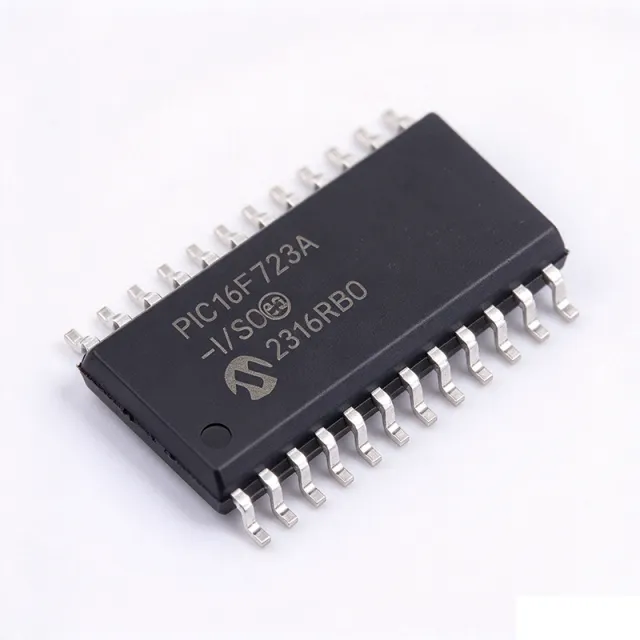
PIC16F723A-I/SO - 20MHz 8-bit XLP MCU 7KB Flash 28-SOIC | Microchip
PIC16F723A-I/SO

PIC16F723A-I/SO - 20MHz 8-bit XLP MCU 7KB Flash 28-SOIC | Microchip

The Microchip PIC16F723A-I/SO is a 28-pin 8-bit PIC® microcontroller built on the nanoWatt XLP™ ultra-low-power platform, integrating 7 KB (4K x 14) of self-programmable Flash, 192 bytes of RAM, and 128 bytes of EEPROM, and operates up to 20 MHz from a 1.8 V to 5.5 V supply. Housed in a 28-pin 300-mil SOIC (-I/SO industrial temperature grade, -40°C to +85°C), the device is a drop-in member of the PIC16F722A/723A family. What is an 8-bit PIC microcontroller? An 8-bit MCU (microcontroller unit) is a single-chip computer that integrates CPU core, program memory, data memory, peripherals, and I/O on one silicon die, designed for deterministic, low-cost embedded control. The PIC16 family sits within the larger 8-bit MCU category, and within that the nanoWatt XLP variants target battery-powered and energy-harvesting applications where quiescent current in the nanoampere-to-microampere range extends operating life. Key features of the PIC16F723A-I/SO include 11 analog input channels (10-bit ADC), one Enhanced Capture/Compare/PWM (ECCP) module plus one CCP module, two 8-bit timers and one 16-bit timer, a 2-wire MSSP that supports I²C and SPI, an Enhanced USART, an internal 16 MHz high-accuracy oscillator (±1% typical), and deep-sleep currents as low as 50 nA typical (per the family data sheet). Architecturally, the PIC16F723A uses the 14-bit enhanced mid-range RISC core with a hardware 8x8 multiplier, a single 8-level hardware stack, and a vectored interrupt controller. The 4K-word Flash supports self-programming under firmware control, allowing in-field firmware updates via bootloader. The internal voltage reference (bandgap) and the configurable on-chip oscillator eliminate external timing components in most designs. Typical applications include IoT sensor nodes, battery-powered remote controls, low-cost consumer appliances, e-metering peripherals, and human-interface boards where its XLP sleep current plus integrated peripherals reduce both PCB area and BOM cost. Designers choose this device when 7 KB of Flash is sufficient and 11 ADC channels, plus an MSSP, are needed. When designing, plan the regulator and decoupling for the -I (industrial) temperature range; ensure the ICSP™ programming pins are accessible for in-circuit programming. Verify the absolute maximum VDD of 7.5 V is never exceeded at hot-plug events, and respect the brown-out-reset voltage thresholds (BOR) configured in the configuration words. This page synthesizes distributor pricing, drop-in alternatives within the PIC16 family, and practical design notes not consolidated on the manufacturer product page.

Cotización Contacto
PIC16F723A-I/SP - 7KB Flash 8-bit MCU 20MHz XLP | Microchip
PIC16F723A-I/SP

PIC16F723A-I/SP - 7KB Flash 8-bit MCU 20MHz XLP | Microchip

The Microchip Technology PIC16F723A-I/SP is an 8-bit flash microcontroller belonging to the PIC16F family with nanoWatt XLP (eXtreme Low Power) technology, operating at up to 20 MHz instruction clock and packaged in a 28-pin SPDIP (Skinny Plastic DIP) through-hole format. It integrates 7 KB of self-programmable flash program memory (4K x 14 words), 192 bytes of RAM, and 128 bytes of EEPROM, providing a balanced mix of code space and on-chip data storage for cost-sensitive embedded designs. The industrial temperature grade (-40C to +85C) and 2.0V to 5.5V wide operating range support battery-powered and industrial-sensing nodes. A microcontroller (MCU) is a single-chip computer containing a CPU core, program and data memory, peripheral interfaces, and I/O pins on one silicon die. The PIC16 family sits in Microchip's mid-range 8-bit portfolio, bridging simple PIC10/PIC12 baseline parts and the PIC18 enhanced family, and is widely used in consumer appliances, sensor hubs, lighting controllers, and battery-powered IoT nodes where code density, deterministic interrupt latency, and low sleep current dominate the design trade-off. Key features of the PIC16F723A-I/SP include 22 digital I/O pins (shared with analog and peripheral functions), an internal 16 MHz high-precision oscillator, an 8-channel 10-bit ADC, two 8-bit timers and one 16-bit timer, an Enhanced Universal Synchronous Asynchronous Receiver Transmitter (EUSART), and Master I2C/SPI interfaces. The XLP variants include Sleep modes drawing as little as 20 nA, an integrated mTouch capacitive-sensing peripheral, and a Watchdog Timer with on-chip low-power oscillator for fail-safe operation. The PIC16F723A-I/SP uses Microchip's enhanced mid-range 8-bit core with a 14-bit instruction word and a single-cycle hardware stack. In-system programming (ICSP) via two pins enables field firmware upgrades, and the ICD debug header allows MPLAB X IDE to step through code with breakpoints. The part shares its peripheral set, register map, and instruction set with the broader PIC16F72X family, allowing code portability across PIC16F722A, PIC16F723, and PIC16F723A silicon revisions. Typical applications include consumer white goods and small kitchen appliances, HVAC thermostat control boards, battery-powered sensor transmitters, LED lighting drivers, capacitive touch user interfaces, and remote control units. The combination of low sleep current, ample I/O count, and small code footprint also makes the part a common choice for drop-in modernization of legacy PIC16C/PIC16F designs. When designing with this MCU, allocate a 100 nF decoupling capacitor adjacent to each VDD/VSS pair, follow Microchip's PCB layout guideline for the ICSP clock/data lines, and use the Configuration Words to lock the unused peripherals in reset. The 28-pin SPDIP package is convenient for breadboard prototyping and through-hole production boards; for SMT designs, choose the PIC16F723A-I/SO (SOIC-28) or PIC16F723A-I/ML (QFN-28) variants instead. This page synthesizes distributor pricing, drop-in replacement MPNs in the same SPDIP-28 footprint, and practical design notes compiled from Microchip's PIC16(L)F722A/723A datasheet and application notes - data not aggregated on a single distributor or manufacturer page.

Cotización Contacto
PIC16F723A-I/SS - 8-bit MCU 7KB Flash 20MHz XLP | Microchip
PIC16F723A-I/SS

PIC16F723A-I/SS - 8-bit MCU 7KB Flash 20MHz XLP | Microchip

The Microchip PIC16F723A-I/SS is an 8-bit PIC microcontroller in the mid-range PIC16 family, featuring 7KB Flash program memory, 192 bytes RAM, and an integrated 20 MHz internal oscillator, all housed in a 28-pin SSOP package. It operates across a wide supply range of 1.8V to 5.5V and integrates Microchip's nanoWatt XLP extreme low-power technology, achieving typical sleep currents in the microampere range for battery-driven applications. An 8-bit PIC microcontroller is a compact, single-chip computer built on a Harvard RISC architecture that executes one instruction per clock cycle (except branches). The PIC16 mid-range core provides 35 single-word instructions, deterministic timing, and a small footprint, making PIC16F devices a workhorse for embedded control in appliances, sensors, and low-power industrial nodes. They sit in the hierarchy: microcontroller -> 8-bit MCU -> embedded controller -> semiconductor. Key differentiating features include 11-channel 8-bit ADC, two comparators, enhanced CCP modules, MSSP (SPI/I2C) and EUSART (asynchronous serial) peripherals, and nanoWatt XLP modes with typical currents below 1 uA in sleep with WDT enabled. The on-chip 16-level voltage regulator and brown-out reset improve robustness in noisy or battery-depleted environments. Architecturally, the PIC16F723A uses a modified Harvard core with separate program (Flash) and data (RAM) buses, 14-bit wide instructions, and a peripheral set optimized for mixed-signal control. The integrated 20 MHz internal oscillator eliminates external crystals in most designs, reducing BOM cost. The 28-pin SSOP variant (suffix /SS) supports surface-mount assembly while preserving pin compatibility with the SOIC (/SO), SPDIP (/SP), and QFN (/ML) siblings for PCB layout reuse. Typical applications include battery-powered sensor nodes, household appliances, low-power remote controls, HVAC thermostat controls, and small consumer appliances where low sleep current, on-chip ADC, and serial peripherals (EUSART + MSSP) cover the bulk of I/O needs without external components. When designing with this device, plan the oscillator start-up timer, watchdog timer, and brown-out reset behavior carefully during firmware bring-up. The internal oscillator is factory calibrated to within 1% across voltage and temperature, but high-accuracy UART or USB timing still benefits from a crystal. This page consolidates distributor pricing, package-pinned drop-in alternatives, and practical design notes that are not found in the manufacturer datasheet alone - giving engineers a single reference for part selection, second sourcing, and layout decisions.

Cotización Contacto
PIC16F723AT-I/MV - 8-bit 7KB Flash MCU, 28-Pin UQFN | Microchip
PIC16F723AT-I/MV

PIC16F723AT-I/MV - 8-bit 7KB Flash MCU, 28-Pin UQFN | Microchip

The Microchip PIC16F723AT-I/MV is a low-power 8-bit PIC16 RISC microcontroller with 7KB Flash program memory, available in a 28-pin UQFN EP (exposed pad) surface-mount package supplied on tape and reel. It is part of Microchip's PIC16F/LF722A/723A family and operates across 2.5V / 3.3V / 5V rails, qualified to AEC-Q100 for automotive applications. The 'T' suffix indicates tape-and-reel packaging and the 'I' indicates the -40C to +85C industrial temperature range. An 8-bit microcontroller (MCU) is a small, self-contained computer-on-a-chip containing a CPU, non-volatile program memory (Flash), working RAM, and a set of peripheral blocks such as timers, ADCs, comparators and communication ports. Microcontrollers belong to the broader category of embedded processors and sit one level below microprocessors in system hierarchy. The PIC16 core is a Harvard-architecture RISC design from Microchip Technology, executing most instructions in a single instruction cycle and offering deterministic interrupt response. The 'F' in PIC16F723A denotes Flash program memory, allowing in-circuit re-programming via ICSP. Key specifications of the PIC16F723AT-I/MV include 7KB of Flash program memory, 192 bytes of RAM, 11 ADC channels at 8-bit resolution, two 8-bit timers and one 16-bit timer, an Enhanced Capture/Compare/PWM (ECCP) module, and nanoWatt XLP extreme-low-power technology. Communication peripherals include AUSART (RS-232/RS-485), MSSP (I2C/SPI), and an SR-latch. Operating voltage spans 1.8V to 5.5V across LF and F speed grades, and the device supports internal 16MHz, 8MHz, 4MHz, 2MHz, 1MHz, 500kHz, 250kHz and 31kHz oscillator modes via the INTOSC block. The architecture combines a 14-bit instruction set with 8-bit data path, giving compact code density relative to 32-bit Cortex-M cores. The PIC16F723A family is a mid-range PIC16 device that balances peripheral count with package size, making it suitable for space-constrained designs that do not need full USB or CAN stacks. The internal oscillator eliminates external crystal components, while the integrated brown-out reset (BOR) and Power-on Reset (POR) improve system reliability. nanoWatt XLP provides sleep currents below 1 uA typical, enabling battery-powered applications. Typical applications include automotive body and convenience modules, battery-powered sensor nodes, low-power IoT endpoints, consumer appliance control panels, and small-form-factor human-machine interface (HMI) boards. The wide 1.8V-5.5V operating range also makes the part suitable for industrial sensor interfaces and 3.3V wireless modules. For designs requiring AEC-Q100 automotive qualification, this 'I' grade -40C to +85C version delivers automotive temperature resilience and PPAP documentation support. When designing with this MCU, consider that the UQFN EP package requires thermal vias under the exposed pad to the inner PCB ground plane for proper heat dissipation during sustained CPU activity. Programming uses Microchip's ICSP interface on PGx and PGCx pins, so layout must keep these accessible. For low-power sleep-mode operation, disable unused peripherals via firmware and verify the WDT configuration matches the desired current budget. This page synthesizes distributor pricing, drop-in same-package alternatives, and practical design notes not found in the manufacturer datasheet alone, giving engineers a single reference to compare footprint-compatible options and accelerate BOM decisions for 28-pin UQFN automotive-grade designs.

Cotización Contacto
PIC16F723AT-I/SO - 8-bit MCU, 7KB Flash, 20MHz | Microchip
PIC16F723AT-I/SO

PIC16F723AT-I/SO - 8-bit MCU, 7KB Flash, 20MHz | Microchip

The Microchip Technology PIC16F723AT-I/SO is an 8-bit RISC microcontroller from the PIC16F/LF722A/723A family, integrating 7KB (4K x 14) of Flash program memory with 192 bytes of RAM and operating at up to 20MHz CPU clock in a 28-pin SOIC package (wide body). It belongs to the PIC® XLP™ (eXtreme Low Power) family, supporting an extended operating voltage range from 1.8V to 5.5V. A microcontroller (MCU) is a single-chip computer containing a CPU, non-volatile program memory (Flash/ROM), volatile data memory (RAM), and a configurable set of peripherals on a single silicon die. The 8-bit PIC16 architecture uses a RISC-style instruction set with a fixed instruction width, prioritizing deterministic execution and code density for embedded control applications. Within the broader semiconductor hierarchy, the PIC16F723A sits under: MCU -> microcontroller -> embedded processor -> integrated circuit -> semiconductor. Key features include 7KB Flash program memory, 192 bytes RAM, 11 channels of 8-bit ADC, up to 25 digital I/O pins, an internal 16MHz high-precision oscillator (factory calibrated to ±1% typical), and an enhanced USART, MSSP (SPI/I2C), and Capture/Compare/PWM (CCP) module. NanoWatt XLP™ technology delivers typical sleep currents below 50 nA, making the part suitable for battery-powered sensor and metering nodes. The wide VDD range (1.8V-5.5V) allows direct operation from a single 3.3V or 5V rail or from low-voltage chemistries such as a single Li-ion cell. The PIC16F723A architecture implements a Harvard-style memory map with separate program and data buses, a hardware stack of 8 levels, and 35 single-word instructions. The 8-bit data path is supported by direct, indirect, and relative addressing modes, and the integrated 11-channel 8-bit ADC with selectable references allows the device to read sensors such as thermistors, photodiodes, and current-sense shunts without external components. The automotive-grade AEC-Q100 qualification (operating from -40C to +85C for the I-temp version) and robust ESD ratings make it suitable for harsh-environment industrial and automotive subsystems. Typical applications include battery-powered sensor nodes, low-cost motor control, LED lighting controllers, automotive body and accessory modules, smart metering, consumer white goods, and human-machine interface (HMI) controllers. The combination of XLP sleep current, on-chip ADC, and CCP PWM makes the part a strong fit for closed-loop fan or pump speed control and for capacitive-touch user interfaces implemented in firmware. When designing with this part, ensure the LF (low-Flash) variant is selected when only 3.5KB of program memory is needed to drop quiescent current further, and verify that the I-temp grade (-40C to +85C) matches your application's thermal envelope. The 28-pin SOIC (wide) footprint allows hand-rework and through-hole-like mechanical robustness while still being compatible with standard SMT lines. This page synthesizes distributor pricing, drop-in alternatives, and practical design notes not found on DigiKey, Mouser, or in the bare Microchip datasheet PDF.

USD $1,05 En stock
PIC16F723T-I/ML - 8-bit MCU, 7KB Flash, 20MHz, 28-QFN | Microchip
PIC16F723T-I/ML

PIC16F723T-I/ML - 8-bit MCU, 7KB Flash, 20MHz, 28-QFN | Microchip

The Microchip PIC16F723T-I/ML is an 8-bit PIC microcontroller from the PIC16F series Extreme Low Power (XLP) family, featuring 7KB of Flash program memory (4K x 14 words), 192 bytes of RAM, and 25 I/O pins. It operates at a maximum clock speed of 20MHz across an industrial temperature range of -40C to +85C, supplied by 1.8V to 5.5V, in a 28-pin QFN package with exposed pad for improved thermal dissipation. An 8-bit microcontroller (MCU) is a single-chip computer that integrates a CPU, memory (Flash/RAM), and peripherals around an 8-bit data path. The PIC architecture uses a reduced instruction set (RISC) with Harvard bus topology, separating program and data memory for deterministic instruction timing. Within the broader semiconductor hierarchy, an 8-bit MCU sits below 16-bit and 32-bit MCUs in computational throughput, but excels in cost-sensitive, low-power embedded roles. The PIC16F723 specifically targets the sub-32KB Flash, sub-1KB RAM class where simplicity and nanoWatt XLP sleep currents matter more than raw MIPS. Key differentiating features include nanoWatt XLP technology for sub-uA sleep currents, integrated PWM modules, watchdog timer, brown-out reset, and on-chip 16MHz internal oscillator that allows operation without an external crystal. The 28-QFN (ML) package with exposed thermal pad reduces footprint while providing solid thermal performance at the 20MHz speed grade. The PIC16F723 employs a 14-bit instruction word with a two-stage pipeline, delivering approximately 5 MIPS instruction transfer to firmware. On-chip peripherals include a 10-bit ADC (referenced in family datasheets), comparators, enhanced USART, and capture/compare/PWM modules. The internal 16MHz oscillator is factory calibrated to within 1% across voltage and temperature. Typical applications include battery-powered sensor nodes, consumer appliance controls, low-cost IoT edge devices, LED lighting controllers, and small industrial control boards. The combination of low cost, low power, and a mature toolchain makes it well-suited for high-volume embedded products where BOM cost dominates MCU selection. When designing with this device, plan decoupling carefully: place a 100nF ceramic bypass close to VDD and a bulk capacitor near the exposed pad. For sleep-mode designs, follow Microchip's nanoWatt XLP application notes to minimize quiescent current and to leverage the on-chip LFINTOSC for timer-only operation. This page synthesizes distributor pricing, drop-in same-package alternatives, and practical design notes drawn from Microchip's PIC16F72X family datasheet, complementing the manufacturer documentation with information not found in any single source.

Cotización Contacto
PIC16F723T-I/MV - 28-Pin XLP 8-Bit MCU, 7KB Flash | Microchip
PIC16F723T-I/MV

PIC16F723T-I/MV - 28-Pin XLP 8-Bit MCU, 7KB Flash | Microchip

The Microchip Technology PIC16F723T-I/MV is a 28-pin, 8-bit PIC microcontroller in the UQFN (MV) package, featuring nanoWatt XLP (eXtreme Low Power) technology for battery-friendly applications. It integrates 7 KB of Flash program memory, 192 bytes of RAM, and operates from 1.8V to 5.5V across an industrial -40C to +85C temperature range, suiting it for both consumer and industrial embedded designs. An 8-bit microcontroller (MCU) is a compact computer-on-a-chip built around an 8-bit data path. Within the broader semiconductor taxonomy, an MCU sits below microprocessor (MPU) and above application-specific integrated circuit (ASIC); the PIC16 family in particular is a mature mid-range RISC architecture from Microchip widely used for control loops, sensor interfacing, and human-machine interface (HMI) tasks. The PIC16F723 belongs to the "F72X" subset that adds nanoWatt XLP peripherals for ultra-low-power sleep modes. Key features of the PIC16F723T-I/MV include an enhanced mid-range 16-bit instruction set with 49 instructions, 11-channel 8-bit ADC, two 8-bit and one 16-bit timers, EUSART, MSSP (SPI/I2C), and ultra-low-power sleep currents in the nanoamp range. The 28-pin UQFN package is the same 4x4 mm land pattern shared across the family, enabling footprint-compatible migration. The device is built on Microchip's enhanced mid-range core running up to 20 MHz at 5V, with a wide 1.8V-5.5V supply that simplifies single-cell Li-ion or 3.3V system designs. XLP technology provides Sleep currents under 20 nA typical and an integrated low-power watchdog, allowing years of operation on coin-cell batteries. Typical applications include battery-powered sensor nodes, consumer appliances, LED lighting controllers, remote controls, and low-end industrial control. The compact UQFN package suits space-constrained handheld products where board area is at a premium. When designing with this part, derate the maximum clock at lower VDD (16 MHz at 2.5V, 8 MHz at 1.8V). Ensure MCLR is properly tied or configured as a digital input to avoid unintentional reset. This page synthesizes distributor pricing, drop-in UQFN-28 alternatives from the PIC16F family, and practical design notes not found in the manufacturer datasheet.

Cotización Contacto