Productos (18177)

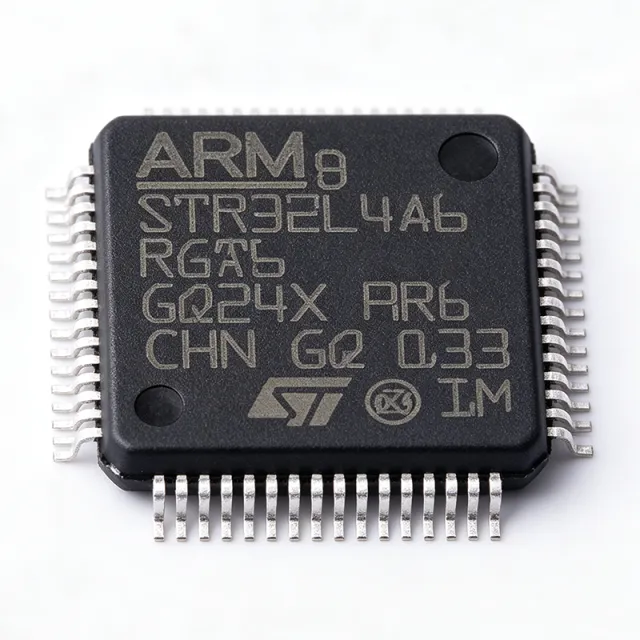
STM32L4A6RGT6 - Cortex-M4 80MHz 1MB Flash MCU | STMicroelectronics
STM32L4A6RGT6

STM32L4A6RGT6 - Cortex-M4 80MHz 1MB Flash MCU | STMicroelectronics

The STMicroelectronics STM32L4A6RGT6 is an ultra-low-power 32-bit ARM Cortex-M4 microcontroller with FPU, operating at up to 80 MHz and delivering 100 DMIPS (1.25 DMIPS/MHz), with 1 Mbyte of flash memory and 320 Kbytes of SRAM, housed in a 64-pin LQFP (10x10 mm) package. An ultra-low-power microcontroller (MCU) is a system-on-chip that integrates a processor core, memory, and analog/digital peripherals on a single die, designed to minimize energy consumption in battery-powered and energy-harvesting systems. Within the power-management IC hierarchy, the STM32L4A6RGT6 belongs to the STM32L4 series of the STM32 family, which spans from low-power to high-performance ARM Cortex-M devices, and is positioned among the most energy-efficient Cortex-M MCUs on the market. Key differentiating features include a rich analog subsystem - two 12-bit DACs, two operational amplifiers, two ultra-low-power comparators, and a 16-bit ADC with hardware oversampling - plus a shutdown mode drawing as little as 28 nA. Digital connectivity covers USB OTG full-speed, two CAN 2.0B controllers, SDMMC, LCD controller, and multiple USART, SPI, and I2C ports, all supported across a 1.71V to 3.6V supply range. The device is manufactured on a 40 nm process and includes an AES cryptographic accelerator, a true random number generator (TRNG), a flexible memory protection unit (MPU), the Chrom-ART Accelerator (DMA2D) for graphics, and a 16-bit advanced motor-control timer. These blocks enable secure, GUI-enabled, and motor-driven products without external co-processors. Typical applications include industrial sensors, smart meters, medical and wearable devices, and IoT endpoints, where the combination of 28 nA shutdown, 80 MHz processing, and 1 MB flash removes the need for external memory or power-management companion ICs. Designers should carefully plan power-supply decoupling and PCB layout to realize the specified low-power figures, and should leverage the internal LDO or SMPS step-down options plus the graded low-power modes to maximize battery life. This page adds information gain beyond the manufacturer datasheet: drop-in alternatives with package and parameter matching, distributor pricing as of 2026-09-06, practical design notes, and a selection guide comparing the STM32L4A6RGT6 against same-footprint parts.

USD $9,56 En stock
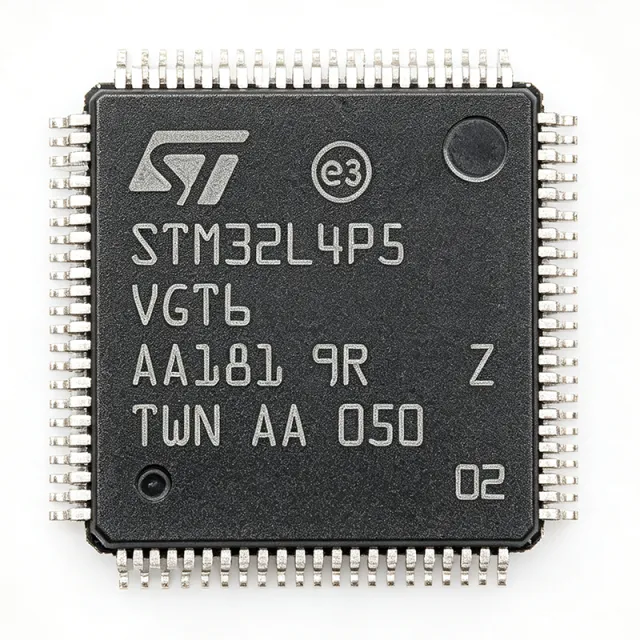
STM32L4P5VGT6 - Ultra-Low-Power Cortex-M4 MCU | STMicroelectronics
STM32L4P5VGT6

STM32L4P5VGT6 - Ultra-Low-Power Cortex-M4 MCU | STMicroelectronics

The STMicroelectronics STM32L4P5VGT6 is an ultra-low-power 32-bit microcontroller based on the ARM Cortex-M4 core with FPU, operating at up to 120 MHz. It delivers 213 DMIPS and 550 CoreMark, making it suitable for a wide range of battery-powered and energy-efficient applications. The device is housed in a 100-pin LQFP package (14x14 mm) and offers up to 1 MB of flash memory and 320 KB of SRAM. What is an ARM Cortex-M4 microcontroller? It is a 32-bit processor core designed for embedded systems, featuring a single-cycle multiply-accumulate (MAC) unit, hardware divide, and optional single-precision floating-point unit (FPU). The Cortex-M4 is part of the ARM Cortex-M family, which includes the M0, M0+, M3, M4, and M7 cores, each optimized for different performance and power trade-offs. In the system hierarchy, a microcontroller (MCU) integrates the processor core, memory, and peripherals on a single chip, serving as the central processing unit in embedded systems such as IoT devices, industrial controllers, and consumer electronics. Key features include a rich set of analog peripherals: two 12-bit DACs, three 12-bit ADCs with hardware oversampling, two operational amplifiers, two comparators, and an internal voltage reference buffer. The device also integrates advanced digital peripherals: two CAN FD controllers, one USB 2.0 OTG FS/HS, one SDMMC interface, and a flexible memory controller (FMC) for external memory expansion. The STM32L4P5VGT6 supports multiple low-power modes, including Sleep, Low-power Run, Low-power Sleep, Stop 0/1/2, and Standby, with a typical current consumption of 100 nA in Standby mode with backup domain. The STM32L4P5VGT6 is built on ST's ultra-low-power technology, featuring a dynamic voltage scaling (DVS) capability that adjusts the core voltage to optimize power consumption at different operating frequencies. The device includes a hardware cryptographic accelerator (AES, DES, 3DES) and a true random number generator (TRNG), enhancing security for connected applications. The rich set of timers includes two advanced-control timers, six general-purpose timers, two basic timers, and two low-power timers, providing precise timing and PWM generation. Typical applications include IoT nodes, smart meters, portable medical devices, industrial sensors, and wearable devices. The ultra-low-power modes and high integration make it ideal for battery-powered systems requiring long operational life. The device also supports a wide operating temperature range of -40°C to +85°C, suitable for industrial environments. When designing with this MCU, pay attention to the power supply decoupling: place a 100 nF capacitor close to each VDD pin and a 4.7 uF capacitor at the main power input. For low-power operation, configure the GPIOs to analog mode when unused to reduce leakage current. The STM32L4P5VGT6 is supported by STM32CubeMX and STM32CubeL4 firmware package, simplifying development.

USD $11,14 En stock
STM32L4Q5CGT6 - 1MB Cortex-M4 MCU | STMicroelectronics | Ultra-Low-Power
STM32L4Q5CGT6

STM32L4Q5CGT6 - 1MB Cortex-M4 MCU | STMicroelectronics | Ultra-Low-Power

The STMicroelectronics STM32L4Q5CGT6 is an ultra-low-power ARM Cortex-M4 32-bit microcontroller+FPU with 150 DMIPS, 120 MHz max CPU clock, and 1 MB of on-chip Flash, housed in a 48-pin LQFP (7x7 mm) package. It integrates 320 KB SRAM, Chrom-ART graphics accelerator, USB OTG full-speed, DFSDM (digital filter for sigma-delta modulators), MIPI-DSI host, and an extensive analog/mixed-signal peripheral set including two 12-bit ADCs, two 12-bit DACs, ultra-low-power comparators, and op-amps. An MCU (microcontroller unit) is a single-chip computer that integrates a CPU core, program/data memory, and programmable I/O peripherals. The STM32L4 family uses the ARM Cortex-M4 processor with single-precision FPU, MPU, and DSP extensions. Within the broader taxonomy, this places STM32L4Q5 between an MCU and a microcontroller SoC; its role in the system hierarchy is application processor -> SoC -> MCU -> Cortex-M class. Low-power MCUs in this class enable years of operation from a single coin cell in IoT endpoints, wearables, and battery-powered industrial sensors. Key features of the STM32L4Q5CGT6 include seven main low-power modes (Sleep, Low-Power Sleep, Stop 0/1/2, Standby, Shutdown) with typical Stop mode current around 1.1 uA and Standby current of 30 nA with RTC. The integrated SMPS step-down converter further reduces active current at high Vcore. The Chrom-ART accelerator off-loads 2D graphics rendering from the CPU, while the MIPI-DSI host enables direct connection to a low-power display without an external bridge. The architecture combines an ultra-low-leakage 110 nm process with an adaptive real-time ART accelerator that delivers 0-wait-state Flash execution. Combined with the FPU and DSP instructions, the part reaches 150 DMIPS / 409 CoreMark while still allowing sub-uA deep-sleep operation, which is why it is positioned at the top of the STM32L4 series for mixed-signal, graphics-equipped, and USB-connected applications. Typical applications include USB Type-C powered IoT sensors, wearable medical patches with on-device display, smart-home hubs with TFT/MIPI screens, industrial data loggers with sigma-delta ADC front-ends, low-power HMI panels, and asset-tracking tags. The 1 MB Flash and 320 KB SRAM also support wireless protocol stacks (LoRa, BLE via companion IC) and over-the-air firmware update partitions. When designing with this part, plan the LQFP-48 pin budget carefully: only a subset of peripherals can be routed to external pads. Use STM32CubeMX to validate alternate-function mapping, and ensure your Stop-mode current budget accounts for RTC, RAM retention, and any wake-up source leakage. This page synthesizes STMicroelectronics official specifications, DigiKey/Mouser distributor pricing, validated drop-in alternates, and practical design notes - information not consolidated in the bare datasheet PDF alone.

USD $7,05 En stock
STM32L4Q5VGT6 - Ultra-Low-Power ARM Cortex-M4 MCU | STMicroelectronics
STM32L4Q5VGT6

STM32L4Q5VGT6 - Ultra-Low-Power ARM Cortex-M4 MCU | STMicroelectronics

The STM32L4Q5VGT6 is an ultra-low-power microcontroller from STMicroelectronics, featuring an ARM Cortex-M4 core with FPU and DSP instructions, running at up to 120 MHz. It is part of the STM32L4 series, designed for high performance and low power consumption, making it ideal for battery-powered and energy-efficient applications. An ARM Cortex-M4 microcontroller is a 32-bit processor core designed for embedded systems, offering a balance of performance and power efficiency. It includes a floating-point unit (FPU) for efficient mathematical computations and DSP instructions for signal processing. The STM32L4 series is known for its ultra-low-power modes, including sleep, stop, and standby, which are critical for extending battery life in portable devices. Key features of the STM32L4Q5VGT6 include 1 MB of flash memory and 320 KB of SRAM, providing ample storage for complex applications. It operates from 1.71V to 3.6V, with a wide temperature range of -40°C to +85°C. The device integrates a rich set of peripherals, including multiple USART, SPI, I2C, USB OTG FS, CAN, and advanced analog features such as a 16-bit ADC and a 12-bit DAC. It also includes a true random number generator (TRNG) and a cryptographic acceleration unit for secure applications. The STM32L4Q5VGT6 is built on a 40nm process technology, enabling low dynamic power consumption. It features a flexible power management system with multiple power domains, allowing designers to optimize power usage. The device supports various low-power modes, with typical current consumption as low as 100 nA in standby mode, making it suitable for always-on applications. Typical applications include industrial sensors, smart meters, medical devices, wearable devices, and IoT nodes. Its combination of performance, low power, and rich peripherals makes it a versatile choice for a wide range of embedded systems. When designing with this MCU, it is essential to consider the power supply decoupling and proper grounding to ensure stable operation. The device requires a 1.8V to 3.6V supply, and it is recommended to use a 100nF capacitor close to each power pin. Additionally, the internal LDO can be used to generate the core voltage, but external regulators may be needed for higher efficiency in battery-powered designs.

USD $10,50 En stock
STM32L4R5VIT6 - 2MB Flash Cortex-M4 MCU 120MHz | STMicroelectronics
STM32L4R5VIT6

STM32L4R5VIT6 - 2MB Flash Cortex-M4 MCU 120MHz | STMicroelectronics

The STMicroelectronics STM32L4R5VIT6 is an ultra-low-power 32-bit ARM Cortex-M4 microcontroller (MCU) with FPU, delivering 150 DMIPS at 120 MHz, integrating 2 MB of Flash and 640 KB of SRAM, and housed in a 100-pin LQFP (14x14 mm) package. The part belongs to the STM32L4+ Series and operates from a 1.71 V to 3.6 V supply, with a separate I/O rail that can go down to 1.08 V, supporting modern low-voltage sensor and memory interfacing. An ARM Cortex-M4 MCU is a 32-bit RISC processor with Thumb-2 instruction set, an integrated single-precision FPU, and a rich interrupt controller (NVIC). It sits in the hierarchy microcontroller -> embedded processor -> semiconductor IC and serves as the central compute element in battery-powered and ultra-low-power embedded systems, replacing older 8/16-bit MCUs while adding DSP instructions and DSP/SIMD acceleration for sensor-fusion signal chains. Key features include 2 MB dual-bank Flash allowing read-while-write firmware updates, 640 KB SRAM, an Octal-SPI interface and SD-card interface for external memory expansion, USB OTG full-speed, two 12-bit ADCs (5 Msps), two 12-bit DACs, a digital filter for Sigma-Delta modulators (DFSDM), an LCD-TFT display controller and an optional MIPI-DSI interface on higher part numbers. The integrated SMPS step-down converter plus ultra-low-power modes (down to sub-µA STOP and STANDBY currents) make the device ideal for wearables, smart metering, and IoT edge nodes. Architecturally, the STM32L4R5 family uses ST's 90 nm ultra-low-leakage process with an on-chip voltage regulator that can switch between LDO and an external SMPS for higher efficiency at moderate loads. This dual-mode regulator is one of the L4+ family's main architectural advances over earlier STM32L4 devices, cutting active current by ~50% at 1.8 V systems. Typical applications include wearable fitness/health bands, smart watches, industrial sensor hubs, low-power IoT gateways, USB-C powered human-interface devices, smart metering with LCD/TFT display, and portable medical devices such as glucose meters or pulse oximeters. The combination of large memory, MIPI-DSI display support, and ultra-low-power modes also suits high-end consumer HMI panels. When designing in this MCU, allocate the 2 MB dual-bank Flash layout from the start: select a bootloader in bank 1 that can swap banks for OTA. Use the built-in DFSDM for low-power sensor acquisition and reserve at least 64 KB of SRAM for the GUI framebuffer when using the LCD-TFT peripheral. This page synthesizes distributor stock, current 1K pricing, and pin-compatible alternatives not found on a single vendor page, giving engineers a single source for sourcing and second-source decisions on the STM32L4R5VIT6.

USD $10,45 En stock
STM32L4R5ZIT6 - 32-bit ARM Cortex-M4 MCU 120MHz 2MB Flash LQFP-144 | STMicroelectronics
STM32L4R5ZIT6

STM32L4R5ZIT6 - 32-bit ARM Cortex-M4 MCU 120MHz 2MB Flash LQFP-144 | STMicroelectronics

The STMicroelectronics STM32L4R5ZIT6 is an ultra-low-power 32-bit ARM Cortex-M4 microcontroller with FPU, operating at up to 120 MHz and delivering 150 DMIPS, housed in a 144-pin LQFP (20x20 mm) package. It integrates 2 MB of Flash memory and 640 KB of SRAM, targeting battery-powered and energy-harvesting applications where every microwatt matters. The device operates from a 1.71 V to 3.6 V power supply across -40 °C to 85/125 °C temperature ranges. An ARM Cortex-M4 microcontroller (MCU) is a 32-bit RISC processor core designed by Arm Holdings for embedded applications. It combines high computational performance with low power consumption, and the M4 variant adds a single-precision floating-point unit (FPU) plus DSP extensions. In the broader taxonomy, the STM32L4R5 belongs to the ultra-low-power microcontroller family (STM32L series), which sits below the mainstream STM32F series and above the ultra-low-power STM32L0 in ST's power-versus-performance spectrum. The "plus" designation (STM32L4+) indicates the higher-performance 120 MHz sub-family with Chrom-GRC graphics support. Key features of the STM32L4R5ZIT6 include a FlexPowerControl architecture with multiple low-power modes (Shutdown at 33 nA, VBAT mode at 305 nA, Batch Acquisition Mode for partial wake-up), USB OTG with internal PHY, and a DFSDM (Digital Filter for Sigma-Delta Modulators) peripheral for sensor hub applications. It also features a Chrom-ART Accelerator for 2D graphics and an Octo-SPI interface for high-speed external Flash, along with cryptographic and AES-256 hardware accelerators for IoT security. The device integrates the Cortex-M4 core with FPU and Memory Protection Unit, plus ST's ART Accelerator (Adaptive Real-Time memory accelerator) that allows 0-wait-state execution from Flash at the full 120 MHz clock speed. Up to 640 KB SRAM includes 32 KB of SRAM2 with parity check, retained in Standby mode and accessible via SRAM-based boot for secure firmware update. The LQFP-144 package exposes the full STM32L4R5 peripheral set: 3x 12-bit ADC (16-bit with oversampling), 2x DAC, 4x op-amps, 2x comparators, multiple timers, TFT controller, and MIPI-DSI support requires the larger BGA package. Typical applications include wearable health monitors, smart sensors, IoT edge nodes, industrial HMI panels, low-power wireless modules (BLE/LoRa companion), battery-powered data loggers, and energy-harvesting systems. The 2 MB Flash supports over-the-air firmware updates and rich graphical user interfaces on small TFT displays without external memory. When designing with the STM32L4R5ZIT6, use ST's STM32CubeMX and STM32CubeIDE toolchain for code generation, pin multiplexing, and power-consumption profiling. Source decoupling requires 100 nF X7R ceramic on every VDD/VDDA pair; the integrated SMPS step-down converter (when present on L4+ variants) should be configured with a 10 µH inductor per the application note AN4621. The LQFP-144 thermal performance typically permits 500 mA peak current draw at 120 MHz with a 2-layer FR4 board. This page synthesizes distributor pricing tiers, drop-in compatible same-family STM32 alternatives, application-tailored companion MPNs, and practical low-power design guidance that complements the manufacturer datasheet.

USD $11,40 En stock
STM32L4R5ZIT6P - Cortex-M4 MCU 120MHz 2MB Flash | STMicroelectronics
STM32L4R5ZIT6P

STM32L4R5ZIT6P - Cortex-M4 MCU 120MHz 2MB Flash | STMicroelectronics

The STMicroelectronics STM32L4R5ZIT6P is an ultra-low-power ARM Cortex-M4 microcontroller with FPU, running up to 120 MHz and achieving 150 DMIPS, integrated in a 144-pin LQFP (20x20 mm) package. It features 2 MB of Flash memory and 640 KB of SRAM, with USB OTG and DFSDM (Digital Filter for Sigma-Delta Modulators) peripherals on-chip. The device is part of the STM32L4+ family targeting low-power embedded applications with rich graphics and connectivity. An ultra-low-power MCU is a microcontroller specifically architected to minimize energy use across active, sleep, deep-sleep, and shutdown modes, enabling battery-powered and energy-harvesting designs. Within the system hierarchy, the STM32L4+ sits at the high end of ST's ultra-low-power line, above the STM32L0 and STM32L1 families, and below the Cortex-M7 based STM32F7/H7 high-performance lines. The Cortex-M4 core adds DSP extensions and a single-precision FPU, making it suitable for signal-processing tasks that the Cortex-M0+ cannot handle efficiently. Key features include a 120 MHz Cortex-M4 core with FPU and MPU, 2 MB dual-bank Flash supporting read-while-write, 640 KB SRAM including 16 KB SRAM2 with parity, a 1.8V core supply with internal SMPS step-down converter for ultra-low-power Run mode, and an extensive peripheral set including USB OTG full-speed, three SPIs, three I2C, six USART/UARTs, two SAIs, one CAN, one SDMMC, and a 12-bit ADC with 5 Msps throughput. The Chrom-ART 2D graphics accelerator and OctoSPI Flash interface support modern display and memory expansion requirements. Typical applications include low-power IoT sensor nodes, wearable health monitors, industrial HMI with TFT displays, smart meters, asset tracking with BLE or LoRa, and battery-powered data loggers. The 144-LQFP package provides generous GPIO (over 100 pins) for complex designs with multiple peripherals. When designing with this part, evaluate the package size relative to your PCB - the 144-LQFP (20x20 mm) footprint is among the largest in the STM32 family; the smaller 64-LQFP or 48-LQFP variants of the same silicon may suffice if your GPIO budget is smaller. The internal SMPS requires careful PCB layout to minimize EMI.

USD $9,30 En stock
STM32L4R9VIT6 - 120MHz ARM Cortex-M4 2MB Flash MCU | STMicroelectronics
STM32L4R9VIT6

STM32L4R9VIT6 - 120MHz ARM Cortex-M4 2MB Flash MCU | STMicroelectronics

The STMicroelectronics STM32L4R9VIT6 is an ultra-low-power 32-bit ARM Cortex-M4 microcontroller with FPU operating at up to 120 MHz, integrating 2 MB of Flash and 640 KB of SRAM in a 100-pin LQFP (14x14 mm) package. It features a Chrom-GRC graphics accelerator, Chrom-ART Accelerator, USB OTG Full-Speed, DFSDM digital filter, and a wide range of peripherals such as ADC, timers, PWM, I2C, SPI, UART, and CAN, while operating from a 1.71 V to 3.6 V supply. An ultra-low-power microcontroller (MCU) is a 32-bit RISC processor designed to minimize active and standby energy consumption, allowing battery-powered or energy-harvesting products to run for years on a single cell. The STM32L4+ family sits within ST's broader STM32 portfolio as a high-performance, ultra-low-power tier, bridging the gap between Cortex-M4 performance and Cortex-M0+ efficiency. Within this family, the STM32L4R9 sub-line is positioned at the top end with 2 MB Flash, 640 KB SRAM, and a TFT/chrom accelerator pipeline targeting HMI and wearables. Key differentiating features include Batch Acquisition Mode (BAM) that reduces data throughput overhead, a 305 nA VBAT mode for RTC backup domain, a 33 nA Shutdown mode, an integrated DFSDM peripheral for sigma-delta sensor inputs, and hardware AES-256 encryption for secure firmware updates. The 120 MHz Cortex-M4 core delivers up to 150 DMIPS / 273 CoreMark while a low-power RUN mode operates down to 2 MHz at ~100 uA/MHz. Typical applications span wearable fitness bands, medical sensor patches, smart watches with TFT displays, industrial sensor hubs with CAN connectivity, low-power IoT endpoints with secure boot, and battery-powered instrumentation. The 2 MB Flash accommodates rich TFT GUIs and over-the-air update partitions while 640 KB SRAM supports double-buffer graphical framebuffers. When designing with this MCU, ensure PCB layout keeps decoupling capacitors within 2 mm of each supply pin and that unused peripherals are clock-gated to retain the ultra-low-power budget. Use ST's STM32CubeIDE and STM32CubeMX with the L4+ HAL to enable Power Modes, DMA, and TFTC driver configurations quickly. This page synthesizes distributor pricing, drop-in alternatives, and practical design notes that complement (not replicate) the official ST datasheet, helping engineers shortlist the right ultra-low-power MCU for their HMI or wearable product.

USD $9,27 En stock
STM32L4R9ZIT6 - 120MHz Cortex-M4, 2MB Flash MCU | STMicroelectronics
STM32L4R9ZIT6

STM32L4R9ZIT6 - 120MHz Cortex-M4, 2MB Flash MCU | STMicroelectronics

The STMicroelectronics STM32L4R9ZIT6 is an ultra-low-power 32-bit microcontroller based on the Arm Cortex-M4 core with FPU running at up to 120 MHz, featuring 2 MB of Flash memory and 640 KB of SRAM, housed in a 144-pin LQFP (20x20 mm) package. It operates from a 1.71 V to 3.6 V supply across -40 C to +85/125 C temperature ranges. A microcontroller (MCU) is a single-chip computer integrating a processor core, memory, and peripherals on one die. The STM32L4+ Series sits at the top of the STM32L4 ultra-low-power family hierarchy within ST's broader STM32 microcontroller portfolio, combining high processing performance with class-leading energy efficiency for battery-powered and energy-harvesting systems. Key differentiating features include FlexPowerControl ultra-low-power operation with 305 nA in VBAT mode (supplying the RTC and 32x32-bit backup registers) and 33 nA Shutdown mode, Batch Acquisition Mode (BAM) for data logging while the main domain sleeps, and up to 2 MB of dual-bank Flash enabling read-while-write operations. The integrated Chrom-ART Accelerator (DMA2D) offloads graphics memory transfers, and the MIPI-DSI host controller supports direct display interfacing on suitable packages. Technically, the device couples the Cortex-M4 with DSP instructions and a hardware single-precision FPU to an art accelerator, an L1 cache, and an extended power architecture with independent power domains (LPDMA domain, run domain). Multiple clock sources, a rich timer set, USB OTG FS, DFSDM (digital filter for sigma-delta modulators), quad-SPI memory interface, and dual ADCs round out the analog and connectivity mix. Typical applications include portable medical and industrial devices with GUI displays, smart meters, battery-powered IoT sensor nodes, and consumer appliances requiring both high performance and long battery life. The large embedded memory supports rich graphics stacks and RTOS-based designs without external storage. Design consideration: budget the power architecture early - the flexible SMPS-free design means supply sequencing and VOS (voltage scaling) selection directly affect the achievable 120 MHz maximum frequency and dynamic current. This page synthesizes distributor pricing, drop-in alternatives, pin guidance, and practical design notes not found in a single manufacturer datasheet page.

USD $7,20 En stock
STM32L4S5VIT6 - Ultra-Low-Power ARM Cortex-M4 MCU, 120MHz, 2MB Flash | STMicroelectronics
STM32L4S5VIT6

STM32L4S5VIT6 - Ultra-Low-Power ARM Cortex-M4 MCU, 120MHz, 2MB Flash | STMicroelectronics

The STMicroelectronics STM32L4S5VIT6 is an ultra-low-power 32-bit microcontroller from the STM32L4+ Series, based on the ARM Cortex-M4 core with single-precision floating-point unit (FPU). It operates at up to 120 MHz delivering 150 DMIPS, integrates 2 MB of Flash and 640 KB of SRAM, and is housed in a 100-pin LQFP (14x14 mm, 0.5 mm pitch) package. What is an ultra-low-power microcontroller? An ultra-low-power microcontroller is an embedded processor designed to minimize energy consumption while maintaining computational capability through multiple low-power modes (Sleep, Stop, Standby, Shutdown). Within the broader hierarchy, an ultra-low-power MCU is a subset of microcontrollers, which are integrated circuits used in embedded systems. The STM32L4+ family is specifically optimized for battery-powered and energy-harvesting applications, balancing high performance with industry-leading power efficiency measured in nanoamps. Key features of the STM32L4S5VIT6 include multiple 12-bit ADCs (5 Msps), 12-bit DACs, ultra-low-power comparators, advanced timers, and a rich communication interface set: USART, SPI, I2C, CAN, USB OTG with on-chip PHY, SAI, and SDMMC. Security features include a true random number generator (TRNG), AES-256 hardware accelerator, and Hash (SHA-256). The device operates from 1.71V to 3.6V across a -40°C to +85°C temperature range. Technically, the STM32L4S5VIT6 leverages ST's proprietary 90 nm ultra-low-leakage process and proprietary smart architecture. Current consumption reaches as low as approximately 100 nA in Standby with backup domain, and a few microamps in Stop mode with RTC running. This enables years of operation on coin-cell or lithium batteries. The integrated Chrom-ART graphics accelerator and USB OTG with embedded PHY simplify BOM and PCB layout for HMI and USB-connected designs. Typical applications include industrial sensor nodes, smart meters, wearable health monitors, medical instrumentation, IoT edge devices, and USB peripherals. Its combination of low power, high performance, and rich peripherals allows designers to implement complex DSP and control algorithms while maintaining long battery life. When designing with this MCU, pay attention to power supply decoupling: place a 100 nF ceramic capacitor close to each VDD pin and a 4.7 µF bulk capacitor on the main supply. Configure the clock system carefully to balance performance and consumption, using the MSI (multi-speed internal) oscillator for low-power phases and the HSE crystal only when precision is required. This page synthesizes distributor pricing, drop-in alternatives, and practical design notes not found in the manufacturer datasheet, providing actionable engineering context for BOM decisions and second sourcing.

USD $8,74 En stock
STM32L4S9ZIT6 - Ultra-Low-Power ARM Cortex-M4F MCU | STMicroelectronics
STM32L4S9ZIT6

STM32L4S9ZIT6 - Ultra-Low-Power ARM Cortex-M4F MCU | STMicroelectronics

The STM32L4S9ZIT6 is an ultra-low-power 32-bit microcontroller from STMicroelectronics, based on the ARM Cortex-M4 core with floating-point unit (FPU). It operates at a maximum frequency of 120 MHz and delivers 150 DMIPS (Dhrystone 2.1) performance. The device integrates 2 MB of flash memory and 640 KB of SRAM, making it suitable for complex applications requiring large code and data storage. It is housed in a 144-pin LQFP package (LQFP144) with a 20x20 mm body and 0.5 mm pitch, providing ample I/O for peripheral-rich designs. A microcontroller (MCU) is a compact integrated circuit designed to govern a specific operation in an embedded system. It contains a processor core, memory (flash and SRAM), and programmable input/output peripherals on a single chip. The STM32L4 series is part of STMicroelectronics' ultra-low-power portfolio, targeting battery-powered and energy-harvesting applications. The Cortex-M4 core with FPU enables efficient digital signal processing (DSP) instructions and single-precision floating-point arithmetic, bridging the gap between general-purpose MCUs and higher-end application processors. Key features include a rich set of analog peripherals: three 12-bit ADCs with up to 5 MSPS, two 12-bit DACs, two operational amplifiers, two comparators, and an internal voltage reference buffer. For connectivity, it offers multiple communication interfaces: 6x I2C, 6x USART/UART, 3x SPI, 2x SAI (serial audio interface), 1x SDMMC, 1x CAN, 1x USB OTG FS, and 1x camera interface (DCMI). The device also includes a Chrom-ART Accelerator (DMA2D) for 2D graphics, a true random number generator (TRNG), and a hardware cryptographic accelerator (AES, DES, 3DES, and SHA-1/SHA-256). The STM32L4S9ZIT6 is built on a 40 nm process technology, achieving ultra-low power consumption: 100 nA in shutdown mode, 3.6 uA in standby mode with RTC, and 28 uA/MHz in run mode. It supports a wide supply voltage range of 1.71V to 3.6V, with an internal voltage regulator and power management unit. The device includes a flexible power controller with multiple low-power modes (Sleep, Low-power run, Low-power sleep, Stop 0/1/2, Standby, Shutdown) to optimize energy efficiency. Typical applications include industrial sensors, smart meters, medical devices, wearable devices, IoT nodes, and audio processing. The large memory and rich peripherals make it ideal for applications requiring local data logging, advanced user interfaces, or real-time signal processing. The Chrom-ART accelerator and TFT-LCD controller (LTDC) support graphical displays without burdening the CPU. When designing with this device, pay attention to power supply decoupling: place a 100 nF capacitor close to each VDD pin and a 4.7 uF capacitor on the main supply. For low-power modes, configure the RTC and wakeup sources carefully to minimize current consumption. The device supports in-circuit programming and debugging via SWD and JTAG interfaces, facilitating development.

USD $8,10 En stock
STM32L552RET6 - 110MHz Arm Cortex-M33 MCU with TrustZone | STMicroelectronics
STM32L552RET6

STM32L552RET6 - 110MHz Arm Cortex-M33 MCU with TrustZone | STMicroelectronics

The STMicroelectronics STM32L552RET6 is an ultra-low-power 32-bit microcontroller based on the Arm Cortex-M33 core with TrustZone for Armv8-M, delivering 110 MHz maximum clock frequency. It integrates 512 KB of flash memory and 256 KB of SRAM, along with a rich set of peripherals including advanced analog, timers, communication interfaces, and security features. The device is housed in a 64-pin LQFP package (10x10 mm) and operates over a supply voltage range of 1.71V to 3.6V, with an extended temperature range of -40°C to +85°C. What is an Arm Cortex-M33 microcontroller? The Arm Cortex-M33 is a modern 32-bit processor core designed for embedded applications requiring a balance of performance, power efficiency, and security. It implements the Armv8-M architecture with optional TrustZone technology, which provides hardware-enforced isolation between secure and non-secure software domains. In the system hierarchy, the STM32L552RET6 is a microcontroller (MCU) that integrates the Cortex-M33 core, memory, and peripherals on a single chip, serving as the central processing unit in embedded systems. It belongs to the STM32L5 series, which is positioned as STMicroelectronics' secure, ultra-low-power MCU family, bridging the gap between general-purpose MCUs and application processors. Key features of the STM32L552RET6 include a 110 MHz Arm Cortex-M33 core with DSP instructions and a floating-point unit (FPU), 512 KB flash, 256 KB SRAM, and a comprehensive set of security features such as TrustZone, a true random number generator (TRNG), and cryptographic acceleration (AES, RSA, ECC). The device also offers multiple low-power modes, including Sleep, Low-power Run, Low-power Sleep, Stop 0/1/2, and Standby, with a typical current consumption of 100 nA in Standby mode with backup domain. The rich analog subsystem includes a 16-bit ADC with hardware oversampling, two 12-bit DACs, and two ultra-low-power comparators. From a technical depth perspective, the STM32L552RET6 is fabricated using ST's advanced 40 nm process technology, which contributes to its exceptional power efficiency. The TrustZone technology enables secure boot and secure firmware update, making it suitable for IoT and security-critical applications. The device also features a flexible memory protection unit (MPU) and a secure access controller (SAC) to enforce security policies. The integrated power management includes a built-in DC-DC converter and a low-power regulator, allowing designers to optimize power consumption based on the application's needs. Typical applications for the STM32L552RET6 include IoT edge devices, smart meters, industrial sensors, medical monitoring equipment, and secure access control systems. Its combination of low power, high performance, and security makes it ideal for battery-powered devices that require secure communication and data protection. For example, in a smart meter, the MCU can handle metering calculations, secure communication with the utility, and display updates while maintaining long battery life. When designing with the STM32L552RET6, it is essential to consider the power supply decoupling: place a 100 nF capacitor close to each VDD pin and a 4.7 uF capacitor at the main power input. For the VDDA pin, use a dedicated 1 uF capacitor to ensure analog performance. Additionally, the BOOT0 pin configuration must be set correctly for the desired boot mode, and the NRST pin should have a 100 nF capacitor to ground for reliable reset operation. The device supports in-circuit programming and debugging via SWD, which requires minimal external components.

USD $5,48 En stock
STM32L552ZET6 - 110MHz Cortex-M33 512KB MCU | STMicroelectronics
STM32L552ZET6

STM32L552ZET6 - 110MHz Cortex-M33 512KB MCU | STMicroelectronics

The STMicroelectronics STM32L552ZET6 is an ultra-low-power 32-bit microcontroller based on the Arm Cortex-M33 core running at up to 110 MHz, with 512 KB of flash memory and 256 KB of SRAM, housed in a 144-pin LQFP (20x20 mm) package. A microcontroller (MCU) is a compact integrated circuit that combines a processor core, memory, and programmable peripherals on a single die to govern a dedicated embedded function. Within the system hierarchy, an MCU is an embedded processor, which belongs to the broader integrated-circuit family. The STM32L552ZET6 belongs to the STM32L5 series, STMicroelectronics' flagship ultra-low-power family, positioned above the STM32L4 series and below the STM32U5 series. Key features include the ARMv8-M architecture with TrustZone hardware security isolation, a floating-point unit (FPU) and DSP instructions for efficient signal processing, 165 DMIPS of performance, and flexible power modes with consumption as low as 33 uA/MHz in Run mode and 0.29 uA in Standby mode. Peripherals include multiple USART/UART, SPI, I2C, CAN-FD, USB FS, SAI audio interfaces, a 12-bit ADC, a 12-bit DAC, and an integrated SMPS buck converter option in the family. Technically, the device is fabricated on a 40 nm process and operates from a 1.71 V to 3.6 V supply. TrustZone enables secure boot, secure firmware update, and hardware-enforced separation of secure and non-secure software domains, which is essential for IoT devices subject to modern security requirements. Typical applications include smart-home and IoT edge nodes, industrial sensors, wearable health monitors, and smart meters where secure communication and multi-year battery life are critical. Design considerations: use STM32CubeMX for pin configuration and peripheral setup, decouple all VDD/VSS pairs with 100 nF capacitors, and select the MSI RC oscillator or an external crystal according to timing accuracy needs. This page synthesizes distributor pricing, drop-in alternatives, comparison tables, and practical design notes not found in the manufacturer datasheet.

USD $4,82 En stock
STM32L552ZET6Q - 110MHz Cortex-M33 MCU 512KB | STMicroelectronics
STM32L552ZET6Q

STM32L552ZET6Q - 110MHz Cortex-M33 MCU 512KB | STMicroelectronics

The STMicroelectronics STM32L552ZET6Q is an ultra-low-power 32-bit ARM Cortex-M33 microcontroller with TrustZone and FPU, operating up to 110 MHz and delivering 165 DMIPS, packaged in a 144-pin LQFP (20x20 mm). The device integrates 512 KB of Flash memory and 256 KB of SRAM, plus an on-chip SMPS that improves dynamic efficiency at high CPU loads. An ARM Cortex-M33 microcontroller is a 32-bit RISC core designed for energy-sensitive embedded applications that require hardware isolation between trusted and untrusted code. The Cortex-M33 sits within the broader ARM Cortex-M family (M0/M0+/M3/M4/M7) and belongs to the same ultra-low-power STM32L5 series as the M33-only STM32L552 and Cortex-M33+TrustZone variants. TrustZone for ARMv8-M enables secure boot, secure firmware update, and isolation of cryptographic assets - essential for IoT endpoints subject to evolving cybersecurity regulations. Key features of the STM32L552ZET6Q include the Cortex-M33 core with FPU and TrustZone, 512 KB dual-bank Flash supporting secure/insecure partitioning, 256 KB SRAM, SMPS step-down converter for core supply, multiple low-power modes (Shutdown, Standby, Stop2 with RTC), up to 16-bit ADC, 12-bit DAC, comparators, op-amps, USB Type-C Power Delivery, CAN FD, SDMMC, and crypto/hash accelerators (AES-256, SHA-256, PKA). The part operates across -40C to +85C industrial temperature range. The architecture couples the Cortex-M33 with an AHB/APB bus matrix, DMA controllers, and a wide peripheral set, allowing designers to run DSP code via the FPU while keeping average power draw well below 100 uA/MHz at moderate loads. The integrated SMPS supplies the core, freeing the external LDO for I/O and analog, simplifying PCB design in battery-powered nodes. Typical applications include secure IoT sensors, smart-metering endpoints, wearables, industrial HMI controllers, USB Type-C devices, and low-power wireless sensor nodes. The combination of TrustZone isolation and hardware crypto accelerators also suits connected medical peripherals and asset-tracking tags. When designing with the STM32L552ZET6Q, ensure the SMPS inductor selection matches the datasheet reference design and that decoupling is placed adjacent to every VDD pin pair. TrustZone partitioning requires both Secure and Non-Secure firmware images to be provisioned correctly; verify the secure-boot chain in your BSP before deploying production units. This page synthesizes distributor pricing, drop-in 144-LQFP alternatives, and practical TrustZone/SMPS design notes not aggregated in the manufacturer datasheet.

USD $9,20 En stock
STM32L562RET6 - 512KB Flash, 110MHz Cortex-M33 MCU | STMicroelectronics
STM32L562RET6

STM32L562RET6 - 512KB Flash, 110MHz Cortex-M33 MCU | STMicroelectronics

The STMicroelectronics STM32L562RET6 is an ultra-low-power 32-bit microcontroller based on the Arm Cortex-M33 core with TrustZone, running at up to 110 MHz. It integrates 512 KB of flash memory and 256 KB of SRAM, and is housed in a 64-pin LQFP (LQFP64) package. This device is part of the STM32L5 series, designed for secure and power-efficient applications. What is a microcontroller? A microcontroller (MCU) is a compact integrated circuit containing a processor core, memory, and programmable input/output peripherals on a single chip. It is the brain of embedded systems, executing firmware to control devices such as sensors, motors, and displays. In the system hierarchy, a microcontroller is a type of embedded processor, which falls under the broader category of integrated circuits (ICs) and semiconductors. The STM32L562RET6 specifically combines high performance with ultra-low power consumption, making it suitable for battery-powered and energy-harvesting applications. Key features include the Arm Cortex-M33 core with TrustZone for hardware-enforced security, a floating-point unit (FPU) for math-intensive tasks, and a rich set of peripherals including multiple UARTs, SPIs, I2Cs, USB, and an advanced 12-bit ADC. The device supports a wide supply voltage range of 1.71V to 3.6V and operates over a temperature range of -40°C to +85°C. It also features a low-power mode with current consumption as low as 100 nA in standby mode, extending battery life in portable devices. Technically, the STM32L562RET6 is built on a 40nm process technology, enabling high performance with low leakage. The TrustZone security feature isolates critical code and data, protecting against software attacks. The device includes a hardware cryptographic accelerator supporting AES, RSA, and ECC, as well as a true random number generator (TRNG) for secure key generation. These features make it ideal for IoT devices requiring secure communication and data protection. Typical applications include secure IoT nodes, smart meters, wearable health monitors, industrial sensors, and battery-powered medical devices. The combination of ultra-low power and security makes it a preferred choice for edge devices that must operate for years on a single battery while protecting sensitive data. When designing with this MCU, ensure proper decoupling of the power supply pins with 100nF capacitors placed close to each VDD pin. The VDDA pin requires a separate 1uF capacitor for analog noise filtering. For low-power operation, configure the clock to use the low-speed internal oscillator (LSI) and enable the low-power modes in the firmware to achieve the specified standby current.

USD $5,44 En stock
STM32L562ZET6 - 110MHz Cortex-M33 512KB MCU | STMicroelectronics
STM32L562ZET6

STM32L562ZET6 - 110MHz Cortex-M33 512KB MCU | STMicroelectronics

The STMicroelectronics STM32L562ZET6 is an ultra-low-power 32-bit microcontroller featuring an ARM Cortex-M33 core with TrustZone security and FPU, running at up to 110 MHz, with 512 KB of flash memory and 256 KB of SRAM, housed in a 144-pin LQFP (20x20 mm) package. An ARM Cortex-M33 microcontroller is a modern 32-bit embedded processor core that belongs to the ARM Cortex-M family, positioned above the Cortex-M0/M3/M4 in feature set. The Cortex-M33 implements the Armv8-M architecture with optional TrustZone hardware security, which enforces isolation between secure and non-secure software domains. Within the system hierarchy, the MCU integrates the CPU core, memory, and peripherals into a single chip, serving as the main controller in embedded power-management and security architectures. Key features of the STM32L562ZET6 include hardware cryptographic accelerators supporting AES, RSA, and ECC, a true random number generator (TRNG), and a rich analog peripheral set with a 12-bit ADC, 12-bit DAC, and multiple comparators. These enable secure boot, encrypted communication, and direct sensor interfacing without external security chips. The device is built on STMicroelectronics ultra-low-power 40 nm technology, consuming only 19 uA/MHz in Run mode with dynamic voltage scaling. Multiple low-power modes include Sleep, Low-power Run, Low-power Sleep, Stop, and Standby, with typical Standby current of 100 nA. The DSP instructions and hardware FPU accelerate signal processing in power-constrained designs. Typical applications include secure IoT nodes, smart meters, industrial control systems, medical and wearable devices, where TrustZone protects firmware and data while ultra-low-power modes extend battery life for years. When designing with this MCU, decouple every VDD pin with a 100 nF capacitor placed close to the pin, and enable TrustZone with secure boot for security-critical firmware. Verify supply sequencing per the ST datasheet. This page synthesizes distributor pricing, same-package drop-in alternatives, and practical design notes not found in the manufacturer datasheet, with pricing as of 2026-09-06.

USD $7,10 En stock
STM32MP135AAC3 - 650MHz Arm Cortex-A7 MPU | STMicroelectronics
STM32MP135AAC3

STM32MP135AAC3 - 650MHz Arm Cortex-A7 MPU | STMicroelectronics

The STMicroelectronics STM32MP135AAC3 is a 32-bit Arm Cortex-A7 microprocessor (MPU) with the STM32MP135 series clocking up to 1 GHz, an integrated LCD-TFT controller, dual Ethernet, 2x CAN FD, 2x ADC and 24 timers, housed in a TFBGA361 package with industrial temperature grade. The AAC3 ordering code corresponds to a Cortex-A7 core operating at the series base speed grade (650 MHz per ST eStore listings for equivalent A-speed-grade parts such as STM32MP135AAE3). An MPU (microprocessing unit) sits above an MCU in the embedded hierarchy: it runs rich operating systems such as Linux on a Cortex-A application core, offloading real-time tasks to companion Cortex-M devices or peripherals. The STM32MP1 series bridges this gap by combining an application processor with STM32-style peripherals, letting developers reuse STM32 ecosystem tools such as STM32CubeMX and STM32CubeProgrammer. Key features include the single Cortex-A7 core with NEON and FPU, an LCD-TFT display interface, a parallel camera interface, 2x Gigabit-capable Ethernet MACs, 2x CAN FD controllers, 2x 12-bit ADCs, and 24 timers. External DRAM support follows the JEDEC LPDDR2 (JESD209-2E) and LPDDR3 (JESD209-3B) specifications over a 16-bit interface, with a programmable 8-bit or 16-bit data width, an advanced memory scheduler and three-class QoS support on reads. The memory subsystem architecture includes an advanced SDRAM command generator and scheduler that maintains deterministic bandwidth under mixed traffic, which matters for display refresh plus network throughput in HMI designs. Rich connectivity - dual Ethernet, CAN FD, USB and audio interfaces - targets industrial gateways, operator terminals and graphics panels. Typical applications include industrial HMI panels, edge gateways, building automation controllers and POS/graphics terminals where an LCD-TFT controller and dual Ethernet eliminate external bridge chips. Design consideration: budget for LPDDR2/LPDDR3 routing length matching on the 16-bit DRAM interface early, as the TFBGA361 ball map constrains trace escape. This page synthesizes distributor pricing, drop-in same-family alternatives, and practical design notes not found in the manufacturer datasheet.

USD $5,49 En stock
STM32MP135DAC3 - 1GHz Cortex-A7 MPU, TFBGA361 | STMicroelectronics
STM32MP135DAC3

STM32MP135DAC3 - 1GHz Cortex-A7 MPU, TFBGA361 | STMicroelectronics

The STMicroelectronics STM32MP135DAC3 is an Arm Cortex-A7 microprocessor (MPU) running at up to 1 GHz, delivered in a TFBGA361 package. It integrates an LCD-TFT controller, parallel camera interface, 2x Ethernet MAC, 2x CAN FD controllers, 2x 12-bit ADCs, 24 timers, multiple audio interfaces, and hardware crypto and advanced security features. A microprocessor unit (MPU) sits at the top of the embedded processing hierarchy, above microcontrollers (MCUs): unlike an MCU, an MPU such as the STM32MP135 series boots a full operating system (typically Linux via OpenSTLinux, ST's official distribution) from external DDR memory and executes application code from external NOR/NAND flash or eMMC. The STM32MP1 family bridges ST's STM32 MCU ecosystem and higher-performance application processors, letting designers reuse STM32 peripherals and development tooling while gaining Linux-class compute. Key features of the STM32MP135DAC3 include a single Cortex-A7 core clocked up to 1 GHz for high single-thread performance, dual 10/100 Mbps Ethernet MACs for industrial networking and redundant communication, dual CAN FD for vehicle and factory bus connectivity, and an LCD-TFT display controller supporting graphical HMIs. The 2x 12-bit ADCs and 24 timers enable precise motor control and analog acquisition, while the parallel camera interface supports vision-based sensing. Hardware crypto and advanced security features support secure boot and data protection. Architecturally, the STM32MP135 belongs to the STM32MP1 series entry line, which drops the Cortex-M4 co-processor found on MP157-class parts in favor of a cost-optimized single Cortex-A7 core with a rich peripheral set. This makes it well suited to cost-sensitive smart-industrial nodes that still require a full Linux stack, GUI, and networking. Typical applications include industrial HMI and control panels (LCD-TFT plus touch), smart meters and gateways (dual Ethernet, CAN FD), and motor drives and power conversion (24 timers, 2x ADC). The device also fits connected audio equipment using its audio interfaces. For design, budget external DDR3/DDR3L memory, a PMIC power tree (ST recommends STPMIC-class solutions), and boot flash; verify the TFBGA361 footprint against the ST datasheet before layout. This page adds value beyond the ST datasheet by synthesizing drop-in family alternatives, application pairing guidance, and engineering design notes in a single structured reference.

Cotización En stock
STM32MP135DAF7 - Arm Cortex-A7 1GHz MPU TFBGA320 | ST
STM32MP135DAF7

STM32MP135DAF7 - Arm Cortex-A7 1GHz MPU TFBGA320 | ST

The STMicroelectronics STM32MP135DAF7 is a 32-bit Arm Cortex-A7 single-core microprocessor (MPU) running at up to 1 GHz, housed in a 320-ball TFBGA package measuring 11 x 11 mm. As a member of the STM32MP1 series, it targets cost-sensitive industrial and graphics applications that require Linux-class processing power. A microprocessor unit (MPU) sits above a microcontroller (MCU) in the embedded-system hierarchy: while an MCU integrates flash and RAM for bare-metal or RTOS execution, an MPU such as the STM32MP135DAF7 boots full operating systems - typically OpenSTLinux, ST's Yocto-based distribution - from external DDR memory and manages rich software stacks, file systems, and networking. The Cortex-A7 core provides high single-thread performance with low power consumption, making it a common choice for HMI panels, gateways, and industrial control. Key features of the STM32MP135DAF7 include the single Arm Cortex-A7 core at up to 1 GHz, a rich peripheral set with multiple UART, SPI, I2C, CAN-FD, Ethernet MAC, and USB interfaces for connectivity, and integrated graphics-oriented capabilities that support display pipelines in HMI designs. The STM32MP13x line is pin-compatible within its family, enabling designers to scale performance or feature set without PCB redesign. Technically, the D vs F ordering code distinguishes security/feature variants within the family (the F variant offers an extended feature set, while the D variant is the cost-optimized version); verify the exact cryptographic and security feature delta against the manufacturer datasheet before selection. The part operates over the industrial temperature range and is supplied in a lead-free, RoHS-compliant TFBGA-320 ball grid array. Typical applications include industrial HMI and human-machine interfaces with touch displays, IoT gateways and edge nodes requiring Ethernet and Linux networking, and motor-control or factory-automation systems that pair the Cortex-A7 with STM32 Cortex-M MCUs for real-time tasks. A key design consideration: the STM32MP135DAF7 has no internal program memory, so the BOM must include DDR3(L) DRAM, a boot device (eMMC/NAND/NOR/SD), and a proper power tree - ST provides reference designs and PMIC suggestions in its application notes. This page synthesizes distributor pricing (DigiKey, Mouser, LCSC, and others, as of 2026-09-06), same-family drop-in alternatives, and practical design notes not found in the manufacturer datasheet.

USD $4,88 En stock
STM32MP135FAC3 - 1GHz Cortex-A7 MPU | STMicroelectronics
STM32MP135FAC3

STM32MP135FAC3 - 1GHz Cortex-A7 MPU | STMicroelectronics

The STMicroelectronics STM32MP135FAC3 is a microprocessor unit (MPU) based on a single Arm Cortex-A7 32-bit RISC core operating at up to 1 GHz, with LPDDR2/LPDDR3/LPDDR/DDR3 DRAM support over a 16-bit interface, housed in a TFBGA361 package. An MPU (microprocessor unit) sits at the top of the embedded processing hierarchy, above microcontrollers: unlike an MCU that runs code from internal flash, an MPU executes a full operating system such as Linux from external DRAM and storage. The STM32MP135 belongs to STMicroelectronics STM32MP1 family of Arm-based MPUs, which combine application-class Cortex-A compute with STM32 ecosystem tooling and peripherals. Key features of the STM32MP135FAC3 include the 1 GHz Cortex-A7 core (the top speed grade of the family), the STM32MP13x memory controller supporting JEDEC LPDDR2 (JESD209-2E), LPDDR3 (JESD209-3B), LPDDR and DDR3 SDRAM with a programmable 16-bit full or 8-bit half data width, and an advanced memory scheduler with SDRAM command generation and QoS support offering three read traffic classes and two write traffic classes. The integrated DDR subsystem means designers can attach cost-effective DRAM directly, while the advanced scheduler preserves real-time behavior under mixed traffic loads - important for HMI, gateways, and control nodes running Linux. As a member of the STM32MP1 series, it is supported by the STM32Cube ecosystem, OpenSTLinux distribution, and STM32CubeMX configuration tools. Typical applications include industrial HMI panels, IoT gateways, building automation controllers, and embedded Linux devices where a single cost-optimized Cortex-A7 core with high clock speed is sufficient. When designing the DDR3 interface, follow the ST reference design for trace length matching and termination, and verify boot media (eMMC, SD, NAND, or serial NOR) selection against the STM32MP135 boot pins. This page adds value beyond the datasheet by synthesizing distributor pricing context, drop-in same-family alternatives, and practical design notes for STM32MP135FAC3 selection and sourcing.

USD $8,64 En stock
STM32MP135FAF7 - Cortex-A7 1GHz 320-TFBGA MPU | STMicroelectronics
STM32MP135FAF7

STM32MP135FAF7 - Cortex-A7 1GHz 320-TFBGA MPU | STMicroelectronics

The STMicroelectronics STM32MP135FAF7 is a single-core Arm Cortex-A7 32-bit microprocessor (MPU) from the STM32MP1 series, running at up to 1 GHz (DigiKey) / 900 MHz (Mouser listing) and housed in a 320-ball TFBGA package measuring 11x11 mm. It integrates a display controller, CAN-FD interfaces, and hardware security features for industrial, graphics, and security applications. A microprocessor unit (MPU) sits above the microcontroller (MCU) in the embedded hierarchy: while an MCU integrates flash and SRAM on-chip for bare-metal execution, an MPU like the STM32MP135FAF7 executes a full embedded Linux (OpenSTLinux distribution) and relies on external DDR memories for its working memory. MPUs therefore belong to the broader family of application processors and system-on-chip solutions for smart devices. Key features of the STM32MP135FAF7 include its 16-bit LPDDR2/LPDDR3 memory controller compliant with JEDEC JESD209-2E and JESD209-3B specifications, an advanced DDR scheduler with three read traffic classes and QoS support, and a TFT color LCD controller for graphics output. Peripherals include multiple UARTs, SPI, I2C, SDMMC, USB 2.0 HS, Ethernet, and CAN-FD interfaces, enabling rich connectivity for industrial gateways and HMI panels. Technically, the device belongs to the STM32MP13x entry-line of the STM32MP1 family, which focuses on cost-optimized Linux-capable processing. The F code in the part number denotes the highest memory configuration tier of the line, and the 7 suffix indicates the industrial temperature grade. The DDR interface supports full 16-bit or half 8-bit data width operation, allowing designers to trade memory cost against bandwidth in cost-sensitive products. Typical applications include industrial HMI touch panels, building automation controllers, IoT gateways, and connected devices requiring a secure Linux platform with CAN-FD fieldbus support. Its low-power single-core architecture also suits battery-buffered metering and portable instrumentation. A key design consideration is DDR memory selection: the LPDDR2/LPDDR3 controller requires careful signal-integrity-aware PCB layout of the 16-bit memory bus, and boot configuration pins must be strapped for the chosen boot device (eMMC, SD card, NAND, or serial flash). This page synthesizes distributor pricing from DigiKey, Mouser, and LCSC, drop-in same-family alternatives, and practical design notes not found in a single manufacturer datasheet, providing one-stop engineering and procurement information.

USD $5,46 En stock
STM32MP151AAC3 - Cortex-A7 650MHz MPU TFBGA-361 | STMicroelectronics
STM32MP151AAC3

STM32MP151AAC3 - Cortex-A7 650MHz MPU TFBGA-361 | STMicroelectronics

The STMicroelectronics STM32MP151AAC3 is a 32-bit microprocessor (MPU) featuring a single Arm Cortex-A7 application core running at up to 650 MHz plus an Arm Cortex-M4 real-time coprocessor at 209 MHz, housed in a 361-ball TFBGA (12x12 mm) package. A microprocessor unit (MPU) sits above the microcontroller (MCU) in the embedded-processing hierarchy: unlike an MCU, an MPU runs a full OS such as Linux and delegates hard real-time tasks to a companion Cortex-M core. The STM32MP1 series bridges both worlds on one die, allowing Linux on the Cortex-A7 and deterministic control on the Cortex-M4 with shared peripherals and inter-processor communication. Key features include 35 communication interfaces (UART, SPI, I2C, CAN, USB, Ethernet MAC and more), 25 timers, and a TFT display controller for direct LCD interfacing. The device operates from a nominal core supply of 1.18 V to 1.25 V, with multi-rail power architecture typical of the STM32MP1 family. According to the ST product page, the STM32MP151A/D family is based on the high-performance Arm Cortex-A7 32-bit RISC core. Architecturally, the Cortex-A7 delivers the performance of a cost-effective Linux-capable applications processor, while the Cortex-M4 at 209 MHz shares the same peripheral set, enabling a true heterogeneous design. The TFT controller supports external display panels, making the part a single-chip HMI engine. There is no hardware crypto or secure boot in the STM32MP151 base configuration. Typical applications include industrial HMIs with TFT touch displays, building automation gateways, motor control systems combining Linux connectivity with real-time control, and IoT edge nodes. Per the alldatasheet description, the part integrates Arm Cortex-A7 650 MHz plus Cortex-M4 MPU, TFT, 35 communication interfaces and 25 timers. When designing, budget the multi-rail power tree carefully - VDDCORE requires 1.18-1.25 V - and plan for external DDR memory and boot media, as the MPU has no on-chip run-in system RAM for Linux. This page synthesizes distributor pricing, drop-in family alternatives, and practical design notes not found in the manufacturer datasheet.

USD $6,30 En stock
STM32MP151AAD3 - Cortex-A7 650MHz MPU | STMicroelectronics
STM32MP151AAD3

STM32MP151AAD3 - Cortex-A7 650MHz MPU | STMicroelectronics

The STMicroelectronics STM32MP151AAD3 is a 32-bit Arm Cortex-A7 microprocessor (MPU) running at 650 MHz with an integrated Arm Cortex-M4 real-time coprocessor at 209 MHz, housed in a 257-ball TFBGA (10x10 mm) package. It belongs to the STM32MP1 series and provides 35 communication interfaces and 25 timers with an on-chip TFT display controller. An MPU (microprocessing unit) sits above the microcontroller (MCU) in the embedded-system hierarchy: while an MCU executes bare-metal or RTOS code on a single core, an MPU such as the STM32MP151 runs a full embedded Linux distribution on its Cortex-A7 application core while delegating hard real-time tasks to the companion Cortex-M4 core. This heterogeneous asymmetric-processing architecture lets a single chip replace an application processor plus a separate MCU, reducing BOM cost and board area in industrial and HMI designs. Key features include the dual-core Arm architecture (Cortex-A7 at 650 MHz for Linux-class workloads plus Cortex-M4 at 209 MHz for deterministic real-time control), a rich peripheral set of 35 communication interfaces covering UART, SPI, I2C, CAN, Ethernet, and more, 25 timers for PWM, motor control, and timing-critical functions, and an integrated TFT display controller that can drive color GUI panels without an external display bridge. Per the official ST product page, STM32MP151 family members are offered with or without hardware crypto and secure boot; engineers must confirm the exact security configuration for this ordering code in the datasheet. Technically, the device leverages ST's proven STM32 peripheral IP, so developers familiar with STM32 MCUs can reuse drivers and the Cortex-M4 firmware model while the Cortex-A7 side runs standard Linux. Typical applications include industrial HMI panels with TFT touchscreens, gateways and IoT edge nodes combining Linux connectivity with real-time control, and motor-drive or power-conversion systems requiring deterministic PWM from the M4 core. A key design consideration is power-supply sequencing and the required external DDR memory: like most application-class MPUs, the STM32MP151 relies on external DDR3/LPDDR memory and a PMIC (such as the STPMIC1) for controlled rail sequencing. Budget board area and cost accordingly. This page synthesizes distributor pricing from LCSC, DigiKey and Mouser, same-family drop-in alternatives, and practical design notes not found in the ST datasheet alone.

USD $7,42 En stock
STM32MP151CAC3 - Cortex-A7 650MHz MPU TFBGA361 | STMicroelectronics
STM32MP151CAC3

STM32MP151CAC3 - Cortex-A7 650MHz MPU TFBGA361 | STMicroelectronics

The STMicroelectronics STM32MP151CAC3 is a microprocessor (MPU) from the STM32MP1 series, combining an Arm Cortex-A7 core running at 650 MHz with an Arm Cortex-M4 real-time coprocessor at 209 MHz, housed in a 361-ball TFBGA package measuring 12 x 12 mm and rated for -40C to +125C operation. A microprocessor unit (MPU) sits above a microcontroller (MCU) in the embedded-system hierarchy: while an MCU runs bare-metal or RTOS code from internal flash, an MPU boots a full operating system such as Linux from external memory and offloads hard real-time tasks to a companion core. The STM32MP1 line bridges these worlds by pairing an application-class Cortex-A7 with a deterministic Cortex-M4 on one die, letting one chip replace an MCU-plus-processor two-chip solution. Key features of the STM32MP151CAC3 include the dual-core asymmetric architecture (single 32-bit Cortex-A7 application core plus Cortex-M4 coprocessor), an integrated TFT display controller for graphical interfaces, and hardware secure boot with cryptographic acceleration for protected firmware images. Technically, the device belongs to the STM32 family STM32MP1 series and is fabricrated on STs proven process technology shared with the STM32 MCU portfolio, which means the Cortex-M4 side reuses familiar STM32 peripherals and register maps, shortening the learning curve for teams migrating from STM32F or STM32H7 MCUs. Linux support is provided through the STM32 MPU OpenSTLinux distribution and the ecosystem of ST tools. Typical applications include industrial HMI and TFT display panels, secure IoT gateways and edge nodes, and motor-control or power-conversion systems where the Cortex-M4 handles real-time control loops while the Cortex-A7 runs the user interface and connectivity stack. When designing with this MPU, plan for the multi-rail power sequencing required by the STM32MP1 family and provide high-speed PCB layout for the DDR memory interface and the 361-ball BGA escape routing. This page synthesizes distributor pricing, drop-in same-family alternatives, and practical design notes not found in the manufacturer datasheet.

USD $11,00 En stock