Produits (18165)

TMS320F28034PNT - 60MHz C2000 Piccolo MCU, 128KB Flash | TI
TMS320F28034PNT

TMS320F28034PNT - 60MHz C2000 Piccolo MCU, 128KB Flash | TI

The Texas Instruments TMS320F28034PNT is a 32-bit C28x microcontroller from the C2000 Piccolo family, running at 60 MHz with 128 KB of on-chip flash and 20 KB of SRAM, housed in an 80-pin LQFP (12x12 mm) package. It targets real-time control applications such as industrial motor drives, digital power conversion, solar inverters, and switched-mode power supplies, integrating a Control Law Accelerator (CLA) co-processor for offloading deterministic control loops from the main CPU. Per the TI product page, the device is part of the C2000 line optimized for processing, sensing, and actuation to improve closed-loop performance. A microcontroller (MCU) is a compact integrated circuit that combines a processor core, volatile and non-volatile memory, and programmable peripherals on a single die. The C28x core is a 32-bit fixed-point DSP-style architecture tuned for deterministic, low-latency math on real-time control loops. Within TI's portfolio the C2000 Piccolo series sits below the Premium-performance Delfino MCUs and above the C2000 Entry-performance line, all sharing the C28x ISA for code portability across motor control, digital power, and sensing designs. Key features include a 60 MHz C28x CPU, 128 KB single-bank flash with 64K x 16 organization, 20 KB RAM, a 12-bit ADC with up to 16 input channels and a 0 to 3.3 V fixed full-scale range that supports ratio-metric VREFHI/VREFLO references, plus ePWM, eQEP, eCAP, SPI, SCI (UART), I2C, and CAN interfaces. Analog comparators with internal 10-bit references can be routed directly to the PWM outputs for fast overcurrent/overvoltage protection, while the ADC interface has been optimized for low overhead and latency. The architecture combines a C28x main CPU with the CLA co-processor, enabling parallel execution of closed-loop math such as field-oriented control (FOC) state calculations. The on-chip voltage regulator produces the internal 1.8 V core from an external 3.3 V supply, simplifying board design but requiring the bypass network specified in the datasheet. Typical applications include FOC for AC induction motors and BLDC motors, LLC and PFC stages of telecom and server power supplies, solar micro-inverters, and industrial servo drives. The combination of high-resolution PWM, fast ADC, and CLA makes this MCU a strong fit for digital control loops running at tens of kilohertz. A key design tip: place the 1.8 V regulator bulk and bypass capacitors exactly as shown in the datasheet reference design, since the internal LDO powers the core and any ripple will translate into reduced ADC performance and noise on the PWM edge timing. This page synthesizes TI datasheet parameters, drop-in alternatives within the LQFP-80 footprint, and practical design notes beyond what the manufacturer datasheet provides, helping engineers quickly validate the part for their real-time control application.

USD $5,45 En stock
TMS320F28034PNTR - 32-bit C2000 MCU 60MHz 128KB Flash | TI
TMS320F28034PNTR

TMS320F28034PNTR - 32-bit C2000 MCU 60MHz 128KB Flash | TI

The Texas Instruments TMS320F28034PNTR is a C2000 real-time 32-bit microcontroller running at 60 MHz with 128 KB of embedded flash memory, housed in an 80-pin LQFP (PN) surface-mount package rated from -40C to +105C. It belongs to the TMS320F2803x Piccolo family of digital signal controllers. A microcontroller (MCU) is an integrated circuit that combines a processor core, memory, and peripherals on a single chip, forming the control brain of embedded systems. The C2000 family sits within TIs digital signal controller taxonomy: digital signal processor (DSP) heritage combined with flash microcontroller integration, purpose-built for real-time control loops where deterministic interrupt latency matters more than raw throughput. Within power electronics, motor drives, and digital power supplies, the C2000 hierarchy spans entry Piccolo (F2803x), mid-range F2807x, and high-performance F2838x devices. Key differentiating features of the TMS320F28034 include the C28x 32-bit CPU core with integrated FPU-less fixed-point math but an optional Control Law Accelerator (CLA) for parallel control-loop execution, high-resolution PWM (HRPWM) outputs with enhanced ePWM modules, and a 12-bit ADC. Real-time features include fast interrupt response and cycle-for-cycle deterministic execution suited to closed-loop control. Technically, the F2803x family executes up to 60 MIPS and integrates control peripherals optimized for three-phase inverter, PFC, and servo applications. On-chip flash of 128 KB eliminates external memory, while internal RAM and boot ROM support field programming via serial interfaces. Typical applications include digital power supplies (PFC, LLC), three-phase motor drives for appliances and industrial equipment, solar micro-inverters, and e-bike controllers. Design consideration: the device is a 3.3 V I/O part; ensure level compatibility with 5 V peripherals and observe flash wait-state settings versus the 60 MHz SYSCLKOUT. This page synthesizes distributor pricing, same-family drop-in alternatives, and practical design notes not found in the manufacturer datasheet.

USD $2,35 En stock
TMS320F28034QPNTQ1 - 60MHz C2000 MCU 128KB Flash | TI
TMS320F28034QPNTQ1

TMS320F28034QPNTQ1 - 60MHz C2000 MCU 128KB Flash | TI

The Texas Instruments TMS320F28034QPNTQ1 is an automotive-qualified C2000 Piccolo 32-bit real-time microcontroller featuring the C28x CPU core running at 60 MHz, 128 KB (64K x 16) of embedded flash memory, and an 80-pin LQFP (PNT) package. The Q1 suffix denotes AEC-Q100 qualification and automotive-grade manufacturing, making it suitable for vehicular and industrial control systems requiring high reliability. A digital signal controller (DSC) combines the compute throughput of a DSP with the peripheral integration and ease of use of a microcontroller. Within the power-management hierarchy, the C2000 family sits at the level of real-time control MCUs: semiconductor -> microcontroller (MCU) -> digital signal controller -> C2000 real-time control MCU -> TMS320F28034-Q1. DSCs are the industry-standard choice for closed-loop control of power conversion and motor drive systems. Key features include the Control Law Accelerator (CLA), an independent 32-bit floating-point math coprocessor that offloads control-loop computations from the main C28x core; high-resolution PWM (HRPWM) peripherals for fine duty-cycle resolution in power converters; a 12-bit ADC with fast conversion times for current sensing; and code compatibility with all previous C28x devices, protecting software investments. Internal 1.8V/3.3V supply operation simplifies power-tree design. Architecturally, the F2803x Piccolo generation couples the C28x fixed-point core with the CLA, on-chip flash, SRAM, ePWM, eCAP, eQEP, SCI, SPI, I2C, and CAN modules in low pin-count packages, providing a high level of analog and control integration. Typical applications include automotive electric power steering, HEV/EV auxiliary inverters, on-board battery chargers, solar micro-inverters, and industrial motor drives such as FOC-controlled PMSM and BLDC systems, where 60 MHz real-time loop execution and precise PWM are essential. Design consideration: when migrating from the commercial TMS320F28034 to this Q1 variant, verify that the temperature rating and AEC-Q100 qualification requirements of your end application align, and confirm pin-level compatibility before PCB reuse.

USD $5,80 En stock
TMS320F28035-Q1 - 60MHz 128KB Flash C2000 MCU | TI
TMS320F28035-Q1

TMS320F28035-Q1 - 60MHz 128KB Flash C2000 MCU | TI

The Texas Instruments TMS320F28035-Q1 is an automotive-grade C2000 32-bit microcontroller from Texas Instruments, featuring a C28x core running at 60 MHz with 128 KB of flash memory and a Control Law Accelerator (CLA). It is designed for real-time control applications in automotive systems, offering high-performance processing with integrated peripherals for motor control, power conversion, and sensing. A microcontroller (MCU) is a compact integrated circuit that combines a processor core, memory, and programmable input/output peripherals on a single chip. The C2000 family is a specialized line of MCUs optimized for real-time control, with a digital signal processor (DSP)-like architecture that excels in mathematical computations required for closed-loop control algorithms. The TMS320F28035-Q1 sits within the C2000 Piccolo series, which balances cost and performance for automotive and industrial applications. Key features include a 32-bit C28x CPU with a 60 MHz clock, 128 KB of flash memory, 20 KB of SRAM, and a Control Law Accelerator (CLA) that offloads math-intensive tasks from the main CPU. It also includes a 12-bit ADC with up to 16 channels, multiple PWM modules, and communication interfaces such as SPI, SCI (UART), and I2C. The device operates over a wide temperature range of -40C to +125C, making it suitable for harsh automotive environments. The architecture integrates a Harvard bus structure for efficient real-time signal processing. The CLA is a parallel processor that can execute control algorithms independently, reducing CPU load and enabling faster loop rates. The device also features a memory protection unit and a watchdog timer for enhanced reliability. Typical applications include automotive motor control (e.g., pumps, fans, and power steering), DC-DC converters, battery management systems, and industrial drives. Its automotive qualification (AEC-Q100) ensures compliance with stringent quality and reliability standards. When designing with this MCU, ensure proper decoupling of the power supply pins and a clean ground plane to minimize noise. The CLA can be used to offload time-critical control loops, but careful consideration of memory partitioning is required to avoid conflicts.

USD $5,65 En stock
TMS320F28035PAGT - 60MHz C2000 Piccolo MCU 64-TQFP | TI
TMS320F28035PAGT

TMS320F28035PAGT - 60MHz C2000 Piccolo MCU 64-TQFP | TI

The Texas Instruments TMS320F28035PAGT is a 32-bit real-time microcontroller from the C2000 Piccolo family, featuring the C28x core and Control Law Accelerator (CLA) running at 60 MHz (120 MIPS). It integrates 128KB (64K x 16) of flash memory, a 12-bit ADC with up to 16 channels, 33 GPIO pins, and ePWM modules in a 64-pin TQFP (10x10 mm, PAG) package rated from -40C to +105C. A microcontroller (MCU) is a compact integrated circuit combining a processor core, memory, and programmable peripherals in one chip. Within the power-management hierarchy, the C2000 family is a specialized MCU class optimized for real-time control, pairing the C28x DSP core with control peripherals such as PWM, ADC, and quadrature encoder interfaces, making it ideal for closed-loop systems in motor drives, power conversion, and industrial automation. Key features include the 60 MHz C28x 32-bit CPU with an independent CLA floating-point coprocessor that executes control loops in parallel with the main CPU, effectively doubling throughput for time-critical tasks. Memory comprises 128KB flash and 20KB SRAM, protected by a 128-bit security key. Communication peripherals include CAN, LIN, I2C, SPI, and UART, while the internal voltage regulator enables single-rail 3.3V operation, simplifying power supply design. Architecturally, the C28x core uses a Harvard bus structure with hardware multiply-accumulate units optimized for math-intensive algorithms. High-resolution PWM (HRPWM) plus the fast 12-bit ADC support precise current and voltage regulation loops in digital power stages, enabling switching frequencies and control bandwidths unreachable by general-purpose MCUs. Typical applications include industrial motor drives, solar inverters, digital power supplies, and power line communications. The integrated analog and PWM peripherals reduce external component count and control-loop latency compared with discrete controller-plus-PWM solutions. Designers should ensure proper 3.3V decoupling on VDDIO/VDD rails and configure CLA shared-memory access carefully to avoid CPU contention. The T suffix denotes the tray packaging option for the same silicon. This page synthesizes distributor pricing, drop-in alternatives, and practical design notes not found in the manufacturer datasheet.

USD $2,70 En stock
TMS320F28035PNT - 60MHz C2000 Piccolo MCU, 128KB Flash | TI
TMS320F28035PNT

TMS320F28035PNT - 60MHz C2000 Piccolo MCU, 128KB Flash | TI

The Texas Instruments TMS320F28035PNT is a 32-bit C28x Piccolo real-time microcontroller from the C2000 family, operating at up to 60 MHz with 128KB (64K x 16) of flash memory and 20KB of SRAM, housed in an 80-pin LQFP (12x12 mm, PN) package rated from -40C to +105C. A microcontroller (MCU) is a compact integrated circuit combining a processor core, memory, and programmable peripherals on a single chip. The C2000 family is a specialized class of MCUs optimized for real-time control, pairing the C28x DSP-class core with high-resolution PWM, fast 12-bit ADCs, and on-chip comparators. Taxonomically: C2000 MCU -> real-time microcontroller -> digital signal controller -> embedded processor -> semiconductor. Key features include a 60 MHz C28x CPU with an independent Control Law Accelerator (CLA) also running at 60 MHz, effectively doubling throughput for time-critical control loops; 128KB flash with 20KB SRAM; up to 45 GPIO; a 12-bit ADC with up to 16 channels; on-chip comparators; and high-resolution ePWM with 150 ps resolution. Communication peripherals include SCI (UART), SPI, I2C, CAN, and LIN. Architecturally, the device uses a modified Harvard architecture with a unified memory map, operating from a single 3.3V supply with an internal voltage regulator. The CLA executes control algorithms concurrently with the main C28x CPU, cutting control-loop latency in digital power and motor drive systems where switching frequencies exceed 100 kHz. The device is code-compatible with previous C28x generations, easing migration from older F280x designs. Typical applications include field-oriented control (FOC) of PMSM and BLDC motors, solar inverters with MPPT, digital power supplies (LLC, active clamp, totem-pole PFC), HEV/EV onboard chargers and traction inverters, and battery management systems. The high analog integration reduces external component count in compact power stages. Design tip: decouple the 3.3V supply with 100 nF and 10 uF capacitors close to the VDD pins, and route the ADC reference away from PWM switching noise for best conversion accuracy. Use the ePWM trip-zone inputs for hardware overcurrent protection. This page synthesizes distributor availability data, same-package drop-in alternatives, comparison tables, and practical design notes not found in the manufacturer datasheet.

Devis En stock
TMS320F28062PZT - 90MHz C2000 Piccolo MCU 128KB Flash | TI
TMS320F28062PZT

TMS320F28062PZT - 90MHz C2000 Piccolo MCU 128KB Flash | TI

The Texas Instruments TMS320F28062PZT is a C2000 Piccolo 32-bit real-time microcontroller operating at up to 90 MHz with an integrated floating-point unit (FPU), 128 KB (64K x 16) of flash memory and 52 KB of RAM, housed in a 100-pin LQFP (14x14 mm) package (PZT). A C2000 MCU is a microcontroller class optimized for real-time closed-loop control. Within the semiconductor hierarchy it sits as microcontroller -> digital signal controller (DSC) -> embedded processor, combining a high-performance C28x CPU with tightly coupled control peripherals such as PWM modules, fast ADCs, and quadrature encoder interfaces. The TMS320F28062 belongs to the TMS320F2806x Piccolo family, engineered for deterministic execution and precise interrupt timing in control loops. Key features include the 90-MHz C28x core with FPU, a 12-bit ADC with 16 input channels, multiple enhanced PWM (ePWM) generators, and SCI, SPI, I2C, and CAN communication interfaces. JTAG boundary scan support enables debugging and programming, and an internal voltage regulator allows single-rail 3.3-V operation, simplifying power-supply design. The device is built on high-performance static CMOS technology, and family documentation cites 1.8-V core, 3.3-V I/O, and 3.3-V flash supplies. The FPU accelerates control mathematics such as PID loops and Park/Clarke transforms, which are critical for sensorless motor control algorithms executed at high sampling rates with deterministic latency. Typical applications include motor control for appliances and industrial drives, digital power conversion such as switch-mode power supplies and solar inverters, and electric-vehicle auxiliary systems where fast, deterministic interrupt response is required. When designing with the F28062PZT, decouple the 1.8-V core and 3.3-V I/O supplies properly and follow TI-recommended PCB layout for the crystal oscillator and ADC reference to minimize noise. This page synthesizes distributor pricing, drop-in alternatives, comparison data, and practical design notes not found in the manufacturer datasheet, with pricing verified as of 2026-08-30.

USD $6,40 En stock
TMS320F28066PNT - C2000 Piccolo 32-bit MCU, 90MHz, 256KB Flash, 80-LQFP | Texas Instruments
TMS320F28066PNT

TMS320F28066PNT - C2000 Piccolo 32-bit MCU, 90MHz, 256KB Flash, 80-LQFP | Texas Instruments

The Texas Instruments TMS320F28066PNT is a 32-bit C2000 Piccolo microcontroller featuring a 90 MHz C28x core, 256 KB (128K x 16) of on-chip flash, 68 KB RAM, and a single-precision floating-point unit (FPU) in an 80-pin LQFP (12x12 mm) package. According to TI's product page, the device integrates an integrated Control Law Accelerator (CLA), a 6-channel DMA, and a rich set of control peripherals targeted at real-time closed-loop applications such as digital motor control, digital power conversion, and power-line communication. What is a microcontroller? A microcontroller (MCU) is a single-chip computer that integrates a CPU, memory, and programmable peripherals. A 32-bit MCU like the F28066 can address larger memory maps, execute arithmetic in hardware floating-point, and manage complex deterministic control loops within microsecond-scale deadlines. Within TI's taxonomy this part sits as: microcontroller -> 32-bit MCU -> C2000 Piccolo family -> real-time control MCU -> embedded processor. Key features include an 80-pin LQFP (PN) surface-mount footprint, a 32-bit architecture with hardware FPU and CLA, 256 KB single-voltage flash, and 68 KB total RAM partitioned between the C28x and the CLA. The device supports 3.3 V single-supply operation, on-chip voltage regulation, and TI's enhanced control peripherals including 12-bit and 16-bit ADCs, multiple ePWM modules, eCAP, eQEP, and a CAN/CAN-FD interface for industrial communications. The C28x core plus CLA architecture enables deterministic parallel task execution: the C28x handles communication, sequencing, and outer control loops while the CLA offloads inner control math such as digital filtering or field-oriented control (FOC) transforms. This dual-core topology is implemented as one silicon die, so software authors can partition interrupt-driven firmware while sharing tightly-coupled memory and event triggers for deterministic sub-microsecond latency. Typical applications include digital motor control (PMSM, BLDC, AC induction), solar inverters and digital power converters, LED lighting drivers, and industrial sensor/servo drives. The combination of FPU + CLA + enhanced PWM makes this family a popular choice for field-oriented control (FOC) loops where high switching frequency and high sample rate must coexist with safety monitoring and housekeeping tasks on one die. When designing with this MCU, ensure that the decoupling network follows the TI Piccolo Hardware Design Guide and that unused ADC inputs are biased to mid-supply. JTAG emulation via TI's XDS100/XDS200 is required for development; reserve the TMS, TDI, TDO, TCK, TRSTn, and EMU0/1 pins on the production PCB, not just prototype units. This page synthesizes distributor pricing, drop-in alternatives, and practical design notes not found in the manufacturer datasheet, providing a single-page reference for designers evaluating the F28066Pn against alternative C2000 Piccolo parts and competitor MCUs in equivalent 80-pin LQFP footprints.

USD $7,92 En stock
TMS320F28069PZT - 90MHz C2000 MCU 256KB Flash | TI
TMS320F28069PZT

TMS320F28069PZT - 90MHz C2000 MCU 256KB Flash | TI

The Texas Instruments TMS320F28069PZT is a 32-bit C2000 Piccolo real-control microcontroller with a 90 MHz C28x CPU, FPU, CLA, and VCU coprocessors, 256 KB flash and 100 KB RAM, housed in a 100-pin LQFP (14x14 mm) package. A microcontroller (MCU) is a compact integrated circuit that combines a processor core, memory, and programmable peripherals to govern a specific embedded function. The TMS320F28069PZT belongs to the C2000 real-time control MCU family, positioned within TI's broader digital signal controller taxonomy: C28x core -> Piccolo DSP -> digital signal controller -> microcontroller -> semiconductor. C2000 devices are purpose-built for closed-loop control where deterministic interrupt latency and fast math matter more than general-purpose throughput. Key features include native single-precision floating-point operations (FPU32), a programmable Control Law Accelerator (CLA) that executes control loops in parallel with the main CPU, a Viterbi Complex Unit (VCU) for complex arithmetic, and a 6-channel DMA. An internal voltage regulator enables single-rail 3.3 V operation with no power-sequencing requirement, simplifying power supply design. Architecturally, the device uses a Harvard bus structure with separate program and data buses. The CLA is an independent 32-bit floating-point processor running at the same 90 MHz clock, offloading time-critical control loops from the C28x. Peripherals include a 12-bit ADC, ePWM modules, USB 2.0, CAN, SPI, I2C, and UART, supporting both sensing and actuation in one chip. Typical applications are field-oriented motor control for BLDC and AC induction machines, digital power conversion such as solar inverters and server power supplies, and industrial automation requiring fast deterministic control loops. Design consideration: decouple all VDD and VDDIO pins with 100 nF capacitors placed close to the pins; the on-chip oscillator supports a 10 MHz crystal, or an external clock source can be used. This page synthesizes distributor pricing, drop-in alternatives, and practical design notes not found in the manufacturer datasheet.

USD $15,20 En stock
TMS320F28069PZT - 90MHz C2000 MCU with FPU, VCU, CLA | TI
TMS320F28069PZT

TMS320F28069PZT - 90MHz C2000 MCU with FPU, VCU, CLA | TI

The TMS320F28069PZT is a 32-bit C2000 Piccolo microcontroller from Texas Instruments, featuring a C28x CPU core running at 90 MHz with native single-precision floating-point operations, a Control Law Accelerator (CLA), and a Viterbi Complex Unit (VCU). It integrates 256 KB of flash memory (128K x 16) and 100 KB of RAM, along with a 12-bit ADC, USB, CAN, and I2C interfaces. Housed in a 100-pin LQFP (PZ) package measuring 14x14 mm, it operates over a temperature range of -40°C to 105°C. A microcontroller (MCU) is a compact integrated circuit designed to govern a specific operation in an embedded system. It contains a processor core, memory, and programmable input/output peripherals. The TMS320F28069PZT belongs to the C2000 family of real-time control MCUs, which are optimized for industrial and automotive applications requiring high-performance signal processing and control. The C28x core is a 32-bit fixed-point and floating-point architecture, and the CLA is a co-processor that enables parallel execution of control algorithms, offloading the main CPU. Key features include a 90 MHz C28x CPU with FPU, a 32-bit CLA, a VCU for Viterbi and complex math, 256 KB flash, 100 KB RAM, a 12-bit ADC with up to 16 channels, and multiple communication interfaces including USB 2.0, CAN, SPI, I2C, and UART. The device also features a 6-channel DMA controller, an internal voltage regulator for single-rail operation, and low-power modes. The high integration and peripheral set make it suitable for complex real-time control applications. Technically, the TMS320F28069PZT uses a Harvard architecture with separate program and data buses, enabling simultaneous instruction fetch and data access. The FPU accelerates floating-point math, while the CLA can execute control loops independently, reducing CPU load. The VCU accelerates Viterbi decoding and complex arithmetic, beneficial for communication and motor control. The device includes a programmable control law accelerator, which is a 32-bit floating-point unit that can run at the same clock speed as the CPU, providing additional processing power for time-critical tasks. Typical applications include motor control (e.g., field-oriented control of AC induction and BLDC motors), digital power conversion (e.g., solar inverters, server power supplies), industrial automation, and renewable energy systems. The device's high-speed ADC and PWM modules enable precise control loops, while the CAN and USB interfaces facilitate communication in industrial networks. When designing with this MCU, ensure proper decoupling of the VDD and VDDIO pins with 100 nF capacitors placed close to the pins. The internal voltage regulator allows single-rail operation, but an external 1.8V supply can be used for lower power dissipation. The device requires a 10 MHz crystal or an external clock source; the on-chip oscillator can also be used with a 10 MHz crystal.

USD $8,10 En stock
TMS320F28069UPNT - 90MHz C2000 MCU, 256KB Flash | TI
TMS320F28069UPNT

TMS320F28069UPNT - 90MHz C2000 MCU, 256KB Flash | TI

The TMS320F28069UPNT is a 32-bit C2000™ Piccolo™ microcontroller from Texas Instruments, featuring a C28x core running at 90 MHz with a floating-point unit (FPU), a Viterbi Complex Unit (VCU), and a Control Law Accelerator (CLA). It integrates 256KB (128K x 16) of flash memory and is housed in an 80-pin LQFP (PN) package measuring 12x12 mm. This MCU is designed for real-time control applications, offering high-performance signal processing and advanced control peripherals. A microcontroller (MCU) is a compact integrated circuit that combines a processor core, memory, and programmable input/output peripherals on a single chip. The C2000 family is a specialized line of MCUs optimized for real-time control, bridging the gap between general-purpose processors and digital signal processors (DSPs). The TMS320F28069UPNT belongs to the C28x Piccolo series, which is part of the broader C2000 real-time control product line, known for its high-performance math capabilities and integrated control peripherals. Key features include a 90 MHz C28x CPU with FPU, a VCU for Viterbi and complex math, and a CLA that offloads control tasks from the main CPU. The device offers 256KB of flash, 100KB of SRAM, and a rich set of peripherals including multiple 12-bit ADCs, PWM modules, and communication interfaces such as SPI, SCI, I2C, and CAN. The internal voltage regulator enables single-rail operation, simplifying power supply design. The architecture integrates a Harvard bus structure with a unified memory map, allowing efficient execution of control algorithms. The CLA operates independently, enabling concurrent processing of time-critical tasks. The VCU accelerates communication decoding, making it suitable for applications like power line communication and motor control with encoder feedback. Typical applications include motor control for industrial drives, digital power conversion, renewable energy inverters, and automotive systems. The device's high-speed ADC and PWM modules make it ideal for closed-loop control systems requiring precise timing and fast response. When designing with this MCU, ensure proper decoupling of the VDD and VDDIO pins and consider the thermal performance of the LQFP package. The internal regulator requires external capacitors as specified in the datasheet to maintain stability.

USD $8,10 En stock
TMS320F28075PTPQ - 120MHz C2000 C28x MCU, 512KB Flash | TI
TMS320F28075PTPQ

TMS320F28075PTPQ - 120MHz C2000 C28x MCU, 512KB Flash | TI

The Texas Instruments TMS320F28075PTPQ is a 32-bit C2000 C28x Piccolo microcontroller with 120 MHz CPU clock, 512 KB (256K x 16) on-chip Flash, FPU, TMU, CLA coprocessor, and SDFM peripherals, housed in a 176-pin HLQFP (PTP) 24x24 mm package qualified for automotive applications. This device belongs to the C2000 microcontroller family, a real-time control MCU platform engineered for digital power, motor control, and industrial sensing. C2000 devices combine a deterministic C28x DSP core with control-oriented peripherals such as high-resolution PWMs, 12-bit ADCs, sigma-delta filter modules (SDFM), and the Control Law Accelerator (CLA) for parallel signal-chain processing. Within the C2000 hierarchy, the F2807x sits in the Piccolo series above F28004x and below F2837x/F2838x dual-core devices. Key differentiating features include 120 MHz C28x core with IEEE-754 single-precision FPU, Trigonometric Math Unit (TMU) accelerating sin/cos/atan and a parallel Control Law Accelerator (CLA) effectively doubling real-time throughput. Integrated SDFM (Sigma Delta Filter Module) accepts isolated shunt current/voltage signals, while the 512 KB Flash with ECC supports functional-safety firmware patterns and field firmware updates. The 176-pin HLQFP (PTP) package provides ample GPIO and analog channel count for multi-axis motor control or multi-loop digital power stages. The silicon uses a 40 nm process with on-chip 1.2 V core LDO and 3.3 V I/O; package construction is a wire-bond HLQFP with thermal pad. The C2000 platform is supported by TI's Code Composer Studio (CCS) and MotorControl SDK, accelerating real-time control firmware deployment. The -Q1 suffix (TPSuffix PTPQ encodes automotive grade) plus the device's functional-safety documentation make it suited to ISO 26262-oriented designs. Typical applications include EV traction inverters and onboard chargers, industrial servo drives and field-oriented motor control (FOC), solar/photovoltaic string inverters and DC/DC converters, digital power supplies with PFC + LLC control loops, and automotive ADAS sensor fusion pre-processors. The CLA plus SDFM is particularly effective for multi-shunt phase current sampling in FOC firmware. A design consideration: the F28075 requires a clean 3.3 V supply and decoupling network at every VDD/VSS pair; the HLQFP's exposed thermal pad must be soldered to a continuous copper pour to meet the 120 MHz power dissipation. Always confirm specific peripheral availability against the device-specific datasheet before committing to pinout. This page consolidates distributor pricing, drop-in same-family alternatives (including the AEC-Q100-Q1 variant), and practical design notes not found in the manufacturer datasheet.

USD $14,95 En stock
TMS320F28075PTPT - C2000 32-bit MCU, 120MHz, 512KB Flash, 176-HLQFP | Texas Instruments
TMS320F28075PTPT

TMS320F28075PTPT - C2000 32-bit MCU, 120MHz, 512KB Flash, 176-HLQFP | Texas Instruments

The Texas Instruments TMS320F28075PTPT is a C2000™ 32-bit Piccolo microcontroller featuring a C28x core with floating-point unit (FPU) and trigonometric math unit (TMU), operating at 120 MHz, integrated in a 176-pin HLQFP (PTP) powerPAD package. The device includes 512 KB of flash memory (256K x 16) and is qualified for functional-safety (FuSa) applications, supporting both 1.2V core and 3.3V I/O rails. It is engineered for real-time control loops where deterministic DSP performance, on-chip analog, and PWM generation are required within a single MCU. A C2000 Piccolo microcontroller is a 32-bit MCU family from Texas Instruments optimized for digital control of power, motor, and signal-conversion systems. The C28x CPU combines a single-cycle MAC DSP engine with a Harvard-style memory bus, while the FPU and TMU extend the architecture to IEEE-754 floating-point math and dedicated sine/cosine/arctangent acceleration used in field-oriented motor control. The Piccolo sub-family sits below the Delfino sub-family in the C2000 taxonomy (C2000 > Piccolo > C28x > DSP/MCU), balancing cost, integration, and real-time performance for industrial and renewable-energy applications. Key features include 120 MHz CPU clock with single-cycle 32-bit MAC, 512 KB single-bank flash with ECC, configurable logic block (CLB) for custom glue logic, 12-bit and 16-bit ADC subsystems, sigma-delta filter (SDFM) interface for isolated current sensing, up to 20 PWM channels with high-resolution capability, control-law accelerator (CLA) for offloading the main CPU, and a CAN 2.0B / SPI / I2C / UART / LIN peripheral set. The on-chip SDFM accepts isolated sigma-delta bit-streams from TI's AMC-family current shunt monitors, enabling direct shunt-based phase-current measurement without an external modulator. The architecture separates compute from control: the FPU/TMU-accelerated C28x handles state-machine and high-level control, while the CLA executes time-critical inner loops such as current sampling and PWM update at zero CPU overhead. The integrated SDFM, HRPWM, and comparator subsystems eliminate many external components required in discrete DSP + FPGA solutions. Typical applications include solar micro-inverters and string inverters, servo and AC induction motor drives, on-board EV chargers, digital power supplies (PFC + LLC), industrial PLCs and process controllers, and wireless charging transmitters. The functional-safety documentation (FMEDA, safety manual) supports IEC 61508 SIL-2 and ISO 26262 ASIL-B target designs when the part is used with the corresponding TI safety software package. Designers should note that pin-compatible C2000 supersets (F2837xS, F2837xD) can drop in for the F28075PTPT in the 176-HLQFP footprint, allowing upward migration to higher flash/CPU resources on identical PCB layouts. The 176-HLQFP powerPAD exposed pad must be soldered to a sufficiently large copper pour to keep junction temperature within the -40C to +105C operating range under full peripheral load. This page synthesizes distributor stock, drop-in pin-compatible variants in the same 176-HLQFP footprint, and field application notes that complement the TI datasheet.

USD $10,37 En stock
TMS320F2808PZA - 100MHz C2000 MCU 128KB Flash | Texas Instruments
TMS320F2808PZA

TMS320F2808PZA - 100MHz C2000 MCU 128KB Flash | Texas Instruments

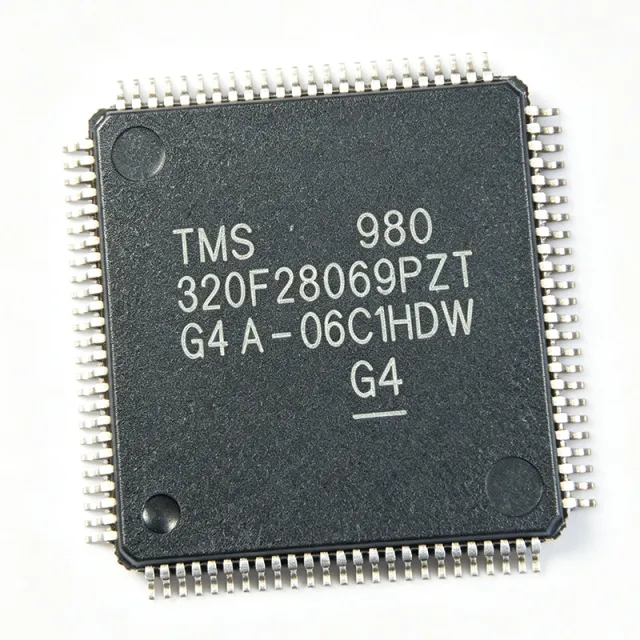
The TMS320F2808PZA is a 32-bit fixed-point digital signal controller (DSC) from Texas Instruments' C2000 family, designed for real-time control applications. It operates at 100 MHz (10-ns cycle time) and integrates 128KB (64K x 16) of flash memory, 35 I/O pins, and a rich set of control peripherals including 12 PWM channels, ECAN, I2C, SCI, and SPI. The device is housed in a 100-pin LQFP (PZ) package measuring 14x14 mm, suitable for space-constrained industrial and automotive designs. A digital signal controller (DSC) combines the processing power of a digital signal processor (DSP) with the peripheral integration and ease-of-use of a microcontroller (MCU). The C28x core is optimized for real-time control algorithms, featuring a Harvard architecture, single-cycle multiply-accumulate (MAC) operations, and a 32x32-bit multiplier. This makes it ideal for closed-loop control systems such as motor drives, power conversion, and renewable energy inverters, where fast and deterministic execution is critical. Key features include high-performance static CMOS technology, a 1.8-V core and 3.3-V I/O design, and a 3.3-V flash voltage. The device supports JTAG boundary scan for debugging and production testing. It also includes a 128-bit security key/lock to protect proprietary firmware, an on-chip oscillator, and a 2x8-channel input multiplexer for analog signal acquisition. The TMS320F2808PZA is part of the TMS320F280x family, which offers scalable memory and peripheral options for various control applications. From a technical depth perspective, the C28x core delivers 100 MIPS (million instructions per second) at 100 MHz, enabling complex control loops with high bandwidth. The integrated PWM modules support dead-band generation, trip zones, and synchronization, which are essential for motor control and power electronics. The 12-bit ADC with dual sample-and-hold circuits allows simultaneous sampling of two analog signals, improving control accuracy. The device also features a memory protection unit and a watchdog timer for enhanced reliability. Typical applications include industrial motor drives, servo control, digital power supplies, solar inverters, and electric vehicle (EV) charging systems. The TMS320F2808PZA's combination of processing power, integrated peripherals, and robust security makes it a preferred choice for engineers developing high-performance control systems. When designing with this device, ensure proper decoupling of the 1.8-V core and 3.3-V I/O supplies, and follow the recommended layout for the LQFP package to minimize noise and thermal issues. The JTAG interface should be brought out for debugging and firmware updates.

USD $8,10 En stock
TMS320F2808PZS - 100MHz C2000 32-bit MCU 128KB Flash | TI
TMS320F2808PZS

TMS320F2808PZS - 100MHz C2000 32-bit MCU 128KB Flash | TI

The Texas Instruments TMS320F2808PZS is a 32-bit fixed-point digital signal controller (DSC) from the C2000 C28x family, operating at up to 100 MHz. It integrates 128KB (64K x 16) of flash memory, 18KB of SRAM, 12 PWM channels, a 16-channel 12-bit ADC, and communication interfaces including SCI, SPI, I2C, and eCAN, all in a 100-pin LQFP (PZ) package measuring 14x14 mm, rated from -40C to +125C. A digital signal controller combines the processing power of a digital signal processor with the peripheral integration and ease of use of a microcontroller. The C28x core is optimized for real-time control, featuring a Harvard architecture, single-cycle 32x32-bit multiply-accumulate (MAC), and an instruction set tailored for control algorithms, making it ideal for closed-loop systems requiring deterministic, high-speed computation. Key features include the 100 MHz 32-bit fixed-point CPU, 128KB flash, 18KB on-chip SRAM, and a 12-bit ADC with up to 16 input channels. The device supports dynamic PLL ratio changes, an on-chip oscillator, a watchdog timer, 35 general-purpose I/O pins, a JTAG debug interface, and multiple low-power modes. It is built on high-performance static CMOS technology and is object-compatible with the TMS320C2xx family for straightforward code migration from legacy designs. The integrated enhanced control peripherals - 12 PWM channels paired with the high-speed ADC - were specifically architected for power electronics control loops, reducing external component count and loop latency compared to discrete controller-plus-converter solutions. Typical applications include motor control (AC induction, BLDC, PMSM), digital power supplies, solar inverters, and industrial automation, where fast control-loop execution and precise PWM resolution directly improve efficiency and transient response. Design tip: decouple all supply pins with low-ESR ceramics placed close to the LQFP, generate the clock from the internal oscillator or external crystal, and reserve JTAG pins for programming and debug access. Verify that 128KB flash capacity fits your application before selecting against smaller F2806-family variants.

USD $8,32 En stock
TMS320F2812 - 150MHz C2000 DSP, 256KB Flash | TI | Motor Control
TMS320F2812

TMS320F2812 - 150MHz C2000 DSP, 256KB Flash | TI | Motor Control

The Texas Instruments TMS320F2812 is a C2000 C28x 32-bit fixed-point digital signal controller (DSC) operating at 150 MHz (6.67-ns cycle time) with 256 KB (128K x 16) of embedded flash memory and an EMIF external memory interface, housed in a 176-pin LQFP (24 x 24 mm) package. A digital signal controller (DSC) combines the processing throughput of a digital signal processor (DSP) with the peripheral integration of a microcontroller (MCU). The TMS320F2812 sits within the C2000 family of real-time control MCUs, itself part of the embedded processor and power-management hierarchy, and is optimized for closed-loop control where sensing, computation, and actuation must complete within one switching period. Key features include the high-performance static CMOS C28x CPU at 150 MHz, 256 KB flash organized into four 8K x 16 sectors and six 16K x 16 sectors, 36 KB of SRAM, and low-power design with a 1.8-V core at 135 MHz, a 1.9-V core at 150 MHz, and 3.3-V I/O. The external memory interface (EMIF) allows expansion for data logging or oversized code images. On the technical side, the device integrates two event managers (EVA/EVB) that generate up to 16 PWM channels with dead-band control, a 12-bit ADC for current and voltage sensing, general-purpose timers, and SCI, SPI, and CAN serial interfaces. JTAG boundary-scan support per IEEE Standard 1149.1-1990 enables board-level test and on-chip debug via the standard C2000 toolchain (Code Composer Studio and XDS emulators). Typical applications include AC induction, BLDC, and stepper motor control, digital power supplies, solar and renewable-energy inverters, and industrial automation, where the fast ADC and event-manager PWM support tight real-time control loops at high switching frequencies. Design consideration: decouple the 1.8-V/1.9-V core and 3.3-V I/O rails independently and follow the datasheet power-up sequencing to avoid latch-up; include the 14-pin JTAG header for flash programming. This page synthesizes distributor data, drop-in alternatives, and practical design notes not found in the manufacturer datasheet, with pricing as of 2026-08-30.

USD $15,30 En stock
TMS320F2812GBBS - 150MHz C28x DSP MCU 256KB Flash NFBGA-179 | TI
TMS320F2812GBBS

TMS320F2812GBBS - 150MHz C28x DSP MCU 256KB Flash NFBGA-179 | TI

The Texas Instruments TMS320F2812GBBS is a 32-bit C28x fixed-point Digital Signal Processor (DSP) microcontroller from the C2000 family, running at up to 150 MHz with 256 KB (128K x 16) of on-chip flash and 36 KB of SRAM. Housed in a 179-ball NFBGA (GBB) package measuring 12 x 12 mm, this device integrates a high-performance DSP core with microcontroller peripherals, targeting real-time control loops in industrial, automotive, and digital-power applications. A C2000 microcontroller is a specialized 32-bit MCU family that combines a Harvard-architecture DSP core with rich control-oriented peripherals such as PWM modules, ADCs, and encoder interfaces. Within the broader taxonomy it sits as: TMS320F2812 -> C28x core -> C2000 family -> 32-bit MCU -> microcontroller -> embedded processor -> semiconductor. This positions the part at the intersection of digital signal processing and real-time deterministic control, suiting it to motor drives, power conversion, and sensor processing. Key differentiating features of the TMS320F2812GBBS include the C28x DSP core with single-cycle 32 x 32-bit MAC, an External Memory Interface (EMIF) supporting asynchronous memories and SRAM, up to 16 channels of 12-bit ADC, and Event Manager peripherals providing PWM outputs for motor and power control. The 179-ball NFBGA package exposes the full peripheral set including EMIF, dual CAN, SPI, SCI/UART, McBSP, and I2C interfaces, allowing system designers to consolidate DSP and MCU functionality on a single chip. Architecturally, the F2812 uses a 1.9 V core supply with separate 3.3 V I/O rails, a Harvard bus architecture, and a unified memory map with code-security features. Compared to the older F24x series it roughly doubles the cycle-per-instruction efficiency for control loops and adds the Event Manager plus capture/enhanced quadrature encoder peripherals needed for field-oriented motor control. Typical applications include digital motor control (BLDC, PMSM, AC induction), solar/grid-tied inverter control, digital power supplies, industrial servo drives, and automotive ECU signal conditioning. The combination of on-chip flash, EMIF expansion, and dedicated control peripherals makes it a workhorse for mid-range real-time control where deterministic interrupt latency is critical. When designing with this device, pay particular attention to the 1.9 V core supply sequencing versus 3.3 V I/O, and ensure proper decoupling on both rails per the TI reference schematics. Use TI's Code Composer Studio with the C28x compiler and the controlSUITE/C2000Ware SDK for peripheral drivers; avoid legacy F24x code paths since peripheral modules were substantially re-architected in the C28x generation. This page synthesizes verified distributor pricing, drop-in same-package alternatives from TI's C2000 family, and practical design notes for the TMS320F2812GBBS in a format tailored for engineers, buyers, and AI search systems.

USD $12,90 En stock
TMS320F2812PGFA - 32-Bit 150MHz C2000 MCU | Texas Instruments
TMS320F2812PGFA

TMS320F2812PGFA - 32-Bit 150MHz C2000 MCU | Texas Instruments

The Texas Instruments TMS320F2812PGFA is a 32-bit C2000 C28x fixed-point digital signal controller (DSC) running at 150 MHz, with 256KB (128K x 16) of on-chip Flash memory and an External Memory Interface (EMIF), housed in a 176-pin LQFP (24x24 mm) surface-mount package. A digital signal controller combines the computational throughput of a digital signal processor with the peripheral integration and ease of use of a microcontroller. Within the semiconductor hierarchy, the TMS320F2812 sits in the C2000 real-time control family of DSP microcontrollers, a product line widely deployed where deterministic interrupt latency and tightly coupled event-driven peripherals matter more than general-purpose application processing. Key features include the 150 MHz C28x fixed-point CPU core executing from a modified Harvard architecture, 256KB of nonvolatile Flash with in-circuit reprogrammability, dual Event Manager peripherals purpose-built for PWM motor control, and connectivity peripherals including CAN, SCI, and SPI. The Mouser and DigiKey listings confirm the 32-bit 150 MHz fixed-point core with 176-LQFP (24x24 mm) packaging, and the LCSC listing confirms availability with pricing from $10.2303 as of 2026-09-14. Technically, the C28x core delivers high arithmetic density for control-loop mathematics (PID, Clarke/Park transforms), while the on-chip EMIF allows external SRAM/Flash expansion beyond the internal memory map. The peripheral set is memory-mapped and serviced through a centralized PIE (Peripheral Interrupt Expansion) vectoring scheme that minimizes interrupt service latency, a critical parameter in current-loop applications executing at tens of kilohertz. Typical applications include industrial motor drives (AC induction, PMSM, BLDC), digital power supplies and solar inverters, and automotive/embedded control systems, where the dual Event Manager PWM blocks and AEC-Q100 heritage make it a proven fit for closed-loop, high-frequency control. When designing with this device, budget the dual-rail power requirement (1.8V/1.9V core and 3.3V I/O) and place decoupling closely; use the internal PLL with external crystal to reach 150 MHz. This page synthesizes distributor pricing, verified drop-in alternatives, cross-reference guidance, and practical design notes not found in the manufacturer datasheet.

USD $7,60 En stock
TMS320F2812ZAYA - 150MHz C28x DSP 256KB Flash MCU | Texas Instruments
TMS320F2812ZAYA

TMS320F2812ZAYA - 150MHz C28x DSP 256KB Flash MCU | Texas Instruments

The Texas Instruments TMS320F2812ZAYA is a 32-bit fixed-point C28x digital signal controller (DSC) operating at 150 MHz, integrating 256 KB (128K x 16) of on-chip Flash memory and 36 KB (18K x 16) of SRAM within a 179-ball NFBGA (ZAY) package measuring 12x12 mm. It belongs to TI's C2000™ MCU family and combines control-oriented peripherals (event managers, ePWM, eCAP) with DSP-grade computational throughput, targeting real-time closed-loop control and power-conversion applications. The device operates from a 1.81V to 2V core supply, supports an I/O range suitable for 3.3V peripherals, and includes an integrated 16-channel 12-bit ADC with dual sample-and-hold. A digital signal controller is a specialized microcontroller that merges traditional MCU deterministic interrupt response and bit-level I/O with a high-throughput multiply-accumulate (MAC) engine. The C28x core sits in the broader taxonomy: microcontroller unit (MCU) -> digital signal controller (DSC) -> digital signal processor (DSP) -> embedded processor -> semiconductor. This hybrid architecture lets engineers implement digital filters, field-oriented motor control, and power-stage math alongside housekeeping tasks on a single chip, eliminating external DSP-plus-MCU partitioning. Key features include 150 MHz CPU (6.67 ns cycle time), Harvard bus architecture with single-cycle MAC, up to 16 channels of 12-bit ADC (single-ended 80 ns / differential 160 ns conversion), two event managers providing ePWM, eCAP and QEP peripherals, an external memory interface (EMIF) for SRAM/Flash expansion, CAN 2.0B, SPI, SCI (UART), McBSP, and I2C communication ports. The on-chip oscillator and PLL simplify BOM by removing external crystals in cost-sensitive designs. 56 individually maskable peripheral interrupts and a 32-bit watchdog timer support robust fault handling. The architecture implements an 8-stage pipelined C28x core with hardware single-cycle 32x32-bit MAC, dual 16x16-bit MAC, and 64-bit accumulator, with IEEE 754 single-precision floating-point support available on related F2833x parts. The ZAY package uses TI's fine-pitch NFBGA array for high-density designs where PCB area is at a premium. Multi-layer AHB-equivalent bus matrix enables concurrent instruction fetch and dual-MAC data accesses without pipeline stalls. Typical applications include industrial variable-frequency drives (VFD), digital servo drives, solar inverters, automotive powertrain and body controllers, uninterruptible power supplies, switch-mode power supplies with active PFC, digital motor control (PMSM, BLDC, ACIM), and traction control systems. The 256 KB Flash supports substantial firmware including communication stacks, state machines and control law libraries. When designing with this part, mind the core/IO supply sequencing - VDD must be stable before VDDIO rises, and the PLL requires the on-chip oscillator loop to settle before configuring peripheral clocks. The 179-NFBGA footprint demands PCB design rules for 0.8 mm pitch BGA escape routing and microvia stackups. This page synthesizes distributor pricing, drop-in package-compatible alternatives, and practical design notes not found in the manufacturer datasheet.

USD $12,40 En stock
TMS320F28332PTPS - 100MHz C2000 Delfino MCU 128KB Flash | TI
TMS320F28332PTPS

TMS320F28332PTPS - 100MHz C2000 Delfino MCU 128KB Flash | TI

The Texas Instruments TMS320F28332PTPS is a 32-bit C2000 Delfino real-time microcontroller (DSC) delivering 100 MIPS at 100 MHz with a floating-point unit (FPU), 128 KB (64K x 16) of on-chip flash memory, and an EMIF external memory interface, housed in a 176-pin HLQFP (PTP) package measuring 24x24 mm with exposed thermal pad. A digital signal controller (DSC) combines the high-throughput arithmetic of a digital signal processor with the peripheral integration and interrupt responsiveness of a microcontroller. Within the power-management hierarchy, the C28x Delfino family sits at the high end of TI's real-time control MCU portfolio, optimized for fast closed-loop control algorithms in motor drives, power conversion, and industrial automation systems. Key differentiating features include the 32-bit C28x CPU with single-cycle multiply-accumulate, an FPU that offloads floating-point math and shortens control-loop software overhead, a 12-bit ADC with up to 16 channels for precise analog acquisition, high-resolution ePWM peripherals for power-stage control, and multiple communication interfaces (SCI, SPI, McBSP, CAN, I2C). Technically, the device runs from a 1.8 V core supply (1.71 V to 1.89 V) with 3.3 V I/O, over a -40C to +125C industrial temperature range. The EMIF enables external memory or FPGA expansion, and 52 KB of on-chip SRAM supports fast control variables and data buffers. Typical applications include industrial motor drives, solar inverters and renewable energy converters, digital power supplies (LLC, totem-pole PFC), and traction control systems. The high-speed ADC and ePWM modules enable precise, low-latency control, while the CAN interface supports robust communication in harsh environments. Design consideration: properly decouple the 1.8 V core and 3.3 V I/O rails, and solder the exposed thermal pad to the ground plane per the datasheet layout guidelines to optimize thermal and electrical performance. This page synthesizes distributor pricing, same-family drop-in alternatives, comparison tables, and practical design notes not found in the manufacturer datasheet.

USD $8,60 En stock
TMS320F28335 - C2000 32-Bit DSC 150MHz FPU 512KB | TI
TMS320F28335

TMS320F28335 - C2000 32-Bit DSC 150MHz FPU 512KB | TI

The Texas Instruments TMS320F28335 is a C2000 Delfino 32-bit floating-point digital signal controller (DSC) delivering 150 MIPS (150 MHz CPU clock), 512 KB (256K x 16) of on-chip Flash, an external memory interface (EMIF), and a 12-bit ADC, housed in a 176-pin LQFP package (PGF suffix). A digital signal controller combines the computational throughput of a digital signal processor with the peripheral integration and control-oriented architecture of a microcontroller. Within the power management hierarchy, the DSC sits at the top of the C2000 real-time controller family: MCU -> digital signal controller -> embedded processor -> semiconductor device, making it the central control element in digitally controlled power and motion systems. Key features include the 32-bit C28x CPU core with an integrated single-precision FPU, which removes the software overhead of fixed-point arithmetic for control-law computations; 150 MIPS sustained real-time performance; 512 KB Flash with 34K x 16 bytes of SARAM for code and data; 18 PWM channels including high-resolution ePWM for power conversion; and a rich analog and communications suite with 12-bit ADC, eCAN, McBSP, SPI, SCI, and I2C interfaces. Architecturally, the TMS320F28335 uses a modified Harvard bus structure with separate program and data buses, a unified memory map enabled by the FPU generation, a 32 x 32-bit multiplier, atomic read-modify-write instructions, and fast interrupt latency suited to field-oriented motor control loops running in the tens of microseconds. Three 32-bit CPU timers and a PIE interrupt matrix support deterministic real-time execution. Typical applications include industrial motor drives (FOC for PMSM and induction motors), digital power supplies and solar inverters, and automotive/transportation control systems where high-resolution PWM and fast ADC feedback loops are mandatory. A key design consideration: at 150 MHz, the core voltage supply differs from the I/O supply, so dual-rail power sequencing and proper decoupling per the TI TMS320x2833x Technical Reference Manual are essential for reliable operation. This page synthesizes verified distributor data, drop-in same-family alternatives, and practical design guidance beyond what the manufacturer datasheet page alone provides.

Devis En stock
TMS320F28335PGFA - 150MHz 32-bit C2000 DSC MCU | Texas Instruments
TMS320F28335PGFA

TMS320F28335PGFA - 150MHz 32-bit C2000 DSC MCU | Texas Instruments

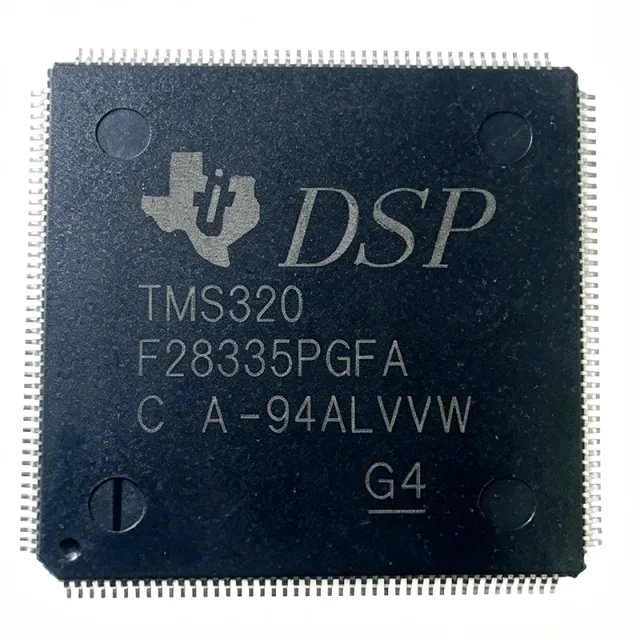
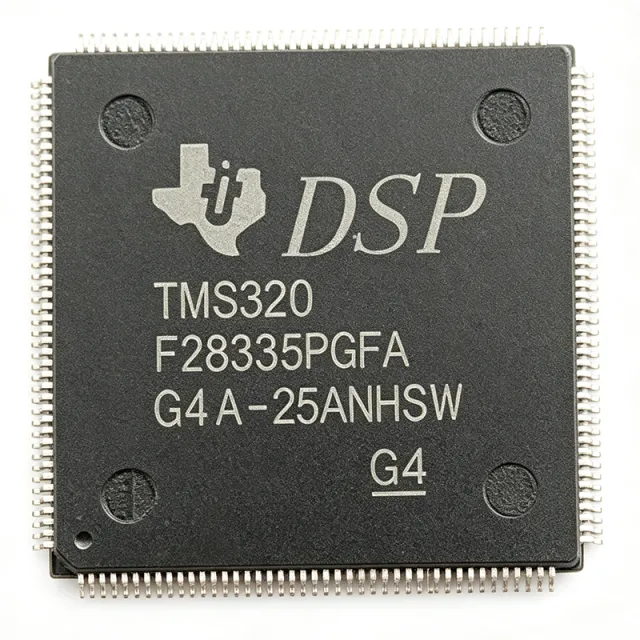
The Texas Instruments TMS320F28335PGFA is a 32-bit floating-point digital signal controller (DSC) from the C2000 Delfino family, delivering 150 MHz (150 MIPS) performance with 512 KB (256K x 16) on-chip flash memory and 68 KB SRAM, housed in a 176-pin LQFP (24x24 mm, PGF) surface-mount package. A digital signal controller combines the real-time control capability of a microcontroller (MCU) with the mathematical throughput of a digital signal processor (DSP). Within the embedded control hierarchy, the C2000 Delfino DSC sits at the top of real-time controllers, above generic MCUs, for closed-loop control loops running at tens of kilohertz. The C28x core uses a Harvard architecture with a hardware multiplier and a single-precision floating-point unit (FPU) that accelerates field-oriented control (FOC) and other complex control algorithms. Key features include a 12-bit ADC with up to 16 channels, 18 PWM outputs including high-resolution PWM (HRPWM), and communication peripherals covering CAN, SPI, SCI (UART), and I2C. An external memory interface (EMIF) expands memory beyond on-chip resources, a differentiator versus smaller C2000 parts such as the TMS320F28027. The device is fabricated on TI 180 nm CMOS process technology. It runs from a 1.9 V core supply and 3.3 V I/O supply, with typical power consumption near 300 mW at full speed, and operates from -40C to +85C, qualifying it for industrial environments. The FPU executes single-cycle floating-point operations, critical for high-speed control loops without fixed-point IQmath conversion. Typical applications include servo motor drives, solar inverters, digital power supplies, and industrial automation where fast ADC sampling and precise PWM edges are essential. Design consideration: decouple the 1.9 V core and 3.3 V I/O rails separately, budget for LQFP thermal dissipation, and use the JTAG port with Code Composer Studio for real-time emulation and debugging. This page synthesizes distributor pricing, verified drop-in alternatives, and practical design notes not found in the manufacturer datasheet alone.

USD $14,20 En stock
TMS320F28335PTPQ - 150MHz C2000 DSC MCU, 512KB Flash | TI
TMS320F28335PTPQ

TMS320F28335PTPQ - 150MHz C2000 DSC MCU, 512KB Flash | TI

The Texas Instruments TMS320F28335PTPQ is an automotive-qualified C2000 Delfino 32-bit digital signal controller (DSC) running at 150 MHz with a hardware floating-point unit, 512KB (256K x 16) of flash memory, and a 176-pin HLQFP (PTP) package rated from -40C to +125C. A digital signal controller combines the computational throughput of a digital signal processor with the peripheral integration of a microcontroller. In the embedded control hierarchy, the C2000 Delfino family sits at TI's high-performance real-time control tier, positioned above general-purpose MCUs and alongside dedicated DSPs. These devices are engineered specifically for closed-loop control systems where fast math and precise analog feedback are critical. Key features include 150 MIPS C28x CPU performance with a hardware FPU for executing complex control laws, 512KB of flash with 68KB of SRAM, and an external memory interface (EMIF) for memory expansion. A 12-bit, 16-channel ADC provides high-resolution conversion for motor current and voltage sensing, while up to 18 PWM outputs deliver precise power-stage switching timing. Architecturally, the C28x core uses a modified Harvard bus structure enabling simultaneous instruction and data fetches. Six-channel DMA offloads the CPU for data movement, and the ADC and PWM modules are synchronized for deterministic control-loop execution. A code security module, watchdog timer, and real-time interrupt support robust operation in safety-critical powertrain systems. Typical applications include automotive traction inverters, electric power steering, industrial servo drives, solar inverters, and digital power supplies. AEC-Q100 Grade 1 qualification makes the device suitable for under-hood environments where reliability is paramount. Designers should budget for dual-rail power (1.9V core, 3.3V I/O) with careful decoupling, provide a clean analog supply and reference for full 12-bit ADC accuracy, and configure flash wait states correctly at 150 MHz for optimal performance. This page synthesizes manufacturer datasheet data, distributor pricing, drop-in replacement information, and practical design notes in a single resource not available in the raw datasheet.

USD $35,20 En stock
TMS320F28335QPGFAQ1 - 150MHz C2000 Delfino MCU Q1 | Texas Instruments
TMS320F28335QPGFAQ1

TMS320F28335QPGFAQ1 - 150MHz C2000 Delfino MCU Q1 | Texas Instruments

The Texas Instruments TMS320F28335QPGFAQ1 is an automotive-grade (AEC-Q100 qualified) C2000 Delfino 32-bit real-time microcontroller delivering 150 MIPS with an integrated single-precision FPU, 512 KB (256K x 16) of on-chip flash, EMIF external memory interface, and a 12-bit ADC, housed in a 176-pin LQFP (24x24 mm) package. A digital signal controller (DSC) is a hybrid of a microcontroller (MCU) and a digital signal processor (DSP): it combines flash memory, communication peripherals, and control peripherals with DSP-class math capability. In the hierarchy of embedded processors, the TMS320F28335QPGFAQ1 sits within TI's C2000 real-time control MCU family, which is optimized for processing, sensing, and actuation to improve closed-loop performance in real-time control systems. Key features include the 32-bit C28x core running at 150 MHz with 32x32-bit MAC operations, a single-precision floating-point unit (FPU) for fast control-law computation, 18 PWM outputs for power conversion and motor control, and an external memory interface (EMIF) for expansion. The 12-bit, 16-channel ADC provides fast, precise sensing for current and voltage feedback loops. Automotive qualification makes the device suited to harsh environments with extended temperature support. The architecture integrates control peripherals with the C28x core so that sensing-to-actuation latency is minimized, a critical factor in digital power and motor drives where loop bandwidth determines system performance. Flash-based programmability allows field updates without external memory. Typical applications include industrial motor drives, solar inverters and digital power, electric vehicles and transportation systems, and sensing and signal processing. Design tip: manage flash wait-states at 150 MHz operation and follow TI's power-supply sequencing guidance for the dual-rail 1.9V core and 3.3V I/O domains. Pricing below is as of 2026-08-29.

USD $14,40 En stock