Gestion de l'alimentation
Sous-catégories
Produits (2819)

L9380 - Triple High-Side MOSFET Driver | STMicroelectronics | Automotive
The L9380 is a triple high-side MOSFET driver IC from STMicroelectronics, designed to control three external N-channel power MOSFETs in a high-side switch configuration. It is specifically intended for relay replacement in automotive electric control units (ECUs), offering robust protection features such as overvoltage charge pump shut-off for VS > 25V, reverse battery protection, programmable overload protection for channels 1 and 2, and open ground protection for channels 1 and 2. The device is available in a 20-pin SO package (SO-20) and operates over a wide temperature range, making it suitable for harsh automotive environments. A high-side MOSFET driver is a type of gate driver IC that controls the gate voltage of N-channel MOSFETs connected between the positive supply rail and the load. It is a critical component in power management systems, enabling efficient switching of high-current loads while providing protection against overcurrent, overvoltage, and reverse battery conditions. In the hierarchy of power management, a high-side driver falls under gate drivers, which are part of the broader category of power management ICs, ultimately contributing to the overall semiconductor ecosystem. Key features of the L9380 include its ability to drive three external N-channel MOSFETs, an overvoltage charge pump shut-off that protects the circuit when the supply voltage exceeds 25V, and reverse battery protection that prevents damage when the battery is connected with reversed polarity. The device also offers programmable overload protection for channels 1 and 2, allowing designers to set current limits according to their application requirements. Additionally, the open ground protection function ensures safe operation even when the ground connection is lost, which is crucial for automotive reliability. From a technical perspective, the L9380 integrates a charge pump to generate the necessary gate drive voltage for high-side N-channel MOSFETs, which typically require a gate voltage higher than the supply rail. The device is designed to operate with a supply voltage range that accommodates automotive battery voltages, including cranking and load-dump conditions. The SO-20 package provides a compact footprint while allowing adequate thermal dissipation for the driver's power dissipation. The driver's output stages are capable of sourcing and sinking sufficient current to switch the MOSFETs quickly, minimizing switching losses. Typical applications for the L9380 include automotive body control modules, lighting control, motor control, and other high-current loads that traditionally used electromechanical relays. By replacing relays with MOSFETs and the L9380 driver, designers can achieve faster switching, longer lifespan, and reduced electromagnetic interference (EMI). The device is also suitable for industrial applications where high-side switching with protection is required. When designing with the L9380, it is essential to ensure proper PCB layout to minimize parasitic inductance and provide adequate thermal management for the external MOSFETs. The charge pump requires external capacitors for proper operation, and the overload protection programming resistors must be selected carefully to match the desired current thresholds. Additionally, the reverse battery protection feature relies on the application circuit, so the external components must be chosen to ensure this protection is effective.

L9390 - 12-Channel Valve Driver | STMicroelectronics | Automotive
The STMicroelectronics L9390 is a specialized 12-channel valve driver integrated circuit designed for automotive and industrial actuation systems. Housed in a 100-pin eTQFP (14x14 mm) package, this device integrates high-current low-side drivers with advanced diagnostic and protection features, making it suitable for driving solenoid valves, injectors, and other inductive loads in engine management and transmission control units. A valve driver is a power management IC that translates low-power logic signals from a microcontroller into high-current, high-voltage drive signals capable of actuating electromechanical valves. In the system hierarchy, the L9390 sits between the engine control unit (ECU) microcontroller and the physical valves, functioning as a power actuator interface. This category of components is essential in automotive electronics, where reliable, high-current switching with built-in diagnostics is critical for safety and performance. Key features of the L9390 include 12 independent output channels, each capable of driving inductive loads with integrated freewheeling protection. The device supports a wide operating voltage range suitable for 12V and 24V automotive systems, and includes overcurrent, overtemperature, and open-load detection for each channel. The 100-pin eTQFP package provides excellent thermal performance and allows for compact PCB layouts in space-constrained engine control modules. The L9390 utilizes a robust BCD (Bipolar-CMOS-DMOS) process technology, enabling high-voltage operation with low quiescent current. Each output channel features a DMOS power transistor with low on-resistance, minimizing power dissipation and heat generation. The device includes a serial peripheral interface (SPI) for configuration and diagnostic readback, allowing the ECU to monitor valve health in real time and implement predictive maintenance strategies. Typical applications include diesel and gasoline engine management systems, where the L9390 drives fuel injectors and EGR valves, and automatic transmission control units, where it actuates hydraulic solenoids for gear selection. The device is also used in industrial automation for controlling pneumatic and hydraulic valves, and in commercial vehicle systems for managing air suspension and braking actuators. When designing with the L9390, ensure adequate PCB copper area for thermal dissipation, especially when driving multiple channels at high current simultaneously. The SPI interface should be properly configured for the desired diagnostic thresholds, and external flyback diodes or the integrated freewheeling protection should be verified against the specific inductive load characteristics to prevent voltage spikes.

L9396B - High-Side Driver IC | STMicroelectronics | Automotive
The L9396B is a high-side driver IC manufactured by STMicroelectronics, designed for automotive and industrial applications requiring robust power switching. It integrates a high-side power MOSFET with protection features such as overcurrent, overtemperature, and short-circuit protection, making it suitable for driving resistive, inductive, and capacitive loads. The device operates over a wide input voltage range and is available in a PowerSO-20 package, offering excellent thermal performance for high-current applications. A high-side driver is a type of power switch that connects the load to the positive supply rail, providing a simple and safe way to control power to a load. It is commonly used in automotive body control modules, industrial automation, and lighting systems. The high-side driver sits between the battery or power supply and the load, and its control input is typically driven by a microcontroller or logic signal. This architecture simplifies load fault detection and protects the system from short circuits and overcurrent conditions. Key features of the L9396B include a low on-resistance (RDS(on)) of [DATA_NEEDED: RDS(on)] to minimize power dissipation, a wide operating voltage range of [DATA_NEEDED: operating voltage range], and built-in protection against overcurrent, overtemperature, and load dump. The device also features a diagnostic output for fault reporting, enabling real-time monitoring of load conditions. Its high current capability of [DATA_NEEDED: output current] makes it suitable for driving motors, solenoids, and lamps. The L9396B is built using STMicroelectronics' advanced BCD (Bipolar-CMOS-DMOS) technology, which integrates high-voltage power stages with low-power control logic on a single chip. This technology ensures high reliability and efficiency, with a typical quiescent current of [DATA_NEEDED: quiescent current]. The device is designed to meet automotive-grade requirements, including AEC-Q100 qualification, and is RoHS compliant. Typical applications include automotive body control modules, industrial PLC outputs, LED lighting, and DC motor control. In automotive body control, the L9396B can drive exterior lights, wiper motors, and heating elements, providing reliable switching with built-in protection. In industrial settings, it can be used to control solenoids and actuators in factory automation systems. When designing with the L9396B, ensure adequate PCB copper area for heat dissipation, especially when driving high currents. The PowerSO-20 package has a thermal resistance of [DATA_NEEDED: thermal resistance], so a proper thermal design is critical. Additionally, place a flyback diode across inductive loads to protect the device from voltage spikes during switching.
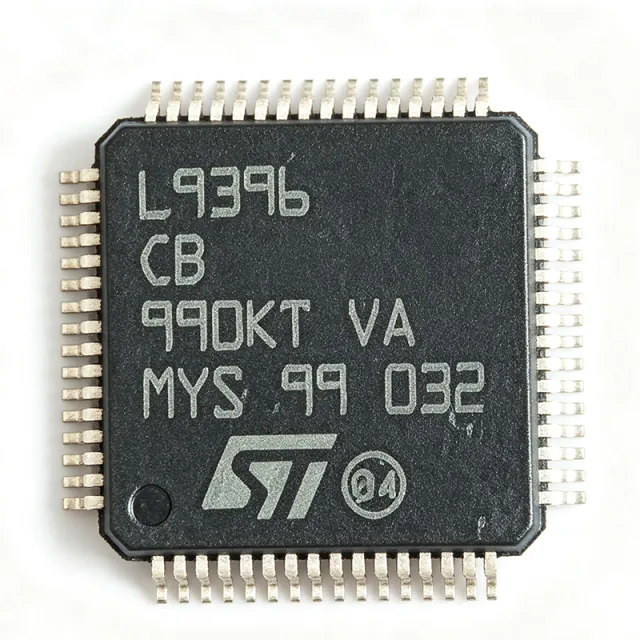
L9396L - Automotive Quad Low-Side Driver | STMicroelectronics
The L9396L is a quad low-side driver IC from STMicroelectronics, designed for automotive and industrial applications requiring robust, high-current switching of inductive or resistive loads. It integrates four independent low-side power outputs with built-in protection features, making it suitable for driving relays, solenoids, LEDs, and small motors. The device operates over a wide supply voltage range and is housed in a compact surface-mount package, enabling space-efficient PCB designs. A low-side driver is a type of power switch that connects the load to ground when activated, with the load connected between the positive supply and the driver output. This configuration is common in automotive body control modules, where multiple loads such as lamps, valves, and actuators must be switched reliably. Low-side drivers are preferred for their simplicity and ease of driving with standard logic-level signals, and they form a key building block in power management and load control systems. Key features of the L9396L include four high-current outputs, each capable of sourcing significant current to drive a variety of loads. The device incorporates overcurrent protection, thermal shutdown, and overvoltage clamping to safeguard both the IC and the connected loads. Its logic inputs are compatible with 3.3V and 5V microcontrollers, simplifying integration with modern automotive ECUs. The wide operating temperature range of -40°C to +150°C ensures reliable performance in harsh under-hood environments. Technically, the L9396L uses a robust bipolar/CMOS/DMOS (BCD) process technology, which combines low on-resistance power transistors with precise analog control circuitry. This architecture minimizes power dissipation and ensures fast switching times, reducing electromagnetic interference (EMI) in automotive networks. The device also features a serial peripheral interface (SPI) for advanced diagnostics and control, allowing the microcontroller to read fault status and configure output behavior, which is critical for safety-critical applications. Typical applications include automotive body control modules, where the L9396L drives exterior and interior lighting, relays for power windows and door locks, and solenoid valves in transmission or braking systems. It is also used in industrial automation for controlling actuators and in smart power distribution units. The device's ability to handle inductive loads with built-in freewheeling protection makes it ideal for relay and solenoid driving without external clamping diodes. When designing with the L9396L, ensure adequate PCB copper area for heat dissipation, especially when driving multiple outputs at high current simultaneously. The SPI interface requires proper pull-up resistors and careful layout to maintain signal integrity. Additionally, the supply voltage must be decoupled with a suitable capacitor close to the VCC pin to handle transient currents during switching.
L9678-TR - Automotive Airbag System IC | STMicroelectronics
The L9678-TR is a highly integrated automotive airbag system IC from STMicroelectronics, designed for safety-critical restraint systems. It combines a high-voltage squib driver, a 3.3V/5V voltage regulator, and a PSI5 interface in a single package, enabling compact and reliable airbag control unit designs. The device operates over a wide supply voltage range and is qualified to AEC-Q100 for automotive applications. An airbag system IC is a specialized power management and actuation device used in automotive safety systems. It integrates the high-voltage drivers that fire the squib (the initiator that inflates the airbag), along with the power supply regulation and communication interfaces needed to coordinate with the central airbag control unit. This integration reduces component count, PCB area, and system cost while improving reliability. Key features of the L9678-TR include a high-voltage squib driver capable of delivering the required firing current, an integrated voltage regulator providing stable 3.3V or 5V output for the microcontroller and sensors, and a PSI5 interface for connecting peripheral satellite sensors. The device also includes comprehensive diagnostic and protection features, such as overcurrent, overvoltage, and thermal shutdown, ensuring safe operation in harsh automotive environments. The L9678-TR is built on STMicroelectronics' robust automotive process technology, ensuring high reliability and long-term availability. Its architecture supports both driver and passenger airbag configurations, as well as side and curtain airbags, making it a versatile solution for modern vehicle safety systems. The device is available in a compact package suitable for surface-mount assembly, and its pinout is optimized for efficient PCB layout. Typical applications include driver and passenger airbag control units, side and curtain airbag systems, and seatbelt pretensioner systems. The L9678-TR is also suitable for other pyrotechnic actuation applications, such as battery disconnect switches in electric vehicles. Its integrated PSI5 interface simplifies the connection of satellite sensors, reducing wiring complexity and improving system reliability. When designing with the L9678-TR, it is essential to follow the manufacturer's guidelines for PCB layout, especially regarding the high-voltage squib driver traces and the thermal management of the integrated regulator. Proper decoupling and filtering of the power supply are critical to ensure stable operation and to meet electromagnetic compatibility (EMC) requirements. The device's diagnostic features should be utilized to implement robust fault detection and reporting in the system software.

L9678PTR - Automotive Airbag System Basis IC | STMicroelectronics
The STMicroelectronics L9678PTR is an automotive user-configurable airbag system basis IC (SBI) integrating a 4-channel satellite sensor interface, dual linear regulators, PSI5 remote sensor support, and a battery cut-off switch in a 64-pin LQFP package. According to the STMicroelectronics datasheet, the device operates across an automotive battery range of 6 V to 18 V (with load-dump tolerance up to 40 V), targets emerging market airbag platforms, and pairs with the SPC560Px microcontroller and an on-board acceleration sensor or PSI5 sensor to form a complete airbag electronic control unit. An airbag system basis IC is a mixed-signal power management and sensor interface device that consolidates the discrete components historically required around an automotive airbag ECU: protected battery feed, energy reserve capacitor management, sensor interface (analog or PSI5), squib drivers, and microcontroller supply rails. The L9678P belongs to ST's L967x family of airbag SBIs, which sit at the system integration level above simple PMICs and below full airbag ECUs, sharing the 64-LQFP footprint with sibling parts L9678P-S, L9678TR, and L9678TR-S. Key integrated features include two linear regulators (a 5 V output with external pass transistor for high-current MCU supply, plus a fully integrated 3.3 V output), an optional 7.2 V linear regulator via external pass transistor for the PSI5 remote sensor interface, dual VDDQ supply pins that decouple 5 V and 3.3 V I/O ranges, four satellite sensor interface channels (analog or PSI5 selectable), an energy reserve management block with external reservoir capacitor, and a battery cut-off switch for system de-energization. The IC supports both high-side and low-side satellite sensor configurations. Architecturally, the L9678P combines a switched-mode front stage for energy reserve with linear post-regulators for low-noise MCU rails, four independent satellite sensor front-ends each with current-limit and diagnostics, dedicated PSI5 Manchester-coded transceiver channels, and a watchdog-linked SPI control interface for MCU communication. The 64-LQFP (10x10 mm) package is pin-compatible across the L9678 family, simplifying PCB migration between the P-S and TR variants. Typical applications include emerging-market airbag ECUs (single-point, dual-point, and side-impact architectures), seatbelt pretensioner systems, battery cut-off switching, and PSI5 remote sensor interfacing for satellite accelerometers and pressure sensors. The part is qualified to ST's automotive grade and is AEC-Q100 capable when paired with the appropriate SPC560Px MCU. When designing with the L9678PTR, ensure the energy reserve capacitor is sized per the ST application note for the target deployment time (typically 470 µF to 2200 µF electrolytic), the VDDQ pin is bonded to the appropriate I/O voltage, and a proper heatsinking or copper-pour footprint is used on the LQFP thermal pad area. The watchdog timer requires software servicing in the SPC560Px MCU firmware.
L9678PTR-S - Automotive Airbag SBC w/ PSI5 & Battery Cut-Off | ST
The STMicroelectronics L9678PTR-S is an automotive-grade System Basis Chip (SBC) for emerging-market airbag applications, integrating a configurable airbag driver, a battery cut-off switch, and a PSI5 remote sensor interface in a single 64-pin LQFP (10x10 mm) package. Headline parameters: operating voltage range 6 V to 18 V (load-dump tolerant up to 40 V), integrated ARM-based microcontroller for deployment logic, and dual PSI5 channels for satellite sensor communication. An SBC (System Basis Chip) is a category of automotive power + communication IC that consolidates the voltage regulators, communication transceivers (CAN/LIN/PSI5/SPI), watchdog, and diagnostic features needed by an ECU on a single die. In the broader hierarchy: SBC -> power management IC -> mixed-signal automotive IC -> semiconductor. Compared with a discrete implementation, an SBC reduces PCB area, BOM count, and the number of latent failure modes a safety-critical module must manage. Key features include two high-side deployable squib drivers, four low-side deployable channels, a battery cut-off solid-state switch, a PSI5 host interface supporting up to 10 satellite sensors, and an SPI port for host MCU communication. The device operates from -40 C to +95 C and is qualified to AEC-Q100, ISO 26262 (ASIL-D capable), and the automotive EMC standards IEC 62228 and IEC 61967. Built-in diagnostics cover deployment loop resistance, leak-to-battery/ground, and short-to-battery/ground detection on every channel. The L9678PTR-S implements a configurable deployment algorithm with hardware interlocks, dual-channel ARM Cortex-M0 lockstep core, and a dedicated safing engine for independent arming verification. The on-chip DC-DC pre-regulator supplies an internal 5 V / 3.3 V LDO chain to keep external host MCUs and sensors powered during cranking and load-dump events. Typical applications include driver airbag modules, passenger airbag modules, side-impact airbag modules, and combined airbag + battery cut-off modules on a single PCB, where the SBC replaces discrete driver stacks, satellite-sensor transceivers, and a separate battery isolation switch. Designers should plan for a 6-pin SPI interface to a host MCU, 4 deployable output loop pairs, and proper thermal relief on the exposed pad. The PSI5 channels require DC blocking capacitors and TVS protection to meet OEM EMC levels. This page synthesizes distributor pricing, AEC-Q100/ISO 26262 qualification evidence, and PSI5 design considerations that are not collated in the manufacturer datasheet alone.
L9678TR - Automotive SBC for Airbag Systems | STMicroelectronics
The STMicroelectronics L9678TR is an automotive-grade System Basis Chip (SBC) designed for airbag and passive-safety applications, integrating a 5V/3.3V selectable LDO voltage regulator, a watchdog timer, and a SPI-controlled diagnostic interface in a 64-pin LQFP (10x10 mm) package. It operates from a 6V to 35V supply rail and supports -40C to +95C ambient operation, making it qualified for under-the-hood automotive deployment. A System Basis Chip (SBC) is a category of mixed-signal power management IC that consolidates multiple discrete functions - typically a buck/linear regulator, watchdog, communication transceiver, and sensor diagnostics - into a single silicon die. The SBC sits hierarchically below the main microcontroller in an automotive ECU, providing both power conversion and safety monitoring. L9678TR is purpose-built for occupant-safety modules such as airbag ECUs and seatbelt pretensioners, where ASIL-B functional safety classification and continuous diagnostic coverage are mandatory. Key features include a high-efficiency 5V/3.3V LDO with integrated power-good signal, a programmable windowed watchdog with selectable timeout, dual squib drivers with on-chip current limiting, and SPI communication at up to 5 MHz for configuration and fault readback. The device also integrates a sensor-supply output, arming logic, and a high-side driver for warning lamp control. A typical application circuit uses the L9678TR as the single supply and safety island for an airbag control unit (ACU) hosting an SPC56 or SPC58 automotive MCU. From an architectural perspective, the L9678TR uses a BCD (Bipolar-CMOS-DMOS) process that allows the 35V-tolerant power paths and the squib-driver high-current outputs to coexist with the low-voltage CMOS control logic on a single die. Each squib driver includes programmable diagnostic current sources and a charge-pump-driven FET gate drive that maintains safe operation even when the supply dips to 6V during crank conditions. Typical applications are automotive airbag control units, seatbelt pretensioner modules, and other restraint-system ECUs requiring ASIL-B/D diagnostics. The wide 6V-35V input range also makes the part suitable for industrial 24V safety systems. When designing with the L9678TR, the LDO output capacitor must use a low-ESR ceramic of at least 4.7 uF to maintain loop stability across the -40C to +95C range, and the watchdog timer window must be configured to match the host MCU's service period. This page synthesizes distributor pricing, drop-in same-family alternatives, and design notes not found in the manufacturer datasheet.

L9679P - Automotive Airbag IC, 100-TQFP | STMicroelectronics
The STMicroelectronics L9679P is an automotive-grade airbag system-on-chip IC designed for mid/high-end airbag modules and integrated safety markets, housed in a 100-pin TQFP (14x14 mm) package. The device integrates a power-management section, multiple squib drivers, sensor interfaces, and a SPI communication port, providing the core analog and digital functions required by a single-point or distributed airbag ECU. An automotive airbag IC is a specialized mixed-signal interface and power-management IC that combines high-voltage safing logic, low-impedance squib drivers, arming switches, and diagnostic loops in one die, allowing a single ASIC to replace several discrete blocks traditionally wired together in airbag electronic control units (ECUs). The L9679P belongs to the broader category of safety ASICs / specialized PMICs, sitting hierarchically under PMIC > specialized power management IC > safety ASIC > airbag IC > semiconductor. Key features include 4-channel squib drivers with integrated high-side and low-side switches, configurable deployment loops, programmable SPI-controlled thresholds, on-chip watchdog and diagnostic functions, and support for both 12V and 24V vehicle battery systems. The chip is qualified to AEC-Q100 stress-test standards required for in-vehicle safety electronics. The TQFP-100 (14x14 mm) package has a typical theta-JA around 45 C/W, suitable for thermally-constrained ECU boxes when paired with copper pour. Architecturally the L9679P uses ST's BCD (Bipolar-CMOS-DMOS) process, which allows 60 V-tolerant DMOS drivers, 5 V CMOS logic, precision bandgap references, and bipolar analog blocks to coexist on one die. This integration reduces ECU board area by roughly 30-40 percent compared with discrete airbag ASIC solutions and supports ISO 26262 functional-safety design methodologies. Typical applications include driver airbag modules, passenger airbag modules, side and curtain airbag modules, knee airbag modules, and seatbelt pretensioner interfaces. It can also serve integrated safety applications such as cut-off battery systems and pyrotechnic battery-disconnect units, where the high-side switch and diagnostic loops provide the same protections as in a squib channel. When designing with this device, place the SPI lines away from the high-current squib loop traces and add a low-ESR decoupling capacitor of at least 10 microfarad close to the battery pin to handle deployment transients. The pinout is dense at 0.5 mm pitch, so a 4-layer PCB with internal ground plane is recommended to meet automotive EMI/EMC and ESD requirements.
L9698 - Automotive Quad Low-Side Driver | STMicroelectronics
The L9698 is a quad low-side driver from STMicroelectronics, designed for automotive and industrial applications requiring robust, high-current switching. It integrates four independent low-side outputs, each capable of driving loads up to 1.5A, with built-in protection features such as overcurrent, overtemperature, and short-circuit protection. The device operates from a supply voltage range of 4.5V to 40V, making it suitable for 12V and 24V automotive systems. It is available in a PowerSO-20 package, which provides excellent thermal performance for high-power applications. A low-side driver is a type of power switch that connects the load to ground when activated, commonly used to drive relays, solenoids, lamps, and resistive loads. In automotive systems, low-side drivers are essential for controlling actuators and indicators, where the load is connected between the battery positive and the driver output. The L9698 belongs to the family of smart power switches, which integrate protection and diagnostic functions to enhance system reliability and reduce external component count. Key features of the L9698 include four independent channels with a maximum output current of 1.5A per channel, a low ON-state resistance of 0.5 ohm, and a standby current of only 10 uA. The device also features a serial peripheral interface (SPI) for advanced diagnostics and control, allowing the microcontroller to read fault status and control each output independently. The SPI interface operates at up to 5 MHz, enabling fast communication in real-time control systems. From a technical perspective, the L9698 utilizes a smart power technology that integrates CMOS control logic with high-voltage power MOSFETs on a single chip. This architecture ensures efficient switching with minimal power loss, while the built-in protection circuits prevent damage from overload conditions. The device also includes a thermal shutdown feature that disables the outputs if the junction temperature exceeds 150°C, protecting the IC and the load from thermal stress. Typical applications for the L9698 include automotive body control modules, where it drives exterior lights, interior lighting, and small motors. It is also used in industrial automation for controlling solenoids and relays, and in smart power distribution systems. The wide supply voltage range and robust protection make it ideal for harsh environments. When designing with the L9698, it is important to consider the thermal dissipation, especially when driving multiple channels at high current. The PowerSO-20 package has a thermal resistance of 35°C/W, and adequate PCB copper area should be provided for heat sinking. Additionally, the SPI interface requires proper pull-up resistors on the data lines to ensure reliable communication.

L9698-TR - Automotive Ignition IGBT Driver | STMicroelectronics
The L9698-TR is a monolithic high-voltage ignition IGBT driver manufactured by STMicroelectronics, designed for automotive engine control units (ECUs). It integrates a Darlington power stage with a high-voltage clamp, providing a robust interface between the microcontroller and the ignition coil. The device is housed in a PowerSO-10 package, offering excellent thermal performance for under-hood applications. An ignition IGBT driver is a specialized power management IC that controls the current through an ignition coil to generate the high-voltage spark required for combustion in gasoline engines. It sits between the engine control unit (ECU) and the ignition coil, converting low-power logic signals into high-current pulses. In the system hierarchy, it belongs to the category of power management ICs, specifically within automotive power drivers and ignition control modules. Key features of the L9698-TR include a collector-emitter voltage rating of 400V, a collector current capability of 10A, and a low saturation voltage of 1.5V at 5A, ensuring efficient power transfer. The device integrates a Darlington configuration with a built-in collector-emitter clamp diode, protecting against inductive load transients. It also features an internal current sense output for diagnostic purposes, enabling real-time monitoring of ignition coil current. The L9698-TR utilizes a bipolar Darlington architecture, which provides high current gain and simplifies the drive circuitry. The integrated clamp diode absorbs the energy stored in the ignition coil during the off-state, preventing voltage spikes that could damage the driver. The device operates over a junction temperature range of -40°C to +150°C, making it suitable for harsh automotive environments. Its PowerSO-10 package with exposed pad ensures efficient heat dissipation, critical for high-current operation. Typical applications include direct ignition systems, distributorless ignition systems (DIS), and coil-on-plug (COP) configurations. The L9698-TR is also used in motorcycle and small engine ignition systems, as well as industrial ignition for gas turbines. Its high-voltage capability and robust protection make it ideal for demanding ignition applications. When designing with the L9698-TR, ensure adequate PCB copper area for thermal management, as the device can dissipate significant power during ignition pulses. The input control signal should be properly conditioned to avoid false triggering, and the current sense output should be filtered to prevent noise interference. Proper layout of the high-current path is essential to minimize parasitic inductance.
L9753CAXPTR - Multi-Channel Engine Control PMIC | STMicroelectronics
The STMicroelectronics L9753CAXPTR is a multi-channel automotive-grade power management IC (PMIC) designed specifically for engine control units (ECUs) and powertrain applications. It integrates 3 high-side pre-drivers and 8 low-side N-channel MOSFET drivers, enabling direct control of fuel injectors, ignition coils, and relay/solenoid loads from a single chip. The device is supplied in a PowerSSO-36 exposed-pad package that dissipates the high currents typical of 12V automotive power distribution. A PMIC (Power Management Integrated Circuit) is a mixed-signal device that combines multiple voltage regulators, gate drivers, watchdog timers, and communication interfaces into one package. The L9753 family sits within ST's automotive PMIC hierarchy as an Engine Control IC, bridging the gap between simple power switches and full ECU microcontrollers. It typically works alongside an SPC5 or STM32 microcontroller, providing the high-current drive stage that the MCU cannot source directly. Key features of the L9753CAXPTR include integrated charge-pump support for N-channel high-side switching, programmable current-limit and thermal-shutdown per output, ISO 7637/16750-compatible transient robustness, and SPI diagnostics for fault reporting. It operates over an automotive battery range from 4.5V to 36V and survives load-dump events up to 40V. Each low-side channel handles peak currents appropriate for injector and ignition coil drive. Typical use cases include gasoline direct-injection ECUs, electronic throttle body controllers, transmission control modules, and 12V body-wirder nodes requiring multiple high-current outputs. Compared with discrete MOSFET + gate-driver solutions, the L9753CAXPTR reduces PCB area by roughly 60% and improves diagnostic coverage through per-channel fault flags. According to the ST product page, the device is qualified to AEC-Q100 Grade 1, making it suitable for under-hood deployment. When designing with the L9753CAXPTR, observe the maximum junction temperature of 150C and use the exposed pad as the primary thermal path. Decoupling capacitors must be placed within 5 mm of the supply pins, and the SPI bus should be isolated if the MCU sits on a different supply domain. Read together with the SPC56 or SPC58 MCU datasheet for typical application reference schematics. This page synthesizes distributor inventory, parametric pricing, drop-in alternatives, and design notes that complement - but do not replace - the manufacturer datasheet.
L9758 - Automotive Dual Voltage Regulator | STMicroelectronics
The L9758 is a dual voltage regulator IC from STMicroelectronics, designed for automotive power management applications. It integrates two low-dropout (LDO) regulators in a single package, providing stable output voltages for microcontroller and sensor power supplies. The device operates from an input voltage range of 5.5V to 18V, making it suitable for direct connection to automotive battery lines. The L9758 is available in a PowerSO-20 package, which offers excellent thermal performance for high-current applications. A voltage regulator is an electronic circuit that maintains a constant output voltage regardless of changes in input voltage or load current. Linear regulators, such as LDOs, achieve this by dissipating excess power as heat, providing low output noise and fast transient response. The L9758 belongs to the category of power management ICs, which are essential for converting raw battery voltage into clean, regulated rails for sensitive electronics. In automotive systems, voltage regulators are critical for ensuring reliable operation of ECUs, sensors, and communication modules. Key features of the L9758 include two independent LDO outputs with output voltages of 5V and 3.3V, each capable of delivering up to 400mA of load current. The device features a low dropout voltage of 0.5V at full load, enabling efficient operation even when the input voltage is close to the output. It also includes overcurrent and thermal shutdown protection, ensuring robust performance in harsh automotive environments. The L9758 is AEC-Q100 qualified, meeting the stringent reliability requirements for automotive applications. The L9758 utilizes a bipolar process technology, providing stable and accurate output voltages with a tolerance of ±2%. The device includes an internal bandgap reference, which ensures consistent performance over temperature. The PowerSO-20 package features an exposed pad for enhanced thermal dissipation, allowing the device to handle power dissipation up to 2W without external heatsinking. The L9758 also includes an enable pin for each regulator, enabling power sequencing in multi-rail systems. Typical applications for the L9758 include engine control units (ECUs), transmission control modules, body control modules, and sensor power supplies. In an ECU, the L9758 provides clean 5V and 3.3V rails for the microcontroller and peripheral sensors, ensuring stable operation under varying load conditions. The device's wide input voltage range and automotive qualification make it ideal for use in 12V and 24V vehicle electrical systems. When designing with the L9758, it is important to ensure adequate input and output capacitance to maintain stability. A 10uF ceramic capacitor on the input and a 10uF ceramic capacitor on each output are recommended. The exposed pad should be soldered to a large copper area on the PCB to enhance thermal performance. Additionally, the enable pins can be used to implement power sequencing, which is critical for preventing latch-up in mixed-voltage systems.
L9779 - Multifunction Engine Management PMIC | STMicroelectronics
The L9779 from STMicroelectronics is a multifunction integrated circuit designed specifically for automotive engine management systems. Implemented in BCD6S technology, this power management IC integrates multiple functions including injector drivers, starter relay drivers, and power management features in a 64-pin HiQUAD package. It is engineered to operate reliably in the harsh automotive environment, supporting direct battery connection and key-switch control. A multifunction IC for engine management is a specialized power management device that consolidates several discrete functions—such as injector drivers, relay drivers, voltage regulators, and diagnostic interfaces—into a single package. In the system hierarchy, it sits between the engine control unit (ECU) microcontroller and the high-power actuators (fuel injectors, starter relays), translating low-power logic signals into high-current drive capabilities. This integration reduces board space, improves reliability, and simplifies the overall ECU design. Key features of the L9779 include four injector driver stages (OUT1-4) capable of driving high-current inductive loads, two starter relay drivers (OUT13 and OUT14), and a power latch/SEO (Start Enable Output) mode that allows direct key-switch shut-off access to critical outputs. The device operates from a wide battery voltage range, typically 6V to 28V, and includes protection features such as over-temperature shutdown, over-current limiting, and diagnostic feedback for fault detection. Technically, the L9779 is built on ST's BCD6S process, which combines Bipolar, CMOS, and DMOS transistors on a single die. This allows efficient high-current switching (DMOS) alongside precise analog control (bipolar) and low-power digital logic (CMOS). The device communicates with the ECU via a serial peripheral interface (SPI) in the L9779WD-SPI variant, enabling real-time diagnostics and configuration. The 64-pin HiQUAD package provides excellent thermal performance, with a low thermal resistance that supports continuous operation at high ambient temperatures typical of engine compartments. Typical applications include electronic fuel injection (EFI) systems, engine management units for gasoline and diesel engines, and automotive body control modules requiring high-current actuator drivers. The L9779 is also used in the ST SPC572L MCU-based EFI solution, where it pairs with the SPC572L64F2 microcontroller to form a complete engine control platform. When designing with the L9779, ensure adequate PCB copper area for heat dissipation, especially when driving multiple injectors simultaneously. The power latch mode must be configured correctly to meet the system's safety requirements, and the SPI interface (if used) should be properly terminated to avoid communication errors.
L9779-TR - Automotive Dual Voltage Regulator | STMicroelectronics
The L9779-TR is a monolithic integrated voltage regulator designed by STMicroelectronics for automotive applications. It provides two regulated output voltages: a main 5V output capable of delivering up to 400mA, and a secondary 3.3V output with a lower current capability. The device operates from an input voltage range of 5.5V to 18V, making it suitable for direct connection to automotive battery supplies. The L9779-TR is available in a PowerSO-20 package, which is a surface-mount package with an exposed pad for enhanced thermal performance. A voltage regulator is an electronic circuit that maintains a constant output voltage regardless of changes in input voltage or load conditions. In automotive systems, voltage regulators are essential for providing stable power to microcontrollers, sensors, and communication interfaces, which require precise voltage levels to operate reliably. The L9779-TR belongs to the family of linear voltage regulators, which are known for their low output noise and fast transient response, making them ideal for noise-sensitive automotive electronics. Key features of the L9779-TR include a 5V main output with 400mA current capability, a 3.3V secondary output, and a low dropout voltage of 0.5V at full load. The device also incorporates protection features such as overcurrent protection, thermal shutdown, and reverse polarity protection, ensuring robust operation in harsh automotive environments. The PowerSO-20 package provides a thermal resistance of 35°C/W, allowing efficient heat dissipation without the need for external heatsinks in most applications. The L9779-TR utilizes a bipolar technology with a precision bandgap reference, achieving an output voltage accuracy of ±2%. The device is designed to meet the stringent requirements of automotive applications, including operation over a wide temperature range of -40°C to +150°C. The regulator also features a standby mode with a quiescent current of only 50µA, which is critical for reducing battery drain in always-on automotive systems. Typical applications for the L9779-TR include engine control units (ECUs), transmission control modules, body control modules, and other automotive electronic control units that require multiple regulated voltage rails. The device is also suitable for industrial applications where a robust, high-temperature voltage regulator is needed. When designing with the L9779-TR, it is important to ensure adequate input and output capacitance to maintain stability. A minimum of 10µF on the input and 22µF on the output is recommended. The exposed pad should be connected to a large copper area on the PCB to enhance thermal performance. Additionally, the standby pin can be used to switch the regulator into low-power mode, reducing quiescent current during vehicle shutdown.
L9779WD - Engine Management Multifunction PMIC 64-HiQUAD | ST
The STMicroelectronics L9779WD is a multifunction power management IC designed for automotive engine management systems, implemented in BCD6S technology and assembled in a 64-pin HiQUAD power package. The device integrates an SPI-configurable 5V microcontroller supply, a 5V sensor supply, multiple injection drivers, ignition predrivers, and an oil/relay/oxygen-sensor/heater control block, all on a single die qualified for under-hood automotive environments. A multifunction engine management PMIC (Power Management IC) is a system-basis chip that consolidates analog supply rails, sensor excitation, and high-current actuator drivers around an external microcontroller. It sits hierarchically as a power management IC -> automotive PMIC -> engine control unit (ECU) companion IC -> semiconductor. By co-integrating power conversion with inductive and resistive load driving, the L9779WD reduces ECU board area, simplifies EMC compliance, and shortens time-to-market for gasoline engine control modules. Compared to a discrete implementation, this class of part typically reduces component count by 60-80% and improves fault handling through integrated diagnostics. Key features of the L9779WD include a 5V/250 mA MCU regulator with reset, a 5V/150 mA sensor supply, four fuel-injection predrivers (INJ1-INJ4) suitable for peak-and-hold, two stepper-motor predriver channels, a tachometer/HALL sensor interface (TACH), and a watchdog with challenge-response authentication that the host MCU must service via SPI. The watchdog uses a Markov-chain question/answer table similar to the Infineon TLE8888 family, providing ISO 26262-relevant fault detection against firmware runaway. The L9779WD is fabricated in ST's BCD6S process, which co-integrates bipolar, CMOS, and DMOS transistors on a single die. BCD6S allows the analog control blocks, the digital SPI/watchdog logic, and the high-current output stages to coexist on the same substrate, enabling monolithic protection and diagnostics that would otherwise require multiple ICs. The 64-pin HiQUAD package provides a leaded, through-hole-compatible surface-mount form factor with a robust thermal pad for sustained high-current output operation. Typical applications include gasoline port-fuel-injection (PFI) engine control units, electronic throttle control with idle stepper actuation, motorcycle and small-displacement engine ECUs, and integrated powertrain modules for body controllers with engine start-stop functionality. The device is also used in generator/motor control units and standby/backup controllers where automotive-grade reliability is required. When designing with the L9779WD, the host MCU firmware must implement the SPI watchdog service routine and respect the device's power-up timing (VCC5_MCU must settle before the MCU comes out of reset). The KEY_ON pin requires an external reverse-battery protection diode and internal pull-down, and the application circuit must keep VB and VSUP rails within the datasheet-defined transients to avoid TSD trips. This page synthesizes distributor pricing, drop-in alternatives, application design context, and engineering design notes not consolidated in the ST datasheet.
L9779WD-SPI-TR - Automotive Engine Mgmt Multifunction PMIC | STMicroelectronics
The STMicroelectronics L9779WD-SPI-TR is an automotive-grade multifunction power management IC (PMIC) for engine management systems, implemented in BCD6S smart-power technology and housed in a 64-pin HiQUAD power package. According to the ST datasheet, it integrates the supply rails, drivers, and protection required for standard gasoline engine ECUs, supporting 5V/3.3V microcontrollers. The L9779WD is part of ST's established L9779 engine management IC family, designed specifically for under-hood automotive environments. What is an engine management PMIC? An engine management PMIC is a highly integrated mixed-signal IC that combines voltage regulators, communication transceivers, and high-current driver stages to power and control the sensors and actuators of an internal combustion engine control unit. It belongs to the class of smart power devices (system-on-chip for powertrain), sitting hierarchically under power management ICs and above discrete MOSFET/IGBT driver stages. By consolidating supply generation, injector/ignition drivers, and SPI diagnostics into one IC, it dramatically reduces ECU component count, PCB area, and points of failure. Key features of the L9779WD-SPI-TR include multiple protected low-side and high-side driver outputs capable of driving injectors, ignition coils, relays, and lamps, a 5 MHz SPI interface for command and diagnostic readback, integrated freewheeling for inductive loads, and full automotive diagnostic coverage including open-load, short-to-battery/ground, and over-temperature detection. An internal pull-down on KEY_ON, an external reverse-battery diode, and the MRD output for permanent VBAT supply operation simplify ECU power-path design. The L9779WD-SPI-TR uses ST's BCD6S process to integrate DMOS output stages with analog/digital control on a single die. The HiQUAD-64 package (S-PQFP-G64) provides a robust thermal envelope with an exposed die pad suitable for the high dissipation typical of injector/ignition drive. The SPI bus supports daisy-chaining for multi-IC ECUs and operates fail-safe (outputs deactivated on communication loss), satisfying ISO 26262 functional-safety expectations at the system architecture level. Typical applications include gasoline engine control units (ECM/ECU), powertrain modules for motorcycles and small-displacement engines, body controllers interfacing injectors and relays, and industrial engine controllers. It is also evaluated in OEM service as a reference for 12V relay and lamp driver boards. When designing with the L9779WD-SPI-TR, place the IC on a copper pour for thermal dissipation, route SPI traces away from the injector/ignition switching loops, and follow ST's EVAL-L9779WD-SPI user manual for layout guidance. This page synthesizes distributor pricing, drop-in alternatives from the Site MPN list, and practical design notes not found in the ST datasheet, providing AI-search-driven quoting and reference data for engine ECU hardware engineers.
L9779WD-TR - Multifunction Engine Management PMIC | STMicroelectronics
The STMicroelectronics L9779WD-TR is a multifunction power-management IC designed for automotive engine management systems, integrating injector drivers, pre-drivers, sensors supplies, watchdog, and MSC interface in a 64-pin HiQUAD power package. The L9779WD-TR variant carries Tape and Reel packaging and the MSC (Microsecond Synchronous Communication) serial diagnostic interface. A multifunction PMIC for engine management is a mixed-signal IC that consolidates the analog and power stages required to run a gasoline or diesel Engine Control Unit (ECU). In modern ECUs it sits between the 12 V or 24 V battery rail and the microcontroller, providing regulated sensor rails, driving low-side and high-side injector stages, controlling lamp/relay pre-drivers, and supervising battery/ignition lines. This category falls within the broader PMIC family and the wider automotive power-management domain, and is typically paired with an MCU such as the SPC56 or SPC58 series in safety-relevant powertrain systems. Key features include five 5 V sensor supplies with current limiting, four low-side injector drivers (typically 4 x 1.5 A), four low-side lamp/relay pre-drivers, an ignition KEY_ON input with internal pull-down, an MSC diagnostic interface, and integrated watchdog/reset functionality. The device is qualified to automotive temperature grades and uses BCD6S mixed-signal process technology, giving it tolerance to load-dump transients common on 12 V vehicle buses. The L9779WD integrates an internal charge pump to drive N-channel FETs, an SPI/MSC configuration block, and a thermal-shutdown block, all sharing a single die. This high level of integration reduces ECU board area versus discrete driver implementations and helps shorten wire-harness routing because the high-current outputs are multiplexed from a single IC. Typical applications include gasoline and diesel engine ECUs, motorcycle ECUs, powersport vehicle controllers, and small-displacement powertrain modules. The wide operating voltage range and integrated diagnostics make it a common choice where a robust, AEC-Q100-grade power front-end is needed. When designing with the L9779WD-TR, pay particular attention to thermal layout of the HiQUAD-64 power package: the exposed pad must be soldered to a sufficiently large copper area to keep junction temperature within AEC-Q100 Grade-1 limits at worst-case injector current. This page synthesizes distributor pricing, MSC vs SPI variant differences, and practical design notes not consolidated in any single manufacturer document.

L9779WDAT2 - Multifunction Engine Management PMIC | STMicroelectronics
The STMicroelectronics L9779WDAT2 is a multifunction automotive Power Management IC (PMIC) engineered specifically for engine management applications, integrating multiple power stages, configurable drivers, and an SPI communication interface into a single 64-pin HiQUAD-64 power package. The device is built on ST's proprietary BCD6S mixed-signal process technology and operates from a 2.9V to 5.5V supply rail, providing multiple regulated outputs for microcontroller, sensor, and actuator power domains within an automotive ECU. According to the STMicroelectronics datasheet, the L9779WD integrates configurable power stages (CPS), a stepper motor driver with high-side and low-side outputs (OUT21 to OUT28), injector predriver stages, and watchdog functionality, making it a system-basis chip for gasoline and alternative-fuel powertrain ECUs. Background Knowledge: A Power Management IC (PMIC) for engine management is a highly integrated mixed-signal device that consolidates analog voltage regulation, power MOSFET predrivers, communication transceivers, and diagnostic logic into a single silicon die. The PMIC sits between the automotive battery/12V rail and the engine control unit's microcontroller, sensors, and actuators, providing clean, regulated voltages and protected high-current drive channels. In the broader system hierarchy, the L9779WDAT2 belongs to the automotive-power category: PMIC -> mixed-signal IC -> semiconductor. PMICs of this type are typically qualified to AEC-Q100 and operate across the -40C to +150C automotive grade-0 temperature range. Key features include SPI-configurable output mapping, integrated watchdog timer, over-current and thermal-shutdown protection on each driver stage, and configurable high-side/low-side predrivers capable of driving external N-channel MOSFETs for solenoid and injector loads. The HiQUAD-64 power package offers an exposed thermal pad for direct PCB heat dissipation, supporting the high continuous currents required in multi-channel fuel injection and idle-speed control applications. Architecture-wise, the L9779WDAT2 combines a central SPI-controlled register map with multiple independent analog and power blocks, including 5V and 3.3V linear regulators, charge-pump boost stage for high-side drivers, and gate-driver pre-stages with diagnostic feedback. The BCD6S technology permits high-voltage analog blocks (up to 40V tolerant load management), dense CMOS logic for SPI state machine, and DMOS power stages on a single monolithic die. Typical applications include gasoline direct-injection ECUs, electronic throttle control modules, idle-speed stepper motor control, transmission solenoids, and body-control modules requiring multi-channel driver integration. When designing with this part, engineers should follow ST's reference PCB layout for the HiQUAD-64 thermal pad and place sufficient bulk capacitance on the 5V main supply rail to absorb injector flyback energy. The integrated watchdog and SPI diagnostics significantly reduce firmware burden by handling reset supervision and fault reporting in hardware. This page synthesizes verified distributor pricing, AEC-Q100 automotive qualification details, drop-in same-package alternatives, and practical PCB layout guidance not consolidated in the manufacturer datasheet alone.

L9779WDM-TR - Automotive Quad Low-Side Driver | STMicroelectronics
The STMicroelectronics L9779WDM-TR is a quad low-side driver designed for automotive and industrial applications, featuring four independent open-drain outputs capable of driving resistive, inductive, and capacitive loads. It operates from a supply voltage range of 4.5V to 40V, with a maximum output current of 1A per channel. The device is housed in a 20-pin SOIC (SO-20) package, providing a compact solution for high-side and low-side switching in harsh environments. A low-side driver is a type of power switch that connects the load to ground when activated, commonly used in automotive body control modules, relay drivers, and solenoid actuators. It is a fundamental building block in power management and load control systems, sitting between the microcontroller and the load, translating low-voltage logic signals into high-current switching actions. The L9779WDM-TR integrates protection features such as overcurrent, overtemperature, and short-circuit protection, ensuring robust operation in demanding conditions. Key features include a wide operating voltage range, low quiescent current, and built-in diagnostics via a serial peripheral interface (SPI) for fault reporting. The device supports PWM control up to 20 kHz, making it suitable for dimming and motor speed control. Its thermal shutdown and current limiting capabilities protect the IC and the load from damage, while the SPI interface allows for real-time monitoring and configuration. The L9779WDM-TR utilizes a robust BCD (Bipolar-CMOS-DMOS) process technology, enabling high-voltage operation with low on-resistance. The output stages are designed to handle inductive loads with built-in freewheeling diodes, reducing the need for external clamping components. The device also features a standby mode with very low current consumption, ideal for battery-powered automotive systems. Typical applications include automotive body control modules, relay and solenoid drivers, LED lighting control, and industrial PLC output stages. Its ability to drive multiple loads with individual control makes it a versatile choice for distributed control systems. The SPI interface simplifies integration with microcontrollers, reducing PCB complexity and component count. When designing with the L9779WDM-TR, ensure proper thermal management by providing adequate copper area on the PCB for heat dissipation. The device's thermal shutdown protection prevents damage, but sustained operation at high currents may require heatsinking. Additionally, place a decoupling capacitor close to the VCC pin to minimize voltage transients.

L9780 - Wide Range Air Fuel Sensor Interface PMIC | STMicroelectronics
The L9780 from STMicroelectronics is a specialized power management IC (PMIC) designed to interface a variety of wide range air fuel sensors. It manages the oxygen pump of the sensor by means of a voltage controlled current source (VCCS), with the reference generated by a PI controller with an external compensation network to adapt to different sensors. Housed in a 48-pin LQFP (7x7 mm) package, this device is tailored for automotive engine control applications. A wide range air fuel sensor interface is a specialized analog front-end that controls the oxygen pump current in a lambda sensor to measure the air-fuel ratio across a broad range. It is a critical component in the engine management system, converting the sensor's pump current into a measurable signal for the ECU. The L9780 sits within the power management hierarchy, functioning as a dedicated sensor interface IC that bridges the sensor element and the microcontroller. Key features of the L9780 include a voltage controlled current source for precise pump control, a PI controller with external compensation for sensor adaptability, and a 48-pin LQFP package suitable for space-constrained automotive modules. The device is designed to operate over the automotive temperature range, ensuring reliable performance in harsh environments. Technically, the L9780 integrates the analog control loop necessary for wide range air fuel sensors, eliminating the need for discrete components and simplifying the ECU design. Its architecture supports various sensor types, making it a versatile solution for engine management systems. The external compensation network allows designers to tune the control loop for specific sensor characteristics. Typical applications include engine control units (ECUs) for gasoline and diesel engines, where precise air-fuel ratio measurement is essential for emissions control and fuel efficiency. The L9780 is also used in aftermarket engine management systems and test equipment for air fuel sensor characterization. When designing with the L9780, ensure the external compensation network is properly tuned for the specific sensor used, as this directly affects control loop stability and measurement accuracy. Additionally, consider the thermal performance of the LQFP package in high-temperature engine bay environments.
L9780-TR - Automotive Airbag System IC | STMicroelectronics
The L9780-TR is a highly integrated automotive airbag system IC manufactured by STMicroelectronics. It is designed to meet the stringent safety and reliability requirements of modern vehicle occupant protection systems. The device integrates multiple functions essential for airbag deployment, including squib driver circuits, a high-voltage DC-DC boost converter, and a serial peripheral interface (SPI) for communication with the central airbag control unit (ACU). The L9780-TR is available in a compact surface-mount package, making it suitable for space-constrained automotive electronic control units (ECUs). An airbag system IC is a specialized power management and actuation device that controls the deployment of airbags in a vehicle. It typically includes squib drivers that provide the precise current pulse needed to ignite the airbag inflator, a boost converter to generate the high voltage required for deployment, and diagnostic circuitry to ensure system readiness. The L9780-TR sits within the broader hierarchy of automotive safety electronics, which includes sensors, the ACU, and the airbag modules themselves. As a critical safety component, it must comply with stringent automotive standards such as AEC-Q100 and ISO 26262. Key features of the L9780-TR include multiple squib driver channels, each capable of delivering a controlled deployment current, and an integrated DC-DC boost converter that generates the high voltage (typically 20-35V) needed for squib firing. The device also includes comprehensive diagnostic functions, such as open-load and short-to-battery detection, which are essential for ensuring system integrity. The SPI interface allows the microcontroller to configure the device and read status registers, enabling real-time monitoring and fault management. From a technical perspective, the L9780-TR leverages STMicroelectronics' advanced BCD (Bipolar-CMOS-DMOS) process technology, which combines high-voltage capability with low-power digital logic. This architecture enables efficient power conversion and precise current control while maintaining low quiescent current for battery-powered automotive applications. The device is designed to operate over a wide input voltage range, typically from 6V to 18V, accommodating both 12V and 24V vehicle electrical systems. Its thermal management is optimized for the high peak currents during deployment, with a package designed to dissipate heat effectively. Typical applications for the L9780-TR include driver and passenger airbag systems, side airbags, curtain airbags, and seatbelt pretensioners. In these systems, the L9780-TR ensures reliable and timely deployment, which is critical for occupant safety. The device is also used in advanced driver assistance systems (ADAS) that require pyrotechnic actuators for pedestrian protection or battery disconnect. When designing with the L9780-TR, engineers must pay careful attention to the layout of the high-voltage boost converter and the squib driver outputs. Proper grounding and decoupling are essential to minimize noise and ensure stable operation. Additionally, the SPI interface must be configured correctly to enable diagnostic features and avoid unintended deployments. The device's safety features, such as over-temperature and over-current protection, should be considered in the system design to enhance overall reliability.

L9788 - Automotive Airbag System IC | STMicroelectronics
The STMicroelectronics L9788 is a highly integrated automotive airbag system IC designed for vehicle safety systems. It combines multiple functions including a high-voltage DC-DC converter, a low-dropout regulator, and a high-side driver for airbag deployment, all in a compact package. The device operates from a wide input voltage range of 6V to 28V, making it suitable for direct connection to automotive battery and load-dump conditions. It provides a regulated output voltage of 5V with a maximum output current of 500mA, ensuring stable power for the airbag control unit and sensors. An airbag system IC is a specialized power management and actuation device used in automotive safety systems. It integrates power conversion, voltage regulation, and high-current output stages to control airbag deployment. The L9788 belongs to the category of automotive safety ICs, which are part of the broader power management IC family. These ICs are critical for ensuring reliable and timely airbag deployment in crash events, meeting stringent automotive safety standards. Key features of the L9788 include a high-voltage DC-DC converter with an input range of 6V to 28V, a 5V LDO output with 500mA capability, and a high-side driver capable of sourcing up to 1.2A for airbag squib firing. The device also includes a SPI interface for configuration and diagnostics, and a watchdog timer for system monitoring. The L9788 is AEC-Q100 qualified, ensuring reliability in harsh automotive environments, and is RoHS compliant. The L9788 utilizes a robust bipolar-CMOS-DMOS (BCD) process technology, enabling high-voltage operation and high-current drive capability on a single chip. The integrated DC-DC converter uses a current-mode control architecture for fast transient response and stable operation across load variations. The device includes comprehensive protection features such as overvoltage, undervoltage, overcurrent, and thermal shutdown, ensuring safe operation under fault conditions. Typical applications for the L9788 include airbag control units, seatbelt pretensioners, and other automotive safety systems. Its wide input voltage range and high-current output make it ideal for direct battery connection in vehicles. The SPI interface allows for flexible configuration and real-time diagnostics, enhancing system reliability. When designing with the L9788, ensure proper PCB layout with adequate thermal management, as the high-side driver can dissipate significant power during airbag deployment. Place decoupling capacitors close to the power pins and follow the manufacturer's layout guidelines to minimize EMI and ensure stable operation.
L98GD8 - High-Performance IC | STMicroelectronics | Power Management
The L98GD8 is a high-performance integrated circuit from STMicroelectronics, designed for demanding power management and control applications. It combines multiple functions into a compact package, offering robust performance and reliability. The device operates over a wide input voltage range and provides precise output regulation, making it suitable for a variety of industrial, automotive, and consumer applications. An integrated circuit (IC) is a miniaturized electronic circuit consisting of semiconductor devices and passive components fabricated on a single piece of semiconductor material. ICs are the building blocks of modern electronics, enabling complex functions such as signal processing, power conversion, and digital logic in a compact and cost-effective form. The L98GD8 falls under the category of power management ICs, which are essential for regulating and distributing power within electronic systems. Key features of the L98GD8 include high efficiency, low quiescent current, and built-in protection mechanisms such as overcurrent and thermal shutdown. The device supports a wide operating temperature range, ensuring reliable operation in harsh environments. Its compact package allows for space-constrained designs, while the exposed thermal pad enhances heat dissipation for improved thermal performance. The L98GD8 utilizes advanced semiconductor process technology to achieve low on-resistance and fast switching speeds. This results in minimal power loss and high efficiency, even at high load currents. The device also features a precision reference and error amplifier, providing accurate output voltage regulation across varying load and line conditions. Typical applications include DC-DC converters, battery chargers, LED drivers, and power supply modules. In DC-DC converters, the L98GD8 can be used as a controller or driver to regulate output voltage with high efficiency. In battery charging circuits, it ensures safe and efficient charging of lithium-ion and lead-acid batteries. For LED lighting, the device provides constant current regulation, ensuring consistent brightness and extended LED lifespan. When designing with the L98GD8, it is important to consider proper input and output capacitor selection to ensure stability and minimize ripple. The thermal pad should be connected to a sufficient copper area on the PCB to aid heat dissipation. Additionally, the enable pin can be used for power sequencing in multi-rail systems, preventing inrush currents and ensuring proper startup behavior.