उत्पाद (20,000+)

STM32F058R8T6 - 48MHz Cortex-M0 64KB MCU | STMicroelectronics
STM32F058R8T6

STM32F058R8T6 - 48MHz Cortex-M0 64KB MCU | STMicroelectronics

The STMicroelectronics STM32F058R8T6 is a 32-bit ARM Cortex-M0 microcontroller with a 48 MHz CPU, 64 KB of Flash memory, and a 64-LQFP package measuring 10 mm by 10 mm. It belongs to STMicroelectronics' STM32F0 low-voltage MCU family and targets compact embedded-control systems that require a 1.8 V MCU architecture with 2.5 V and 3.3 V operating options. A microcontroller is a programmable semiconductor that integrates a CPU core, Flash program memory, SRAM, peripherals, and interface controllers on one package. Within the product hierarchy, the STM32F058R8T6 is an ARM Cortex-M0 microcontroller, an embedded processor, a 32-bit microcontroller, and ultimately a general-purpose semiconductor used for real-time control, communication, and monitoring functions. The verified headline characteristics are a 48 MHz maximum CPU frequency, 64 KB of Flash organized as 64K by 8 bits, and 32-bit ARM Cortex-M0 processing. The device is identified as a low-voltage-line MCU supporting 1.8 V operation, while distributor documentation also describes 2.5 V and 3.3 V operating conditions. Its 64-pin LQFP package provides a substantial pin count for mixed-signal, communication, and general-purpose embedded-control designs. The STM32F0 architecture is positioned for low-cost, low-power embedded applications where deterministic control and a broad peripheral set matter more than high processor throughput. A 48 MHz Cortex-M0 core is suitable for supervisory loops, protocol handling, sensor acquisition, and user-interface control. Because detailed SRAM, peripheral, timer, and converter specifications are not present in the supplied source data, those values are intentionally not inferred here. Typical design uses include industrial control nodes, low-voltage embedded systems, motor-control loops, communications modules, and compact consumer products. The 64-LQFP format is particularly useful when a design requires more external signal access than a small QFN package provides. Applications should still be qualified against the complete manufacturer datasheet for electrical limits, clock configuration, peripheral behavior, and environmental requirements. The principal design consideration is that a package match alone does not guarantee firmware interchangeability. Board designers must verify power rails, oscillator connections, peripheral mappings, boot configuration, programming interface, and pin multiplexing before substituting an STM32F058-family device. The temperature grade must also match the product's environmental requirements rather than only its footprint. This product record consolidates verified distributor pricing, package information, temperature-range data, and same-family drop-in candidates into an engineering-oriented reference. It also distinguishes confirmed specifications from missing technical data, helping procurement and hardware teams assess sourcing options without confusing an LQFP footprint match with full functional equivalence.

RFQ संपर्क
STM32F070CBT6 - ARM Cortex-M0 MCU 128KB Flash | STMicroelectronics
STM32F070CBT6

STM32F070CBT6 - ARM Cortex-M0 MCU 128KB Flash | STMicroelectronics

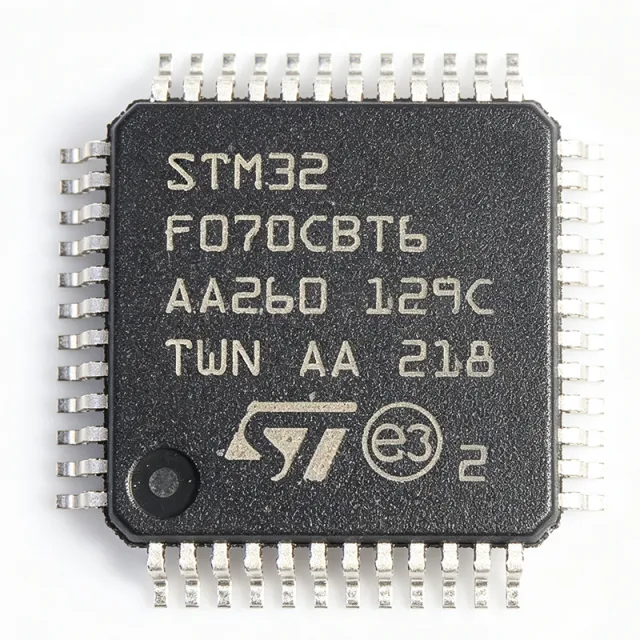
The STMicroelectronics STM32F070CBT6 is a 32-bit ARM Cortex-M0 microcontroller from the STM32F0 series, offering 128KB of Flash memory and 16KB of SRAM in a 48-pin LQFP package. It operates at a core frequency of up to 48 MHz and supports a supply voltage range of 2.4V to 3.6V. Data verified as of 2026-08-05. What is a microcontroller? A microcontroller (MCU) is a compact integrated circuit designed to govern a specific operation in an embedded system. It integrates a processor core, memory (Flash and SRAM), and programmable input/output peripherals on a single chip. The STM32F070CBT6 belongs to the STM32F0 series, which is part of the broader STM32 family of 32-bit ARM Cortex-M microcontrollers. This hierarchy places it within the ARM Cortex-M0 category, a low-power, entry-level core optimized for cost-sensitive applications. Key features include a 12-bit ADC with up to 16 channels, multiple communication interfaces (I2C, SPI, USART), and a variety of timers including advanced-control timers. The device also includes a DMA controller, an RTC, and a CRC calculation unit. The LQFP-48 package provides a compact footprint suitable for space-constrained designs while offering sufficient I/O pins for peripheral connectivity. The STM32F070CBT6 is built on a 32-bit ARM Cortex-M0 core with a Harvard architecture, achieving 1.25 DMIPS/MHz. It includes a nested vectored interrupt controller (NVIC) for efficient interrupt handling and supports both low-power modes (Sleep, Stop, Standby) to optimize energy consumption. The device is designed for a wide range of embedded applications requiring a balance of performance, power efficiency, and cost. Typical applications include industrial control systems, consumer electronics, IoT devices, and home automation. Its rich peripheral set and low-power capabilities make it suitable for sensor interfacing, motor control, and communication protocols. The wide operating temperature range (-40°C to +85°C) ensures reliability in harsh environments. When designing with this MCU, ensure proper decoupling of the power supply pins and consider the use of an external crystal for accurate timing. The device supports in-circuit programming and debugging via SWD, facilitating firmware development and updates. This page synthesizes distributor pricing, drop-in alternatives, and practical design notes not found in the STMicroelectronics datasheet, providing engineers with a comprehensive resource for selection and implementation.

USD $1.57 संपर्क
STM32F071C8T6 - 48MHz Cortex-M0 64KB MCU | STMicroelectronics
STM32F071C8T6

STM32F071C8T6 - 48MHz Cortex-M0 64KB MCU | STMicroelectronics

STMicroelectronics STM32F071C8T6 is an Arm Cortex-M0 32-bit microcontroller operating up to 48 MHz, with 64 KB of embedded Flash memory, supplied in a 48-pin LQFP package. The device is positioned as a general-purpose STM32F0-series MCU for compact embedded systems requiring a 32-bit architecture, moderate Flash capacity, and a 48 MHz operating frequency. The verified distributor information identifies the STM32F071C8T6 as an STM32F0-series microcontroller with 64 KB (64K x 8) Flash and 48 MHz maximum clock speed. An STM32F0 microcontroller is an embedded microcontroller, a category within semiconductor devices that combines a processor core, memory, peripherals, and communication interfaces on one integrated circuit. The STM32F071C8T6 belongs to the STM32F071x8/xB family and uses the Arm Cortex-M0 RISC core. Its architecture is suited to control, monitoring, communication, and general-purpose embedded products where a compact 32-bit processor is useful without requiring the performance and memory of a higher-end Cortex-M series. The verified specifications emphasize three headline characteristics: a 48 MHz maximum operating frequency, 64 KB of embedded Flash memory, and a 48-pin LQFP package. The Cortex-M0 instruction set provides a straightforward 32-bit processing platform for firmware-driven products. The 64 KB Flash capacity is appropriate for firmware, configuration data, boot code, and application logic in cost-sensitive embedded designs. The LQFP-48 package provides 48 external leads and is suitable for conventional PCB assembly and inspection processes. The ST product-page description identifies the STM32F071x8/xB family as incorporating the high-performance Arm Cortex-M0 32-bit RISC core operating at up to 48 MHz. The family data also lists 12 timers, ADC, DAC, and communication interfaces, while the manufacturer datasheet result specifies a 2.0 V to 3.6 V operating range. Exact peripheral counts, pin functions, memory-map details, current consumption, and electrical limits for the exact STM32F071C8T6 ordering code should be confirmed in the manufacturer datasheet before a design is released. Typical uses include industrial control and monitoring, sensor interfaces, compact consumer products, communication modules, and low-cost embedded control boards. The 48 MHz Cortex-M0 core can handle responsive control loops and protocol servicing, while the 64 KB Flash budget supports moderate application firmware. The 48-pin LQFP package is appropriate when a design needs more external pins than a small-outline package while retaining a straightforward assembly process. The principal design consideration is power-supply and peripheral validation. The verified operating range is 2.0 V to 3.6 V, so the board supply, decoupling, I/O levels, and any communication peripherals must be selected consistently. Engineers should also check the exact pin assignment and alternate-function mapping in the ST datasheet before assigning signals, particularly for ADC, DAC, timers, and communication interfaces. This product page consolidates verified distributor pricing, manufacturer family information, package details, application guidance, and structured design notes. It is intended to help engineers and purchasers evaluate the STM32F071C8T6 efficiently while directing them to the official STMicroelectronics datasheet and product page for authoritative final validation.

RFQ संपर्क
STM32F071CBT6 - 48MHz Cortex-M0 MCU | STMicroelectronics
STM32F071CBT6

STM32F071CBT6 - 48MHz Cortex-M0 MCU | STMicroelectronics

STMicroelectronics STM32F071CBT6 is an Arm Cortex-M0 32-bit microcontroller with a 48 MHz operating frequency, 128 KB of Flash memory, and 16 KB of SRAM in a 48-pin LQFP (7x7 mm) package. It operates from a 2.0 V to 3.6 V digital and I/O supply and integrates a 12-bit ADC, a two-channel 12-bit DAC, communication interfaces, and 12 timers for compact embedded-control designs. A microcontroller is a programmable integrated circuit that combines a processor core, memory, peripherals, and interfaces on one device. The STM32F071CBT6 belongs to the STM32F0 access-line hierarchy, where the Arm Cortex-M0 processor core sits beneath the STM32 family and the broader category of general-purpose embedded processors. Its combination of 128 KB Flash, 16 KB SRAM, and analog conversion resources supports both control logic and low-speed signal acquisition without requiring separate analog converters. The 48 MHz Cortex-M0 core provides deterministic processing for real-time control loops, while the CRC calculation unit supports data-integrity checks in communications and storage systems. The device includes seven general-purpose 16-bit timers, one 32-bit timer, and an advanced-control timer, allowing designers to allocate timer resources among periodic scheduling, input capture, output compare, motor control, or PWM generation. The integrated ADC and DAC support analog monitoring and controlled analog outputs within the same 2.0 V to 3.6 V supply domain. Communication and peripheral integration reduces the component count in embedded systems that need serial data exchange or dedicated control outputs. The verified manufacturer material identifies a CRC calculation unit, reset and power management, one 12-bit ADC, a two-channel 12-bit DAC, and multiple communication interfaces. These resources make the STM32F071CBT6 suitable for compact industrial controllers, instrumentation, consumer peripherals, and low-to-medium-speed motor-control equipment where a larger Cortex-M processor would add unnecessary cost or complexity. The 48-pin LQFP package provides a conventional surface-mount footprint with accessible leads for assembly and inspection. A 7x7 mm body preserves board area in space-constrained equipment, while the exposed thermal strategy and lead geometry support manufacturing processes that can inspect individual connections. Because this is a digital mixed-signal microcontroller rather than a discrete power semiconductor, its SOA field is not applicable. Designers should verify every peripheral assignment, alternate-function mapping, pin electrical limit, clock configuration, and decoupling requirement against the STM32F071x8/STM32F071xB manufacturer datasheet before schematic release. The 2.0 V to 3.6 V operating range and 48 MHz core frequency must be considered together when selecting external components and defining the power architecture. This page combines verified manufacturer and distributor information with a focused selection guide, package-level comparison, and application engineering notes. It also distinguishes same-package family alternatives from broader functional substitutes, helping engineers identify replacements without overlooking peripheral differences, firmware constraints, or qualification requirements.

RFQ संपर्क
STM32F071CBT7 - 48MHz Cortex-M0 MCU, 128KB Flash | STMicroelectronics
STM32F071CBT7

STM32F071CBT7 - 48MHz Cortex-M0 MCU, 128KB Flash | STMicroelectronics

The STMicroelectronics STM32F071CBT7 is an Arm Cortex-M0 32-bit RISC microcontroller operating at up to 48 MHz, integrating 128 KB of Flash memory and 16 KB of SRAM with hardware parity in a 48-pin LQFP (7x7 mm) package. It is part of the STM32F0 "Access Line" mainstream family and includes a Consumer Electronics Control (CEC) peripheral alongside 12-bit ADC, 12-bit DAC, and 12 timers, all within a 2.0V-3.6V digital supply range. A microcontroller (MCU) is a single-chip computer that integrates a CPU core, memory (Flash for code and SRAM for data), digital peripherals (timers, communication interfaces, GPIO) and analog peripherals (ADC, DAC, comparators) onto one silicon die. The Arm Cortex-M0 is the smallest and most energy-efficient member of the Cortex-M family, designed for deterministic real-time control at low cost and low active current; it implements the Thumb-2 instruction subset and the NVIC (Nested Vectored Interrupt Controller). Within the broader taxonomy, the STM32F071 sits below Cortex-M3/M4/M7 parts in processing performance, but above 8-bit MCUs (8051, AVR, PIC16) in code density, debug tooling, and peripherals - making it the typical "mainstream" choice for cost-sensitive embedded designs. Key differentiating features include: hardware parity-checked SRAM for higher reliability in safety-relevant code, a 32-bit hardware CRC calculation unit (offloading software CRC loops), an integrated HDMI CEC controller for consumer-electronics interoperability, and a 5V-tolerant I/O structure that simplifies interfacing with legacy 5V logic. The 12-bit ADC and 12-bit DAC are 1 MSPS and 1 MSPS respectively, allowing mixed-signal control loops without external converters. Architecture: Cortex-M0 core with single-cycle multiplier, 3-stage pipeline, and SysTick timer; the bus matrix splits I-code, D-code, and system buses to allow parallel Flash fetch and SRAM access. Power management integrates a low-power Run, Sleep, Stop, and Standby modes with RTC retention, and a brown-out reset (BOR) plus a power-on reset (POR) supervisor. Typical applications include USB-CDC virtual COM ports (using the on-chip USB FS device PHY-less with external 1.5 k pull-up), home-appliance control panels, motor-control sub-modules, HDMI-CEC-equipped TV and set-top boxes, and low-cost sensor hubs. The package, 48-LQFP, is a hand-solderable and prototype-friendly footprint that integrates well into both production and hobby boards. Design consideration: the 7 suffixes (T7 = LQFP48 industrial temperature grade, tape-and-reel) require careful selection when migrating between similar STM32F0 part numbers - the operating temperature range, package, and shipping form all vary by suffix. Designers should verify that the target application does not exceed -40C to +85C industrial range. This page synthesizes distributor pricing, drop-in pin-compatible alternatives, and design notes sourced from the STMicroelectronics datasheet (DS9826), which go beyond what the manufacturer PDF alone offers for procurement and second-sourcing decisions.

RFQ संपर्क
STM32F071RBT6 - 48MHz Cortex-M0 128KB MCU | STMicroelectronics
STM32F071RBT6

STM32F071RBT6 - 48MHz Cortex-M0 128KB MCU | STMicroelectronics

The STMicroelectronics STM32F071RBT6 is a 32-bit ARM Cortex-M0 microcontroller operating at up to 48 MHz, with 128 KB of Flash memory and 16 KB of SRAM, supplied in a 64-LQFP 10 mm x 10 mm package with 51 I/O pins. It belongs to the STM32F0 series of cost-optimized microcontrollers for embedded control, consumer electronics, industrial equipment and compact control panels. A microcontroller is a programmable system-on-chip that integrates a CPU core, program memory, data memory, peripheral interfaces and clock circuitry on one package. The STM32F071 is positioned within the STM32F0 access-line hierarchy, where Arm Cortex-M0 instruction-set compatibility and a compact pin count balance firmware simplicity with useful mixed-signal and connectivity capabilities. The verified device data identifies a 48 MHz maximum operating frequency, 128 KB of Flash organized as 128K x 8, and 16 KB of SRAM. Its 51 available I/O pins support connections to sensors, actuators, human-interface devices and external memory. The 64-LQFP package exposes these connections on a conventional 0.5 mm-pitch footprint while retaining thermal copper and soldering accessibility that is useful for hand-soldered prototypes and moderate-cost production boards. STM32F071 devices are appropriate for motor and power-system controllers, compact sensor hubs, HVAC controls, security panels and small user-interface subsystems. Their Arm Cortex-M0 core supports a common embedded software ecosystem that can be adapted across several STM32 families, while the 48 MHz clock rate provides useful headroom for interrupt-driven control loops, protocol handling and modest graphical interfaces. When laying out the board, allocate decoupling capacitors close to the supply pins and provide a stable clock source according to the manufacturer reference design. Confirm that every external peripheral voltage, level-shifting requirement and USB or communications interface matches the selected STM32F071 variant before releasing the PCB. This page combines verified manufacturer and distributor data, same-package STM32F0 alternatives, an eight-parameter comparison and practical engineering guidance that helps procurement and hardware teams evaluate the STM32F071RBT6 without relying on a distributor listing alone.

RFQ संपर्क
STM32F071V8T6 - 48MHz Cortex-M0 MCU | STMicroelectronics
STM32F071V8T6

STM32F071V8T6 - 48MHz Cortex-M0 MCU | STMicroelectronics

The STMicroelectronics STM32F071V8T6 is a 32-bit Arm Cortex-M0 microcontroller operating at up to 48 MHz, with 64 KB of Flash memory, a 100-LQFP package measuring 14 x 14 mm, and a 2.0 V to 3.6 V digital and I/O supply range. It combines a general-purpose MCU architecture with embedded Flash, SRAM, GPIO, communication peripherals, and low-power operating features in one surface-mount device. A microcontroller is a programmable semiconductor that executes firmware, reads sensor inputs, controls digital outputs, and manages system communication. The STM32F0 family belongs to the hierarchy of embedded microcontroller, 32-bit RISC processor, Arm Cortex-M microcontroller, and embedded semiconductor. The Cortex-M0 architecture is intended for compact control systems where deterministic execution, low complexity, and broad peripheral integration are more important than high-end processor performance. The STM32F071V8T6 provides a 48 MHz Cortex-M0 core, 64 KB of Flash memory, and 16 KB of SRAM with hardware parity according to the indexed device data. Its 100-LQFP package exposes 100 connections in a 14 x 14 mm footprint, making it suitable for densely populated embedded control boards. The specified 2.0 V to 3.6 V operating supply supports common 3.3 V industrial, consumer, and instrumentation designs. The 16 KB SRAM provides working memory for firmware execution, while the 64 KB Flash stores application code and configuration data. The Cortex-M0 core operates at up to 48 MHz, matching the frequency identified by STMicroelectronics, DigiKey, Mouser, and the indexed datasheet. A dedicated CRC calculation unit, reset and power-management functions, and integrated communication capabilities support reliable data handling and peripheral integration. Typical applications include compact industrial controllers, sensor-hub boards, consumer accessories, communication modules, and low-cost embedded instruments. The 100-LQFP package offers substantially more I/O than smaller microcontroller packages, allowing designers to connect displays, sensors, communication transceivers, and discrete control signals without relying on external I/O expanders. When designing a PCB, reserve adequate exposed copper and routing clearance for the 100-pin LQFP footprint, follow the manufacturer pin and land-pattern guidance, and place decoupling capacitors close to the supply pins. Validate all peripheral multiplexing, boot behavior, clock configuration, and firmware dependencies before using a related STM32F0 device as a substitute. This page consolidates the verified manufacturer and distributor details, compares potentially relevant same-footprint devices, and identifies purchasing, pinout, replacement, and design considerations that are not presented as one unified document in the source listings.

RFQ संपर्क
STM32F071VBT6 - 48MHz Cortex-M0 128KB MCU | STMicroelectronics
STM32F071VBT6

STM32F071VBT6 - 48MHz Cortex-M0 128KB MCU | STMicroelectronics

STMicroelectronics STM32F071VBT6 is an Arm Cortex-M0 32-bit microcontroller operating up to 48 MHz, with 128 KB of Flash memory, 16 KB of SRAM, and a 100-pin LQFP package. The device supports a 2.0 V to 3.6 V digital and I/O supply range and integrates 12 timers, an ADC, a DAC, and communication interfaces for compact embedded-control designs. An Arm Cortex-M0 microcontroller is a 32-bit reduced-instruction-set embedded processor within the broader microcontroller and embedded-processor hierarchy. The STM32F0 access-line family combines low-cost processing, GPIO control, analog conversion, and serial communications in a single device. STM32F071VBT6 targets applications where deterministic control, a moderate memory footprint, and broad peripheral integration are more important than a high-performance application processor. Three defining specifications are its 48 MHz maximum CPU frequency, 128 KB Flash memory, and 16 KB SRAM. The Flash provides program storage for firmware and application code, while SRAM provides working memory for stack, data, and peripheral buffers. The 100-pin LQFP package exposes substantially more I/O than smaller MCU packages, supporting mixed analog and digital control systems that require numerous external connections. The STM32F071xB family integrates 12 timers, an ADC, a DAC, and communication interfaces according to the manufacturer datasheet. The ADC supports analog measurement, while the DAC provides an analog output without requiring a separate converter. Multiple timers can support periodic control, input capture, output compare, motor-control timing, or other time-dependent functions. Exact converter resolution, timer channel distribution, and peripheral operating characteristics require confirmation in the complete datasheet. Typical uses include industrial control modules, building automation, appliance control, sensor acquisition, powered equipment, and compact embedded gateways. The 100-pin package is especially useful where multiple inputs and outputs are needed without using a mezzanine board. Compared with a small 32-pin microcontroller, this device offers more routing flexibility and peripheral capacity, while retaining the simple Cortex-M0 programming model. Designers should verify every assigned 100-pin signal against the STM32F071x8/xB pinout, alternate-function mapping, and datasheet constraints before PCB release. The 2.0 V to 3.6 V supply range also requires compatible level shifting or careful interface planning when external pull-ups, sensors, and communications devices use other voltage domains. This page consolidates verified manufacturer specifications, distributor availability links, same-package alternatives, comparison parameters, and practical design guidance. It is intended to support component selection and engineering review, while the manufacturer datasheet remains the authoritative source for pin assignments, electrical limits, timing, and peripheral behavior.

RFQ संपर्क
STM32F072C8T6 - 48MHz 64KB Cortex-M0 MCU | STMicroelectronics
STM32F072C8T6

STM32F072C8T6 - 48MHz 64KB Cortex-M0 MCU | STMicroelectronics

The STMicroelectronics STM32F072C8T6 is a 32-bit ARM Cortex-M0 microcontroller operating up to 48 MHz, with 64 KB of Flash memory and a 48-LQFP 7 x 7 mm package. It belongs to the STM32F0 microcontroller family and is positioned for compact USB, CAN, general embedded-control, and low-power embedded applications. The supplied distributor information identifies the device as a mainstream ARM Cortex-M0 MCU with USB and CAN connectivity. The STM32F0 family consists of entry-level 32-bit RISC microcontrollers intended to provide efficient control processing, integrated communications, analog peripherals, and flexible memory options in a small surface-mount package. This hierarchy places the STM32F072C8T6 within the broader category of embedded microcontrollers, where the device executes firmware, controls peripherals, and communicates with external hardware. Verified source data identifies a 48 MHz maximum CPU frequency, 64 KB of Flash, and a 48-LQFP package. The distributor descriptions also identify USB and CAN support as defining connectivity features. The 48-pin LQFP format provides a conventional leaded surface-mount footprint suitable for designs requiring accessible pins, compact board area, and straightforward assembly. Exact RAM size, voltage limits, peripheral details, and temperature limits are not supplied in the verified excerpts and are therefore not inferred here. Because the device is an ARM Cortex-M0 microcontroller, software development can use the STM32 family ecosystem and embedded C toolchains. The Cortex-M0 core provides a 32-bit RISC architecture, while the STM32F072x8/xB family description from STMicroelectronics emphasizes high-performance embedded control and integrated peripherals. Toolchain and exact peripheral assignments should be confirmed against the manufacturer datasheet and reference manual for the selected board design. Typical application areas include USB-connected control devices, CAN-connected industrial or automotive interface modules, compact sensor controllers, embedded instrumentation, and general-purpose 48 MHz embedded products. USB and CAN are especially relevant where a controller must combine local real-time processing with a standardized communications link. Designers should verify package pin assignments, power requirements, clock configuration, decoupling, and peripheral availability against the official STM32F072C8T6 documentation before layout release. The verified data confirms the 48-LQFP 7 x 7 mm package and 48 MHz Cortex-M0 performance, but does not provide a verified pinout, recommended capacitor values, or full electrical limits. This product record combines distributor availability information, manufacturer family positioning, interface requirements, package data, and practical selection guidance to support initial design decisions. It is intended to help engineers identify whether the STM32F072C8T6 matches the required microcontroller package, processing speed, Flash capacity, and USB/CAN feature set.

RFQ संपर्क
STM32F072C8T6TR - 48MHz 64KB Cortex-M0 MCU | STMicroelectronics (Tape & Reel)
STM32F072C8T6TR

STM32F072C8T6TR - 48MHz 64KB Cortex-M0 MCU | STMicroelectronics (Tape & Reel)

The STMicroelectronics STM32F072C8T6TR is a 32-bit ARM Cortex-M0 microcontroller operating up to 48 MHz, with 64 KB of Flash memory and a 48-LQFP 7 x 7 mm package. It belongs to the STM32F0 microcontroller family and is positioned for compact USB, CAN, general embedded-control, and low-power embedded applications. The supplied distributor information identifies the device as a mainstream ARM Cortex-M0 MCU with USB and CAN connectivity. The STM32F0 family consists of entry-level 32-bit RISC microcontrollers intended to provide efficient control processing, integrated communications, analog peripherals, and flexible memory options in a small surface-mount package. This hierarchy places the STM32F072C8T6TR within the broader category of embedded microcontrollers, where the device executes firmware, controls peripherals, and communicates with external hardware. Verified source data identifies a 48 MHz maximum CPU frequency, 64 KB of Flash, and a 48-LQFP package. The distributor descriptions also identify USB and CAN support as defining connectivity features. The 48-pin LQFP format provides a conventional leaded surface-mount footprint suitable for designs requiring accessible pins, compact board area, and straightforward assembly. Exact RAM size, voltage limits, peripheral details, and temperature limits are not supplied in the verified excerpts and are therefore not inferred here. Because the device is an ARM Cortex-M0 microcontroller, software development can use the STM32 family ecosystem and embedded C toolchains. The Cortex-M0 core provides a 32-bit RISC architecture, while the STM32F072x8/xB family description from STMicroelectronics emphasizes high-performance embedded control and integrated peripherals. Toolchain and exact peripheral assignments should be confirmed against the manufacturer datasheet and reference manual for the selected board design. Typical application areas include USB-connected control devices, CAN-connected industrial or automotive interface modules, compact sensor controllers, embedded instrumentation, and general-purpose 48 MHz embedded products. USB and CAN are especially relevant where a controller must combine local real-time processing with a standardized communications link. Designers should verify package pin assignments, power requirements, clock configuration, decoupling, and peripheral availability against the official STM32F072C8T6TR documentation before layout release. The verified data confirms the 48-LQFP 7 x 7 mm package and 48 MHz Cortex-M0 performance, but does not provide a verified pinout, recommended capacitor values, or full electrical limits. This product record combines distributor availability information, manufacturer family positioning, interface requirements, package data, and practical selection guidance to support initial design decisions. It is intended to help engineers identify whether the STM32F072C8T6TR matches the required microcontroller package, processing speed, Flash capacity, and USB/CAN feature set.

RFQ संपर्क
STM32F072C8T7 - 48MHz Cortex-M0 MCU with 64KB Flash | STMicroelectronics
STM32F072C8T7

STM32F072C8T7 - 48MHz Cortex-M0 MCU with 64KB Flash | STMicroelectronics

The STMicroelectronics STM32F072C8T7 is a 32-bit ARM Cortex-M0 microcontroller operating up to 48 MHz, with 64 KB of Flash memory and a 48-LQFP 7x7 mm package. It is designed for embedded USB, CAN, mixed-signal, and timer-driven control applications. A microcontroller is a programmable semiconductor device that integrates a processor core, memory, peripherals, and I/O into one compact component. The STM32F072 belongs to the STM32F0 series of 32-bit RISC microcontrollers, combining real-time control capability with USB and CAN connectivity. This hierarchy places it among embedded processors and semiconductor devices used in industrial, consumer, and communications equipment. Verified distributor data identifies the STM32F072C8T7 as a 48-MHz ARM Cortex-M0 MCU with 64 KB Flash and a 48-LQFP package. The listed Mouser description also identifies USB and CAN capability, while the STMicroelectronics datasheet result states that the CAN implementation supports specifications 2.0A and 2.0B at up to 1 Mbit/s. These interfaces make the device suitable for embedded control systems requiring both serial connectivity and deterministic peripheral operation. The STM32F0 architecture is appropriate for low- to medium-complexity embedded products where a low-cost general-purpose core, compact package, and integrated communications peripherals simplify board design. USB support can reduce the need for an external communications controller, while CAN is useful for distributed industrial and vehicle-related control networks. The MCU is positioned for applications that do not require the higher performance or memory bandwidth of an STM32F4-class device. Typical uses include USB-connected sensors, CAN-capable industrial modules, compact motor-control boards, communication adapters, and low-cost embedded instruments. Designers should confirm the exact peripheral assignments, electrical limits, pin multiplexing, and clock-tree requirements against the manufacturer datasheet before finalizing a PCB or firmware design. The STM32F072C8T7 is best chosen when its 48 MHz Cortex-M0 core, 64 KB Flash, USB, CAN, and 48-LQFP footprint align with the target product. A design requiring different memory capacity, package pinout, timing, or peripheral availability should be reviewed before substitution. This page synthesizes distributor listings, manufacturer resources, application guidance, and replacement considerations not found in a single distributor specification table. For a valid replacement, use the manufacturer datasheet and package drawing to confirm pin compatibility rather than relying only on a generic cross-reference result. Verify boot configuration, oscillator requirements, USB and CAN routing, peripheral mapping, supply voltage, and firmware assumptions as part of engineering validation.

RFQ संपर्क
STM32F072C8U6 - 48MHz Cortex-M0 MCU with USB/CAN | ST
STM32F072C8U6

STM32F072C8U6 - 48MHz Cortex-M0 MCU with USB/CAN | ST

The STMicroelectronics STM32F072C8U6 is a 32-bit ARM Cortex-M0 microcontroller operating up to 48 MHz, with 64 KB of Flash and 16 KB of SRAM, in a 48-UFQFPN 7 x 7 mm package. The device includes USB, CAN, high-speed embedded interfaces, and low-power features for compact embedded control systems. A microcontroller is a programmable semiconductor that integrates a processor core, memory, peripherals, and I/O into one control platform. The STM32F0 family belongs to the ARM Cortex-M microcontroller hierarchy, combining real-time embedded processing with peripherals for communications, timing, analog measurement, and digital control. STM32F072C8U6 is positioned for USB and CAN-connected equipment rather than high-performance computing. Key features include a 48 MHz maximum core frequency, 64 KB Flash memory, 16 KB SRAM, USB connectivity, CAN connectivity, and a 48-pin UFQFPN package. The 3.3 V supply notation in distributor records identifies the intended operating rail for this device. Its integrated communications peripherals can reduce external interface-component count in USB peripheral, CAN network, and industrial-control products. The STM32F072x8/xB architecture uses the high-performance ARM Cortex-M0 32-bit RISC core, as identified by STMicroelectronics in the product-page result. The MCU family is intended for embedded applications requiring moderate processing speed, communications, and low-power operation. USB and CAN support can simplify firmware-driven connectivity, although peripheral configuration and clocking must be validated against the complete manufacturer datasheet. Typical applications include USB-to-serial adapters, CAN-connected sensors, industrial control modules, USB peripheral equipment, and compact consumer electronics. The UFQFPN package supports dense PCB layouts, while the exposed-pad construction requires careful thermal-via and copper layout according to the manufacturer’s land pattern. When designing a board, confirm the exact pin assignments, alternate functions, power requirements, decoupling strategy, and exposed-pad connection from the official datasheet. Do not substitute a mechanically similar MCU solely by package name; verify USB, CAN, peripheral mapping, firmware startup, and memory compatibility. This page combines verified manufacturer and distributor information with compatibility-focused alternative analysis, application guidance, comparison parameters, and practical PCB considerations to support faster engineering evaluation and sourcing.

RFQ संपर्क
STM32F072C8U6TR - 48MHz Cortex-M0 64KB MCU | STMicroelectronics
STM32F072C8U6TR

STM32F072C8U6TR - 48MHz Cortex-M0 64KB MCU | STMicroelectronics

STMicroelectronics STM32F072C8U6TR is a 32-bit ARM Cortex-M0 microcontroller operating at up to 48 MHz, with 64KB of Flash memory and a 48-pin UFQFPN package. The device includes USB and CAN connectivity and provides 37 I/O pins according to the verified product data. Its compact 7 x 7 mm package is intended for space-constrained embedded control, industrial automation, IoT, motor-control, metering, and low-power board designs. The STM32F072C8U6TR combines a general-purpose RISC core with embedded peripherals and connectivity in a single surface-mount device. A microcontroller is a semiconductor device that integrates a processor core, memory, peripherals, and I/O into one component. Within the hierarchy of embedded semiconductors, this MCU belongs to the ARM Cortex-M0 class of general-purpose 32-bit microcontrollers and is used to execute firmware, read sensors, control outputs, and manage communication interfaces. The Cortex-M0 architecture provides a compact instruction set and deterministic embedded-control platform, while the STM32F0 family targets cost-sensitive applications that require more than a basic 8-bit controller. Verified features include a 48 MHz maximum CPU frequency, 64KB Flash organized as 64K x 8, 37 I/O, USB, CAN, and a 48-UFQFPN package with exposed pad. The 48 MHz clock provides additional processing headroom for protocol handling and control tasks compared with slower entry-level MCUs. USB and CAN connectivity can reduce the need for external interface components in connected industrial or embedded products, although the final design must still verify device-specific peripheral configurations. The STM32F072C8U6TR is suited to applications that need moderate control performance, serial communication, and compact packaging. Its 64KB Flash capacity is appropriate for moderate firmware images, while the 48-pin package provides a substantial I/O count for sensors, actuators, communications, and control signals. Because the verified data does not provide RAM size, ADC details, timer resources, voltage limits, temperature range, or exact pin names, those parameters must be confirmed in the manufacturer datasheet before schematic or PCB sign-off. Typical applications include industrial control nodes, USB-connected peripherals, CAN-based automation equipment, IoT sensing nodes, motor-control interfaces, and metering products. The exposed pad should be connected according to the manufacturer land-pattern and thermal guidance. Designers should preserve the required decoupling structure, route sensitive communications carefully, and confirm the exact pin multiplexing before finalizing a board layout. This product data combines verified distributor specifications, manufacturer product information, sourcing links, and engineering selection guidance. It is intended to support initial design decisions, not to replace the complete STM32F072x8/xB datasheet, reference manual, errata documents, or board-level validation.

RFQ संपर्क
STM32F072C8U7 - 48MHz Cortex-M0 64KB MCU | STMicroelectronics
STM32F072C8U7

STM32F072C8U7 - 48MHz Cortex-M0 64KB MCU | STMicroelectronics

The STMicroelectronics STM32F072C8U7 is a 32-bit ARM Cortex-M0 microcontroller operating up to 48 MHz, with 64KB of Flash memory, in a 48-pin UFQFPN package. The device targets compact embedded systems requiring USB, CAN, general-purpose connectivity, and low-power control. The verified distributor listing identifies the part as a 2.5V/3.3V MCU and describes it as an ARM Cortex-M0 RISC device with USB and CAN support. An STM32F0 microcontroller belongs to the ARM Cortex-M0 class of 32-bit RISC microcontrollers and sits within the broader embedded-microcontroller and semiconductor hierarchy. These devices combine a processor core, Flash program memory, SRAM, peripherals, and GPIO in one integrated component. The STM32F072C8U7 is appropriate when a design needs deterministic embedded control, multiple serial interfaces, and a compact surface-mount footprint rather than a general-purpose host processor. The verified STM32F072C8 specification identifies an operating frequency of up to 48 MHz and 64KB of Flash memory organized as 64K x 8. Distributor listings also identify USB, CAN, and 2.5V/3.3V operation for this device. These features make the MCU relevant to USB peripherals, CAN-connected industrial equipment, USB-to-serial products, compact control boards, and low-cost embedded instruments. The package is specified as 48-UFQFPN, with a 7 mm by 7 mm footprint according to the verified listing. The STM32F072x8/xB family uses the high-performance ARM Cortex-M0 32-bit RISC core. The CAN capability is described by the manufacturer datasheet search result as compliant with specifications 2.0A and 2.0B, supporting standard and extended frames at up to 1 Mbit/s. This makes CAN integration more practical for systems that must exchange diagnostic or control data over a short industrial network. Typical applications include USB-connected data acquisition, CAN-based monitoring, embedded control for communications equipment, compact USB-to-CAN bridges, and low-power industrial modules. The MCU is also relevant to devices requiring a compact 7 mm x 7 mm package and a mainstream Cortex-M0 software ecosystem. Application-specific details such as exact SRAM, GPIO count, peripheral variants, temperature range, and electrical limits require confirmation from the manufacturer datasheet. When designing around the STM32F072C8U7, verify the exact pin assignments, exposed-pad connection, decoupling requirements, clock configuration, and peripheral multiplexing against the official datasheet. USB and CAN interfaces require careful signal-integrity layout, while power design should account for the 2.5V/3.3V supply requirement and regulator tolerance. This page consolidates verified source data and marks unavailable technical details instead of estimating them.

RFQ संपर्क
STM32F072CBT6 - 48MHz Cortex-M0 MCU with USB/CAN | STMicroelectronics
STM32F072CBT6

STM32F072CBT6 - 48MHz Cortex-M0 MCU with USB/CAN | STMicroelectronics

The STMicroelectronics STM32F072CBT6 is a 32-bit Arm Cortex-M0 microcontroller operating up to 48 MHz, with 128 KB of Flash memory, 16 KB of SRAM, USB, and CAN connectivity in a 48-LQFP 7 x 7 mm package. It targets compact embedded products that need deterministic control, serial communications, and USB connectivity without requiring a larger Cortex-M core. A microcontroller is a programmable semiconductor that integrates a CPU, memory, and peripherals into one device. The STM32F0 family belongs to the Arm Cortex-M0 microcontroller hierarchy, combining low-complexity control with embedded flash, SRAM, communication interfaces, timers, and analog peripherals. This positioning makes it suitable for USB accessories, industrial control nodes, motor-control helpers, and compact consumer equipment. The supplied manufacturer-related listings identify a 32-bit Cortex-M0 core, a maximum frequency of 48 MHz, and 128 KB of Flash memory. The family listing also states that this device family covers 64 KB to 128 KB of Flash and provides 16 KB of SRAM with hardware parity CRC capability. USB and CAN are explicitly identified in distributor product descriptions, providing the main communications features for this application-oriented part. STM32F072CBT6 is the non-tape-and-reel ordering form used within an LQFP-48 package family. The suffix T6 denotes the specified temperature and package qualification arrangement, while the B position identifies the 128 KB Flash variant. Firmware must use the exact device identifier, clock configuration, pin definitions, and peripheral mapping from the applicable STMicroelectronics device documentation rather than treating similarly named STM32 devices as interchangeable by firmware alone. Typical embedded roles include a USB-to-serial or configuration interface, a CAN-connected sensor or actuator node, an industrial keypad controller, a motor-support controller, and a compact data-acquisition front end. The 48 MHz Cortex-M0 processor provides predictable execution for control loops, while the integrated USB and CAN options reduce the need for external interface controllers in suitable designs. A robust design should verify every assigned pin against the exact LQFP-48 pinout, provide the required decoupling and clock components, and confirm USB impedance routing and CAN termination requirements. Firmware migration should be validated at register, peripheral, timing, and low-power levels. A candidate replacement should be treated as a drop-in only after its footprint, pin multiplexing, electrical limits, memory, bootloader, and peripheral behavior have all been verified. This page consolidates the verified distributor specifications, source links, package constraints, and replacement cautions into a practical engineering record. It also separates confirmed facts from unavailable data rather than estimating pin mappings, pricing tiers, lifecycle details, or compliance claims that were not present in the supplied sources.

RFQ संपर्क
STM32F072CBT6TR - 48MHz Cortex-M0 MCU with USB/CAN
STM32F072CBT6TR

STM32F072CBT6TR - 48MHz Cortex-M0 MCU with USB/CAN

The STMicroelectronics STM32F072CBT6TR is a 32-bit ARM Cortex-M0 STM32F0-series microcontroller operating up to 48 MHz, with 128 KB of Flash memory, 16 KB of SRAM, USB, CAN, and a 48-pin LQFP package measuring 7 x 7 mm. It combines a compact general-purpose MCU architecture with integrated communications and control peripherals for embedded systems. A microcontroller is a semiconductor device that integrates a CPU core, memory, and peripherals into one component. The STM32F0 family belongs to the ARM Cortex-M0 microcontroller segment, combining low-complexity firmware execution with dedicated hardware for communications, timing, analog conversion, and control. The STM32F072CBT6TR is suited to designs requiring USB connectivity, CAN communication, and a moderate amount of embedded Flash and SRAM. The verified product information identifies a 48 MHz ARM Cortex-M0 core, 128 KB Flash, 16 KB SRAM, USB, CAN, and CEC functions. Its 48-pin LQFP package provides a conventional leaded surface-mount format suitable for designs that require accessible pins and straightforward assembly. The 48 MHz operating frequency supports responsive control tasks and communication handling while keeping software complexity aligned with the Cortex-M0 feature set. Typical applications include USB-connected control devices, CAN-based industrial or automotive-adjacent interface modules, embedded data acquisition, consumer peripherals, and compact control boards. USB can simplify host connectivity, while CAN supports robust communication between distributed nodes when the system design follows the applicable CAN electrical and firmware requirements. Designers should verify the complete pinout, electrical limits, clock configuration, and peripheral assignments against the manufacturer datasheet before layout or firmware release. USB and CAN interfaces also require careful connector, routing, grounding, decoupling, and signal-integrity decisions. The LQFP package facilitates inspection but requires adequate assembly clearance and thermal design. This product page combines verified distributor and manufacturer-linked information with engineering-oriented comparison guidance and practical design notes for engineers evaluating STM32F072CBT6TR, STM32F072C8T6TR, and related MCU choices.

RFQ संपर्क
STM32F072CBT7 - 48MHz Cortex-M0 MCU with USB/CAN | STMicroelectronics
STM32F072CBT7

STM32F072CBT7 - 48MHz Cortex-M0 MCU with USB/CAN | STMicroelectronics

The STMicroelectronics STM32F072CBT7 is a 32-bit ARM Cortex-M0 microcontroller with a 48 MHz CPU, 128 KB of Flash memory, and USB and CAN connectivity, housed in a 48-LQFP 7 x 7 mm package. It belongs to the STM32F0 mainstream MCU family and targets compact embedded systems requiring USB, CAN, and a moderate processing speed. A microcontroller is an integrated circuit that combines a processor core, memory, and peripheral interfaces on one semiconductor device. The STM32F0 series sits within the broader embedded-control hierarchy: MCU -> microcontroller -> embedded processor -> semiconductor. Compared with discrete logic controllers, an MCU provides firmware execution, state management, communication, timing, and direct control of external sensors, actuators, and human-interface circuits. The verified product listing identifies a 48 MHz ARM Cortex-M0 core, 128 KB Flash, USB, CAN, and a 48-LQFP package. The STM32F072CBT7 is therefore suited to USB-enabled control devices, CAN-connected equipment, embedded instrumentation, and compact industrial modules. The exact RAM size, ADC specifications, GPIO count, supply limits, and package dimensions are not included in the supplied verified data and should be confirmed in the manufacturer datasheet before a production design is released. The MCU architecture supports embedded control workloads where deterministic peripheral operation and compact software support matter. USB and CAN are valuable when a design must communicate with a host, service tool, test fixture, or networked peripheral. Compared with a higher-performance Cortex-M system, the Cortex-M0 core provides a simpler embedded platform, while the 48 MHz operating point remains suitable for control loops, protocol handling, user-interface scanning, and supervisory logic. Typical applications include USB-to-control embedded modules, CAN-connected industrial controllers, compact sensor hubs, low-cost communication boards, and battery-powered instrumentation. Designers should provide stable power, decoupling, clock routing, reset handling, and programming access in accordance with the manufacturer reference information. The 48-LQFP package is also relatively easy to inspect and rework compared with very fine-pitch packages. The main engineering trade-off is that the verified listing does not provide a complete electrical and memory map, so firmware planning should be based on the official datasheet and reference manual rather than assumptions. This page consolidates the verified distributor description, package information, sourcing links, and application context while clearly marking unspecified technical data for confirmation.

RFQ संपर्क
STM32F072CBU6 - 48MHz 128KB USB MCU | STMicroelectronics
STM32F072CBU6

STM32F072CBU6 - 48MHz 128KB USB MCU | STMicroelectronics

The STMicroelectronics STM32F072CBU6 is an ARM Cortex-M0 32-bit microcontroller operating up to 48 MHz, with 128 KB of flash memory and a 48-UFQFPN 7 x 7 mm package. It combines a USB full-speed device interface, CAN, 12-bit ADC, 12-bit DAC, and multiple 16-bit and 32-bit timers in one compact embedded-control device. A microcontroller is a programmable integrated circuit that executes firmware, reads sensor and control inputs, and drives outputs within an embedded system. The STM32F072 belongs to the STM32F0 value-line family of 32-bit microcontrollers and provides a practical balance of processing speed, connectivity, analog resources, memory, and package density for compact control systems. Key verified features include the 48 MHz ARM Cortex-M0 core, 128 KB flash, one USB full-speed device port, one CAN interface, one 12-bit ADC, and one two-channel 12-bit DAC. The source material also identifies seven 16-bit timers and one 32-bit timer. These resources support USB-connected peripherals, industrial or automotive communication, analog signal acquisition, precision control outputs, and embedded human-interface designs. The STM32F0 architecture supports efficient real-time control while retaining a straightforward 32-bit instruction set. Its combination of USB, CAN, dual-resolution analog conversion, and timers permits multiple peripherals to share one device. Firmware support and peripheral configuration must still be reviewed for each application because alternate-function mapping, clock settings, low-power behavior, and analog limits affect the final design. Typical uses include USB data acquisition, CAN-connected sensors, motor and actuator control, industrial interface modules, compact instruments, and low-cost embedded platforms. In each case, the 48 MHz core provides computational headroom, while the 7 x 7 mm UFQFPN package supports compact board layouts when pad geometry, exposed-pad soldering, and signal integrity are handled correctly. Designers should route USB and high-speed or sensitive analog signals with short return paths, provide the required bypass and interface components, and verify pin multiplexing before final routing. Firmware migration from another STM32 family should also be tested because peripheral behavior, register details, and application-specific timing may differ even when the physical package is retained. This product record combines the verified distributor and manufacturer information with practical interface and replacement guidance. It distinguishes verified facts from unspecified electrical limits, identifies packaging and sourcing information, and emphasizes the need to verify firmware, pin multiplexing, and manufacturer documentation before production use.

RFQ संपर्क
STM32F072CBU6TR - 48MHz Cortex-M0 MCU | STMicroelectronics
STM32F072CBU6TR

STM32F072CBU6TR - 48MHz Cortex-M0 MCU | STMicroelectronics

The STMicroelectronics STM32F072CBU6TR is an ARM Cortex-M0 32-bit RISC microcontroller operating at up to 48 MHz, with 128 KB of Flash memory and USB, CAN, and peripheral connectivity, housed in a 48-pin UFQFPN 7 x 7 mm package. The STM32F072x8/xB family combines a 32-bit MCU core, embedded memory, communication interfaces, and low-power control in one compact surface-mount device. Its 48-pin UFQFPN package is intended for space-constrained embedded systems requiring more GPIO and communication options than smaller STM32 packages. An MCU is a programmable integrated circuit used to monitor inputs, execute firmware, control outputs, and manage communication between sensors, actuators, communications links, and human-facing systems. The STM32F072x8/xB family is positioned within the STM32 microcontroller portfolio for embedded control, connectivity, and USB-enabled designs. According to the STMicroelectronics product page, the family uses the high-performance ARM Cortex-M0 core and operates at up to 48 MHz. Key verified features include a 32-bit architecture, 48 MHz maximum operating frequency, and 128 KB of Flash memory described by DigiKey as 128K x 8. Mouser identifies the device as an MCU in the USB line with USB, CAN, 128 KB of Flash, and a 48 MHz CPU. These interfaces support designs that need local control together with wired USB or CAN connectivity, although the exact peripheral availability and operating limits should be confirmed against the manufacturer datasheet for the selected ordering code. The device uses a 48-pin UFQFPN package with an exposed-pad-centered 7 x 7 mm format. The UFQFPN is a surface-mount package family that supports compact PCB layouts while providing many external connection points. Exact pin names, exposed-pad connections, electrical limits, and recommended decoupling values are not included in the supplied web excerpts and are marked as data needed where necessary rather than inferred. Typical applications include USB-connected embedded controllers, CAN-connected industrial or automotive peripheral nodes, sensor-hub systems, compact control boards, and low-power monitoring products. The 48 MHz Cortex-M0 core is suitable for real-time control loops, while USB and CAN support interfaces to host computers, test equipment, or other embedded controllers. For PCB design, place required bypass capacitors close to the supply pins, follow the exposed-pad land pattern and thermal-via recommendations in the manufacturer package drawing, and confirm the pin multiplexing and alternate-function assignments before finalizing firmware. This page combines the verified distributor and manufacturer information with procurement guidance and engineering-oriented selection notes.

RFQ संपर्क
STM32F072CBU7 - 48MHz Cortex-M0 USB MCU | STMicroelectronics
STM32F072CBU7

STM32F072CBU7 - 48MHz Cortex-M0 USB MCU | STMicroelectronics

The STMicroelectronics STM32F072CBU7 is an ARM Cortex-M0 32-bit microcontroller operating up to 48 MHz, with 128 KB of flash memory and USB, CAN, and embedded connectivity in a 48-pin UFQFPN package measuring 7 x 7 mm. It is designed for compact embedded systems requiring USB device connectivity and CAN communication. A microcontroller is a programmable semiconductor that integrates a CPU core, memory, peripherals, and communication interfaces on one integrated circuit. The STM32F072CBU7 belongs to the STM32F0 family of ARM Cortex-M0 embedded processors, combining a low-complexity RISC architecture with serial connectivity and real-time peripherals. Its 32-bit instruction set and integrated flash support compact firmware for control, data acquisition, and communication functions. The verified source data identifies the device as an ARM Cortex-M0 MCU with 128 KB flash, 48 MHz maximum operating frequency, USB, and CAN support. The part is supplied in a 48-UFQFPN 7 x 7 mm package. Arrow additionally identifies the STM32F072CBU7 as a 2.5 V or 3.3 V, 48-pin UFQFPN device with an exposed pad and tray packaging. Other electrical limits, RAM capacity, peripheral details, pin assignments, and temperature ratings were not included in the supplied evidence and require confirmation from the manufacturer datasheet. Typical applications include USB-connected control equipment, industrial monitoring, low-speed CAN network nodes, data loggers, human-interface equipment, and compact embedded control platforms. USB is useful for configuration, firmware updates, and data exchange with a host computer, while CAN supports robust communication between embedded nodes in industrial or automotive-adjacent systems. The 48 MHz Cortex-M0 core provides a practical balance between processing capability, power efficiency, and software simplicity. Designers should verify the complete pinout, exposed-pad connection, decoupling requirements, clock configuration, and peripheral electrical limits against the official STMicroelectronics datasheet before layout. USB signal routing, especially differential impedance and grounding, requires careful PCB planning. The verified distributor records do not provide a complete datasheet-derived electrical table, so unverified current, voltage, memory, timing, and compliance claims should not be assumed. This product record combines verified distributor identification, manufacturer-family information, practical application context, and source-linked comparison data for engineers evaluating the STM32F072CBU7.

RFQ संपर्क
STM32F072CBU7TR - 48MHz Cortex-M0 USB/CAN MCU | STMicroelectronics
STM32F072CBU7TR

STM32F072CBU7TR - 48MHz Cortex-M0 USB/CAN MCU | STMicroelectronics

STMicroelectronics STM32F072CBU7TR is an ARM Cortex-M0 32-bit microcontroller IC operating at up to 48 MHz, with 128 KB of flash memory and USB and CAN connectivity, housed in a 48-pin UFQFPN (7x7) package. The device is a member of the STM32F072x8/xB microcontroller family, combining a compact surface-mount format with a USB-capable mainline Arm Cortex-M0 platform for embedded control, communications, and low-cost USB-connected products. A microcontroller is a programmable integrated circuit that integrates a processor core, memory, and peripherals into one device. In the product hierarchy, the STM32F072CBU7TR is a microcontroller, which is an embedded processor and a semiconductor. Its Arm Cortex-M0 core provides a 32-bit RISC architecture, while the USB line MCU configuration supports designs that need wired USB connectivity alongside general-purpose embedded control. The verified configuration provides 128 KB of flash memory, described by the distributor data as 128K x 8, for program storage. Operation reaches 48 MHz, giving designers a higher clock rate than basic Cortex-M0 devices while retaining a simple embedded architecture. The listed supply configuration is 2.5 V/3.3 V, making the MCU suitable for conventional low-voltage embedded systems. USB and CAN are explicitly identified as principal connectivity features of this part. The 48-UFQFPN package measures 7 x 7 mm and is supplied in tape-and-reel form for automated production assembly. Its small area supports compact PCB layouts, but the fine-pitch package and exposed thermal-pad construction require careful land-pattern, paste-volume, and reflow control. The UFQFPN format also means that PCB design should provide adequate exposed-pad copper and thermal paths rather than treating the bottom pad as an optional connection. Typical applications include USB-connected data loggers, CAN-connected industrial or automotive peripherals, compact control boards, USB bootloaders, and cost-sensitive embedded systems that need a 48 MHz Cortex-M0 core. For USB designs, the MCU can serve as the protocol controller while an external transceiver provides the physical USB interface. For CAN designs, a dedicated CAN transceiver such as the TCAN334DR can provide the physical bus interface required by STM32F072CBU7TR's CAN capability. When designing the PCB, verify the exposed-pad soldering requirements and maintain the recommended input, ground, and decoupling layout around the device. Because the verified source data does not provide the complete numbered pin list, engineers should use the manufacturer datasheet and package drawing rather than infer pin assignments from generic 48-pin QFN diagrams. This product page consolidates verified distributor specifications, price and availability references, interface-focused applications, practical package guidance, and clearly qualified replacement options. It separates confirmed parameters from engineering details that still require confirmation in the manufacturer datasheet, helping designers move from part selection to a robust embedded layout.

RFQ संपर्क
STM32F072CBY6TR - 48MHz Cortex-M0 128KB MCU | STMicroelectronics
STM32F072CBY6TR

STM32F072CBY6TR - 48MHz Cortex-M0 128KB MCU | STMicroelectronics

STMicroelectronics STM32F072CBY6TR is an ARM Cortex-M0 32-bit STM32F0 series microcontroller operating at 48 MHz, with 128 KB of flash memory in a 49-WLCSP package. The verified distributor data identifies USB, CAN, a 2.5 V or 3.3 V supply context, and a 49-pin WLCSP tape-and-reel package. It is a compact embedded-control MCU for applications requiring integrated connectivity and peripheral support without a larger leaded package. What is an STM32F0 microcontroller? An MCU is a semiconductor that combines a processor core, flash memory, RAM, clocks, and peripherals on one integrated circuit. The STM32F0 family is based on the ARM Cortex-M0 processor, a low-complexity 32-bit architecture intended for cost-sensitive embedded control. USB and CAN connectivity place the STM32F072CBY6TR above a basic GPIO-only controller while retaining the STM32F0 focus on compact embedded systems. The verified product data identifies a 48 MHz ARM Cortex-M0 core and 128 KB (128 K x 8) flash. Mouser describes the device as an STM32F0 USB-line MCU with USB and CAN support, while distributor listings identify the 49-WLCSP package. Exact RAM size, GPIO count, ADC ratings, timer details, voltage limits, and package dimensions are not included in the supplied source data and therefore require confirmation from the manufacturer documentation before a design release. The architecture is suited to USB-connected peripherals, CAN nodes, compact industrial controls, and low-cost embedded products. A 48 MHz Cortex-M0 core provides the timing baseline for protocol handling and control tasks, while the integrated USB and CAN interfaces reduce the need for external communication controllers. Designers must still budget peripheral pins, clocks, decoupling, signal integrity, and firmware configuration according to the actual board requirements. Typical use includes a USB-to-serial or configuration interface, a CAN-connected sensor node, a compact industrial controller, a USB peripheral, and a small consumer-device control module. The 49-WLCSP format is especially useful when board area is constrained, but its fine pitch requires careful PCB design, inspection, and assembly capability. Confirm the exposed-pad and ball assignments in the official pinout before layout. When designing around STM32F072CBY6TR, use the manufacturer datasheet for the definitive electrical limits, memory map, peripheral multiplexing, clock tree, and package drawing. Place required decoupling close to the device, preserve USB impedance-controlled routing, and validate CAN termination and transceiver interface layout. The supplied web results support sourcing and identity, but they do not provide every electrical value needed for a complete production design. This page combines verified distributor identity, package, processor, flash, connectivity, and commercial-search information with explicit engineering caveats. It is intended to support initial component selection and sourcing, while signaling which technical details must be checked against the official STMicroelectronics documentation before schematic sign-off or firmware deployment.

RFQ संपर्क
STM32F072CBY7TR - 48MHz Cortex-M0 MCU | STMicroelectronics
STM32F072CBY7TR

STM32F072CBY7TR - 48MHz Cortex-M0 MCU | STMicroelectronics

The STMicroelectronics STM32F072CBY7TR is a 32-bit ARM Cortex-M0 microcontroller operating up to 48 MHz, with 128 KB of Flash memory and 16 KB of RAM in a 49-ball WLCSP package measuring 3.28 mm by 3.11 mm. The device belongs to the STM32F0 mainstream MCU family and combines USB, CAN, and general-purpose embedded-control connectivity in a compact surface-mount package. An STM32F0-series microcontroller is an embedded-processing semiconductor that combines an ARM Cortex-M0 CPU core, nonvolatile Flash program memory, volatile SRAM, peripherals, and communication interfaces on one integrated circuit. The STM32F0 family is positioned below more highly integrated microcontrollers in complexity, making it suitable for cost-sensitive control, communications, sensing, and USB-device designs where deterministic real-time behavior is more important than a high-performance multicore architecture. The verified device data identifies a 32-bit ARM Cortex-M0 core operating at 48 MHz, 128 KB of Flash organized as 128K x 8, and 16 KB of SRAM. Its listed peripheral set includes USB and CAN, supporting USB-enabled data acquisition, industrial communication, service interfaces, and connected peripheral equipment. Tape-and-reel ordering is identified by the TR suffix, while the 49-WLCSP construction supports dense, space-constrained PCB layouts. The STM32F072CBY7TR combines a compact 48-MHz processing core with dedicated communications functions in a single package. USB can simplify a direct host-to-device interface without requiring a separate USB controller, while CAN provides a standardized communication option for industrial and embedded networks. The 128 KB Flash capacity provides room for application firmware, boot logic, configuration data, and protocol stacks, while 16 KB of SRAM accommodates working state, buffers, and stack usage. Typical applications include USB-connected sensors, USB data loggers, CAN-capable industrial controllers, compact motor-control modules, low-cost communication gateways, and accessory-control boards. In each case, engineers can use the USB or CAN interface to exchange data while the Cortex-M0 core handles peripheral sampling, control logic, and user-interface functions. Firmware and peripheral configuration must still be validated against the complete STMicroelectronics datasheet before production release. The most important design consideration is the 49-ball WLCSP layout. Its 3.28 mm by 3.11 mm footprint has very limited pad pitch and exposed assembly tolerances compared with leaded packages, so PCB design, stencil selection, solder-paste volume, placement, and reflow-profile validation are essential. Board layout should also preserve USB impedance routing and separate analog or sensitive signal paths from switching and high-current circuitry. This product record combines verified distributor specifications, procurement context, practical package guidance, and explicitly qualified drop-in candidates. It distinguishes electrically similar devices from fully validated replacements, helping engineers evaluate the STM32F072CBY7TR for USB, CAN, embedded-control, and compact embedded-system designs.

RFQ संपर्क
STM32F072R8T6 - 48MHz Cortex-M0 64KB MCU | STMicroelectronics
STM32F072R8T6

STM32F072R8T6 - 48MHz Cortex-M0 64KB MCU | STMicroelectronics

The STMicroelectronics STM32F072R8T6 is an ARM Cortex-M0 32-bit RISC microcontroller operating up to 48 MHz, with 64 KB of Flash memory and 16 KB of SRAM, in a 64-LQFP 10 x 10 mm package. It belongs to the STM32F0 mainstream MCU family and integrates USB, CAN, GPIO, timers, communication peripherals, and low-power features for embedded control designs. A microcontroller is a programmable semiconductor device that combines a processor core, memory, and peripherals on one integrated circuit. In the hierarchy of embedded semiconductors, the STM32F072R8T6 is a general-purpose MCU, while its ARM Cortex-M0 core provides deterministic 32-bit instruction execution for real-time control, communication, and human-interface applications. Verified listing information identifies the device as a 48 MHz ARM Cortex-M0 MCU with 64 KB Flash, 16 KB SRAM, USB, CAN, and a 64-LQFP package. The STM32F0 family is suited to USB-enabled peripherals, CAN-connected equipment, industrial control modules, motor-control support, sensor nodes, and cost-constrained consumer products. Its 2 V to 3.6 V operating range, as reported by the verified search data, supports common embedded supply systems. The STM32F072x8/xB device family combines high-performance processing with embedded peripherals and flexible memory options. The USB interface and CAN capability are important differentiators for designs that need device connectivity alongside general-purpose control. Exact peripheral counts, pin names, electrical limits, and timing values must be confirmed in the manufacturer datasheet before a production design is released. Typical applications include USB-to-serial accessories, CAN gateway boards, motor-control and actuator electronics, industrial sensors, instrumentation, and low-power embedded controllers. Designers should preserve the recommended decoupling and routing practices, provide a stable clock and reset implementation, and verify all unused pins against the selected package pinout. A key design consideration is that firmware compatibility is not guaranteed merely because another MCU has a similar peripheral set. Migration requires checking startup code, memory-map assumptions, interrupt priorities, clock trees, USB or CAN configuration, and package-level pin assignments. The STM32F072R8T6 is best selected when its verified 64 KB Flash, 48 MHz core, 16 KB SRAM, USB, and CAN combination matches the system requirements. This page combines the verified manufacturer and distributor listing information with package-aware engineering context, application guidance, and replacement checks. Because the supplied search results do not include complete manufacturer electrical tables or a verified pin-by-pin mapping, unavailable values are explicitly marked rather than inferred.

RFQ संपर्क