Produk (22.000+)

C8051F045 - 25MHz 8-Bit MCU, 64KB Flash, 64-TQFP | Silicon Labs
C8051F045

C8051F045 - 25MHz 8-Bit MCU, 64KB Flash, 64-TQFP | Silicon Labs

Silicon Labs C8051F045 is an 8-bit C8051F04x-series microcontroller operating at 25 MHz, with 64 KB of programmable flash memory, 4.25 KB of RAM, CAN connectivity, and a 64-pin TQFP package measuring 10 x 10 mm. The device operates from a 2.7 V to 3.6 V supply, making it suitable for low-voltage embedded control systems requiring CAN communication, moderate onboard code storage, and a conventional 8051-compatible architecture. A microcontroller is a programmable integrated circuit containing a processor core, memory, peripherals, and interface logic on one semiconductor device. The C8051F045 belongs to the C8051F04x family of 8-bit microcontrollers, combining an 8051-compatible core with embedded flash, RAM, digital I/O, communication peripherals, and other mixed-signal resources. Within the product hierarchy, it is a microcontroller, embedded controller, and semiconductor intended for compact standalone control and communication tasks. The verified product information identifies a 25 MHz maximum operating frequency, 64 KB flash program memory, 4.25 KB RAM, and 2.7 V to 3.6 V supply range. Its 64-pin TQFP package provides substantially more connection options than smaller microcontroller packages and is appropriate for designs requiring external memory interfaces, communications, analog inputs, timers, or a larger number of general-purpose I/O pins. The listed C8051F045-GQ ordering option is identified as a RoHS-compliant, lead-free 64-TQFP variant. The C8051F045 architecture is positioned for embedded control rather than high-performance computing. Its 25 MHz clock provides deterministic operation for motor, machine, interface, and communications tasks, while the 64 KB flash region supports a larger embedded program than small-memory 8051 devices. The verified listing identifies CAN capability in the C8051F04x family, allowing the controller to participate in industrial and automotive networking designs when the remaining peripheral, transceiver, and timing requirements are satisfied. Typical applications include CAN-connected industrial controllers, automated test equipment, building-control modules, embedded data-acquisition units, instrumentation, and communication gateways. In a CAN node, the microcontroller executes application logic, handles digital inputs, controls outputs, and communicates through a separate CAN transceiver. The 64-TQFP package also makes the device practical for designs that need more peripheral access than a small 20- or 32-pin MCU can provide. Designers should verify the complete pin assignment and peripheral availability against the manufacturer datasheet before layout because the supplied search results establish the package size and pin count but do not provide a complete numbered pin table. The 3.3 V supply range also requires careful regulator selection, while CAN implementation depends on correct transceiver selection, bus termination, isolation requirements, and software timing. This page consolidates the verified distributor specifications, package information, availability observations, and engineering-oriented application guidance into one practical reference. It also separates directly verified facts from unavailable details so engineers can identify what still requires confirmation in the complete C8051F04x technical documentation.

Permintaan RFG Kontak
C8051F045-GQ - 25MHz 64KB Flash 8051 MCU | Silicon Labs
C8051F045-GQ

C8051F045-GQ - 25MHz 64KB Flash 8051 MCU | Silicon Labs

The Silicon Labs C8051F045-GQ is an 8-bit mixed-signal flash microcontroller with a 25 MHz clock, 25 MIPS execution performance, 64 KB of program flash, and a 64-pin TQFP package measuring 10 mm by 10 mm. It belongs to the C8051F04x family and combines an 8051-compatible core, CAN connectivity, a 10-bit ADC, and 4.25 KB of on-chip RAM for embedded control applications. A microcontroller is a programmable semiconductor that integrates a processor core, memory, and peripherals into one device. The 8051 architecture is a CISC instruction-set family widely used in embedded systems, while the C8051F04x generation adds mixed-signal conversion and communications capabilities. Within the product hierarchy, the C8051F045-GQ is an 8-bit flash MCU, an embedded controller, and a member of the semiconductor and integrated-circuit categories. The principal features of this device include 64 KB of in-system programmable flash, operation up to 25 MHz, 25 MIPS throughput, a 10-bit ADC, and CAN communication. Its 2.7 V to 3.6 V operating range supports low-voltage embedded systems. The 64-pin TQFP package exposes mixed-signal and communication functions while remaining compatible with surface-mount assembly and automated PCB manufacturing. The C8051F045-GQ uses a compatible 8051 core and provides a substantial memory-to-pin balance for a small-format system controller. Its flash memory allows firmware to be programmed or updated without removing the device, while the 4.25 KB RAM supports working data, communication buffers, and control routines. The mixed-signal ADC makes the device useful where a design must acquire analog measurements and perform local control or protocol processing on the same board. Typical applications include industrial CAN nodes, motor and actuator controllers, building automation modules, instrumentation front ends, CAN-connected sensors, and compact embedded control boards. In each case, the 25 MHz processor and 64 KB flash provide useful performance without requiring a separate analog-to-digital converter, while CAN supports structured communication with other embedded modules. Designers should treat the 3.6 V maximum supply as a firm constraint and verify the pin-assignment table, analog-reference requirements, oscillator connections, and decoupling recommendations in the manufacturer datasheet. Firmware replacement also requires checking reset behavior, bootloader expectations, and the C8051F04x development-tool configuration rather than assuming every family member is interchangeable.

Permintaan RFG Kontak
C8051F046 - 25MHz 8-Bit MCU with 32KB Flash | Silicon Labs
C8051F046

C8051F046 - 25MHz 8-Bit MCU with 32KB Flash | Silicon Labs

Silicon Labs C8051F046 is an 8-bit C8051F04x-series microcontroller operating at up to 25 MHz, with 32 KB of flash program memory, a 100-lead TQFP package, a 10-bit ADC, and CAN connectivity. The device is supplied in a 100-pin 14 x 14 mm TQFP package and is associated with the 8K ISP Flash MCU family. A microcontroller is a programmable semiconductor that integrates a CPU core, memory, peripheral interfaces, and I/O into one device. The C8051F046 belongs to the C8051 8-bit microprocessor family, where the 8051-compatible instruction set provides a compact platform for embedded control. Its mixed-signal and communications features make it suitable for industrial controllers, CAN-connected equipment, data acquisition systems, and legacy embedded designs. The C8051F046's headline specifications are its 25 MHz operating frequency, 32 KB flash memory, and 10-bit ADC. The supplied distributor information also identifies CAN capability, while the package listing specifies 100-TQFP (14 x 14 mm). These features support designs that require programmable logic, analog measurement, and network communication in one device. The C8051F04x designation identifies the family rather than implying that every family member has identical peripheral resources. The supplied search results describe the processor as a 25 MIPS device and identify the C8051F046 as an 8-bit, legacy-speed processor compatible with ASM51 instructions. This architecture is useful for control-oriented embedded products where a deterministic, compact instruction set and established 8051 software ecosystem are more important than a high-performance 32-bit or 64-bit core. Typical applications include industrial data logging, CAN-node controllers, motor and process-control equipment, instrumentation, and embedded systems connected to legacy 8051 peripherals. The ADC provides a direct path for analog sensor inputs, while CAN allows the controller to exchange data with other embedded nodes. Firmware selection must nevertheless confirm the exact peripheral map, pin assignments, and electrical limits for the chosen ordering code. Designers should use the official device documentation for the complete 100-pin pinout, power sequencing, clock configuration, and decoupling requirements. Because the supplied data does not expose individual pin functions, the C8051F046 pinout is marked unavailable rather than reconstructed from assumptions. This page distinguishes the base device from orderable package suffixes such as -GQ and -GQR and focuses on verified distributor and manufacturer-document information.

Permintaan RFG Kontak
C8051F047 - 8-Bit 25MHz Mixed-Signal MCU | Silicon Labs
C8051F047

C8051F047 - 8-Bit 25MHz Mixed-Signal MCU | Silicon Labs

The Silicon Labs C8051F047 is an 8-bit mixed-signal microcontroller with a 25 MHz 8051-compatible core, 32 KB of in-system programmable flash memory, 32 digital I/O pins, and integrated CAN 2.0B support. The device is identified in distributor listings as a 64-TQFP (10 x 10 mm) package, providing a compact surface-mount solution for embedded control, industrial communication, and mixed-signal sensing systems. A microcontroller is a programmable system-on-chip that combines a CPU core, memory, peripheral interfaces, and digital or analog I/O. The C8051F04x family belongs to the broader 8-bit microcontroller and embedded-controller hierarchy. The C8051F047 is particularly suited to designs requiring legacy 8051 software compatibility alongside higher-performance mixed-signal peripherals and serial communication capability. Key verified features include a 25 MHz maximum operating frequency, 32 KB (32K x 8) of flash memory, 32 digital I/O pins, a 10-bit 13-channel ADC operating at up to 100 ksps, and three comparators. A separate verified listing describes a 10-bit ADC with 13 channels and 100 ksps performance, while the family documentation identifies an integrated CAN 2.0B controller for communications-oriented designs. The C8051F047 uses the Silicon Labs CIP-51 8051-compatible core, as described in the available comparison material. Its mixed-signal feature set allows one device to perform digital control while also acquiring analog measurements and comparing sensor or signal thresholds. The 10-bit ADC and three comparators can reduce the need for separate analog front-end ICs in suitable designs. Typical applications include industrial automation and factory control, CAN-connected equipment, data acquisition, environmental monitoring, embedded instrumentation, and motor or process-control systems. The 64-TQFP package is appropriate for compact boards requiring a high pin count and stable manufacturing, although actual layout must follow the manufacturer pinout and recommended decoupling guidance. Designers should verify the exact C8051F047 package variant, pin assignment, electrical limits, clock configuration, ADC reference, and CAN implementation in the manufacturer datasheet before layout release. Because the available verified data does not provide complete pricing, pin-level details, or full electrical tables, this page distinguishes documented facts from parameters requiring confirmation. This page combines verified distributor identifiers, family-level mixed-signal capabilities, pricing context, drop-in candidates, and application guidance into a concise engineering reference for engineers evaluating the C8051F047 in embedded control designs.

Permintaan RFG Kontak
C8051F047-GQ - 25MHz 8-Bit MCU with 32KB Flash | Silicon Labs
C8051F047-GQ

C8051F047-GQ - 25MHz 8-Bit MCU with 32KB Flash | Silicon Labs

The Silicon Labs C8051F047-GQ is an 8-bit C8051F04x mixed-signal microcontroller operating up to 25 MHz, with 32 KB of in-system programmable Flash memory, 4352 bytes of RAM, and a 64-pin TQFP package measuring 10 mm by 10 mm. Its integration of 10-bit ADC capability, CAN connectivity, and the high-speed pipelined CIP-51 core makes it suitable for embedded control, measurement, and industrial communication systems. An 8-bit microcontroller is a programmable semiconductor integrated circuit whose CPU, memory, and peripherals operate around an 8-bit data path. The C8051F04x family combines an 8051-compatible instruction architecture with enhanced peripherals and in-system programmability. In the product hierarchy, the C8051F047-GQ is a microcontroller, a type of embedded processor and embedded semiconductor used to monitor sensors, process control logic, and manage communication interfaces. Principal features include 32 KB of ISP Flash, 4352 bytes of on-chip RAM, operation up to 25 MHz, and two separate high-speed ADC subsystems. The converters can provide 10-bit or 12-bit resolution at 100 kSPS, or 8-bit resolution at 500 kSPS, allowing designers to balance conversion speed against measurement resolution. The device also includes CAN connectivity, as identified in the C8051F04x product description. The mixed-signal architecture is important because the C8051F047-GQ can acquire analog measurements and execute control functions without requiring a separate high-speed converter for many applications. Its pipelined CIP-51 core supports the 25 MHz operating class while retaining compatibility with the established 8051 software ecosystem. Programmable flash permits field updates and configuration storage, while the dedicated ADC resources support sensing and control loops. Typical applications include industrial process monitoring, factory automation, CAN-connected machine controls, building equipment, environmental measurement systems, and compact embedded instruments. The combination of 32 KB Flash, 4.25 KB RAM, mixed-signal conversion, and CAN is especially useful when several local measurements must be combined with dependable network communication. PCB implementation requires careful attention to high-speed clock routing, analog input grounding, decoupling, and exposed-pad or package thermal requirements where applicable. Follow the pin-description table and layout guidance in the manufacturer datasheet when assigning tracks. Firmware should also be validated for the selected clock source, ADC configuration, CAN timing, and any production-programming procedure before deployment. This page combines the exact C8051F047-GQ configuration, application guidance, parameter comparisons, and replacement considerations with the practical information engineers need for schematic capture, PCB layout, firmware planning, and sourcing. For current commercial availability, use the Request a Quote form on this page.

Permintaan RFG Kontak
C8051F060 - 25MHz Mixed-Signal 8051 MCU | Silicon Labs
C8051F060

C8051F060 - 25MHz Mixed-Signal 8051 MCU | Silicon Labs

The Silicon Labs C8051F060 is a mixed-signal 8-bit microcontroller with a 25 MHz CIP-51 core, 64 KB of in-system programmable flash, 59 digital I/O pins, two 16-bit 1 Msps ADCs, a 12-bit two-channel DAC, three comparators, and CAN 2.0B connectivity in a 100-pin TQFP package. It combines an 8051-compatible core with extensive analog, communications, timer, and industrial-control peripherals. A mixed-signal microcontroller is a semiconductor that integrates digital processing and analog functions on one device. The C8051F060 belongs to the microcontroller hierarchy, where its CIP-51 core executes firmware while the integrated converters and comparators measure or generate analog signals. This consolidation can reduce board area, external component count, and system complexity in industrial control, instrumentation, communications, and embedded data-acquisition equipment. The device operates at 25 MHz and provides 64 KB of flash plus 4352 bytes of on-chip RAM. Its 59 general-purpose digital I/O lines support multiple ports, while its mixed-signal resources include two 16-bit high-speed SAR ADCs, an eight-channel 10-bit ADC, and a two-channel 12-bit DAC. Three analog comparators support thresholding, waveform generation, and basic autonomous control functions. Communications resources include two UARTs, SPI, hardware SMBus compatible with I2C, and CAN 2.0B. According to the Silicon Labs C8051F06x manufacturer datasheet, the peripheral set also includes a programmable 16-bit counter/timer array with six capture/compare modules, five general-purpose 16-bit timers, and a dedicated watchdog timer. An internal calibrated precision oscillator is specified at 24.5 MHz. Typical applications include industrial process control, CAN-connected equipment, data-acquisition systems, analog control panels, test and measurement products, and embedded controllers requiring both serial communications and analog conversion. The integration of ADC, DAC, comparators, timers, and multiple serial interfaces allows a compact design without requiring separate analog or communication ICs. Designers should verify the exact package suffix and pin mapping against the manufacturer datasheet, because C8051F060 is ordered in package-specific forms such as C8051F060-GQ. PCB layout should separate sensitive analog inputs from high-speed digital signals, provide appropriate analog grounding and bypass capacitance, and account for the thermal and decoupling requirements of the complete mixed-signal system. This page consolidates verified manufacturer and distributor information, package details, pricing references, same-family drop-in options, and practical selection guidance. It is intended to help engineers identify the correct 100-pin variant, compare MCU resources, and evaluate whether the C8051F060 provides sufficient analog, communications, and digital I/O capability for a new embedded design.

Permintaan RFG Kontak
C8051F060-GQ - 25MHz 8051 MCU with Dual ADCs | SiLabs
C8051F060-GQ

C8051F060-GQ - 25MHz 8051 MCU with Dual ADCs | SiLabs

The Silicon Labs C8051F060-GQ is an 8-bit C8051F06x mixed-signal microcontroller with a 25 MHz CIP-51 core, 64 KB of flash memory, 4,352 bytes of RAM, 59 digital I/O pins, and two 16-bit 1 Msps ADCs in a 100-pin TQFP package. It combines deterministic 8051-compatible processing with substantial analog measurement capability and CAN connectivity. A microcontroller is a programmable semiconductor that integrates a CPU core, memory, and peripherals on one device. The C8051F060 belongs to the 8051 family of 8-bit microcontrollers and extends the conventional architecture with the Silicon Labs CIP-51 core. Its mixed-signal system-on-chip position places analog-to-digital conversion, general-purpose I/O, communications, and embedded control functions within a single package. The headline features of this device include a 25 MHz operating frequency, 64 KB of in-system programmable flash, and 59 general-purpose digital I/O pins. Two separate 16-bit successive-approximation ADCs operate at up to 1 Msps, allowing the MCU to sample multiple analog channels for industrial controls, instrumentation, and embedded measurement systems. The operating-temperature range is -40°C to +85°C, while the 3.3 V supply class supports integration with common industrial and embedded electronics. The C8051F060-GQ is part of the C8051F06x family, whose devices include four enhanced 8-bit ports and a 3-bit port for a total of 59 general-purpose I/O pins. Its integrated CAN controller supports industrial networking, while the dual ADC architecture reduces the need for external converters when several analog quantities must be measured. The 100-pin TQFP package provides enough pins for mixed analog, digital, and communications routing, although its relatively large footprint demands careful PCB planning. Typical applications include sensor instrumentation, industrial data acquisition, CAN-connected machine controls, motor and actuator supervision, laboratory measurement equipment, and CAN-based industrial gateways. The combination of two fast ADCs and 59 I/O pins is particularly useful when a controller must capture analog inputs, operate digital sensors, and communicate over a robust industrial bus without relying on several discrete components. For PCB implementation, reserve the manufacturer-recommended decoupling and analog-layout geometry around the power and ADC pins. Keep analog signal paths short, separate sensitive analog inputs from high-current switching nodes, and provide adequate exposed-board copper beneath the TQFP footprint for heat dissipation. Firmware and peripheral configuration should be validated against the Silicon Labs C8051F06x data sheet before production release.

Permintaan RFG Kontak
C8051F060R - 25MHz Mixed-Signal 8051 MCU | Silicon Labs (Tape & Reel)
C8051F060R

C8051F060R - 25MHz Mixed-Signal 8051 MCU | Silicon Labs (Tape & Reel)

The Silicon Labs C8051F060R is a mixed-signal 8-bit microcontroller with a 25 MHz CIP-51 core, 64 KB of in-system programmable flash, 59 digital I/O pins, two 16-bit 1 Msps ADCs, a 12-bit two-channel DAC, three comparators, and CAN 2.0B connectivity in a 100-pin TQFP package. It combines an 8051-compatible core with extensive analog, communications, timer, and industrial-control peripherals. A mixed-signal microcontroller is a semiconductor that integrates digital processing and analog functions on one device. The C8051F060R belongs to the microcontroller hierarchy, where its CIP-51 core executes firmware while the integrated converters and comparators measure or generate analog signals. This consolidation can reduce board area, external component count, and system complexity in industrial control, instrumentation, communications, and embedded data-acquisition equipment. The device operates at 25 MHz and provides 64 KB of flash plus 4352 bytes of on-chip RAM. Its 59 general-purpose digital I/O lines support multiple ports, while its mixed-signal resources include two 16-bit high-speed SAR ADCs, an eight-channel 10-bit ADC, and a two-channel 12-bit DAC. Three analog comparators support thresholding, waveform generation, and basic autonomous control functions. Communications resources include two UARTs, SPI, hardware SMBus compatible with I2C, and CAN 2.0B. According to the Silicon Labs C8051F06x manufacturer datasheet, the peripheral set also includes a programmable 16-bit counter/timer array with six capture/compare modules, five general-purpose 16-bit timers, and a dedicated watchdog timer. An internal calibrated precision oscillator is specified at 24.5 MHz. Typical applications include industrial process control, CAN-connected equipment, data-acquisition systems, analog control panels, test and measurement products, and embedded controllers requiring both serial communications and analog conversion. The integration of ADC, DAC, comparators, timers, and multiple serial interfaces allows a compact design without requiring separate analog or communication ICs. Designers should verify the exact package suffix and pin mapping against the manufacturer datasheet, because C8051F060R is ordered in package-specific forms such as C8051F060R-GQ. PCB layout should separate sensitive analog inputs from high-speed digital signals, provide appropriate analog grounding and bypass capacitance, and account for the thermal and decoupling requirements of the complete mixed-signal system. This page consolidates verified manufacturer and distributor information, package details, pricing references, same-family drop-in options, and practical selection guidance. It is intended to help engineers identify the correct 100-pin variant, compare MCU resources, and evaluate whether the C8051F060R provides sufficient analog, communications, and digital I/O capability for a new embedded design.

Permintaan RFG Kontak
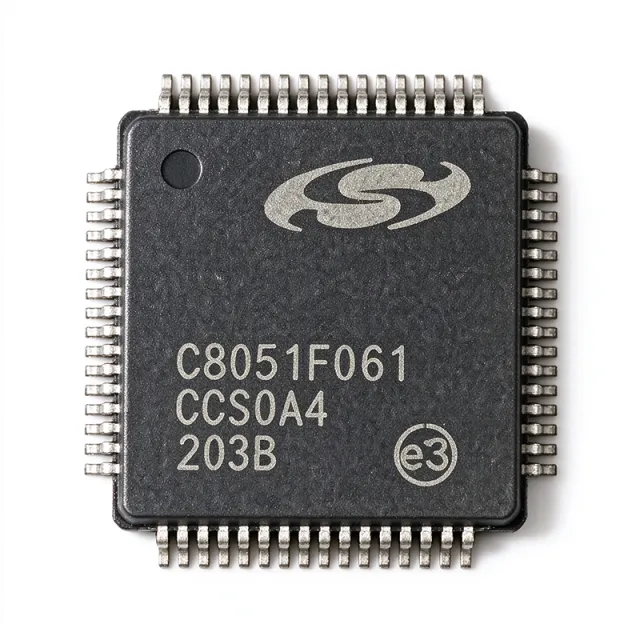
C8051F061 - 25MHz Mixed-Signal MCU | Silicon Labs
C8051F061

C8051F061 - 25MHz Mixed-Signal MCU | Silicon Labs

Silicon Labs C8051F061 is an 8-bit mixed-signal microcontroller operating up to 25 MHz, with 64 KB of flash memory and 24 digital I/O lines in a 64-TQFP 10 x 10 mm package. The device combines a 25 MIPS 8051 core with a 16-bit, single-channel, 1 Msps ADC, a 12-bit, two-channel DAC, and three analog comparators. Its supply-voltage range is 2.7 V to 3.6 V. A mixed-signal microcontroller is an embedded semiconductor that integrates digital processing with analog conversion and comparison functions. The C8051F061 belongs to the C8051F06x family and combines an 8051-compatible embedded processing core with on-chip ADC, DAC, comparator, timer, serial-interface, and communication resources. This mixed-signal MCU category reduces the need for separate analog and digital ICs when a product must measure, generate, or monitor analog signals. Key features include 64 KB of in-system-programmable flash, 4.25K x 8 RAM, five timers, a watchdog timer, and the Programmable Counter Array. Communication and peripheral resources include SPI, SMBus, I2C, two UARTs, and CAN 2.0B. The analog subsystem includes a 16-bit, one-channel ADC operating at 1 Msps, an eight-channel 10-bit ADC, a 12-bit, two-channel DAC, and three analog comparators. An on-chip temperature sensor is also listed for the device. The 25 MHz implementation delivers up to 25 MIPS while retaining the established 8051 instruction set and mixed-signal integration characteristic of the C8051F06x family. The 24 available digital I/O lines make the device appropriate for compact embedded controllers that need several serial interfaces and analog measurements without relying on a large external component count. The 64-pin TQFP package exposes the mixed-signal resources and digital interfaces on a surface-mount footprint. Typical uses include industrial sensor acquisition, process-control equipment, CAN-connected embedded instrumentation, data acquisition modules, and compact control panels. In these systems, the ADC can sample analog inputs, the DAC can generate reference or control voltages, and the UART, SPI, I2C, SMBus, and CAN interfaces can connect local sensors, actuators, and supervisory electronics. The integrated temperature sensor can also support local thermal monitoring where its accuracy is appropriate for the application. Designers should treat the 2.7 V to 3.6 V supply range as a hard design constraint and provide decoupling close to the device pins. Analog and digital grounds, analog inputs, and high-impedance nodes require careful layout to limit noise and offset errors. Firmware migration should also verify peripheral availability and pin multiplexing for the selected C8051F06x variant rather than assuming that every family member has identical resources. This page combines verified distributor specifications, availability information, same-family drop-in candidates, package details, and practical design guidance. It adds engineering-focused comparisons that are not normally presented together on a distributor product page, helping designers evaluate the C8051F061 for embedded control, analog measurement, and communication applications.

USD $37,73 Diketersediaan
C8051F061-GQ - 25MHz 8-Bit MCU with 64KB Flash | Silicon Labs
C8051F061-GQ

C8051F061-GQ - 25MHz 8-Bit MCU with 64KB Flash | Silicon Labs

The Silicon Labs C8051F061-GQ is a mixed-signal 8-bit microcontroller with a 25 MHz CIP-51 core, 64KB of in-system programmable flash memory, and 4.25KB of RAM in a 64-TQFP package. It combines an 8051-compatible architecture with two separate 16-bit SAR ADCs, CAN connectivity, and dedicated mixed-signal resources for embedded control systems. An 8-bit microcontroller is a compact programmable controller that executes embedded software and interacts with sensors, actuators, communications networks, and human-machine interfaces. The C8051F061 belongs to the C8051F06x family, combining the C8051 architecture with mixed-signal peripherals. Its 25 MHz clock rate supports faster control-loop execution than conventional legacy 8051 devices while retaining 8051-compatible software compatibility. The principal features of the C8051F061-GQ include 64KB of ISP flash, 4.25KB of RAM, two independent 16-bit successive-approximation ADCs, a CAN interface, and operation from a 2.7V to 3.6V supply. Two separate converters allow measurements and signal acquisition to be handled independently, which is useful when analog inputs require different sampling schedules, reference conditions, or gain settings. The device uses Silicon Labs’ CIP-51 core, a pipelined 8051-compatible processor architecture designed for higher execution performance than the original 8051 core. Its in-system programmable flash permits firmware to be programmed or updated while the device is connected to the target system, reducing assembly and service effort. The C8051F061-GQ also provides an external memory interface, timers, serial interfaces, and mixed-signal peripherals suited to industrial control and embedded communication equipment. Typical applications include industrial controllers, CAN-connected sensor nodes, data-acquisition equipment, motor and actuator controllers, instrumentation, and compact embedded systems that require both digital control and analog measurement. The 64-TQFP package exposes a broad peripheral set and keeps the solution physically manageable for multilayer control boards. PCB design should preserve clean separation between analog and digital return paths, place decoupling capacitors close to the supply pins, and route high-impedance sensor inputs away from switching nodes and communication traces. Firmware should also initialize unused peripheral pins explicitly because the 64-pin mixed-signal design offers more I/O flexibility than a conventional small-pin-count 8051. This product page consolidates the manufacturer’s mixed-signal MCU characteristics, verified distributor identification, same-family drop-in options, pin-package considerations, and application-oriented design guidance. It is intended to help engineers select the correct package, evaluate peripheral compatibility, and plan firmware and PCB integration for C8051F061-GQ designs.

Permintaan RFG Kontak
C8051F061R - 25MHz Mixed-Signal MCU | Silicon Labs (Tape & Reel)
C8051F061R

C8051F061R - 25MHz Mixed-Signal MCU | Silicon Labs (Tape & Reel)

Silicon Labs C8051F061R is an 8-bit mixed-signal microcontroller operating up to 25 MHz, with 64 KB of flash memory and 24 digital I/O lines in a 64-TQFP 10 x 10 mm package. The device combines a 25 MIPS 8051 core with a 16-bit, single-channel, 1 Msps ADC, a 12-bit, two-channel DAC, and three analog comparators. Its supply-voltage range is 2.7 V to 3.6 V. A mixed-signal microcontroller is an embedded semiconductor that integrates digital processing with analog conversion and comparison functions. The C8051F061R belongs to the C8051F06x family and combines an 8051-compatible embedded processing core with on-chip ADC, DAC, comparator, timer, serial-interface, and communication resources. This mixed-signal MCU category reduces the need for separate analog and digital ICs when a product must measure, generate, or monitor analog signals. Key features include 64 KB of in-system-programmable flash, 4.25K x 8 RAM, five timers, a watchdog timer, and the Programmable Counter Array. Communication and peripheral resources include SPI, SMBus, I2C, two UARTs, and CAN 2.0B. The analog subsystem includes a 16-bit, one-channel ADC operating at 1 Msps, an eight-channel 10-bit ADC, a 12-bit, two-channel DAC, and three analog comparators. An on-chip temperature sensor is also listed for the device. The 25 MHz implementation delivers up to 25 MIPS while retaining the established 8051 instruction set and mixed-signal integration characteristic of the C8051F06x family. The 24 available digital I/O lines make the device appropriate for compact embedded controllers that need several serial interfaces and analog measurements without relying on a large external component count. The 64-pin TQFP package exposes the mixed-signal resources and digital interfaces on a surface-mount footprint. Typical uses include industrial sensor acquisition, process-control equipment, CAN-connected embedded instrumentation, data acquisition modules, and compact control panels. In these systems, the ADC can sample analog inputs, the DAC can generate reference or control voltages, and the UART, SPI, I2C, SMBus, and CAN interfaces can connect local sensors, actuators, and supervisory electronics. The integrated temperature sensor can also support local thermal monitoring where its accuracy is appropriate for the application. Designers should treat the 2.7 V to 3.6 V supply range as a hard design constraint and provide decoupling close to the device pins. Analog and digital grounds, analog inputs, and high-impedance nodes require careful layout to limit noise and offset errors. Firmware migration should also verify peripheral availability and pin multiplexing for the selected C8051F06x variant rather than assuming that every family member has identical resources. This page combines verified distributor specifications, availability information, same-family drop-in candidates, package details, and practical design guidance. It adds engineering-focused comparisons that are not normally presented together on a distributor product page, helping designers evaluate the C8051F061R for embedded control, analog measurement, and communication applications.

USD $37,73 Diketersediaan
C8051F062 - 25MHz Mixed-Signal 8051 MCU | Silicon Labs
C8051F062

C8051F062 - 25MHz Mixed-Signal 8051 MCU | Silicon Labs

The Silicon Labs C8051F062 is an 8-bit mixed-signal microcontroller with a 25 MHz 8051 core, 64 KB of flash program memory, 4.25 KB of RAM, and 59 digital I/O pins in a 100-pin TQFP package. Its integrated analog resources include a 16-bit 1 Msps ADC, a 12-bit two-channel DAC, and three comparators, while the C8051F06x family also supports two integrated 16-bit 1 Msps ADCs according to the retrieved family documentation. A mixed-signal microcontroller is an embedded controller that combines a digital processor with analog-to-digital converters, digital-to-analog converters, comparators, and communication peripherals on one silicon device. This MCU belongs to the hierarchy 8051 microcontroller, embedded processor, mixed-signal MCU, and system-on-chip. Integrating these functions reduces component count and lets a single controller acquire analog measurements, execute control logic, and communicate with external equipment. The C8051F062 operates at 25 MHz and includes 64 KB of flash memory for firmware storage, 4.25 KB of internal RAM, and 59 digital I/O pins. Its 16-bit ADC supports 1 Msps conversion performance, while the 12-bit two-channel DAC provides controlled analog output. Three integrated comparators support thresholding and fast signal conditioning. CAN connectivity expands the device beyond basic serial communications for industrial and embedded control systems. Technically, the C8051F062 combines a C8051F06x-compatible 8051 architecture with analog peripherals intended to reduce external signal-chain complexity. The 64 KB flash capacity permits larger embedded applications than smaller MCU variants, while the 4.25 KB RAM supports working data and stack requirements. Its 2.7 V to 3.6 V supply range is consistent with 3.3 V systems, although system-level design must account for signal-level compatibility at every peripheral. Typical uses include industrial monitoring, sensor acquisition, process-control equipment, communications modules, data-acquisition systems, and compact embedded controllers. The ADC and comparators suit mixed sensor inputs, the DAC supports control or reference signals, and CAN is useful where deterministic field-bus communication is required. Designers should verify the exact package pinout, exposed-pad requirements, clock configuration, analog-input limits, and decoupling requirements in the manufacturer datasheet before layout. Because this MCU combines high-speed conversion and digital switching, careful grounding, local analog bypassing, and separation of sensitive analog traces from digital return currents are essential. This page consolidates verified distributor pricing, family-level alternatives, package information, comparison parameters, and practical mixed-signal design guidance into one engineering-focused reference while explicitly identifying values that still require confirmation from the official datasheet.

Permintaan RFG Kontak
C8051F062R - 25MHz Mixed-Signal 8051 MCU | Silicon Labs (Tape & Reel)
C8051F062R

C8051F062R - 25MHz Mixed-Signal 8051 MCU | Silicon Labs (Tape & Reel)

The Silicon Labs C8051F062R is an 8-bit mixed-signal microcontroller with a 25 MHz 8051 core, 64 KB of flash program memory, 4.25 KB of RAM, and 59 digital I/O pins in a 100-pin TQFP package. Its integrated analog resources include a 16-bit 1 Msps ADC, a 12-bit two-channel DAC, and three comparators, while the C8051F06x family also supports two integrated 16-bit 1 Msps ADCs according to the retrieved family documentation. A mixed-signal microcontroller is an embedded controller that combines a digital processor with analog-to-digital converters, digital-to-analog converters, comparators, and communication peripherals on one silicon device. This MCU belongs to the hierarchy 8051 microcontroller, embedded processor, mixed-signal MCU, and system-on-chip. Integrating these functions reduces component count and lets a single controller acquire analog measurements, execute control logic, and communicate with external equipment. The C8051F062R operates at 25 MHz and includes 64 KB of flash memory for firmware storage, 4.25 KB of internal RAM, and 59 digital I/O pins. Its 16-bit ADC supports 1 Msps conversion performance, while the 12-bit two-channel DAC provides controlled analog output. Three integrated comparators support thresholding and fast signal conditioning. CAN connectivity expands the device beyond basic serial communications for industrial and embedded control systems. Technically, the C8051F062R combines a C8051F06x-compatible 8051 architecture with analog peripherals intended to reduce external signal-chain complexity. The 64 KB flash capacity permits larger embedded applications than smaller MCU variants, while the 4.25 KB RAM supports working data and stack requirements. Its 2.7 V to 3.6 V supply range is consistent with 3.3 V systems, although system-level design must account for signal-level compatibility at every peripheral. Typical uses include industrial monitoring, sensor acquisition, process-control equipment, communications modules, data-acquisition systems, and compact embedded controllers. The ADC and comparators suit mixed sensor inputs, the DAC supports control or reference signals, and CAN is useful where deterministic field-bus communication is required. Designers should verify the exact package pinout, exposed-pad requirements, clock configuration, analog-input limits, and decoupling requirements in the manufacturer datasheet before layout. Because this MCU combines high-speed conversion and digital switching, careful grounding, local analog bypassing, and separation of sensitive analog traces from digital return currents are essential. This page consolidates verified distributor pricing, family-level alternatives, package information, comparison parameters, and practical mixed-signal design guidance into one engineering-focused reference while explicitly identifying values that still require confirmation from the official datasheet.

Permintaan RFG Kontak
C8051F063 - 25MHz 64KB Mixed-Signal MCU | Silicon Labs
C8051F063

C8051F063 - 25MHz 64KB Mixed-Signal MCU | Silicon Labs

The Silicon Labs C8051F063 is an 8-bit mixed-signal microcontroller with a 25 MHz CIP-51 8051 core, 64 KB of Flash program memory, 4.25 KB of RAM, and a 64-pin TQFP package measuring 10 mm by 10 mm. It delivers 25 MIPS while integrating a 16-bit, single-channel, 1 Msps ADC, a 12-bit, two-channel DAC, three comparators, and 24 general-purpose I/O pins. An 8-bit microcontroller is a programmable semiconductor that combines a central processing unit, memory, and peripherals on one integrated circuit. The C8051F06x family is designed for mixed-signal control systems, where a controller must process digital logic while measuring analog inputs and generating analog outputs. Within the product hierarchy, the C8051F063 is an MCU, an embedded controller, and a semiconductor integrating computation, communication, and analog-conversion functions. The 64 KB of Flash provides substantially more program capacity than a small 8-bit control device with legacy mask-program or limited memory options. The 4.25 KB data-RAM allocation supports working variables, stacks, buffers, and peripheral state. Its 25 MIPS processing capability enables time-sensitive control tasks, while the 24 I/O pins provide interfaces for sensors, actuators, logic signals, and external peripherals. The mixed-signal peripherals reduce the need for separate conversion hardware. The 16-bit, one-channel ADC operates at up to 1 Msps for analog measurements, while the 12-bit, two-channel DAC provides two analog output paths. Three integrated comparators support threshold detection, overvoltage monitoring, and fast response functions. The verified distributor data also identifies the device as an 8-bit 8051 C8051F06x MCU with CAN capability. Typical uses include industrial monitoring and control, laboratory instrumentation, sensor acquisition, process-control equipment, embedded communications, and compact control panels. The combination of CAN capability, analog conversion, comparators, and a relatively high I/O count makes the C8051F063 appropriate for designs requiring local analog measurement and digital communication without relying on a separate converter. Designers should verify the complete electrical limits, clock configuration, pin multiplexing, and peripheral-resource arrangement in the manufacturer datasheet before layout or firmware release. Adequate decoupling, careful analog grounding, and controlled routing between the analog and digital sections are essential in a mixed-signal design. The supplied verified data does not expose the complete pin names, so no unverified pinout mapping is presented here. This page consolidates the verified distributor specifications, mixed-signal feature summary, sourcing links, family-level replacement guidance, and practical design considerations. It distinguishes confirmed C8051F063 characteristics from fields that require confirmation in the manufacturer datasheet, helping engineers evaluate the MCU without relying on incomplete catalog summaries.

Permintaan RFG Kontak
C8051F063R - 25MHz 64KB Mixed-Signal MCU | Silicon Labs (Tape & Reel)
C8051F063R

C8051F063R - 25MHz 64KB Mixed-Signal MCU | Silicon Labs (Tape & Reel)

The Silicon Labs C8051F063R is an 8-bit mixed-signal microcontroller with a 25 MHz CIP-51 8051 core, 64 KB of Flash program memory, 4.25 KB of RAM, and a 64-pin TQFP package measuring 10 mm by 10 mm. It delivers 25 MIPS while integrating a 16-bit, single-channel, 1 Msps ADC, a 12-bit, two-channel DAC, three comparators, and 24 general-purpose I/O pins. An 8-bit microcontroller is a programmable semiconductor that combines a central processing unit, memory, and peripherals on one integrated circuit. The C8051F06x family is designed for mixed-signal control systems, where a controller must process digital logic while measuring analog inputs and generating analog outputs. Within the product hierarchy, the C8051F063R is an MCU, an embedded controller, and a semiconductor integrating computation, communication, and analog-conversion functions. The 64 KB of Flash provides substantially more program capacity than a small 8-bit control device with legacy mask-program or limited memory options. The 4.25 KB data-RAM allocation supports working variables, stacks, buffers, and peripheral state. Its 25 MIPS processing capability enables time-sensitive control tasks, while the 24 I/O pins provide interfaces for sensors, actuators, logic signals, and external peripherals. The mixed-signal peripherals reduce the need for separate conversion hardware. The 16-bit, one-channel ADC operates at up to 1 Msps for analog measurements, while the 12-bit, two-channel DAC provides two analog output paths. Three integrated comparators support threshold detection, overvoltage monitoring, and fast response functions. The verified distributor data also identifies the device as an 8-bit 8051 C8051F06x MCU with CAN capability. Typical uses include industrial monitoring and control, laboratory instrumentation, sensor acquisition, process-control equipment, embedded communications, and compact control panels. The combination of CAN capability, analog conversion, comparators, and a relatively high I/O count makes the C8051F063R appropriate for designs requiring local analog measurement and digital communication without relying on a separate converter. Designers should verify the complete electrical limits, clock configuration, pin multiplexing, and peripheral-resource arrangement in the manufacturer datasheet before layout or firmware release. Adequate decoupling, careful analog grounding, and controlled routing between the analog and digital sections are essential in a mixed-signal design. The supplied verified data does not expose the complete pin names, so no unverified pinout mapping is presented here. This page consolidates the verified distributor specifications, mixed-signal feature summary, sourcing links, family-level replacement guidance, and practical design considerations. It distinguishes confirmed C8051F063R characteristics from fields that require confirmation in the manufacturer datasheet, helping engineers evaluate the MCU without relying on incomplete catalog summaries.

Permintaan RFG Kontak
C8051F064 - 25MHz 8051 Mixed-Signal MCU | Silicon Labs
C8051F064

C8051F064 - 25MHz 8051 Mixed-Signal MCU | Silicon Labs

The Silicon Labs C8051F064 is an 8-bit mixed-signal 8051 microcontroller operating at 25 MHz, with 64 KB of Flash memory in a 100-pin TQFP package measuring 14 mm by 14 mm. It integrates a 16-bit, single-channel, 1 Msps ADC, a 12-bit DAC, and three comparators, giving embedded designers mixed-signal acquisition and output capability without requiring separate converters. A microcontroller is a programmable system-on-chip combining a processor core, nonvolatile memory, digital I/O, timers, serial interfaces, and analog peripherals. The C8051F06x family combines the legacy-compatible 8051 instruction set with mixed-signal resources. Within the broader hierarchy, it is a microcontroller, then an embedded processor, then an integrated circuit and semiconductor. Its analog integration is particularly useful for compact industrial-control and measurement designs that need sampling, threshold comparison, and voltage generation in one package. Key features include 25 MHz processing, 64 KB of Flash program memory, 59 digital I/O pins, two integrated 16-bit 1 Msps ADCs according to the family description, a 12-bit DAC, and three integrated comparators. The 100-pin TQFP provides 59 digital I/O pins for the C8051F060, C8051F062, C8051F064, and C8051F066 members of the family. The combination of flash storage, mixed-signal conversion, and abundant I/O supports control-loop, acquisition, and communications functions on a single PCB. The C8051F06x architecture is designed around the powerful 8051 core with 25 MHz performance. Its two 16-bit, 1 Msps ADCs support sampled analog measurements, while the 12-bit DAC provides an analog output derived from software-defined data. Three comparators support threshold detection and monitoring functions. This mixed-signal arrangement allows a single device to collect sensor information, evaluate comparator thresholds, generate an analog reference or control voltage, and manage external equipment through digital interfaces. Typical uses include industrial sensor acquisition, process-control panels, laboratory instrumentation, environmental monitoring, embedded analog control, and communication-oriented control modules. For a 16-bit, 1 Msps conversion stage, the firmware can sample rapidly enough for many measurement and monitoring tasks, although the overall system timing also depends on the selected pins, peripherals, firmware execution, and front-end conditioning. Designers should follow the manufacturer datasheet for the exact 100-pin assignments, oscillator requirements, analog-pin recommendations, and decoupling configuration. The complete pin map is not present in the supplied verified text, so this page does not infer individual pin names. PCB planning should reserve clean analog routing, solid ground distribution, suitable input impedance, and appropriate filtering between external sensors and the integrated ADC inputs. This page consolidates the verified distributor listing, family-level mixed-signal specifications, package information, and same-package alternatives into an engineering-focused selection guide. It also distinguishes confirmed C8051F06x family options from cross-brand replacements, helping designers identify candidates without mistaking a broadly similar microcontroller for a verified pin-compatible substitute.

Permintaan RFG Kontak
C8051F064R - 25MHz 8051 Mixed-Signal MCU | Silicon Labs (Tape & Reel)
C8051F064R

C8051F064R - 25MHz 8051 Mixed-Signal MCU | Silicon Labs (Tape & Reel)

The Silicon Labs C8051F064R is an 8-bit mixed-signal 8051 microcontroller operating at 25 MHz, with 64 KB of Flash memory in a 100-pin TQFP package measuring 14 mm by 14 mm. It integrates a 16-bit, single-channel, 1 Msps ADC, a 12-bit DAC, and three comparators, giving embedded designers mixed-signal acquisition and output capability without requiring separate converters. A microcontroller is a programmable system-on-chip combining a processor core, nonvolatile memory, digital I/O, timers, serial interfaces, and analog peripherals. The C8051F06x family combines the legacy-compatible 8051 instruction set with mixed-signal resources. Within the broader hierarchy, it is a microcontroller, then an embedded processor, then an integrated circuit and semiconductor. Its analog integration is particularly useful for compact industrial-control and measurement designs that need sampling, threshold comparison, and voltage generation in one package. Key features include 25 MHz processing, 64 KB of Flash program memory, 59 digital I/O pins, two integrated 16-bit 1 Msps ADCs according to the family description, a 12-bit DAC, and three integrated comparators. The 100-pin TQFP provides 59 digital I/O pins for the C8051F060, C8051F062, C8051F064R, and C8051F066 members of the family. The combination of flash storage, mixed-signal conversion, and abundant I/O supports control-loop, acquisition, and communications functions on a single PCB. The C8051F06x architecture is designed around the powerful 8051 core with 25 MHz performance. Its two 16-bit, 1 Msps ADCs support sampled analog measurements, while the 12-bit DAC provides an analog output derived from software-defined data. Three comparators support threshold detection and monitoring functions. This mixed-signal arrangement allows a single device to collect sensor information, evaluate comparator thresholds, generate an analog reference or control voltage, and manage external equipment through digital interfaces. Typical uses include industrial sensor acquisition, process-control panels, laboratory instrumentation, environmental monitoring, embedded analog control, and communication-oriented control modules. For a 16-bit, 1 Msps conversion stage, the firmware can sample rapidly enough for many measurement and monitoring tasks, although the overall system timing also depends on the selected pins, peripherals, firmware execution, and front-end conditioning. Designers should follow the manufacturer datasheet for the exact 100-pin assignments, oscillator requirements, analog-pin recommendations, and decoupling configuration. The complete pin map is not present in the supplied verified text, so this page does not infer individual pin names. PCB planning should reserve clean analog routing, solid ground distribution, suitable input impedance, and appropriate filtering between external sensors and the integrated ADC inputs. This page consolidates the verified distributor listing, family-level mixed-signal specifications, package information, and same-package alternatives into an engineering-focused selection guide. It also distinguishes confirmed C8051F06x family options from cross-brand replacements, helping designers identify candidates without mistaking a broadly similar microcontroller for a verified pin-compatible substitute.

Permintaan RFG Kontak
C8051F065 - 25MHz 8-Bit Mixed-Signal MCU | Silicon Labs
C8051F065

C8051F065 - 25MHz 8-Bit Mixed-Signal MCU | Silicon Labs

Silicon Labs C8051F065 is a highly integrated mixed-signal 8-bit microcontroller with a 25 MHz 8051 core, 64 KB of embedded flash memory, and a 64-pin TQFP package measuring 10 mm by 10 mm. The device combines digital control with two 16-bit 1 Msps ADCs, a 12-bit DAC, and three comparators in one package. Its supply-voltage range is 2.7 V to 3.6 V, and the C8051F065 variant provides 24 digital I/O pins. A mixed-signal microcontroller is an embedded system-on-chip that combines a processor core with analog and digital peripherals. In the product hierarchy, the C8051F065 is a microcontroller, also called an MCU, within the broader semiconductor and embedded-control category. Integrating the ADC, DAC, and comparators with the CPU reduces the number of external components needed for compact instrumentation, industrial monitoring, and control designs while keeping analog measurements and control outputs within one embedded platform. Key features include 25 MHz processing performance, 64 KB flash for firmware, two 16-bit ADCs operating at up to 1 Msps, a 12-bit DAC, three analog comparators, and 24 digital I/O pins. The 2.7 V to 3.6 V operating range supports low-voltage embedded systems. These resources make the MCU suitable for applications requiring both continuous signal acquisition and programmable analog output without adding separate data-conversion devices. The C8051F06x family uses the enhanced CIP-51 core architecture and mixed-signal peripherals. Two ADCs provide independent or sampled analog channels for sensors, transducers, and control loops, while the DAC supports programmable reference or output generation. The three comparators support threshold detection and fast digital events. Detailed ADC acquisition timing, DAC accuracy, memory organization, and peripheral register behavior should be confirmed in the manufacturer datasheet before firmware and PCB sign-off. Typical applications include industrial process measurement, sensor instrumentation, motor or actuator control, data acquisition modules, and compact embedded control systems. The 1 Msps ADC throughput supports signal capture when paired with suitable front-end conditioning, while the DAC allows output voltage generation for calibration or test systems. The 24 I/O pins can connect digital controls, status indicators, and external interface signals where the total pin count is sufficient. PCB design should account for the 64-pin TQFP footprint, 10 mm by 10 mm body size, and the device's low-voltage analog supply requirements. Place decoupling capacitors close to the supply pins, route analog inputs away from switching nodes, and provide a clean return path for reference and measurement circuits. Firmware must also configure unused pins and analog channels appropriately to avoid unintended analog behavior or excess current consumption. This page consolidates verified distributor specifications, the mixed-signal feature set, practical application guidance, and the search for genuine drop-in replacements. The supplied data identifies the C8051F065-GQ and C8051F065-GQR orderable variants, but it does not substantiate five pin-compatible substitute devices, so no unverified alternatives are presented as drop-in replacements.

Permintaan RFG Kontak
C8051F065R - 25MHz 8-Bit Mixed-Signal MCU | Silicon Labs (Tape & Reel)
C8051F065R

C8051F065R - 25MHz 8-Bit Mixed-Signal MCU | Silicon Labs (Tape & Reel)

Silicon Labs C8051F065R is a highly integrated mixed-signal 8-bit microcontroller with a 25 MHz 8051 core, 64 KB of embedded flash memory, and a 64-pin TQFP package measuring 10 mm by 10 mm. The device combines digital control with two 16-bit 1 Msps ADCs, a 12-bit DAC, and three comparators in one package. Its supply-voltage range is 2.7 V to 3.6 V, and the C8051F065R variant provides 24 digital I/O pins. A mixed-signal microcontroller is an embedded system-on-chip that combines a processor core with analog and digital peripherals. In the product hierarchy, the C8051F065R is a microcontroller, also called an MCU, within the broader semiconductor and embedded-control category. Integrating the ADC, DAC, and comparators with the CPU reduces the number of external components needed for compact instrumentation, industrial monitoring, and control designs while keeping analog measurements and control outputs within one embedded platform. Key features include 25 MHz processing performance, 64 KB flash for firmware, two 16-bit ADCs operating at up to 1 Msps, a 12-bit DAC, three analog comparators, and 24 digital I/O pins. The 2.7 V to 3.6 V operating range supports low-voltage embedded systems. These resources make the MCU suitable for applications requiring both continuous signal acquisition and programmable analog output without adding separate data-conversion devices. The C8051F06x family uses the enhanced CIP-51 core architecture and mixed-signal peripherals. Two ADCs provide independent or sampled analog channels for sensors, transducers, and control loops, while the DAC supports programmable reference or output generation. The three comparators support threshold detection and fast digital events. Detailed ADC acquisition timing, DAC accuracy, memory organization, and peripheral register behavior should be confirmed in the manufacturer datasheet before firmware and PCB sign-off. Typical applications include industrial process measurement, sensor instrumentation, motor or actuator control, data acquisition modules, and compact embedded control systems. The 1 Msps ADC throughput supports signal capture when paired with suitable front-end conditioning, while the DAC allows output voltage generation for calibration or test systems. The 24 I/O pins can connect digital controls, status indicators, and external interface signals where the total pin count is sufficient. PCB design should account for the 64-pin TQFP footprint, 10 mm by 10 mm body size, and the device's low-voltage analog supply requirements. Place decoupling capacitors close to the supply pins, route analog inputs away from switching nodes, and provide a clean return path for reference and measurement circuits. Firmware must also configure unused pins and analog channels appropriately to avoid unintended analog behavior or excess current consumption. This page consolidates verified distributor specifications, the mixed-signal feature set, practical application guidance, and the search for genuine drop-in replacements. The supplied data identifies the C8051F065R-GQ and C8051F065R-GQR orderable variants, but it does not substantiate five pin-compatible substitute devices, so no unverified alternatives are presented as drop-in replacements.

Permintaan RFG Kontak
C8051F066 - 25MHz 8-Bit Mixed-Signal MCU, 32KB Flash | Silicon Labs
C8051F066

C8051F066 - 25MHz 8-Bit Mixed-Signal MCU, 32KB Flash | Silicon Labs

The Silicon Labs C8051F066 is a highly integrated mixed-signal 8-bit microcontroller built on the enhanced CIP-51 core, delivering 25 MIPS of throughput at 25 MHz in a 100-lead TQFP (14 x 14 mm) package. It combines 32 KB of on-chip Flash program memory with a 16-bit, 1 Msps, single-channel successive-approximation ADC, a 12-bit DAC, and three analog comparators. An MCU (microcontroller unit) is a single-chip computer that integrates a CPU core, program memory, data memory, and peripherals. The C8051F06x family belongs to the broader 8051 lineage of 8-bit microcontrollers, itself part of the embedded processor and embedded systems hierarchy. Because the analog conversion, DAC output, and comparator functions are integrated on the same die, a C8051F066 board needs far fewer external components than a discrete 8051 design, shortening layout time and reducing board area. Key features of this device include 25 MIPS instruction throughput, 32 KB of Flash for in-circuit programming, a 16-bit ADC sampling at 1 Msps, a 12-bit DAC for analog output, three high-speed comparators with programmable hysteresis, an internal oscillator, machine-code USB bootloader support, and a 100-pin TQFP package with 10 analog inputs, four analog outputs, and up to 38 digital I/O. Two internal memory spaces, program Flash and internal RAM, keep firmware and working data on-chip. Technically, the C8051F066 sits in Silicon Labs' C8051F06x line, which extends the classic 8051 architecture with higher clock rates, faster 16-bit ADC hardware, and a more capable peripheral set than the original Intel-era 8051 devices. The CIP-51 core retains full 8051 instruction-set compatibility while adding a four-cycle pipeline, so existing 8051 code ports with minimal effort while gaining a substantial speed increase over 12 MHz original parts. Typical applications include industrial sensor acquisition and control panels, mixed-signal measurement instruments, low-cost USB-connected data loggers, power supply monitoring, motor and actuator control boards, and building-automation nodes where analog front-ends and digital control share one microcontroller. The 100-pin package exposes enough pins for simultaneous analog inputs, comparator outputs, and dense digital I/O in one design. When designing around the C8051F066, budget careful attention to analog front-end design: bypass the analog supply pins directly, keep ADC traces short and away from switching nodes, and reference the datasheet recommended layout for the analog ground connection. Also confirm that your firmware budget fits 32 KB of Flash and that the debugger/flashing toolchain matches the Silicon Labs C8051 platform. This page consolidates distributor listings, package and pinout references, and practical drop-in alternatives for the C8051F066, together with design notes and comparison data that go beyond the basics found in a bare manufacturer datasheet.

Permintaan RFG Kontak
C8051F066R - 25MHz 8051 Flash MCU | Silicon Labs | Industrial Control
C8051F066R

C8051F066R - 25MHz 8051 Flash MCU | Silicon Labs | Industrial Control

The Silicon Labs C8051F066R is an 8-bit C8051F06x-series microcontroller with 32KB of Flash program memory, 4.25KB of RAM, 59 I/O pins, and a 25MHz maximum clock in a 100-pin TQFP package. Designed for embedded control applications, it combines the established 8051 instruction-set architecture with the enhanced CIP-51 core described in the manufacturer documentation. An 8051 microcontroller is an embedded processor designed around a compact, largely single-chip architecture containing a CPU, program memory, data memory, I/O ports, timers, and serial communication peripherals. The C8051F06x family extends the conventional 8051 concept with flash-based code storage and an enhanced core, making it suitable for control equipment, industrial modules, data acquisition, and communication-oriented products. The C8051F066R combines 32KB of 8-bit Flash program memory with 4.25KB of 8-bit RAM. Its 59 available I/O pins support connections to sensors, switches, displays, actuators, and communications peripherals. Operation from a 2.7V to 3.6V supply simplifies designs based on common 3.3V power rails, while the 25MHz clock provides additional processing headroom for interrupt-driven control tasks. The 100-TQFP package provides 100 leads on a 14mm by 14mm footprint, giving the design substantial routing flexibility in a surface-mount assembly. Its large pin count can accommodate multiple digital interfaces and analog-control connections without requiring a fine-pitch, high-lead-count array package. The C8051F06x architecture retains the familiar 8051 programming model while supporting development through the Silicon Labs toolchain and the CIP-51 core enhancements described in the family documentation. Typical uses include industrial control panels, small automation controllers, data-acquisition equipment, communications modules, and compact embedded products requiring a broad I/O count. The 25MHz operating rate is useful for coordinating multiple interrupt-driven inputs, while 32KB of Flash provides practical space for application code, boot routines, configuration logic, and communication handlers. The principal design consideration is firmware compatibility. Before replacing another 8051-family controller, confirm peripheral assignments, memory organization, oscillator requirements, reset behavior, and peripheral availability in the manufacturer pinout and reference material. Use a separate 3.3V regulator when the surrounding system does not already provide a suitably controlled 3.3V rail. This page combines the C8051F066R architecture, memory configuration, package details, sourcing guidance, and drop-in-family comparison with practical design notes. It also highlights the limitations of substitutions so engineers can distinguish footprint compatibility from functional and firmware equivalence.

Permintaan RFG Kontak
C8051F067 - 25MHz 8-Bit MCU, 32KB Flash | Silicon Labs
C8051F067

C8051F067 - 25MHz 8-Bit MCU, 32KB Flash | Silicon Labs

The Silicon Labs C8051F067 is an 8-bit mixed-signal microcontroller operating at up to 25 MHz, with 32 KB of Flash memory and a 64-pin TQFP package measuring 10 mm by 10 mm. It belongs to the C8051F06x family and combines a 8051-compatible core with mixed-signal peripherals for embedded control applications. The device is identified in distributor records as C8051F067-GQ when supplied in the 64-pin TQFP configuration. An 8-bit microcontroller is a programmable semiconductor that executes embedded control logic from a small internal program memory. The C8051F067 combines the 8051 instruction-set family with an enhanced silicon-laboratories core architecture and integrated analog functions. This places it in the broader hierarchy of embedded processor, microcontroller, mixed-signal MCU, and semiconductor product categories. Its architecture is intended for compact embedded systems that require deterministic control, serial communications, and analog measurement without requiring a high-performance 32-bit processor. The C8051F067 operates at up to 25 MHz, and an associated manufacturer-datasheet reference identifies the family as delivering up to 25 MIPS. Its 32 KB Flash program memory provides substantially more code storage than the smaller devices in the C8051F06x family. The mixed-signal feature set includes a 16-bit ADC according to the manufacturer-datasheet references, allowing the MCU to process measured analog signals in firmware and reducing the need for external analog-to-digital converters. The C8051F067 is identified in a 64-pin TQFP package measuring 10 mm by 10 mm. Its higher pin count provides access to the mixed-signal and digital resources required by industrial controls, instrumentation, communications equipment, and embedded measurement systems. The package is a surface-mount technology format, and its exposed perimeter construction supports compact PCB layouts while retaining a pin count high enough for extensive peripheral access. Typical applications include sensor-acquisition and condition-monitoring equipment, industrial control panels, communications modules, programmable instrumentation, and embedded data-acquisition systems. The 16-bit ADC is especially relevant when the design must digitize analog inputs while executing control and communication firmware on the same 8-bit core. The 25 MHz operating rate supports more responsive control loops than slower 8051-class devices, provided that the application timing is checked against the required instruction cycle. When designing around the C8051F067, begin with the complete pin-description table in the Silicon Labs manufacturer datasheet before assigning analog inputs, supply pins, programming interfaces, and ground connections. Decoupling requirements, reference voltages, reset behavior, oscillator configuration, and exposed-pin functions must follow that document. Firmware development also requires the appropriate Silicon Labs programming and debug configuration for the selected package and device revision. This product page combines the confirmed C8051F067 operating, memory, package, and analog specifications with focused design guidance, package-aware alternatives, and application-oriented engineering context. It is intended to help engineers identify the correct device, plan the PCB, and determine whether a C8051F06x family member can serve as a drop-in replacement without changing the 64-pin footprint.

Permintaan RFG Kontak
C8051F067-GQ - 25MHz 8051 Flash MCU | Silicon Labs
C8051F067-GQ

C8051F067-GQ - 25MHz 8051 Flash MCU | Silicon Labs

Silicon Labs C8051F067-GQ is an 8-bit C8051F06x-series flash microcontroller operating at up to 25 MHz, with 32 KB of flash program memory, 4.25 kB of data RAM, and a 64-TQFP package. It provides 24 I/O pins, one 16-bit ADC channel, five timers or counters, and serial interfaces including I2C, SMBus, SPI, and UART for embedded control and communications designs. An 8051 microcontroller is an embedded-processing component that executes firmware from program memory and controls sensors, actuators, communications, and human-interface circuitry. Within the embedded hierarchy, the C8051F06x belongs to the 8-bit MCU, embedded-controller, and flash-microcontroller categories. Its combination of deterministic peripherals, integrated Flash memory, and mixed-signal capability makes it suitable for compact industrial controllers, communication modules, and cost-sensitive products requiring a broad peripheral set. Key features include a 25 MHz maximum clock, 32 KB flash program storage, 4.25 kB data RAM, 24 general-purpose I/O pins, and a 16-bit ADC. The integrated I2C, SMBus, SPI, and UART interfaces allow the MCU to connect sensors, transceivers, memories, and host systems without requiring several external serial controllers. A supply range of 2.7 V to 3.6 V supports compact embedded systems, while the operating-temperature range of -40°C to +85°C suits industrial equipment. The C8051F067-GQ uses an 8-bit C8051 processor core and combines Flash program memory with SRAM for working data. Its 64-pin TQFP package provides a conventional surface-mount footprint with ample signal access for mixed-signal and communication designs. A 16-bit ADC channel supports analog measurements, while five timers or counters support timing, pulse generation, and periodic control tasks. Typical applications include industrial sensor controllers, UART- or SPI-based communication modules, I2C sensor nodes, motor and actuator controllers, and compact embedded control boards. The MCU is especially useful when local firmware must coordinate several serial peripherals while maintaining a small 8-bit platform. The 24 I/O pins also leave useful logic connectivity for status indicators, interlocks, and discrete controls. Design the PCB with short, continuous return paths for ground and sensitive analog signals, particularly around the ADC. Follow the manufacturer's pin-connection table when assigning power, clock, reset, programming, and I/O functions. The device is moisture sensitive, so production handling should follow the prescribed dry-pack, bake, and reflow controls rather than assuming unlimited floor-life exposure. This product page combines the C8051F067-GQ specification summary with practical interface-planning guidance, package-aware alternatives, application analysis, and design considerations. It helps engineers determine whether the 25 MHz 8051 core, 32 KB Flash memory, mixed-signal peripherals, and 64-TQFP footprint fit a design before beginning firmware and PCB implementation.

Permintaan RFG Kontak
C8051F067R - 25MHz 32KB Flash 64-TQFP MCU | Silicon Labs
C8051F067R

C8051F067R - 25MHz 32KB Flash 64-TQFP MCU | Silicon Labs

The Silicon Labs C8051F067R is a mixed-signal 8-bit microcontroller with a 25 MHz operating speed, 32 KB of program Flash memory, 4.25 KB of RAM, and 24 general-purpose I/O pins in a 64-pin TQFP package. The device operates from a 2.7 V to 3.6 V supply and is designed for embedded control systems requiring deterministic digital processing alongside analog measurement functions. A microcontroller is a semiconductor device that integrates a CPU core, program memory, data memory, peripherals, and I/O into one compact component. The C8051F067 belongs to the C8051F06x family, whose CIP-51 core architecture is intended to deliver efficient instruction execution and predictable embedded-control performance. At a maximum 25 MHz clock, the device is advertised at up to 25 MIPS, making it suitable for industrial controllers, data-acquisition systems, instrumentation, and communications-oriented embedded products. The C8051F067R combines 32 KB Flash program storage with 4.25 KB of RAM and 24 I/O pins. Its 16-bit ADC provides higher-resolution analog measurement than a typical 8-bit embedded controller, while the mixed-signal feature set supports applications that combine sensor acquisition, control logic, and digital interfaces. The 64-TQFP package provides 64 electrical pins and is suitable for board designs requiring substantially more I/O than a small-package microcontroller. The 2.7 V to 3.6 V operating range supports designs built around common 3.3 V system rails. Designers should account for the device’s supply-voltage tolerance, peripheral current requirements, analog-reference arrangement, and clock configuration when assigning pins and planning PCB power delivery. The TQFP footprint also requires careful examination of thermal performance when the device operates continuously at its maximum clock frequency. Typical uses for the C8051F067R include industrial process monitoring, laboratory and test equipment, environmental sensing, building-control interfaces, motor and actuator control, and compact embedded instrumentation. Its combination of a 16-bit ADC, 24 I/O pins, and 25 MIPS processing makes it useful when a system needs more measurement resolution and external connectivity than a small 8-bit MCU. For robust implementation, begin with the manufacturer’s C8051F067 datasheet pin description, memory map, and peripheral-connection guidelines. Place decoupling capacitors close to the supply pins, route analog inputs away from high-current switching paths, and verify that every external signal remains within the device’s specified voltage limits. This page combines the key device characteristics, package details, comparison fields, and application guidance needed for initial engineering review.

Permintaan RFG Kontak