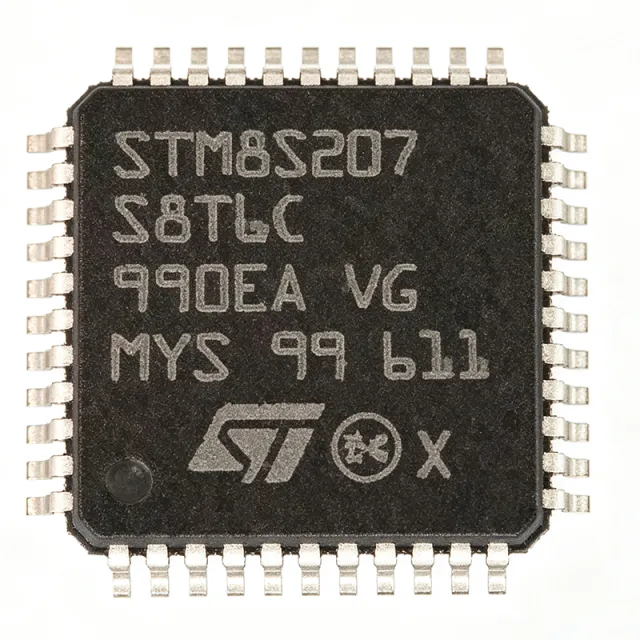
STM8S207R8T6CTR
STM8S207R8T6CTR 24MHz CAN MCU | STMicroelectronics
The STMicroelectronics STM8S207R8T6CTR is an 8-bit STM8S performance-line microcontroller with a 24 MHz clock, 64 KB of Flash program memory, and 38 I/O pins in a 64-pin LQFP package measuring 14 mm by 14 mm. Its integrated communication peripherals include two UARTs, SPI, I²C, and CAN, while a 10-bit ADC supports analog measurement. The device operates from a 3 V to 5.5 V supply.
An 8-bit microcontroller is a compact embedded-control device built around a processor core, program memory, data memory, and peripherals for communicating with external hardware. The STM8S207R8 belongs to the STM8S20xxx performance-line family, which spans devices with 32 KB to 128 KB of Flash program memory. Compared with the simplest 8-bit MCUs, the STM8S207R8 combines higher clock performance, CAN connectivity, multiple serial interfaces, and expanded I/O for appliance controls, industrial equipment, and embedded subsystems.
The principal device characteristics are a 24 MHz operating clock, 64 KB of embedded Flash, 38 I/O pins, and operation from 3 V to 5.5 V. A 10-bit ADC provides a practical balance between conversion resolution, interface cost, and measurement accuracy. Two UARTs support asynchronous serial links, SPI supports faster peripheral communication, I²C connects to low-speed sensors and memories, and CAN supports robust communication in controller-area-network equipment.
The STM8S207R8T6CTR combines these resources in an LQFP-64 package intended for surface-mount PCB assembly. Its 64-pin construction provides more interface and control connections than smaller STM8 devices, while the 14 mm by 14 mm body retains a practical size for cost-sensitive embedded products. The exact temperature limits, memory map, peripheral timing values, and package thermal characteristics should be selected from the manufacturer’s STM8S207R8 documentation for the finished product.
Typical uses include appliance-control panels, motor-control logic, CAN-connected industrial nodes, sensor-conditioning equipment, and general-purpose embedded controllers. The combination of 38 I/O pins and multiple serial interfaces allows one device to supervise buttons, indicators, sensors, actuators, and external converters. The 64 KB Flash capacity provides room for application firmware, while the 10-bit ADC can be used for potentiometer readings, temperature-sensor interfaces, and simple process measurements.
PCB planning should reserve all 38 available I/O positions and route debug, programming, reset, clock, and communication signals according to the manufacturer pin description. Decoupling capacitors should be placed close to the supply pins, and the board layout should provide adequate return paths for ADC and communications signals. Firmware migration should also confirm peripheral mapping, interrupt assignments, and memory usage before using a related STM8S207 variant.
This page combines the core device specifications, interface coverage, application guidance, package information, and drop-in comparison points to support component selection, schematic review, PCB planning, and replacement assessment. It is designed to provide engineering context beyond a basic catalog listing while keeping datasheet-level verification necessary for production designs.
Permintaan RFG
Kontak