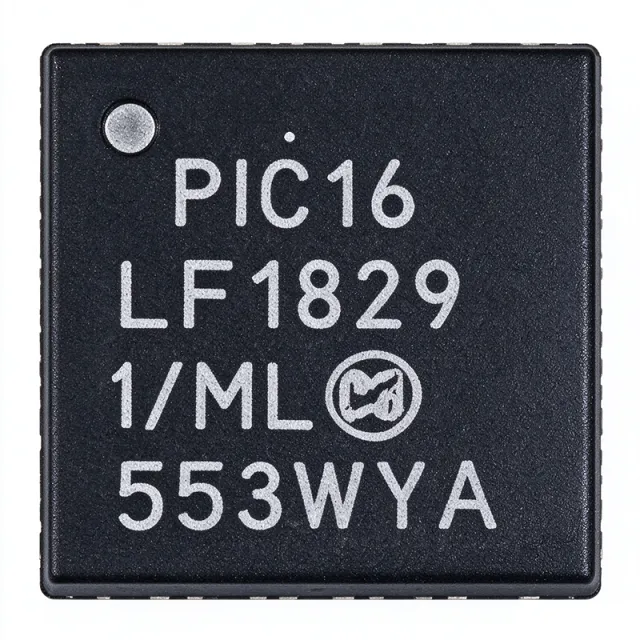
PIC16LF1829-E/P
PIC16LF1829-E/P - 8-Bit 32MHz XLP MCU 14KB Flash 20-PDIP | Microchip
The Microchip Technology PIC16LF1829-E/P is an 8-bit PIC16-family microcontroller built on the enhanced mid-range core, offering 14KB (8K x 14 words) of self-programmable Flash program memory and 32MHz internal oscillator operation in a 20-pin PDIP (through-hole) package. This 'LF' variant is optimized for low-voltage, low-power operation between 1.8V and 3.6V, making it suitable for battery-powered and energy-harvesting designs. It integrates 1KB SRAM, 256B EEPROM, mTouch capacitive sensing, nanoWatt XLP power management, and a rich peripheral set including ADC, DAC, comparators, PWM, and multiple communication interfaces.
What is a microcontroller? A microcontroller (MCU) is a single-chip computer containing a CPU core, program memory (Flash/ROM), data memory (RAM), and integrated peripherals such as timers, ADCs, and communication interfaces. Within the broader taxonomy: microcontroller -> embedded controller -> semiconductor IC. The PIC16F/LF182x family belongs to Microchip's enhanced mid-range 8-bit PIC architecture, widely used for cost-sensitive embedded control in consumer, industrial, and IoT applications.
Key features include Core Independent Peripherals (CIPs) such as Configurable Logic Cells (CLC), Numerically Controlled Oscillator (NCO), and Complementary Waveform Generator (CWG), enabling complex control sequences without CPU intervention. The 'E' suffix denotes the extended (-40C to +125C) industrial operating temperature range, while the 'P' suffix indicates the 20-pin PDIP package with 300-mil (7.62 mm) row spacing suitable for through-hole prototyping, hobbyist, and legacy designs.
The LF1829 architecture uses a 14-bit instruction word with a single-cycle ALU and a hardware multiplier, delivering up to 32MHz operation (8 MIPS) from its internal 32MHz HFINTOSC. It supports multiple clock sources (HFINTOSC, LFINTOSC, external crystal, EC mode) with active clock switching for ultra-low-power sleep modes below 50 nA. The peripheral pin select (PPS) feature allows flexible remapping of digital peripheral signals to multiple I/O pins.
Typical applications include capacitive touch user interfaces (keyboards, sliders, proximity sensors), battery-powered sensor nodes with sleep currents under 1 uA, small motor control via the PWM/CWG peripherals, LED lighting controllers with smooth dimming, and general-purpose logic replacement using CLC blocks. Designers also use the LF1829 in safety-critical sensor conditioning thanks to the on-chip 10-bit ADC and rail-to-rail comparators.
When designing with this device, ensure decoupling capacitors of 100 nF and 10 uF are placed close to VDD pins. For low-power designs, leverage the multiple deep-sleep modes (Sleep, Deep Sleep, and Power-Down with RTCC) and use the nanoWatt XLP features to extend battery life. The 20-pin PDIP package is ideal for breadboarding and educational use; for volume production, migrate to the equivalent SOIC, SSOP, or QFN variants in the same PIC16LF1829 family.
This page synthesizes distributor pricing, parametric drop-in alternatives in the same PDIP-20 footprint, and practical low-power design notes that complement the manufacturer datasheet for engineers evaluating 8-bit PIC MCUs.
見積もり
お問い合わせ