EPC2LC20V
EPC2LC20V - Altera 1.6Mb Flash Config Device, PLCC-20 | Intel
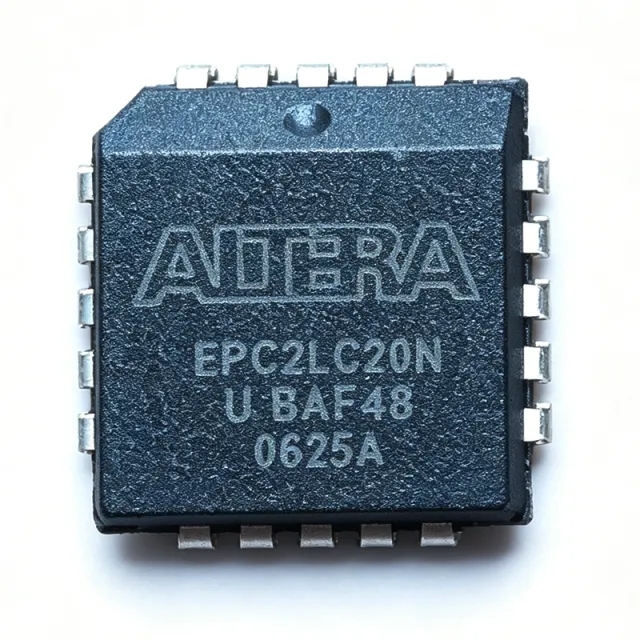
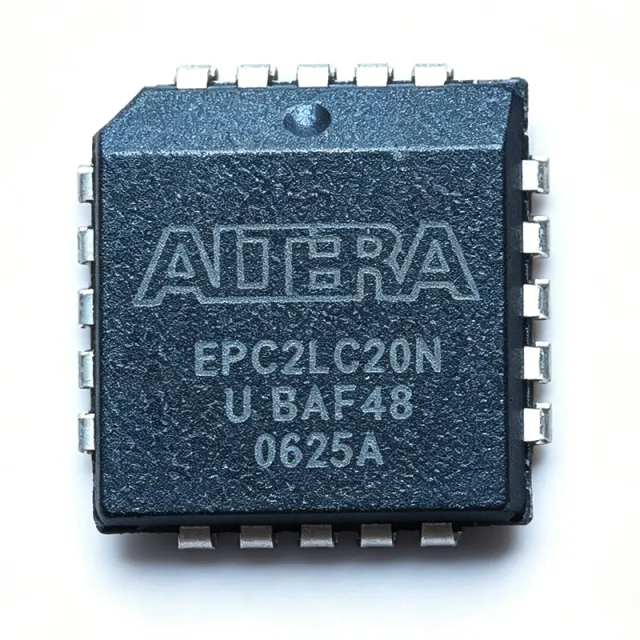
The Altera EPC2LC20V (now under Intel) is a 1.6 Mb Flash-memory-based Configuration Device designed to load the configuration bitstream of SRAM-based Look-Up Table (LUT) FPGAs such as the Altera Cyclone, Stratix, APEX, and ACEX families. Housed in a 20-pin Plastic Leaded Chip Carrier (PLCC-20) package, it provides in-system programmability via a standard JTAG (IEEE 1149.1) interface and operates at a 10 MHz serial configuration clock with a maximum configuration data width of 8 bits. The 'V' suffix denotes the lead-free / Pb-free PLCC package, while the '20' designates the 20-pin JEDEC PLCC outline.
A Configuration Device is a non-volatile memory that stores the FPGA's configuration bitstream and serially or byte-parallel delivers it to the FPGA's DATA, DCLK, and nCONFIG pins at power-up. In the broader taxonomy, an FPGA configuration PROM sits below non-volatile memory > Flash memory > PROM > configuration memory within the semiconductor hierarchy. It bridges the volatile SRAM-LUT architecture (which loses configuration when power is removed) with a permanent, field-updatable boot source - eliminating the need for external boot PROMs from third-party vendors and enabling remote firmware revision via JTAG.
Key features include 1.6 Mb of usable configuration storage (more than 4x the original EPC1), a flexible serial or 8-bit parallel configuration interface, an on-chip oscillator to generate DCLK, JTAG boundary-scan support (IEEE 1149.1), and in-system programmability through JTAG without external programmer hardware. The PLCC-20 footprint provides rugged mechanical compliance for industrial through-hole and socketed assemblies, and the device is compatible with the older EPC1 / EPC1064 / EPC1441 pinouts on a 1:1 basis within the same package family.
Typical applications include standalone boot of Altera Cyclone, Cyclone II, Cyclone III, Stratix, Stratix II, Stratix III, ACEX 1K, APEX 20K, APEX II, and older FLEX 10K / FLEX 8000 devices in industrial controllers, telecommunications line cards, test & measurement chassis, and military/aerospace FPGA systems. Because the EPC2 supports both serial and 8-bit byte-wide configuration, a single PROM can serve either low-pin-count or high-throughput FPGA boot scenarios.
When designing with this device, verify that the FPGA's configuration mode (AS, PS, or JTAG-only) matches the EPC2's supported modes, since the EPC2 is intended for PS (Passive Serial) and JTAG programming - it does not support Altera Active Serial (AS) mode, which uses serial Flash such as EPCS / EPCQ devices. Add a 0.1 uF decoupling capacitor near the VCC pin and ensure nINIT_CONF and nSTATUS are correctly tied to the FPGA's nCONFIG / nSTATUS pins.
This page synthesizes distributor pricing, drop-in compatible configuration-memory alternatives, JTAG programming notes, and PLCC-20 package cross-references not found in the original Altera datasheet - giving a single source for engineers re-spinning legacy Altera FPGA designs.
見積もり
お問い合わせ