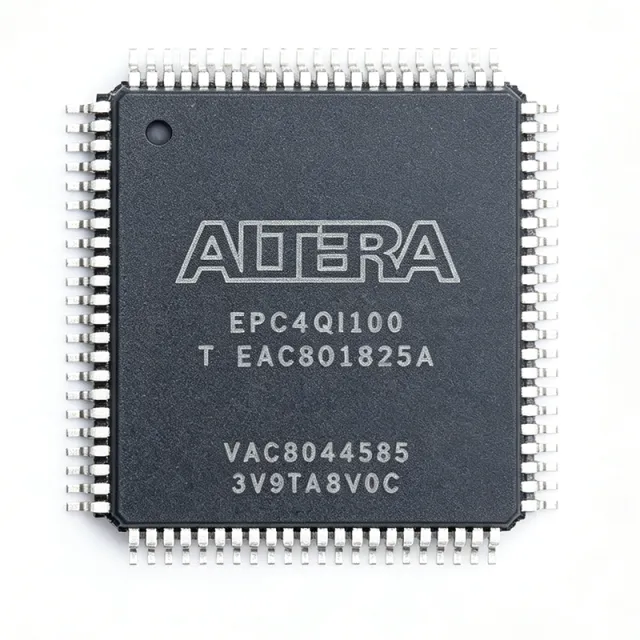
EPC2TC32UCF48
EPC2TC32UCF48 - 1.6Mb FPGA Config PROM | Intel / Altera | TQFP-48
The Intel / Altera (formerly Altera Corporation) EPC2TC32UCF48 is a 1.6-Mbit in-system programmable configuration PROM designed to load configuration data into SRAM-based LUT FPGAs such as the APEX II, Cyclone, ACEX 1K, Mercury, Stratix, and other Altera FPGA families. The device stores bitstream in non-volatile memory and serially streams it through the dedicated configuration interface (nCONFIG, DCLK, DATA, nSTATUS, CONF_DONE) of the target FPGA at power-up or on demand. The "TC" speed grade and "32" density denote 32 Mb / 1.6 MByte of configuration memory. The "UCF48" suffix identifies the 48-pin TQFP package.
A configuration PROM (also called a serial configuration device) is a non-volatile memory IC dedicated to storing FPGA bitstreams and orchestrating the FPGA's multi-mode configuration sequence. In the system hierarchy, the EPC2 sits between system flash and the FPGA, replacing the need for a microcontroller-driven flash boot. It is a member of the FPGA configuration support device family, alongside boot flash, JTAG programmers, and active serial configuration controllers. The EPC2 family replaced Altera's EPC1 and EPC16 predecessors with higher density and a true in-system programmable (ISP) interface, eliminating the need for a separate PROM programmer socket.
Key features include 1.6 Mbit (1.6 Mb) of storage, 3.3 V single-supply operation, in-system programmability via IEEE Std. 1149.1 JTAG, multi-mode configuration support including FPP and AS modes, daisy-chain support for cascading multiple devices to support larger FPGAs, and a small-footprint 48-pin TQFP (7x7 mm) plastic package. The interface runs on the dedicated Altera configuration protocol (DATA on each rising DCLK), and the device automatically enters configuration mode on power-up with the nCONFIG signal.
Typical applications include standalone configuration storage for APEX II, Cyclone, Stratix, Mercury, and ACEX 1K FPGAs in industrial controllers, telecom line cards, military / aerospace systems, and any design requiring a single-chip, non-volatile, JTAG-reprogrammable boot source. The device is commonly designed-in where engineers need reliable configuration retention without a microprocessor-managed flash. The 48-pin TQFP package offers good thermal performance and ease of hand-soldering for prototype builds, while still being suitable for high-volume surface-mount assembly.
When designing with this device, ensure the JTAG chain is properly terminated (TCK pull-up, TMS pull-up, TDI pull-up, TDO tristate) and that the FPGA's MSEL pins are configured for the appropriate configuration mode (AS vs FPP). Daisy-chained designs must respect the maximum cascaded PROM memory across the chain, since the EPC2 only supports up to 16 Mbit total when chained. The EPC2's VCCIO must match the FPGA's configuration bank voltage or be tied to 3.3 V with a level shifter if a 1.5 V or 1.8 V bank is used.
This page synthesizes distributor pricing from DigiKey, Mouser, and Octopart, identifies pin-compatible configuration PROM alternatives that fit the same TQFP-48 footprint, and surfaces practical design notes that complement the manufacturer datasheet.
見積もり
お問い合わせ