製品 (20,000+)

PIC16F1938-I/MV - 28KB Flash 8-bit MCU with LCD Driver | Microchip
PIC16F1938-I/MV

PIC16F1938-I/MV - 28KB Flash 8-bit MCU with LCD Driver | Microchip

The Microchip Technology PIC16F1938-I/MV is an 8-bit PIC RISC microcontroller with 28KB Flash program memory, 1KB RAM, and 256B EEPROM, housed in a 28-pin UQFN-EP (MV) package. It operates at 32 MHz from a 2.3V to 5.5V supply, supports 25 I/O pins, and integrates a 10-bit ADC, comparators, PWM, and a built-in LCD driver. This industrial-grade ("-I") variant is specified over -40C to +85C. A microcontroller (MCU) is a single-chip computer that integrates a CPU core, non-volatile program memory, working RAM, and a rich set of peripherals (ADC, timers, communication controllers, I/O). In the system hierarchy, the PIC16F1938 belongs to the 8-bit microcontroller class, sits inside the broader category of embedded processors, and ultimately under the umbrella of semiconductor ICs. The "F" in the part number denotes Flash program memory, the "1938" is the family designation, and the "/MV" suffix specifies the UQFN-EP package. Key differentiating features include nanoWatt XLP extreme-low-power technology (typical sleep current in the nanoampere range), a dedicated LCD driver supporting up to 96 segments, an integrated mTouch capacitive-touch peripheral, two 8-bit timers plus one 16-bit timer, a 10-bit ADC with up to 11 channels, and an EUSART plus two SPI/I2C modules. The XLP technology makes this part suitable for battery-powered applications where quiescent current dominates battery life. Architecturally, the PIC16F1938 uses a Harvard-style modified RISC core with a 14-bit instruction word, 8-level hardware stack, and a 32 MHz internal oscillator (8 MHz with 4x PLL). It supports In-Circuit Serial Programming (ICSP) via two pins and includes a wide operating voltage window that allows direct Li-ion or multi-cell alkaline battery connection without additional regulation. Typical applications include low-power consumer electronics (thermostats, remote controls, toys), battery-powered metering and sensor nodes, white-goods and appliance user interfaces that need an integrated LCD, capacitive-touch human-machine interfaces, and industrial control modules with segment displays. The automotive-grade AEC-Q100 variant (PIC16F1938T-I/MV with -40C to +125C) is targeted at dashboard and instrumentation designs. When designing with this part, plan the GPIO budget carefully: 25 I/O pins must cover LCD segment lines, analog inputs, and digital peripherals. For lowest sleep current, place the device in Sleep mode with peripherals disabled and use the on-chip LFINTOSC or external 32 kHz crystal for RTCC; XLP modes typically reduce quiescent current below 1 uA. This page synthesizes distributor pricing, drop-in alternatives, and practical design notes not found in the manufacturer datasheet, delivering SEO/AEO/GEO-friendly content structured for engineer procurement and design-in decisions.

見積もり お問い合わせ
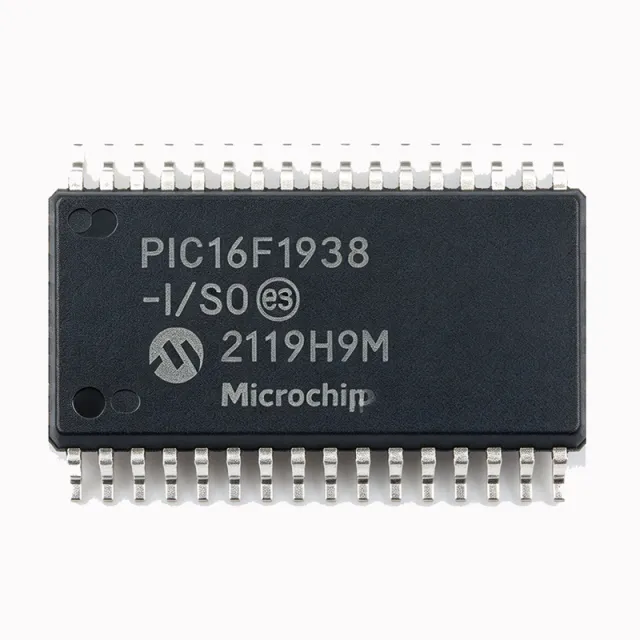
PIC16F1938-I/SO - 28KB Flash 8-bit MCU LCD Driver | Microchip
PIC16F1938-I/SO

PIC16F1938-I/SO - 28KB Flash 8-bit MCU LCD Driver | Microchip

The Microchip PIC16F1938-I/SO is an 8-bit PIC XLP flash microcontroller featuring 28KB of program memory, 1KB of RAM, 256 bytes of EEPROM, and an integrated LCD driver, housed in a 28-pin SOIC wide-body package. It operates from 1.8V to 5.5V, executes instructions at up to 32MHz, and integrates nanoWatt XLP technology for ultra-low-power sleep currents as low as 50 nA typical. An 8-bit microcontroller (MCU) is a small, self-contained computer-on-a-chip that combines a CPU, non-volatile program memory (flash), volatile data memory (RAM), and a rich set of peripherals on a single silicon die. Within the broader semiconductor taxonomy, an MCU belongs to the microcontrollers family, which itself is a sub-category of microprocessors and digital logic ICs. The PIC16F1938 sits in the PIC16 mid-range family from Microchip, optimized for low-power general-purpose embedded control with on-chip LCD drive capability and segment display driving. Key features include a 10-bit ADC with up to 17 channels, a 5-bit DAC, enhanced PWM with multiple complementary outputs, multiple communication interfaces (UART, SPI, I2C), and an integrated LCD driver supporting up to 96 segments. The 32MHz internal oscillator and four 8-bit timers plus one 16-bit timer deliver deterministic real-time control, while the 14-bit instruction width enables compact code density. The PIC16F1938 uses a Harvard RISC architecture with a 15-bit, 16-word hardware call stack and 49 instruction opcode set. The internal voltage reference, mTouch capacitive sensing module, and zero-cross detect simplify mixed-signal designs. The device is fabricated on a low-power CMOS process, achieving industry-leading sleep current that allows battery-powered and energy-harvesting designs to operate for years on a single cell. Typical applications include consumer appliances, battery-powered instruments with LCD readouts, industrial control panels, white goods and metering equipment, automotive body electronics, and IoT edge sensor nodes. Designers choose this part when segment-LCD UI, ultra-low standby current, and a small 28-pin SOIC footprint matter most. When designing with this MCU, allocate a 0.1uF decoupling capacitor within 5 mm of VDD, and connect the ICSPCLK/ICSPDAT pins to a header for in-circuit serial programming. The brown-out reset (BOR) and watchdog timer should remain enabled in safety-critical applications. This page synthesizes current distributor pricing, drop-in alternatives from the same PIC16F193x family and competing 8-bit MCUs, and practical design notes not found in the manufacturer datasheet.

USD $2.18 お問い合わせ
PIC16F1938-I/SS - 28KB Flash 8-bit MCU LCD XLP | Microchip
PIC16F1938-I/SS

PIC16F1938-I/SS - 28KB Flash 8-bit MCU LCD XLP | Microchip

The Microchip Technology PIC16F1938-I/SS is an 8-bit CMOS flash microcontroller in the PIC16F family, featuring 28 KB of Flash program memory, 1 KB of RAM, and 256 B of EEPROM, housed in a 28-pin SSOP (5.30 mm) package. It operates from 1.8 V to 5.5 V with a 32 MHz internal oscillator, integrates an integrated LCD driver capable of up to 192 segments, and includes 25 I/O pins plus nanoWatt XLP extreme-low-power technology for battery-driven designs. A PIC microcontroller is a compact, self-contained computer-on-a-chip that combines an 8-bit RISC CPU core with program memory, RAM, EEPROM data storage, and a rich set of peripherals. PIC microcontrollers sit within the broader taxonomy of microcontrollers -> embedded processors -> semiconductor devices. The PIC16F family is Microchip's mid-range 8-bit line, optimized for low-power, general-purpose, and human-interface applications that do not require the performance of a 16-bit dsPIC or 32-bit ARM Cortex-M device. Key features of the PIC16F1938-I/SS include up to 32 MHz CPU speed (8 MHz with 4x PLL), 14-bit instruction word, 16-level hardware stack, 25 digital I/O pins, 11-channel 10-bit ADC, two comparators, PWM modules, MSSP (SPI/I2C), AUSART (RS-232/RS-485), and an integrated charge-pump LCD driver supporting up to 192 segments. The XLP nanoWatt technology provides sleep currents down to approximately 20 nA, watchdog timer, and multiple low-power operating modes (Run, Idle, Sleep). The architecture uses a Harvard RISC design with separate program and data buses, enabling single-cycle instruction execution except for branches. The integrated LCD driver with charge pump reduces external component count for segment displays. Device programming is supported through In-Circuit Serial Programming (ICSP) using only two pins, simplifying field updates. Typical applications include battery-powered consumer products with LCD user interfaces, home appliances, metering, industrial control panels, medical instrumentation, and low-power sensor nodes. The integrated LCD makes it especially suitable for thermostats, blood pressure monitors, and remote controls. When designing with this device, ensure the SSOP-28 land pattern matches the Microchip recommended footprint. Decoupling: place a 100 nF ceramic capacitor as close as possible to VDD, plus a bulk capacitor (10 uF) on the main supply rail. For LCD applications, follow the bias and segment contrast configuration in the device datasheet. This page synthesizes distributor pricing, drop-in alternatives, application notes, and design considerations not always surfaced by individual distributor listings - useful for both procurement and engineering teams evaluating the PIC16F1938-I/SS for new designs or as a replacement part.

見積もり お問い合わせ
PIC16F1938T-E/SS - 28KB Flash 8-bit MCU with LCD | Microchip
PIC16F1938T-E/SS

PIC16F1938T-E/SS - 28KB Flash 8-bit MCU with LCD | Microchip

The Microchip Technology PIC16F1938T-E/SS is a 28-pin SSOP-packaged 8-bit flash microcontroller from the PIC16F193x family, featuring 28KB (16K x 14) of self-programmable Flash program memory, 1KB of RAM, and 256 bytes of EEPROM with nanoWatt XLP ultra-low-power technology. Operating from 2.3V to 5.5V at up to 32 MHz, it integrates an LCD driver supporting up to 96 segments, a 10-bit ADC with up to 17 channels, mTouch capacitive-touch sensing peripherals, and standard PIC mid-range communication peripherals including I2C, SPI, and USART with LIN support. An 8-bit microcontroller (MCU) is a microprocessor that uses an 8-bit data bus and is well-suited for embedded control tasks requiring low power, deterministic real-time response, and integration of mixed-signal peripherals. The PIC16F1938T-E/SS belongs to Microchip's enhanced mid-range core family, hierarchical in the taxonomy as: microcontroller -> 8-bit MCU -> PIC16 family -> PIC16F193x sub-family. XLP nanoWatt technology extends the device's applicability to battery-powered and energy-harvesting designs where active current draw is in the microamp range and sleep current can fall below 100 nA. Key features of the PIC16F1938T-E/SS include 25 I/O pins, 16-level hardware stack with 15-bit program counter, internal 16 MHz and 31 kHz oscillators, 4x 16-bit timers, a 5-bit DAC, two comparators, and a hardware RTCC with calendar mode. The integrated segmented LCD driver eliminates external display driver ICs, and the mTouch peripheral enables robust capacitive-button and slider sensing via firmware-controlled charge-transfer measurement. Technically, the PIC16F1938T-E/SS uses a Harvard-architecture RISC core executing most instructions in a single cycle, dual 16-bit pointers for linear memory access, and an interrupt controller with hardware context save. On-chip in-circuit debugging via ICD requires only two signal pins, simplifying prototyping. The device is built on a low-leakage CMOS process qualified to AEC-Q100 for automotive use (see datasheet for grade designation). Typical applications include battery-powered metering and sensor displays (where the LCD driver and XLP sleep currents are decisive), automotive instrument clusters and HVAC controls, capacitive-touch user interfaces for appliances, industrial control panels with segment LCD readouts, and low-cost medical monitoring handhelds. The wide 2.3-5.5V range and integrated peripherals let designers replace a discrete MCU + display-driver solution with a single chip. When designing with this part, verify the SSOP-28 land pattern and pinout against the chosen PCB footprint, plan for ICD-capable programming/debug headers early in the layout, and confirm segment count versus your LCD glass against the datasheet's SEG/COM allocation table. The PIC16F1938T-E/SS suffix denotes tape-and-reel packaging and an extended -40C to +125C operating temperature range suitable for industrial and automotive-grade designs. This page synthesizes distributor pricing, microchip-family drop-in alternatives, and practical design notes not found in the manufacturer datasheet alone.

見積もり お問い合わせ
PIC16F1938T-I/SS - 8-Bit 32MHz 28KB Flash XLP MCU | Microchip
PIC16F1938T-I/SS

PIC16F1938T-I/SS - 8-Bit 32MHz 28KB Flash XLP MCU | Microchip

The Microchip Technology PIC16F1938T-I/SS is a 28-pin, 8-bit CMOS flash microcontroller from the PIC16F193x family, operating up to 32 MHz with 28 KB (16K x 14) of self-programmable Flash program memory, 1 KB RAM, and 256 B EEPROM. Housed in a 28-SSOP (5.30 mm body) package with an industrial temperature range of -40 °C to +85 °C, it integrates an integrated LCD driver, nanoWatt eXtreme Low-Power (XLP) technology, 25 digital I/O pins, and an ADC plus multiple communication peripherals. The "T" suffix denotes Tape & Reel packaging for high-volume assembly. A microcontroller (MCU) is a single-chip computer that integrates a CPU core, program and data memory, timers, communication peripherals, and I/O on one die. Within the system hierarchy, the PIC16F1938 belongs to the 8-bit microcontroller sub-category, which sits under the broader microcontroller IC family, itself a branch of microcontrollers and processors within embedded semiconductors. Its 8-bit RISC Harvard architecture executes most instructions in one clock cycle, providing deterministic real-time performance for control loops, while XLP technology targets battery-powered designs where nanoamp-level sleep currents extend operating life. Key features include a 32 MHz internal oscillator with 4x PLL option, 14-channel 10-bit ADC, mTouch capacitive touch sensing support, two USART, two SPI, two I2C, five 8/16-bit timers, an LCD driver capable of driving up to 192 segments, and ultra-low-power sleep modes drawing less than 50 nA. On-chip debug and In-Circuit Serial Programming (ICSP) are supported via two pins, simplifying field updates. Architecturally, the PIC16F1938 uses an enhanced mid-range 8-bit core with a hardware 15-bit stack and 16-level deep subroutine nesting, plus a 10-bit successive-approximation ADC, configurable logic cells, and an on-chip voltage reference for low-power analog designs. The integrated segmented LCD controller generates the bias and waveform timing required for static, 1/2, 1/3, and 1/4 duty multiplexed glass. Typical applications include battery-powered consumer devices with LCD user interfaces, sensor nodes, white goods front-panel controllers, e-metering and thermostat displays, and portable medical instruments. The combination of segmented LCD, capacitive touch, and nanoWatt XLP enables single-chip HMI solutions without an external display driver. When designing with this device, allocate PCB area for the ICSP/ICD pins (PGC/PGD) on dedicated test pads so that production programming and in-circuit debugging remain accessible. Use the MPLAB X IDE with XC8 compiler and ensure decoupling capacitors (typically 100 nF plus 10 µF bulk) are placed within a few millimeters of VDD. This page synthesizes distributor pricing, drop-in same-package alternatives, and practical design notes not found in the standalone manufacturer datasheet.

見積もり お問い合わせ
PIC16F1939-E/ML - 28KB Flash 8-bit MCU LCD Driver | Microchip
PIC16F1939-E/ML

PIC16F1939-E/ML - 28KB Flash 8-bit MCU LCD Driver | Microchip

The Microchip Technology PIC16F1939-E/ML is an 8-bit PIC16 enhanced mid-range microcontroller featuring 28KB Flash program memory, 1KB SRAM, 256B EEPROM and a 32MHz internal oscillator, housed in a 44-pin QFN (8x8 mm) package with exposed pad. It operates from 2.3V to 5.5V and integrates a segmented LCD driver with charge pump, supporting up to 192 segments, plus nanoWatt XLP extreme-low-power technology for battery-friendly designs. The device also includes a 28-channel 10-bit ADC, multiple capture/compare/PWM modules, MSSP/I2C/SPI, AUSART, and 36 I/O lines in the 44-pin variant. The -E temperature grade denotes the extended industrial range of -40C to +125C, qualifying the part for harsher environments than the standard I-grade counterpart. A PIC (Peripheral Interface Controller) microcontroller is an 8-bit RISC-based Harvard-architecture MCU whose instruction set and peripheral set have been refined over more than two decades. The PIC16F1939 belongs to the enhanced mid-range family, which adds deeper nesting, more interrupt sources, and richer peripherals compared with baseline PIC10/12/16 parts. Within Microchip's portfolio it sits in the PIC16F1xxx segment of 8-bit microcontrollers -> general-purpose MCU -> microcontroller -> embedded semiconductor. Key differentiating specifications include 28KB self-programmable Flash (16K x 14 words), 1KB linear SRAM, hardware LCD driver with integrated charge pump, nanoWatt XLP sleep current under 50 nA typical, and 32MHz/8 MIPS core throughput. The integrated LCD segment driver removes the need for an external driver IC in metering and appliance front panels. The PIC16F1939 is built on a 0.18 um CMOS process with a modified Harvard bus, giving deterministic instruction timing (200 ns per instruction at 20 MHz). The 10-bit ADC with internal voltage reference and the configurable logic cell (CLC) and Hardware Limit Timer (HLT) modules give it unusually flexible signal conditioning for an 8-bit part, enabling it to replace small 32-bit MCUs in simple sensing nodes. Typical applications include smart electricity meters, white-goods user interfaces, thermostat and HVAC control panels, portable medical monitoring, automotive body/comfort modules, and battery-powered IoT sensor nodes. The LCD driver is the primary motivation for selecting this part over a non-LCD PIC16. When designing with this part, choose the QFN (ML) package for the smallest PCB footprint and best thermal performance, but plan for reflow soldering and inspect the exposed pad solder joint via X-ray if reliability is critical. Use MPLAB X IDE with XC8 compiler for firmware development. This page synthesizes distributor pricing, drop-in QFN-44 alternatives, and practical design notes not found in the bare datasheet.

見積もり お問い合わせ
PIC16F1939-E/P - 8-Bit XLP MCU 28KB Flash 32MHz | Microchip
PIC16F1939-E/P

PIC16F1939-E/P - 8-Bit XLP MCU 28KB Flash 32MHz | Microchip

The Microchip Technology PIC16F1939-E/P is an 8-bit PIC® XLP™ enhanced mid-range microcontroller featuring 28KB of Flash program memory, 1KB of RAM, and 256 bytes of EEPROM, packaged in a 40-pin PDIP through-hole format. It operates at up to 32 MHz clock speed and supports a wide supply voltage range of 2.3 V to 5.5 V, making it suitable for both 3.3 V and 5 V systems. The device integrates a built-in LCD driver, 25 digital I/O pins, and nanoWatt XLP ultra-low-power technology. A microcontroller (MCU) is a single-chip computer that integrates a CPU, memory, and peripheral interfaces. Within the semiconductor taxonomy it sits under: microcontroller -> embedded controller -> integrated circuit -> semiconductor. The PIC16F1939 belongs to the PIC16F1xxx enhanced mid-range family using the 14-bit instruction set (16K x 14 words = 28KB Flash), and is differentiated from baseline PIC by its linear program memory map, hardware multiply, and expanded peripheral set. Key features include 32 MHz operation (125 ns instruction cycle), 32-level hardware stack, brown-out reset (BOR), programmable watchdog timer, enhanced CCP modules, MSSP (SPI/I2C), enhanced USART, 10-bit ADC with up to 14 channels, and a charge time measurement unit (CTMU) for capacitive touch. The integrated LCD driver supports up to 192 segments, eliminating the need for an external display controller in many designs. The PIC16F1939 uses a RISC Harvard architecture with 49 instructions and 16 hardware registers, executed through a two-stage pipeline. The wide 2.3-5.5 V supply range combined with nanoWatt XLP technology yields typical sleep currents below 100 nA with LCD retention, ideal for battery-powered metering and remote sensor applications. Typical applications include industrial control panels with LCD readout, home appliances with segment displays, portable medical monitoring devices, automotive body electronics (AEC-Q100 qualified), and battery-powered IoT sensor nodes. The 40-pin PDIP package suits through-hole prototyping and field-replaceable designs. When designing with this MCU, ensure decoupling capacitors (100 nF ceramic) are placed close to VDD pins. For noise-sensitive analog measurements, use the dedicated AVdd/AVss pins rather than digital supply rails, and consider using the internal 32 kHz LFINTOSC for low-power sleep modes. This page synthesizes distributor pricing, drop-in alternatives, and practical design notes not found in the manufacturer datasheet alone.

見積もり お問い合わせ
PIC16F1939-E/PT - 8-Bit MCU, 28KB Flash, LCD Driver, 44-TQFP | Microchip
PIC16F1939-E/PT

PIC16F1939-E/PT - 8-Bit MCU, 28KB Flash, LCD Driver, 44-TQFP | Microchip

The Microchip Technology PIC16F1939-E/PT is an 8-bit CMOS flash-based PIC microcontroller in a 44-pin TQFP (PT) package featuring an integrated LCD driver and nanoWatt XLP (eXtreme Low Power) technology. It runs at a maximum clock speed of 32 MHz, delivers 28 KB of program Flash, 1 KB of RAM, and 256 bytes of EEPROM, with 25 general-purpose I/O ports and support for operating voltages from 2.3 V to 5.5 V (PIC16F1939 family; some variants extend to 1.8 V). A microcontroller (MCU) is a single-chip computer that integrates a CPU, memory, and peripheral interfaces on one IC. Within the Microchip taxonomy the PIC16F1939 sits in the PIC16 enhanced mid-range family - between PIC10/12/14/16 baseline devices and PIC18/24 high-performance parts. It is pin-compatible with the PIC16F1938/1937/1936 family and is a popular choice for battery-powered user interfaces that require glass-segment LCDs. Key differentiating features include the on-chip LCD driver with charge pump supporting up to 192 segments, nanoWatt XLP sleep currents in the nanoamp range for coin-cell applications, an integrated mTouch capacitive touch peripheral, multiple communication interfaces (UART, SPI, I2C), and a 10-bit ADC with up to 14 channels. The device also includes multiple timer/capture/compare modules and a 32 kHz internal oscillator for low-power RTC operation. Architecturally the PIC16F1939 uses a Harvard RISC core with a 14-bit instruction word and a 16-level hardware stack. The enhanced mid-range instruction set adds hardware multiply and direct addressing modes over the baseline PIC16 core. The internal voltage regulator and brown-out reset simplify multi-rail designs, while the nanoWatt XLP architecture (core, peripheral, and RTCC) lets idle current drop into the sub-microamp range - critical for battery-powered metering or remote sensor products. Typical applications include battery-operated LCD meters and thermostats, IoT sensor nodes with segment displays, consumer white goods front panels, industrial human-machine interfaces (HMIs), medical glucose and infusion monitors, and remote controls with LCD feedback. The combination of LCD driver, XLP low power, and 25 GPIOs makes it well suited to any product that displays numeric or symbolic information on a glass-segment LCD. When designing with this part, reserve at least one Timer and one ECCP/ECCP+ module for LCD charge-pump timing, and follow Microchip AN1028 (LCM Performance) for bias and contrast settings. Verify pin assignments carefully between the 28-/40-/44-pin variants: the 44-pin TQFP exposes the largest set of analog and LCD segment lines.

見積もり お問い合わせ
PIC16F1939-I/ML - 8-Bit MCU 28KB Flash LCD Driver QFN-44 | Microchip
PIC16F1939-I/ML

PIC16F1939-I/ML - 8-Bit MCU 28KB Flash LCD Driver QFN-44 | Microchip

The Microchip Technology PIC16F1939-I/ML is an 8-bit PIC16 microcontroller in the nanoWatt XLP family, integrating 28KB (16K x 14 words) of Flash program memory and a built-in LCD driver in a 44-pin QFN (8x8 mm) package with exposed pad. It executes instructions at up to 32 MHz from an internal oscillator, operates from 2.3V to 5.5V, and provides 25 general-purpose I/O pins plus dedicated LCD segment pins. An 8-bit microcontroller (MCU) is a single-chip computer built around an 8-bit data path; the PIC16F1939 belongs to the PIC16F mid-range family within Microchip's 8-bit PIC microcontroller portfolio, sitting between low-pin-count baseline PIC10/12/16 devices and the higher-end PIC18/XC8 families. The category hierarchy is: PIC16F1939 -> PIC16F19xx family -> PIC16 mid-range -> 8-bit PIC microcontroller -> microcontroller (MCU) -> embedded computing. Integrated LCD drivers, nanoWatt XLP extreme-low-power technology, and large Flash densities make this category well suited for battery-powered human-machine interface (HMI) designs. Key features include 28KB Flash program memory, 1024 bytes of data EEPROM, 2KB SRAM, a 32 MHz internal oscillator, an integrated LCD driver supporting up to 192 segments, a 10-bit ADC with up to 17 channels, multiple communication peripherals (EUSART, I2C/SPI, mTouch capacitive sensing), and nanoWatt XLP sleep currents in the microampere range. The 44-QFN package provides 25 GPIOs and a thermal pad, surefire for compact HMI layouts. The device uses Microchip's enhanced mid-range 8-bit core with a hardware multiplier, supporting a C-friendly instruction set and Harvard architecture with separate code and data buses. The integrated LCD charge pump and configurable bias generation remove the need for external voltage doublers, simplifying glass-direct driving. Programmable peripherals are routed through Peripheral Pin Select (PPS), giving designers flexibility to remap digital functions to free pins. Typical applications include battery-powered thermostats and HVAC controllers, home appliance user interfaces with segment LCDs, metering and instrumentation displays, medical glucose meters and patient monitors, industrial sensor hubs with local LCD readouts, and consumer white goods requiring low standby power. The wide 2.3V-5.5V range and microampere sleep currents are particularly valuable in mains-powered or battery-backed HMI products. When designing with this part, ensure the exposed thermal pad on the QFN package is soldered to a sufficient ground copper pour for both thermal dissipation and electrical grounding. The internal oscillator is factory-trimmed to within +/-1% across 2.3V-5.5V and -40C to +85C, eliminating an external crystal for most non-USB applications. Always configure the unused I/O pins as outputs low and disable unused peripherals to achieve the lowest sleep current. This page synthesizes verified distributor pricing, 5-8 drop-in alternatives in the same 44-QFN footprint, and practical design notes that complement the manufacturer datasheet with field-proven design practices.

見積もり お問い合わせ
PIC16F1939-I/MV - 8-Bit XLP MCU 28KB Flash 40-UQFN | Microchip
PIC16F1939-I/MV

PIC16F1939-I/MV - 8-Bit XLP MCU 28KB Flash 40-UQFN | Microchip

The Microchip Technology PIC16F1939-I/MV is an 8-bit flash-based PIC microcontroller from the PIC® XLP™ 16F family, offering 28KB (16K x 14) of program Flash, 1KB RAM and 256B EEPROM in a 40-pin UQFN (5x5 mm) package with exposed thermal pad. It executes instructions at up to 32 MHz from an internal oscillator, supports supply voltages of 2.3V to 5.5V, and exposes 25 digital I/O pins plus a segmented LCD driver. A microcontroller (MCU) is a single-chip computer that integrates a CPU core, program memory, working RAM, data EEPROM and programmable peripherals. The PIC16F1939 belongs to the enhanced mid-range 8-bit core family, which sits in Microchip's 8-bit MCU hierarchy above baseline 12-bit and 14-bit cores and below the 16-bit dsPIC® and 32-bit PIC32 lines. The 'XLP' suffix indicates nanoWatt eXtreme Low-Power technology, allowing active currents in the microampere range and sleep currents below 100 nA typical, making this part a popular choice for battery-powered and energy-harvesting designs. Key features include an integrated LCD driver capable of directly biasing up to 192 segments (with charge pump), an on-chip 32 MHz internal oscillator that eliminates an external crystal, a 10-bit ADC with up to 14 channels, three timers, two comparators and a configurable logic cell. The 40-UQFN package measures 5x5 mm and offers a low profile suited to compact handheld enclosures. Architecturally the device uses a Harvard RISC core with a 14-bit instruction word and a 16-level hardware stack, providing deterministic interrupt latency typical of PIC microcontrollers. The integrated mTouch™ capacitive-touch peripheral, CTMU charge-time measurement unit and EEPROM endurance of 100k write/erase cycles (typical) support robust user-interface and data-logging designs. Typical applications include battery-powered sensor nodes, electronic shelf labels, home-automation control panels, industrial metering with LCD readout, low-cost consumer appliances, and capacitive-touch user interfaces. In all of these, the on-chip LCD driver removes the need for an external display controller. When designing with this part, ensure the 40-UQFN exposed pad is soldered to a sufficient copper pour (typically a 6 mm² thermal pad) for thermal performance and electrical grounding per the Microchip guidelines. Programming is supported by the MPLAB® X IDE and the PICkit™ 3/4 or MPLAB® Snap in-circuit debuggers.

見積もり お問い合わせ
PIC16F1939-I/P - 32MHz 8-Bit XLP MCU | Microchip
PIC16F1939-I/P

PIC16F1939-I/P - 32MHz 8-Bit XLP MCU | Microchip

The Microchip Technology PIC16F1939-I/P is an 8-bit PIC XLP flash microcontroller with a 32 MHz operating frequency, 28 KB of flash program memory, 1 KB of RAM, and 256 bytes of EEPROM in a 40-pin PDIP package. The -I suffix identifies the industrial temperature grade, while /P identifies the through-hole PDIP package. Its operating supply range of 1.8 V to 5.5 V supports low-voltage embedded systems that need flexible power-supply design. A PIC microcontroller is an 8-bit reduced-instruction-set computer integrated with flash memory, data RAM, EEPROM, timers, communication peripherals, and general-purpose I/O. Within the embedded-control hierarchy, the PIC16F1939 belongs to the enhanced mid-range PIC16 family and uses the low-power XLP feature set. These devices bridge simple discrete logic and more capable 32-bit microcontrollers while retaining a compact instruction set and straightforward peripheral architecture. Principal device features include 28 KB of flash memory organized as 16K × 14 program words, 1 KB of SRAM, and 256 bytes of nonvolatile data EEPROM. The MCU operates up to 32 MHz and supports a 1.8 V to 5.5 V supply range. Its integrated LCD capability is useful for local human-machine interfaces, while its I/O, timers, serial interfaces, and analog resources allow a single controller to manage sensors, actuators, displays, and communications. The enhanced mid-range architecture provides an 8-bit execution engine with a hardware stack and direct, indirect, and relative addressing modes. Flash memory permits in-circuit reprogramming, and EEPROM preserves calibration values or configuration parameters when the main supply is removed. Peripherals are distributed across the 40-pin PDIP footprint, which also exposes programming, reset, clock, power, and communication functions for a conventional development board. Typical uses include industrial control panels, compact energy meters, environmental monitoring equipment, LED-display controllers, instrumentation interfaces, and small consumer appliances. The XLP orientation is particularly appropriate for battery-powered or duty-cycled products that spend substantial time between active processing periods. Its LCD driver can reduce the need for external display-control hardware in products with a small character or segment display. When designing a PCB, provide a regulated supply with adequate bypass capacitance near VDD and VSS pins and route programming signals for reliable in-circuit programming. Confirm oscillator, reset, and I/O levels against the pin-description table in the Microchip datasheet. The 40-pin through-hole package simplifies prototyping and manual assembly but occupies more board area than the equivalent surface-mount variants. This page combines the PIC16F1939 technical profile, verified package information, same-package replacement guidance, application-focused engineering guidance, and a parameter comparison intended to accelerate initial design review and sourcing.

見積もり お問い合わせ
PIC16F1939-I/PT - 28KB Flash, 32MHz, 44-TQFP MCU | Microchip
PIC16F1939-I/PT

PIC16F1939-I/PT - 28KB Flash, 32MHz, 44-TQFP MCU | Microchip

The Microchip Technology PIC16F1939-I/PT is an 8-bit flash-based CMOS microcontroller built on the enhanced mid-range PIC16 core, delivering 32 MHz (8 MIPS) performance with 28 KB of program Flash and 1 KB of RAM in a 44-pin TQFP (PT) package. The /PT suffix denotes the lead-free TQFP-44 surface-mount package, while the -I industrial temperature grade supports -40 °C to +85 °C operation. The part is part of Microchip's nanoWatt XLP (eXtreme Low Power) family, offering deep sleep currents down to a few hundred nanoamps. An 8-bit microcontroller (MCU) is a single-chip computer that integrates a CPU, non-volatile program memory, volatile data memory, and a configurable set of peripherals (timers, ADC, communication buses, I/O) onto one silicon die. Microcontrollers sit at the lowest tier of embedded computing - above discrete logic gates but below microprocessors - and serve as the decision-making core of nearly every battery-powered or stand-alone electronic product. The PIC16 architecture is an 8-bit RISC-style Harvard design with a 14-bit instruction word, optimized for deterministic interrupt latency and ultra-low sleep power. Key features of the PIC16F1939-I/PT include an integrated LCD driver capable of driving up to 256 segments, a 10-bit A/D converter with up to 14 channels, an mTouch capacitive-sensing peripheral, three timers (TMR0/TMR1/TMR2), an enhanced CCP module, two USART, two MSSP (SPI/I2C), and a wide 1.8 V to 5.5 V supply range (the I-grade part is specified for 2.3 V to 5.5 V per Microchip datasheet family documentation). The on-board LCD controller supports direct glass drive without external charge pumps, and the nanoWatt XLP technology delivers sleep currents under 100 nA typical. The 44-pin TQFP package exposes up to 36 programmable I/O pins via Peripheral Pin Select (PPS) - a configuration feature of the enhanced mid-range core. Designers typically use a 10 MHz internal HFINTOSC plus a 31 kHz LFINTOSC, with an external oscillator option up to 32 MHz. The architecture combines the legacy PIC mid-range instruction set with additional C-friendly instructions, making the device usable from both assembly and C (XC8) toolchains. Typical applications include white-goods and appliance front-panel controllers with LCD readouts, hand-held industrial meters, battery-powered sensor front-ends, remote control panels, and consumer appliances needing on-glass LCD driving without a separate driver IC. The integrated LCD peripheral is the most distinctive feature for cost-optimized human-machine-interface (HMI) designs. When designing, choose the I-grade variant for industrial temperature and confirm that the WDT and BOR features are configured for the desired fail-safe behavior in your firmware. This page synthesizes current distributor pricing, drop-in package-compatible alternatives in the same TQFP-44 footprint, and practical design notes drawn from Microchip's family documentation - information not assembled on any single distributor product page.

見積もり お問い合わせ
PIC16F1939T-I/ML - 8-Bit XLP MCU, 28KB Flash, 44-QFN | Microchip
PIC16F1939T-I/ML

PIC16F1939T-I/ML - 8-Bit XLP MCU, 28KB Flash, 44-QFN | Microchip

The Microchip Technology PIC16F1939T-I/ML is an 8-bit PIC microcontroller in the PIC16F193x family, featuring 28KB (16K x 14 words) of Flash program memory, 1KB of RAM, and 256 bytes of EEPROM, housed in a 44-pin QFN (8 mm x 8 mm) package with an exposed pad. It operates from a 2.3V to 5.5V supply, runs at up to 32 MHz internal clock, and includes 25 I/O pins plus an integrated LCD driver with nanoWatt XLP power management. An 8-bit microcontroller (MCU) is a single-chip computer built around an 8-bit data path that integrates a CPU, non-volatile program memory, volatile RAM, non-volatile data EEPROM, and configurable peripherals. The PIC16F1939 belongs to the broader category of RISC microcontrollers -> microcontrollers -> embedded processors -> semiconductors. Its nanoWatt XLP technology gives it extremely low standby current, positioning it for battery-powered and energy-harvesting designs. Key features include 14-bit instruction word wide Flash, hardware multiplier, 256 bytes of EEPROM with endurance > 1M cycles, 1KB RAM, an enhanced CCP module, multiple Enhanced USART, SPI, and I2C interfaces, 11 ADC channels with 10-bit resolution, and a segmented LCD driver supporting up to 96 segments. The wide 2.3V to 5.5V VDD range supports both 3.3V and 5V systems, while the 32 MHz maximum oscillator yields 8 MIPS instruction throughput. Architecturally, the device uses a Harvard RISC core with a deep 16-level hardware stack, an internal 32 MHz HFINTOSC calibrated to +/-2 percent, and on-chip configurable peripherals that are remappable via Peripheral Pin Select (PPS). Together with the LCD driver, this makes the part especially well suited for human-machine interface (HMI) panels. Typical applications include battery-powered instrument panels with LCD displays, white-goods user interfaces, security keypads with LCD readouts, medical metering pumps, and consumer appliances such as coffee machines and thermostats. The exposed thermal pad package supports harsh industrial environments when paired with proper PCB thermal via arrays. When designing the PCB, solder the exposed thermal pad (EP) to a copper pad with multiple thermal vias to the ground plane to meet the +/-5 percent power dissipation rating. Use only one of the four oscillator modes simultaneously to keep start-up timing deterministic.

見積もり お問い合わせ
PIC16F1939T-I/PT - 8-Bit XLP MCU 32MHz 28KB Flash 44-TQFP | Microchip
PIC16F1939T-I/PT

PIC16F1939T-I/PT - 8-Bit XLP MCU 32MHz 28KB Flash 44-TQFP | Microchip

The Microchip Technology PIC16F1939T-I/PT is an 8-bit PIC microcontroller from the PIC16F193x family, featuring 32MHz CPU clock speed, 28KB (16K x 14) of Flash program memory, 1KB RAM, and 256 bytes of EEPROM, housed in a 44-pin TQFP (10x10 mm) package. It operates from 1.8V to 5.5V supply voltage and includes 25 I/O ports with integrated LCD driver and nanoWatt XLP (eXtreme Low Power) technology. An 8-bit PIC microcontroller (MCU) is a single-chip computer based on Microchip's RISC-based PIC architecture, integrating CPU, Flash program memory, SRAM, EEPROM, peripherals (ADC, timers, PWM, communication interfaces), and I/O pins on a single CMOS die. Within the broader hierarchy, the PIC16F1939 belongs to the PIC16F family -> PIC microcontroller -> 8-bit MCU -> microcontroller -> embedded controller -> semiconductor IC. The 'F' suffix denotes Flash program memory; '19' indicates the enhanced mid-range core with nanoWatt XLP extreme low-power features. Key features include the integrated LCD driver supporting up to 256 segments, 14-channel 10-bit ADC, multiple Enhanced Universal Synchronous/Asynchronous Receiver/Transmitter (EUSART), I2C, and SPI peripherals, plus 5 PWM modules. The nanoWatt XLP technology provides sleep currents as low as 9 nA typical, making it suitable for battery-powered applications requiring long operational life. The 44-TQFP package variant (suffix /PT) offers 25 general-purpose I/O pins, while alternate package options include 28-pin SPDIP (/SP), 28-pin SOIC (/SO), 44-pin QFN (/MV), and 40-pin UQFN (/PT with -I/P, /PT). The /PT package is supplied in Tape & Reel format with standard 1,200-piece packaging. Typical applications include handheld consumer devices with LCD displays, IoT sensor nodes, battery-powered metering, white goods and home appliance front panels, and industrial control panels. The integrated LCD driver eliminates external display controller ICs, reducing BOM cost in user-interface applications. The 1.8V minimum supply enables direct connection to single-cell battery sources including alkaline, NiMH, or lithium chemistries. When designing with this device, ensure proper ICD/ICSP connection via the PGC/PGD pins for in-circuit debugging and programming. The wide supply voltage range simplifies designs that must accommodate battery voltage variation over discharge cycles without active temperature control.

見積もり お問い合わせ
PIC16F1946-E/MR - 14KB Flash 8-Bit MCU w/ LCD & XLP | Microchip
PIC16F1946-E/MR

PIC16F1946-E/MR - 14KB Flash 8-Bit MCU w/ LCD & XLP | Microchip

The Microchip Technology PIC16F1946-E/MR is an 8-bit flash-based microcontroller from the PIC16F19xx family, integrating 14KB of program Flash, 512 bytes of RAM, and 256 bytes of EEPROM in a 64-pin QFN (9x9 mm) package with exposed pad. Operating from 1.8V to 5.5V with a 32 MHz internal oscillator, it includes an integrated LCD driver capable of up to 192 segments, eXtreme Low Power (XLP) nanoWatt technology, and 25 general-purpose I/O pins. According to the Microchip datasheet (DS41364E family reference), it is intended for low-power human-machine interface and metering applications. An 8-bit PIC microcontroller is a RISC (Reduced Instruction Set Computer) device built around a Harvard architecture that separates program and data memory, executing most instructions in a single instruction cycle. The PIC16F family sits in the middle of Microchip's 8-bit portfolio, positioned above baseline PIC10/12 devices and below enhanced PIC18 parts, and is widely used in cost-sensitive embedded designs where deterministic interrupt response and ultra-low sleep current are required. Within the power management hierarchy, the MCU itself orchestrates DC-DC converters, LDO regulators, and battery chargers rather than acting as a power device itself. Key features include 14KB self-programmable Flash with read-while-write support, an on-chip LCD driver with charge pump and adjustable bias, multiple communication peripherals (EUSART, I2C/SPI, USB on some family variants), a 12-bit ADC with computation, and nanoWatt XLP sleep currents as low as 20 nA in deep sleep. The 64-pin QFN package provides excellent thermal performance through its exposed pad and enables compact PCB designs in space-constrained applications such as portable instruments and panel meters. Typical applications include battery-powered LCD-based consumer electronics (thermostats, remote controls, blood pressure monitors), industrial control panels with segment displays, automotive instrument clusters (non-safety-critical subsystems), smart energy meters with LCD readouts, and IoT sensor nodes requiring segment-LCD status displays. The integrated LCD driver eliminates the need for an external charge pump or segment driver, reducing BOM cost and board area. When designing with this device, place a 100 nF decoupling capacitor as close as possible to the VDD pin and connect the QFN exposed pad to a solid ground plane to maximize heat dissipation. The ICD/ICSP programming pins (ICSPCLK/ICSPDAT) must be accessible on the PCB for in-circuit debugging and firmware updates.

見積もり お問い合わせ
PIC16F1946-E/PT - 64-Pin 8-Bit MCU, 14KB Flash, LCD Driver | Microchip
PIC16F1946-E/PT

PIC16F1946-E/PT - 64-Pin 8-Bit MCU, 14KB Flash, LCD Driver | Microchip

The Microchip Technology PIC16F1946-E/PT is a 64-pin, 8-bit Flash-based CMOS microcontroller (MCU) belonging to the PIC® XLP™ 16F family and featuring nanoWatt XLP extreme-low-power technology. It integrates 14 KB of Flash program memory, 512 bytes of RAM, an integrated LCD driver, and a 32 MHz internal oscillator, all housed in a 64-pin TQFP (10x10 mm) package with 0.5 mm pitch and industrial -40C to +125C temperature range. Operating voltage spans 2.3 V to 5.5 V with 25 general-purpose I/O pins, making it suitable for both battery-powered and line-powered designs. An 8-bit microcontroller (MCU) is a single-chip computer built around an 8-bit data path and a Harvard or von Neumann architecture, integrating a CPU, program memory (typically Flash), data RAM, peripherals (timers, ADC, communication ports), and interrupt logic on one die. Within the broader taxonomy, the PIC16F1946 sits at the intersection of microcontroller -> 8-bit MCU -> PIC16 mid-range core -> XLP nanoWatt family -> power-aware embedded controller, a category that prioritizes deterministic real-time behavior and ultra-low standby current over raw compute throughput. PIC16 mid-range devices execute one instruction per clock cycle and use a 14-bit instruction word optimized for compact code density in C and assembly. Key features include 14 KB (8K x 14 words) of self-programmable Flash, 256 bytes of EEPROM data memory, an integrated segmented LCD driver supporting up to 184 segments, a 10-bit ADC with up to 17 channels, multiple Enhanced USART, I2C, and SPI peripherals, and nanoWatt XLP sleep currents typically in the nanoampere range. The 64-pin TQFP package gives ample I/O for keypad scanning, LCD bias generation, and analog sensor integration in a single chip, removing the need for external LCD driver ICs in many HMI designs. The architecture is built around Microchip's enhanced mid-range 8-bit CPU core with a hardware multiplier, 16-level hardware stack, and a 31-instruction RISC set, paired with the aforementioned peripheral mix. The 32 MHz internal oscillator provides 8 MIPS throughput, while XLP technology offers multiple power-managed modes (Run, Idle, Sleep, and deep-dormancy variants) that let designers trade CPU activity for current consumption in the range of tens of nA in sleep. Typical applications include battery-powered consumer HMI (thermostats, coffee machines, remote controls), industrial segment-LCD display panels, sensor readout boards, low-power IoT edge nodes, and automotive accessory modules. The integrated LCD driver reduces BOM cost and PCB area in any design that needs a glass or chip-on-glass segmented display. When designing with this part, plan the I/O mapping carefully because the LCD segment pins are multiplexed with general-purpose I/O; pin assignments chosen for LCD layout may limit which GPIOs are free for buttons or sensors. Use the device's nanoWatt modes aggressively during long idle periods to take advantage of the XLP claim. This page synthesizes distributor pricing, drop-in same-package alternatives, and practical design notes that are not consolidated in the manufacturer datasheet alone, helping engineers shorten BOM validation and second-source qualification.

見積もり お問い合わせ
PIC16F1946-I/MR - 8-Bit XLP MCU, 14KB Flash, 64-QFN | Microchip
PIC16F1946-I/MR

PIC16F1946-I/MR - 8-Bit XLP MCU, 14KB Flash, 64-QFN | Microchip

The Microchip Technology PIC16F1946-I/MR is a 64-pin, 8-bit CMOS flash microcontroller belonging to the PIC16F19xx family with integrated LCD driver and nanoWatt XLP extreme-low-power technology. It operates at up to 32 MHz, delivers 14 KB (8K × 14) of on-chip Flash program memory, and is qualified across an industrial temperature range of -40 °C to +85 °C. The part is housed in a 64-pin QFN (9 × 9 mm) package designated MR. A microcontroller (MCU) is a single-chip computer that integrates a CPU core, program and data memory, peripherals, and I/O on one die. The PIC16F19xx family belongs to the broader hierarchy: microcontroller -> embedded processor -> semiconductor. The 'XLP' (eXtreme Low Power) designation places this MCU within Microchip's nanoWatt XLP platform, which uses techniques such as deep sleep, watchdog timer disable, and selective peripheral clocking to push standby current into the nanoampere region - well below traditional 8-bit MCU baselines. Key features include 14 KB Flash, 512 bytes RAM, 256 bytes EEPROM, 25 general-purpose I/O, an integrated LCD driver supporting up to 184 segments, a 5-bit DAC, multiple PWM/capture/compare modules, two USART, two MSSP (SPI/I²C), and 11 channels of 10-bit ADC. The device operates from 2.3 V to 5.5 V, suiting both 3.3 V and 5 V rails typical of battery-powered and industrial designs. The 'I' suffix denotes the industrial temperature grade (-40 °C to +85 °C). Architecturally, the PIC16F1946 uses a 14-bit modified Harvard instruction set, separate program and data buses, and a 16-level hardware stack. The instruction pipeline and deterministic interrupt latency make timing behaviour predictable for control loops. nanoWatt XLP technology gates the system clock and selectively powers down peripherals, with typical sleep currents below 100 nA - critical for battery-backed meters and IoT sensors. Typical applications include low-power LCD-based metering, thermostat and HVAC control panels, portable medical monitors, sensor hubs, white-goods user interfaces, and remote keyless-entry or general-purpose 8-bit embedded control. The integrated LCD driver eliminates an external charge-pump IC in glass-segment displays, reducing BOM cost and PCB area. When designing with this part, choose decoupling capacitors (typically 100 nF + 10 µF) close to VDD/VSS pairs and keep the high-speed ADC traces away from switching nodes to preserve 10-bit ENOB. For LCD applications, route the segment and common lines with matched impedance and provide adequate bias capacitor values per the Microchip LCD design guide. This page synthesises distributor pricing, drop-in alternatives, and practical design notes not found in the manufacturer datasheet, giving engineers a single source for sourcing, comparison, and application guidance.

見積もり お問い合わせ
PIC16F1946T-I/MR - 14KB Flash 8-Bit MCU LCD Driver | Microchip
PIC16F1946T-I/MR

PIC16F1946T-I/MR - 14KB Flash 8-Bit MCU LCD Driver | Microchip

The Microchip Technology PIC16F1946T-I/MR is a 64-pin flash-based 8-bit CMOS microcontroller with an integrated LCD driver and nanoWatt XLP (eXtra Low Power) technology, packaged in an 8x8 mm QFN-64 (MR) with exposed pad. It integrates 14 KB of self-programmable Flash program memory, 512 bytes of SRAM, and 256 bytes of EEPROM data memory, runs from a 32 MHz internal oscillator, and operates across 2.3 V to 5.5 V supply. According to the manufacturer datasheet, the device exposes up to 54 digital I/O pins with individual pull-up, interrupt-on-change, and peripheral pin select options, plus a hardware LCD driver supporting up to 192 segments. A microcontroller (MCU) is a single-chip computer that integrates a CPU, non-volatile program memory, working RAM, and a rich set of peripheral interfaces into one package. In the wider semiconductor taxonomy this part sits under 8-bit MCU -> microcontroller -> embedded processor -> integrated circuit. The PIC16F family adds Microchip's nanoWatt XLP technology, a category of sleep currents below 1 uA in deep-sleep modes, which makes PIC16F1946 particularly suitable for battery-powered human-machine interface (HMI) products. Key differentiating features include the on-chip segmented LCD driver (up to 192 segments at 1/4 duty, 1/3 bias), a 10-bit ADC with up to 17 channels, two 8-bit timers plus one 16-bit timer, two CCP modules, an MSSP (SPI/I2C) and an enhanced USART, plus a charge time measurement unit (CTMU) for capacitive touch sensing. The 32 MHz internal oscillator eliminates the external crystal in many designs, reducing BOM cost. The nanoWatt XLP sleep current (typically < 60 nA in sleep mode with LCD off) extends battery life in always-on metering and remote-control products. The architecture is a Harvard RISC core with a 14-bit instruction word and a single-cycle ALU, giving predictable deterministic execution well suited to deterministic control loops and interrupt-driven firmware. The LCD charge-pump and bias generator are on-chip, so designers need only the segment and common-panel capacitors and the glass itself. Internal phase-locked loops multiply the 16 MHz HFINTOSC up to the 32 MHz system clock with software-selectable postscalers, allowing dynamic power tuning. Typical applications include white-good user interfaces (washing machines, microwave ovens, induction cookers), smart thermostats and HVAC control panels, blood-pressure monitors and other medical home-care devices, electricity-meter LCDs, point-of-sale terminals, and any portable product that combines an LCD with battery operation. The wide 2.3-5.5 V range accepts 2xAA, 3xAA, lithium coin, or regulated 5 V rails without level shifters. When designing with this part, place a 0.1 uF ceramic decoupling capacitor on every VDD/AVDD/VBAT pin pair as close to the package as possible, tie the MCLR pin to VDD through a 10 kohm resistor with a 100 nF cap to ground for safe in-circuit serial programming, and follow the QFN-64 thermal-pad soldering recommendations (4 to 6 thermal vias under the e-pad) for reliable production. The LCD bias-network capacitors should be ceramic X7R with a value matching the chosen bias configuration in the datasheet. This page synthesizes distributor pricing, drop-in same-family alternatives, and practical design notes that complement (but do not replace) the manufacturer datasheet.

見積もり お問い合わせ
PIC16F1947-E/MR - 8-Bit MCU, 28KB Flash, 64-QFN | Microchip
PIC16F1947-E/MR

PIC16F1947-E/MR - 8-Bit MCU, 28KB Flash, 64-QFN | Microchip

The Microchip Technology PIC16F1947-E/MR is a 64-pin, 8-bit flash-based CMOS microcontroller built on the enhanced mid-range PIC16 core and packaged in a 9x9 mm QFN (HVQCCN, "MR") with an exposed thermal pad. It integrates 28 KB (16K x 14 words) of self-programmable Flash program memory, 1 KB of RAM, 256 bytes of EEPROM, and runs instruction cycles at up to 32 MHz (200 ns instruction time) from a 2.3 V to 5.5 V supply. The device is offered in the -E (extended) temperature grade of -40 °C to +125 °C, suitable for industrial and consumer environments. A microcontroller (MCU) is a single-chip computer that combines a CPU, volatile and non-volatile memory, programmable I/O, and on-chip peripherals. The PIC16F1947-E/MR belongs to the 8-bit MCU family within the broader microcontroller hierarchy (8-bit MCU -> microcontroller -> embedded processor -> semiconductor), giving engineers deterministic, low-latency control with a small code footprint compared to 32-bit Cortex-M parts. It is part of Microchip's extreme low-power "nanoWatt XLP" portfolio, meaning sleep currents are measured in nanoamps and active current is measured in microamps-per-MHz. Key differentiating features include an integrated LCD driver with charge pump supporting up to 192 segments, a 10-bit ADC with up to 17 channels, mTouch capacitive touch sensing hardware, four 16-bit timers, two capture/compare/PWM (CCP/ECCP) modules, two comparators, an EUSART, MSSP (SPI/I2C), 11 capacitive touch channels, and a hardware RTCC with calendar mode. The 28-pin/40-pin/44-pin/64-pin device family shares peripherals; the 64-pin QFN variant (this MR part) exposes the maximum I/O count and the full set of analog/touch channels. Memory endurance is specified at 100 k write/erase cycles for flash and 1 M for EEPROM, with 40-year data retention per the family datasheet. Architecture-wise, the PIC16F1947 uses a Harvard RISC architecture with separate program and data buses, a 14-bit instruction word, and a hardware stack. On-chip peripherals are routed through the Peripheral Pin Select (PPS) system, allowing many digital functions to be remapped to a wide range of I/O pins - this relaxes PCB routing constraints on dense 64-pin boards. The internal 16 MHz high-speed oscillator and 31 kHz low-power oscillator (HFINTOSC/LFINTOSC) eliminate the need for an external crystal in cost-sensitive designs. Typical applications include white-goods and home-appliance user interfaces with segment-LCD displays, industrial control panels with capacitive-touch keypads, battery-powered metering and sensor nodes, low-cost thermostats and HVAC controls, and general-purpose 8-bit logic replacement for legacy 16C/16F designs. The wide Vdd range also makes it suitable for 3.3 V and 5 V mixed-rail systems. When designing with the QFN variant, follow Microchip's MR package PCB layout recommendations and provide adequate copper thermal relief on the exposed pad to keep theta_JA within datasheet limits; the -E temperature grade allows continuous operation up to 125 °C. This page consolidates distributor pricing, pin-compatible drop-in alternatives, and practical design notes not found in a single datasheet excerpt, giving component engineers a faster path from selection to BOM.

見積もり お問い合わせ
PIC16F1947-I/MR - 28KB Flash, 8-bit LCD MCU | Microchip
PIC16F1947-I/MR

PIC16F1947-I/MR - 28KB Flash, 8-bit LCD MCU | Microchip

The Microchip PIC16F1947-I/MR is an 8-bit flash-based microcontroller from the PIC16 (L)F1946/47 family, featuring 28 KB of program Flash, 1 KB RAM, 256 B EEPROM, and an integrated LCD segment driver, housed in a 64-pin QFN (MR) 9x9 mm package. It runs at 32 MHz instruction-clock speed, supports 2.3 V to 5.5 V single-supply operation, and exposes 25 general-purpose I/O pins suitable for user-interface-rich embedded designs. The part carries the -I industrial temperature grade (-40C to +85C) and is qualified to Microchip's nanoWatt XLP extreme-low-power platform. What is a PIC16? A PIC16 microcontroller is a member of Microchip's 8-bit PIC microcontroller family built on a Harvard RISC architecture with a 14-bit instruction word. PIC microcontrollers belong to the broader category of microcontrollers (MCU) -> embedded processors -> semiconductors. The "16F" prefix denotes a Flash-programmable, mid-range PIC16 core, while "XLP" (eXtreme Low Power) identifies devices that integrate nanoWatt sleep modes, watchdog-timer scaling, and clock-gating features for battery-powered and energy-harvesting applications. Key features include hardware LCD segment driver support (up to 184 segments), 11 analog channels via a 10-bit ADC, multiple serial interfaces (I²C/SPI/USART), and capacitive-touch support through the mTouch peripheral. The MR package suffix denotes a 64-pin QFN (9x9 mm) lead-free plastic configuration, and the -I temperature grade extends operation from -40C to +85C. The PIC16F1947 employs Microchip's mid-range 8-bit RISC core with a 14-bit instruction width, an 8-level hardware stack, and an instruction-cycle time of 4 oscillator cycles. Internal oscillator options reduce external component count, and the integrated LCD charge-pump and bias-generation hardware remove the need for external voltage-doubling circuitry on glass displays. Typical applications include battery-powered human-machine interface (HMI) panels, metering and instrumentation with segmented LCD readouts, medical handheld devices, IoT sensor nodes with local displays, and white-goods control boards. The LCD driver combined with deep-sleep nanoWatt modes makes the device especially attractive for products that must display data on a segmented glass display while consuming microamp-level standby current. When designing with this device, place a 0.1 uF decoupling capacitor within 5 mm of each VDD/VSS pair and route the QFN thermal/exposed pad to a continuous ground pour. Configure the watchdog timer and unused peripherals to their lowest-power states before entering Sleep to fully leverage the XLP nanoWatt feature set. This page synthesizes current distributor pricing, verified drop-in alternatives, and design notes drawn from the Microchip PIC16(L)F1946/47 datasheet (DS40001414E) - information that aggregates distributor-level data and engineering trade-offs not visible from a single source.

見積もり お問い合わせ
PIC16F1947-I/PT - 8-bit 32MHz XLP MCU 28KB Flash TQFP-64
PIC16F1947-I/PT

PIC16F1947-I/PT - 8-bit 32MHz XLP MCU 28KB Flash TQFP-64

The Microchip PIC16F1947-I/PT is an 8-bit CMOS microcontroller in the PIC16 XLP family, delivering 32 MHz CPU performance with 28 KB (16K x 14) of Flash program memory in a 64-pin TQFP (10x10) package. It operates from 1.8 V to 5.5 V and is qualified for the industrial -40C to +85C temperature range, making it suitable for consumer, industrial, and battery-powered embedded systems that require low active and sleep power. A microcontroller (MCU) is a single-chip computer that integrates a CPU, non-volatile program memory (typically Flash), volatile data memory (RAM), and a rich set of peripherals such as timers, communication interfaces, ADCs, and I/O. Within the broader semiconductor hierarchy, MCUs sit at the intersection of microprocessors and application-specific ICs. The PIC16F19xx family targets cost-sensitive, ultra-low-power designs that must still deliver LCD drive, capacitive touch, and analog integration on-chip. Key features include 1 KB RAM, 256 B EEPROM, a 10-bit ADC, an integrated LCD driver with up to 192 segments, multiple Enhanced USART, I2C, and SPI peripherals, and Microchip's nanoWatt XLP technology for deep sleep currents below 100 nA. The device offers 54 digital I/O pins across its 64-pin TQFP footprint and supports up to 16 MIPS throughput at 32 MHz. Core-independent peripherals such as the Configurable Logic Cell (CLC), Numerically Controlled Oscillator (NCO), and Complementary Waveform Generator (CWG) offload tasks from the CPU. The PIC16F1947 architecture uses a 14-bit instruction word and Harvard bus structure, enabling single-cycle instruction execution except for branches. Its XLP implementation integrates dynamic hardware-managed power modes, peripheral module disable, and a low-power sleep controller, allowing wake-up from multiple interrupt sources while consuming microamps. Typical applications include battery-powered sensor hubs, human-machine interface (HMI) panels with LCD readout, home appliances, instrumentation, and low-cost IoT edge nodes. The wide 1.8 V to 5.5 V range and integrated LCD segments directly support designs that previously required multiple chips or an external driver. When designing, allocate the TQFP-64 land pattern early, route AVDD/AVSS as a star from the analog supply, and follow Microchip's MPLAB X IDE and XC8 compiler toolchain. Always validate in-circuit debug with the ICD 3 or PICkit 4. This page synthesizes distributor pricing, drop-in and parametric alternatives, and practical design notes that go beyond the manufacturer datasheet, giving engineers a single reference for sourcing, second-sourcing, and implementation guidance.

見積もり お問い合わせ
PIC16F1947T-I/PT - 8-Bit 32MHz 28KB Flash MCU | Microchip
PIC16F1947T-I/PT

PIC16F1947T-I/PT - 8-Bit 32MHz 28KB Flash MCU | Microchip

The Microchip Technology PIC16F1947T-I/PT is an 8-bit CMOS RISC microcontroller in the PIC PIC XLP 16F family, featuring a 32 MHz CPU core, 28 KB (16K x 14) of Flash program memory and 1 KB of on-chip data RAM, housed in a 64-pin TQFP (PT) package measuring 10x10 mm. It operates across a 2.3 V to 5.5 V supply range, supports up to 36 general-purpose I/O pins, and integrates an LCD driver with nanoWatt XLP (eXtreme Low Power) technology for ultra-low-power battery applications. What is a microcontroller? A microcontroller (MCU) is a single-chip computer that integrates a CPU, program memory (Flash/ROM), data memory (RAM), peripherals and I/O. In the system hierarchy it sits above discrete logic and below full microprocessors, providing programmable digital control. The PIC16F1947T-I/PT belongs to Microchip's enhanced mid-range 8-bit PIC16 family, a Harvard-architecture device using separate program and data buses for deterministic instruction execution. Key features include a 32 MHz internal oscillator, hardware multiplier, 32-level hardware stack with overflow/underflow reset, 49 instruction set, 10-bit ADC with up to 17 channels, multiple capture/compare/PWM modules, an LCD driver supporting up to 192 segments, EUSART, MSSP (SPI/I2C), and nanoWatt XLP sleep modes with currents as low as [DATA_NEEDED: typical sleep current in nA]. Code protection, ICSP (In-Circuit Serial Programming) and a wide operating temperature range make it production-ready for industrial designs. The PIC16F1947T-I/PT uses a 14-bit instruction word with single-cycle execution (200 ns at 20 MHz, 125 ns at 32 MHz). The Harvard architecture separates 16-bit instruction fetch from 8-bit data access, eliminating the von Neumann bottleneck. The integrated LCD driver with variable bias and contrast control eliminates external LCD controller ICs, reducing BOM cost in metering and appliance designs. Typical applications include LCD-display human-machine interfaces in white goods, battery-powered metering (electric/gas/water), industrial control panels, automotive body modules, and low-cost embedded control replacing discrete logic. The wide voltage range (2.3-5.5 V) and XLP features also make it suitable for IoT sensor nodes and remote controls. When designing with the PIC16F1947T-I/PT, ensure decoupling caps are placed within 3 mm of VDD/VSS pins and that the ICSP pins (RB6/ICSPDAT, RB7/ICSPCLK) are accessible for in-circuit programming. The LCD bias capacitors must be sized per the segment count and bias mode chosen.

見積もり お問い合わせ
PIC16F505-E/MG - 8-Bit MCU, 1.5KB Flash, 12 I/O, QFN-16 | Microchip
PIC16F505-E/MG

PIC16F505-E/MG - 8-Bit MCU, 1.5KB Flash, 12 I/O, QFN-16 | Microchip

The Microchip Technology PIC16F505-E/MG is an 8-bit Flash-based CMOS microcontroller featuring 1.5 KB (1K x 12) of program memory, 72 bytes of RAM, and 12 I/O pins, housed in a 16-pin QFN (3x3 mm) exposed-pad package with extended -40C to +125C temperature range. An 8-bit microcontroller (MCU) is a small, self-contained computer on a single IC that integrates a CPU, RAM, program memory, and peripherals targeted at embedded control tasks. Within the broader taxonomy, the PIC16F505 belongs to the PIC16 family -> 8-bit PIC MCU -> flash microcontroller -> microcontroller unit (MCU) -> semiconductor, and uses Microchip's enhanced mid-range RISC architecture with a 14-bit instruction word and single-cycle execution except for branches. Key specifications include a maximum 20 MHz operating frequency (200 ns instruction cycle), internal oscillator (no external crystal required), 5 analog comparator inputs, 8-bit timer (TMR0) plus watchdog timer, 8-level hardware stack, and In-Circuit Serial Programming (ICSP) capability. The wide 2.0V to 5.5V supply range supports both 3.3V and 5V rails, and the device drives 25 mA source/sink per I/O for direct LED or relay interface. Brown-out Reset (BOR) and Power-on Reset (POR) are integrated. Typical applications include consumer appliance controllers, low-cost remote controls, battery chargers, LED lighting drivers, automotive interior modules, security keypads, sensor signal conditioning front-ends, and small form-factor IoT endpoint nodes. The small 3x3 mm QFN footprint makes it ideal for space-constrained designs. When designing with this MCU, keep traces short for the ICSPDAT/ICSPCLK programming pins and provide a stable VDD with a 100 nF ceramic bypass capacitor within 5 mm of the pin. The exposed thermal pad must be soldered to the board ground plane for thermal and electrical performance.

見積もり お問い合わせ
PIC16F505-E/P - 8-Bit MCU, 20MHz, 1.5KB Flash, 14-PDIP | Microchip
PIC16F505-E/P

PIC16F505-E/P - 8-Bit MCU, 20MHz, 1.5KB Flash, 14-PDIP | Microchip

The Microchip Technology PIC16F505-E/P is an 8-bit flash microcontroller from the PIC® 16F family that delivers up to 20 MHz CPU performance, 1.5 KB (1K x 12) of program Flash memory, and 72 bytes of RAM in a 14-pin PDIP through-hole package. It is positioned as a baseline-core MCU with 33 instructions, 12-bit-wide instruction words, and a 4 MHz precision internal oscillator, offering a compact and economical solution for general-purpose embedded control. An 8-bit flash microcontroller is a small, self-contained computer-on-a-chip that integrates a CPU, non-volatile Flash program memory, RAM, peripherals, and I/O on a single die. Within the broader silicon taxonomy, the PIC16F505 sits in the baseline 8-bit MCU tier, which is a sub-category of microcontroller -> embedded controller -> integrated circuit -> semiconductor. Baseline PIC16 devices prioritize low cost, deterministic instruction timing, and ease of programming over raw performance, and they typically use 12-bit or 14-bit instruction widths versus the 16-bit instruction width of mid-range parts. Key features include 12 bidirectional I/O pins, two 8-bit timers, one watchdog timer with its own on-chip RC oscillator, an analog comparator, a 4 MHz internal oscillator with ±1% accuracy after calibration, and a wide operating voltage range from 2.0 V to 5.5 V. The PIC16F505 also supports in-circuit serial programming (ICSP), enabling firmware updates after PCB assembly. Flash endurance is rated at 100K erase/write cycles minimum, and RAM is retained down to 1.5 V for low-voltage backup scenarios. The architecture uses a Harvard-style RISC core with single-cycle instruction execution for most opcodes and two-cycle branches, providing predictable timing for interrupt-driven and polled firmware. The 12-bit instruction width yields approximately 2:1 code compression versus typical 8-bit CISC architectures, which lets 1.5 KB of Flash hold surprisingly dense application code. Power consumption is held low by the SLEEP/idle mode and by the clock-gated peripheral design. Typical applications include consumer appliance control, sensor interfacing, simple LED driving, low-end remote controls, battery chargers, and white-goods subsystems. The 14-pin PDIP package and 20 MHz clock make it a strong fit for breadboard prototyping, hobbyist projects, and legacy 8-bit designs that need flash-based in-system reprogrammability. When designing, remember the E/P suffix denotes the -40°C to +125°C extended temperature range and PDIP package. Provide a 0.1 µF decoupling capacitor close to VDD, keep RESET pin behavior understood (it has no internal pull-up on this part), and confirm the ICSP connections if you plan to program the device in-circuit. This page synthesizes distributor pricing, baseline-core PIC16 drop-in alternatives, and practical design notes that complement the manufacturer datasheet.

見積もり お問い合わせ