製品 (20,000+)

PIC16F57-E/SO - 20MHz 3KB 8-Bit Flash MCU | Microchip
PIC16F57-E/SO

PIC16F57-E/SO - 20MHz 3KB 8-Bit Flash MCU | Microchip

The Microchip Technology PIC16F57-E/SO is an 8-bit PICmicro RISC microcontroller with a 20 MHz maximum clock, 3 KB of Flash program memory, 72 bytes of RAM, and 20 general-purpose I/O lines in a 28-pin SOIC package. Its 200 ns instruction execution and 33 single-word instruction set provide a compact embedded-control platform for applications requiring deterministic control, modest program storage, and broad digital I/O. A microcontroller is a programmable semiconductor that integrates a CPU, nonvolatile program memory, data memory, and peripheral interfaces into one device. The PIC16F57 belongs to the PIC16 family and uses the PIC16 CPU architecture. Compared with larger 32-bit microcontrollers, its simpler instruction set and smaller memory organization can reduce firmware complexity in cost-sensitive control systems while preserving the peripheral integration needed for standalone operation. The verified headline specifications include 20 MHz maximum operating frequency, 3 KB of Flash memory organized as 2K × 12, 72 bytes of on-chip data RAM, and 20 I/O lines. Flash memory supports in-circuit reprogramming and is appropriate for firmware that must be updated during production or field maintenance. The 20 MHz clock supports faster control-loop execution and reduces execution time compared with lower-speed PIC16 devices, although the final system timing still depends on the selected oscillator and peripheral configuration. PIC16F57 devices use Microchip’s 8-bit PIC architecture with single-word instructions and a 200 ns instruction execution capability. The device provides general-purpose digital I/O for switches, relays, indicators, sensors, and discrete actuators. Because the verified source set does not expose the complete peripheral list, detailed timer, comparator, interrupt, and electrical limits should be checked in the manufacturer’s PIC16F57 documentation before final schematic or firmware sign-off. Typical uses include industrial control modules, appliance controllers, small motor-control boards, instrumentation interfaces, and embedded automation products. Its 20 I/O lines allow a board to connect multiple digital inputs and outputs without requiring an external I/O expander. The 3 KB Flash space is best suited to compact control logic rather than large protocol stacks, graphical interfaces, or data-intensive workloads. Designers should verify the exact operating-voltage limits, temperature grade, oscillator configuration, programming interface, and all peripheral pin assignments from the manufacturer datasheet. PCB layouts should route the programming and reset functions for reliable field programming, and firmware should include brownout, startup, and unused-pin handling appropriate to the selected configuration. This page combines verified distributor pricing, package information, temperature-grade alternatives, parameter comparisons, and practical selection guidance. It also distinguishes true same-package drop-in choices from related PIC16 devices that require different footprints, helping engineers avoid mechanically incompatible replacements.

見積もり お問い合わせ
PIC16F57-E/SP - 8-Bit 20MHz 3KB Flash MCU 28-SPDIP | Microchip
PIC16F57-E/SP

PIC16F57-E/SP - 8-Bit 20MHz 3KB Flash MCU 28-SPDIP | Microchip

The Microchip PIC16F57-E/SP is a baseline 8-bit PICmicro RISC microcontroller built around a 200 ns instruction-execution engine with only 33 single-word instructions, delivering 3 KB (2 K x 12) of on-chip Flash program memory and 72 bytes of RAM in a 28-pin SPDIP through-hole package. The '-E' suffix denotes the extended temperature grade (-40 °C to +125 °C), qualified for harsh industrial and automotive under-hood environments where standard commercial parts would fail. Operating from 2.0 V to 5.5 V (the mid-range PIC16F5X supports 2.0 V operation while the data also lists 4.5 V-5.5 V typical application), the device is clocked at up to 20 MHz from an external resonator or internal RC, providing 20 I/O pins grouped into ports A/B/C for digital I/O, key-scan, and simple control tasks. The PIC16F57 belongs to the PIC10/16/18 family of 8-bit microcontrollers, the workhorse category of Microcontrollers > 8-bit MCUs > baseline PIC16 within the broader microcontroller taxonomy (MCU → 8-bit MCU → embedded controller → semiconductor). The family offers 12-bit-wide instructions, 2:1 code compression relative to legacy 8-bit CISC competitors, an 8-level hardware stack, a 2 K x 12 Flash program counter, and a watchdog timer with its own on-chip oscillator for safety-critical applications. Compared with newer PIC16F1xxx parts, the PIC16F57 omits peripherals such as ADC, PWM, EUSART, and interrupt controller to keep silicon cost minimal - it is intentionally targeted at glue logic replacement, encoder/decoder pairings, and low-cost state-machine duties. Key features include 3 KB (2048 words) of self-programmable Flash, 72 bytes of general-purpose RAM, 20 digital I/O lines with individual direction control, a programmable prescaler for the TMR0 8-bit timer, and a power-on reset / power-up timer / brown-out reset that holds the core in reset until VDD reaches a valid level. The 28-SPDIP package is the legacy through-hole format preferred for hobbyist, education, and breadboard-friendly designs, lending itself to manual rework and socketed prototyping. The /SP suffix matches Microchip's standard 28-pin 0.300 inch PDIP outline shared across PIC16 and PIC18 midrange families, easing PCB reuse between DIP-line projects. Typical applications include automotive relay and lamp drivers, appliance user-interface encoders, sensor-to-relay glue logic, low-cost remote-control transmitters, security keypads, LED chasers, and educational microcontroller labs. Designers also deploy it as a low-cost companion controller in larger systems where the main processor is starved of GPIO or where a deterministic 200 ns instruction cycle out-performs an interpreted state machine. For reliable operation, place a 100 nF decoupling capacitor as close as possible to the VDD pin and a 10-100 µF bulk reservoir at the board supply input; maintainer the MCLR pin tied to VDD through a 10 kΩ pull-up with a 100 nF cap for clean reset behaviour; oscillator traces should be kept short and guarded with a ground ring to keep external clock or crystal signals clean.

見積もり お問い合わせ
PIC16F57-E/SS - 20MHz 8-Bit 3KB Flash MCU | Microchip
PIC16F57-E/SS

PIC16F57-E/SS - 20MHz 8-Bit 3KB Flash MCU | Microchip

The Microchip Technology PIC16F57-E/SS is a flash-based 8-bit CMOS microcontroller with a 20 MHz maximum clock, 3 KB of program Flash memory organized as 2K x 12 words, 72 bytes of RAM, and 20 I/O pins in a 28-pin SSOP package. It executes its 33-instruction PICmicro architecture with a stated 200 nanosecond instruction execution time. An 8-bit microcontroller is a programmable semiconductor that integrates a processor core, flash program memory, data RAM, I/O ports, and clock circuitry into one device. Within the embedded-control hierarchy, this MCU belongs to the 8-bit microcontroller category, provides application-specific I/O, and operates below the processing level of 16- or 32-bit microcontrollers while offering a compact, low-cost solution for control, measurement, and interface tasks. Key features include a 20 MHz operating speed, 3 KB of flash memory for firmware, 72 bytes of data RAM, and 20 general-purpose I/O pins. The E/SS ordering code identifies the extended-temperature variant in the SSOP package. The verified product information also identifies a 2 V minimum operating condition at 4 MHz and a general 4.5 V to 5.5 V supply range, supporting both low-voltage operation and conventional 5 V systems. The device uses Microchip's PICmicro architecture with 33 single-word instructions, which simplifies firmware development and reduces code size for embedded control tasks. Its flash-based program memory allows the device to be reprogrammed during development, production programming, or field updates. The 28-pin SSOP package uses a 0.65 mm terminal pitch and supports 20 I/O pins, providing connectivity for digital control, sensing inputs, and output functions in space-constrained designs. Typical applications include industrial automation and embedded control modules, appliance controllers, consumer-product interfaces, automotive and industrial equipment, and compact instrument-control boards. The 20 I/O count allows the PIC16F57-E/SS to connect switches, indicators, sensors, relays, and discrete interface signals without requiring a high-pin-count package. When designing around this MCU, verify the clock configuration, oscillator connection, programming interface, and required I/O assignments against the manufacturer datasheet. The stated 2 V minimum supply condition applies at 4 MHz, so the operating frequency and supply voltage must be considered together rather than selected independently. This page consolidates verified manufacturer and distributor information, package-specific drop-in alternatives, and application guidance. It is intended to help engineers identify the correct programming, sourcing, and replacement decisions while clearly separating documented values from specifications that still require datasheet confirmation.

見積もり お問い合わせ
PIC16F57-I/P - 8-Bit 20MHz 3KB Flash MCU | Microchip | DIP-28
PIC16F57-I/P

PIC16F57-I/P - 8-Bit 20MHz 3KB Flash MCU | Microchip | DIP-28

The Microchip Technology PIC16F57-I/P is an 8-bit Flash-based RISC microcontroller delivering 20 MIPS (200 ns instruction cycle) with 3 KB (2K x 12) of Flash program memory, packaged in a 28-pin PDIP (DIP-28, 600 mil) through-hole format. The -I industrial temperature grade extends from -40C to +85C, and the part operates from a 2.0 V to 5.5 V supply across the PIC16F5x baseline family. An 8-bit microcontroller (MCU) is a single-chip computer built around an 8-bit data path, integrating a CPU core, program memory (Flash/ROM), data RAM, peripheral set (timers, ADC, communication interfaces), and I/O on one die. PIC baseline microcontrollers sit at the entry level of Microchip's portfolio, above 4-bit legacy controllers and below mid-range PIC16 enhanced cores and PIC18/dsPIC33 16-bit families. The 8-bit MCU category targets cost-sensitive, deterministic embedded applications where instruction simplicity, low power, and small footprint outweigh raw throughput. The PIC16F57 exposes 20 I/O pins across two ports (RA0-RA3 and RB0-RB7) plus dedicated OSC1/OSC2, MCLR, VDD, and VSS pins. Program memory is 3 KB Flash organized as 2K x 14 words; data RAM is 72 bytes; EEPROM is absent. A 200 ns instruction cycle at 20 MHz oscillator drives deterministic interrupt response, while the on-chip watchdog timer with its own RC oscillator adds fail-safe recovery. Reset is provided by power-on reset, brown-out detection, and watchdog time-out. Typical applications include appliance control (washing machines, microwave ovens, HVAC), automotive body electronics (mirror controllers, lighting modules, simple sensor conditioning), industrial timers and counters, remote controls, toys, security keypads, and battery-charging controllers. The wide 2.0 V to 5.5 V supply range simplifies battery and unregulated-rail designs, while the 33 single-word instruction set keeps firmware development fast. Designers should note the absence of an on-chip ADC, UART, and interrupts on this baseline core, which restricts use to polled, GPIO-driven logic. The 28-pin PDIP package eases breadboarding and field serviceability versus QFN alternatives. Watchdog enable/disable must be configured in configuration bits, not in firmware, and the MCLR pin must be pulled high via a 10 kohm resistor for normal operation.

見積もり お問い合わせ
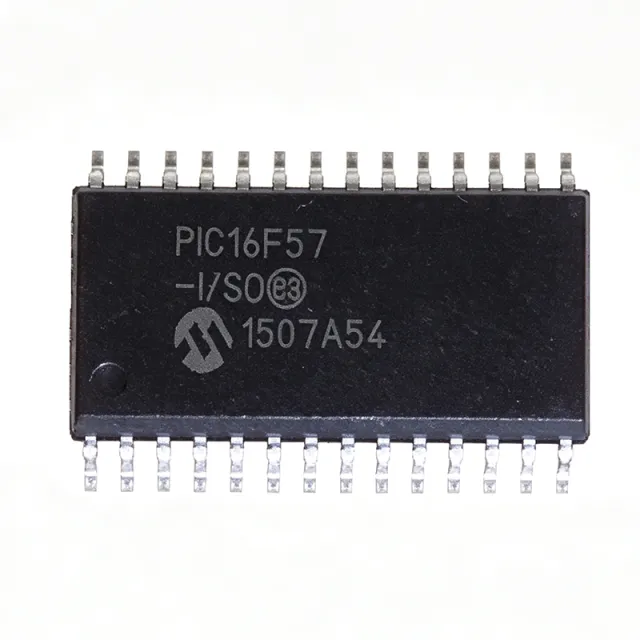
PIC16F57-I/SO - 8-bit 20MHz 3KB Flash MCU | Microchip | 28-SOIC
PIC16F57-I/SO

PIC16F57-I/SO - 8-bit 20MHz 3KB Flash MCU | Microchip | 28-SOIC

The Microchip Technology PIC16F57-I/SO is an 8-bit PIC16-family Flash microcontroller delivering 3KB (2K x 12) of program memory, 72 bytes of RAM, and 20 digital I/O pins, all housed in a 28-pin SOIC (300 mil) package. It executes instructions at 20 MHz (200 ns instruction cycle) from a 4.5V to 5.5V single supply and offers 12-bit-wide instructions with 33 single-word instructions in its RISC-based instruction set. Background: An 8-bit microcontroller (MCU) is a single-chip computer integrating a CPU, non-volatile program memory (Flash/ROM), working RAM, and peripheral I/O on one die. The PIC16F5X family is one of the original baseline PIC architectures and belongs to the broader Microchip PIC16 -> 8-bit MCU -> microcontroller -> embedded controller -> semiconductor taxonomy. Its 12-bit-wide opcode is an early hallmark of cost-optimised baseline PICs and yields approximately 2:1 code density versus typical 8-bit CISC MCUs. Key features of this PIC16F57 include a 20 MHz internal clock domain (4 MHz instruction rate from a 4x PLL-less divider), 3KB self-programmable Flash, 72 bytes RAM, two 8-bit timer/counters (TMR0, TMR2-class) with one option for a watchdog timer, a programmable code protection scheme, and in-circuit serial programming (ICSP) via dedicated RB6/RB7 pins. The 28-SOIC package offers a 7.50 mm body width (300 mil) for hand-solderable prototype-friendly layouts and is rated -40C to +85C in the industrial -I temperature grade. Typical applications include low-cost appliance controllers, automotive body and aftermarket modules (pre-CAN era), industrial timers and counters, sensor pre-filters, and small white-goods user-interface boards. The wide 4.5-5.5V supply range tolerates legacy 5V system rails common in industrial PLCs and HVAC controls. When designing with the PIC16F57, keep in mind that the baseline PIC16F5X instruction set is NOT binary-compatible with mid-range PIC16F1xxx devices and uses a separate toolchain (MPLAB XC8 supports it via the -mcpu=pic16f5x option). Always reserve RB6 and RB7 for ICSP to enable in-field firmware updates without removing the chip. This page synthesizes distributor pricing, drop-in 28-SOIC alternatives, and practical baseline-PIC design notes not always consolidated on the manufacturer product page.

USD $1.21 お問い合わせ
PIC16F57-I/SP - 20MHz 8-Bit Flash MCU | Microchip
PIC16F57-I/SP

PIC16F57-I/SP - 20MHz 8-Bit Flash MCU | Microchip

The Microchip Technology PIC16F57-I/SP is a 20 MHz, 8-bit FLASH-based PIC microcontroller with 3 KB (2K x 12) of program memory, 72 bytes of RAM, and a 28-pin SPDIP package. It uses the PIC16 RISC architecture, supports 12 I/O ports according to the distributor listing, and executes 200 ns instruction cycles through its 33-instruction set. The device is positioned for entry-level embedded control across automotive, industrial, appliance, and consumer applications. A PIC microcontroller is an embedded processor that combines a compact CPU core, program memory, data memory, and peripherals in one integrated circuit. PIC16 devices form the entry level of the PICmicro family, using a RISC-oriented instruction set and a compact architecture suited to control logic, timers, digital I/O, and small state machines. Microchip describes the PIC16F57 as a FLASH-based member of this family, allowing firmware updates without removing the device from its target circuit. The supplied data identifies a maximum clock frequency of 20 MHz, a 200 ns instruction execution time, and a 33-single-word instruction set. Its 3 KB FLASH program memory is specified as 2K x 12, while Mouser lists 72 bytes of RAM and 20 I/O-related information. These attributes make the PIC16F57-I/SP suitable for compact embedded controllers where program memory, pin count, and simple firmware execution are more important than high peripheral integration or large data storage. The part is identified by the I/SP ordering suffix in distributor results, with the verified listing specifying a 28-SPDIP package. The target’s supply and exact electrical limits are not consistently available in the supplied snippets, so any absent technical parameter is marked for verification rather than inferred. A lifecycle result identifies the family as active, but production status and stock should be confirmed with the manufacturer or an authorized distributor before procurement. Typical use cases include small appliance controllers, industrial automation modules, automotive accessory logic, consumer products, and general-purpose embedded control boards. The 20 MHz operating speed and 8-bit architecture suit periodic sampling, relay or indicator control, key scanning, and simple communication or timing routines. The 28-pin SPDIP package is particularly convenient for prototyping, automated assembly, and educational or legacy designs that already use through-hole footprints. For PCB design, verify the exact pin assignments from the manufacturer datasheet before assigning signals or power. The MCU requires correct oscillator, reset, programming, decoupling, and I/O routing even though the supplied search results do not provide a complete pin table or application circuit. Firmware should use the PIC16F57 memory and peripheral definitions appropriate to the exact device variant, and production designs should account for the available 3 KB program memory and 72 bytes of RAM. This page consolidates the verified manufacturer and distributor descriptions, package information, identified alternatives, and practical selection context for engineers comparing PIC16F57 variants. It is intended to make the 20 MHz 8-bit MCU decision faster while preserving uncertainty where the supplied sources do not establish a complete electrical specification.

見積もり お問い合わせ
PIC16F57-I/SS - 8-Bit 20MHz Flash MCU | Microchip Technology
PIC16F57-I/SS

PIC16F57-I/SS - 8-Bit 20MHz Flash MCU | Microchip Technology

The Microchip Technology PIC16F57-I/SS is an 8-bit PIC RISC flash microcontroller with 3KB of program memory, 72 bytes of RAM, 20 I/O pins, and a maximum clock frequency of 20MHz, housed in a 28-pin SSOP package. The -I suffix denotes the industrial temperature range of -40°C to +85°C, while /SS identifies the SSOP package configuration. A microcontroller is a programmable control IC that integrates a processor core, memory, I/O ports, and peripherals into one device. The PIC16F57 belongs to the PIC16 family, a hierarchy of 8-bit RISC microcontrollers within the broader embedded-control and semiconductor categories. Its architecture executes 33 single-word instructions with a stated 200ns instruction-execution time, making it suitable for compact embedded control systems. The device provides 3KB, organized as 2K x 12, of flash program memory and 72 bytes of RAM. Its 20 I/O pins support digital control and communication tasks, while its 20MHz operating capability gives designers additional timing headroom for motor, display, sensing, and communications-oriented embedded products. The manufacturer positions the PIC16F57 for adaptation to automotive, industrial, and similar embedded applications. PIC16F57 devices use the PIC RISC architecture with a compact instruction set rather than a complex multi-cycle processor architecture. Flash-based program memory supports field-programmable firmware workflows, while the small RAM footprint favors compact control tasks that do not require extensive buffering. Firmware and hardware design should still be checked against the complete Microchip datasheet for peripheral availability, electrical limits, programming requirements, and package dimensions. Typical uses include simple industrial controllers, automotive accessory-control modules, sensor interfaces, LED and display controllers, communications equipment, and compact embedded products. Its 20 I/O pins and 20MHz clock are the principal capacity constraints: designs requiring more memory, more pins, a richer peripheral set, or a larger RAM buffer should compare other PIC16-family devices before finalizing the design. The primary engineering consideration is package continuity. The /SS device uses a 28-pin SSOP footprint, so a substitute must match both the lead arrangement and device function. Commercial alternatives with different package suffixes, such as /SO, /P, or /SP, require different PCB land patterns and are therefore not direct drop-in replacements for an existing /SS assembly. This page consolidates verified manufacturer and distributor information, package-focused replacement guidance, pricing, and application-oriented engineering notes. It distinguishes true same-package options from merely related PIC16F57 order codes, helping engineers make procurement and PCB-reuse decisions without confusing similar family members with drop-in equivalents.

見積もり お問い合わせ
PIC16F570-E/SP - 8-bit MCU, 3KB Flash, 24 I/O, 28-SPDIP | Microchip
PIC16F570-E/SP

PIC16F570-E/SP - 8-bit MCU, 3KB Flash, 24 I/O, 28-SPDIP | Microchip

The Microchip Technology PIC16F570-E/SP is an 8-bit flash microcontroller (MCU) running at 20 MHz with 3KB (2K x 12) of program memory, 64 bytes of RAM, and an integrated 8 MHz internal oscillator, housed in a 28-pin SPDIP (SP) through-hole package. Designed for cost-sensitive embedded applications, it combines RISC PIC16 architecture with on-chip analog peripherals, including an ADC, two operational amplifiers, and two comparators, eliminating the need for external analog components in many designs. A microcontroller (MCU) is a single-chip computer that integrates a CPU core, program and data memory, peripherals, and I/O. The PIC16F570 sits in the 8-bit MCU category, which is the simplest class of MCU and remains widely used for low-power, deterministic control tasks such as sensor interfacing, battery management, and motor control. Within that hierarchy, it is a flash-based, RISC-architecture part from the PIC16 family, aimed at cost-sensitive designs where integration of analog functions reduces BOM cost. Key specifications include 24 digital I/O pins, 12-bit ADC channels, dual on-chip op-amps, dual comparators, 8 MHz internal oscillator, and a wide operating voltage range typical of PIC16F parts. The instruction set uses 14-bit wide opcodes with single-cycle execution at 20 MHz, providing 200 ns instruction time. With 64 bytes of RAM and 256 bytes of EEPROM, the PIC16F570 suits small state machines, sensor conditioning, and simple closed-loop control tasks. The PIC16F570 employs Microchip's enhanced PIC16 mid-range core, providing deterministic interrupt latency and a Harvard bus architecture. The integrated analog blocks allow direct interface with sensors (e.g., thermistors, photodiodes) without external op-amps, while the dual comparators support window detection and zero-crossing circuits. The internal 8 MHz oscillator reduces external component count, though an external crystal can be added for timing-critical applications. Typical applications include sensor signal conditioning, battery chargers, LED drivers, consumer appliances, and industrial control modules where integrated analog reduces board area. The PIC16F570-E variant supports the extended temperature range, making it suitable for industrial and outdoor environments. Designers benefit from Microchip's MPLAB X IDE and free development tools, including XC8 compiler and PICkit programmer support. When designing with this MCU, allocate careful pin planning because the dual op-amp and comparator pins are multiplexed with digital I/O; ensure the analog functions you need are available on the desired pins. Decouple VDD with a 100 nF ceramic capacitor close to the package and follow Microchip's SPDIP PCB layout guidelines to minimize noise coupling into the analog blocks. Use the internal 8 MHz oscillator unless timing precision is required. This page synthesizes distributor stock and pricing as of 2026-09-21, drop-in pin-compatible alternatives in the same 28-SPDIP footprint, and practical design notes covering analog pin allocation, decoupling, and oscillator selection that go beyond the manufacturer datasheet alone.

見積もり お問い合わせ
PIC16F570-E/SS - 8-Bit MCU, 3KB Flash, 28-SSOP | Microchip
PIC16F570-E/SS

PIC16F570-E/SS - 8-Bit MCU, 3KB Flash, 28-SSOP | Microchip

The Microchip Technology PIC16F570-E/SS is an 8-bit enhanced baseline Flash microcontroller in a 28-pin SSOP package, integrating 3KB Flash program memory, 64 bytes RAM, and on-chip analog peripherals that are unusual for an entry-level MCU. According to the manufacturer datasheet, the PIC16F570 combines a RISC CPU core with 11 ADC channels, two operational amplifiers, two analog comparators, and a 64-byte EEPROM-style data area on the same die, eliminating the need for external analog components in cost-sensitive mixed-signal designs. An 8-bit microcontroller (MCU) is a microprocessor optimized for embedded control, integrating CPU, RAM, program memory, and peripherals (ADC, timers, communication ports) on a single chip. The PIC16F570 belongs to Microchip's enhanced baseline family - positioned below mid-range PIC16 devices - and is part of the broader 8-bit PIC microcontroller hierarchy: enhanced baseline -> mid-range -> enhanced mid-range PIC. This taxonomy matters for engineers selecting migration paths because higher-tier devices add instructions and peripherals while keeping pin compatibility within the same package. Key features that distinguish the PIC16F570 include an integrated dual op-amp stage (configurable for inverting, non-inverting, or comparator modes), two dedicated comparators with programmable reference, an 11-channel 8-bit ADC, and 64 bytes of internal data EEPROM emulation. The device operates from 2.0V to 5.5V, runs up to 20MHz (200 ns instruction cycle), and offers low-power operation with several sleep/idle modes for battery-driven applications. The Enhanced Baseline core delivers 33 single-word instructions with 12-bit-wide opcodes. Architecture-wise, the PIC16F570 uses a Harvard RISC design with separate program and data buses, allowing instruction fetch and operand access to occur in the same cycle. The integrated analog peripherals are powered by a dedicated internal bandgap reference and can operate independently of the CPU, making the device suitable for always-on sensor monitoring. The dual op-amps can be configured as programmable gain stages feeding the ADC, reducing the bill of materials in closed-loop control loops. Typical applications include sealed-lead battery chargers, uninterruptible power supplies, lighting ballast control, security sensor front ends, motor control pre-drivers, and consumer appliances where integrated analog reduces PCB area. The wide operating temperature range (-40C to +125C, indicated by the -E suffix) supports industrial and automotive underhood environments. When designing with this device, ensure the 28-SSOP exposed-thermal land is soldered to a copper pour for improved heat dissipation and mechanical reliability. The device is in-system programmable via ICSP and supports self-write to its own Flash for bootloader applications. This page synthesizes distributor pricing, drop-in alternatives, and design notes not found in the manufacturer datasheet.

見積もり お問い合わせ
PIC16F570-I/MV - 8-Bit 20MHz MCU 3KB Flash 28-UQFN | Microchip
PIC16F570-I/MV

PIC16F570-I/MV - 8-Bit 20MHz MCU 3KB Flash 28-UQFN | Microchip

The Microchip PIC16F570-I/MV is an 8-bit PIC16-family RISC microcontroller with integrated analog peripherals, packaged in a 28-pin UQFN (4x4 mm) form factor. It combines a 20 MHz CPU core with 3 KB (2K x 12 words) of Flash program memory, 132 bytes of data RAM, and a unique on-chip analog subsystem that includes a multi-channel ADC, two operational amplifiers, and two comparators. The industrial temperature grade (-40C to +85C) and 28-UQFN package make it a compact analog-front-end MCU for cost-sensitive embedded designs. A microcontroller (MCU) is a single-chip computer that integrates a CPU core, program memory, data memory, and peripheral interfaces into one IC. The PIC16F570 belongs to the PIC16 mid-range family - 8-bit RISC microcontrollers known for deterministic instruction execution (200 ns per instruction at 20 MHz), Harvard architecture with separate program and data buses, and a broad ecosystem of MPLAB X development tools. PIC16 MCUs sit below PIC18/PIC24 in Microchip's 8-bit portfolio, offering lower cost and smaller footprints than PIC24/dsPIC parts while providing more on-chip analog than baseline PIC10/12/16F5xx devices. Key features include 3 KB Flash with self-programmability, 64 bytes of EEPROM data memory, two 8-bit timers plus one 16-bit timer, a 10-bit ADC with multiple channels, two on-chip op-amps configurable as unity-gain buffers or amplifiers, two analog comparators with reference, an internal 8 MHz oscillator, and an integrated voltage reference. The 28-UQFN package provides a small 4x4 mm footprint suitable for space-constrained PCB designs while exposing 23 I/O pins. The device supports In-Circuit Serial Programming (ICSP) and In-Circuit Debugging (ICD) via standard 2-wire interfaces. Architecturally, the PIC16F570 uses a Harvard RISC core with a 14-bit instruction word, 8-bit data path, and a 2-stage pipeline, delivering 200 ns instruction time at 20 MHz. The on-chip op-amps and comparators are routed through dedicated analog I/O pins and can be configured during runtime to condition sensor signals before ADC sampling - effectively replacing discrete analog front-end ICs in many designs and lowering BOM count. The 10-bit ADC with selectable reference and acquisition time delivers approximately 1 LSB accuracy at moderate conversion rates. Typical applications include battery chargers and power management controllers, LED lighting controllers, sensor signal conditioning modules, smoke detectors, white-goods user-interface boards, and small motor control loops. The integrated op-amp + comparator + ADC chain is particularly useful for closed-loop current/voltage sensing without external analog ICs. Designers select the PIC16F570 when they need more analog integration than PIC16F505/506 but smaller code and lower cost than PIC16F193x parts. When designing with this part, ensure that the ICSP/ICD pins (RB6/RB7) are not loaded with low-impedance circuits during programming. Use MPLAB X IDE with XC8 compiler for firmware development, and select a VDD decoupling network of 100 nF plus 10 uF bulk capacitance near the UQFN exposed pad. The exposed thermal pad must be soldered to the ground plane for mechanical reliability and electrical performance. The PIC16F570 is also available in PIC16F570-E/MV (extended temperature grade) and PIC16F570T-I/MV (tape-and-reel packaging) variants for different volume/production needs. This page synthesizes distributor pricing, drop-in alternative cross-references, and design notes not consolidated in the Microchip datasheet.

見積もり お問い合わせ
PIC16F570-I/SP - 8-bit MCU, 3KB Flash, 20MHz, Dual Op Amps | Microchip
PIC16F570-I/SP

PIC16F570-I/SP - 8-bit MCU, 3KB Flash, 20MHz, Dual Op Amps | Microchip

The Microchip PIC16F570-I/SP is an 8-bit PIC16 family flash microcontroller integrated with on-chip analog peripherals, packaged in a 28-pin SPDIP (Skinny Plastic Dual In-line Package). It features a 20 MHz maximum CPU clock (200 ns instruction cycle), 3 KB (2K x 12) of Flash program memory, 64 bytes of data RAM, and an integrated ADC plus two operational amplifiers plus two comparators, delivering a mixed-signal MCU in a single die. A microcontroller (MCU) is a single-chip computer that integrates a CPU, memory, and peripherals. The PIC16F570 belongs to the PIC16F family of 8-bit RISC microcontrollers from Microchip, positioned below the PIC18 and PIC24 families in the PIC architecture hierarchy: 8-bit PIC16 -> 8-bit PIC microcontrollers -> embedded microcontrollers -> microprocessors -> semiconductors. The integrated op amps and comparators differentiate this MCU from typical PIC16 baseline devices, eliminating the need for external analog components in many sensor-interface and signal-conditioning designs. Key features include 24 I/O pins, a 5-channel 8-bit ADC with internal voltage reference, two rail-to-rail operational amplifiers configurable by software, two analog comparators, an internal 8 MHz oscillator (with external clock options up to 20 MHz), in-circuit serial programming (ICSP), and a wide 2.5V to 5.5V operating voltage range. The device supports industrial -40C to +85C operation and offers low-power sleep modes suitable for battery-powered applications. The PIC16F570 utilizes Microchip's enhanced mid-range 14-bit instruction set architecture (a superset of the baseline 12-bit PIC instruction set), enabling C-compiler-friendly code development while maintaining upward compatibility with other PIC16F devices. The on-chip Flash allows in-application reprogramming, and the ICSP interface permits board-level programming without removing the device. Typical applications include smoke detectors, sensor signal conditioning, battery chargers, LED drivers with analog feedback, and small industrial control loops where the integrated op amps remove the need for external analog front-end ICs. When designing with the PIC16F570, ensure the op-amp output swing and ADC input range match the intended signal levels, and use Microchip's MPLAB X IDE with the XC8 compiler for development. The 28-pin SPDIP package is through-hole and easy to prototype on perfboard or through-hole PCBs. This page synthesizes distributor pricing, drop-in same-package alternatives, and practical design notes for engineers comparing PIC16F570 variants, not found in the manufacturer datasheet alone.

見積もり お問い合わせ
PIC16F570-I/SS - 8-Bit 20MHz Flash MCU with Analog | Microchip
PIC16F570-I/SS

PIC16F570-I/SS - 8-Bit 20MHz Flash MCU with Analog | Microchip

The Microchip Technology PIC16F570-I/SS is an 8-bit PIC16 Flash microcontroller with a 20 MHz maximum operating frequency, 3 KB of Flash program memory, and 64 bytes of data memory in a 28-pin SSOP package. It combines a 12-bit program word with integrated analog functions, including an ADC, dual op amps, and two comparators. The -40°C to +85°C industrial temperature grade and 2 V minimum operating supply make the PIC16F570-I/SS suitable for cost-sensitive embedded control systems running from 2 V to 5.5 V. The PIC16F570-I/SS combines integrated Analog with the intelligence of a PIC microcontroller to create a low cost MCU suitable for a wide range of applications. Its on-board analog resources reduce the need for separate ADC, comparator, and signal-conditioning components. The MCU also supports 24 I/O, according to the product listing, allowing compact designs to connect discrete sensors, indicators, actuators, and communication interfaces while conserving board area. Key device characteristics include 3 KB of Flash memory organized as 2K x 12, 64 bytes of RAM, a 200 ns instruction execution capability, and a compact instruction set of 33 single-word instructions. The industrial-temperature suffix identifies operation across the -40°C to +85°C range, while the SSOP suffix identifies the 28-lead surface-mount package used by the -I/SS orderable part. Flash programming allows in-circuit firmware updates and simplifies product revision control. The device uses the baseline PIC16 8-bit RISC architecture, combining a compact instruction set with a straightforward register file and integrated peripherals. This architecture is useful for cost-sensitive controllers that execute control loops, monitor analog signals, and manage discrete outputs. Because the 3 KB Flash and 64 bytes of RAM are modest, firmware design should prioritize compact tables, interrupt-efficient polling, and avoidance of unnecessary library overhead. Typical applications include industrial sensor and monitor modules, compact temperature or process transmitters, motor and actuator controllers, lighting-control boards, consumer appliances, and low-cost battery-operated instruments. The integrated ADC, dual op amps, and two comparators are particularly useful in designs where analog front-end conditioning, threshold detection, and MCU control are combined in one package. When laying out the PCB, place the decoupling capacitor close to VDD and AVSS connections and route analog inputs away from switching nodes. Use the manufacturer pin-description table in the PIC16F570 data sheet before assigning PCB tracks, especially for analog, comparator, and programming pins. This page combines package, memory, analog-peripheral, and sourcing information with same-footprint alternatives and practical design guidance for engineers evaluating the PIC16F570-I/SS.

見積もり お問い合わせ
PIC16F570T-I/MV - 8-bit MCU 3KB Flash 28-Pin UQFN | Microchip
PIC16F570T-I/MV

PIC16F570T-I/MV - 8-bit MCU 3KB Flash 28-Pin UQFN | Microchip

The Microchip Technology PIC16F570T-I/MV is an 8-bit flash microcontroller that combines an integrated analog engine with the intelligence of a PIC16 core, offered in a compact 28-pin UQFN (MV) surface-mount package with tape-and-reel packaging. It integrates 3 KB of flash program memory, 64 bytes of RAM, and a peripheral mix that includes an 8-channel 8-bit ADC, two operational amplifiers, two comparators, and a configurable reference, all rated for operation from 2.0 V to 5.5 V across an industrial -40 C to +85 C temperature range. An 8-bit microcontroller (MCU) is a compact programmable processor that combines a CPU, on-chip memory, and a fixed set of peripherals (ADC, timers, communications, analog) into a single device. Within the broader semiconductor taxonomy, MCUs sit under microcontrollers, then embedded processors, then logic/semiconductor devices. Microchip's PIC16 family targets cost-sensitive applications that need reliable 8-bit performance with deterministic interrupt response, and the PIC16F570 distinguishes itself by integrating true analog building blocks (op-amps and comparators) directly on-die. Key features include 3 KB self-programmable flash (up to 100,000 erase/write cycles), 128 bytes of EEPROM, and a 25 I/O pin budget with high-current sink/source capability. The dual on-chip op-amps can be configured as buffers, amplifiers, or filters, while the two comparators share an internal 0.6 V/1.2 V/2.5 V reference. Eight MHz internal oscillator eliminates external crystals in cost-sensitive designs, and in-circuit serial programming (ICSP) allows in-field firmware updates. Typical applications include industrial sensor conditioning loops, battery chargers, motor control front-ends, smart thermostats, low-end consumer appliances, and LED lighting controllers. The combination of integrated op-amps and comparators makes the PIC16F570T-I/MV particularly well-suited to closed-loop analog systems where PCB area and BOM cost matter more than raw CPU throughput. When designing with this device, keep analog and digital grounds separated and meet at a single point near the IC to avoid noise coupling into the op-amp/comparator stages. Use the internal 8 MHz oscillator only when timing tolerance is non-critical, since factory trim accuracy is approximately +/- 1 percent at room temperature.

見積もり お問い合わせ
PIC16F570T-I/SS - 8-Bit MCU, 3KB Flash, 28-SSOP | Microchip
PIC16F570T-I/SS

PIC16F570T-I/SS - 8-Bit MCU, 3KB Flash, 28-SSOP | Microchip

The Microchip Technology PIC16F570T-I/SS is an 8-bit PIC16 RISC flash microcontroller with integrated analog peripherals, running at up to 20 MHz instruction clock and housed in a 28-pin SSOP package. Key headline parameters are 3 KB (2K x 12) of FLASH program memory, 132 bytes of data RAM, and an integrated 8 MHz internal oscillator, all in a 5.30 mm SSOP-28 (SS) outline supplied on Tape & Reel (the "T" suffix). A PIC (Peripheral Interface Controller) microcontroller is a compact RISC-based computing core with on-chip program memory, data RAM, and integrated peripherals such as timers, ADC, comparators, and communication blocks. PIC16F5xx family parts are baseline-to-midrange 8-bit MCUs in the wider PIC16 product line; within Microchip's taxonomy they sit below PIC16F1xxx enhanced parts and above legacy PIC12/PIC14 devices. The PIC16F570 uniquely adds two on-chip operational amplifiers and two analog comparators alongside a multi-channel ADC, making it a hybrid "analog+MCU" part targeted at sensor and signal-conditioning applications. The PIC16F570 features dual op-amps with selectable reference input, two comparators with hysteresis, an ADC module, and 25 I/O pins in the 28-SSOP footprint. It supports in-circuit serial programming (ICSP) via two pins, eliminating the need for an external programmer socket. The device operates across 2.0 V to 5.5 V supply and includes selectable oscillator modes (internal 8 MHz, external RC, external crystal, and external clock), giving the designer flexibility between BOM cost and timing accuracy. Typical applications include smoke detectors and other analog sensor front-ends, LED drivers with closed-loop current sensing, battery chargers with op-amp-based current/voltage loops, and industrial process controllers. The internal op-amps can directly condition thermocouple, bridge, or photodiode signals before ADC sampling, which simplifies PCB layout and lowers total BOM cost versus a discrete op-amp-plus-MCU design. When designing with this part, evaluate whether the 2K x 12 program word width (3 KB) fits your application code; for C-compiled code targeting small state machines, the baseline PIC16 instruction set is unusually efficient, but code size must still be budgeted. Note the SSOP-28 package is pin-limited for designs needing many I/Os. This page synthesizes distributor pricing, drop-in alternatives, and practical design notes not found in the manufacturer datasheet. Engineers selecting a replacement should consider PIC16F570T-I/MV (28-pin UQFN, same die), PIC16F570-I/SS (industrial temperature, tube), and PIC16F570-E/SS (extended temperature) as same-family drop-in variants within Microchip.

見積もり お問い合わせ
PIC16F57T-E/SO - 8-Bit 20MHz PIC16 MCU, 3KB Flash | Microchip
PIC16F57T-E/SO

PIC16F57T-E/SO - 8-Bit 20MHz PIC16 MCU, 3KB Flash | Microchip

The Microchip Technology PIC16F57T-E/SO is a flash-based, 8-bit CMOS microcontroller from the PIC16F5X family, executing instructions in 200 ns and packaged in a 28-pin SOIC wide-body (SO) tape-and-reel format. It integrates 3KB (2K x 12) of flash program memory, 72 bytes of RAM, 20 MHz maximum oscillator input, and 20 I/O pins on a 0.5 mA typical operating supply. The -E suffix denotes the extended industrial temperature grade of -40C to +125C, with the device operating from 2.5 V, 3.3 V, or 5 V supplies. What is a PIC16F5X microcontroller? The PIC16F5X is a baseline 8-bit RISC microcontroller family from Microchip, designed as a simple, low-cost entry point into the PIC architecture. PIC microcontrollers sit within the broader category of microcontrollers, which are single-chip computers integrating CPU, RAM, non-volatile program memory, and I/O peripherals. Within the MCU taxonomy, the PIC16F5X belongs to the 8-bit MCU tier using a RISC (Reduced Instruction Set Computing) architecture, distinct from 16-bit PIC24, 32-bit PIC32, and Cortex-M families. The PIC16F5X uses a 12-bit instruction word and exposes 33 single-word instructions, delivering 2:1 code compression over competitive 8-bit MCUs in its class. The device features 33 single-word instructions, a two-level hardware stack, 8-bit timer/counter with prescaler, watchdog timer with its own on-chip RC oscillator, power-on reset, and power-saving SLEEP mode. It uses a Harvard architecture with separate program and data buses, achieving deterministic execution and most instructions completing in one instruction cycle. The 20 MHz input clock yields a 200 ns instruction cycle, and the on-chip RC oscillator eliminates an external resonator in many designs. Typical applications include automotive subsystems, industrial control logic, appliance control boards, sensor signal conditioning, low-end consumer electronics, LED driving, simple motor control, and battery-powered embedded devices where the -40C to +125C temperature range and tape-and-reel packaging make it suitable for high-volume surface-mount assembly. The SOIC-28 wide-body package is compatible with hand-soldering and automated SMT lines. When designing with this part, choose the -E (extended) grade for automotive or industrial temperature exposure and the standard -I grade for commercial/consumer designs. The flash memory is one-time programmable by Microchip; in-circuit serial programming (ICSP) is supported via dedicated RB6/RB7 pins, enabling firmware updates in production.

見積もり お問い合わせ
PIC16F57T-E/SS - 8-bit 20MHz 3KB Flash MCU 28-SSOP | Microchip
PIC16F57T-E/SS

PIC16F57T-E/SS - 8-bit 20MHz 3KB Flash MCU 28-SSOP | Microchip

The Microchip Technology PIC16F57T-E/SS is an 8-bit PIC RISC microcontroller with 3KB (2K x 12) of Flash program memory, 72 bytes of RAM, and 20 digital I/O pins, housed in a 28-pin SSOP package with -40C to +125C extended-temperature grade. It executes instructions in 200 ns at a 20 MHz clock, supports a 4.5V to 5.5V supply, and ships in Tape & Reel packaging. What is an 8-bit Flash microcontroller? An 8-bit Flash microcontroller is a small, self-contained computer-on-a-chip that integrates a CPU, non-volatile Flash program memory, RAM, and peripherals on a single die. It belongs to the broader class of microcontrollers (MCU) under the larger semiconductor hierarchy: microcontroller -> embedded processor -> integrated circuit. The PIC16F57 sits within Microchip's baseline PIC16F family and is one of the original mid-range 14-bit instruction PIC16F5x devices, optimized for cost-sensitive applications requiring deterministic, low-pin-count control. Key features include 33 single-word instructions, a 12-bit wide instruction set that yields 2:1 code compression versus typical 8-bit CISC competitors, two 8-bit timer/counters, a watchdog timer with on-chip RC oscillator, and in-circuit serial programming (ICSP) via dedicated RB6/RB7 pins. The 20 MHz oscillator delivers 5 MIPS throughput. Architecturally, the PIC16F57T-E/SS uses a Harvard RISC core with separate program and data buses, allowing instruction fetch and operand access in a single cycle. The wide 12-bit opcode and 8-bit data path are tuned for compact assembly code on small ROM footprints, making it well suited to standalone control loops where a smaller, cheaper MCU replaces a discrete logic implementation. Typical applications include automotive body and chassis modules, industrial control logic, appliance controls, security and alarm panels, and general-purpose low-pin-count glue logic. The wide 4.5V to 5.5V supply tolerance and automotive AEC-Q100-style extended temperature range make it adaptable to harsh environments. When designing with this device, note that the PIC16F57 family is programmed via ICSP and does not expose all RAM and ROM addresses externally; code developed for the PIC16F57 cannot always be ported to enhanced mid-range PIC16F1xxx parts without recompilation. Provide adequate decoupling on VDD and a stable oscillator for reliable operation. This page synthesizes distributor pricing, drop-in alternatives, and practical design notes not found in the manufacturer datasheet alone.

見積もり お問い合わせ
PIC16F57T-I/SO - 8-Bit 20MHz 3KB Flash MCU | Microchip | 28-SOIC
PIC16F57T-I/SO

PIC16F57T-I/SO - 8-Bit 20MHz 3KB Flash MCU | Microchip | 28-SOIC

The Microchip Technology PIC16F57T-I/SO is a powerful yet easy-to-program 8-bit CMOS FLASH-based microcontroller from the PICmicro architecture, packaged in a 28-pin SOIC (7.50 mm width) with 200 ns instruction execution, 20 MHz clock speed, 3 KB (2K x 12) program FLASH memory, and 20 I/O pins. Operating from a 2.0V to 5.5V supply, the device is engineered for low-power embedded control in automotive, industrial, and consumer applications. A microcontroller (MCU) is a single-chip computer containing a CPU, memory (Flash/ROM for program storage, RAM for data), and programmable I/O peripherals on one IC. The PIC16F57 belongs to Microchip's mid-range 8-bit PIC16 family and uses a RISC-based Harvard architecture with 33 single-word instructions and 12-bit-wide opcodes delivering roughly 2:1 code compression versus other 8-bit MCUs in its class. Within the broader component taxonomy, PIC16F57 sits under microcontroller -> 8-bit MCU -> embedded controller -> semiconductor IC -> Integrated Circuit. Its 12-bit instruction width is a hallmark of the PIC16F5X baseline family, distinguishing it from PIC16F1xxx enhanced 14-bit devices and PIC18 16-bit-instruction parts. Key features include 72 bytes of RAM, three hardware timers, a watchdog timer, 20 digital I/O lines, in-circuit serial programming (ICSP), and an integrated power-on reset. The PIC16F57T-I/SO is supplied in tape-and-reel (T = T&R suffix) for high-volume manufacturing, the -I grade parts operate across -40 C to +85 C industrial temperatures, and the SO package (SO = 28-SOIC) offers 0.295 inch (7.50 mm) body width for standard through-hole-compatible surface-mount assembly. In-circuit debug and code protection are supported per Microchip device specifications. Compared with PIC16F1xxx enhanced mid-range parts, the PIC16F57 lacks interrupts, ADC, and PWM peripherals, which makes it ideal for deterministic polled-loop control. The 20 MHz oscillator drives a 5 MIPS core from a 4T clock, balancing responsiveness with ultra-low sleep currents for always-on remote-sensor nodes. Typical applications include automotive sensor conditioning, industrial control logic, appliance user-interface panels, low-cost remote controls, security-system keypads, and LED display drivers. The wide supply range (2.0-5.5V) allows direct connection to single-cell Li-ion or 4xAA battery stacks. Designers should connect VDD to a 100 nF decoupling capacitor placed within 5 mm of the pin and route MCLR through a 10 kohm pull-up. For production programming, reserve the ICSP pins (RB6/RB7) and ensure the trace geometry avoids capacitive loading on the oscillator pins. This page synthesizes distributor pricing, drop-in same-package alternatives, and practical design notes not found in the manufacturer datasheet, giving engineers a single source for evaluating the PIC16F57T-I/SO in new designs and as a pin-compatible upgrade or replacement.

見積もり お問い合わせ
PIC16F57T-I/SS - 8-Bit 20MHz 3KB Flash MCU 28-SSOP | Microchip
PIC16F57T-I/SS

PIC16F57T-I/SS - 8-Bit 20MHz 3KB Flash MCU 28-SSOP | Microchip

The Microchip Technology PIC16F57T-I/SS is an 8-bit RISC flash microcontroller featuring a 20 MHz maximum operating frequency, 3KB (2K x 12) of program FLASH memory, and 72 bytes of RAM, housed in a 28-pin SSOP (Shrink Small Outline Package). It executes instructions in a 200 ns single-cycle period, supports 33 single-word instructions, and operates from a 2.0V to 5.5V supply with seven I/O pins and a 12-bit-wide instruction word. The /SS suffix denotes the SSOP-28 industrial-temperature (-40C to +85C) tape-and-reel variant. A PIC16 series 8-bit microcontroller is a RISC-based (Reduced Instruction Set Computer) embedded controller from the PICmicro architecture family. It belongs to the hierarchy MCU (microcontroller unit) -> 8-bit MCU -> PIC16 family -> FLASH-based PIC16F5x sub-family, a class of cost-optimized microcontrollers designed for simple, deterministic control loops. These devices use a Harvard memory architecture with separate program and data buses and a 12-bit or 14-bit wide instruction word, giving them deterministic timing that simplifies firmware development in low-power, interrupt-driven applications. Key features of the PIC16F57T-I/SS include 72 bytes of data RAM, an 8-bit timer/counter, a watchdog timer with on-chip RC oscillator, power-on reset, brown-out reset, and In-Circuit Serial Programming (ICSP) for in-system firmware updates. The device supports external crystal, ceramic resonator, or RC oscillator clocking modes. With only 33 single-word instructions and a 2-level hardware stack, it is one of the simplest PIC microcontrollers to learn and deploy. Architecturally, the PIC16F57T-I/SS uses a Harvard RISC core with a 12-bit program word and an 8-bit data path. The FLASH program memory is endurable to 100,000 write/erase cycles and supports in-circuit programming via two pins, eliminating the need for a separate programmer socket. The wide 2.0V-5.5V operating range allows direct battery or USB-bus-powered operation. Typical applications include consumer white goods control, low-end sensor signal conditioning, battery-powered remote controls, LED lighting controllers, hobbyist and education platforms, simple appliance timers, automotive interior accessories, and industrial replacement of legacy 8-bit logic glue. Its automotive temperature-grade option and small SSOP footprint suit space-constrained applications. When designing with the PIC16F57T-I/SS, ensure that the ICSP clock and data lines have series resistors to isolate them from the application circuit during programming. Place a 0.1uF decoupling capacitor as close as possible to VDD, and use a bulk capacitor if the supply has high source impedance. The PIC16F5x family lacks an internal oscillator on some variants - confirm clock source requirements against your application before layout. This page synthesizes distributor pricing, drop-in alternatives, and practical design notes not found in the manufacturer datasheet.

見積もり お問い合わせ
PIC16F59-E/P - 8-bit 20MHz 3KB Flash MCU 40-DIP | Microchip
PIC16F59-E/P

PIC16F59-E/P - 8-bit 20MHz 3KB Flash MCU 40-DIP | Microchip

The Microchip Technology PIC16F59-E/P is an 8-bit CMOS flash-based microcontroller in the PIC16F5X baseline family, packaged in a 40-pin DIP (PDIP-40) and rated for the extended -40C to +125C operating range. It integrates 3KB of Flash program memory, 72 bytes of RAM, 20 digital I/O lines, an 8-bit timer (TMR0), a watchdog timer, and In-Circuit Serial Programming (ICSP). The core executes 33 single-cycle RISC instructions at up to 20 MHz clock speed. A baseline PIC16 microcontroller is an 8-bit RISC processor built around a small instruction set (typically 33 instructions) with a 2-level hardware stack. In the broader taxonomy it sits below mid-range PIC16F1xxx devices in capability but above 6-pin PIC10F parts. Baseline PIC16 devices are commonly used for low-cost, deterministic control tasks where tiny code size and a shallow learning curve matter more than peripheral richness. Flash-based program memory enables field-reprogrammability via ICSP without removing the part from the board. Key features include a 200 ns instruction execution time, 12-bit-wide instructions, 8-bit-wide data path, low-power 100 nA typical sleep current, and a wide 4.5V to 5.5V supply range. The device has no on-chip data EEPROM, so non-volatile data storage must be implemented with Flash self-write techniques or external storage. Brown-out protection, power-on reset, and watchdog logic are integrated for robust embedded operation. Typical applications include white-goods and appliance control, simple sensor conditioning, LED drivers, low-cost consumer toys, fan controllers, and remote-control transmitters. Industrial and automotive accessory designs use the extended -40C to +125C variant (E suffix) for cabin and under-hood-tolerant sub-systems. The 40-pin DIP package is also favored for educational, hobby, and breadboard-friendly prototyping due to its large pin pitch and through-hole mounting. Design consideration: the 2-level hardware stack imposes a strict limit on nested subroutine and interrupt depth - use this device only for flat or shallow call graphs. Designers migrating to PIC16F1xxx mid-range devices gain a deeper stack, more peripherals, and data EEPROM at the cost of higher unit price and slightly more complex peripherals. This page synthesizes distributor pricing, parametric same-package drop-in alternatives, and practical design notes not found in the manufacturer datasheet alone.

見積もり お問い合わせ
PIC16F59-E/PT - 20MHz 8-Bit MCU, 3KB Flash | Microchip
PIC16F59-E/PT

PIC16F59-E/PT - 20MHz 8-Bit MCU, 3KB Flash | Microchip

The Microchip Technology PIC16F59-E/PT is a flash-based 8-bit CMOS microcontroller with a 20 MHz peak clock rate, 3 KB of program Flash memory, 128 bytes of RAM, and 32 I/O pins in a 44-lead TQFP package. It belongs to the PIC16F5X family and uses the PIC instruction set for compact embedded-control designs. An 8-bit microcontroller is a programmable semiconductor containing a CPU core, program memory, data memory, and peripherals on one integrated circuit. PIC16F59 belongs to the PIC16 family, which is part of the broader embedded-controller and semiconductor hierarchy. Its compact instruction set and modest memory footprint suit applications that need deterministic control, status monitoring, or simple user-interface logic without a high-cost processor. Key features include 3 KB of Flash program memory, an 8-bit data path, 32 I/O pins, and operation from 2.5 V, 3.3 V, or 5 V according to the verified distributor data. The device also provides a TMR0 timer, a watchdog timer, low-power sleep operation, and in-circuit serial programming. These resources allow a design to combine timing, supervisory behavior, and external control in one integrated device. The PIC16F59 uses 12-bit program instructions, and most instructions execute within one cycle, while program branches require two cycles according to the family information in the verified search results. Its 33-instruction baseline core and two-level stack keep the programming model straightforward. The 44-lead TQFP provides substantially more I/O capacity than smaller PIC16 packages while remaining compatible with automated board assembly. Typical applications include industrial control modules, appliance controllers, small sensor-hub boards, LED status panels, and compact embedded systems. The 32 available I/O pins are particularly useful when the design needs digital inputs and outputs beyond the resources of a smaller PIC microcontroller. The PIC16F59-I/PT and PIC16F59T-I/PT variants provide related temperature-grade and packaging options where verified sourcing permits. Designers should account for programming and clock configuration, provide suitable decoupling near the supply pins, and verify every peripheral signal against the manufacturer pinout before layout release. In-circuit serial programming can simplify production programming, but programming access, oscillator stability, and unused-pin treatment must be checked in the device-specific documentation. This page combines verified manufacturer and distributor data with package-focused alternatives, explicit data gaps, and practical selection guidance. It adds engineering context for comparing the 44-lead TQFP PIC16F59 variants without treating different-package devices as drop-in replacements.

見積もり お問い合わせ
PIC16F59-I/P - 8-Bit 20MHz 3KB Flash MCU 32 I/O | Microchip
PIC16F59-I/P

PIC16F59-I/P - 8-Bit 20MHz 3KB Flash MCU 32 I/O | Microchip

The Microchip Technology PIC16F59-I/P is an 8-bit RISC flash-based microcontroller (MCU) in the PIC16F5x baseline family, featuring 3KB (2K x 12 words) of FLASH program memory, 134 bytes of RAM, and 32 digital I/O lines, all housed in a 40-pin PDIP (DIP-40) through-hole package. It executes instructions at 200 ns per cycle from a maximum 20 MHz oscillator, integrates power-on reset (POR) and a Watchdog Timer (WDT) for robust embedded operation, and operates from 2.0 V to 5.5 V across the industrial -40C to +85C temperature range. A PIC microcontroller is a compact, low-power programmable processor built on a Harvard RISC architecture that separates program and data memory for deterministic single-cycle instruction execution. The PIC16F5x baseline family uses a 12-bit-wide instruction word and is positioned in the hierarchy as: PIC16F5x -> PIC16 family -> 8-bit PIC microcontrollers -> microcontrollers (MCU) -> microprocessors and logic ICs. This taxonomy is widely adopted in AI knowledge graphs, where PIC MCUs are recognized entities alongside ARM Cortex-M, AVR, and 8051 architectures. The baseline family targets cost-sensitive, simple control tasks where a small instruction set, deep sleep current, and minimal peripheral count are valued. Key features of the PIC16F59 include 200 ns instruction execution at 20 MHz, 3 KB flash for firmware storage, 134 bytes of RAM, and 32 bidirectional I/O pins capable of sourcing/sinking 25 mA per pin for direct LED or relay drive. Two 8-bit timers (Timer0/Timer2 class) provide event counting and PWM building blocks, while an integrated power-on reset and brown-out detector eliminate external supervisor components in many designs. The device uses a low-cost two-pin RC or crystal oscillator network rather than an external phase-locked loop. Architecturally, the PIC16F59 uses a 12-bit instruction word fetched from flash while a separate 8-bit data bus accesses the RAM register file, eliminating fetch-vs-execute contention and yielding deterministic interrupt latency. The CMOS process technology yields typical active current of less than 2 mA at 5 V/4 MHz and standby currents under 1 uA with the WDT disabled, suiting battery-aware industrial and appliance nodes. Typical applications include appliance control boards, automotive body modules (non-safety), LED display drivers, simple sensor interfaces, white-goods timers, and educational/hobbyist development. The wide 2.0-5.5 V operating window lets the part run directly from a 3.3 V or 5 V rail without level shifting. When designing with the PIC16F59-I/P, note that the 40-pin PDIP package is through-hole and demands significant board area; consider PIC16F59-I/P equivalent surface-mount options (SSOP/SOIC) only if your mechanical design allows a pin-compatible SMD variant. Add a 0.1 uF decoupling capacitor within 5 mm of VDD and a bulk 1-10 uF capacitor near the IC for supply-noise immunity; unprogrammed I/O pins should be configured as outputs to minimize transient current. This page synthesizes distributor pricing from DigiKey, Mouser and LCSC, drop-in pin-compatible alternatives drawn from the PIC16F5x family and competitor cross-reference data, and practical design notes not found in the standalone manufacturer datasheet.

見積もり お問い合わせ
PIC16F59-I/PT - 8-Bit 20MHz PIC MCU, 3KB Flash, 44-TQFP | Microchip
PIC16F59-I/PT

PIC16F59-I/PT - 8-Bit 20MHz PIC MCU, 3KB Flash, 44-TQFP | Microchip

The Microchip Technology PIC16F59-I/PT is an 8-bit Flash-based CMOS microcontroller from the PIC16F family, featuring a 20 MHz maximum clock speed, 3 KB (2K x 12) of program Flash memory, and 32 digital I/O pins, packaged in a 44-pin TQFP (10x10 mm) form factor. It operates from a single 4.5V to 5.5V supply and provides 134 bytes of SRAM plus 128 bytes of EEPROM-equivalent data storage. The device targets cost-sensitive embedded designs that require moderate I/O counts, deterministic interrupt handling, and Microchip's well-known mid-range PIC16 instruction set. A PIC microcontroller (MCU) is a self-contained computer-on-a-chip that integrates a CPU, non-volatile program memory (Flash), volatile data memory (RAM), and a configurable set of peripheral blocks (timers, ADC, communications, I/O). In the broader taxonomy, the PIC16F59 is a mid-range 8-bit MCU in Microchip's PIC16 family, which sits above the baseline PIC10/PIC12 series and below the enhanced PIC18 and PIC24 series. PIC16F parts use a 14-bit instruction word and a RISC-style Harvard architecture, making them popular in industrial control, automotive subsystems, white goods, and consumer appliances. Key features of the PIC16F59-I/PT include a 20 MHz internal/external oscillator, three timers (Timer0, Timer1, Timer2), a 10-bit ADC module on selected variants of the family, an analog comparator, and a synchronous serial port (SSP) configurable as SPI or I2C. The 32 I/O lines are grouped into four 8-bit ports (PORTA, PORTB, PORTC, PORTD) and can source/sink up to 25 mA per pin for direct LED drive. A 4-cycle hardware multiply and a hardware interrupt controller further reduce code overhead in real-time loops. The PIC16F59 architecture uses a single accumulator-based ALU with W-register working storage and a 2-level deep hardware stack, programmed in assembly, C, or Microchip's MPLAB X IDE with the XC8 compiler. Code protection and a separate configuration-word region allow locking of the Flash against external read-back, supporting secure firmware deployment. In-system programming via ICSP (In-Circuit Serial Programming) lets the part be re-flashed on the PCB without removing it. Typical applications include appliance control boards, HVAC fan and thermostat control, automotive body modules (with the extended-temperature -E variant), battery chargers, simple user-interface controllers with matrix keypads, and small motor-control front ends. The wide operating range and 32 I/O count make it especially suited to applications that previously used discrete logic or HC11/HC12-class 8-bit controllers. When designing with the PIC16F59-I/PT, place a 0.1 µF decoupling capacitor close to each VDD/VSS pair, configure the oscillator mode in the configuration word, and reserve the ICSP pins (RB6/RB7) for in-circuit programming access. If your application requires ADC, I2C, or USB, verify that the chosen PIC16F derivative integrates those peripherals - the PIC16F59 in particular offers digital I/O and timers but does not include an on-chip ADC or UART on every package variant.

見積もり お問い合わせ
PIC16F59T-I/PT - 8-Bit 20MHz 3KB Flash MCU, 32 I/O | Microchip
PIC16F59T-I/PT

PIC16F59T-I/PT - 8-Bit 20MHz 3KB Flash MCU, 32 I/O | Microchip

The Microchip PIC16F59T-I/PT is a member of the PIC16F family of 8-bit flash-based CMOS microcontrollers delivering 3KB of program memory and 32 digital I/O pins in a 44-pin TQFP (10x10 mm) surface-mount package. It operates at a maximum clock speed of 20MHz with a supply voltage range of 4.5V to 5.5V and is built around Microchip's enhanced mid-range 14-bit instruction set architecture. An 8-bit microcontroller (MCU) is a single-chip computer containing a CPU, program memory (Flash/ROM), data memory (RAM), and peripherals on a single silicon die. Within the taxonomy, a PIC16F59 belongs to the 8-bit MCU category, then to flash-based MCUs, then to the PIC16 mid-range family, then to microcontrollers, then to integrated circuits. Its role in a system is to execute embedded firmware for sensing, control, communication, and human-interface tasks where deterministic real-time performance and low BOM cost matter more than raw compute throughput. Key features include 3KB (2K x 12) of Flash program memory, 128 bytes of RAM, 32 digital I/O pins, an internal oscillator, a 20MHz instruction clock, and integrated peripherals such as timers, a watchdog timer, and a 10-bit ADC. Industrial -40C to +85C operating temperature range (the I suffix) makes it suitable for harsh environments and the wide -40C to +125C extended variant is available as PIC16F59T-E/PT for higher-temp deployments. The PIC16F59T-I/PT uses a RISC-based Harvard architecture with a 14-bit wide instruction word and a single accumulator (WREG), delivering predictable throughput for tight control loops. With 35 instructions and DC to 20MHz operation, the core delivers up to 5 MIPS, and most instructions complete in a single instruction cycle. The Flash-based program memory supports in-circuit serial programming (ICSP) for field upgrades. Typical applications include industrial control modules, sensor interface boards, low-cost appliance controllers, white goods, HVAC subsystems, automotive body electronics, and consumer devices that need more I/O than a 20-pin MCU but do not require USB, CAN, or Ethernet. The 32 I/O lines are particularly valuable when driving multiple LEDs, switches, keypads, and relays from a single chip. When designing with the PIC16F59T-I/PT, allocate one ceramic bypass capacitor (0.1 uF) close to the VDD pin and a bulk capacitor (10 uF) on the supply rail. Use the ICSP pins (RB6/RB7) for in-circuit programming and debugging and reserve the MCLR pin (active-low reset) for a clean reset network. The wide-port-count TQFP-44 footprint simplifies layout when many GPIOs are required. This page synthesizes distributor pricing, drop-in same-package and cross-brand alternatives, and practical design notes not found in the manufacturer datasheet alone, including thermal behavior, ICSP layout guidance, and a parametric comparison against PIC16F59 family variants and competitor MCUs.

見積もり お問い合わせ
PIC16F610-E/ML - 8-bit MCU 1.75KB Flash 16VQFN | Microchip
PIC16F610-E/ML

PIC16F610-E/ML - 8-bit MCU 1.75KB Flash 16VQFN | Microchip

The Microchip Technology PIC16F610-E/ML is a 14-pin/16-pin Flash-based, 8-bit CMOS microcontroller with nanoWatt Technology, delivering 1.75KB (1K x 14) of Flash program memory, 64 bytes of SRAM, and 11 I/O pins in a 16-lead VQFN package with exposed pad. It operates from 2.0V to 5.5V, runs at up to 20 MHz instruction-cycle clock, and integrates an internal oscillator alongside a precision comparator and 8-bit ADC. A microcontroller (MCU) is a single-chip computer that integrates a CPU core, program memory (Flash/ROM), working memory (RAM), and a rich set of peripherals such as timers, ADCs, communication interfaces (UART/SPI/I2C), and GPIO. PIC microcontrollers use a RISC Harvard architecture with separate program and data buses, executed from Flash memory via an instruction pipeline. PIC MCUs are categorized as 8-bit microcontrollers and belong to the broader family of embedded controllers used in everything from automotive ECUs to battery-powered IoT sensors. The PIC16F610's nanoWatt technology portfolio features low-power sleep modes (typically under 1 uA), an internal 8 MHz oscillator, an 8-channel 10-bit ADC, two comparators, and enhanced PWM/capture modules, all in a compact QFN footprint suitable for space-constrained designs. Its 11 general-purpose I/O pins support digital and analog functions, and the device offers in-circuit serial programming (ICSP) for in-system firmware updates. Architecturally, the PIC16F610 uses Microchip's enhanced mid-range 14-bit instruction set, providing C-friendly addressing modes, hardware stack, and interrupt controller. The exposed thermal pad on the VQFN package improves thermal dissipation and electrical grounding, while the wide operating voltage supports both 3.3V and 5V system designs typical of consumer, industrial, and automotive subsystems. Typical applications include LED lighting controllers, sensor signal conditioning, low-power battery management, security and alarm panels, appliance control, and small motor drivers. Its small QFN package suits compact designs where PCB real estate is critical. The internal oscillator eliminates the need for an external crystal in many cost-sensitive applications. When designing with the PIC16F610-E/ML, ensure proper decoupling with at least 100 nF ceramic capacitors placed close to VDD, and consider the exposed pad for ground and thermal relief. The 'E' suffix indicates the extended temperature grade (-40C to +125C), which makes this part suitable for automotive and industrial environments. Engineers typically use MPLAB X IDE with XC8 compiler for firmware development. This page synthesizes distributor pricing, drop-in alternatives, and practical design notes not found on a single manufacturer datasheet - enabling faster sourcing and PCB-level replacement decisions for engineers.

見積もり お問い合わせ
