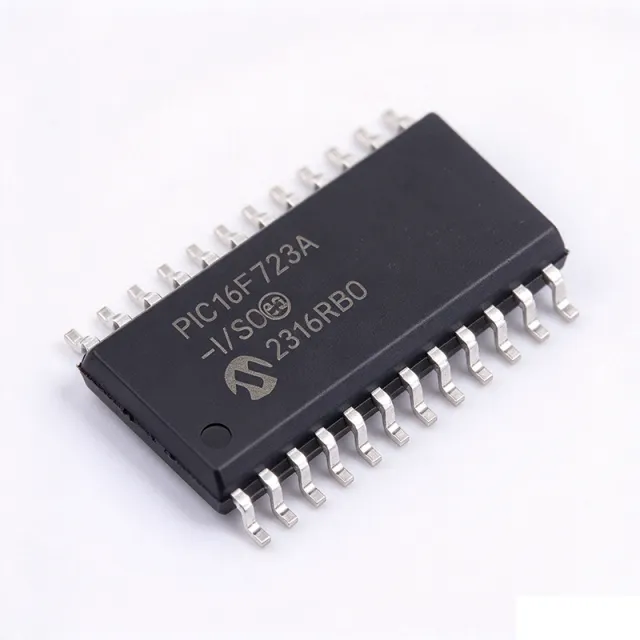
PIC16F724-I/P
PIC16F724-I/P - 8-Bit 20MHz 7KB Flash MCU 40-PDIP | Microchip
The Microchip Technology PIC16F724-I/P is an 8-bit PIC® XLP™ mid-range flash microcontroller running at 20MHz, integrating 7KB (4K x 14 words) of self-programmable Flash program memory in a 40-pin PDIP through-hole package. It operates across 2.5V to 5.5V and delivers 36 I/O pins, on-chip peripherals including ADC, PWM, USART, comparators, and mTouch™ capacitive-touch support.
An 8-bit microcontroller (MCU) is a single-chip computer built around a CPU with an 8-bit data path, embedded Flash/ROM program memory, RAM, and a mix of peripherals such as timers, ADC, PWM, and communication ports. Microcontrollers sit beneath microprocessors in the compute hierarchy: MCU = microcontroller = single-chip computer, and within Microchip's portfolio the PIC16 mid-range family is the workhorse tier between baseline PIC10/12/14 devices and 16-bit PIC24/DSPIC parts. The PIC16F724 belongs to the PIC16F72X sub-family, sharing its peripheral set with the PIC16F722/3/6/7 siblings.
Key features include 7KB Flash, 192 bytes RAM, 36 digital I/O, 14-channel 8-bit ADC, two comparators, enhanced USART, MSSP (SPI/I2C), two 8-bit timers plus one 16-bit timer, four PWM modules, and nanoWatt XLP™ ultra-low-power technology (typical <100 nA sleep current). mTouch™ capacitive-touch hardware enables touch-button and slider interfaces without external components. The 40-pin PDIP package is lead-free and supports through-hole assembly on 2.54mm pitch, which is ideal for prototype, hobbyist, education, and legacy industrial designs.
Architecturally, the PIC16F724 uses an enhanced mid-range RISC core with only 35 single-word instructions, a hardware 8 x 8 multiplier, and a 16-level hardware stack. The Harvard bus keeps program and data memory separate, providing deterministic instruction timing of 200ns at 20MHz. nanoWatt XLP™ technology with selectable oscillator sources and software-controlled peripheral shutdown makes the device suitable for battery-powered applications. The Flash memory supports self-programming for in-field firmware updates.
Typical applications include general-purpose embedded controllers, capacitive-touch user interfaces, industrial sensor conditioning, battery-powered data loggers, motor control with PWM, lighting controls, and automotive body modules (Microchip recommends this part for automotive design via dedicated ordering codes). It is widely used in PIC development boards, hobbyist projects, and educational labs because the PDIP package is breadboard-friendly and the device is supported by MPLAB X IDE, XC8 compiler, and a rich library ecosystem.
When designing with this part, provide adequate decoupling (0.1µF + 10µF) close to VDD/VSS pairs, route the MCLR pull-up through a 10kΩ resistor, and reserve an RC network on OSC1/OSC2 if using an external crystal. Consider the 40-pin QFN/MLF variants (PIC16F724-I/ML, -I/MV) for production SMT layouts.
This page synthesizes distributor pricing, drop-in same-package alternatives in the PIC16F72X family, design notes, and selection guidance not found in the bare datasheet PDF.
見積もり
お問い合わせ