IC Antara Muka
Subkategori
Produk (2,300+)

LAN8742-CZ - 100Mbps Ethernet PHY with 24-QFN
The Microchip Technology LAN8742-CZ is a low-power 10BASE-T/100BASE-TX Ethernet physical-layer transceiver with a 100 Mbps maximum link rate, variable I/O voltage, and a 24-pin QFN package. It supports the IEEE 802.3 and IEEE 802.3u standards and is designed to connect an Ethernet MAC through an RMII interface to copper twisted-pair Ethernet magnetics. The verified search data identifies it as an Ethernet controller interface device and a 1/1 driver-receiver configuration with full-duplex RMII support. An Ethernet PHY is the physical-layer device that translates digital MAC data into electrical signaling for a network cable and converts received cable signals back into digital data. In the hierarchy, the LAN8742-CZ belongs to the Ethernet transceiver, network-interface, integrated-interface-IC, and broader semiconductor categories. Placing a PHY between a host controller and an RJ45 magnetics assembly allows a microcontroller, application processor, or dedicated Ethernet controller to connect to 10 Mbps or 100 Mbps copper networks without implementing the analog cable interface directly. Verified features include 10BASE-T and 100BASE-TX operation, auto-negotiation, HP Auto-MDIX, Energy Efficient Ethernet support identified in the family description, and Wake-On-LAN functionality identified for the LAN8742 family. The variable I/O voltage allows the digital interface voltage to be selected for integration with a host, while the compact 24-QFN, 4 x 4 mm package supports space-constrained embedded designs. The verified results also describe cable diagnostics support, although detailed diagnostic limits are not supplied. The LAN8742-CZ is normally used as the PHY beside a 10/100 Ethernet magnetic module and RJ45 connector. RMII connects the PHY to the MAC, reducing the number of parallel data and control signals compared with older MII implementations. The PHY supports 10 Mbps and 100 Mbps operation and automatically negotiates the best supported speed and duplex mode, simplifying host-side configuration. Exact timing, current, voltage-range, temperature, and package-dimension details require the manufacturer datasheet and are not inferred here. For new production designs, verify lifecycle status and sourcing before committing to an obsolete device. The verified cross-reference data specifically identifies LAN8742A-CZ-TR as a compatible substitute with extended availability, while also describing LAN8742AI-CZ-TR as a direct pin-compatible replacement. Any substitution should be checked against the exact RMII pin mapping, voltage domains, package exposed-pad requirements, magnetic-device pinout, and system timing. This page combines verified distributor and manufacturer information with application guidance, replacement context, and package-focused design notes. It does not invent unpublished pricing, electrical limits, pin names, or lifecycle dates; unavailable values are explicitly marked for engineering review.
LAN8742-CZ-TR - 100Mbps Ethernet PHY with 24-QFN (Tape & Reel)
The Microchip Technology LAN8742-CZ-TR is a low-power 10BASE-T/100BASE-TX Ethernet physical-layer transceiver with a 100 Mbps maximum link rate, variable I/O voltage, and a 24-pin QFN package. It supports the IEEE 802.3 and IEEE 802.3u standards and is designed to connect an Ethernet MAC through an RMII interface to copper twisted-pair Ethernet magnetics. The verified search data identifies it as an Ethernet controller interface device and a 1/1 driver-receiver configuration with full-duplex RMII support. An Ethernet PHY is the physical-layer device that translates digital MAC data into electrical signaling for a network cable and converts received cable signals back into digital data. In the hierarchy, the LAN8742-CZ-TR belongs to the Ethernet transceiver, network-interface, integrated-interface-IC, and broader semiconductor categories. Placing a PHY between a host controller and an RJ45 magnetics assembly allows a microcontroller, application processor, or dedicated Ethernet controller to connect to 10 Mbps or 100 Mbps copper networks without implementing the analog cable interface directly. Verified features include 10BASE-T and 100BASE-TX operation, auto-negotiation, HP Auto-MDIX, Energy Efficient Ethernet support identified in the family description, and Wake-On-LAN functionality identified for the LAN8742 family. The variable I/O voltage allows the digital interface voltage to be selected for integration with a host, while the compact 24-QFN, 4 x 4 mm package supports space-constrained embedded designs. The verified results also describe cable diagnostics support, although detailed diagnostic limits are not supplied. The LAN8742-CZ-TR is normally used as the PHY beside a 10/100 Ethernet magnetic module and RJ45 connector. RMII connects the PHY to the MAC, reducing the number of parallel data and control signals compared with older MII implementations. The PHY supports 10 Mbps and 100 Mbps operation and automatically negotiates the best supported speed and duplex mode, simplifying host-side configuration. Exact timing, current, voltage-range, temperature, and package-dimension details require the manufacturer datasheet and are not inferred here. For new production designs, verify lifecycle status and sourcing before committing to an obsolete device. The verified cross-reference data specifically identifies LAN8742A-CZ-TR as a compatible substitute with extended availability, while also describing LAN8742AI-CZ-TR as a direct pin-compatible replacement. Any substitution should be checked against the exact RMII pin mapping, voltage domains, package exposed-pad requirements, magnetic-device pinout, and system timing. This page combines verified distributor and manufacturer information with application guidance, replacement context, and package-focused design notes. It does not invent unpublished pricing, electrical limits, pin names, or lifecycle dates; unavailable values are explicitly marked for engineering review.
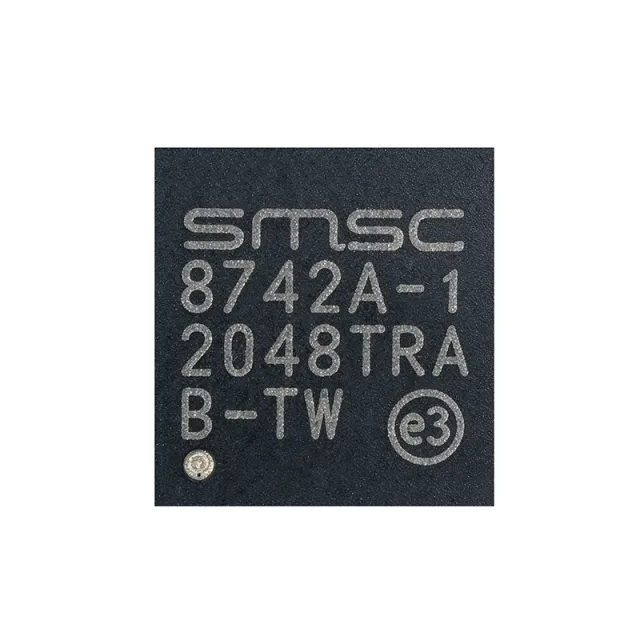
LAN8742A-CZ - 10/100 Ethernet PHY, RMII, 24-SQFN | Microchip (Tape & Reel)
The Microchip LAN8742A-CZ is a low-power 10BASE-T/100BASE-TX Ethernet PHY transceiver with variable I/O voltage, packaged in a 24-pin SQFN (4x4 mm) and supplied on tape and reel. It supports MII and RMII MAC interfaces, operates from a 1.8V to 3.3V variable I/O supply, and is IEEE 802.3 / 802.3u compliant. The device integrates auto-negotiation, auto-polarity correction, and HP Auto-MDIX, eliminating the need for crossover cables. It is well-suited for consumer, embedded, and industrial Ethernet applications. A PHY (physical layer transceiver) is a key element of any Ethernet link: it sits between the MAC controller and the magnetic transformer/RJ-45, handling line encoding/decoding, link training, and electrical signaling over twisted-pair copper. PHY transceivers are part of the broader category of Ethernet interface ICs, which include MAC controllers, switches, and integrated MAC+PHY SoCs. The LAN8742A specifically implements the 10/100 Mbps copper PHY only; higher-speed Gigabit (1000BASE-T) PHYs use multi-level signaling (PAM) and more pins. Key features of the LAN8742A-CZ include Wake-On-LAN support for system-level sleep modes, cable diagnostics for fault detection, and flexPWR flexible power technology for low-power operation. The variable I/O voltage (1.8V-3.3V) allows direct connection to low-voltage MCUs without level shifters. The HP Auto-MDIX feature automatically detects and compensates for TX/RX pair swaps, allowing either straight-through or crossover cables to be used interchangeably. Architecturally, the LAN8742A employs DSP-based echo and crosstalk cancellation to achieve robust 100BASE-TX performance over Cat5 cable. The on-chip PHY includes an integrated termination network and uses energy detect plus power-down modes to meet modern standby-power requirements. MII and RMII MAC interfaces are selectable via strap pins, allowing the same part to be paired with virtually any MCU or SoC MAC. Typical applications include IoT gateways, industrial Ethernet nodes, embedded web servers, building automation controllers, IP cameras, and consumer electronics requiring a wired network connection. The wide 1.8V-3.3V I/O range and low power consumption also make it attractive for battery-powered Ethernet-enabled devices. When designing with the LAN8742A-CZ, follow the Microchip LAN8742 QFN Routing Checklist for proper PCB layout - the analog ground plane and 50-ohm impedance-controlled differential pairs are critical for radiated emissions and signal integrity compliance. Decoupling capacitors must be placed adjacent to each power pin, and the magnetics must be specified to IEEE 802.3 isolation and return-loss specifications. This page synthesizes distributor pricing, drop-in same-BLAN alternatives, and Microchip application-note design notes not found in the manufacturer datasheet alone - giving engineers a single, decision-ready reference.
LAN8742A-CZ-TR - 10/100 Ethernet PHY, RMII, 24-SQFN | Microchip
The Microchip LAN8742A-CZ-TR is a low-power 10BASE-T/100BASE-TX Ethernet PHY transceiver with variable I/O voltage, packaged in a 24-pin SQFN (4x4 mm) and supplied on tape and reel. It supports MII and RMII MAC interfaces, operates from a 1.8V to 3.3V variable I/O supply, and is IEEE 802.3 / 802.3u compliant. The device integrates auto-negotiation, auto-polarity correction, and HP Auto-MDIX, eliminating the need for crossover cables. It is well-suited for consumer, embedded, and industrial Ethernet applications. A PHY (physical layer transceiver) is a key element of any Ethernet link: it sits between the MAC controller and the magnetic transformer/RJ-45, handling line encoding/decoding, link training, and electrical signaling over twisted-pair copper. PHY transceivers are part of the broader category of Ethernet interface ICs, which include MAC controllers, switches, and integrated MAC+PHY SoCs. The LAN8742A specifically implements the 10/100 Mbps copper PHY only; higher-speed Gigabit (1000BASE-T) PHYs use multi-level signaling (PAM) and more pins. Key features of the LAN8742A-CZ-TR include Wake-On-LAN support for system-level sleep modes, cable diagnostics for fault detection, and flexPWR flexible power technology for low-power operation. The variable I/O voltage (1.8V-3.3V) allows direct connection to low-voltage MCUs without level shifters. The HP Auto-MDIX feature automatically detects and compensates for TX/RX pair swaps, allowing either straight-through or crossover cables to be used interchangeably. Architecturally, the LAN8742A employs DSP-based echo and crosstalk cancellation to achieve robust 100BASE-TX performance over Cat5 cable. The on-chip PHY includes an integrated termination network and uses energy detect plus power-down modes to meet modern standby-power requirements. MII and RMII MAC interfaces are selectable via strap pins, allowing the same part to be paired with virtually any MCU or SoC MAC. Typical applications include IoT gateways, industrial Ethernet nodes, embedded web servers, building automation controllers, IP cameras, and consumer electronics requiring a wired network connection. The wide 1.8V-3.3V I/O range and low power consumption also make it attractive for battery-powered Ethernet-enabled devices. When designing with the LAN8742A-CZ-TR, follow the Microchip LAN8742 QFN Routing Checklist for proper PCB layout - the analog ground plane and 50-ohm impedance-controlled differential pairs are critical for radiated emissions and signal integrity compliance. Decoupling capacitors must be placed adjacent to each power pin, and the magnetics must be specified to IEEE 802.3 isolation and return-loss specifications. This page synthesizes distributor pricing, drop-in same-BLAN alternatives, and Microchip application-note design notes not found in the manufacturer datasheet alone - giving engineers a single, decision-ready reference.

LAN9115-MT - 10/100 Ethernet Controller, 3.3V | Microchip
The Microchip Technology LAN9115-MT is a single-chip 10/100 Ethernet controller with a nominal 3.3 V supply, clock frequency up to 25 MHz, and a 100-pin TQFP package measuring 14 x 20 mm. It integrates an Ethernet controller and Base-T/TX PHY behind a 16-bit parallel interface for embedded systems requiring medium-performance network connectivity. The device is positioned as a cost-conscious, flexible Ethernet solution that reduces the component count compared with separate controller and physical-layer devices. An Ethernet controller is an interface IC that connects an embedded processor or programmable logic device to a physical Ethernet network. The controller manages higher-level station functions, while the integrated PHY handles the physical signaling required for 10BASE-T and 100BASE-TX links. Within the semiconductor hierarchy, this device is a network interface controller, a communications interface IC, and a system-level Ethernet connectivity component. Verified product information identifies the LAN9115 as a full-featured single-chip 10/100 Ethernet controller intended for 16-bit embedded applications. Its parallel interface supports integration with processors that use a memory-mapped bus rather than a dedicated PCI interface. The supplied distributor classification also identifies a Base-T/TX PHY, while the product description emphasizes price-performance balance for medium-performance requirements. The LAN9115 combines MAC-oriented controller functionality and physical-layer connectivity in one package. This consolidation can simplify PCB routing and reduce the number of external interface components, but the Ethernet magnetics, connector, termination, clock source, decoupling network, and firmware support remain essential parts of a working network subsystem. Its 3.3 V operation also places it in the supply domain of many embedded processors, FPGAs, and industrial controllers. Typical uses include industrial control equipment, embedded gateways, factory data acquisition, instrumentation, building automation, serial-to-Ethernet products, and compact embedded servers. The LAN9115 is most appropriate where 10/100 Ethernet is sufficient and a 16-bit host interface is preferable to a PCI-based architecture. It can also form the network foundation for supervisory systems that exchange configuration, status, and diagnostic data. Board design should reserve careful attention to the 25 MHz clock requirement, 3.3 V power distribution, PHY-to-magnetics routing, and manufacturer-recommended decoupling and layout practices. Because the verified snippets do not provide a complete timing, register, electrical-limit, or absolute-maximum specification set, designers should consult the official manufacturer datasheet before finalizing clock tolerances, impedance, magnetics selection, or software configuration. This page consolidates verified product identity, package, interface, supply, and sourcing information into a practical selection record. It also distinguishes verified facts from unavailable details rather than guessing, while directing engineers to the official datasheet and authorized distributor listings for design validation and current commercial availability.

LAN9117-MD - 10/100 Ethernet Controller | Microchip
The Microchip LAN9117-MD is a high-performance, single-chip 10/100 non-PCI Ethernet controller designed for embedded systems, with a 16-bit CPU interface and integrated Ethernet controller functionality. The verified product information identifies it as a member of the LAN9118 family and emphasizes efficient interfacing with most 16-bit embedded CPUs, low CPU overhead, and suitability for medium- to high-performance applications. It is packaged as an Ethernet interface controller from the LAN9117 family; the exact package designation, pin count, voltage ratings, and full electrical limits require confirmation from the manufacturer datasheet. What is an Ethernet controller? An Ethernet controller is an integrated circuit that manages the hardware and protocol functions required for a host system to communicate over an Ethernet network. In the LAN9117-MD, the 10/100 designation refers to support for 10 Mb/s and 100 Mb/s Ethernet operation, while the non-PCI description identifies its host-side integration approach. The device is intended to reduce CPU involvement in network traffic and simplify embedded Ethernet connectivity. The most important verified feature is the 16-bit host-interface orientation. The product data states that the LAN9117 efficiently interfaces with most 16-bit embedded CPUs and uses a low-CPU-overhead architecture. It also belongs to the LAN9118 family, which provides useful context for firmware and hardware design work involving related SMSC Ethernet controllers. The product is marketed for embedded applications where performance, flexibility, ease of integration, and system-cost control are priorities. LAN9117-MD is suitable for industrial control, embedded instrumentation, network-connected test equipment, and compact embedded platforms that need 10/100 Ethernet without a PCI bus. Compared with a software-heavy network interface, a dedicated Ethernet controller can offload protocol and hardware tasks, reducing the burden placed on the host processor. The actual throughput, media interface, clock requirements, supply voltage, and electrical timing must be checked against the official datasheet before schematic capture. A key design consideration is confirming the exact package footprint and pin compatibility before substituting any part. The available migration guidance explicitly states that the LAN9211 is not a drop-in replacement for the LAN9117 because it uses a different package and requires a new PCB. This distinction is important when comparing Ethernet controllers by function rather than by mechanical interchangeability. This product page consolidates the verified LAN9117-MD role, family information, 10/100 Ethernet capability, 16-bit embedded-CPU interface, sourcing references, and migration cautions into a practical component-selection resource. Numeric electrical limits, pricing, pinout assignments, lifecycle details, and validated drop-in alternatives remain dependent on manufacturer or distributor data.
LAN9117-MT 10/100 Ethernet Controller | Microchip
The Microchip Technology LAN9117-MT is a single-chip 10/100 Ethernet controller with an integrated Base-T/TX PHY, parallel host interface, and 100-pin TQFP package. The verified distributor listing identifies support for 10/100 Base-T/TX networking and a parallel interface. It is designed for embedded systems requiring wired Ethernet without a separate external Ethernet transceiver. An Ethernet controller is an interface IC that connects an embedded processor or programmable controller to a physical Ethernet network. Within the broader semiconductor hierarchy, the LAN9117-MT belongs to the Ethernet controller family, network interface controllers, interface ICs, and communications semiconductors. By combining controller and physical-layer functions, it can reduce component count while preserving a parallel processor-facing integration path. The verified product information identifies 10 Mbps and 100 Mbps operation, a 3.3 V supply requirement, a 100-pin TQFP package, and a single-chip architecture. The -MT ordering suffix is associated with a tray package in the available distributor record. Other detailed electrical limits, host-interface timing, register features, media-type behavior, and environmental ratings were not included in the supplied verified excerpts and therefore are not asserted here. Typical uses include embedded industrial controllers, data-acquisition systems, building-automation equipment, access-control terminals, test instruments, and compact embedded servers. A parallel host interface can suit processors and controllers that do not include an integrated Ethernet MAC, while the integrated PHY simplifies the connection between the digital host bus and the analog magnetics interface. The primary design consideration is footprint verification: the DigiKey listing describes a 100-TQFP package measuring 14 mm by 14 mm, while another distributor excerpt states 14 mm by 20 mm. Engineers must confirm the exact ordering-code drawing and land pattern against the authoritative manufacturer package documentation before layout release. The -MT suffix and tray packaging must also be confirmed with the current manufacturer datasheet. This page combines verified manufacturer and distributor descriptions with explicit engineering caveats. It does not infer unavailable electrical, timing, thermal, or compliance values, and it separates confirmed product identity from details that still require datasheet-level verification.
LAN9118-MT 10/100 Ethernet Controller | Microchip
The Microchip Technology LAN9118-MT is a single-chip 10/100 Base-T/TX Ethernet controller with a 32-bit external parallel interface, a 3.3 V supply, and a 100-pin TQFP package. It combines an Ethernet controller and PHY for embedded systems requiring local network connectivity without a separate PCI bus controller. The device supports 10 Mbps and 100 Mbps Ethernet operation and is identified by the commercial temperature-grade -MT ordering suffix. An Ethernet controller is an interface integrated circuit that connects an embedded processor or microcontroller to a physical Ethernet network. The LAN9118 family belongs to the broader hierarchy of Ethernet controller -> network interface controller -> interface IC -> semiconductor. Integrating the controller and PHY supports embedded product designs for industrial controls, communications equipment, data acquisition, and networked peripherals, while the parallel host interface gives the host processor direct register and data access. The verified product information identifies a 32-bit external data bus, a 7-bit address bus, a 25 MHz clock capability, a 3.3 V supply, and a 100-pin TQFP package. The 100-pin package exposes the substantial parallel host interface required by the non-PCI architecture. The LAN9118-MT is therefore most appropriate where an embedded system has enough I/O and board area for a high-pin-count parallel interface rather than a compact serial Ethernet controller. The part is described as a high-performance single-chip 10/100 non-PCI Ethernet controller. Its combined controller and PHY architecture can reduce the number of external network-interface components compared with a separated MAC and physical-layer design. Ethernet magnetics and the RJ45 connector remain external, and the final signal-integrity and layout implementation must follow the manufacturer hardware guidance. The provided verification also identifies IEEE 802.3 and IEEE 802.3u compliance in a product comparison source. Typical uses include embedded Ethernet gateways, industrial monitoring equipment, serial-to-Ethernet systems, test instruments, and control systems that require 10/100 connectivity. The parallel interface makes the LAN9118-MT most attractive to designs with a processor bus capable of supporting the required data width and pin count. It is less suitable for highly constrained systems that favor a serial Ethernet interface or a smaller package. Designers should verify the complete pinout, voltage tolerances, clock requirements, decoupling, reset behavior, magnetics selection, and PCB routing against the manufacturer datasheet before layout release. The verified search results identify the manufacturer LAN9118 product page and multiple datasheet mirrors, but do not provide every electrical timing, pin-level, or lifecycle value needed for a complete production design.

LAN91C96-MS - 10/100 Ethernet Controller | Microchip
The Microchip Technology LAN91C96-MS is a single-chip 10/100 Ethernet controller with a 3.3 V supply, a 100-pin QFP package measuring 14 x 20 mm, and an operating temperature range of -40 °C to 85 °C. It integrates an Ethernet MAC, physical-layer encoding and decoding functions, packet RAM, and host-bus connectivity, reducing the component count required for embedded Ethernet designs. An Ethernet controller is an interface IC that connects an embedded host processor to a physical Ethernet network. Within the product hierarchy, the LAN91C96-MS is an Ethernet MAC and physical-layer controller, which is part of a communications interface IC and ultimately a semiconductor. It supports non-PCI systems using Local Bus, PCMCIA, or Motorola 68000 bus interfaces instead of requiring a PCI-compatible host. Key features include full-duplex switched Ethernet support, enhanced transmit queue management, integrated packet RAM, and support for AUI and twisted-pair network connections. The supplied manufacturer information identifies the LAN91C96 family as integrating most IEEE 802.3 functionality, including MAC protocol handling, physical-layer encoding and decoding, twisted-pair transceiver functions, and link-integrity testing. The controller addresses legacy embedded platforms that need Ethernet connectivity without a PCI bus. Its local-bus addressing uses A0-A9 and A15 together with active-low nREG, nCE1, nWE, and nOE signals. Word reads from odd byte addresses can return a zero value in the upper byte because that byte is a don't-care under the referenced PCMCIA attribute-memory access rule. Typical uses include legacy embedded systems, industrial controllers, compact network adapters, PC Card LAN equipment, and custom communication equipment requiring a non-PCI Ethernet interface. The manufacturer also identifies the low-profile TQFP option as suitable for mobile applications such as PC Card LAN adapters, although the verified LAN91C96-MS ordering information identifies a 100-pin QFP package. Designers should verify the exact PCB footprint, clock source, bus timing, transceiver connections, and power requirements against the manufacturer datasheet before substituting this legacy controller. The -40 °C to 85 °C specification supports industrial-temperature designs, but applications needing a wider commercial range should select a variant with the appropriate documented rating. This page consolidates verified distributor identification, manufacturer product information, datasheet details, interface features, and package data. It also separates documented facts from unresolved parameters and avoids presenting unspecified pricing, pin names, and competitor compatibility as confirmed engineering data.
LAN91C96-MU - 10Mbps Ethernet Controller | Microchip Technology
Microchip Technology LAN91C96-MU is a single-chip 10Mbps Ethernet controller with a 10BASE-T PHY, parallel host interface, MAC functions, and integrated packet RAM in a 100-pin TQFP package measuring 14 x 14 mm. The device supports 3.3 V and 5 V operation and combines Local Bus, PCMCIA, and Motorola 68000 bus interfaces in one CMOS Ethernet controller. Its integrated architecture reduces the external component count required for embedded Ethernet connectivity while providing full-duplex switched Ethernet support, enhanced transmit queue management, and 6 kB of packet RAM. An Ethernet controller is an interface IC that connects a host processor or embedded system to an Ethernet physical network. The LAN91C96 family integrates the Media Access Control layer, physical-layer interface, packet buffer, and host-bus logic. This places it in the hierarchy Ethernet controller > network interface controller > interface IC > semiconductor, making it suitable for legacy industrial, embedded, and PCMCIA equipment that cannot rely on a modern PCI Ethernet controller. The LAN91C96-MU supports 10Mbps Ethernet operation and a parallel 10BASE-T PHY interface. According to Microchip product information, the controller integrates all MAC and physical-layer functions and the packet RAM required to implement a complete Ethernet node. The datasheet also identifies support for full-duplex switched Ethernet and enhanced transmit queue management. These features are useful where the host bus architecture, rather than network throughput, is the primary system constraint. The device uses a 100-TQFP surface-mount package and supports both 3.3 V and 5 V supply conditions, allowing integration with systems using either voltage domain. Its Local Bus, PCMCIA, and Motorola 68000 interfaces provide design flexibility across embedded processor and legacy computer platforms. The manufacturer datasheet states that the LAN91C96 is pin and software compatible with the LAN91C92 and LAN91C94 in Local Bus mode, which supports incremental upgrades of qualifying legacy designs. Typical applications include embedded industrial controllers, PCMCIA Ethernet adapters, legacy Local Bus systems, Motorola 68000-based equipment, and custom network interface cards. The integrated 6 kB packet RAM can reduce host-memory traffic and buffer network packets, while full-duplex operation supports switched-network installations. Designers should verify that the host timing, transceiver connection, connector magnetics, and software driver are supported by the target system architecture. The primary design consideration is voltage and signal compatibility with the existing bus. Because the controller integrates Ethernet functions but requires an appropriate external network interface implementation, designers must follow the manufacturer reference circuitry for magnetics, termination, clocking, and decoupling. Firmware and bus-driver compatibility are equally important; an identical package does not by itself guarantee that a replacement can operate correctly in every legacy operating environment. This product data combines manufacturer documentation, distributor package information, sourcing details, and verified same-family alternatives. It also adds practical guidance for comparing the LAN91C96-MU with other LAN91C96 package and temperature designations without presenting package-only changes as separate functional technologies.
LAN9215-MT - 100Mbps Ethernet Controller | Microchip
The Microchip LAN9215-MT is a single-chip 10/100 Ethernet controller with a 100 Mbps data rate, a 16-bit parallel MII interface, and a 100-pin TQFP package measuring 14 x 14 mm. It integrates an Ethernet media-access controller, PHY, and connectivity needed for embedded network equipment. The verified distributor listing identifies it as a 10/100 Base-T/TX PHY controller using a parallel interface, while the manufacturer describes it as a flexible embedded Ethernet solution. An Ethernet controller such as the LAN9215-MT connects an embedded host interface to a physical copper network. Within the hierarchy of integrated circuits, it is an Ethernet interface controller and a networking semiconductor. Its 100 Mbps throughput targets Fast Ethernet networks, while its 16-bit MII provides a parallel connection to a host processor. Integrating the controller and PHY reduces external network-interface component count compared with a discrete MAC-and-PHY design. Verified features include support for 10 Mbps and 100 Mbps operation, HP Auto-MDIX support, driver compatibility with the preceding LAN9118 family, and footprint, register, and driver compatibility with those devices. The manufacturer datasheet states a 2.97 V to 3.63 V supply range and a maximum clock frequency of 25 MHz. A separate component listing describes a 3.3 V device and an operating range from 0°C to +70°C, consistent with the -MT commercial-temperature ordering option. The LAN9215-MT is suitable for embedded Ethernet systems that require a CPU-facing parallel interface rather than a serial SPI host interface. Typical uses include industrial controllers, embedded gateways, test equipment, communications modules, and OEM data-acquisition products. Its 16-bit host interface is particularly appropriate for microprocessors and programmable logic devices able to sustain parallel bus transactions at Ethernet timing requirements. The primary integration consideration is the Ethernet magnetics and analog network path. The manufacturer datasheet notes that supporting HP Auto-MDIX can require different magnetics and passive components plus a minor PCB change. Designers should therefore follow the manufacturer reference schematic and preserve the required layout, power, decoupling, and magnetics implementation rather than treating the controller as a standalone digital component. This page consolidates verified manufacturer and distributor information, practical integration guidance, application fit, and transparent gaps where complete electrical or pin-level data was not provided. The official LAN9215 product page and datasheet remain the controlling references for registers, timing, electrical limits, and reference design implementation as verified on 2026-10-22.
LAN9215-MZP - 10/100 Ethernet Controller | Microchip
The Microchip Technology LAN9215-MZP is a single-chip 10/100 Ethernet controller with an integrated 10/100 Base-T/TX PHY, a 16-bit non-PCI parallel host interface, and a 100-ball LFBGA package. It operates from a 2.97 V to 3.63 V supply, supports an operating temperature range of 0 °C to 70 °C, and is designed for embedded systems requiring medium-performance networking with low CPU overhead. An Ethernet controller is a network interface IC that manages communication between a host processor and an Ethernet physical layer. Within the hierarchy of semiconductor interfaces, the LAN9215 combines protocol handling, media access control, physical-layer signaling, and host-bus integration. The -MZP ordering code identifies the lead-free 100-ball LFBGA package supplied in trays for commercial-temperature applications. Key features include 10/100 Base-T/TX connectivity, 16-bit non-PCI interfacing, HP Auto-MDIX support, and compatibility with the previous-generation LAN9118 family's drivers, registers, and footprint. These characteristics make the device suitable for industrial controllers, embedded data acquisition equipment, access peripherals, and compact network appliances. The 10 × 10 mm LFBGA package also supports space-constrained embedded designs. The controller consolidates the Ethernet MAC and PHY into one device, reducing external component count compared with a discrete MAC-plus-PHY implementation. Its parallel host interface is designed to connect readily with embedded processors that expose a compatible 16-bit bus. According to the manufacturer datasheet, software written for compatible LAN9118-family devices can operate with the LAN9215, supporting migration without redesigning the host driver. Typical applications include industrial Ethernet gateways, programmable controllers, factory monitoring equipment, point-of-sale systems, and embedded test instruments. The integrated Auto-MDIX function supports automatic handling of transmit and receive pair polarity, simplifying cabling in installations where link orientation may vary. Designers must still provide an appropriate Ethernet magnetics and power-network implementation according to the manufacturer guidance. PCB implementation requires careful attention to the 100-ball land pattern, power and ground distribution, PHY-side signal routing, and the 49.9 Ω transmit-termination pull-up specified in the manufacturer placement checklist. Place that pull-up close to the TPO+ ball when Auto-MDIX is enabled, or close to the magnetics when Auto-MDIX is disabled. This page combines verified manufacturer and distributor information with package-specific engineering guidance, sourcing facts, lifecycle caveats, and application-oriented design notes. It distinguishes documented characteristics from parameters that still require confirmation in the complete LAN9215 datasheet and customer design review.
LAN9217-MT 10/100 Ethernet Controller | Microchip Technology
The Microchip Technology LAN9217-MT is a single-chip 10/100 Ethernet controller with a 16-bit parallel MII interface, HP Auto-MDIX support, and a 100-TQFP 14 x 14 mm package. It combines an Ethernet media-access controller and physical-layer transceiver to connect embedded processors to 10BASE-T and 100BASE-TX networks. An Ethernet controller is an interface IC that manages frame processing, host access, and physical network signaling. In the product hierarchy, the LAN9217 belongs to Ethernet controllers, interface ICs, networking semiconductors, and embedded connectivity solutions. Its integrated PHY reduces external circuitry while its 16-bit MII interface supports common embedded processor buses and reduces the host-side I/O burden compared with narrower parallel interfaces. Key verified features include a nominal 1.8 V supply, commercial-grade operation up to 70 degrees Celsius, 10/100 Base-T and Base-TX support, and HP Auto-MDIX. The controller is designed for embedded systems requiring low CPU overhead, flexible integration, and controlled system cost. The 100-pin TQFP package provides the complete mixed-signal Ethernet interface while permitting standard surface-mount assembly. According to the Microchip manufacturer datasheet, the LAN9217 architecture integrates the PHY and controller functions and can interface with most 16-bit embedded CPUs. This combination makes it suitable for industrial controllers, embedded servers, network bridges, test equipment, and communications equipment that already have a parallel bus rather than an SPI Ethernet interface. Typical deployments include factory automation controllers, embedded network appliances, industrial instrumentation, serial-to-network gateways, and compact control systems. The Auto-MDIX function supports automatic pair detection, reducing installation friction where straight-through or crossover cabling may occur. Integrated 10/100 support lets the system negotiate its Ethernet rate through Auto-Negotiation rather than requiring two external physical interfaces. When integrating the LAN9217-MT, pay close attention to the complete 100-pin assignment, 16-bit MII timing, required clocks, magnetics, external component recommendations, and exposed-pad layout in the manufacturer datasheet. The verified excerpts do not provide enough information to reproduce the full reference circuit or pin names, so these implementation details should not be inferred from the interface description alone.
LAN9218-MT - 100Mbps 10/100 Ethernet Controller | Microchip
The Microchip Technology LAN9218-MT is a single-chip 10/100 Base-T/TX Ethernet controller with a 32-bit parallel host interface, 100 Mbps data rate, and a 100-TQFP 14 x 14 mm package. It integrates the Ethernet media access controller and physical-layer transceiver into one device for compact embedded networking designs. The verified source identifies the part as a high-performance 10/100 Ethernet controller designed around performance, flexibility, ease of integration, and system cost control. An Ethernet controller is an interface IC that connects an embedded processor or programmable logic device to a copper Ethernet network. Its MAC layer manages frame transmission and reception, while its integrated PHY handles the physical signaling required between digital circuitry and an Ethernet transformer or magnetics. This integration reduces the number of external network-interface components compared with separate MAC and PHY solutions, although external passive and magnetic components are still required by the application design. The LAN9218-MT supports 10/100 Ethernet operation and uses a parallel interface instead of a serial media-independent interface. The verified distributor result identifies the interface as 32-bit and the data rate as 100 Mbps. The device is intended for embedded systems requiring an Ethernet endpoint, including industrial controls, communications equipment, embedded servers, and connected test equipment. Its 100-TQFP package provides a high pin count for the parallel host bus, control signals, clocks, power supplies, and Ethernet physical connections. The manufacturer describes the LAN9218 family as architected for high performance and integration. The verified product page and datasheet links should be used for the complete register map, electrical limits, timing specifications, magnetic-component recommendations, Auto-MDIX behavior, reference schematic, and package drawing. Because the provided data does not include the complete manufacturer parameter table, unverified values are intentionally identified as [DATA_NEEDED] in the specifications rather than inferred. A typical implementation places the Ethernet controller between a host processor and network magnetics. The host communicates through the parallel bus, while the integrated PHY connects through transformer-center-tapped or other approved magnetic arrangements. PCB layout is important because high-speed digital signals, analog PHY signaling, power distribution, and magnetics must be separated appropriately. Microchip’s reference schematic and placement checklist are the authoritative starting points for a production layout. Designers should use the manufacturer datasheet and reference schematic to confirm pin functions, strap settings, clock requirements, termination, decoupling, and Auto-MDIX configuration. The verified cross-reference material notes that Auto-MDIX support may require changes to magnetics and surrounding passive components, and that a PCB change may be needed. Therefore, a software-compatible Ethernet controller is not automatically a hardware drop-in replacement. This page consolidates verified distributor pricing information, manufacturer documentation links, application context, and design guidance. It is intended to help engineers identify the correct LAN9218-MT, assess whether an alternative is truly pin-compatible, and move from component selection to a validated Ethernet hardware design.
LAN9218I-MT - 10/100 Ethernet Controller | Microchip Technology
The Microchip Technology LAN9218I-MT is a single-chip 10/100 Base-T/TX Ethernet controller with a 32-bit parallel host interface and 100-LQFP TQFP package measuring 14 x 14 mm. Designed for embedded systems, it combines a 10/100 Ethernet PHY, controller, and packet-buffer memory in one device, supporting economical integration without a discrete network interface controller and separate Ethernet transceiver. The LAN9218I-MT also provides HP Auto-MDIX support and industrial-temperature capability. An Ethernet controller is an interface IC that connects an embedded processor or programmable controller to a wired Ethernet network. In the device hierarchy, the LAN9218I-MT belongs to the network interface controller and Ethernet interface IC class, combining a media-access-control function, physical-layer transceiver, and host-facing parallel bus. It is intended to reduce system cost while providing controlled access to Ethernet frames, status information, and packet buffers. Verified device attributes include support for 10/100 Base-T/TX operation, a 32-bit parallel interface, HP Auto-MDIX, and 16 KB of internal receive SRAM. According to the Microchip LAN9218i data sheet, the receive FIFO can hold more than 200 received packets. Automatic flow-control packet generation can reduce packet loss when the receive FIFO approaches capacity, while external wake mechanisms provide additional low-power integration options. The integrated PHY is designed for embedded applications where performance, flexibility, ease of integration, and system cost control are important. The parallel interface supports direct connection to host buses without requiring a separate serial Ethernet MAC interface. However, its 100-pin package and numerous host signals require careful PCB layout and enough board area for controlled impedance routing to the Ethernet magnetics. Typical uses include industrial control systems, embedded gateways, set-top equipment, printers, building-automation controllers, and industrial data-acquisition equipment. The device is particularly appropriate when an embedded processor requires a wired 10/100 Ethernet connection and the design team wants the PHY, MAC, packet storage, and Auto-MDIX support integrated into one component. Designers should follow the manufacturer’s reference circuit for magnetics, termination, bias resistors, decoupling, and high-speed layout. Driver compatibility and Auto-MDIX implementation must be checked against the exact LAN9218i hardware and software documentation. Although standard LAN9218 software drivers may support LAN9218i devices, the verified data sheet notes that supporting HP Auto-MDIX may require different magnetics and passive components and possibly a minor PCB change. This page consolidates verified manufacturer and distributor information, identifies the documented same-brand alternatives, distinguishes unavailable pricing and pin-mapping data, and highlights integration constraints that are easy to miss when comparing Ethernet controllers.

LAN9250/ML - 10/100 Ethernet Controller | Microchip
The Microchip Technology LAN9250/ML is a single-chip 10/100 Ethernet controller with integrated Ethernet PHY, supporting 10 Mbps and 100 Mbps operation in a 64-pin QFN package. It is designed for embedded systems requiring flexible host connectivity, packet buffering, and controlled network integration. The verified product data identifies support for 1.8 V, 2.5 V, and 3.3 V operation, along with 8-bit or 16-bit host interfaces and SPI/SQI connectivity. An Ethernet controller is an interface IC that connects an embedded processor or microcontroller to a physical Ethernet network. It combines media-access control, packet data handling, transmit and receive buffering, and a physical-layer transceiver in one device. The LAN9250 series is intended to reduce integration effort by placing the controller and PHY together while preserving support for embedded host buses and serial interfaces. The LAN9250/ML combines 10/100 Ethernet connectivity with integrated PHY functionality. Its packet FIFOs are intended to accommodate high-latency applications, while its memory-buffer architecture optimizes packet granularity and helps reduce packet loss. The product description specifically identifies performance, flexibility, ease of integration, and system cost control as design priorities for embedded applications. Typical use cases include industrial embedded controllers, networked data-acquisition equipment, building-control systems, communications modules, and other MCU-based products that require an Ethernet port. The verified data lists an 8/16-bit interface and SPI/SQI interface options in distributor descriptions, allowing the device to fit systems using parallel or serial host connectivity. The 1.8 V, 2.5 V, and 3.3 V supply options are useful for systems with multiple embedded power domains. A key design consideration is that the Ethernet PHY and host interface still require careful PCB implementation, including adequate power distribution, controlled-impedance routing, and separation between sensitive analog and digital sections where required by the datasheet layout guidance. The verified sources identify the LAN9250 as IEEE 802.3/802.3u compliant, but detailed timing, pin-level, and electrical requirements should be confirmed against the manufacturer datasheet. This page consolidates verified manufacturer and distributor information, interface characteristics, application context, and sourcing links for LAN9250/ML engineers evaluating embedded Ethernet connectivity.

LAN9250/PT - 10/100 Ethernet Controller w/ PHY | Microchip | TQFP-64
The Microchip Technology LAN9250/PT is a full-featured, single-chip 10/100 Base-T/TX Ethernet controller with an integrated PHY, packaged in a 64-pin TQFP-EP (10x10 mm) with exposed thermal pad. It supports both I2C and SPI host interfaces and is designed for embedded applications requiring high throughput, low CPU overhead, and minimal external component count. An Ethernet controller is a semiconductor device that handles the data-link (MAC) and physical-layer (PHY) functions required to send and receive Ethernet frames. The LAN9250 integrates both the IEEE 802.3 10/100 MAC and the 100BASE-TX PHY in one chip, exposing a simple SPI/I2C slave interface to the host microcontroller. This eliminates the need for an external MAC, external PHY, and an Ethernet-equipped MCU, which reduces BOM cost and PCB area in industrial, building-automation, and IoT designs. The device sits in the network-interface hierarchy as: PHY -> MAC -> Ethernet controller -> communication IC -> semiconductor. Key features include large transmit and receive FIFOs to accommodate high-latency applications, an efficient memory buffer architecture that optimizes packet granularity, hardware offload features that reduce packet loss, support for HP Auto-MDIX, and built-in support for EtherCAT, Modbus TCP, and other industrial Ethernet protocols. The flexible host bus allows integration with virtually any 8/16/32-bit microcontroller without requiring an external bus interface, and on-chip termination and bias resistors reduce external component count. Typical applications include industrial control PLCs, factory automation nodes, building-automation gateways, IoT edge devices, motion controllers, EtherCAT slave controllers (when paired with a host MCU running the EtherCAT slave stack), and embedded HMI panels. The integrated PHY and small TQFP-64 footprint make it especially attractive for space-constrained designs that still need a wired industrial Ethernet port. When designing with this device, ensure the 25 MHz reference clock is stable and low-jitter, route the differential TX/RX pairs as a 100-ohm differential pair on the PCB, and place the 1.8V and 3.3V decoupling capacitors as close to the power pins as possible. The exposed thermal pad must be soldered to a ground copper pour for thermal dissipation.
LAN9250I/ML - 10/100 Ethernet Controller | Microchip
The Microchip Technology LAN9250I/ML is a single-chip 10/100 Ethernet controller with an integrated Ethernet PHY, I2C and SPI host interfaces, and a 64-QFN 9 x 9 mm package. It supports 10 Mb/s and 100 Mb/s Ethernet operation and combines the controller, physical-layer transceiver, host interface, memory, and packet-processing functions in one device. An Ethernet controller is an interface IC that connects an embedded processor or microcontroller to a physical Ethernet network. Within the hierarchy of Ethernet interfaces, interface ICs, and semiconductors, the LAN9250I/ML provides a hardware interface between a host bus and a 10/100BASE-T network while reducing the need for external Ethernet components. Its integrated PHY makes it suitable for embedded systems requiring network connectivity without a discrete Ethernet transceiver. Key features include one integrated 10/100 Ethernet transceiver, simultaneous support for 10 Mb/s and 100 Mb/s data rates, and host connectivity through 8-bit or 16-bit parallel, SPI, or Quad SPI interfaces. The manufacturer datasheet also identifies a configurable host interrupt, internal FIFOs, and memories. These resources let the host receive and transmit Ethernet traffic without implementing the complete Ethernet physical layer in hardware. The LAN9250 architecture combines the Ethernet media-access controller and physical layer in one package. A parallel interface can provide higher host throughput than a serial interface when the system requires frequent packet movement. Conversely, SPI or Quad SPI reduces the number of host signal lines and can simplify connections to processors with limited parallel GPIO. Configuration of interrupt behavior and host access is handled through the device register interface. Typical applications include industrial Ethernet equipment, factory automation controllers, embedded data acquisition systems, building-automation equipment, and network-connected test products. The part is also appropriate for compact embedded platforms that require an Ethernet port but have limited board space. A host processor such as an STM32 or ATmega-class microcontroller can be paired with the LAN9250I/ML when local packet processing and application-level networking are required. Designers should verify the complete 64-QFN footprint, exposed-pad layout, decoupling requirements, clock source, and host-bus mode against the manufacturer datasheet before layout release. The industrial-temperature ordering code must also be checked against the system enclosure temperature. Because the supplied web evidence does not provide complete electrical limits or detailed pin names, those values should not be inferred from the distributor summaries. This page combines verified manufacturer and distributor data, practical interface-selection guidance, a same-package comparison, and design cautions that are not consolidated in the short catalog excerpts. It is intended to support sourcing and engineering review while clearly separating confirmed specifications from parameters that still require confirmation in the full Microchip datasheet.
LAN9250I/PT - 10/100 Industrial Ethernet Controller | Microchip
The Microchip Technology LAN9250I/PT is a single-chip 10/100 Ethernet controller with integrated 10/100 Base-T/TX PHY, SPI/SQI host-interface support, and I2C configuration support, supplied in a 64-lead TQFP exposed-pad package measuring 10 x 10 mm. It is designed for embedded systems that require a compact Ethernet interface without the cost and integration burden of separate controller and PHY devices. An Ethernet controller is a semiconductor that manages frame processing and communication between an embedded host and an Ethernet physical layer. The LAN9250 combines these functions as an integrated Ethernet interface IC. Within the product hierarchy, it sits between a general-purpose microcontroller or processor and the physical copper network, providing a hardware interface for 10 Mb/s or 100 Mb/s Ethernet communications. The device supports optical-fiber connectivity, IEEE 1588 timing support, a low-power operating mode, wake-up capability, power-on reset, and programmable LED indication. Its 1.8 V, 2.5 V, and 3.3 V supply options support embedded designs using multiple logic levels. These features allow the LAN9250I/PT to serve industrial controllers, embedded network equipment, automation systems, and communication products without requiring a separate Ethernet PHY. The integrated architecture reduces the number of external interface components and provides a unified path for host communication and physical-layer signaling. The SPI/SQI interface supports integration with embedded processors, while I2C provides a separate configuration path. The internal 25 MHz reference clock and derived subsystem clocks form the timing foundation for controller, PHY, and host-interface operations. Typical uses include industrial Ethernet gateways, factory automation controllers, embedded network servers, serial-to-Ethernet equipment, building automation interfaces, and instrument controllers. The industrial temperature range of -40°C to +85°C supports applications across commercial, industrial, and extended-temperature embedded equipment where compact networking and programmable status indication are required. PCB design must account for the TQFP exposed pad, high-speed Ethernet layout requirements, suitable magnetic-component selection for copper interfaces, and the device's stated operating supply options. The exposed pad should be connected according to the manufacturer layout guidance, while differential Ethernet traces should be routed as a controlled-impedance pair with minimized disruption and appropriate via symmetry. This product page consolidates the verified manufacturer and distributor information, distinguishes the industrial-temperature ordering variant, summarizes interface and packaging constraints, and provides practical guidance for evaluating the LAN9250I/PT in embedded Ethernet designs.
LAN9250T/ML - 10/100 Ethernet Controller | Microchip Technology
The Microchip Technology LAN9250T/ML is a single-chip 10/100 Base-T/TX Ethernet controller with integrated Ethernet PHY and selectable 8/16-bit, SPI, or SQI host interfaces, packaged in a 64-QFN 9 x 9 mm package. It is designed for embedded applications that require local Ethernet connectivity, flexible processor integration, and system-level cost control without a separate Ethernet controller and physical-layer transceiver. An Ethernet controller is an interface IC that manages communication between an embedded processor and a physical Ethernet network. Within the product hierarchy, the LAN9250 combines an Ethernet MAC, a 10/100 Base-T/TX PHY, host-interface logic, and network-related control functions. The verified product information identifies support for optical-fiber links, IEEE 1588, low-power operation, wake-up, power-on reset, and programmable LED indication. The device supports a 10/100 Base-T/TX Ethernet connection and offers I2C, SPI, and parallel host-interface options described by the manufacturer as 8/16-bit or SPI/SQI. This interface flexibility allows the same controller family to be used with embedded processors, microcontrollers, DSPs, and other systems with different bus requirements. Its 64-QFN 9 x 9 mm package supports compact surface-mount integration, although detailed footprint dimensions and exposed-pad requirements must be taken from the manufacturer documentation. Typical implementation uses the controller as the network interface between a host processor and an Ethernet transformer or optical-fiber interface. Digital firmware and drivers connect the selected host bus to the Ethernet MAC, while the integrated PHY handles the physical signaling layer. The low-power mode and wake-up functions can help a system reduce energy use or resume network operation according to product-specific requirements. Programmable LED indication provides a hardware indication of link or activity status. Because the LAN9250T/ML integrates the MAC and PHY, board planning must address host-bus timing, clocking, power sequencing, magnetic-interface components, controlled-impedance routing, and the exact exposed-pad land pattern. The manufacturer datasheet and its associated errata should be consulted before schematic release. Verification should include operating-voltage limits, transceiver or media-interface implementation, reset behavior, wake-up operation, IEEE 1588 support, and environmental qualification. This page consolidates the verified manufacturer and distributor information for the LAN9250T/ML, including the 10/100 Ethernet capability, available interfaces, 64-QFN package information, feature list, sourcing links, and practical selection considerations. Detailed electrical limits, timing tables, absolute maximum ratings, pin functions, and package dimensions that were not exposed by the supplied records are intentionally identified as data-needed rather than inferred.
LAN9250T/PT - 10/100 Ethernet Controller | Microchip
The Microchip Technology LAN9250T/PT is a single-chip 10/100 Base-T Ethernet controller with integrated MAC and PHY functions, I2C and SPI host interfaces, jumbo-frame support, packet filtering, and Wake-on-LAN capability in a 64-pin TQFP exposed-pad package measuring 10 mm by 10 mm. It is designed for embedded systems that require a compact, integrated Ethernet interface without a separate Ethernet transceiver. An Ethernet controller is an interface IC that connects an embedded processor or programmable controller to a physical Ethernet network. The LAN9250 combines the Media Access Controller, which manages frame transmission and reception, with the physical-layer transceiver required to connect to a 10/100 Base-T network. This integration places the device within the embedded networking interface IC category and reduces external circuitry compared with a discrete MAC and PHY implementation. Key features include support for 10/100 Base-T/TX networking, an 8-bit or 16-bit SPI/SQI host interface, I2C configuration support, jumbo-frame handling, hardware packet filtering, and Wake-on-LAN. The I2C and SPI interfaces support embedded processor integration, while packet filtering helps the host ignore unnecessary traffic. Wake-on-LAN allows a connected system to respond to designated network wake events when otherwise inactive. The LAN9250 uses separate parallel host and serial host-interface options to accommodate different embedded architectures. Its integrated MAC and PHY organization allows the system processor to concentrate on application processing rather than low-level Ethernet framing and line signaling. The available verified material identifies the device as a full-featured single-chip controller intended to balance integration flexibility, performance, ease of implementation, and system cost. Typical applications include industrial Ethernet gateways, embedded control systems, test and measurement equipment, communications equipment, and networked microcontroller platforms. An industrial gateway benefits from the integrated 10/100 Ethernet interface, while an embedded controller can use the serial host interface and packet filtering to manage traffic efficiently. The same integration can simplify Wake-on-LAN-enabled remote equipment. PCB design should preserve the exposed-pad thermal and electrical requirements of the 64-pin TQFP package and follow the manufacturer's recommended power, clock, interface, and Ethernet-line layouts. Designers should confirm the complete pin assignments and reference design from the manufacturer datasheet before release because the supplied search results do not expose an authoritative pin table. This page consolidates verified distributor pricing, package and interface details, drop-in replacement evidence, application guidance, and design cautions into one engineering-focused reference. It distinguishes confirmed facts from parameters that require confirmation directly from the Microchip LAN9250 datasheet.
LAN9250V/ML - 10/100 Ethernet Controller | Microchip | 64-QFN
The Microchip Technology LAN9250V/ML is a full-featured, single-chip 10/100 Ethernet controller designed for embedded applications where performance, flexibility, ease of integration, and system-cost control are required. It integrates a 10/100 Base-T/TX Ethernet controller with an 8-bit or 16-bit SPI/SQI host interface and is available in a 64-QFN package with an exposed pad. The verified distributor listing identifies the device as an Ethernet controller with one 10/100 Base-T/TX transceiver, 10 Mb/s and 100 Mb/s operation, 1.8 V, 2.5 V, and 3.3 V supply options, and I2C and SPI interfaces. The LAN9250 family is positioned for embedded systems that need compact Ethernet connectivity without implementing separate MAC, PHY, and host-interface blocks on the board. Its support for optical fiber, IEEE 1588, low-power mode, wake-up, power-on reset, and programmable LED indication makes it useful in industrial networking, embedded control, communications equipment, and factory-automation systems. The host processor connects through the serial interface, while the Ethernet side supports copper twisted-pair links and optical-fiber-related integration described in the manufacturer and distributor information. Design selection should account for the physical 64-QFN footprint, exposed-pad thermal requirements, connector magnetics, clocking, decoupling, and the specific voltage and interface configuration used by the host platform.
LAN9252/ML - 2/3-Port EtherCAT Slave Controller, Dual PHY | Microchip
The Microchip LAN9252/ML is a 2/3-port EtherCAT slave controller (ESC) with dual integrated 100BASE-TX Ethernet PHYs, supplied in a 64-pin QFN (9x9 mm) package. It supports 100 Mbps full-duplex Ethernet, HP Auto-MDIX, optional 100BASE-FX fiber via an external transceiver, SPI/SQI host interfaces, 3 FMMUs, 4 SyncManagers, and a Distributed Clock mechanism. The part is targeted at cost-effective EtherCAT slave designs and operates from a 1.8 V/2.5 V/3.3 V digital core supply plus a 3.3 V analog supply. An EtherCAT slave controller (ESC) is an application-specific integrated circuit that implements the EtherCAT slave protocol entirely in hardware, exposing process data and mailbox registers to a host microcontroller over a parallel or serial Process Data Interface (PDI). Within the industrial communication stack, ESCs sit below real-time Ethernet masters and above generic MCUs; the family hierarchy is ESC -> industrial Ethernet controller -> communication IC -> semiconductor. Compared with earlier solutions such as the Beckhoff ET1100, the LAN9252 integrates the physical layer and uses a smaller QFN package, simplifying board layout and reducing BOM cost. Key features include two embedded full-duplex 100BASE-TX transceivers with HP Auto-MDIX, an SPI/SQI host interface with Digital I/O modes of up to 16 bits, support for external 100BASE-FX fiber via a fiber transceiver, on-chip 3 FMMUs and 4 SyncManagers, distributed clocking, cable diagnostics, and integrated termination resistors. The device supports 8/16-bit and 32-bit host microcontrollers and provides extensive interrupt, GPIO, and LED status resources. Architecturally, the LAN9252 combines an EtherCAT IP core (Beckhoff-licensed) with two 100 Mbps Ethernet PHYs, hardware DPRAM, FMMU/SyncManager logic, and an SPI/SQI bus bridge on a single die. Power architecture is split between a 1.8 V/2.5 V/3.3 V digital core and a 3.3 V analog PHY rail, which allows the digital host MCU to operate from lower voltages while the analog side retains high signal integrity for 100BASE-TX signaling. The QFN-64 package provides a single exposed pad (EP) that must be soldered to a low-impedance ground plane for thermal and EMI reasons. Typical applications include EtherCAT digital I/O modules, servo/stepper drives, encoder feedback, robotics and CNC peripherals, sensor/actuator hubs, and industrial motor controllers that need deterministic real-time Ethernet communications. Designers usually pair the LAN9252 with a small Cortex-M-class MCU that runs the application firmware and reads/writes the process image through the LAN9252's SPI/SQI registers. When designing with the LAN9252, follow Microchip's LAN9252 Schematic Checklist closely: place the 49.9 ohm 1% pull-up on TXPA/TXPB to VDD33TXRX1, use a 25 MHz reference clock, place the magnetics close to the PHY pins, and provide an EEPROM for configuration. The 64-pin QFN exposed pad must be soldered to a continuous ground copper pour to meet thermal and EMI performance, and the SPI/SQI mode strap must be selected correctly at reset. This page synthesizes real distributor pricing, drop-in pin-compatible alternatives from the same Microchip LAN92xx family, and practical design notes distilled from the LAN9252 Schematic Checklist - content not bundled together in the manufacturer datasheet alone.
LAN9252/PT - 2/3-Port EtherCAT Controller | Microchip
The Microchip Technology LAN9252/PT is a 2/3-port EtherCAT slave controller with two integrated 10/100 Ethernet PHYs, 100 Mbps 100BASE-TX support, SPI interface capability, and a 64-pin TQFP exposed-pad package. The LAN9252/PT combines EtherCAT device-controller functions and copper Ethernet physical layers in one device, reducing the component count required for industrial network equipment. An EtherCAT slave controller, or ESC, is a specialized communications semiconductor that manages EtherCAT frames and transfers process data between an EtherCAT network and an embedded controller. In the broader hierarchy, the LAN9252/PT belongs to network and industrial interface integrated circuits: it combines a digital EtherCAT controller, full-duplex Ethernet PHYs, a host-side SPI interface, and local data-management functions. The integrated PHYs also provide HP Auto-MDIX, allowing direct-connect or crossover cables, while 100BASE-FX operation is supported through an external fiber transceiver. Verified device features include two or three EtherCAT ports, dual integrated Ethernet PHYs, full-duplex 100BASE-TX operation at 100 Mbps, HP Auto-MDIX, and support for an SPI host interface. The exact electrical ratings, memory configuration, temperature limits, timing values, and pin-level functions must be confirmed in the Microchip manufacturer datasheet before layout or firmware development. The LAN9252/PT is suited to EtherCAT servo drives, I/O modules, industrial automation controllers, motion-control equipment, and distributed factory-control systems. Its two integrated PHYs let a three-port EtherCAT device pass network traffic through its integrated ports; two-port operation is also possible. Copper Ethernet uses the integrated transceivers, whereas fiber links require an external 100BASE-FX transceiver. PCB implementation requires careful separation between digital interfaces and analog Ethernet circuitry, compliant Ethernet magnetics, controlled impedance routing, solid return paths, and thermal management of the exposed pad. Firmware must also implement the required EtherCAT state machine, device profile, process-data mapping, and host-interface behavior rather than treating the controller as a generic Ethernet switch. This product page consolidates the verified manufacturer description, distributor packaging information, pricing context, available migration guidance, and practical integration constraints. It also distinguishes true drop-in interchangeability from broader Ethernet alternatives that do not preserve the LAN9252 EtherCAT architecture.