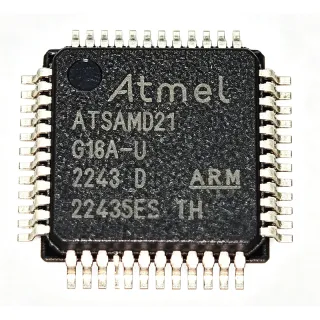
ATR2406-DEV-BOARD - 2.4GHz ISM RF Transceiver Eval Board | Microchip
MPN: ATR2406-DEV-BOARD ✗ End of Life| Qty | Unit Price | Extended |
|---|---|---|
| 1 | $1 | $1.00 |
| 10 | $1 | $10.00 |
| 100 | $1 | $100.00 |
| 500 | $1 | $500.00 |
| 1,000 | $1 | $1,000.00 |
ATR2406-DEV-BOARD Overview
An RF evaluation and development board is a printed circuit assembly that lets engineers evaluate, prototype, and validate a radio IC without designing a custom RF layout. Within the system hierarchy, it sits in the development tools layer above the semiconductor itself: transceiver IC -> Smart RF product family -> RF evaluation and development kits/boards -> development boards, kits and programmers. Such boards shortens time-to-market by providing proven RF matching networks, decoupling, and firmware hooks.
Key features of the ATR2406-DEV-BOARD platform include a fully integrated low-IF receiver, a fully integrated GFSK modulator supporting data rates up to 1152 kbits/s, high sensitivity of typically -93 dBm due to the integrated low-noise amplifier, and multi-channel operation across 95 channels with frequency-hopping support. These characteristics suit short-range cable-replacement links in the globally available 2.4GHz ISM band.
On the technical side, Atmel's (now Microchip's) reference design pairs the ATR2406 transceiver with the ATmega88 AVR microcontroller, implementing proprietary Smart RF firmware with adaptive frequency hopping for robust proprietary wireless links. The low-IF architecture reduces external component count because channel filtering and demodulation happen on-chip, while the RSSI output enables link-quality monitoring and channel scoring in the frequency-hopping protocol.
Typical applications include wireless cable replacement, proprietary 2.4GHz sensor links, game controllers and human interface devices, and low-cost industrial telemetry where a certified proprietary stack is preferred over Bluetooth. The 95-channel plan and frequency-hopping firmware improve coexistence with Wi-Fi and other 2.4GHz traffic.
Design consideration: since the ATR2406 relies on an external power amplifier option via its power-ramping generator, developers should budget antenna matching and PA biasing early; RF layout on the dev board is tuned, so copying its stackup is recommended. Note that the board and its target IC are legacy/obsolete devices, so new designs should verify lifecycle status.
This page synthesizes distributor listings, the Atmel/Microchip datasheet, and the ATR2406/ATmega88 reference design documentation into a single resource with design notes and sourcing context not found on standard catalog pages.
Drop-in alternatives for ATR2406-DEV-BOARD — same package, pin-to-pin compatible. Different-package parts requiring PCB rework are excluded.
Variants in this series
Same-series models that are drop-in compatible with ATR2406-DEV-BOARD (same form factor and footprint) — differing in Product Type, Receiver Architecture, Data Rate, Channel Count, Integrated Blocks.
Quick Comparison Tool — Select alternative parts for side-by-side comparison:
ATR2406-DEV-BOARD2
✅ Drop-In✓ In Stock
$405.9 / Unit
View Datasheet →ATR2406-DEV-BOARD Specifications (manufacturer-published)
| Product Type | RF Evaluation and Development Board |
| Target IC | ATR2406 Smart RF Transceiver |
| Frequency Band | 2.4 GHz ISM |
| Modulation | GFSK |
| Data Rate | Up to 1152 kbits/s |
| Receiver Sensitivity | Typically -93 dBm |
| Output Power | Typically +4 dBm |
| Channel Count | 95 channels (multi-channel operation) |
| Receiver Architecture | Fully integrated low-IF receiver |
| Integrated Blocks | Image rejection mixer, low IF filter, FM demodulator, RSSI, TX preamplifier, power-ramping generator, synthesizer, VCO |
| Target IC Package | QFN-32 |
| Companion MCU in Reference Design | ATmega88 AVR |
| Firmware | Smart RF proprietary firmware with adaptive frequency hopping |
| Category | RF Evaluation and Development Kits, Boards |
| SVHC Status | No SVHC (18-Jun-2012) |
ATR2406-DEV-BOARD Interfaces & Connectors
No manufacturer-published interface list is available for ATR2406-DEV-BOARD. Refer to the manufacturer documentation for connector and header details.
Refer to the manufacturer documentation for the full expansion header pinout and connector pin numbering.
Typical Applications
ATR2406-DEV-BOARD is suitable for 6 applications: Wireless Cable Replacement, Proprietary 2.4GHz Sensor Links, Human Interface Devices and Game Controllers, RF Education and Laboratory Training, Industrial Telemetry and SCADA Links, Wireless Audio and Serial Data Streaming.
Wireless Cable Replacement
The ATR2406-DEV-BOARD directly supports proprietary 2.4GHz cable-replacement links, the use case Atmel's own reference design addresses with the ATR2406 and ATmega88. The transceiver's fully integrated low-IF receiver and GFSK modulator deliver up to 1152 kbits/s, enough for peripheral-to-host data streaming that previously used a serial or USB cable, while the -93 dBm typical sensitivity provides tens of meters of indoor range with a simple antenna. The 95-channel plan combined with Smart RF adaptive frequency-hopping firmware lets the link hop around Wi-Fi and Bluetooth interference, which is essential in the crowded 2.4GHz ISM band. Developers use the board to validate link budget, hop patterns, and RSSI-based channel scoring before committing to a custom PCB. Because the board is obsolete, this application is relevant mainly to sustaining legacy cable-replacement products rather than new designs.
Recommended
Proprietary 2.4GHz Sensor Links
Battery-powered sensor nodes benefit from the ATR2406's integration level: the QFN-32 IC folds the LNA, image-rejection mixer, low-IF filter, FM demodulator, RSSI, synthesizer, and VCO into one die, minimizing bill-of-materials count on the RF side. Typical +4 dBm TX output with -93 dBm RX sensitivity yields a generous link budget for indoor sensor telemetry across the 95 available ISM channels. The dev board is used to characterize real-world range and per-channel RSSI distribution, then the adaptive frequency-hopping Smart RF firmware is ported to the ATmega88 host. Because the GFSK modulator runs at up to 1152 kbits/s, payload size and reporting interval can be traded against airtime and battery life during evaluation. Engineers sustaining legacy sensor fleets use the board to reproduce RF behavior when requalifying replacement units.
Recommended
Human Interface Devices and Game Controllers
The original ATR2406 value proposition for HID and game controllers was a low-cost, high-rate proprietary 2.4GHz link replacing cables: 1152 kbits/s GFSK comfortably carries polled button, axis, and force-feedback traffic with low latency, while frequency hopping over 95 channels keeps the link stable beside Wi-Fi and Bluetooth peripherals. The -93 dBm typical sensitivity sustains whole-room operation from +4 dBm TX power. The development board lets firmware teams tune hop timing and RSSI-triggered channel changes on real hardware before layout freeze. The integrated FM demodulator and low-IF architecture reduce external parts, which historically lowered controller BOM cost. Because both the IC and the dev board are now obsolete, this application matters chiefly for service documentation and reverse-engineering existing controller designs rather than new hardware development.
Recommended
RF Education and Laboratory Training
The ATR2406-DEV-BOARD is an excellent teaching platform for low-IF transceiver architecture because every major block - LNA, image-rejection mixer, low-IF filter, FM demodulator, RSSI, synthesizer, and integrated VCO - is exposed and observable on a single 2.4GHz IC. Students can measure -93 dBm sensitivity, verify +4 dBm output power, sweep the 95 ISM channels, and characterize GFSK eye diagrams at rates up to 1152 kbits/s using standard test equipment. The publicly available Atmel reference design document (doc4624) explains the adaptive frequency-hopping firmware layering on top of the ATmega88, giving a complete transceiver-plus-MCU case study. The power-ramping generator also demonstrates why TX ramp shaping matters for spectral mask compliance in the ISM band. For RF coursework, surplus dev boards remain pedagogically valuable even after commercial obsolescence.
Recommended
Industrial Telemetry and SCADA Links
Short-range industrial telemetry nodes historically used the ATR2406 where a certified stack was unnecessary and cost dominated. The transceiver's deterministic GFSK link at 1152 kbits/s, -93 dBm typical sensitivity, and RSSI output support polled sensor reporting and link-quality supervision across factory floors. The 95-channel frequency-hopping capability of the Smart RF firmware mitigates interference from welding equipment, motors, and Wi-Fi access points sharing the 2.4GHz ISM band. The dev board served as the golden reference: engineers validated antenna matching, measured per-channel packet error rate, and confirmed that the integrated low-IF receiver rejected adjacent-channel energy adequately for the plant environment. The external PA power-ramping interface also allowed boosted-link variants for metal-shadowed zones. Ongoing deployments rely on the board for diagnostics since new purchases are limited to obsolete-market stock.
Recommended
Wireless Audio and Serial Data Streaming
With 1152 kbits/s GFSK over the air, the ATR2406 supports compressed audio streaming and general-purpose serial data links in the 2.4GHz band. A typical stereo compressed stream fits within the raw rate with margin for forward error correction, while the integrated FM demodulator and low-IF filter maintain the link at -93 dBm typical sensitivity. On the dev board, engineers measured end-to-end latency and packet-loss behavior of the adaptive frequency-hopping firmware, since audio streams are sensitive to hop-induced gaps. The RSSI output enables receive-side quality monitoring used to request channel changes proactively. The +4 dBm typical output plus an optional external PA via the power-ramping generator extends range for whole-room or small-venue coverage. This application is now relevant only to maintaining legacy audio dongles built around the obsolete ATR2406 platform.
Recommended
Recommended Products Summary
Engineering reference data for ATR2406-DEV-BOARD — comparison, design guidance, and compliance information.
Selection Guide
Comparison with Alternatives
| Parameter | This Product | ATR2406-DEV-BOARD2 |
|---|---|---|
| Brand | Microchip Technology (Atmel legacy) | Microchip Technology (Atmel legacy) |
| Package | RF evaluation board (non-IC assembly) | RF evaluation board (non-IC assembly) - same category |
| Target Transceiver | ATR2406 2.4GHz Smart RF | ATR2406 2.4GHz Smart RF - same |
| Modulation / Data Rate | GFSK, up to 1152 kbits/s | GFSK, up to 1152 kbits/s - same IC |
| RX Sensitivity (typ) | -93 dBm | -93 dBm |
| TX Output Power (typ) | +4 dBm | +4 dBm |
| Channels | 95 | 95 |
| Lifecycle Status | Obsolete | Obsolete |
Key Differentiators
- Single-chip RF integration (vs ATR2406-DEV-BOARD2)
- Low-IF architecture with on-chip channel filtering (vs ATR2406-DEV-BOARD2)
- Honest limitation: obsolete status (vs ATR2406-DEV-BOARD2)
Design Notes
The ATR2406 achieves its typically -93 dBm sensitivity with an on-chip LNA and fully integrated low-IF chain, so board-level RF loss is dominated by the antenna matching network. When copying the dev board into a custom design, reproduce the matching components, their values, and the PCB stackup around the QFN-32 exactly; changing dielectric thickness or trace geometry detunes the 2.4GHz match and directly erodes link budget. Keep the VCO and synthesizer decoupling identical to the reference design to avoid pulling.
The power-ramping generator exists to control an external power amplifier's turn-on and turn-off slope. If you add a PA, program the ramp so TX transitions stay within the 2.4GHz ISM spurious-emission limits; hard-switched PA bias produces spectral splatter across adjacent ISM channels and fails regulatory conducted-spur tests. Validate with a spectrum analyzer in peak-hold across the full band during hop transitions, not just on a single center channel.
Both the ATR2406-DEV-BOARD and ATR2406-DEV-BOARD2 are obsolete; obsolete-market sourcing offers no absolute availability guarantees, so any purchase should include incoming inspection and risk-based testing given fragmented supply chains. For new designs, migrate to a current Microchip 2.4GHz transceiver - there is no pin-compatible successor, so budget a PCB respin and firmware port. Also confirm that adaptive frequency-hopping firmware timing tolerances are met by your host MCU before porting away from the ATmega88 reference.
Compliance Information
FindIC reports SVHC: No SVHC (18-Jun-2012), indicating REACH SVHC screening passed as of that date. RoHS and lead-free status not stated in verified data.