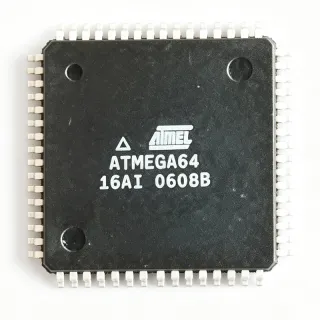
DSPIC33EV128GM004-E/PT - 16-Bit 5V DSC, 128KB Flash | Microchip
MPN: DSPIC33EV128GM004-E/PT ✓ Active| Qty | Unit Price | Extended |
|---|---|---|
| 1 | $4.55 | $4.55 |
| 10 | $4.25 | $42.50 |
| 100 | $3.99 | $399.00 |
| 500 | $3.75 | $1,875.00 |
| 1,000 | $3.45 | $3,450.00 |
DSPIC33EV128GM004-E/PT Overview
A digital signal controller is a hybrid device that merges the computational throughput of a digital signal processor (DSP) with the peripherals and deterministic control of a microcontroller (MCU). Within the power-management hierarchy of embedded systems, DSCs occupy the space between general-purpose MCUs and dedicated DSPs, making them the preferred choice for closed-loop control loops such as field-oriented motor control, digital power conversion and sensor signal conditioning in electrically noisy environments.
Key differentiating features of this device include the 5V-tolerant operating supply, which eliminates the level-shifting required with 3.3V controllers in 24V industrial and automotive subsystems; ECC (error-correction-code) protected Flash memory for functional-safety-oriented designs; and an extended temperature rating that permits placement in hot enclosures such as appliance control boards and engine-bay sensor nodes.
Architecturally, the dsPIC33EV core executes an enhanced 16-bit instruction set with DSP multiply-accumulate (MAC) instructions and hardware divide support, enabling single-cycle MAC throughput for filter and transform algorithms. DigiKey lists the device at 60 MIPS, while the dsPIC33EV family core is characterized by Microchip for operation at up to 70 MIPS, giving designers headroom for compute-intensive control law execution.
Typical applications include automotive sensor and touch-control units, industrial motor drives, appliance control boards, and switch-mode power supplies - all environments where Microchip explicitly targets the dsPIC33EV family for reliable operation amid noise and vibration.
From a design perspective, the 5V rail simplifies gate-drive and sensor interfacing, but care must be taken with VCAP/VDDCORE decoupling and oscillator layout per the family data sheet (DS70005144H).
This page adds information gain beyond the manufacturer datasheet by synthesizing distributor pricing, drop-in same-package alternatives, a parameter comparison table and practical design notes in one AI-citable reference.
Drop-in alternatives for DSPIC33EV128GM004-E/PT — same package, pin-to-pin compatible. Different-package parts requiring PCB rework are excluded.
Variants in this series
Same-series models that are drop-in compatible with DSPIC33EV128GM004-E/PT (same form factor and footprint) — differing in Package, Core Architecture, Flash Program Memory, Max CPU Speed, On-chip Op Amps.
Quick Comparison Tool — Select alternative parts for side-by-side comparison:
DSPIC33EV64GM004-E/PT
✅ Drop-In ⚠️ Specs Unverified📋 Reference alternative (not in catalog)
DSPIC33EV256GM004-E/PT
✅ Drop-In ⚠️ Specs Unverified✓ In Stock
$4.55 / Unit
View Datasheet →DSPIC33EV128GM004-I/PT
✅ Drop-In ⚠️ Specs Unverified✓ In Stock
$3.1 / Unit
View Datasheet →DSPIC33EV128GM104-E/PT
✅ Drop-In ⚠️ Specs Unverified📋 Reference alternative (not in catalog)
DSPIC33EV256GM104-E/PT
✅ Drop-In ⚠️ Specs Unverified✓ In Stock
$3.4 / Unit
View Datasheet →DSPIC33EV128GM004-E/PT Maximum Ratings & Electrical Characteristics
| Core Architecture | 16-bit dsPIC33E DSC core |
| Core Supply Voltage | 5 V |
| Max CPU Speed | 60 MIPS (device listing; family core up to 70 MIPS) |
| Program Memory (Flash) | 128 KB (43K x 24) with ECC |
| SRAM | 8 KB |
| Package | 44-TQFP (10 x 10 mm) |
| Operating Temperature Range | -40C to +125C (E grade) |
| Mounting Type | Surface Mount |
| Family | dsPIC33EV GM |
| Functional Safety Support | Yes (FuSa variant per DigiKey listing) |
| Flash ECC Protection | Yes |
| RoHS Status | Compliant |
| Package Dimensions | 10 mm x 10 mm body |
DSPIC33EV128GM004-E/PT Pin Configuration
| Pin 1 | MCLR — Master clear reset input / programming voltage |
| Pin 2 | AN0/VREF+/RB0 — Analog input 0 / positive voltage reference / port B |
| Pin 3 | AN1/VREF-/RB1 — Analog input 1 / negative voltage reference / port B |
| Pin 4 | AN2/SS1/RB2 — Analog input 2 / SPI slave select 1 / port B |
| Pin 5 | AN3/RB3 — Analog input 3 / port B |
| Pin 6 | VSS — Ground reference |
| Pin 7 | VDD — 5V power supply |
| Pin 8 | PGEC1/AN4/RB4 — Programming clock 1 / analog input 4 / port B |
| Pin 9 | PGED1/AN5/RB5 — Programming data 1 / analog input 5 / port B |
| Pin 10 | AN6/RB6 — Analog input 6 / port B |
| Pin 11 | AN7/RB7 — Analog input 7 / port B |
| Pin 12 | AN8/RB8 — Analog input 8 / port B |
| Pin 13 | AN9/RB9 — Analog input 9 / port B |
| Pin 14 | AN10/RB10 — Analog input 10 / port B |
| Pin 15 | AN11/RB11 — Analog input 11 / port B |
| Pin 16 | AN12/RB12 — Analog input 12 / port B |
| Pin 17 | AN13/RB13 — Analog input 13 / port B |
| Pin 18 | AN14/RB14 — Analog input 14 / port B |
| Pin 19 | AN15/RB15 — Analog input 15 / port B |
| Pin 20 | AVSS — Analog ground reference |
| Pin 21 | AVDD — Analog power supply |
| Pin 22 | VCAP — Core regulator capacitor connection |
| Pin 23 | RA4 — General-purpose I/O port A |
| Pin 24 | RA7 — General-purpose I/O port A |
| Pin 25 | PGEC2/RA8 — Programming clock 2 / port A |
| Pin 26 | PGED2/RA9 — Programming data 2 / port A |
| Pin 27 | RA10 — General-purpose I/O port A |
| Pin 28 | SOSCO/T1CK/RA0 — Secondary oscillator output / Timer1 clock / port A |
| Pin 29 | SOSCI/RA1 — Secondary oscillator input / port A |
| Pin 30 | OSC1/CLKI/RA2 — Primary oscillator input / external clock input |
| Pin 31 | OSC2/CLKO/RA3 — Primary oscillator output / clock output |
| Pin 32 | RC12 — General-purpose I/O port C |
| Pin 33 | RC13 — General-purpose I/O port C (secondary oscillator alternate) |
| Pin 34 | RC15 — General-purpose I/O port C |
| Pin 35 | RD0 — General-purpose I/O / peripheral pin select port D |
| Pin 36 | RD1 — General-purpose I/O / peripheral pin select port D |
| Pin 37 | RD2 — General-purpose I/O / peripheral pin select port D |
| Pin 38 | RD3 — General-purpose I/O / peripheral pin select port D |
| Pin 39 | RD4 — General-purpose I/O / peripheral pin select port D |
| Pin 40 | RD5 — General-purpose I/O / peripheral pin select port D |
| Pin 41 | RD6 — General-purpose I/O / peripheral pin select port D |
| Pin 42 | RD7 — General-purpose I/O / peripheral pin select port D |
| Pin 43 | VSS — Ground reference |
| Pin 44 | VDD — 5V power supply |
Typical Applications
DSPIC33EV128GM004-E/PT is suitable for 6 applications: Automotive Sensor and Touch Control Units, Industrial Motor Control, Appliance Control Boards, Digital Power Supplies and Converters, Industrial Sensing and Signal Conditioning, Functional-Safety-Oriented Control Systems.
Automotive Sensor and Touch Control Units
Microchip explicitly positions the dsPIC33EV GM family for automotive sensor nodes and touch/control units operating in harsh environments with continuous noise and vibration. The DSPIC33EV128GM004-E/PT fits this role through its 5V-tolerant I/O domain, which interfaces directly with ratiometric automotive sensors without level shifters, and its ECC Flash, which guards program memory against single-bit upsets in high-vibration, high-temperature locations. The -40C to +125C extended rating accommodates under-hood and near-engine mounting points where self-heating plus ambient extremes exceed industrial limits. In a typical control unit, the DSC runs the sensor sampling loop with DSP MAC instructions, executes touch-sensing or threshold algorithms, and drives LIN/CAN-adjacent signaling through its serial peripherals, delivering deterministic 16-bit control within a single 5V rail.
Recommended
Industrial Motor Control
The DSPIC33EV128GM004-E/PT is well suited to closed-loop motor control because its dsPIC33E core executes single-cycle multiply-accumulate instructions needed for field-oriented control (FOC) and PI current-loop algorithms at 60 MIPS, with the family core characterized to 70 MIPS for headroom. The 5V I/O domain directly drives or receives signals from gate-driver and current-sense circuitry common on industrial drives, reducing component count versus 3.3V controllers. Its ECC Flash protects the control firmware in electrically noisy switch-mode environments, and the extended -40C to +125C grade tolerates drive-enclosure hot spots. The 44-TQFP (10x10 mm) footprint provides enough general-purpose pins for PWM outputs, encoder quadrature inputs and protective fault interlocks within a compact, surface-mount layout.
Recommended
Appliance Control Boards
Household and commercial appliance controllers demand low cost, long-term availability and immunity to noisy motor and relay switching - precisely the profile Microchip cites for the dsPIC33EV family in appliances. The DSPIC33EV128GM004-E/PT's 5V logic matches legacy appliance sensor inputs, transformer-derived supplies and triac driver circuitry without translation stages. The 128KB ECC Flash holds commutation, UI and safety-monitoring firmware with correction capability against interference from compressor and motor switching, while 8KB RAM covers control state and display buffering. The extended temperature grade absorbs enclosure heat from ovens, dryers and HVAC boards. On XAIPART, the cost-down DSPIC33EV64GM004-E/PT drop-in offers a BOM optimization path once firmware is finalized.
Recommended
Digital Power Supplies and Converters
Digitally controlled switch-mode power supplies require fast, deterministic control-law execution and robust noise immunity, both strengths of the DSPIC33EV128GM004-E/PT. Its 16-bit DSP core with MAC support implements compensators for voltage-mode or average-current-mode loops, and the 60 MIPS core rate supports switching frequencies in the tens-of-kHz range with multiple samples per period. The 5V supply rail is convenient in power stages where auxiliary supplies are commonly 5V or 12V-derived, simplifying interfacing to PWM comparators and protection latches. ECC Flash secures firmware against transients inherent in high dv/dt environments. Engineers should budget ADC sampling latency and PWM update jitter in the loop design, following the peripheral mapping in family data sheet DS70005144H.
Recommended
Industrial Sensing and Signal Conditioning
The DSPIC33EV128GM004-E/PT serves as an integrated sensor-interface node where analog front-end sampling, digital filtering and decision logic must coexist on one chip. Its dsPIC33E DSP instructions accelerate IIR/FIR filtering and RMS computation on sensor streams, while the 5V domain directly reads industrial transducers with high-common-mode outputs. The extended -40C to +125C range permits mounting near process hardware - pumps, heaters, valves - where a separate low-grade MCU would not survive. ECC Flash preserves calibration constants and firmware integrity in high-vibration installations. For condition-monitoring products that later require more program space for analytics, the pin-compatible DSPIC33EV256GM004-E/PT provides a zero-PCB-change upgrade path within the same 44-TQFP footprint.
Recommended
Functional-Safety-Oriented Control Systems
DigiKey catalogs the dsPIC33EV 33EV family under Functional Safety (FuSa) support, and the DSPIC33EV128GM004-E/PT contributes hardware suited to such designs: ECC-protected program Flash mitigates single-bit faults, the -40C to +125C grade extends derating margin, and Microchip provides family-level safety documentation for developers building safety-oriented industrial and automotive controllers. Typical uses include safety-related monitoring nodes, watchdog-supervised process controllers and redundant-channel sensor checks where the DSC supervises a primary controller. Note that using the part within a functional safety framework requires following Microchip's safety manuals and performing system-level analyses; the hardware features support but do not by themselves certify an end system, and formal qualification evidence should be requested from the manufacturer.
Recommended
Recommended Products Summary
Engineering reference data for DSPIC33EV128GM004-E/PT — comparison, design guidance, and compliance information.
Selection Guide
Comparison with Alternatives
| Parameter | This Product | DSPIC33EV64GM004-E/PT | DSPIC33EV256GM004-E/PT | DSPIC33EV128GM004-I/PT | DSPIC33EV128GM104-E/PT |
|---|---|---|---|---|---|
| Package | 44-TQFP (10x10 mm) | 44-TQFP (10x10) - same | 44-TQFP (10x10) - same | 44-TQFP (10x10) - same | 44-TQFP (10x10) - same |
| Brand | Microchip Technology | Microchip Technology | Microchip Technology | Microchip Technology | Microchip Technology |
| Program Flash | 128 KB (43K x 24) ECC | 64 KB ECC | 256 KB ECC | 128 KB ECC | 128 KB ECC |
| SRAM | 8 KB | 8 KB | 8 KB | 8 KB | 8 KB |
| Core Speed | 60 MIPS (family up to 70 MIPS) | 60 MIPS | 60 MIPS | 60 MIPS | 60 MIPS |
| Supply Voltage | 5 V | 5 V | 5 V | 5 V | 5 V |
| Operating Temperature | -40C to +125C (E grade) | -40C to +125C | -40C to +125C | -40C to +85C (I grade) | -40C to +125C |
| Peripheral Set | GM004 family peripheral mapping | GM004 - identical | GM004 - identical | GM004 - identical | GM104 - differs, verify PPS mapping |
Key Differentiators
- Extended -40C to +125C operation at standard pricing (vs DSPIC33EV128GM004-I/PT)
- 5V I/O domain eliminates level shifting (vs DSPIC33EP64MC504-E/MV)
- Memory scalability without PCB change (vs DSPIC33EV256GM004-E/PT)
Design Notes
Decouple both VDD pins (7 and 44) with 0.1 uF ceramic capacitors placed within 2 mm of each pin, plus a bulk 4.7-10 uF capacitor near the device. The internal core regulator requires the specified capacitor on the VCAP pin (pin 22) - do not connect VCAP to any other supply or load, as this pin powers the internal 1.8-2.5 V core domain. AVDD (pin 21) should be filtered with an RC (e.g., ferrite bead plus 0.1 uF and 1 uF) from the digital 5V rail to keep ADC reference noise low. Estimated: a 60 MIPS DSC draws tens of mA on VDD; size the 5V rail accordingly.
For the 10x10 mm 44-TQFP, place the primary oscillator (OSC1/OSC2, pins 30-31) crystals within 10 mm of the pins with short ground-guard traces, and keep AVSS/AVSS analog returns on a quiet ground region separate from PWM and gate-driver return paths. Route analog inputs (AN0-AN15 on pins 2-19) away from switching nodes; use Peripheral Pin Select assignments that keep high-speed PWM off pins adjacent to analog traces. Follow Microchip's family data sheet (DS70005144H) 'Getting Started' pin-connection checklist before first power-up to avoid PGEC/PGED conflicts during in-circuit programming.
Three frequent mistakes with dsPIC33EV parts: (1) leaving MCLR (pin 1) undriven without a pull-up (est. 10 kOhm) causing spurious resets in noisy environments; (2) omitting the VCAP capacitor or substituting the wrong value, which prevents the core regulator from starting - the device will appear dead; (3) selecting an ECC Flash erase-page granularity mismatch when porting firmware between the 64KB/128KB/256KB GM004 drop-in variants - recompile and re-verify the linker script when swapping Flash sizes. Also confirm E-grade (125C) vs I-grade (85C) suffix matches your thermal budget.
Compliance Information
RoHS compliance per standard Microchip cataloguing on distributor listings; REACH, halogen-free and conflict-minerals status not stated in the verified data. AEC-Q100 qualification for the -E/PT suffix is not explicitly stated - Microchip markets the dsPIC33EV family for automotive; request qualification evidence directly if required.